GDP miss ‘just’ govt

This plays to investors who think a drop in govt spending is good for the private sector as it ‘gets govt out of the way’ and ‘opens the door’ for that much more private sector growth in short order.

While this could be sort of but not necessarily true at full employment, it is of course not true in any case with with today’s excess capacity.

Seems they forget that today, cuts in govt spending immediately translate into cuts in private sector sales, which are the driver of private sector output and employment.

Yes, private sector credit expansion has (had?) begun to ‘kick in’, somewhat more than replacing the decline in govt deficit spending from the ‘automatic fiscal stabilizers’ of slowing transfer payments and rising revenues from higher incomes. The causation was from more ‘borrowing to spend’ in the economy to less deficit spending.

And that all can accelerate and continue for many years before, left alone, the deficit gets too small (and shrinking) to support the growing private sector credit expansion, as it all becomes unsustainable and implodes.

But at any point during that credit expansion, a pro active dose of govt deficit reduction can remove sufficient income to restrict the private sector’s credit expansion. People who may have borrowed to buy a house or a car, for example, suddenly losing their jobs and those purchases not happening, etc.

So the idea that 3% GDP is a ‘given’ due to private sector credit expansion and therefore a proactive tax hike and spending cut of maybe 1.25% of GDP will lower that to 1.75% growth misses that dynamic, as it presumes the proactive fiscal adjustments don’t throw a monkey wrench into the credit expansion dynamics. Like what’s been happening in the euro zone.

—– Original Message —–
At: Apr 26 2013 07:39:34

The miss was mostly a result of government declining, again. This is really the surprise. Trade was also a drag, but from a surprise perspective government is the winner. In all, gov subtracted a chunky 0.8ppts from the topline – meaning if you add it back Q1 would have printed 3.3%.

Having said that, this a rearview mirror report and what we already know about the handoff to Q2 is that it was weak. Indeed, we are looking for a rather paltry 1% outcome here in Q2.

Finally, in terms of today’s report, no underlying detail is inconsistent with our thinking about the handoff to Q2.
Rogoff and Reinhart NYT response

The intellectual dishonesty continues.
As before, it’s the lie of omission.

R and R are familiar with my book ‘The 7 Deadly Innocent Frauds of Economic Policy’ and, when pressed, agree with the dynamics.

They know there is a more than material difference between floating and fixed exchange rate regimes that they continue to exclude from their analysis.

They know that one agents ‘deficit’ is another’s ‘surplus’ to the penny, a critical understanding they continue to exclude.

They know that ‘demand leakages’ mean some other agent must spend more than its income to sustain output and employment.

They know federal spending is via the Fed crediting a member bank reserve account, a process that is not operationally constrained by revenues. That is, there is no dollar solvency issue for the US government.

They know that ‘debt management’, operationally, is a matter of the Fed simply debiting and crediting securities accounts and reserve accounts, both at the Fed.

They know that if there is no problem of excess demand, there is no ‘deficit problem’ regardless of the magnitudes, short term or long term.

They know unemployment is the evidence deficit spending is too low and a tax cut and/or spending increase is in order, and that a fiscal adjustment will restore output and employment, regardless of the magnitude of deficits or debt.

Carmen’s husband Vince was the head of monetary affairs at the Fed for many years, serving both Alan Greenspan and Ben Bernanke. He knows implicitly how the accounts clear and how the accounting works, to the penny. He knows the currency itself is a case of monopoly. He knows the Fed, not ‘the market’ necessarily sets rates. He knows that, operationally, US Treasury securities function as interest rate support, and not to fund expenditures. He knows it all!

Carmen, Vince, please come home! I hereby offer my personal amnesty- come clean NOW and all is forgiven! As you well know, coming clean NOW will profoundly change the world. As you well know, coming clean NOW will profoundly alter the course of our civilization!

Carmen, Vince, either you believe in an informed electorate or you don’t!?

(feel free to distribute)

Debt, Growth and the Austerity Debate

By: Carmen Reinhart and Kenneth Rogoff

Franklin College Receives Swiss Institutional University Recognition

Congrats!!!

FW from President Gregory Warden:

It is with great pleasure and tremendous pride that I am able to announce that the Swiss University Conference [SUK/CUS], the governing body for higher education in Switzerland, has granted Franklin College Switzerland full university institution accreditation, stating in its recent notification:

We are pleased to inform you of the positive decision made by the SUK [CUS] on April 18, 2013 regarding the accreditation of Franklin College Switzerland as a university institution.

The notice of accreditation went on to state:

The expert team is convinced that Franklin College Switzerland has gone through a major development since the last accreditation. This is largely the result of the realization of the recommendations by the 2005 OAQ expert team. Franklin College Switzerland now is better integrated within the Swiss landscape, as well as being connected within Europe. According to the expert team, it has above all strengthened its research activities. The qualifications and in particular the research activities of the faculty have significantly increased since the last accreditation.

In 2005 the Swiss University Conference granted Swiss university accreditation to all major programs of study leading to the Franklin College Bachelor of Arts degreemaking Franklin the first and only university to receive such recognition. With our new institutional accreditation, it is with even greater pride that Franklin is now the first and only university to have institutional university accreditation in both the United States and Switzerlanda distinction that will serve Franklin and its past and future graduates well.

In the Swiss Center of Accreditation and Quality Assurance in Higher Educations expert team recommendation to the Swiss University Conference they stated that Franklin College fulfills all accreditation standards, making the following statement and recommendation:

Franklin College is an American and private institution of higher education in Europe, and thus it represents a kind of hybrid organization. It has introduced new educational principles into the European setting, it is very international by its course offerings and by its student body, and in its teaching it puts heavy emphasis on the general skills and human values, that are especially appropriate for the 21st century world. Its programs are well linked to meet the current challenges in higher education, also on a global scale. Its teaching methods are innovative and appropriate. The students also have a strong feeling of belonging to the Franklin community. The network of its alumni appears to be very active, spread all over the world. The Franklin graduates appear to be well placed especially in international companies. Its strategic goals appear very appropriate to meet the needs and challenges higher education at large is currently facing at least in Europe, but also globally. The experts group recommends accreditation of Franklin College Switzerland, without conditions.

Everyone associated with Franklin should be very proud of all that has been achieved since it was founded in 1969. This recognition is an affirmation of the quality of the institution as a whole and the hard work and contributions of so many peoplefaculty, staff, students, alumni, parents and trustees. Franklin would not be the special place it is today if it were not for each and everyones efforts on its behalf.

Thank you and best regards,

P. Gregory Warden
President

Asia Insights: China: Why GDP growth has weakened despite strong credit growth – 25 Apr 2013

So some was gross, not net, and some unspent:

Nomura: Asia Insights: China: Why GDP growth has weakened despite strong credit growth

  • Economic growth in China has weakened surprisingly despite rapid credit growth in H2 2012 and Q1 2013.
  • We believe a large part of the new credit supply in Q1 did not go into the real economy. For example, at least 20% of urban construction bond issuance was used to pay off expiring bank loans.
  • Recent policy signals suggest credit growth will slow in Q2. We reiterate our view that economic growth will slow in Q2, while the market consensus expects a rebound.

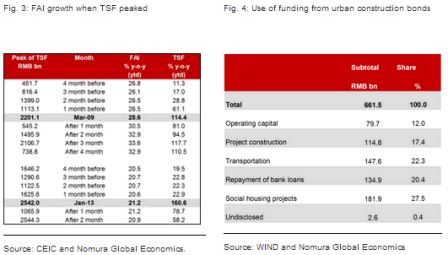
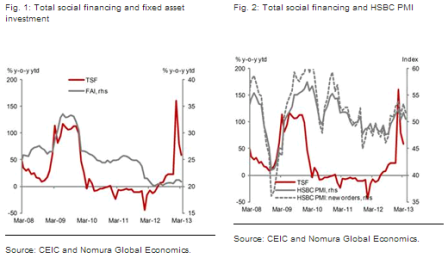
We had expected economic growth in China to rise in Q1 because of very strong credit growth, but GDP growth surprisingly slowed to 7.7% from 7.9% in Q4 2012, and economic activity in Q2 has started on a weak note. This is very different to what happened in 2009, when growth in total social financing picked up from 26.6% y-o-y in Q4 2008 to 114% in Q1 2009 and 121% in Q2 2009, growth in fixed asset investment moved up from 26.8% y-o-y in Q4 2008 to 28.6% in Q1 2009, the HSBC PMI rose to 44.8 from 40.9, and the new orders component in the HSBC PMI jumped to 43.6 from 36.1 (Figures 1, 2 and 3).

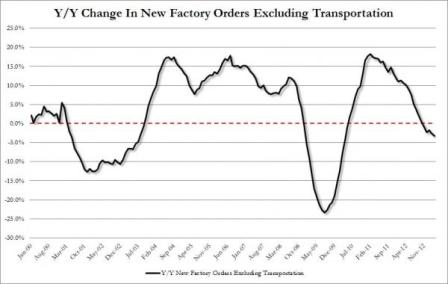
But in 2013 it is a very different story. Total social financing rose to an historical high and jumped by 160.6% y-o-y in January and by 58.2% y-o-y in Q1, but fixed asset investment (FAI) growth only picked up slightly to 21.2% y-o-y in January and February, and then slowed to 20.9% in March. GDP growth slowed to 7.7% y-o-y in Q1. The flash HSBC PMI weakened in April despite favorable seasonal factors it has only dropped once in April once during the past seven years. The new orders component of the flash HSBC PMI has dropped as well.

Many investors ask us the same question: where has all the money gone? We believe a large part of the new credit supply in Q1 did not go into the real economy. We do not have comprehensive information, but we provide the following two pieces of evidence. First, we collected public information on the 370 largest issues of urban construction debt that took place in 2012, and found that at least 20% of the money raised was used to repay debt (Figure 4). It is not surprising to us as many infrastructure investments projects are not yet profitable. Therefore, local government financing vehicles need to continue borrowing new funds for debt financing.

Another piece of evidence comes from a recent government policy announcement. According to a Chinese newspaper, First Financial Daily, the National Development and Reform Commission (NDRC) issued a policy notice at the end of March to ensure the funds raised for public housing construction in the bond market are not used for other purposes. We believe this policy may be triggered by cases where some funds were misused. Indeed, risks of such events have been mentioned repeatedly in government documents.

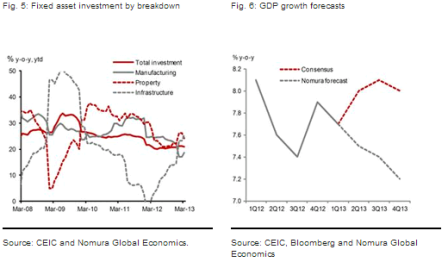
Why didnt money flow into the real economy? We think it is partly because the underlying demand for investment is weak. FAI growth for the manufacturing industry has been on a downward trend since 2011 and dropped sharply in Q1 2013 despite strong infrastructure FAI growth, which should have generated some positive spillover effects for manufacturers (Figure 5). The over-capacity problem in the manufacturing industry has been exacerbated by aggressive policy easing in 2009 and 2012.

We reiterate our view that economic growth will slow to 7.5% in Q2 as credit growth weakens (Figure 6). The consensus expects growth to recover to 8% in Q2, but recent policy signals suggest policy tightening has started and will adversely affect growth. In particular, the government has investigated several high profile corruption cases in the bond market in the past few days, and the Peoples Bank of China held a meeting on 24 April with commercial banks to clean up irregular activities in the bond market, according to a Chinese newspaper Economic Information. This initiative will likely lead to a slowdown in bond issuance and growth in total social financing in the coming months.


Full size image


Full size image


Full size image

Housing Rebound in U.S. Hampered by Success as Costs Soar

I still don’t see used home prices anywhere near ‘replacement cost?’

So prices have to go up quite a bit (and affordability go down) for a serious building boom to start?

Even as U.S. housing rebounds from its worst downturn since the 1930s, production bottlenecks are pushing up building-materials costs, land prices are rising and skilled labor ready to begin work is hard to find.

Housing Rebound in U.S. Hampered by Success as Costs Soar

By Shobhana Chandra & John Gittelsohn

April 24 (Bloomberg) — Even as U.S. housing rebounds from its worst downturn since the 1930s, production bottlenecks are pushing up building-materials costs, land prices are rising and skilled labor ready to begin work is hard to find.

Suppliers of glass, drywall and wood products, who reduced output during the slump, are testing the vigor of the rebound by boosting prices before committing to restore capacity. Builders, including Lennar Corp. (LEN), Toll Brothers Inc. (TOL) and KB Home, are asking homebuyers for more money as a result or are delaying sales, posing a temporary hurdle for the industry that has become one of the pillars of the economic expansion.

Building-material manufacturers are raising prices dramatically, and once theyre convinced that these prices are going to stick, theyll start reinvesting in those plants, helping ease supply constraints, said John Burns, chairman of Irvine, California-based John Burns Real Estate Consulting, which provides research to developers, construction-product manufacturers and investors. Those can take a year to get up and running.

In a sign demand remains strong, a report yesterday showed sales of new houses advanced in March, capping the best quarter for the industry since 2008. Purchases of new single-family properties climbed 1.5 percent to a 417,000 annual pace, the Commerce Department said.

Low FF rate and down shift of Labor Particpation

Maybe they are beginning to confirm my ‘suspicion’ the mainstream has the rate thing backwards? Not that I agree with all their reasons, of course!

Subject: For The Economist in Us – Low FF rate and down shift of Labor Particpation

A short and interesting piece can be found on the St Louis Fed web site (and attached). Good chart on the second page showing the Federal Funds Rate and the Employment-to-Population Ratio. Towards the end of the report there is an interesting point about the current near zero rate and how it lifted, it could have have people re-enter the work force because it would increase the return to saving(s). I guess the labor force drop-outs view they’re not “leaving much on the table” . -Peter
—————————————————————————–
It is titled “Low Interest Rates Have Yet to Spur Job Growth”.

The study says that “low interest rates , of late, do not seem to be having much of the intended effect either on spending or on job growth.”

A serious concern in labor market has been the down shift of the labor participation rate which may be hiding the true level of unemployment as people drop out of the labor force.

The paper states “”Interest rates represent the return we get for waiting to consume. Low interest rates encourage more spending today, which the Fed intends, and more leisure today, which the Fed does not intend. Labor participation rates decline for many reasons, but low interest rates work in the direction of discouraging labor market participation.”

Apparently, the Fed has been chasing its own tail and the more it has lowered rates in order to produce higher demand for labor, it has generated lower participation rates.

The paper concludes, with great understatement, “After four years of low interest rates and stagnating growth around the world, a better understanding of low interest rate policies is needed.”

Maybe Chair Bernanke agrees and this explains his announced absence from Jackson Hole.

Germany’s Ifo Drops in April, Raising Odds of ECB Cut

And a rate cut only makes it worse, as per the interest income channels:

Germany’s Ifo Drops in April, Raising Odds of ECB Cut

April 24 (Bloomberg) — Germany’s Ifo index dropped in April, in a further sign that Europe’s largest economy is slowing.

The business climate reading came in at 104.4 down from 106.7 in March and expectations of 106.2.

The weak data follows Tuesday’s weaker-than-expected purchasing managers index (PMI) data.

That sparked speculation that the European Central Bank will cut interest rates at its meeting next week on Thursday.

European shares shrugged off the weak Ifo reading, in a sign the market is cheering a possible ECB rate cut.

The euro fell against the dollar after the Ifo data was released.