Taper worms at the wheel

The taper worms are still driving things this am.

To the taper worms, tapering equals ‘bonds’ higher in yield and stocks lower in price.

Fundamentally, however, the Fed only tapers if the economy is strong which is good for stocks.

And no tapering means the economy is weak, which is fundamentally bad for stocks and bond friendly (lower yields).

That is, the Fed uses the taper message to signal its economic forecast, and it’s that economic forecast that is fundamentally meaningful for stocks and bonds.

But in this thin/illiquid May market the whims of global hedge funds and portfolio managers rule.

Bernanke


Karim writes:

Question: On timing of tapering
Answer:
If the labor market continues to improve at the current pace, could taper in the next few meetings.
Asked if he expected this to occur before Labor Day; depends on the data.
Did not answer question about how much warning he would give the market before tapering.

Question: Exit principles
Answer:
First have to wind down purchases. He emphasized that the outlook for the labor market is the key driver (not inflation) for whether to taper. And he emphasized that buying at a lesser pace is still easing.
Says no need to sell securities at this point. Makes case for letting securities roll-off in terms of market impact and remittances to Treasury. And he also expresses a desire to return to a Treasury only balance sheet at some point, though also says MBS likely to just roll off the balance sheet.

Text Excerpts Below

  • A key adjective between some and improvement in the labor market is still missing!
  • Removing policy accommodation and policy tightening not appropriate at this juncture (no guidance).
  • Also notes that buying assets at a lower pace (tapering) is still providing accommodation.
  • Many focusing on removing policy accommodation phrase thus has nothing to with tapering (that it is referring to ending QE altogether).
  • Rest of text is largely a rehash of defense of cost/benefit analysis of low rates, headwinds from fiscal policy, and scarring effects of long-term unemployment.


Good report, thanks!

Some interesting language here:

Conditions in the job market have shown some improvement recently. The unemployment rate, at 7.5 percent in April, has declined more than 1/2 percentage point since last summer. Moreover, gains in total nonfarm payroll employment have averaged more than 200,000 jobs per month over the past six months, compared with average monthly gains of less than 140,000 during the prior six months. In all, payroll employment has now expanded by about 6 million jobs since its low point, and the unemployment rate has fallen 2-1/2 percentage points since its peak.

Despite this improvement, the job market remains weak overall: The unemployment rate is still well above its longer-run normal level, rates of long-term unemployment are historically high, and the labor force participation rate has continued to move down.


Over the nearly four years since the recovery began, the economy has been held back by a number of headwinds. Some of these headwinds have begun to dissipate recently, in part because of the Federal Reserve’s highly accommodative monetary policy. Notably, the housing market has strengthened over the past year, supported by low mortgage rates and improved sentiment on the part of potential buyers. Increased housing activity is fostering job creation in construction and related industries, such as real estate brokerage and home furnishings, while higher home prices are bolstering household finances, which helps support the growth of private consumption.

Recognizing the drawbacks of persistently low rates, the FOMC actively seeks economic conditions consistent with sustainably higher interest rates. Unfortunately, withdrawing policy accommodation at this juncture would be highly unlikely to produce such conditions. A premature tightening of monetary policy could lead interest rates to rise temporarily but would also carry a substantial risk of slowing or ending the economic recovery and causing inflation to fall further.

The Chairman has previously indicated that inflation risks are asymmetrical, as they feel reasonably secure about being able to deal with higher inflation via rate hikes, vs feeling reasonably insecure about addressing deflationary forces given the 0% lower bound on rates.

Such outcomes tend to be associated with extended periods of lower, not higher, interest rates, as well as poor returns on other assets.

Japan, for example

Moreover, renewed economic weakness would pose its own risks to financial stability.

Euro zone?

In the current economic environment, monetary policy is providing significant benefits. Low real interest rates have helped support spending on durable goods, such as automobiles, and also contributed significantly to the recovery in housing sales, construction, and prices. Higher prices of houses and other assets, in turn, have increased household wealth and consumer confidence, spurring consumer spending and contributing to gains in production and employment. Importantly, accommodative monetary policy has also helped to offset incipient deflationary pressures and kept inflation from falling even further below the Committee’s 2 percent longer-run objective.

Again, deflation concerns

That said, the Committee is aware that a long period of low interest rates has costs and risks. For example, even as low interest rates have helped create jobs and supported the prices of homes and other assets, savers who rely on interest income from savings accounts or government bonds are receiving very low returns. Another cost, one that we take very seriously, is the possibility that very low interest rates, if maintained too long, could undermine financial stability. For example, investors or portfolio managers dissatisfied with low returns may “reach for yield” by taking on more credit risk, duration risk, or leverage. The Federal Reserve is working to address financial stability concerns through increased monitoring, a more systemic approach to supervising financial firms, and the ongoing implementation of reforms to make the financial system more resilient.

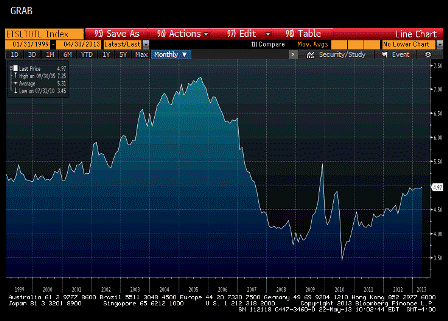
Existing home sales

Looks like it’s pretty much gone sideways this year?


Full size image

CNBC:

First-time buyers, who help drive healthy markets, made up only 30 percent of sales in March. That’s well below the 40 percent typical in a healthy market and down from nearly 33 percent in March 2012. Those buyers purchase from existing homeowners, who then are able to move on to larger houses.

mtg purchase apps fall again…

>   
>   (email exchange)
>   
>   Seems like Bullard is calming mkt down ahead of bernankes testimony
>   

FED’S BULLARD:WOULD GET WORRIED IF INFL FALLS BELOW 1% – MNI


BULLARD:NO NEED TO REDUCE VOLUME OF BOND-BUYING IN NEAR TERM – MNI

Right
Some of the headline hawks suddenly turned a bit dovish.
And yellen got a bit more hawkish?
Seems they are converging?

Bernanke has to make the case that weakness justifies QE if he wants to do it to keep mtg rates down, which he does. He doesn’t want housing to sag and then get blamed. Recall that part of the QE logic last year was to try to stay ahead of the cliff risks as much as possible. But he also has to ‘manage expectations’ in that he believes if he is negative on the economy his take can cause it to sag.

Tough spot.

And, ironically, the macro back drop of course is that QE removes interest income from the economy, with MBS having the highest coupons.

So stocks rally as portfolio indifference levels adjust to the mistaken belief that QE somehow supports stocks, when in fact it’s doing the opposite, which shows up in weak top line growth/weak nominal GDP and weak earnings growth, etc.

And currently it’s all in the context of the deficit perhaps getting too small to support the kind of private sector credit growth necessary to overcome the demand leakages (including the recent proactive govt deficit reduction) and print positive GDP numbers.

Mortgage Applications Tumble as Interest Rates Jump

May 22 (Reuters) — Applications for home mortgages dropped for a second week in a row last week as a spike in interest rates stymied demand for refinancing, data from an industry group showed on Wednesday.

The Mortgage Bankers Association said its seasonally adjusted index of mortgage application activity, which includes both refinancing and home purchase demand, tumbled 9.8 percent in the week ended May 17.

The index of refinancing applications slumped 11.7 percent, while the gauge of loan requests for home purchases, a leading indicator of home sales, fell 3 percent.

Yes, I know it’s not all that good of an indicator, but it’s an indicator nonetheless.

Thinking Caps On – Grab a Coffee – Sales/Trading Commentary

From: JJ LANDO
At: May 14 2013 07:41:14

Consider the following thought experiment. These are the scenarios:
A. The Treasury decides that it will fund itself 30% more in Overnight Bills and reduce issuance across the curve.
B. The Fed announces it will increase QE by 30% (it will remit the net income of this activity back to the Treasury like taxes)
C. Congress announces a new tax on all passive income from USTs, to holders both at home and abroad (ie Central Banks), for all new-issue USTs
D. Lew pre-announces that we will ‘selectively default’ and apply a haircut of on all future Treasury coupon payments of new issues.

Here’s what’s funny. Most intelligent market participants will say things like:
A. Stocks down a few percent on fear of downgrade. Economy slightly weaker or unchanged.
B. Stocks up 5-10% and economy grows another 1% for 1-2yrs; monetary stimulus.
C. Stocks down 5-10% on tax hike (like last year) that maybe corrects. Economy slows 1-2% for a year or so because it’s a tax hike (ie fiscal consolidation).
D. Stocks down 80% and we go into a great depression on steroids. All investment dollars flee the US. I can’t tell you what happens next because my Bloomberg account gets shut down. They might even declare an Internet Holiday.

Here’s what’s craziest: THESE ARE ALL THE SAME THING. The name and the process is different, the OPTICS is different, but the net is the same. There’s the government and there’s everyone else. The government either pays more out – in interest payments or transfer payments or vendor payments, or it takes back more in taxes or default or interest ‘savings.’ Everything the government net gets in ‘revenue’ the rest of the world loses in income. Everything the government dissaves (deficits) the rest of the world saves. Equal and opposite.

[You need to further get around the idea that reserves are overnight bills and there’s no such thing as ‘monetary base’ – just interest rates; that lower discount rates are lower no matter how you get there; that rate cuts are taxes are austerity, even considering the benefit to risk assets from ‘lower riskfree discount rates’… it’s all basically true if you think abt it long and hard].

Here we are, almost 550 rate cuts into this thing, and inflation everywhere with QE is basically falling (see chart), and incomes are falling everywhere but in the top brackets (see page 9 here for a TRULY SOBERING CHART)… let us never forget that the goal is TO IMPROVE PEOPLE’S QUALITY OF LIFE NOT TO JUICE GDP . Thus economics as a whole also has some major shortcomings. Exporting your way to prosperity is the same as turning your entire population into servants to foreign masters. Disinflation due to lower input costs or better goods or technological gains are good things. HOWEVER if suddenly 20-somethings find social currency in free online friend status rather than cars and houses and weddings – if it makes them happy that’s great but it is also a downward shift in the demand curve that if isn’t replaced leads to someone somewhere being unemployed. These are different issues that shouldn’t all be swept under the ‘disinflation’ rug.

But I digress. Where am I going with all this?
Let’s pretend risk is now in the last 6m-18m phase where everything rallies, everyone in the pool, everyone chases any risk premium to sell, and the underlying income trends are irrelevant. Since I also will posit the Fed isn’t hiking in the next 18 months, I now believe the Fed will entirely miss this risk cycle. Which means they are on hold beyond any trading horizon. So what triggers the end of the cycle? Most would argue – the fear that they ‘tighten’ or ‘hike’ or ‘aren’t on hold anymore.’
To that I disagree…the income and earnings just isn’t there and QE is hurting…in fact the reason the consumer is now tracking +3-4% has been due to a decline in the savings rate (1-handle in q1 as tax hikes hit) that is prone to reverse…it’s MUCH more likely is what triggers the end is that the world starts to understand that QE is a lot like a tax (+ some ‘Richfare’) rather than a stimulus…and that lower rates do raise asset prices for the asset rich but lower incomes and the net to the median person is not what it appears…I see progress on this day every front…TBAC is starting to get it…the inflation markets are starting to get it… we’ll get there … low rates forever…buy blues..

Obama double talk on jobs

Note the flip flop.

Obama Says Job Market May ‘Stall’ as Result of Budget Cuts

By Hans Nichols

May 19 (Bloomberg) — President Barack Obama told a group of Democratic donors in Atlanta that the economy and job market could falter as a result of the automatic spending cuts that went into effect March 1.

“Because of some policies in Washington, like the sequester, growth may end up slowing,” Obama said at a luncheon for the Democratic Senatorial Campaign Committee. “We may see once again the job market stall.”

The president was in Atlanta to give the commencement address at Morehouse College and he told the donors that while he was energized by the spirit of the graduates “they are entering into a job market that is still challenging.”

Earlier, at the commencement ceremony, Obama gave the labor market a more positive rendering. He told the graduates “you’re graduating into a job market that’s improving.”

American employers added more workers than forecast in April, sending the unemployment rate down to a four-year low of 7.5 percent. More Americans than projected filed claims for jobless benefits last week and manufacturing in the Philadelphia region unexpectedly shrank in May, signs that a slowdown in growth is rippling through the U.S. economy.

Obama administration approved wider exports of liquefied natural gas

Interesting!

US Energy Revolution Gathers Pace

By Ed Crooks, Jonathan Soble and Guy Chazan

May 18 (FT) — The growing role of the U.S. in world energy markets was underlined on Friday as the Obama administration approved wider exports of liquefied natural gas and international companies committed billions of dollars for new infrastructure.

The developments were both consequences of the shale revolution in the U.S., in which improvements in the techniques of horizontal drilling and hydraulic fracturing, or “fracking,” have unlocked new supplies of oil and gas, and raised the prospect that the US will be an increasingly important supplier of energy to the rest of the world.

The Department of Energy on Friday authorized the Freeport LNG project in Texas to export to countries that do not have a trade agreement with the US, including Japan and the members of the EU. It was the first such approval to be granted for two years and only the second ever.

President Barack Obama had been expected to approve worldwide sales from the Freeport project, as the administration sees rising energy exports as providing economic benefits and strengthening the global influence of the U.S.

However, a vocal lobby of companies in industries such as chemicals and steel has urged restrictions on gas exports to ensure U.S. manufacturers continue to derive a competitive advantage from cheap energy.

Freeport has signed deals to sell its gas to Osaka Gas and Chubu Electric of Japan, and BP of the U.K. The export project is owned by a consortium including Osaka Gas and Michael Smith, Freeport’s founder and chief executive.

Separately, Japanese and European companies said they would invest billions of dollars in another proposed gas export project, the $10 billion Cameron LNG plant in Louisiana.