
Brazil hikes rates to fight inflation

Fundamentally this increases govt deficit spending/interest income for the private sector, a negative for the currency and inflation, especially as it adds to costs.

However it also adds to spending/output/employment which causes policy makers to think they got it right by hiking as the stronger economy ‘needs’ the higher rates, etc.

Brazil in fourth consecutive rate rise

(FT) Brazil’s central bank has moved to restore investors’ confidence in Latin America’s biggest economy by resorting to its fourth consecutive interest rate increase to tame stubbornly high inflation. The central bank’s monetary policy committee, Copom, raised Brazil’s benchmark Selic rate by 50 basis points to 9 per cent late on Wednesday, the latest increase in a 175 basis point tightening cycle since April. “The committee evaluates that this decision will contribute to set inflation into decline and ensure that this trend persists in the upcoming year,” it said, repeating the brief statement issued at its last meeting in July. On Thursday last week Alexandre Tombini, Brazil’s central bank president, launched an unprecedented $60bn intervention programme to halt the plunge of the real.
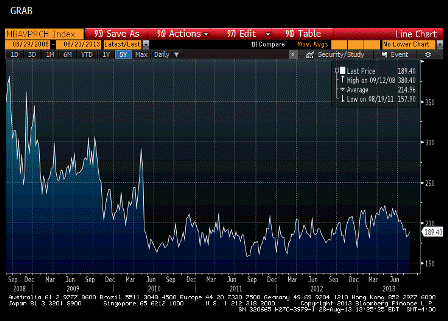
comments on GDP

Q2 revised up to 2.5 with higher exports and higher inventories.

Higher inventories can be either voluntary or involuntary, but in any case either unlikely to repeat and can reverse subsequently. And sustaining higher net exports is also problematic with the dollar spiking vs yen and now most other emerging market currencies. And at the same time spiking oil prices increase US import expenditures.

And consumption growth at only 1.8 looks to be decelerating as well.

So with the narrative of govt reductions of net spending needing to be offset by either some other agent spending more than his income, or output goes unsold, we have the foreign sector reducing net exports and unsold inventories in reaction to reduced govt.

And so far it looks to me like Q3, again in line with the narrative, is facing some serious downside risk.

purch apps and related comments


Full size image

This shows what’s happened to the number of home mortgage purchase applications since rates went up (they’ve gone down!).

While higher rates help savers as much as they hurt borrowers, the borrowing at the higher rates has to take place for the savers to get helped.

Yes, Tsy auction rates are higher, but the Fed is buying pretty much the same amount of securities that the Tsy is selling, so no help there.

It’s when the economy is ‘strong enough’ such that borrowing continues even at the higher rates that those rates ‘feed back into the economy’ through savers.

However, it is now the case that ‘investors’ hiked mtg rates due to various Fed fears, etc. with the open question being whether or not prospective home buyers will in fact borrow at those rates. If they don’t, no savers get helped and housing adds less to GDP.

Meanwhile, the Fed wants to exit QE on it’s ‘risk/reward’ analysis and has stated that improvement in the ‘labor market’ is what warrants the exit. And if ‘market forces’ have moved rates higher due to the economic outlook that’s ok too, so the current level of rates and weaker housing is unlikely to alter tapering plans, leaving the coming August jobs report as the critical data point. At the same time, the Fed wants to remain highly ‘accommodative’ and so will likely take communicative measures to attempt to keep longer rates lower, as they seem to have run out of operational alternatives.

So in my search for the agents who will increase their ‘borrowing to spend’ sufficiently to offset this year’s decrease in the govt’s deficit spending, seems I can scratch off ‘housing’.

And if any of you notice any signs of ‘borrowing to spend’ I’m missing please let me know- it’s lonely (and depressing!) being the only one to see the kind of downside risk to GDP growth I’m seeing…

EU Said to Draft Gazprom Complaint as Putin Prepares G-20 Talks

And if you recall from a write up a few years back Russia promised not to take advantage like this. Who would’ve thought?

In any case it’s bad real terms of trade for euro zone gas buyers, but helps exports of whatever Russia buys with the inflated euro revenues, with export prices held down by austerity, etc.

EU Said to Draft Gazprom Complaint as Putin Prepares G-20 Talks

By Gaspard Sebag

August 26 (Bloomberg) — European Union regulators are drafting a formal antitrust complaint against OAO Gazprom, which supplies a quarter of the EUs natural gas, threatening to escalate a probe thats been attacked by Russian President Vladimir Putin.

Officials are working on a statement of objections against Russias state-owned gas export monopoly, according to three people familiar with the probe, who asked not to be named because the status of the inquiry is confidential.

A complaint over allegations that the company abused its dominant position in the gas market may be sent by the end of the year if Gazprom and the EU fail to open settlement talks, said one of the people.

A showdown with Gazprom risks inflaming relations with Russia just as Putin prepares to host a meeting of leaders from the Group of 20 nations next month in St. Petersburg. Russian Foreign Minister Sergei Lavrov warned this month that if the European Union imposes antitrust sanctions against Gazprom, it will be difficult for the company to operate in markets where it faces open discrimination.

The case has the potential to seriously disturb EU-Russia relations, said Thijs Van de Graaf, a researcher at the Ghent Institute for International Studies in Belgium. Gazprom is not a normal company in Russia. It does not only give account to its shareholders but also serves political goals.

Mobilization and Money

The way I say it is the funds to pay taxes and buy tsy secs come from govt spending/lending.
That is, govt is best thought of as spending first, then ‘collecting’ taxes and ‘borrowing.’

And, as a minor correction, govt doesn’t ‘issue money, then spending it’ but in general just instructs the Fed to credit a member bank account.

Mobilization and Money

By J.D. Alt

Economists: Future deficits top US fiscal problem

Can’t seem to find their long term inflation problem that has to be behind this conclusion?

The Fed’s long term inflation forecast is 2%, so no long term deficit problem implied there…

Economists: Future Deficits Top US Fiscal Problem

August 26 (AP) — The biggest fiscal challenge facing the U.S. is the size of projected deficits in the 2020s and 2030s, according to a survey of business economists.

The National Association for Business Economics surveyed 220 of its members in July and August. The survey found that members were more concerned about the size of deficits in the next two decades than current deficits or deficits over the next 10 years: 43 percent of the economists named budget gaps in the 2020s and 2030s as the top fiscal challenge, compared with 37 percent who chose projected deficits over the next 10 years.

The policy survey found that no consensus on the best way to address those deficits.

From SCE

Taken from ‘Soft Currency Economics’, 1993

That was 20 years ago and the same error persists!!!

:(

How the Government Spends and Borrows as Much as it Does Without Causing Hyperinflation

Most people are accustomed to viewing savings from their own individual point of view. It can be difficult to think of savings on the national level. Putting
part of one’s salary into a savings account means only that an individual has not spent all of his income. The effect of not spending as such is to reduce the demand for consumption below what would have been if the income which is saved had been spent. The act of saving will reduce effective demand for current production without necessarily bringing about any compensating increase in the demand for investment. In fact, a decrease in effective demand most likely reduces employment and income. Attempts to increase individual savings may actually cause a decrease in national income, a reduction in investment, and a decrease in total national savings. One person’s savings can become another’s pay cut. Savings equals investment. If investment doesn’t change, one person’s savings will necessarily be matched by another’s’ dissaving’s. Every credit has an offsetting debit.

As one firm’s expenses are another person’s income, spending equal to a firm’s expenses is necessary to purchase its output. A shortfall of consumption results in an increase of unsold inventories. When business inventories accumulate because of poor sales: 1) businesses may lower their production and employment and 2) business may invest in less new capital. Businesses often invest in order to increase their productive capacity and meet greater demand for their goods. Chronically low demand for consumer goods and services may depress investment and leaves businesses with over capacity and reduce investment expenditures. Low spending can put the economy in the doldrums: low sales, low income, low investment, and low savings. When demand is strong and sales are high businesses normally respond by increasing output. They may also invest in additional capital equipment. Investment in new capacity is automatically an increase in savings. Savings rises because workers are paid to produce capital goods they cannot buy and consume. The only other choice left is for individuals to “invest” in capital goods, either directly or through an intermediary. An increase in investment for whatever reason is an increase in savings; a decrease in individual spending, however, does not cause an increase in overall investment. Savings equals investment, but the act of investment must occur to have real savings.

The structural situation in the U. S. is one in which individuals are given powerful incentives not to spend. This has allowed the government, in a sense, to spend people’s money for them. The reason that government deficit spending has not resulted in more inflation is that it has offset a structurally reduced rate of private spending. A large portion of personal income consists of IRA contributions, Keoghs, life insurance reserves, pension fund income, and other money that compounds continuously and is not spent. Similarly, a significant portion of business income is also low velocity; it accumulates in corporate savings accounts of various types. Dollars earned by foreign central banks are also not likely to be spent.

The root of this paradox is the mistaken notion that savings is needed to provide money for investment. This is not true. In the banking system, loans, including those for business investments, create equal deposits, obviating the need for savings as a source of money. Investment creates its own money. Once we recognize that savings does not cause investment it follows that the solution to high unemployment and low capacity utilization is not necessarily to encourage more savings. In fact, taxed advantaged savings has probably caused the private sector to desire to be a NET saver. This condition requires the public sector to run a deficit, or face deflation.