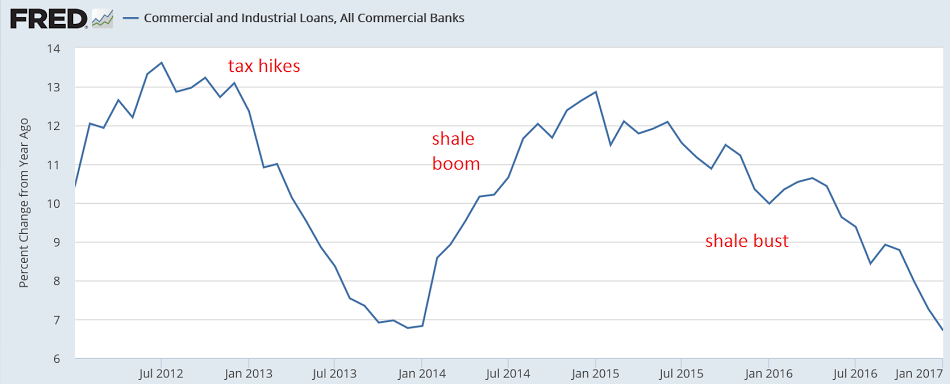
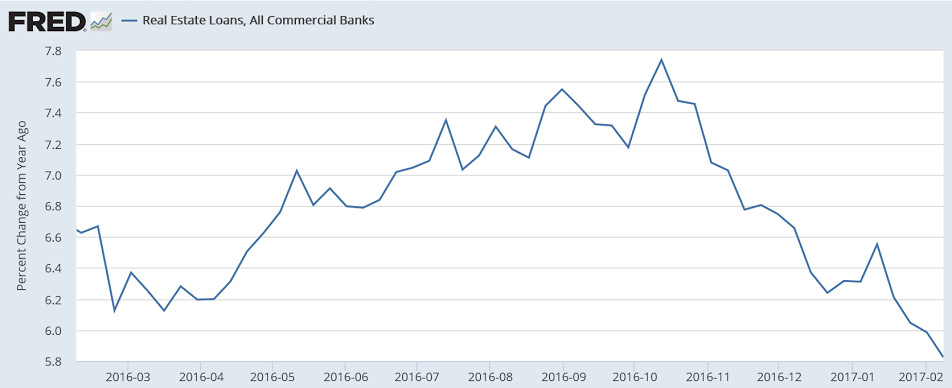
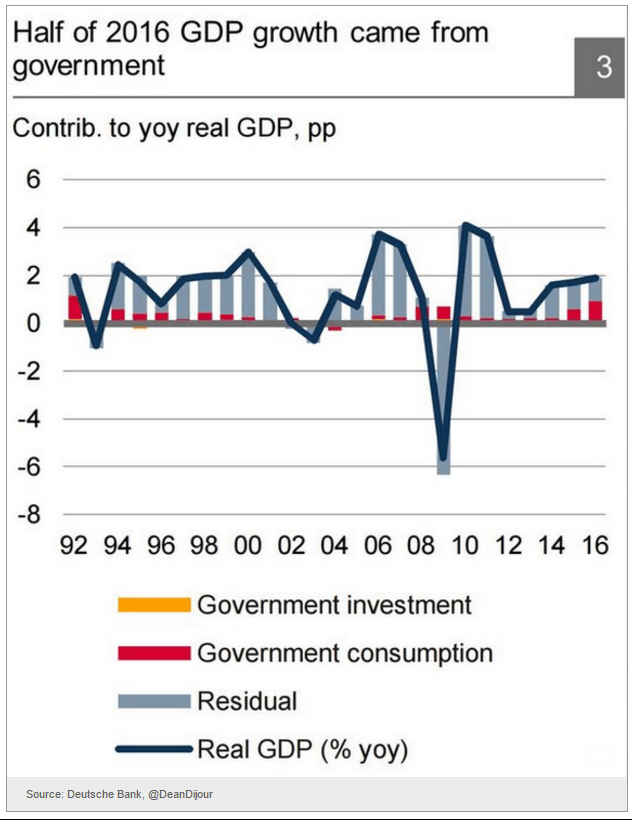
Bank lending, NYC new construction, GDP chart

Manhattan condo market cracking, developers roll out big incentives

Manhattan saw rampant new construction since the recession, and thousands of new luxury units flooded the market, with stark consequences. The median sale price for new construction ended 2016 down 44 percent, compared with the end of 2015, according to a quarterly report from Miller Samuel for Douglas Elliman. Closed sales dropped 13 percent. Most worrisome, the supply of condos for sale rose a striking 34 percent.

Just my imagination or is there a tendency for govt. spending to go up a bit more during election years?
;)

Euro area current account, E commerce retail sales, Tax refunds

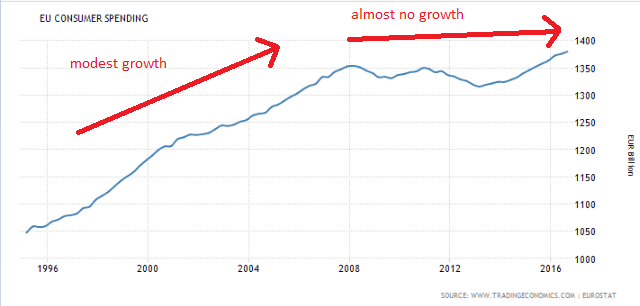
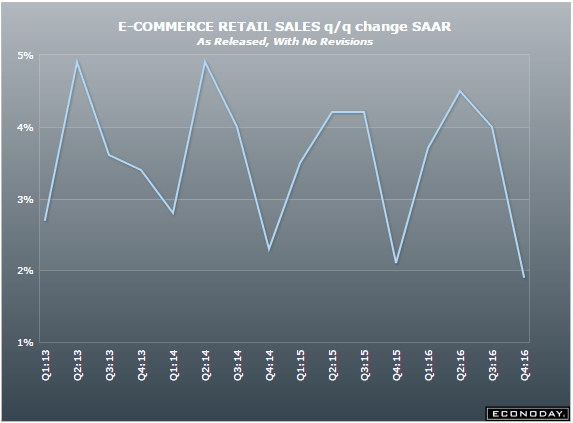
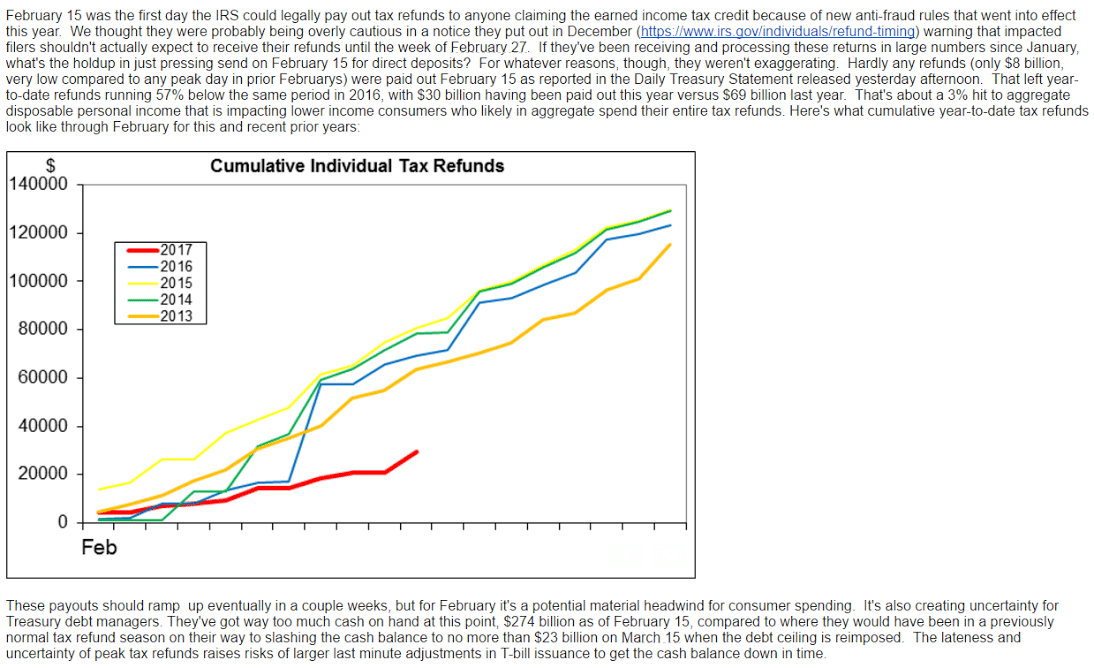
This is very euro friendly stuff.

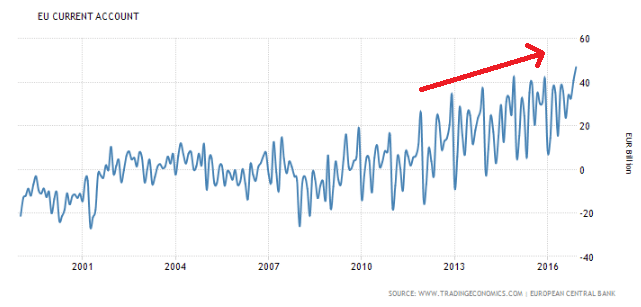
Euro Area Current Account

Eurozone’s current account surplus widened sharply to EUR 47.0 billion from EUR 41.4 billion in the same month of the previous year. The primary income surplus increased firmly to EUR 18.2 billion from EUR 13.0 billion a year ago and the goods surplus rose to EUR 32.8 billion from EUR 31.4 billion, while the services surplus was nearly unchanged at EUR 6.4 billion. Meanwhile, the secondary income deficit rose to EUR 10.5 billion from EUR 9.3 billion in the same month a year earlier. Considering 2016 full year, the current account surplus widened to EUR 361.8 billion from EUR 316.7 billion in 2015.


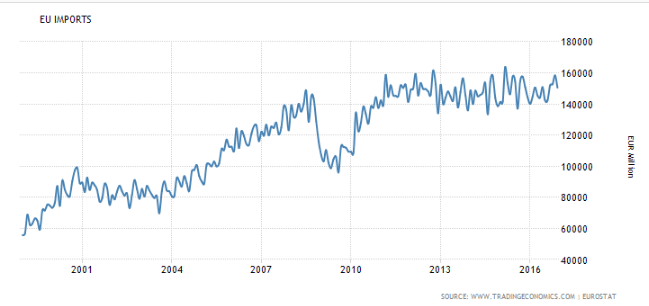
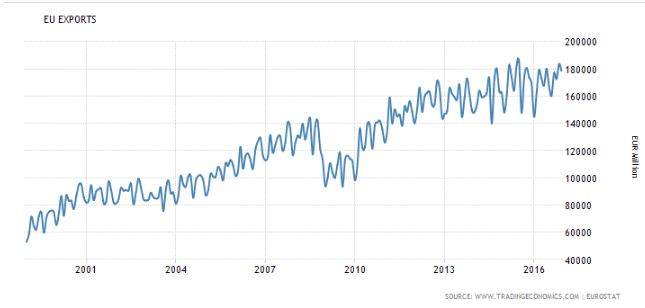
Imports (real benefits) flat and exports (real costs) growing reduces ‘real terms of trade’ and thereby the real standard of living:


And the trade surplus is good for export industries but at the expense of the macro economy:

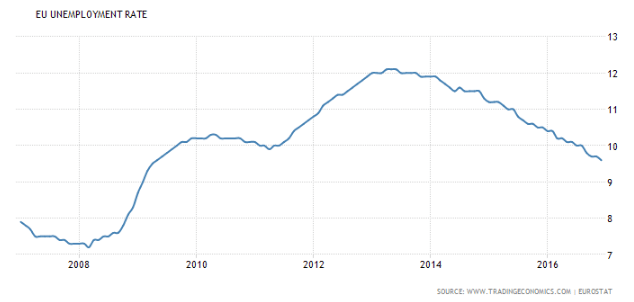
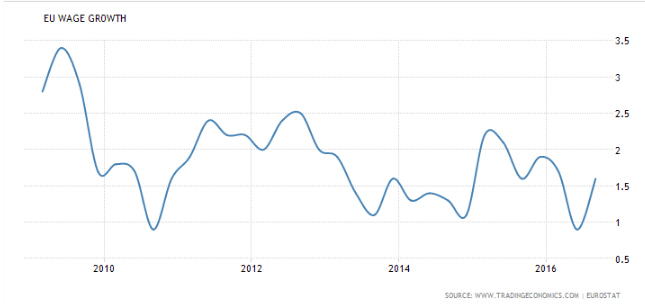
Hi unemployment depresses domestic demand, wages, etc. improving ‘competitiveness’:


Lower lows:

Housing starts, Philidelphia Fed survey, NY Fed on household debt

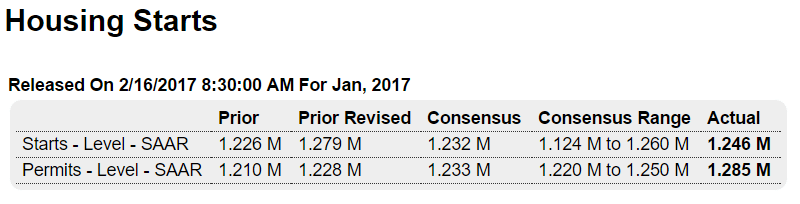
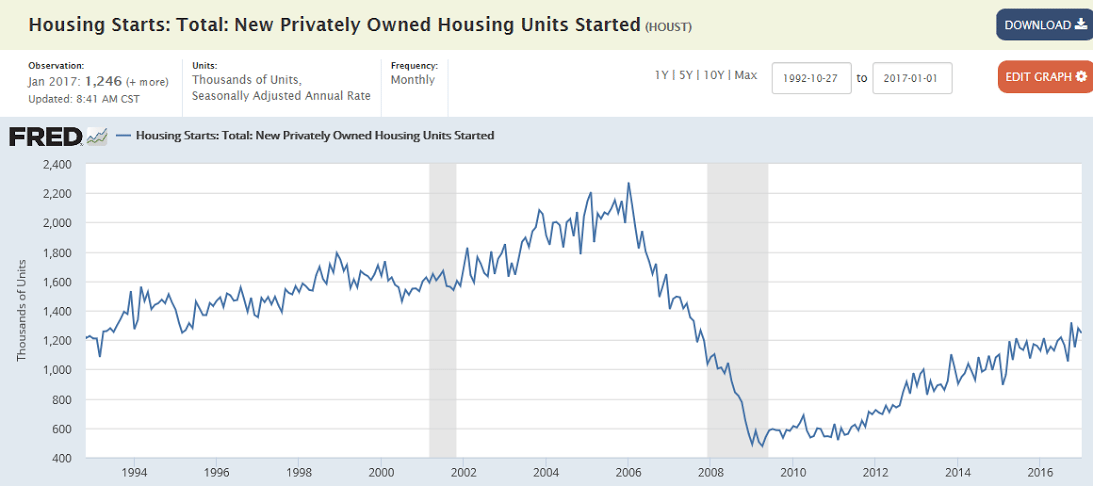
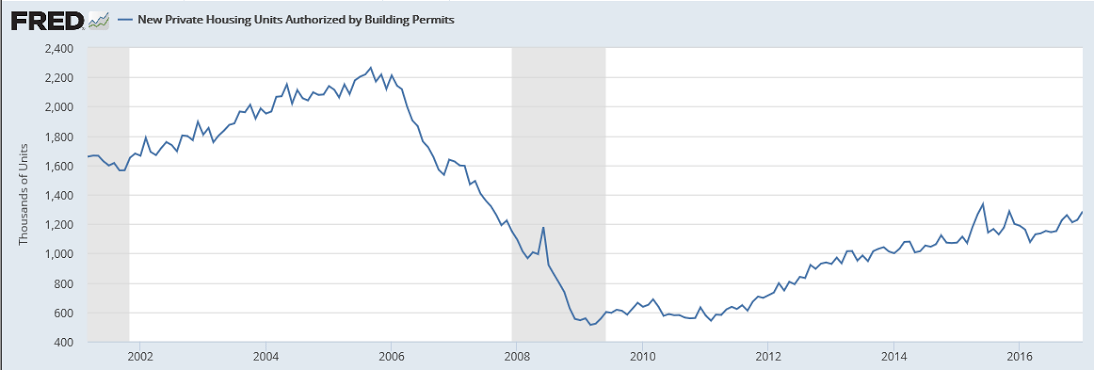
Still depressed by historical standards, and still seem to me to be going sideways, as per the charts:

Highlights

Housing starts did fall 2.6 percent in January but the 1.246 million annualized rate is well above Econoday’s consensus for 1.232 million. Details show a 1.9 percent rise for single-family starts to a 823,000 rate, offset by a 10.2 percent decline in multi-family units to 423,000. Year-on-year, however, both components are very positive, up 6.2 percent for single-family homes and at a very strong 19.8 percent for multi-units.

Permits rose 4.6 percent in January to a 1.285 million rate that also easily beat the consensus, for 1.233 million. But here single-family permits, which are very closely watched, fell 2.7 percent to a 808,000 rate that is still, however, 11.1 percent higher than a year ago. Multi-family permits jumped to 477,000 from a 398,000 rate but are up a relatively modest 3.5 percent from a year ago.

This report is always volatile and bumpy from component to component but in sum, housing starts and permits are pointing to continuing strength for new homes where lack of supply held down what nevertheless was a solidly positive 2016 for the sector.


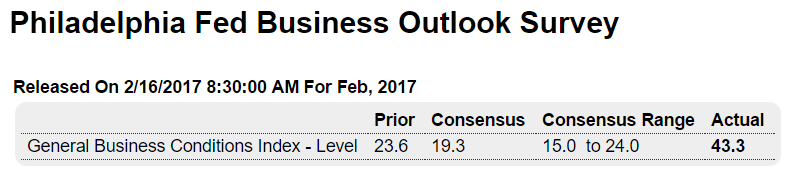
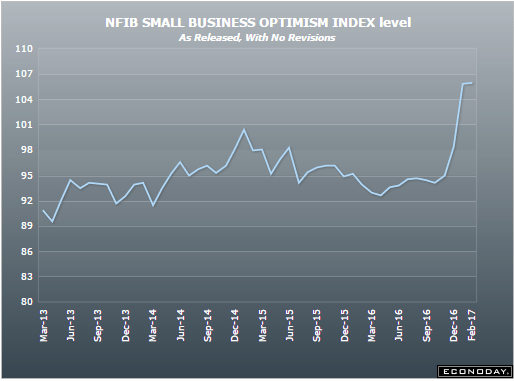
More trumped up expectations?

Highlights

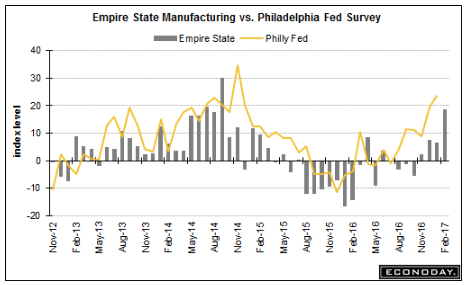
The strength of the Philadelphia Fed’s general business conditions index is impossible to exaggerate. February’s 43.3 is not a misprint. It’s the strongest since very far back, since January 1984. Yes, this index is a response to a single question on monthly sentiment but its enormous strength is confirmed by a very tangible reading, and that is the new orders index which jumped 12 points in the month to 38 which itself is a record or should be one if it is not.

Other readings in this report are less spectacular but very strong including a big build for backlogs, a healthy draw for inventories, understandable slowing in delivery times, and noticeable pressures in costs and positive traction for selling prices.

As an advance indicator, this report rivals the ISM manufacturing survey in importance. These readings point squarely at 2017 acceleration for a factory sector that limped through 2016.

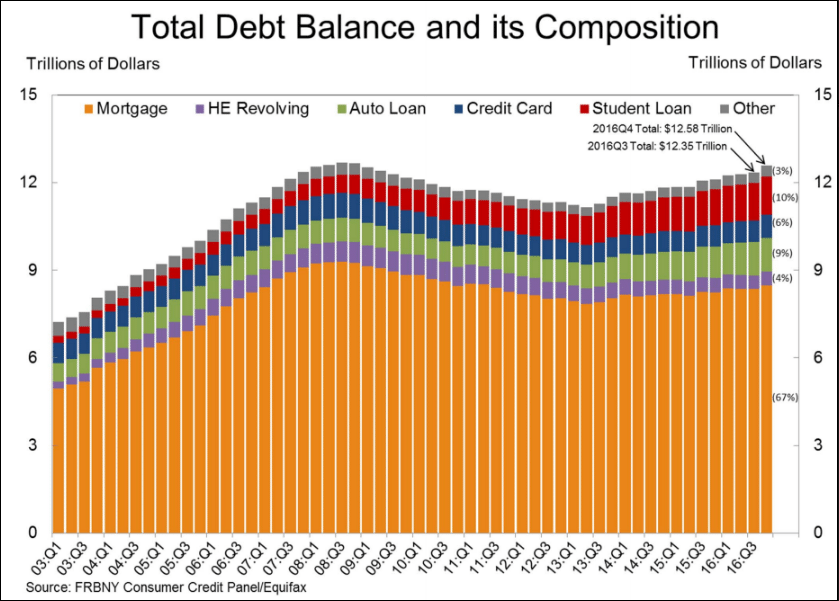
Not uncommon for a sudden surge of debt to come before a drop in spending, as consumers get caught short on the income side and borrow for a while as they transition to reduced spending:

From the NY Fed: Household Debt Increases Substantially, Approaching Previous Peak

The Federal Reserve Bank of New York today issued its Quarterly Report on Household Debt and Credit, which reported that total household debt increased substantially by $226 billion (a 1.8% increase) to $12.58 trillion during the fourth quarter of 2016. This marked the largest quarterly increase in total household debt since the fourth quarter of 2013, and debt today is now just 0.8% below its peak of $12.68 trillion reached in the third quarter of 2008. Every type of debt increased since the previous quarter, with a 1.6% increase in mortgage debt, 1.9% increase in auto loan balances, a 4.3% increase in credit card balances, and a 2.4% percent increase in student loan balances. This boost in balances was in part driven by new extensions of credit, with a large increase in the volume of mortgage originations and a continuation in the strong recent trend in auto loan originations. This report is based on data from the New York Fed’s Consumer Credit Panel, a nationally representative sample of individual- and household-level debt and credit records drawn from anonymized Equifax credit data.

Mortgage balances increased and mortgage originations reached the highest level seen since the beginning of the Great Recession.

Mortgage delinquencies remained mostly unchanged and the delinquency transition rates for current mortgage accounts improved slightly.

New foreclosure notations reached another new low for the 18-year history of this series.

Overall delinquency rates were roughly stable this quarter.

This quarter saw the lowest number of bankruptcy notations in the 18-year history of this series, continuing an overall downward trend since the financial crisis.
emphasis added

Read more at http://www.calculatedriskblog.com/#x5tyrtmlKLRi2SWM.99

You can see how it moved up into the crash of 08:

Retail sales, Empire manufacturing, Mortgage purchase applications, Industrial production, Builder confidence, Business inventories

First the good news:

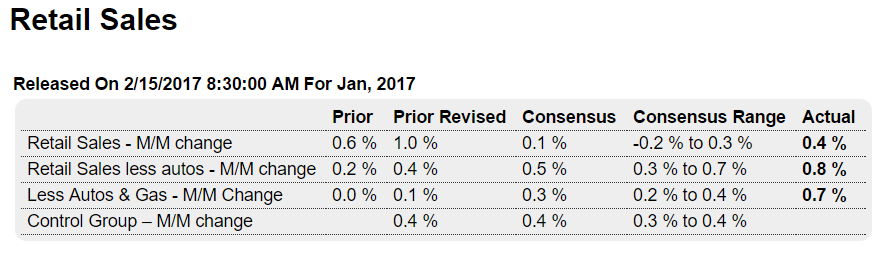
Up more than expected and last month revised higher:

Highlights

Consumer spending data have been surprisingly moderate given the unusual strength in consumer confidence, but today’s retail sales report, which includes an important revision, now moves spending more in line with confidence. Retail sales rose 0.4 percent in January which tops Econoday’s very modest 0.1 percent consensus and the top estimate of 0.3 percent. Importantly December, which is the most important retail month, is now revised a sharp 4 tenths higher to a very strong plus 1.0 percent.

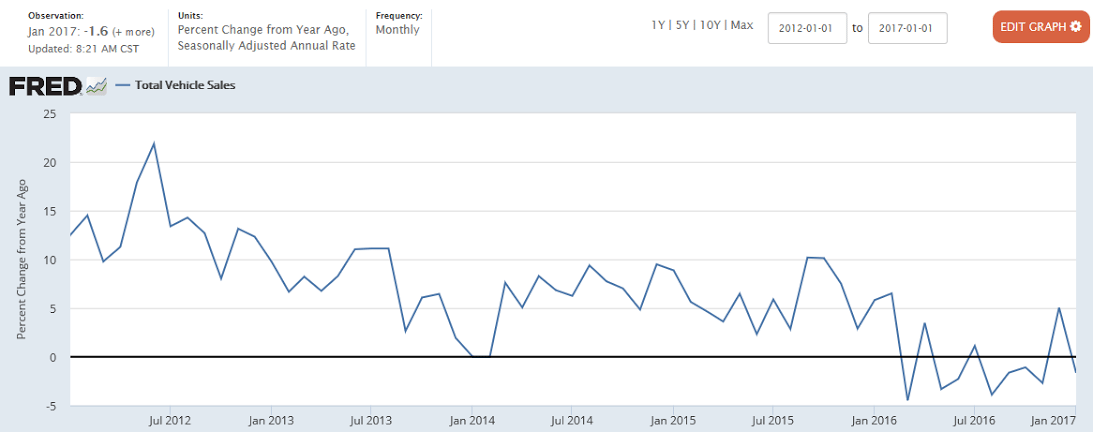
Vehicles were the special strength of the December report, at a revised plus 3.2 percent vs an initial 2.4 percent, and in a give back are really the only weakness in the January report at minus 1.4 percent. Excluding vehicles, retail sales jumped a very sharp 0.8 percent in January which again beats the top forecast. Ex-auto for December is also part of the good news, revised 2 tenths higher to 0.4 percent.

Electronics & appliance stores show a big January gain at 1.6 percent with restaurants at 1.4 percent and department stores up 1.2 percent. Sporting goods, clothing, health & personal care and building materials all show gains.

But gasoline, where prices are up, have been adding to the gains the past two months and excluding which sales in January show a less impressive gain of only 0.2 percent. This reading for December, however, is a much more impressive plus 0.8 percent.

But gasoline only dims the strength of the report for January which, next to February, is the slowest month on the retail calendar. Today’s data point to momentum for consumer spending, which is by far the economy’s most important sector.

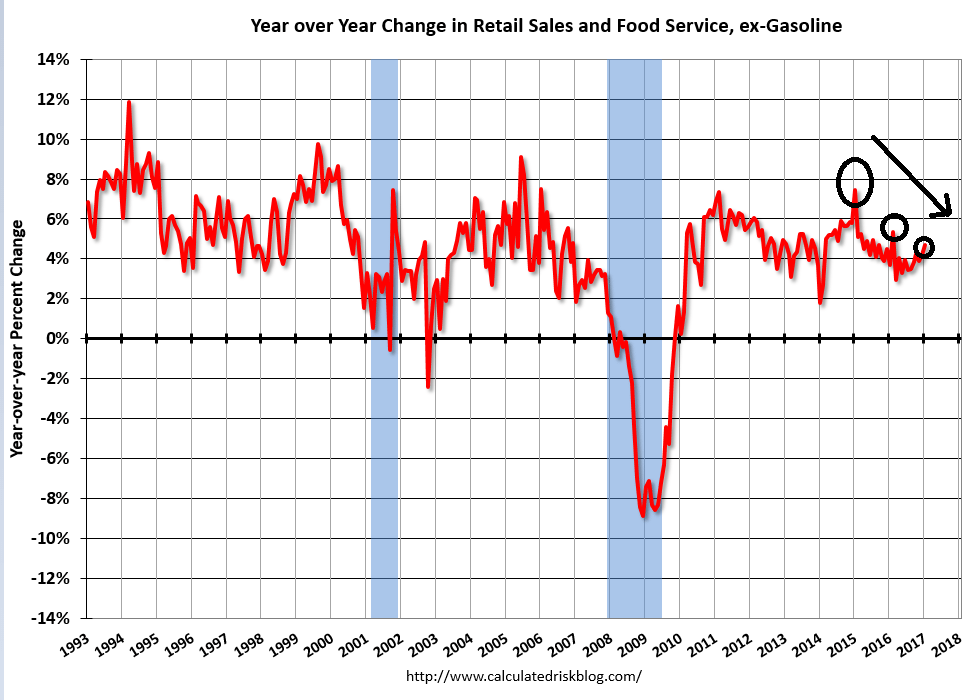
I’m waiting to see if the spikes keep getting lower as in the prior cycle:


Now the not so good news:


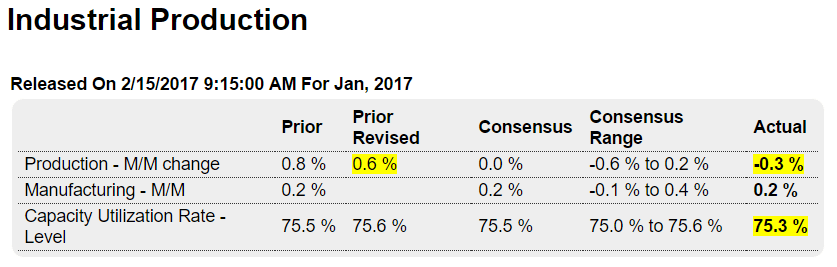
As previously discussed, it was weather related elevated utility output that supported the higher than expected report.

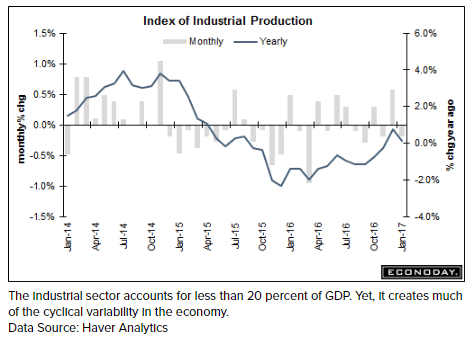
Now last month has been revised lower and this month has reversed as utility output ‘normalizes’:

Highlights

A swing in utility output skewed what is, however, no better than a modest industrial production report for January. Industrial production, reflecting a 5.7 percent weather-related drop for utilities, fell 0.3 percent which is below Econoday’s no-change consensus.

But the real disappointment in the report is the manufacturing component which could muster no better than a consensus gain of 0.2 percent. This reading hasn’t been able to build any momentum to speak of and was held down in January by a sharp 2.9 percent monthly downswing in vehicles. Excluding motor vehicles, manufacturing volumes rose 0.5 percent which is really the highlight of today’s report. Also a highlight though is mining which is the report’s third and smallest component. Mining continues to show new life with a very sharp 2.8 percent jump in January.

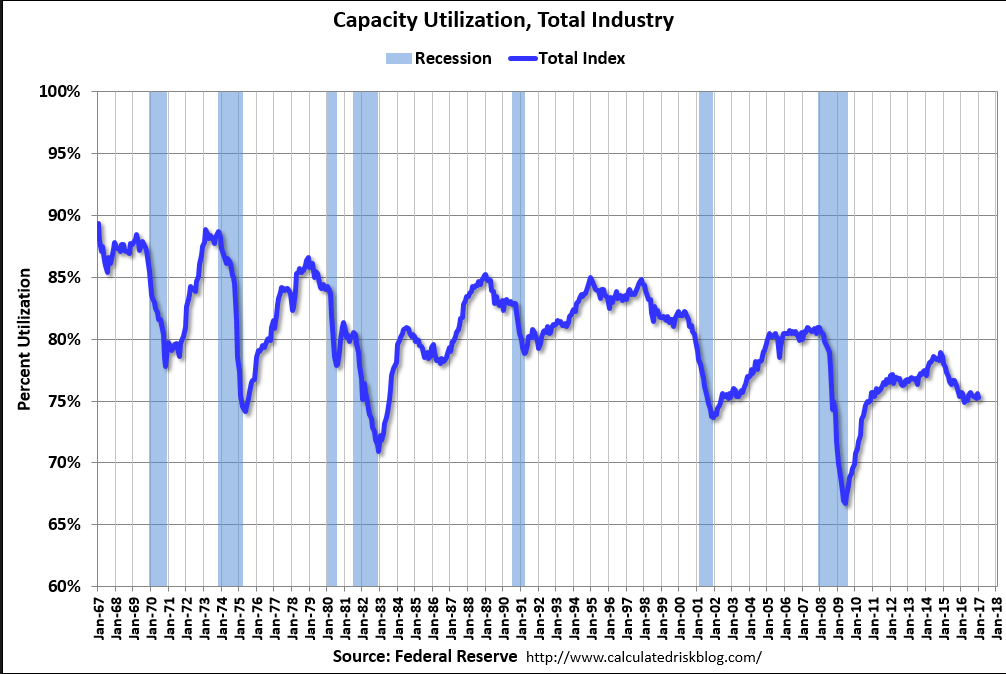
Overall capacity utilization reflects the general softness of the industrial sector, at 75.3 percent for a 3 tenths decline in the month and 4.6 percentage points below its long run average. Manufacturing utilization is likewise soft at 75.1 percent.

The industrial economy, held down by weak global demand, has been running below average the past 2-1/2 years, when energy prices first collapsed in mid-2014. But advance indicators, including this morning’s Empire State report, are almost uniformly pointing to a rebound ahead, a rebound however that has yet to appear in the government’s definitive data.

Highlights

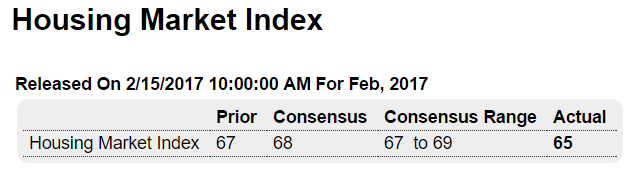
The big post-election surge in home builder optimism is over as the February housing market index is down 2 points to a much lower-than-expected 65. This is still well above breakeven 50 and points to confidence but marks a noticeable drop from 67 and 69 in January and December.

Builder confidence in the market for newly-built single-family homes declined two points in February to a level of 65 on the National Association of Home Builders/Wells Fargo Housing Market Index (HMI).
Read more at http://www.calculatedriskblog.com/#d255y1KsUy63VrWh.99

All three HMI components fell in February. The component gauging current sales conditions dipped one point to 71, and the index charting sales expectations in the next six months registered a three-point decline to 73. The component measuring buyer traffic dropped five points to 46.
Read more at http://www.calculatedriskblog.com/#d255y1KsUy63VrWh.99

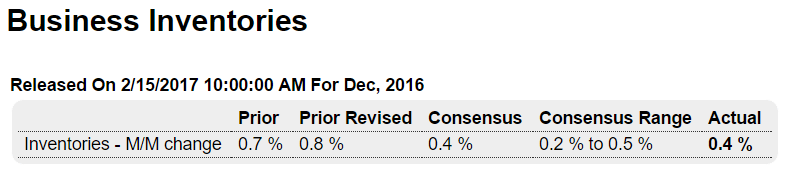
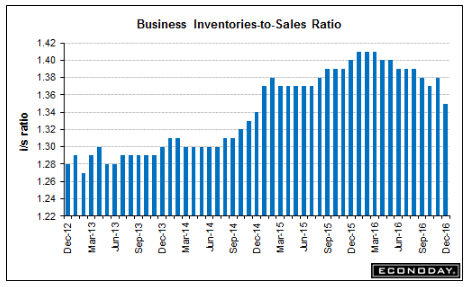
Inventory/sales ratio came down but watch for a reversal in Jan as vehicle and other sales were down. And in any case they remain elevated:

Consumer sentiment, China policy, Iran

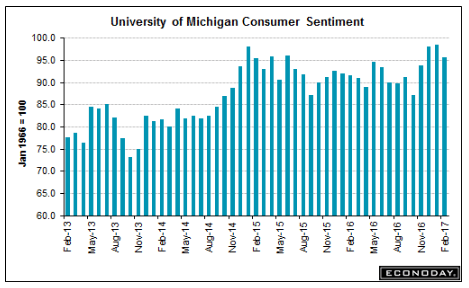
Trumped up expectations fading:

21001

No telling why our new President changed his mind on this one. Might have something to do with a kosher house being a two china policy… ;)

White House confirms Trump’s agreement to honor ‘One China’ policy

By Everett Rosenfeld

Feb 10 (CNBC) — A White House statement confirmed a Thursday night report that President Donald Trump had agreed to honor China’s “One China” policy in his first call with the country’s president.
“President Donald J. Trump and President Xi Jinping of China had a lengthy telephone conversation on Thursday evening. The two leaders discussed numerous topics and President Trump agreed, at the request of President Xi, to honor our “one China” policy,” The White House said in a statement.

“Representatives of the United States and China will engage in discussions and negotiations on various issues of mutual interest. The phone call between President Trump and President Xi was extremely cordial, and both leaders extended best wishes to the people of each other’s countries. They also extended invitations to meet in their respective countries. President Trump and President Xi look forward to further talks with very successful outcomes.”

China state-run news agency Xinhua reported in Chinese that Trump told Xi he believed that the two nations could promote bilateral relationships to a “historical high level.”

Earlier, Trump had attracted criticism from China for saying that the U.S. did not necessarily have to stick to the “One China” policy.

China’s foreign ministry responded at the time that it was extremely concerned with Trump’s comments, with spokesman Geng Shuang telling reporters that the policy was the basis of relations between the world’s two largest economies.

The government’s official response came after the Communist Party-owned paper, Global Times, published an opinion piece with the headline: “Trump, please listen clearly, the One China policy cannot be traded” as it warned Trump that China cannot “be easily bullied.”

“If Trump abandons the one-China principle, why should China need to be U.S.’ partner in most international affairs?” said the paper, which is known for its extreme nationalistic views.

Most would think Trump is “ignorant like a child” in handling diplomacy, the paper added.

21002

Mortgage purchase apps, Tax reform, Trump comments

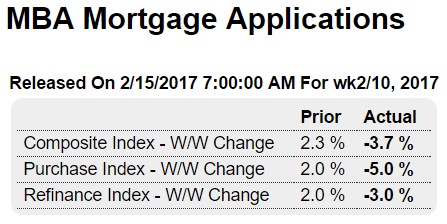
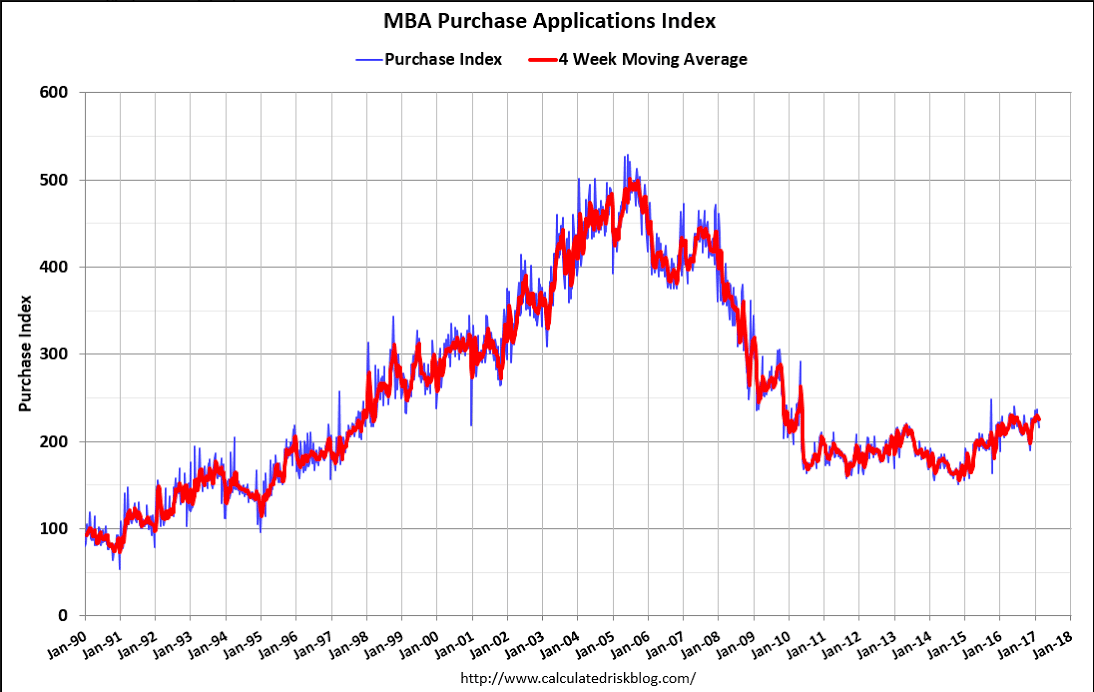
Purchase applications seemed to have, at best, leveled off a what remains very depressed levels:

20801
Revenue neutral won’t do the trick, and since the tax cuts are likely to be lower multiple than any spending cuts it could slow things down:

Taxpayers should expect to see revenue-neutral tax reform as early as this summer, Republican Sen. Rob Portman told CNBC on Wednesday.

“We need to do it. It’s urgent. It’s one way we know we can give the economy a shot in the arm,” the Ohio senator told “Squawk Box.”

He said the ultimate goal for Republicans besides passing the tax reform is making it revenue neutral, meaning no increase or decrease in federal tax revenues.

20802

As previously discussed, the CIA said they would do this type of thing to get Trump’s approval:

Donald Trump’s staff get him to agree to policies by saying ‘Obama wouldn’t have done it’

Military officials got Donald Trump to agree to the botched Yemen raid by suggesting Barack Obama would never have had the courage to do it, it has been reported.

Seems to me every passing day further confirms President Trump is just a 7 or 8 year old child in a 70 year old body, thereby subject to this type of manipulation.

Jolts, Consumer credit, Trade, Brexit poll

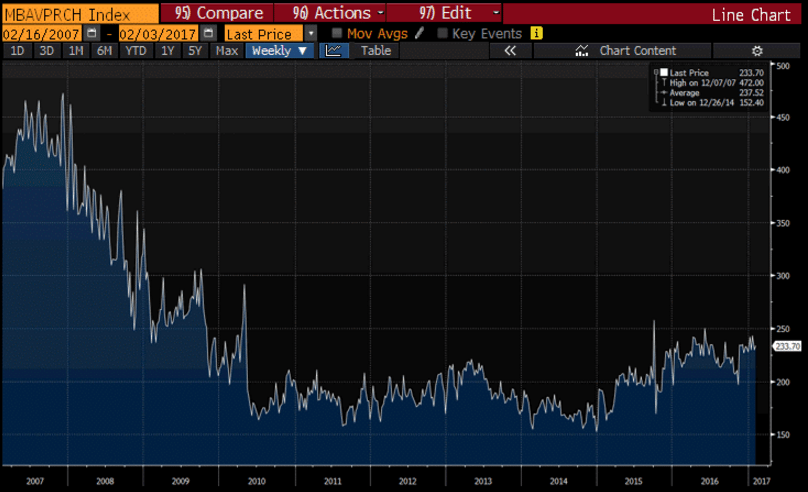
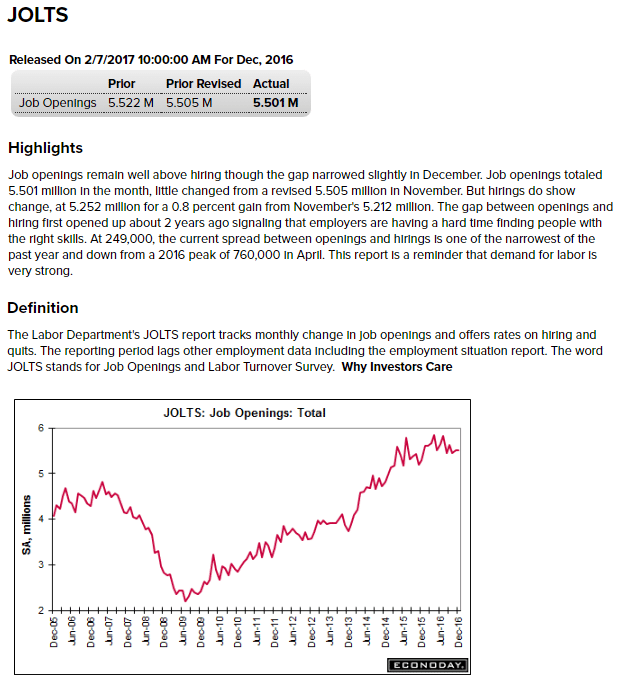
Still looks to me like it’s already rolled over:

20701
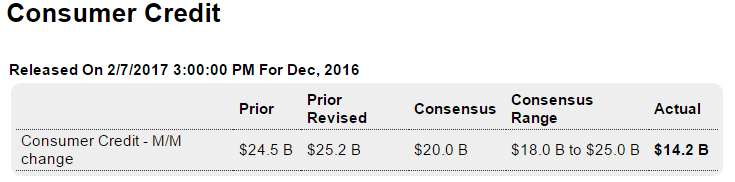
Less than expected indicating spending likely to be less than expected as well:

20702

Highlights

Growth in consumer credit slowed in December, to $14.2 billion vs an upward revised $25.2 billion in November. Revolving credit showed less life in December than prior months, rising only $2.4 billion vs November’s $11.8 billion. Weakness here helps explain the general weakness in core shopping during December. Nonrevolving credit, reflecting demand for auto loans and especially student loans, rose an intrend $11.8 billion.

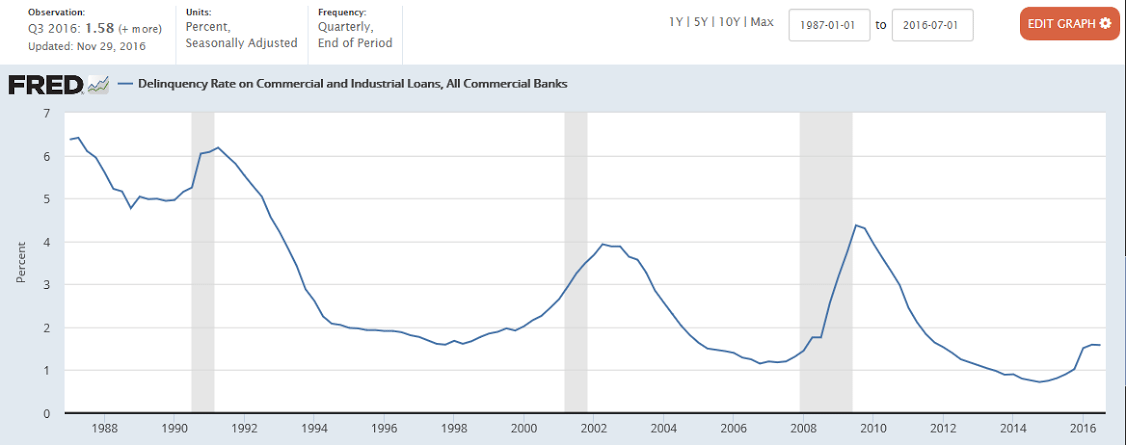
When losses start to increase, banks tend to tighten credit:

Credit conditions for most business lending unchanged in fourth quarter: Fed (Reuters) Loan officers at U.S. banks reported largely unchanged lending standards and slightly looser terms for business loans in the last three months of 2016, the Federal Reserve reported on Monday in a quarterly survey. About a third of the 69 institutions surveyed, however, said they had “tightened somewhat” the standards for commercial real estate construction and land development loans, and close to a fifth had tightened standards on loans secured by multifamily properties.

This was released Nov 29:

20703
The higher crude oil prices look to be showing up in the next report:

20704

Highlights

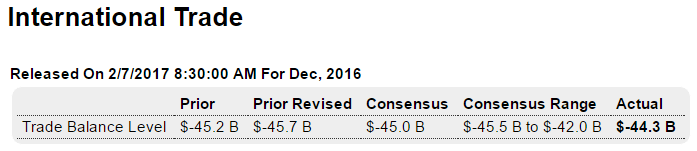
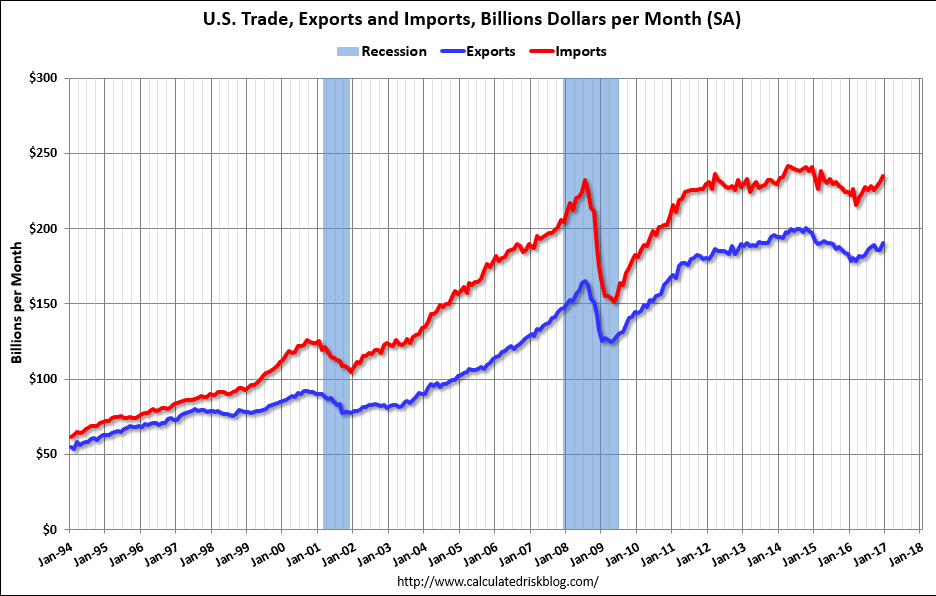
Strong exports of capital goods helped limit the nation’s trade deficit in December to a lower-than-expected $44.3 billion vs a revised $45.7 billion in November. Exports, also boosted by strong demand for U.S. services, rose a very solid 2.7 percent to $190.7 billion in the month, strength offset however by a 1.5 percent rise in imports to $235.0 billion that was swollen by heavy imports of vehicles.

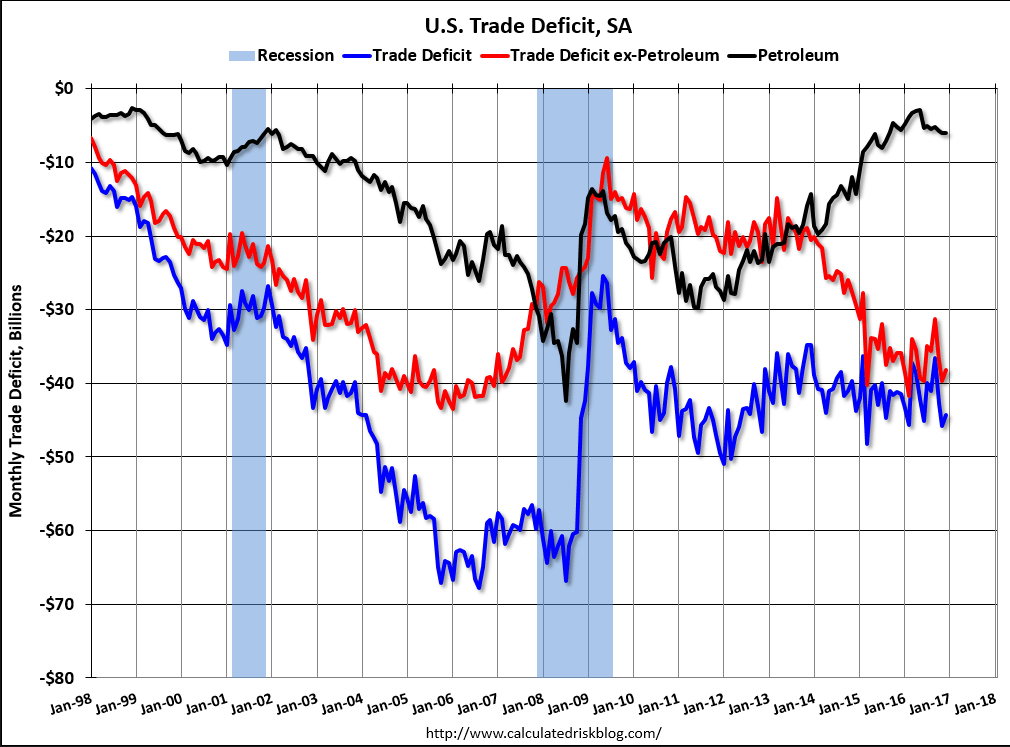
Petroleum was not a factor in the December report with the related deficit unchanged from November at $6.1 billion. Details here show a 0.3 percent dip in imports to $14.3 billion in December and a 0.6 percent dip in exports to $8.2 billion. Month-to-month import volumes slipped slightly but were offset by a rise in the average barrel of crude to $41.45 which is the highest since September 2015.

Country data show a narrowing in the monthly gap with China to $27.8 billion from November’s $30.5 billion and a narrowing with Mexico to $4.4 billion from $5.8 billion. For full year 2016, the gap with China totaled $347.0 billion, down from $367.2 billion in 2015, and with Mexico at $63.2 billion vs $60.7 billion in 2015. Gaps in Canada narrowed in December to $2.2 billion for $11.2 billion in 2016 and narrowed to $12.2 billion with the EU for a 2016 total of $146.3 billion.

December exports were the highest since April 2015 though imports were the heaviest since March 2015. Still, the active two-way traffic points to strong cross-border trade and improved global demand.

20705

20706

Seems to be a shift in progress?

Most British voters now approve of May’s approach to Brexit (Reuters) A majority of Britons approve of the government’s approach to leaving the European Union. Prime Minister Theresa May set out her vision for Brexit in a speech in mid-January, outlining plans to leave the EU single market in a clean break with the bloc. The proportion of the public that approve of the government’s preparations for Brexit stood at 53 percent, ORB found, up 15 points from a poll last month when only 38 percent approved, with 62 percent disapproving. The poll also found that 47 percent agreed that May would get the right deal for Britain, with just 29 percent disagreeing.

Nonfarm Payrolls, Factory orders, ISM non manufacturing, Conway comments

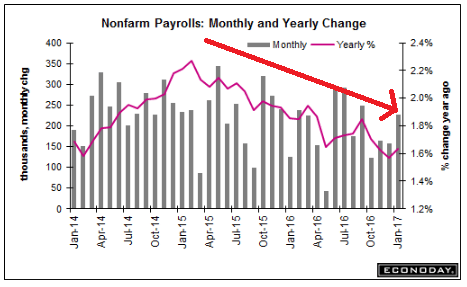
Better than expected. Lots of seasonality to January numbers. For example, warm weather that adds a few construction jobs gets magnified, and due to light temporary help hiring during the holiday season there were fewer workers to layoff in January, giving a boost to temporary help type measures. Meanwhile, however, the deceleration trend in the year over year chart continues, and wage growth remains subdued and last month’s downward revision indicated prior concerns were premature:
20301

Highlights

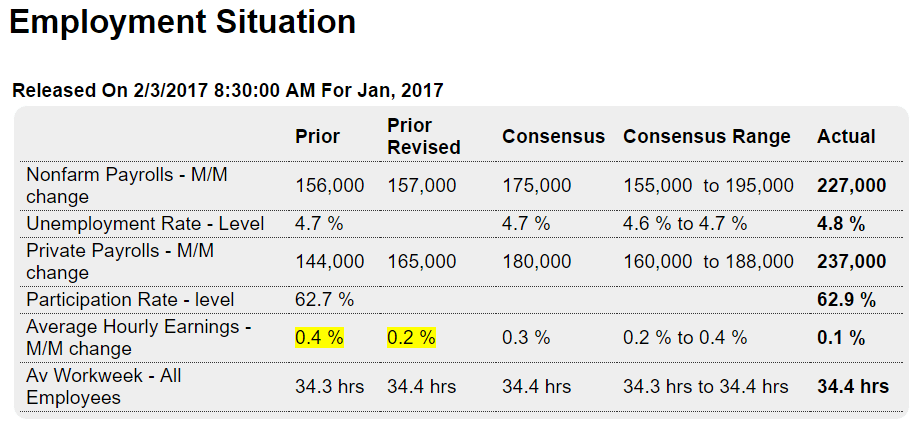
In very positive news, payroll growth in January did indeed exceed expectations, rising 227,000 for the best showing since September and well above the 2016 average of 187,000. Construction spending has been improving and it’s seen in payrolls where the sector added a very strong 36,000 jobs in the month. Finance employment follows at 32,000.

In a sign of labor market slack, the unemployment rate rose 1 tenth to what is still a very low 4.8 percent. This reflects new entrants into the labor market as the labor force participation rate, which has been depressed, bounced 2 tenths higher to 62.9 percent. The pool of available workers rose 183,000 in the month to 13.4 million.

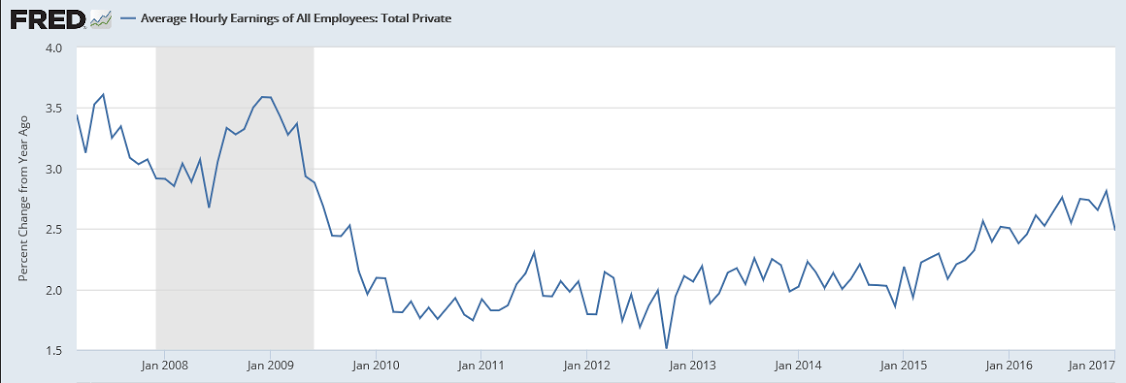
The surprise in this report, and one that will not heat up expectations for a rate hike at the March FOMC, is surprisingly light wage pressure as average hourly earnings ticked only 0.1 percent higher with, importantly, December revised down from an initially hot 0.4 percent to a gain of only 0.2 percent. The year-on-year rate, which was skirting the 3 percent line in December’s initial data, is now way back at 2.5 percent.

The mix of this report is non-inflationary sustainable growth: rising payrolls, new entrants, stable wages. ADP and jobless claims, not to mention jobs-hard-to-get in the consumer confidence report, were all signaling a stronger-than-expected employment report for January, something to remember ahead of the next employment report. Note that the net effect of revisions, which include annual bench marking and a population update, were negligible but did skew November lower (164,000 vs a prior 204,000) and September higher (249,000 vs 208,000).
20302
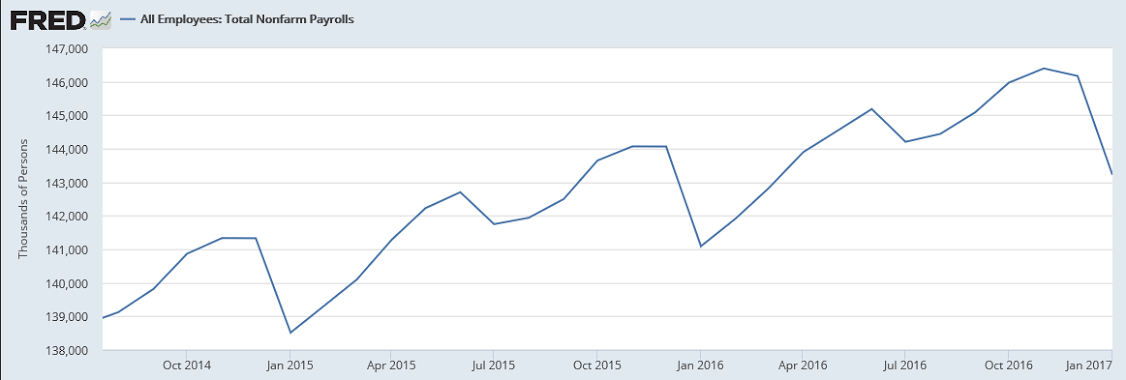
This is the number of employed not seasonally adjusted. As you can see, January always falls off quite a bit, so the seasonally adjusted numbers take that into account best they can by looking at past January drop offs, and looking at year over year growth, as in the chart above, ‘removes’ the seasonal factors:
20303
Wage growth remains subdued indicating a lack of aggregate demand:
20304
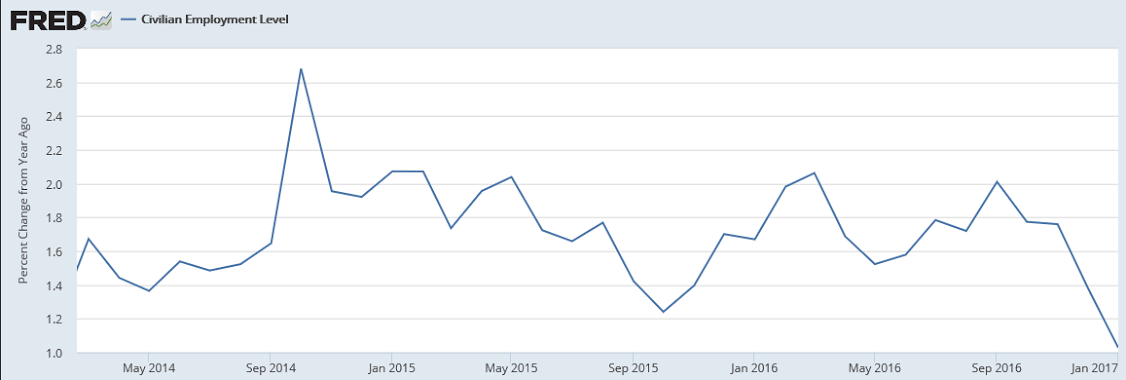
This is the year over year growth rate of the household survey which tends to be more volatile:
20305
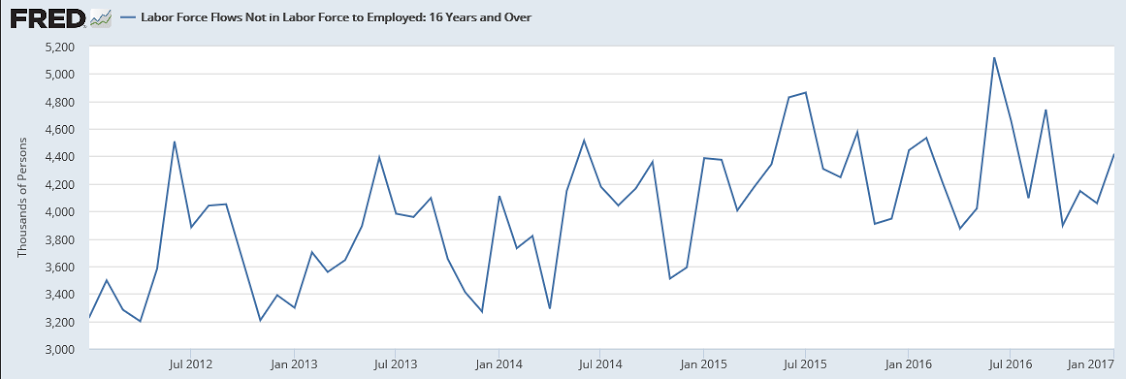
So last month 4.418 million people who got jobs hadn’t been counted as being available for work the day before:
20306
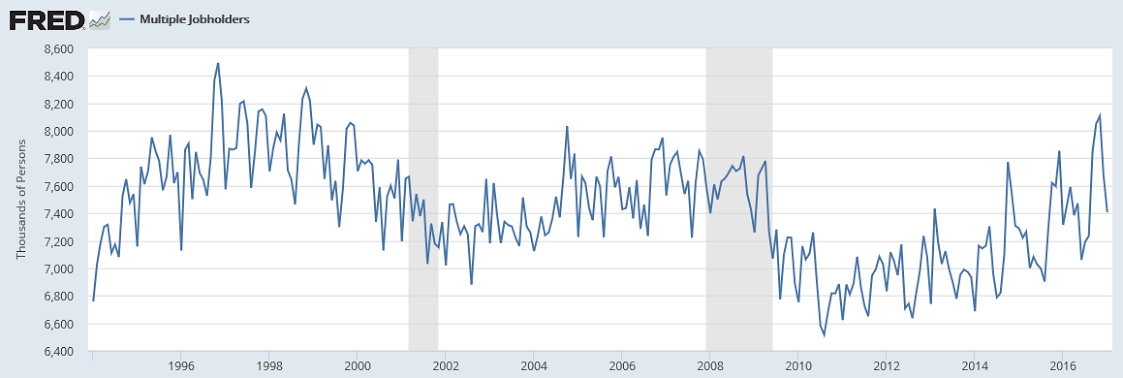
And the number of people holding more than one job seems to be working its way higher:
20307
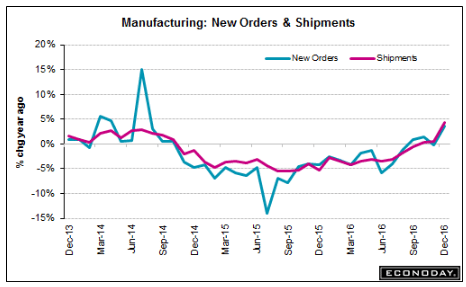
As previously discussed, factory orders seem to be modestly growing again vs prior, lower levels:
20308
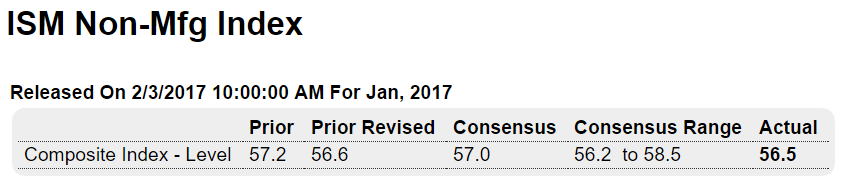
Trumped up expectations are fading a bit for this service sector survey:
20309

Highlights

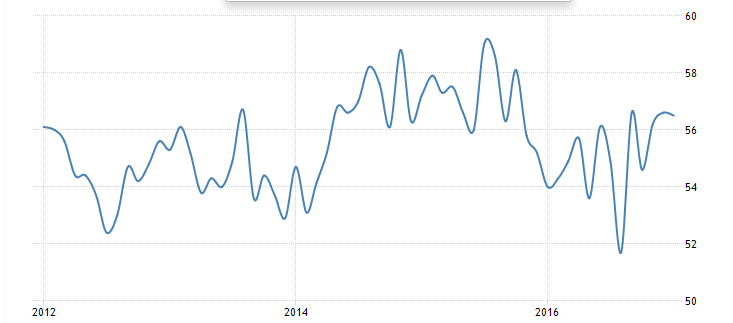
Keeping with the morning’s theme of strength, the ISM non-manufacturing index came in steady at 56.5 with new orders at an even stronger 58.6 and with business activity leading the report at 60.3. Employment, like this morning’s jobs report, is solid at 54.7 for a 2-point gain in the month.

But backlog orders, despite the strength in new orders, remain flat which will contain future employment gains. Another negative is new export orders which had been strong reflecting foreign demand for U.S. technical and managerial services but which fell into contraction in January at 48.0.

The bulk of the data, however, is very strong, starting off 2017 on the same note of strength that the report showed throughout 2016.

20310

Ryan timeline, Trump remarks

It will be a while before even the discussions begin:

House Speaker Paul Ryan said Thursday that Republican lawmakers will try to push through tax reform and infrastructure bills — two key policies for investors — in the spring after focusing on health care.

“It’s just the way the budget works that we won’t be able to get the ability to write our tax reform bill until our spring budget passes, and then we write that through the summer,” Ryan said on “Fox and Friends.”

He added that an infrastructure package “comes out of our spring budget, as well.”

Black history month remarks: http://theconcourse.deadspin.com/a-full-transcript-of-donald-trumps-black-history-month-1791871370

Prayer breakfast remarks:

Like every president since Dwight D. Eisenhower, President Donald Trump attended the annual National Prayer Breakfast. But the 45th president was the only one to ask the bipartisan gathering to pray for Arnold Schwarzenegger.

Trump did address faith in his speech Thursday, but he also took jabs at “Celebrity Apprentice” after the show’s producer Mark Burnett introduced him.

“When I ran for president, I had to leave the show. That’s when I knew for sure I was doing it,” Trump said. “And they hired a big, big movie star, Arnold Schwarzenegger, to take my place. And we know how that turned out. The ratings went right down the tubes, it’s been a total disaster, and Mark will never, ever bet against Trump again. And I want to just pray for Arnold if we can for those ratings, OK?”

And then there’s this type of thing:

In a report released at 4:56 a.m. Thursday from Reuters:

“U.S. military officials told Reuters that Trump approved his first covert counterterrorism operation without sufficient intelligence, ground support or adequate backup preparations.

“As a result, three officials said, the attacking SEAL team found itself dropping onto a reinforced Al Qaeda base defended by landmines, snipers, and a larger than expected contingent of heavily armed Islamist extremists.”

Early reports on the troubling raid have also repeatedly stated that the Obama administration knew full well about the target, but did not execute the raid for “operational reasons.” What that generally means is that the Obama administration surveyed this situation and did not feel that they had the intelligence needed to run the operation.

One of the three military officials who spoke to Reuters confirmed this very thing. They said, “The decision was made … to leave it to the incoming administration, partly in the hope that more and better intelligence could be collected.”

And this:

Renewed fighting in east Ukraine has become the first major international test of the Trump administration and could embolden Russia without a strong U.S. response, the chairman of the powerful Senate Armed Services Committee told the president on Thursday, urging him to follow through on permission Congress has already granted to send weapons to Ukraine.

Sen. John McCain pointed out in a letter to President Donald Trump that forces backed by Moscow began testing the shaky cease-fire lines around the Ukrainian town of Avdiivka almost immediately after Trump spoke by telephone with the Russian president on Saturday.

“Vladimir Putin is moving quickly to test you as commander-in-chief,” the Arizona Republican wrote. “America’s response will have lasting consequences.”