Holiday sales, Atlanta Fed, Freight transport index

Not long ago they blamed cold weather, now it was the warm weather.

And this time not a word about the consumer not spending his gas savings…
;)

Holiday sales fall short of forecasts: NRF

Jan 15 (CNBC) — The National Retail Federation said Friday that holiday sales increased 3 percent to $626.1 billion in November and December, falling short of the trade group’s forecast for 3.7 percent growth, as unseasonably warm weather and low prices weighed on results.

The news came shortly after the Commerce Department said retail sales posted an unexpected drop in December, falling 0.1 percent from the previous month. Compared with the prior year, December sales rose 2.2 percent, to $448.1 billion, according to the government data.

During the October to December period, total sales rose 1.8 versus the prior year, according to the department. Total sales for all of 2015 increased 2.1 percent, representing their weakest result since 2009, Reuters said.

“Make no mistake about it, this was a tough holiday season for the industry,” said NRF President Matthew Shay. “Weather, inventory challenges, advances in consumer technology and the deep discounts that started earlier in the season and that have carried into January presented stiff headwinds.”

“Despite these factors, the industry rallied, consumers responded and sales still grew at a healthy rate.”

How the industry generated this growth, however, remained a top concern among analysts. They cautioned that profitability will likely take a hit when retailers start rolling out their fourth-quarter earnings results in coming weeks, thanks to aggressive discounts.

“Knowing that the topline growth was fueled by promotions tells us that the real number for us to focus on is … the individual bottom-line results for retailers, because that’s where we’re going to see the real profitability numbers,” said Steve Barr, PwC’s U.S. retail and consumer leader.

Industry forecasts had called for modest sales growth this holiday season, as low gas prices and a stronger economy battled against muted wage gains and higher rent and health-care costs. Retailers that cater to middle-income shoppers faced even more headwinds, including price deflation and a shift in consumer spending toward dining out or travel.

As a result, the National Retail Federation predicted retail sales excluding autos, gas and restaurants would increase 3.7 percent in November and December, compared with the prior year’s 4.1 percent growth.

In the same vein, consulting firm AlixPartners forecast holiday sales (excluding motor vehicles, food services and dining, and gas stations) would rise 2.8 to 3.4 percent during the final two months of the year, compared with 4.4 percent growth in 2014.

And Deloitte, whose prediction covers the November through January period (but excludes motor vehicles and gasoline) predicted a 3.5 to 4 percent increase. That would mark a slowdown from its recorded 5.2 percent gain the prior year.

As the season progressed, however, analysts grew more pessimistic that sales would meet these forecasts. Despite retailers’ best efforts to get shoppers into their stores earlier, November got off to a slow start. Then, over the critical Black Friday weekend, ShopperTrak data indicated that sales fell an estimated 10.4 percent.

What’s more, unseasonably warm weather through December took a huge bite out of retailers’ traffic and sales, with Planalytics calculating a $572 million sales loss for specialty apparel stores during the final two months. That figure does not even take into account department stores, which also rely heavily on apparel. In its holiday sales release,Macy’s blamed 80 percent of its 4.7 percent same-store sales decline on cold-weather goods.

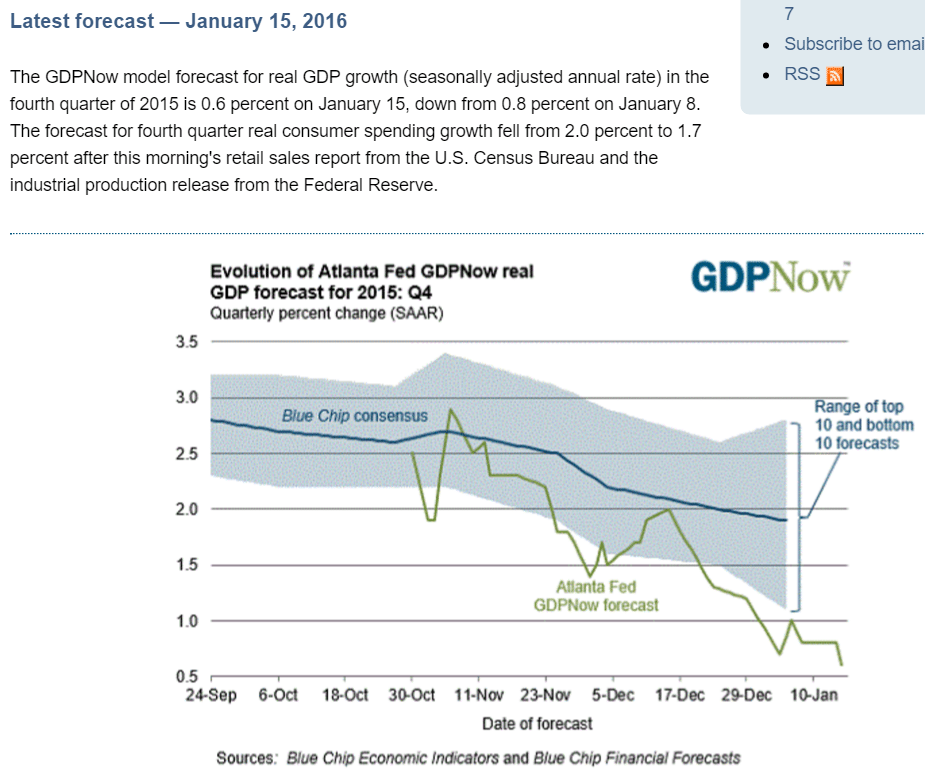
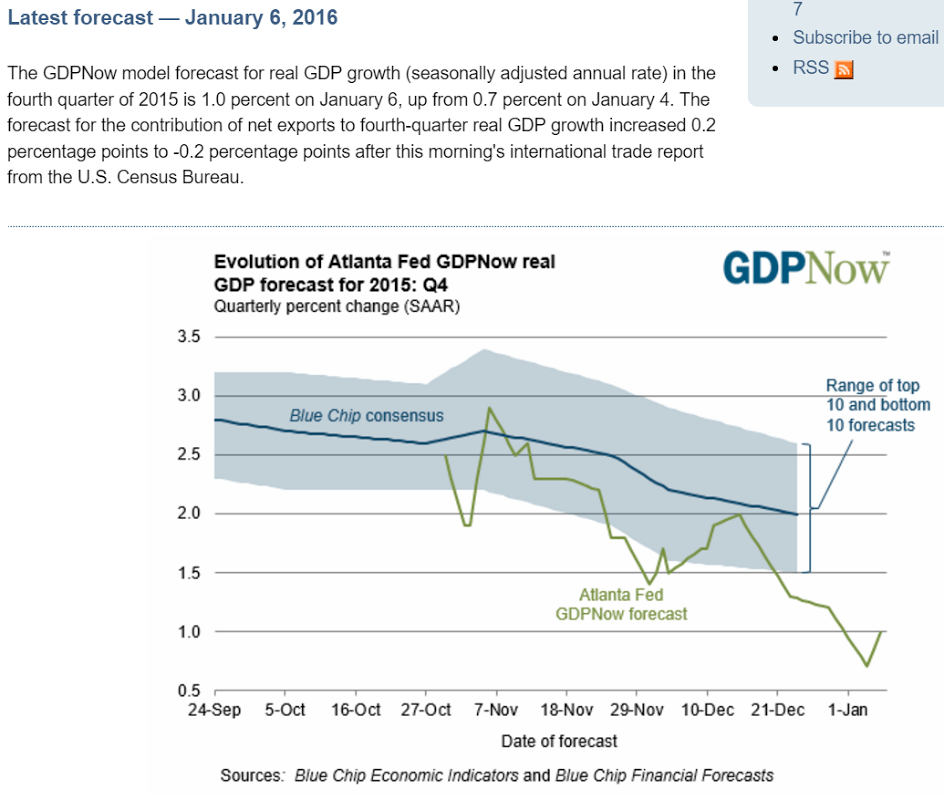
Down again, now forecasting only .6% GDP growth for Q4:
er-1-19-1

er-1-19-2

Fed comment, Retail sales, Empire State Manufacturing, Industrial production, Business inventories, Consumer sentiment

Looks like the Fed hiked during a recession.

Should make for interesting Congressional testimony…

Maybe the hundreds of $ millions they spend on economic research isn’t enough???
;)

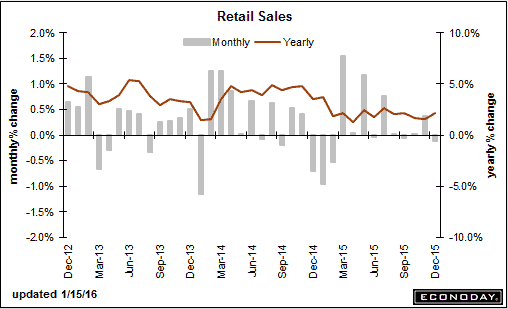
Sales remain at recession levels:

Retail Sales

er-1-15-2-1
Highlights
Retail sales proved disappointing in December, down 0.1 percent in a headline that is not skewed by vehicles or even that much by gasoline. Ex-auto sales also fell 0.1 percent while the core ex-auto ex-gas reading came in unchanged which is well below both expectations as well as low-end expectations. The Beige Book yesterday warned us about weak apparel sales which in this report fell a very steep 0.9 percent, in a decline that likely reflects more than just import-price contraction. The general merchandise category, which is very large, fell 1.0 percent in the month. Electronics & appliances also show contraction.

December winds up what was a not-so-great year for the nation’s retailers. Total sales rose only 2.1 percent in the year, the smallest gain since 2009 and well down from 3.9 percent in 2014. Excluding motor vehicles, sales rose 0.9 percent, far lower than 2014’s 3.1 percent.

There are, however, some positives in the report including another strong gain for restaurants, up 0.8 percent, and also another gain for furniture & home furnishings, up 0.9 percent in strength that confirms ongoing improvement in the housing sector. But sales at non-store retailers rose only 0.3 percent for a second straight month which are moderate gains that do not confirm anecdotal reports of unusual holiday strength for online shopping.

Upward revisions do take some of the sting out of the December report but not much. November total sales are revised 2 tenths higher to plus 0.4 percent and reflects a sharp upward revision to vehicle sales to plus 0.5 percent. But vehicle sales couldn’t muster any strength in December, coming in unchanged. And sales at gasoline stations extended their long run of contraction that reflects falling oil prices, down 1.1 percent in December.

There’s plenty of jobs for consumers and gas prices are low — but so are wages. The consumer started to slow down at year end and that was before the new trouble in China. Today’s data will pull down expectations for fourth-quarter growth.
er-1-15-2-2

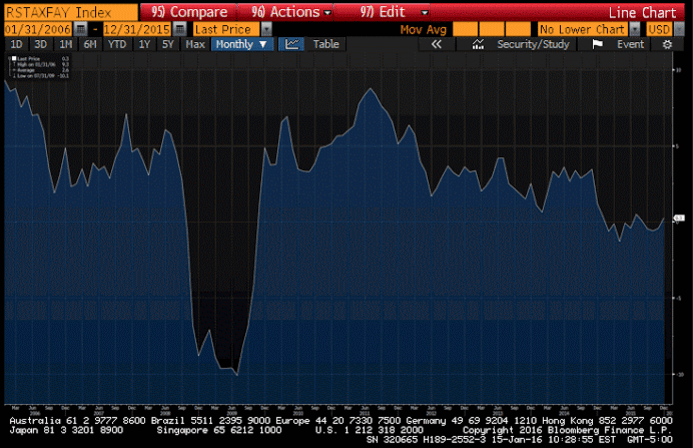
Retail Sales ‘control group’ (retail sales excluding food, auto dealers, building materials, and gas stations)
er-1-15-2-3
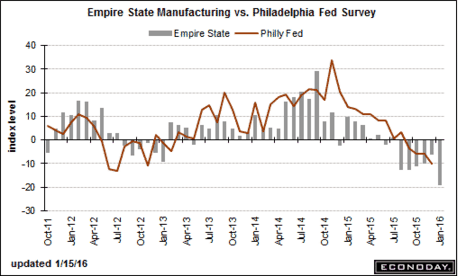
More recession evidence, and maybe worse…

Empire State Mfg Survey

er-1-15-2-4
Highlights
The contraction in factory activity in the New York manufacturing region, which began way back in August, unfortunately is picking up a lot of steam this month, at minus 19.37 for the January headline which is the lowest reading since April 2009. New orders, at minus 23.54, are contracting for an eighth straight month and at the sharpest pace since March 2009. Unfilled orders, at minus 11.00, are in an even deeper string of contraction. Employment, at minus 13.00, is down for a sixth straight month as is the workweek, at minus 6.00. And there’s a crumbling going on in the 6-month outlook which, at 9.51 is still in the positive column but shows the least optimism since way back in March 2009. This report is grim and offers an initial look at January’s factory activity which, based on these results, appears to be getting hit by global concerns.
er-1-15-2-5

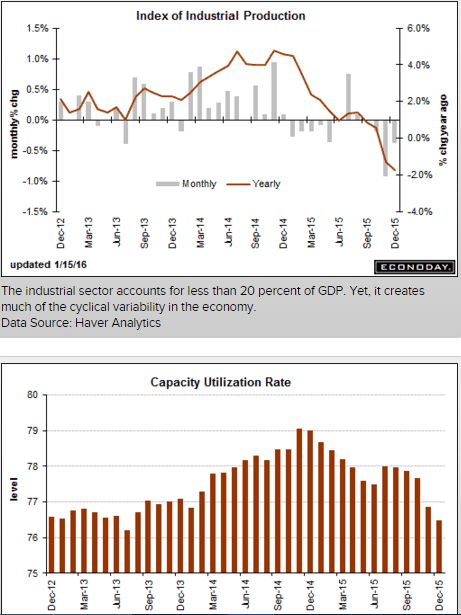
More recession evidence, or worse…

Industrial Production

er-1-15-2-6
Highlights
December was not a good month for the industrial economy as industrial production fell a sharper-than-expected 0.4 percent. Utility output, down 2.0 percent, declined for a third straight month reflecting unseasonably warm temperatures. Mining, reflecting low commodity prices and contraction in energy extraction, has also been week, down 0.8 percent for a fourth straight decline. Turning to manufacturing, which is the most important component in this report, production fell 0.1 percent for a second straight month (November revised downward from an initial no-change reading).

Details on manufacturing include a second straight contraction for vehicles, down 1.7 percent following November’s 1.5 percent decline. Weakness here, along with weakness in the motor vehicle component of this morning’s retail sales report, will raise talk that the auto sector, which had been one of the highlights of the 2015 economy, may slow down in 2016, at least the early part of the year. Construction supplies are a positive, up 0.6 percent for the second strong showing in three months and confirming strength underway in data for construction spending.

Capacity utilization fell 4 tenths from a downwardly revised November to 76.5 percent. A low utilization rate, which is running roughly 4 percentage points below its long-term average, holds down the cost of goods.

Year-on-year rates confirm weakness, down 1.8 percent overall with utilities down 6.9 percent and mining down 11.2 percent. Manufacturing is in the plus column but it’s nothing spectacular, at plus 0.8 percent.

Making matters worse is a downward revision to November, now at minus 0.9 percent vs an initial decline of 0.6 percent. Looking at the annualized rate for the fourth quarter, industrial production fell 3.4 percent though manufacturing did increase but not much, up 0.5 percent. Weather factors are skewing utility output but otherwise, readings are fundamentally soft and reflect the downturn in global demand made more severe for U.S. producers by strength in the dollar.
er-1-15-2-7

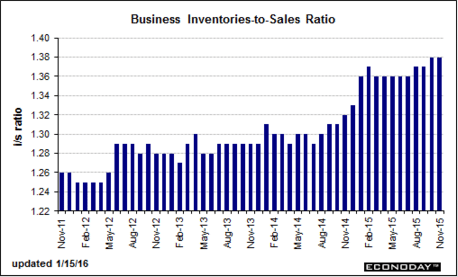
Inventories down some but sales down same so relative to sales inventories remain way high, another recession indication:

Business Inventories

er-1-15-2-8
Highlights
Inventories are contracting, the result of defensive draws in the wholesale and manufacturing sectors. Business inventories fell 0.2 percent in November following a decline in October of 0.1 percent. Wholesale inventories fell 0.3 percent for a second straight month with manufacturing down 0.3 percent following October’s 0.2 percent draw. Retail, up 0.2 and 0.1 percent in November and October, was the only sector adding inventories and today’s weak results for December retail sales may point to an unwanted build for December.

Relative to sales, which also fell 0.2 percent and were down 0.3 percent in October, total inventories are stable, at a ratio of 1.38. This report is indicative of economic weakness and will not be building expectations for fourth-quarter growth let alone the outlook for first-quarter growth.
er-1-15-2-9

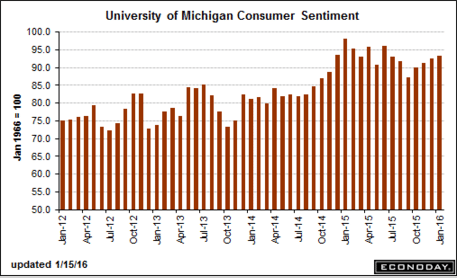
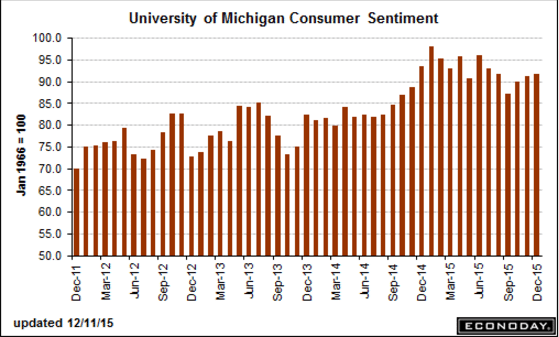
This was up a tad so they have something to report on the news. But even here the current conditions took a dive. And, as previously discussed, this is one man one vote, not one dollar one vote, and total spending has been decelerating:

Consumer Sentiment

er-1-15-2-10
Highlights
The first indication of the China effect on U.S. consumers looks positive but ultimately is mixed. January’s flash consumer sentiment index did rise 7 tenths from final December to 93.3 but current conditions, the component that picks up the immediate impact of special factors, fell 3.0 points to 105.1. Should volatility in markets begin to ease and confidence in China improve, this reading could pop back as quickly as month end.

Lifting the mid-month index is a rise in the expectations component, up 3.0 points 85.7. Behind this gain is strength in the jobs market and perhaps even falling oil prices as 1-year inflation expectations are down a sizable 2 tenths to 2.4 percent. This is offset in part by a 1 tenth rise in 5-year expectations to 2.7 percent.

The resilience in long-term optimism is a plus for the U.S. economy though the eroding in short-term inflation expectations will not be encouraging to Federal Reserve policy makers who have launched a rate-hike sequence for an economy still struggling against deflation. The Dow is moving off opening lows in early reaction to this report.
er-1-15-2-11

Jobs, Wholesale trade, China, Rail traffic

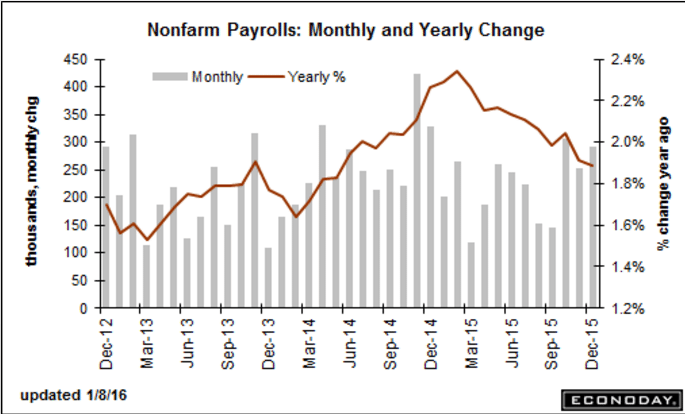
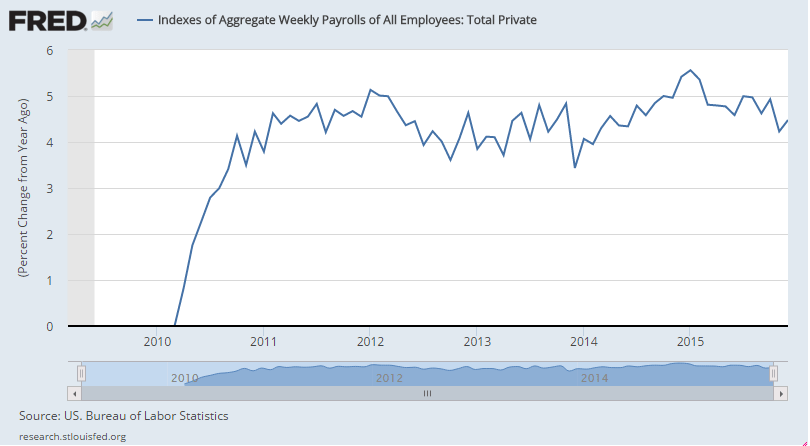
Anyone notice that the annual growth rate of employment continues the deterioration that began with the collapse in oil capex?
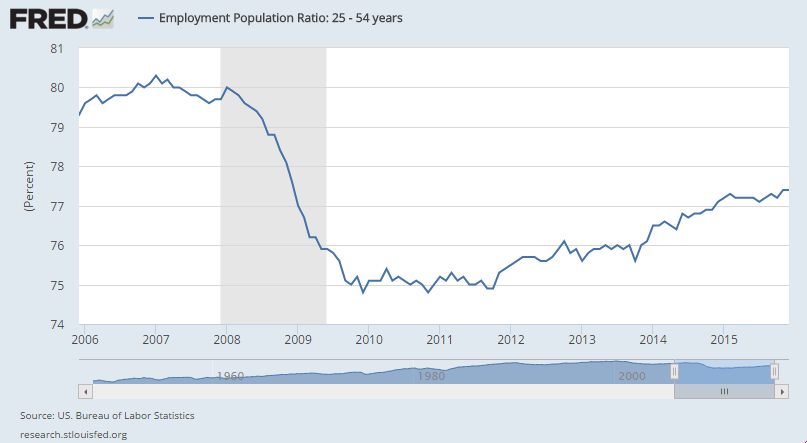
Or that, once again, it looks like most all the new jobs were taken by people previously considered out of the labor force?
And the anemic wage growth also contributes to the narrative of a continuously deteriorating plight for people trying to work for a living:

Employment Situation
er-1-8-1
Highlights
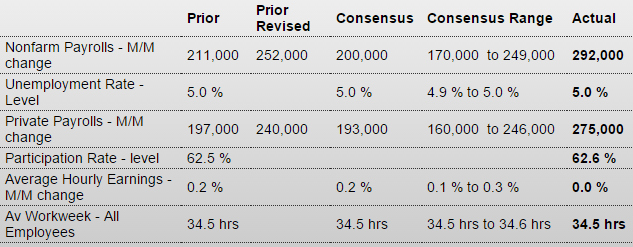
The labor market is stronger than most assessments with December results well outside top-end estimates and big upward revisions underscoring the strength of prior months. Nonfarm payrolls jumped 292,000 in December which is 92,000 above the consensus and 43,000 above Econoday’s high forecast. The gain importantly is led by professional & business services which is considered a leading component for future hiring and which rose 73,000 for the second outsized gain of the last three months. Construction, boosted by the nation’s unseasonable weather, has also been adding workers, up 45,000 in December. Upward revisions to the two prior months total 50,000 with November now at 252,000 and October over 300,000 at 307,000.

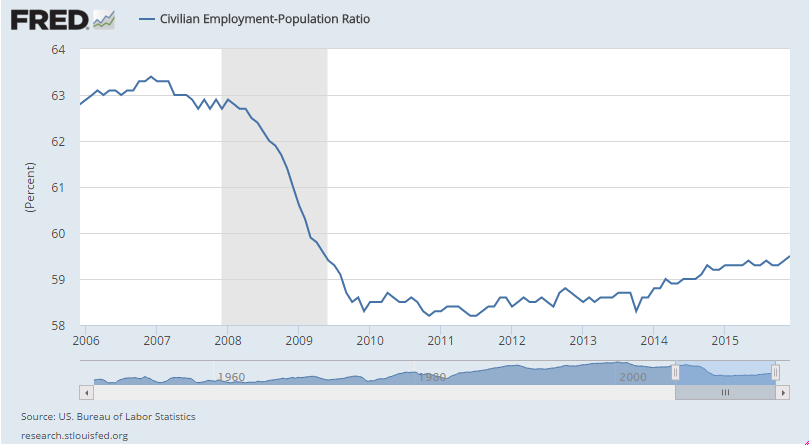
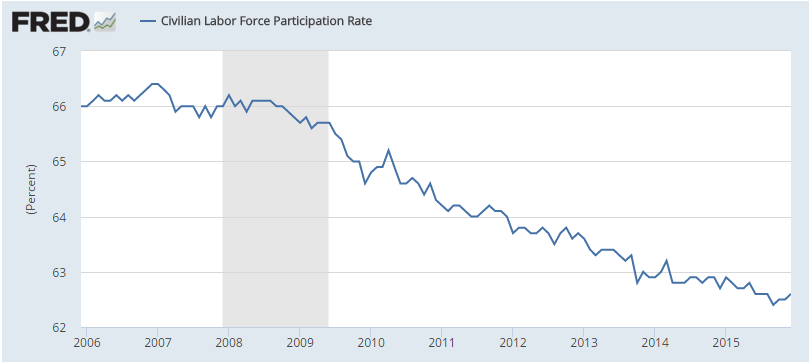
Despite payroll strength, the unemployment rate held steady at 5.0 percent as more people looked for work in the month. The labor force participation rate improved 1 tenth to 62.6 percent as did the employment-to-population ratio, to 59.5 percent. Wages, also despite the payroll strength, came in unchanged though the year-on-year rate, boosted by an easy year-ago comparison, rose 2 tenths to 2.5 percent which, however, is lower than many expected. The average workweek held unchanged at 34.5 hours while manufacturing hours slipped 0.1 percent which will pull down estimates for next week’s industrial production report.

Turning back to industry payrolls, the bureau of labor statistics is highlighting a 34,000 rise in temporary help services. This is a subcomponent of professional & business services and is considered an especially sensitive barometer for future hiring. Other industries posting gains include trade & transportation at 31,000, government at 17,000, and manufacturing at a modest 8,000. Mining payrolls, hurt by low commodity prices, continue to contract, down 8,000 and are one of the few industries in the minus column.

This report is strong and should confirm confidence that the U.S. economy is, or at least was in December, largely insulated against global weakness. The strength of this report is certain to grab global attention though the lack of wage punch underscores the two-track economy and the Fed’s dilemma — strong job growth but weak inflation.

er-1-8-2
Also decelerating since the oil capex collapse:
er-1-8-3
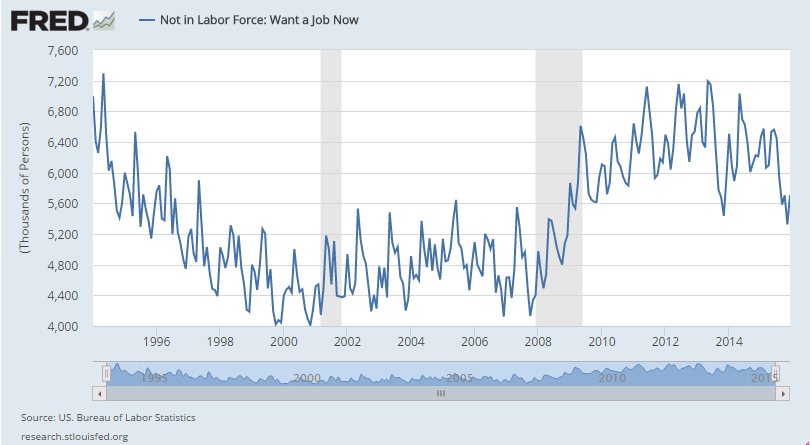
So 10 million + people decided all at once they didn’t ever want to work anymore in 2008? That is, we still have massive ‘slack’ in the ‘labor market’ best I can tell:
er-1-8-4
er-1-8-5
er-1-8-6
And this is still higher than it was in the prior recession:
er-1-8-7
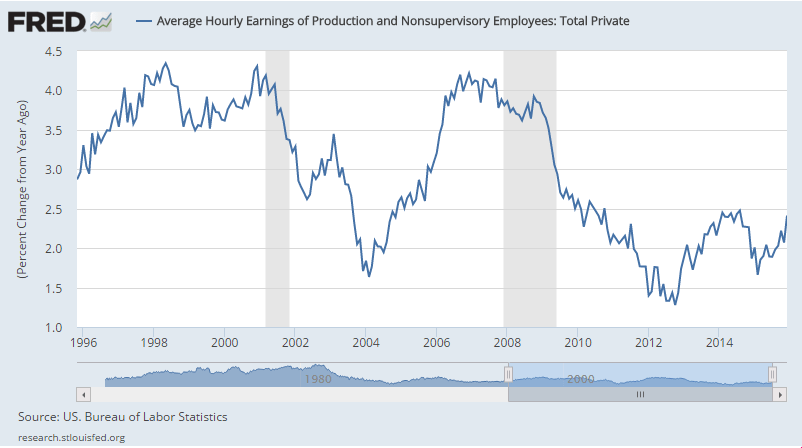
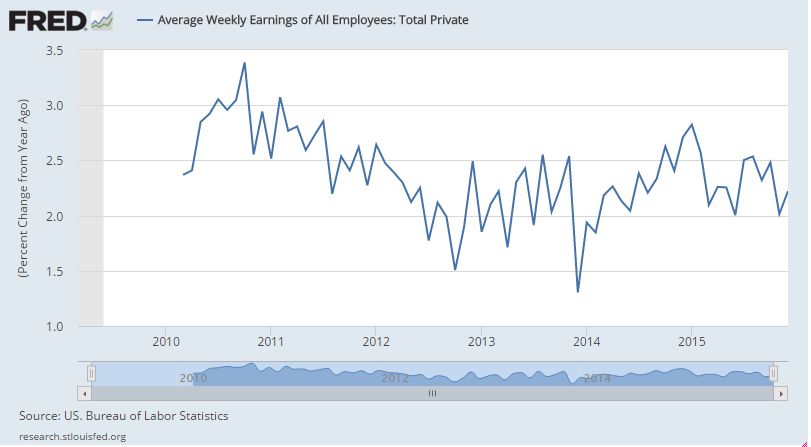
Earnings continue to grow only at depressed rates, maybe because of all the ‘slack’ in the ‘labor market?’
er-1-8-8
er-1-8-9
Inventories fell, but sales fell even more, so the inventory to sales ratio went up.
Not good!!!

Wholesale Trade
er-1-8-10
Highlights
Wholesale inventories fell a sizable 0.3 percent for a second straight month in November. Sales at the wholesale level fell an even sharper 1.0 percent in the month and, despite the decline in inventories, drove the stock-to-sales ratio up to 1.32 vs 1.31 in the two prior months. A year-ago, the ratio was at 1.23 in what is confirmation that inventories in the sector remain heavy. Inventories of farm products and petroleum rose due to weak sales while inventories of furniture and metals fell on strong sales. Previously released data on the factory sector show a 0.3 percent inventory contraction in November. The missing piece, retail inventories, will be posted following next week’s retail sales report.

er-1-8-11
‘Monetary Policy’ in this case means currency management. So we called China a currency manipulator and predator when they bought fx reserves to keep their currency from getting too strong too fast from FDI flows, etc., and then when they let their currency float as FDI flows reversed we criticized them.

And we had a ‘strong dollar policy’ while at the same time telling China their currency needed to appreciate when they were buying fx to moderate the appreciation. It’s all be continuous ‘talking out of both sides of the mouth’

And with a large trade and current account surplus it’s only a matter of time until China is again accumulating fx reserves to keep their currency from appreciating. But in light of the current criticism of their weakening currency, maintaining ‘stability’ when it’s back in appreciation mode may be applauded.

China central bank to maintain prudent monetary policy, keep yuan stable

ECB comment, Retail Sales, Fed Atlanta, Oil comment

Seems there’s no wisdom on the topic of ‘money’ anywhere of consequence:

No ‘plan B’ for ECB despite still low inflation: Praet

Jan 6 (Reuters) — Executive Board member Peter Praet said various factors, notably low oil prices and less buoyant emerging economies, meant it was taking longer to reach the goal of inflation of close to but below 2 percent. “We need to be attentive that this shifting horizon does not damage the credibility of the ECB,” he added. “There is no plan B, there is just one plan. The ECB is ready to take all measures necessary to bring inflation up to 2 percent. If you print enough money, you get inflation. Always. If, as is happening now, the prices of oil and commodities are tumbling, then it’s more difficult to drive up inflation,” he said.

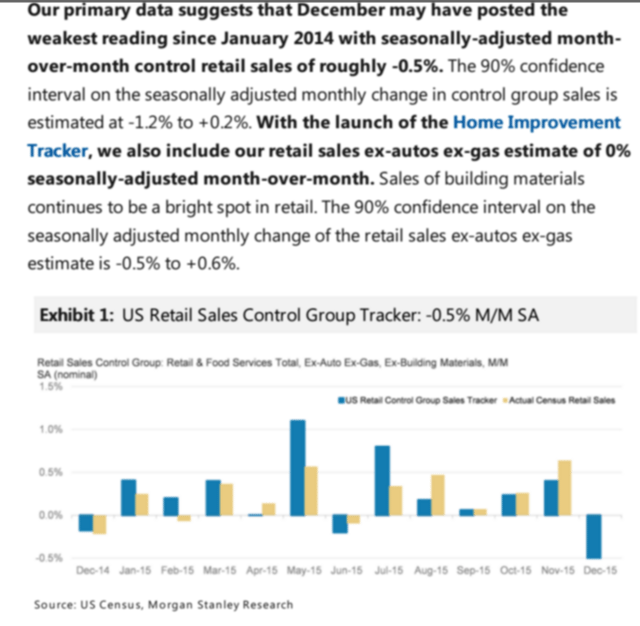
From Morgan Stanley:

er-1-7-1

Up to 1% for Q4 on the trade number, which is subject to revision.

And DB is forecasting +.5%.
er-1-7-2
The still don’t seem to understand it’s only about pricing, not quantity:

Brent Crude Oil Drops Below $35

World’s benchmark oil fell by more than 4.8% to below $35 a barrel around 9:30 AM NY time, extending a third consecutive day of losses. It is the lowest price since 2004 as oversupply worries increased as tensions between Saudi Arabia and Iran diminish chances of major producers cooperating to cut production.

Not to forget their models use the oil futures prices, which express storage charges, as indications of future spot prices, and that this ‘rookie error’ tends to inflate their inflation forecasts:

A number of members commented that it was appropriate to begin policy normalization in response to the substantial progress in the labor market toward achieving the Committee’s objective of maximum employment and their reasonable confidence that inflation would move to 2 percent over the medium term.

However, some members said that their decision to raise the target range was a close call, particularly given the uncertainty about inflation dynamics, and emphasized the need to monitor the progress of inflation closely.

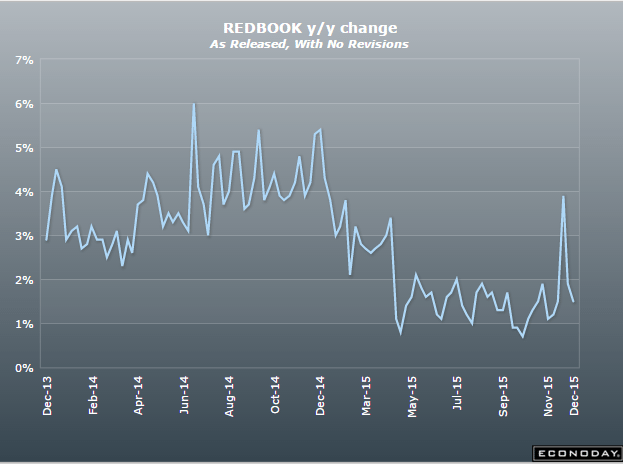
Bank of China, Port traffic, Redbook retail sales, Car sales early indication

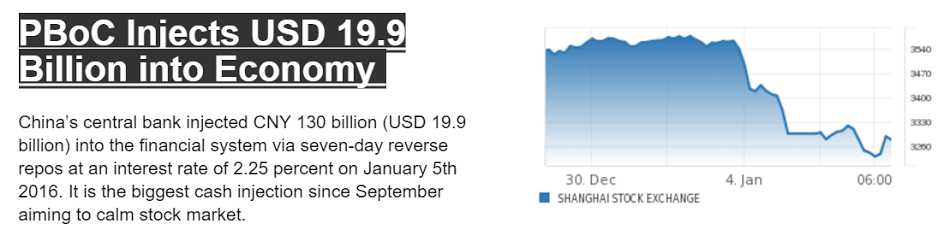
This does nothing apart from supporting their policy rate:
er-1-5-1

Port Traffic Grew at Slowest Rate Since Recession in 2015

Container traffic rose only 0.8% last year at the 30 busiest ports worldwide, the smallest increase since 2009, according to an estimate by Alphaliner

By Robbie Whelan

Jan 4 (WSJ) — Container traffic at the world’s busiest ports grew last year at its slowest rate since the recession, according to an estimate by Alphaliner, a shipping industry data provider.

Demand was held back by a lack of “peak season,” the months heading into the holidays when manufacturers normally ship large quantities of goods to retailers globally. This year, traffic in the top 30 ports sank 0.9% in the third quarter, the first decline over those months since 2009, Alphaliner said.

For the full year, Alphaliner projects container traffic rose 0.8%, the smallest increase since 2009. Weak demand has left carriers struggling to find customers to fill their ships, even as new vessels hit the seas at a record pace. Last year, ships with a combined capacity of 1.7 million twenty-foot containers entered the global fleet. To combat the lower ocean freight rates resulting from excess capacity, ship owners and operators have idled more than 1.3 million TEUs of capacity.

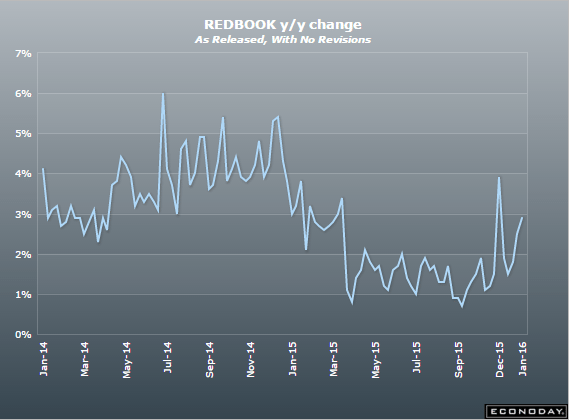
Doing better as year over year comps get easier:
er-1-5-2

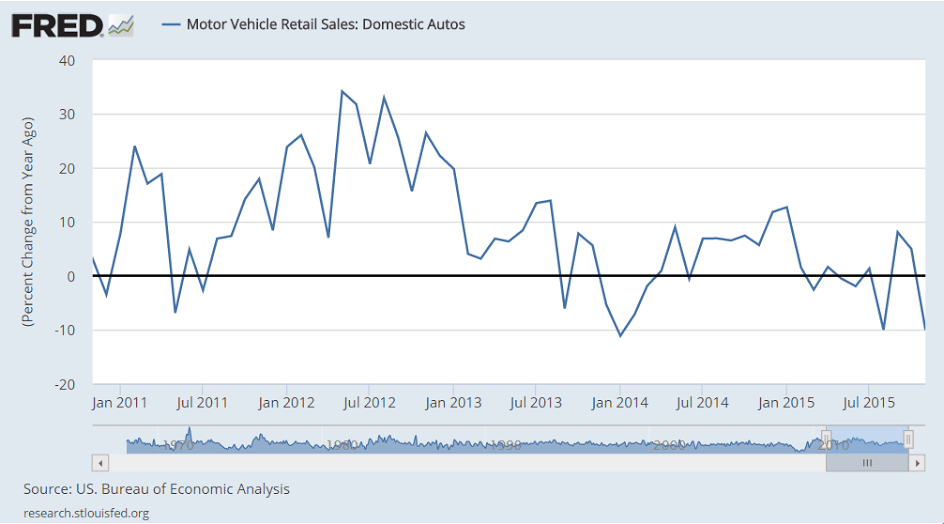
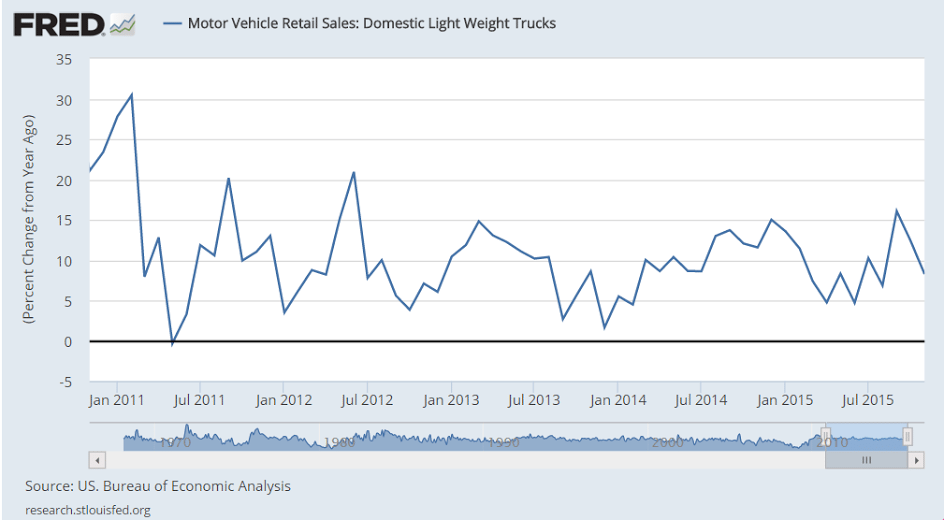
The Big Three are in and December sales are running below expectations down about 5 percent from November vs expectations for a 1 to 2 percent decline. Car sales are especially weak with sales of light trucks down only slightly. The Big Three account for roughly half of all sales. Foreign brands will be posting their results through the session.

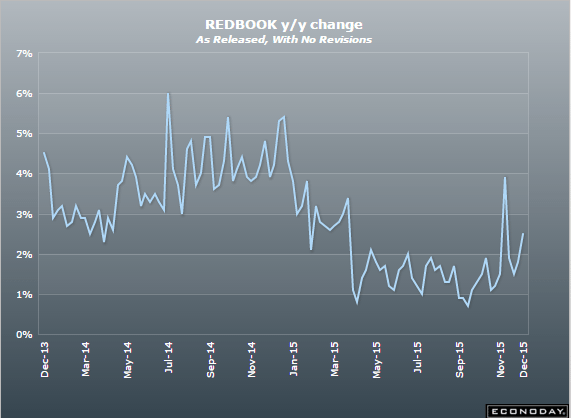
Trade, Capex, Japan tax hike, Redbook retail sales, Saudi spending cuts

Not good for Q4 GDP. Remember, lower oil prices were supposed to reduce our trade deficit…
;)

International Trade in Goods
er-12-29-1
Highlights
November’s international trade goods deficit narrowed to $60.5 billion from the revised $63.0 billion in October. October’s estimate previously was minus $58.4 billion. Expectations were for a deficit of $60.9 billion. Both exports and imports continued to decline on the month. Goods exports were down 2.0 percent while imports were 1.8 percent lower. Weak categories for imports were industrial supplies & materials and capital goods excluding auto. Export categories showing weakness include foods/feeds/beverages, industrial supplies and consumer goods excluding autos.

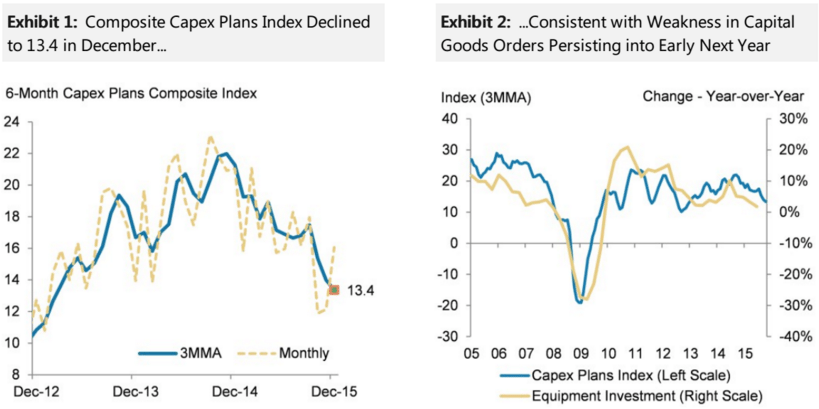
This is from Morgan Stanley. Capital expenditures are generally a large source of agents spending more than their incomes, offsetting those spending less than their incomes. This is not good- orders back to 2008 types of levels:
er-12-29-2
As before ‘the beating will continue until morale improves’:

Opposition to Japan’s sales tax hike falls below 50%

Dec 28 (Nikkei) — Public opposition to an April 2017 consumption tax increase has declined after the ruling coalition agreed on a food exemption backed by a majority of eligible voters, the latest Nikkei Inc./TV Tokyo poll shows. At 47%, fewer than half of respondents to the weekend poll opposed the tax increase, down 9 percentage points from October. Support for raising the tax gained 6 points to 42%. The tax hike will take the rate to 10%. Prime Minister Shinzo Abe’s Liberal Democratic Party and coalition partner Komeito seek to keep the tax on food, excluding alcohol and restaurant meals, at the current 8%.

Sales growth improving some from depressed levels:
er-12-29-3
Lots of similar cuts for next year, as oil related spending reductions continue:

Saudis Plan Unprecedented Subsidy Cuts to Counter Oil Plunge

Dec 28 (Bloomberg) — Saudi Arabia reduced energy subsidies and allocated the biggest part of government spending in next year’s budget to defense and security. Authorities announced increases to the prices of fuel, electricity and water as part of a plan to restructure subsidies within five years. The government intends to cut spending next year and gradually privatize some state-owned entities and introduce value-added taxation as well as a levy on tobacco. The government recorded a budget deficit of 367 billion riyals ($98 billion) in 2015. That’s about 16 percent of gross domestic product.

CPI, Empire survey, Redbook retail sales, Housing index

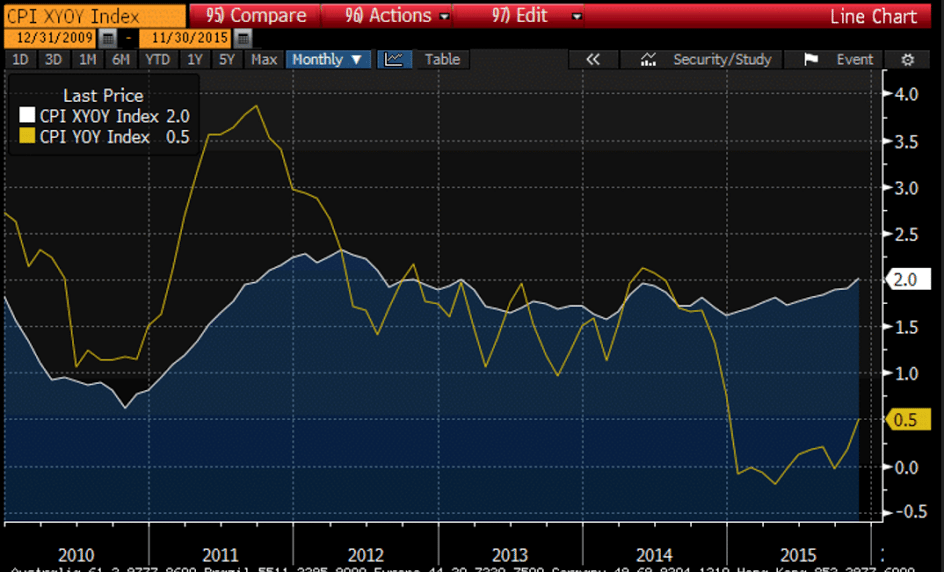
One of the Fed’s mandates. The ‘headline’ number is below target due to the energy impulse, but the ‘core’ rate, led by services, is on target. The question is whether energy prices, if they remain at current levels, will ‘pull down’ other prices. And the comparisons with last year are now vs the lower numbers that were released after the oil price collapse.

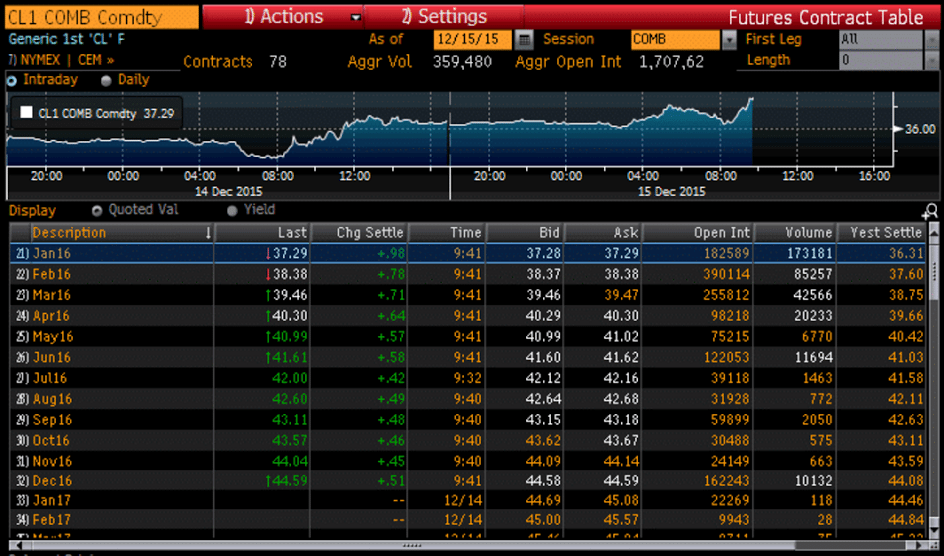
And not to forget that the Fed uses futures prices as indications of future spot prices, even for non perishables, which technically only represent ‘storage prices’.

So with oil futures prices substantially higher than spot (due to elevated storage costs which have been supported by Iran storing oil in anticipation of being able to sell it next year) the Fed’s forecasts will use those elevated prices to forecast that much more inflation.

United States : Consumer Price Index
er-12-15-1
Highlights
Consumer price inflation is very low though the deflationary thrust may be clearing. The CPI came in as expected with no change in November with the core rate, which excludes food and energy, also coming in at expectations with a moderate 0.2 percent gain.

Many components show declines in the month including transportation, apparel (where low import prices are still at play), and recreation. Food prices also fell in the month, which is the first drop since March, while energy prices really fell, down 1.3 percent in November reflecting a 2.4 percent decline for gasoline in a dip that continues to extend through December as well. But there are areas showing pressure including medical care for a second month in a row. Housing is also up but only at a moderate 0.2 percent with owner’s equivalent rent also up 0.2 percent.

Year-on-year prices are showing lift but reflect easy comparisons with price weakness this time last year. The overall rate is up 0.5 percent, 3 tenths higher in the month, with the core rate up 1 tenth to 2.0 percent which hits the Fed’s target.

This report is in line with the Fed’s outlook, showing an easing, at least to a degree, in deflationary pressures. But still falling fuel prices are definitely a live risk to the Fed’s inflation hopes.

Core vs. headline CPI:
er-12-15-2
The Fed uses the prices in green when forecasting inflation:
er-12-15-3
More bad stuff here. Employment is the Fed’s other mandate:

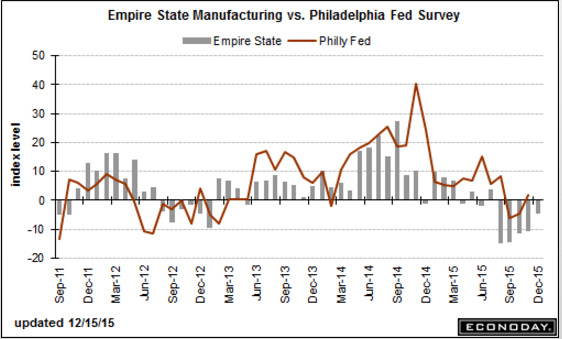
Empire State Mfg Survey
er-12-15-4
Highlights
Factory activity continues to contract in the New York manufacturing region and especially, unfortunately, employment and the workweek. The Empire State index posted its fifth negative reading in a row, minus 4.59 for December which however is the least weak reading of the run. New orders, at minus 5.07, are down for a seventh month in a row but here to the degree of contraction is easing. Not easing, however, is employment which is deeply negative at minus 16.16 for the fourth contraction in a row and the deepest since July 2009. The workweek is another disappointment, at minus 27.27 for the worst reading since even further back, to April 2009.

But there are pluses in this report led by a big gain for the six-month outlook, to 38.51 from 20.33. The gain reflects greater optimism for new orders and shipments but no greater optimism for employment where hiring is expected to be no more than moderate.

Turning back to negatives, prices received are down for a fourth month in a row, at minus 4.04. Contraction in prices for finished goods points to price concessions and lack of demand.

The recovery worst readings for employment and the workweek are definitely worrisome signs. Yes, this report has been running lower than other regional manufacturing reports but today’s results do not point to any year-end lift for the factory sector which is being hit by low exports and low prices.

er-12-15-5
Down again, not good:
er-12-15-6
And housing indicators continue to slow, contrary to all forecasts:

Housing Market Index
er-12-15-7

Retail sales, Business inventories, Consumer Sentiment

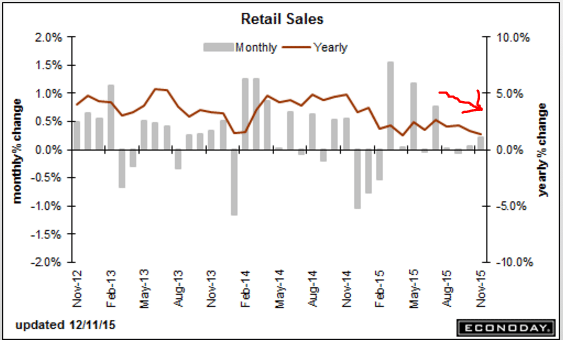
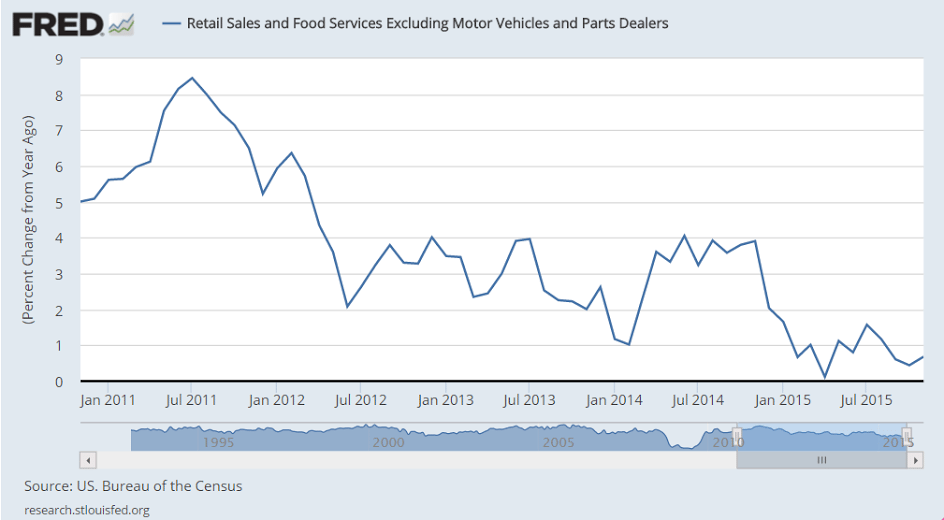
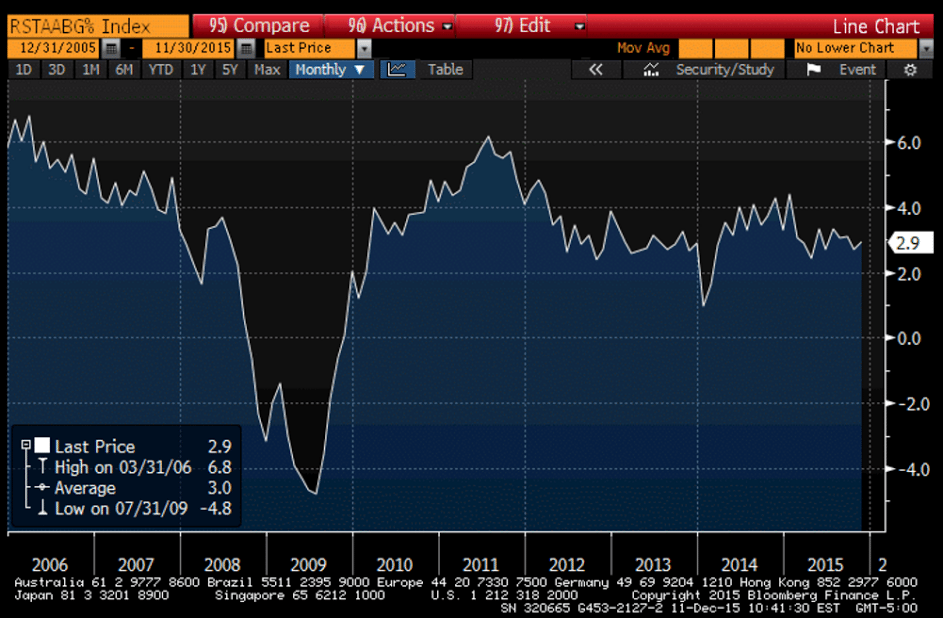
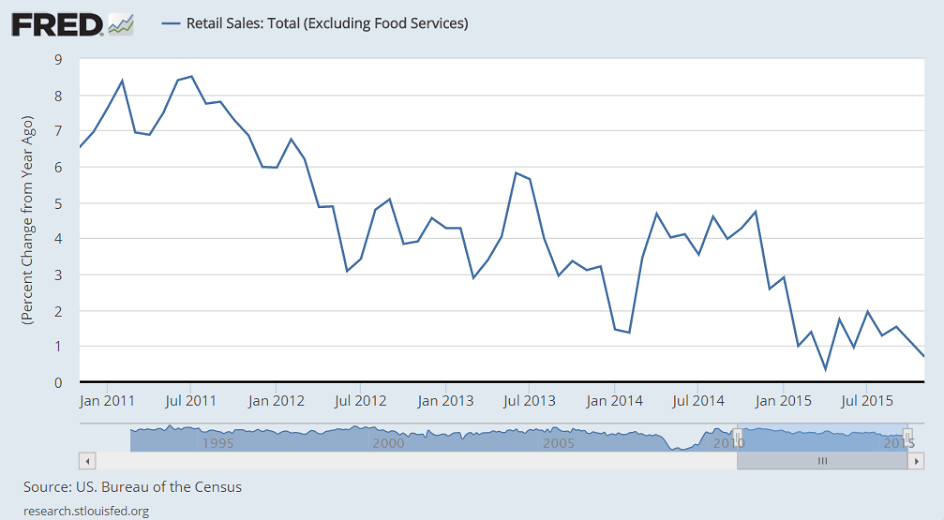
Retail sales = retail (gross) income and growth is still way down year over year, as per the charts.

Also declining vehicle sales are highly problematic, as they were what was keeping a bad story from being that much worse. And not to forget when looking at year over year change oil and gas prices were already down quite a bit by this time last year:

Retail Sales
er-12-11-1
Highlights
Once again the headline for the retail sales report understates underlying strength. Total retail sales rose only 0.2 percent in November which is just under the Econoday consensus. But weakness here came from vehicles of all places which otherwise have been one of this year’s standout component for this report. Excluding vehicles, sales rose 0.4 percent which is 1 tenth above expectations. Excluding both vehicles and gasoline, core sales rose a very solid 0.5 percent which is 2 tenths above expectations. A key discretionary category, restaurants, shows yet another very strong gain, this at 0.7 percent in the month. Also showing sizable gains are electronics & appliances, clothing & accessories, non-store retailers (once again), and the general merchandise category where, despite a deflationary pull from falling import prices, sales jumped 0.7 percent in the month.
Vehicle sales fell 0.4 percent in the month on top of October’s 0.3 percent decline. These declines are a bit of a surprise given steady readings in unit sales of vehicles which have been holding firmly at 12-year highs. Whether there’s a rebound ahead for vehicle sales, which had been so strong through the year, will be key to consumer spending going into the new year. Sales at gasoline stations continue to contract, at minus 0.8 percent in the month. Furniture sales, which have been strong, fell back as did sales of building materials & garden supplies, which have been soft.

Year-on-year rates show nonstore retailers out in front, at plus 7.3 percent to confirm acceleration for online sales. Restaurants are right behind at plus 6.5 percent year-on-year followed by furniture and by sporting goods, both at plus 5.4 percent. All together, core retail sales are up a moderate 3.6 percent year-on-year held down by contraction in electronics & appliances and soft readings for grocery stores and general merchandise. Outside the core, motor vehicles are still in the thick of things, at plus 4.0 percent year-on-year, with gasoline stations down 19.9 percent. Total retail sales are up only 1.4 percent but the gain goes up to 3.6 percent (the same as the core) when excluding just gas.

Taken together, rates of growth are no more than moderate but certain areas are posting eye-catching results, results that point to what must have been a successful Black Friday sales push. The consumer, boosted by a solid labor market and having more money to spend because of low gas prices, is definitely alive and spending going into the final weeks of the holiday season. In a methodology note, the November data reflect a new sample and prior levels have been revised (mostly lower).

er-12-11-2
er-12-11-3
er-12-11-4
This one’s call the ‘control group’ (excludes auto dealers, gas stations, food services, building materials) and sure doesn’t look to me like it’s part of a rate hike story:
er-12-11-5
These came out Dec 3:
er-12-11-6
Trucks doing better:
er-12-11-7
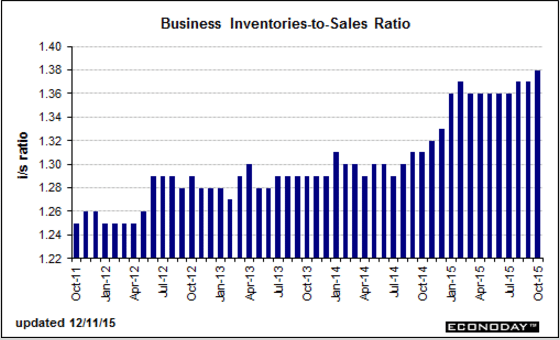
Inventory building stops but slow sales hike the inventory/sales ratio:

Business Inventories
er-12-11-8
Highlights
Businesses appear to be putting the brakes on inventories which however are still rising a bit relative to sales. Business inventories were unchanged in October with September revised down 2 tenths to plus 0.3 percent in readings that will pull down the GDP outlook slightly. Sales came in unchanged which is just enough to drive up the stock-to-sales ratio to 1.38 from 1.37. This time last year, this reading was at 1.31.

All three components show only the most minimal change in inventories, up 0.1 percent for retailers and down 0.1 percent for both manufacturers and for wholesalers. And sales tell the story, unchanged in October for both retailers and wholesalers and down 5 tenths for manufacturers.

The lack of punch in the economy, the result of weak foreign demand, continues to put upward pressure on inventories. But businesses are successfully keeping their stocks as low as possible, thereby limiting future corrections in production and employment.
er-12-11-9
er-12-11-10

Factory orders, ISM non mfg, ECB news

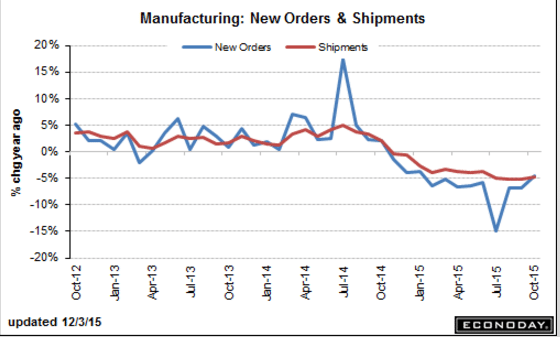
Yes, they were up, but there is a ‘seasonal’ aspect to it, including an air show, so the year over year chart is a bit more indicative of what’s going on and it’s still in negative territory. Also, vehicle orders declined, and inventories remained at levels that beg continuing production cuts.

Factory Orders
er-12-3-1
Highlights
Factory orders bounced sharply higher in October and, together with the bounce higher for manufacturing in the industrial production report, confirm what was a very solid month for the sector. Factory orders rose 1.5 percent in the month led by a 2.9 percent surge in durable goods orders (revised 1 tenth lower from last week’s advance release). This gain offsets a no change result for non-durable goods orders.

Excluding transportation, and orders tied to the biennial Dubai airshow, new orders rose a less exciting 0.2 percent. But indications from core capital goods are very strong with new orders surging 1.3 percent on top of a 0.5 percent orders gain in September. Turning to capital goods industries, new orders for machinery jumped 1.2 percent with computer orders up 5.9 percent.

A negative in the report is a surprising 2.0 percent decline for vehicle orders, a disappointment that may very well be reversed in coming months based on the sustained and unusual strength of vehicle sales.

Looking at other readings, total shipments fell 0.5 percent in October which is not a good start to the fourth quarter with core capital goods shipments also down 0.5 percent. But future shipments are certain to benefit from October’s orders gain. Inventories, which are widely seen as too high, did dip 0.1 percent but relative to shipments could do no more than hold steady at a ratio of 1.35. Unfilled orders are positive, ending two months of decline with a 0.3 percent gain.

Given that the factory sector has been in decline all year, the order data in this report are encouraging and should help offset concern from this week’s sub-50 reading in the ISM manufacturing report.
er-12-3-2

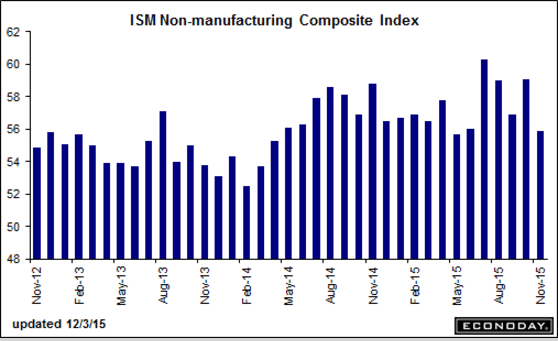
After a ‘normal’ lag non manufacturing is now clearly softening form the decline in aggregate demand that began with the oil capex collapse about a year ago, with nothing that I can see stepping up to replace it. And note that exports went into contraction as it’s been the non manufacturing exports that have held up as other exports declined:
ISM Non-Mfg Index
er-12-3-3
Highlights
Strength in ISM’s non-manufacturing sample is cooling but remains very solid, at 55.9 in November which is, however, the lowest rate of monthly growth since May. Readings across the report have also edged down to growth levels last seen in the second quarter including new orders (57.5), backlog orders (51.5), and employment (55.5). New export orders, at 49.5, show their first contraction since April. The breadth of strength across industries, with 12 showing growth and six in contraction, is positive but, like most of this report, less positive than prior months. Still, this report surged through the third quarter and into October making a step down to a lower rate no major surprise.
er-12-3-4

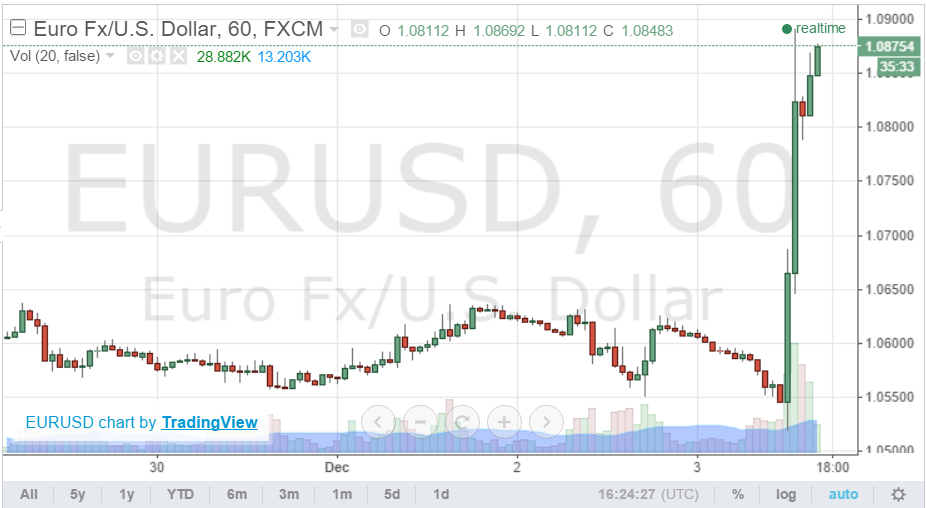
So Draghi increased the tax on deposits, and this time the euro went up. Maybe portfolios don’t have any more left to sell as the high and growing trade surplus drains them from global markets?

Euro Rises After ECB

The Euro gained around 0.58% to 1.0667 USD right after the ECB cut deposit facility rate by 10 bps to -0.3% and said further stimulus measures would be announced during the press conference.
er-12-3-5

And taking euro away from depositors hasn’t seem to help consumer spending:

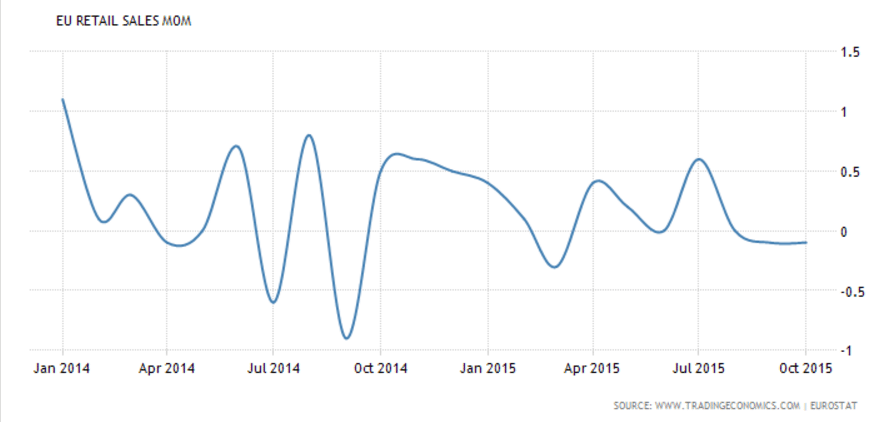
Euro Area Retail Sales Unexpectedly Fall

Retail sales in the Eurozone edged down 0.1 percent in October of 2015, following a 0.1 percent drop in September and no growth in August. Figures came below market expectations of a 0.2 percent gain, marking the longest period of no growth since mid-2013. Sales of food, drinks and tobacco shrank 0.5 percent, those of auto fuel fell 0.4 percent while sales of non-food products edged up 0.1 percent.

er-12-3-6

Recent interview transcript, Car sales, Fed Atlanta GDP forecast

Transcript: Interview with Economist Warren Mosler

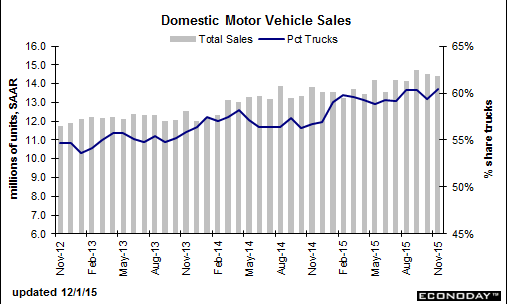
Interesting- total sales rate unchanged, but domestic vehicle sales rate down again.

In other words, not currently growing:

Motor Vehicle Sales
er-12-1-12
Highlights
Consumers have really shown their strength the last three months, buying vehicles at a 12-year high annualized rate of 18.2 million. That’s right, for three months in a row. The results, however, do not point to a monthly gain for the motor vehicle component of the November retail sales report — but they do point to a foundation of strength.

The composition of November’s unit sales shows a shift higher for light truck sales, no doubt the result of low gasoline prices, that offsets a shift lower for cars. Low gas prices are keeping more money in consumer pockets, reflected not only in a rising savings rate but also in exceptionally strong vehicle sales.
er-12-1-13

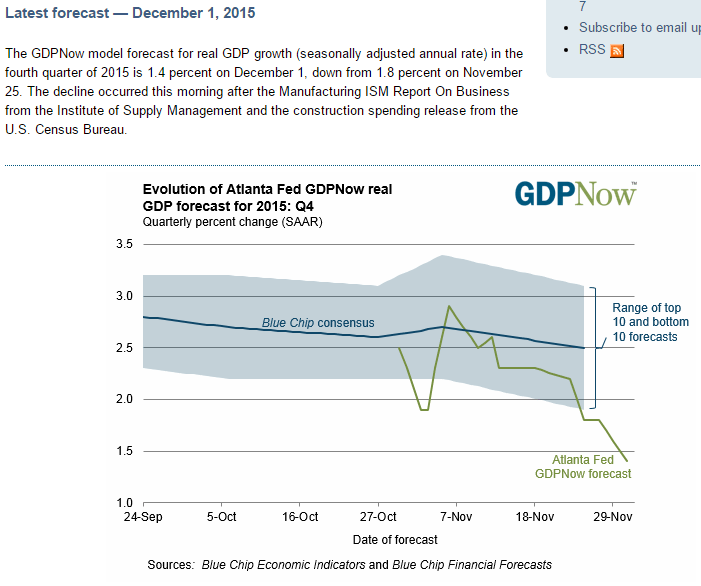
Down again, now forecasting only 1.4% for Q4:
er-12-1-14