Business Wire: JPMorgan Chase and NY Fed

Similar to the beginning of the end of the 1998 crisis when D bank bot Banker’s Trust when BT couldn’t fund itself, and then D bank funded Lehman and other dealers in a similar position to where Bear was yesterday.

Back then it happened after a three 25bp fed rate cuts. This time it happened after a total of 225 in cuts.

Today, JPMorgan Chase & Co. (NYSE: JPM) announced that, in conjunction with the Federal Reserve Bank of New York, it has agreed to provide secured funding to Bear Stearns, as necessary, for an initial period of up to 28 days. Through its Discount Window, the Fed will provide non-recourse, back-to-back financing to JPMorgan Chase. Accordingly, JPMorgan Chase does not believe this transaction exposes its shareholders to any material risk. JPMorgan Chase is working closely with Bear Stearns on securing permanent financing or other alternatives for the company.

JPMorgan Chase and Federal Reserve Bank of New York To Provide Financing To Bear Stearns

Today, JPMorgan Chase & Co. (NYSE: JPM) announced that, in conjunction with the Federal Reserve Bank of New York, it has agreed to provide secured funding to Bear Stearns, as necessary, for an initial period of up to 28 days. Through its Discount Window, the Fed will provide non-recourse, back-to-back financing to JPMorgan Chase. Accordingly, JPMorgan Chase does not believe this transaction exposes its shareholders to any material risk. JPMorgan Chase is working closely with Bear Stearns on securing permanent financing or other alternatives for the company.

Re: fed’s action

>
>     On Wed, Mar 12, 2008 at 8:40 PM, Davidson, Paul wrote
>
>     Warren:
>
>     Don’t you think it was a strange open market operation —
>     where the Fed was moving Treasuries from their balance
>     sheets to private balance sheets (even temporarily) —
>     while accepting as collateral the highest grade mortgage
>     backed securities? Usually open market operations involve
>     Treasuries going one way and bank deposits (not
>     collateral) going the other way.
>
>

Hi Paul,

It was a ‘securities lending operation’ and was probably done that way to be in compliance with existing Fed regulations regarding interaction with the dealer community.

The Fed probably already had authority to lend securities to the primary dealers from their portfolio, and either get cash in return or other securities rated AAA or better (govt, agency, etc). So they offered to loan their tsy secs and accepted the dealer’s securities as collateral for the transaction.

Note that the dealers remain as beneficial owner of the securities pledged to the Fed in return for the tsy secs, and so the Fed is not assuming that risk. The dealers do get tsy secs which they can then in turn use as collateral for loans in the market place at much lower rates than loans vs the collateral they gave the Fed.

So the end result is the dealers get to borrow at the lower rates.

No ‘money’ is added to the system by the Fed. The Fed just sets rates as is always the case.

However, this is not to say they didn’t have other reasons for doing it this way. They continue to display a very limited knowledge of monetary operations and it’s not always clear why they do what they do.

Best to Louise!

Warren

Monetary ops

The larger point is that ANY assets banks are allowed to hold already have to be on the regulators approved list, and banks in any case can fund all their (legal) assets with with govt insured deposits.

So why should another arm of government, the Fed, not always provide funding for the same govt approved assets that the govt already provides funding for? Why did it take them so long to come up with the TAF and now with the security lending facility?

And even now only with partial measures?

Clearly they are still in the dark on the workings of monetary ops and reserve accounting?

You may recall my proposal back in August (long before that, actually):

Drop the discount rate to the FF rate and open it up to any bank legal assets.

This should have always been the case.

The Fed’s ‘job’ is to administer interest rates, and that’s how you do it.

It’s about price, not quantity. Fed operations don’t materially change any of the monetary aggregates, as many who should have known all along have been ‘discovering.’

Yes, in good times the system did function reasonably well, but the risk was always there that in a crisis it would break down.

My other proposals remains equally valid:

Let government agencies fund via the Fed Financing Bank (at Treasury rates). They exist for public purpose, shareholders remain at risk for default losses, and lower interest rates would get passed through to the housing markets.

The Treasury should open it’s lending facility and lend Treasury securities in unlimited size to primary dealers.

Lastly, this is a good time to get the Treasury out of the capital markets and limit them to the issuance of 3 month bills. This would lower long-term rates, which is the investment part of the curve.

Reuters: payrolls and the output gap

U.S. Feb payrolls drop for second straight month

by Glenn Somerville

U.S. employers cut payrolls for a second straight month during February, slashing 63,000 jobs for the biggest monthly job decline in nearly five years as the labor market weakened steadily, a government report on Friday showed.

The Labor Department said last month’s cut in jobs followed an upwardly revised loss of 22,000 jobs in January instead of 17,000 reported a month ago. In addition, it said that only 41,000 jobs were created in December, half the 82,000 originally reported.

December was first reported as a ‘very weak’ 17,000 increase, revised to up 82,000 a month later (not ‘as originally reported’ as above) and now further revised to up 41,000.

These are substantial swings with current market sensitivities, and January and February will likely be further revised next month.

At the same time, the unemployment rate fell to 4.8%. The previous increases corresponded to an unexpected jump in the labor force participation rate, which has now fallen back some in line with Fed expectations.

The Fed has long been anticipating that demographic forces would reduce the labor force participation rate and thereby tighten the labor markets.

That is, we are running out of people to hire; so, new hires fall while the unemployment rate stays the same or goes down.

The last several months are consistent with this outlook, and it means the output gap isn’t all that large, as 4.75% unemployment is deemed by the Fed to be full employment with anything less further driving up inflation.

All this makes things more difficult for the Fed:

  • Stagnant GDP
  • Declining labor force
  • Very small output gap
  • Dangerously rising inflation

Without a major net supply response (a 5+ million bdp jump in crude or crude substitutes or drop in demand), crude prices will likely continue to rise. The drop in net demand for OPEC crude that cuased the price to break was about 15 million bdp in the 1980s, for example.

Reuters: Yellen the Dove turing more hawkish

Yellen: Fed faces unpleasant mix on prices, growth

by Ros Krasny

CHICAGO (Reuters) – San Francisco Federal Reserve Bank President Janet Yellen said on Friday that the U.S. central bank faces an “unpleasant combination” of risks to inflation and growth in setting interest rate policy.

“The U.S. economy is particularly exposed to downside risks from the unwinding of the housing bubble and disruptions in financial markets,” Yellen said in remarks prepared for Banque de France’s symposium on globalization and monetary policy in Paris.
“There is some slack now in the U.S. labor market and, if these downside economic risks materialize, quite a bit more slack could emerge,” she said, which would tend to dampen inflation.

The dove position: OK to cut now because inflation coming down later anyway.

Still, Yellen said inflation risks were “roughly balanced” and that the Fed “cannot afford to take for granted that inflation expectations will remain well-anchored.”

The hawk position: if you let inflation expectations elevate (and there are signs this is happening), it’s too late, and a much larger output gap is needed to bring it back down.

Bloomberg: from Fisher the hawk

While Fisher is perhaps the most hawkish voting member and voted against Bernanke at the last meeting, continuously rising crude/food prices and a not so large output gap are causing more voting members to firm their anti-inflation rhetoric in recent weeks:

Fisher Says Credit Markets May Not Force Fed to Act

by Naga Munchetty and Scott Lanman

Enlarge Image/Details

(Bloomberg) Federal Reserve Bank of Dallas President Richard Fisher said investors shouldn’t assume that rising credit costs will force the central bank to cut interest rates as deeply as it did in January or in an emergency meeting.

“We reacted with very deliberate actions that took place over a very short timeframe” in January, Fisher said in an interview with Bloomberg Television in Paris. “That shouldn’t lead markets to expectations that we will continue to react in that manner.”

Fisher also downplayed speculation that the Fed is set to reduce its benchmark interest rate before policy makers’ next scheduled session on March 18. Yesterday, yields on agency mortgage-backed securities rose to a 22-year high relative to U.S. Treasuries, while the cost to protect corporate bonds from default climbed to a record.

“I would discourage you from thinking that simply because of a significant action in the credit markets, like we had yesterday, that suddenly we’re going to have an Open Market Committee meeting, and that suddenly we’re going to move Fed funds rates in response,” said Fisher. “It doesn’t work that way.”

Traders see a 100 percent chance that the Fed will lower its 3 percent benchmark rate by three-quarters of a percentage point this month, according to futures contracts. The probability a month ago of such a move was 30 percent.

`Process’ Turmoil
At the same time, Fisher said that the credit-market turmoil “has to be processed.”

That is, the Fed is more inclined to give markets time to work things out. While demand is weak, the output gap has remained modest.

And now, with inflation and inflation expectations elevated, they need a larger output gap to bring it down (rising MNOG).

The world’s 45 biggest banks and securities firms have written off $181 billion since the beginning of 2007, reflecting the collapse of the U.S. subprime-mortgage market.

Without a failure, so far, and without the feared supply-side constraints. Yes, credit standards have tightened, but not due to actual ‘money shortages’.

“There’s a danger if the Fed reacts to new information immediately,” said Fisher, 58, a former money manager and U.S. Senate candidate who joined the Dallas Fed in 2005. “But obviously we take into account all the information as closely as we can.”

Fed officials have cut the target for the overnight interbank lending rate by 2.25 percentage points since August, taking it to 3 percent. The 1.25 percentage point of reductions in January was the fastest easing of policy in two decades. Yields on two-year Treasuries fell to 1.41 percent at 11:55 a.m., the lowest since 2003, as traders anticipate further cuts.

Fisher was the lone voting member of the Federal Open Market Committee who dissented from the Jan. 30 decision to reduce the rate by a half point.

Jobs Report
The FOMC’s decisions in January were in response to a “weaker prospect for the economy,” Fisher said.

Which is why he voted against it. When the risks shifted from ‘market functioning induced collapse’ to ‘slowing demand/weaker GDP/larger output gap’, he stepped aside.

The U.S. Commerce Department releases February payroll- growth and unemployment figures at 8:30 a.m. Washington time today. The jobless rate probably rose to a two-year high and payrolls increased at a quarter of last year’s pace as builders and manufacturers fired more workers, economists said before the report.

A modestly larger output gap is expected. Fisher and others aren’t so sure that it will be large enough to bring down the rate of inflation, as it’s still going up even with current weakness.

Yes, inflation is a lagging indicator, but oil prices are a leading indicator and drive future inflation for years down the road.

Fisher was in Paris for a conference on globalization, inflation and monetary policy, hosted by France’s central bank. In a speech before the interview, Fisher said “persistent” increases in commodity prices make it harder for central bankers to determine precisely how much inflation may be rising.

Exactly. And so far, the rate cuts are seen to have been driving down the dollar, driving up crude prices and future inflation, and not doing a whole lot for market functioning.

Bernanke and the beast: beware the MNOG!

4:20 pm Eastern time, March 6
2008-03-06 Tips 5y5y fwd

TIPS 5y5y fwd

Twin themes remain since Q2 2006: weakness and inflation.

Weakness:
The great repricing of risk continues driving credit spreads wider, bid/offer spreads wider, volumes lower, and market forces continue to drive a general, massive deleveraging in the financial sector.

Housing is very weak: sales and construction are down more than 50% from the highs.

Unemployment is up a few tenths, and domestic demand in general is subdued.

Overall, strong exports keep us out of recession, and the real economy muddles through with GDP near zero.

Inflation:
Crude back up through $105, and the $ index down big to all time lows, driving up import prices and external demand (and rising export prices), and our own pension funds are driving up commodity prices by allocating funds to passive commodities.

CPI is up about 4.5% year over year, and core is moving up towards 2.5% as well.

The Fed
The Fed strategy has been to cut rates as an expression of doing what’s necessary to help the financial sector’s problems from spreading to the real economy.

The Fed sees a risk of a massive, 1930’s like, output gap and deflation. They see no reason to worry about the current 4.5% inflation when a potential 10%+ deflation/depression is looming, and with their models forecasting lower inflation.
And as they see inflation expectations remaining now ‘reasonably well anchored,’ and futures markets indicating lower prices for the out months vs the spot months, the Fed’s models continue to forecast lower inflation in the months and years ahead.

Policy is necessarily formed on forecasts, not rear view mirror observations, even if those forecasts have been continuously wrong for the last year. As a point of logic, there is no choice but to continue to forecast to the best of their ability and to continue to formulate policy around those forecasts.

Unfortunately, things have gone awry.

Rather than adding to demand and supporting GDP through the anticipated monetary and credit channels, the Fed’s rate initial rate cuts instead have seemingly driven the $US down and raised the price of imports, particularly energy.

With nominal wages ‘reasonably well anchored’ this has acted as a tax on the consumer and further reduced domestic demand. Falling real wages did coincide with increased exports, but not enough to keep GDP from falling ‘below trend’ and the output gap somewhat wider than it was previously.

Further rate cuts did the same – drove the $ down/prices up further, and reduced real wages and domestic demand. And further increased exports just enough to keep GDP near zero.

And the ‘credit crisis’ continues.

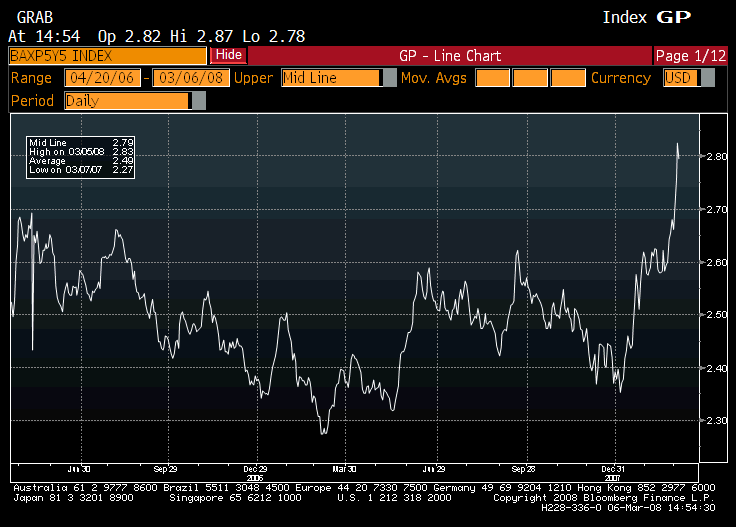
And inflation expectations have elevated. Note the attached chart of 5 year TIPS 5 years forward. The Fed has indicated this is one of their important indicators of inflation expectations and was taking comfort that it had been reasonably well anchored up to a few months ago. Now it’s just passed previous all time highs.

Even the Fed doves have recently said inflation is above their comfort zones, and they have been qualifying their support for rate cuts with statements like ‘if oil prices fall or remain at current levels’ when crude was around $100 or less.

Here’s the problem for the Fed:
They rely on output gaps to bring inflation down to their comfort zones. When they see even tail risk of major deflationary forces setting in they feel more than justified in addressing that risk of an excessive output gap that would not only slow inflation but bring on outright deflation.

But as inflation persists and expectations become less well anchored, the Fed believes the required output gap to bring inflation back down increases substantially, as their most recent studies show that it takes ever larger moves in interest rates to alter unemployment, and ever larger moves in unemployment to alter inflation.

Should housing simply stop contracting, and housing prices only level off, tail risk of an output gap large enough to cause a massive deflation fades.

Suddenly, the forecast output gap, while positive, is far too low to bring inflation and inflation expectations back into the Fed’s comfort zones.

The Fed is already out on the fringes of mainstream economics, including the text books Bernanke and Mishkin have written.

Mainstream economics says that if you are at full employment (believed by the Fed to be a 4.75% unemployment rate) when faced with rising energy costs that drive up prices and reduce consumer demand, leave it alone.

Don’t cut rates and add to demand, and turn a relative value story into an inflation story.

Instead, let demand weaken, let GDP fall, so that other prices will remain stable and and only relative value adjusts as markets allocate by price.

If you do support demand with rate cuts, you only drive inflation higher, real wages fall anyway, inflation expectations elevate, and the real cost of then stopping/reversing this process and bringing inflation back down is far higher than if you had left it alone.

In fact, that’s what all Fed members said continuously up to last August. In recent testimony, for example (see recent postings on this website), Bernanke said the Fed didn’t cut rates because there was an inflation problem.

If crude stays at current levels or continues higher (which I suggest it will as Saudis/Russians continue to act as swing producers, and demand remains far higher than needed for them to continue to support prices at current levels), all inflation measures will continue to march higher.

And with oil producers and other foreigners now spending their $ revenues rather than holding $US financial assets, exports keep rising and keep the current output gap from widening.

For the Fed, this means the MNOG (minimum non-inflationary output gap) needed to bring inflation down to comfort zones goes up substantially.

Their current MNOG could now very well be substantially higher than the current output gap (unemployment was last reported at 4.9%).

And this MNOG beast seems to be growing by the day.

So today’s news of initial claims coming down some, retail sales showing some Feb recovery vs Jan, pending home sales flattening, muni markets reorganizing and selling bonds again, and the ISM bouncing back yesterday, and mainstream companies in general reporting reasonably good to excellent current earnings, all indicate the MNOG is growing faster than the current output gap is growing.

And less than 60 days away are the $150 billion in tax rebate checks.

For the Fed, however, ‘deflationary spiral’ tail risk remains, particularly if you see the risks as those of the 1930’s gold standard days. Back then, the supply side of credit would abruptly shut down for both the private and the public sector, and financial sector issues were immediately transmitted to the real economy. (It doesn’t work that way with today’s non convertible currency and floating exchange rate regime, where public sector spending is not operationally constrained, but the Fed doesn’t yet seem to see it that way.)

Today’s equity markets contribute to the Fed’s tail risk fears- they see the stock market as a reliable leading indicator.

The equity markets are under pressure from both directions: a weak economy is bad for business and a rebound means higher interest rates from the Fed.

And with a Fed that believes the only tool it has to fight tail risk deflation is changing interest rates (see Bernanke testimony), it is rational for markets to expect the Fed to toss another big chunk of raw meat to the MNOG with another big fed fund rate cut after the March 18 meeting.

Data dependent, of course.

Payrolls tomorrow. Jan revision probably more relevant than the Feb number, as the pattern has been for substantial revisions a month after the initial announcement.

CNNMoney.com: Dallas Fed President: Inflation, not recession, is No. 1 woe – Mar. 4, 2008

Yes, Fisher is on record as the lead inflation hawk.

If he’s right and it turns out Bernanke cut rates into a 70’s style inflation Fisher has to be a leading candidate for Fed Chairman. Much like when Volcker replace Miller in 1979. And Kohn gets passed over a second time, this time for missing the inflation surge, if it happens.

Too early to tell which way it will go. I give the odds to inflation, whether the economy strengthens or weakens.

Bernanke is betting his career that the economy will weaken and bring inflation down. And, as he stated last week, ‘and the futures markets agree.’

Fed officials debate recession risk

Dallas Fed President Fisher argues inflation greatest threat to economy, while Fed Governor Mishkin says recession risks are greater than central bank’s forecast.

by Chris Isidore

Fed's aggressive cut fans fear
The central bank’s decision to slash rates are raising inflation fears as the economy shows signs of slowing. Play video


NEW YORK (CNNMoney.com) — Two members of the Federal Reserve’s rate-setting body gave conflicting speeches Tuesday as to whether rising inflation or a recession is the greater risk for the economy.

Inflation risk greater Dallas Federal Reserve President Richard Fisher said Tuesday he believes inflation is a greater threat, saying he would accept a slowdown of the U.S. economy in order to keep price pressures in check. The remarks suggest that Fisher, a so-called inflation hawk, will keep pushing his Fed colleagues to stop cutting rates.

But Frederic Mishkin, a Fed governor and a close ally of Fed Chairman Ben Bernanke, argued in a speech to the National Association for Business Economics that the risks are so great that the economy will not be able to meet even the Fed’s modest forecast, which essentially calls for little or no growth in the first half of the year. He argued price pressures remain in check and that the threat from inflation should wane in upcoming years.

The Fed made a 0.75 percentage point rate cut at an emergency meeting Jan. 21, and another half-point cut at the conclusion of the Jan. 29-30 meeting. Fisher, who joined the Federal Open Market Committee for the two-day meeting, was the sole vote against that cut.

The FOMC is next set to meet March 18, and investors are widely expecting another half-point cut at that meeting.

In remarks prepared for a speech in London, Fisher said that he’s upset by talk that recent Fed rate cuts represent an “easy money” policy by the U.S. central bank.

“Talk of ‘cheap money’ makes my skin crawl,” he said in his prepared remarks. “The words imply a debased currency and inflation and the harsh medicine that inevitably must be administered to purge it.”

“So you should not be surprised that I consider the perception that the Fed is pursuing a cheap-money strategy, should it take root, to be a paramount risk to the long-term welfare of the U.S. economy,” he added.

Fisher points out that yields on long-term bonds have risen, not declined, in the wake of the Fed rate cuts, a sign of growing concern about inflation – although he conceded that traders could be mistaken about the effect of the cuts on prices.

“Twitches in markets that have occasionally led me to wonder if they were afflicted with the financial equivalent of Tourette’s syndrome,” he said.

But Fisher said inflation readings have not been encouraging and that he believes price pressures can continue to build even in the face of an economic slowdown, an economic condition popularly known as “stagflation.”

Fisher argues it’s better to have the economy go into an economic downturn than to risk a pickup in inflationary pressure through low rates due to global forces.

“We cannot, in my opinion, confidently assume that slower U.S. economic growth will quell U.S. inflation and, more important, keep inflationary expectations anchored,” he said. “Containing inflation is the purpose of the ship I crew for, and if a temporary economic slowdown is what we must endure while we achieve that purpose, then it is, in my opinion, a burden we must bear, however politically inconvenient.”

Recession risk greater But Mishkin said he believes the economy is at greater risk than seen in the Fed forecast released last month which called for modest growth between 1.3% to 2% between the fourth quarter of 2007 and the end of this year.

“I see significant downside risks to this outlook,” he said. “These risks have been brought into particularly sharp relief by recent readings from a number of household and business surveys that have had a distinctly downbeat cast.”

The Fed governor argues that the housing prices are at risk of falling more than forecasts, and that if that happens, he believes it will put a crimp in both consumer confidence and their access to credit. He said that the declines also could create greater upheaval in the financial markets, which he argues “causes economic activity to contract further in a perverse cycle.”

Mishkin also said he expects the problems in the economy to cause a rise in unemployment. And while he believes the Fed needs to keep an eye on inflation pressures, he doesn’t believe they pose a significant threat anytime soon.

“By a range of measures, longer-run inflation expectations appear to have remained reasonably well contained even as recent readings on headline inflation have been elevated,” he said.

“I expect inflation pressures to wane over the next few years, as product and labor markets soften and the rise in food and energy prices abates,” he added. He also said he believes that inflation measures that strip out volatile food and energy prices should be close to 2% a year going forward, which is the upper end of what is generally believed to be the Fed’s comfort zone that leaves the door open for further rate cuts.

Plosser speech

From Philadelphia Fed President Plosser:

To be more concrete, many versions of the simple rules that I refer to when gauging the current stance of monetary policy call for a funds rate that is above the current funds rate.

‘Taylor Rule’ etc.

But the severity of the events affecting the smooth functioning of financial markets suggests that rates, perhaps,

PERHAPS???

should be somewhat lower than simple rules might suggest. However, determining the appropriate extent of such extra accommodation is difficult to quantify, but should also be disciplined by systematic policy.

Consequently, there are, and should be, limits to such departures from the guidance given by simple rules.

Seems he’s in the camp that the Fed is at or near its limits regarding rate cuts when inflation is this threatening.

One cannot, and should not, ignore other fundamental aspects of policy, especially the tendency for inflation to accelerate when policy is unduly easy.

This is the mainstream view – inflation doesn’t just go up, it accelerates when expectations begin to elevate.

Moreover, departures from the more systematic elements of making policy decisions must be relatively transitory and reversed in due course if we are to keep expectations of future inflation well-anchored.

Bernanke conspicuously left this out of his testimony last week.

Otherwise we risk eroding the public’s confidence in monetary policy’s commitment to deliver price stability, and we know from the 1970s and early 1980s that the cost of regaining the public’s confidence can be quite high.

Sounds like he’s in the Fisher camp and not inclined to favor another cut with inflation where it is.

The benefits of operating in an environment with the transparency afforded by simple rules is that it gives monetary policymakers the ability to anchor expectations and affords them the opportunity to temporarily deviate from the simple rules in extraordinary circumstances without eroding central bank credibility. We are now, perhaps,

‘PERHAPS’ again – meaning we might not be.

in a period of extraordinary circumstances and have deviated from the benchmarks suggested by simple rules. But such deviations should be temporary and limited and promptly reversed when conditions return to normal.

Can’t be more clear on this.

Monetary policymakers should continue to pursue their efforts to develop and put into practice more rule-like behavior. It is one of the more important paths to sound monetary policy over the long-run.

Looks like more movement to the Fisher camp as the March 18 meeting approaches.

Re: falling interest rates

(an intersibling email)

>
> On 3/3/08,  seth wrote:
> who is buying 2 year notes at 1.63????
> seth
>

simple:

high food and gas prices= weaker consumer= fed cutting rates = weaker $= even higher food and gas prices= even weaker consumer = fed cutting rates even more= even weaker $… = prices at infinity and rates at minus infinity

get long!!!