Reuters: Bernanke: full effect of rate cuts yet to be felt

by Alister Bull

(Reuters) The full benefit of recent Federal Reserve interest rate cuts has not yet been felt, Fed Chairman Ben Bernanke said Thursday, nodding to a policy lag that may reduce the need for many more rate moves ahead.

Ben Bernanke

CNBC.com

Ben Bernanke


“Further actions will have to depend on how the economy evolves and we are looking of course at both sides of our mandate, growth and inflation,” Bernanke told a U.S. Senate Banking Committee hearing on the rescue of troubled investment bank Bear Stearns.

“The effects of monetary policy are felt over a period of time and we expect to see further positive effects of these policies going forward,” he said.

“I believe we have helped to offset the credit crunch to some extent.” Bernanke acknowledged in testimony Wednesday that there was a risk U.S. growth could contract slightly in the first half of this year, before picking up in the next six months.

On the other hand, recent economic indicators have been mixed, with some signaling that conditions were not getting worse at an accelerating pace and may even be stabilizing.

First time he’s used this kind of language.

Bernanke also stressed Thursday that the Fed was uncomfortable with the current high levels of inflation, while arguing that these pressures should abate in the months ahead.

“The primary reason for the high inflation is rapid increases in the price of globally traded commodities, including crude oil and food,” he said.

Headline U.S. consumer prices rose 4.0 percent in February versus a year ago.

“It is our expectation, which is consistent with the prices seen in futures markets, that these prices will moderate in the coming year and that therefore, overall inflation will tend to slow,” Bernanke said.

“However, we are aware of the uncertainties involved with that and we are obviously going to be watching the situation very carefully,” he added.

2008-04-02 US Economic Releases

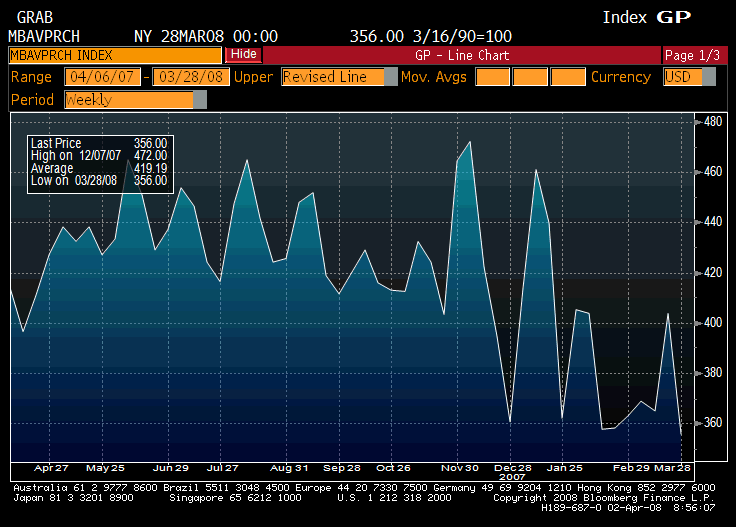
2008-04-02 MBAVPRCH Index

MBAVPRCH Index (Mar 28)

Survey n/a
Actual 356.0
Prior 403.7
Revised n/a

Down this week, maybe a holiday issue. Looks looks like Q1 was in a lower range than Q4, but not all that bad.

Also, mortgage bankers have less capacity than previously, and banks are said to be gaining market share.


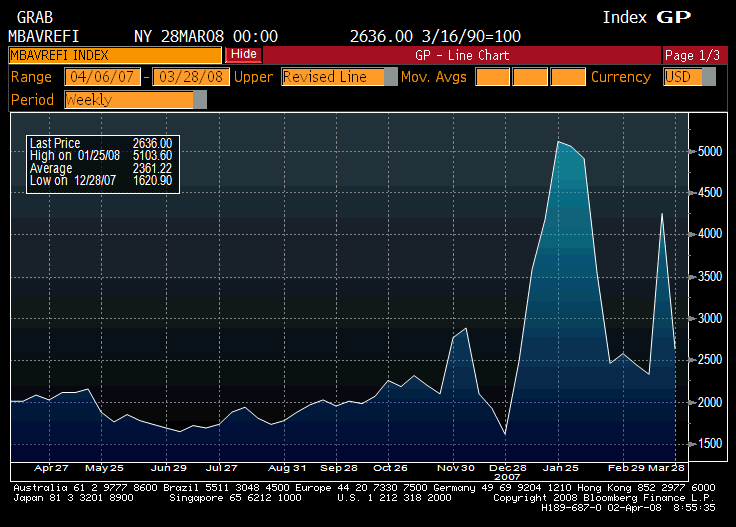
2008-04-02 MBAVREFI Index

MBAVREFI Index (Mar 28)

Survey n/a
Actual 2636.0
Prior 4255.2
Revised n/a

Refi’s have been coming in spikes. Not sure why.


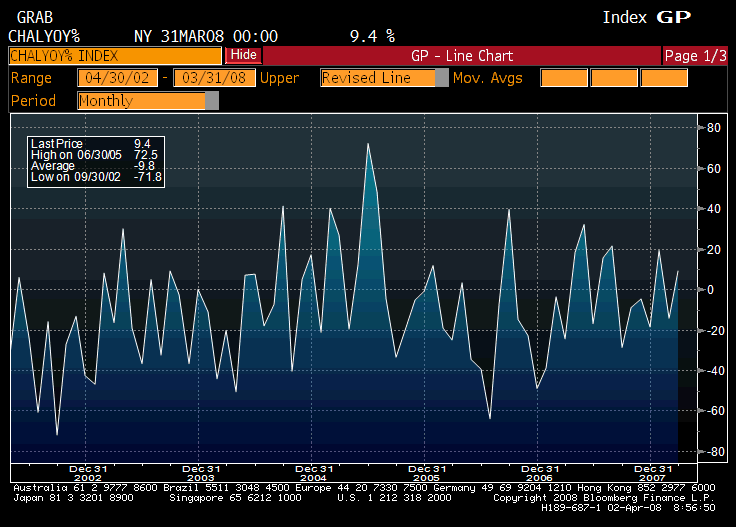
2008-04-02 Challenger Job Cuts YoY

Challenger Job Cuts YoY (Mar)

Survey n/a
Actual 9.4%
Prior -14.2%
Revised n/a

This hasn’t been a reliable indicator but nonetheless seems to indicate a recession isn’t in the cards.


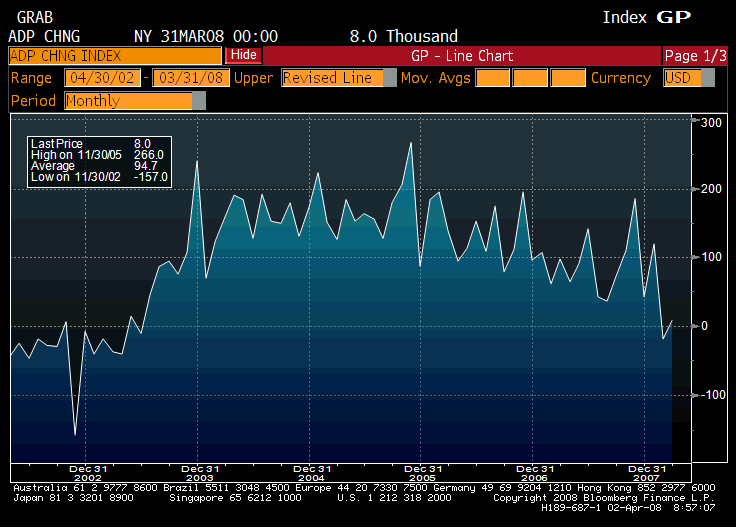
2008-04-02 ADP Employment Change

ADP Employment Change (Mar)

Survey -45K
Actual 8K
Prior -23K
Revised -18K

ADP flattish, and last month revised up a bit.

Friday’s payroll number could be much the same: last month revised up some, and current month a bit higher than expected.

The overall trend is to less job creation, but the labor force participation rate has also been falling and keeping reported unemployment in check.

But it doesn’t matter anymore.

Employment is now going to be treated as a ‘rear view mirror’ issue and not ‘forward looking’

Same with losses to be reported by the financial sector.

Economics risks are now to the upside.

If housing doesn’t fall by another large chunk and further subtract from GDP, the Fed is left with an output gap not nearly large enough to forecast inflation coming back to target levels, without also including rate hikes in its internal forecasts (rate forecasts are not released). (The Fed’s long term inflation forecasts are necessarily at their target levels, as those forecasts include ‘appropriate monetary policy’ to hit those targets.)

Without a lot more weakness than current conditions indicate, markets will anticipate the Fed is unlikely to keep rates at current levels.

Meanwhile, current levels of demand for crude are more than sufficient for the Saudis to continue as swing producer/price setter.

And the foreign sector is still in the process of reducing their rate of accumulation of USD financial assets as evidenced by the falling trade gap, falling USD, and rising US exports.


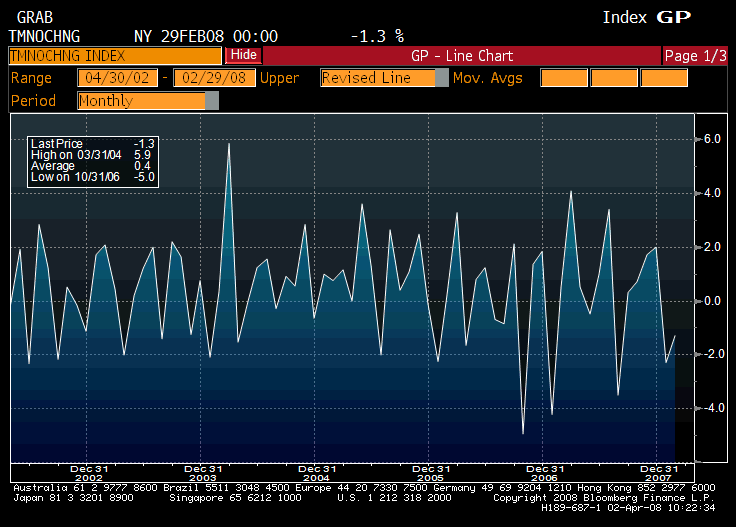
2008-04-02 Factory Orders

Factory Orders (Feb)

Survey -0.8%
Actual -1.3%
Prior -2.5%
Revised -2.3%

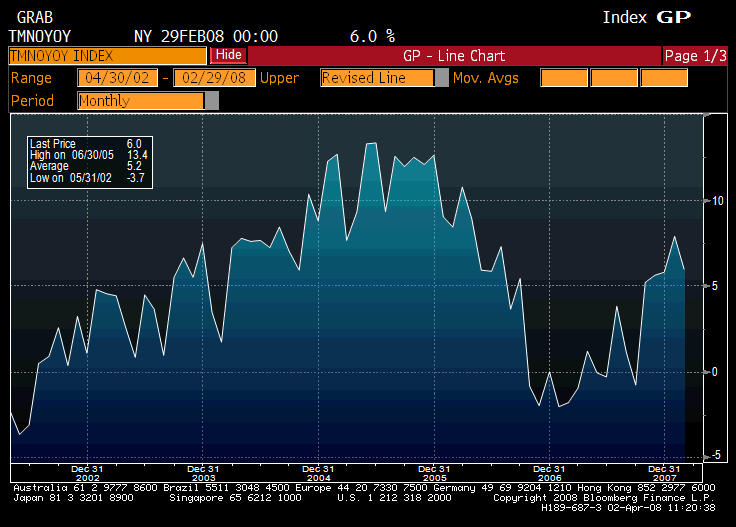
2008-04-02 Factory Orders YoY

Factory Orders YoY (Feb)

Survey n/a
Actual 6.0%
Prior 7.9%
Revised n/a

Pretty good up trend in progress here.

2008-04-01 US Economic Releases

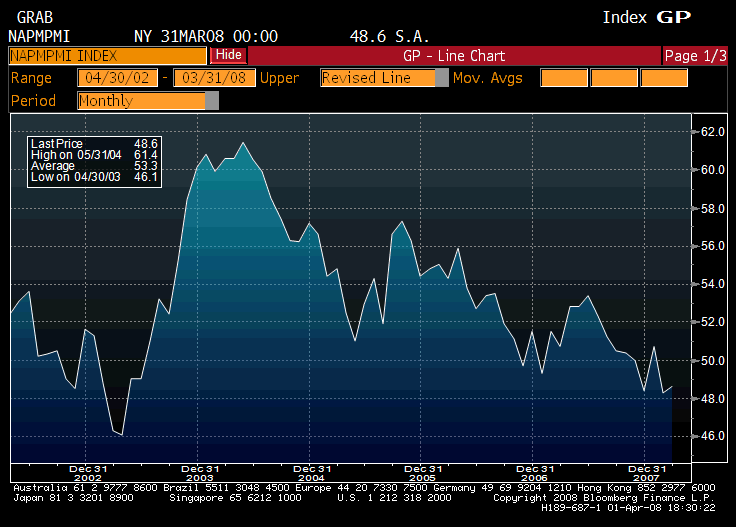
2008-04-01 ISM Manufacturing

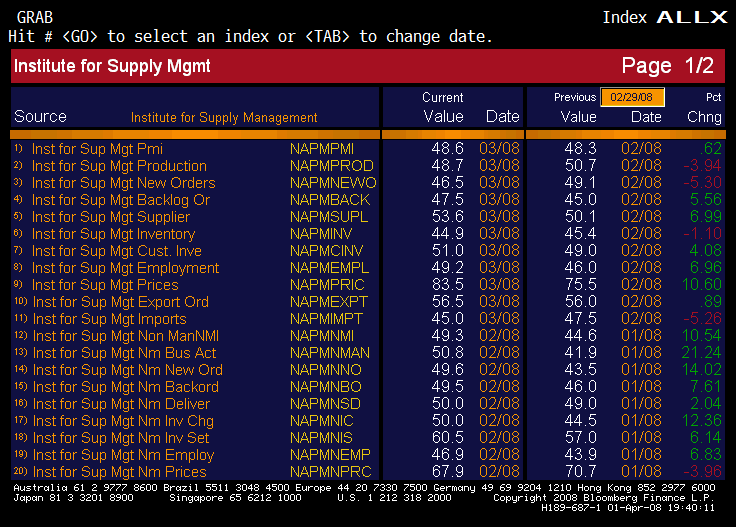
ISM Manufacturing (Mar)

Survey 47.5
Actual 48.6
Prior 48.3
Revised n/a

Still soft, but better than expected and not at recession levels of 44 or less.


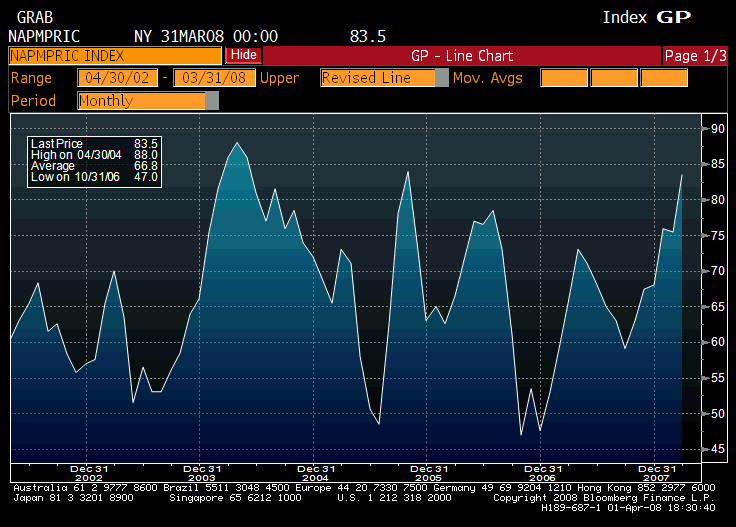
2008-04-01 ISM Prices Paid

ISM Prices Paid (Mar)

Survey 75.0
Actual 83.5
Prior 75.5
Revised n/a

2008-04-01 ISM TABLE

2008-04-01 ISM TABLE

ISM TABLE

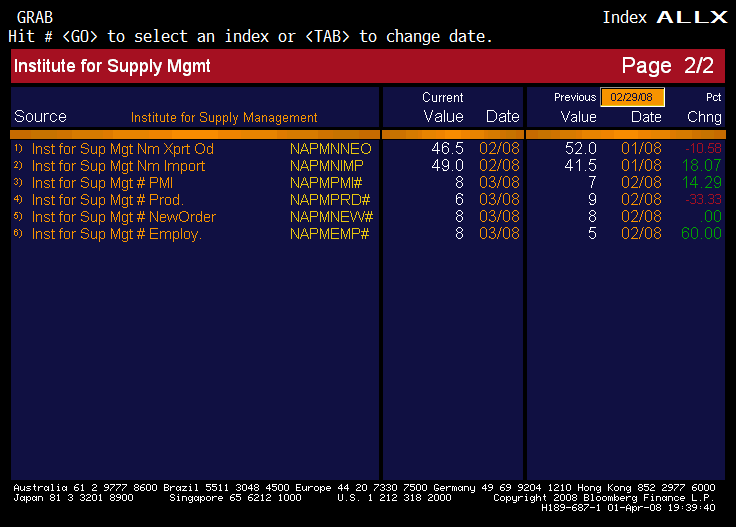
Prices paid up and employment up -inflation and a lower output gap- not the direction the Fed wants the economy to be going.


2008-04-01 Construction Spending MoM

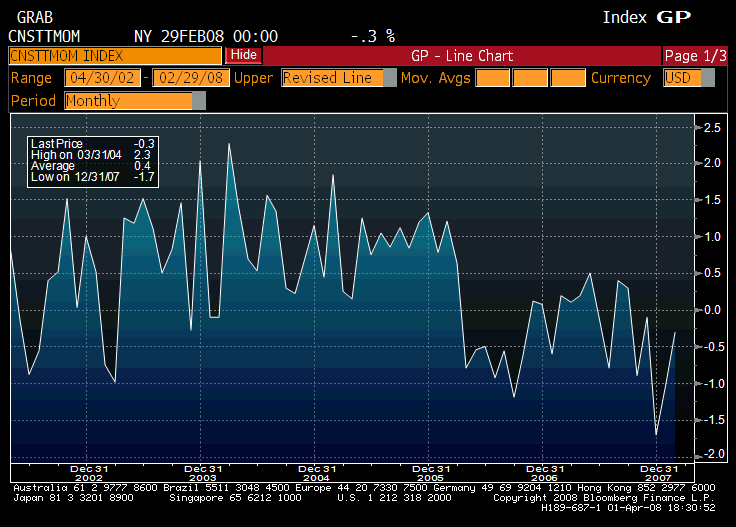
Construction Spending MoM (Feb)

Survey -1.0%
Actual -0.3%
Prior -1.7%
Revised -1.0%

Better than expected, prior month revised up, and the chart still looks lower but not all that bad.


2008-04-01 ABC Consumer Confidence

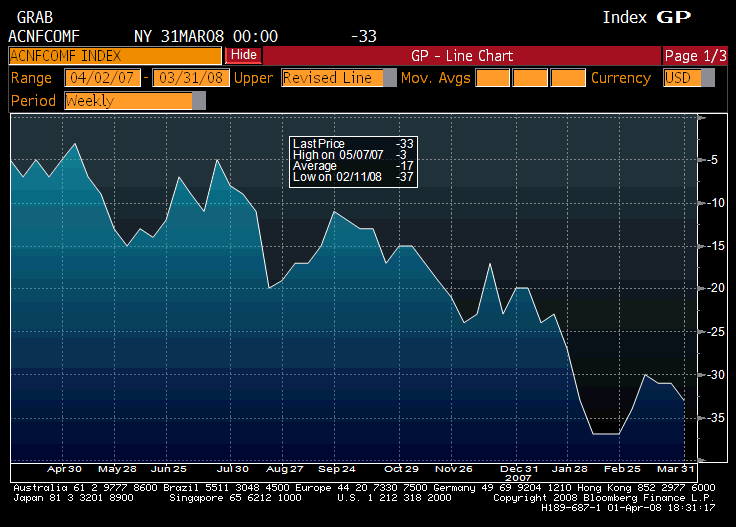
ABC Consumer Confidence (Mar 30)

Survey -n/a
Actual -33
Prior -31
Revised n/a

Seems to have bottomed, and today’s stock market action should give it a boost.


2008-04-01 Total Vehicle Sales

Total Vehicle Sales (Mar)

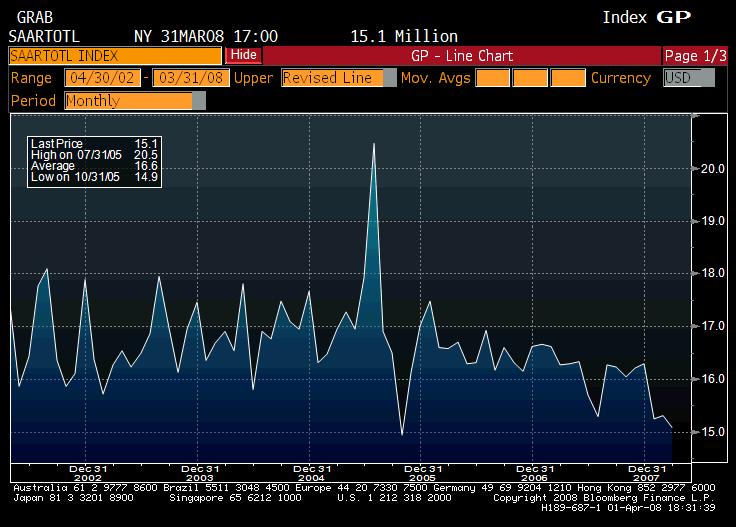
Survey 15.2M
Actual 15.1M
Prior 15.3M
Revised n/a

2008-04-01 Domestic Vehicle Sales

Domestic Vehicle Sales

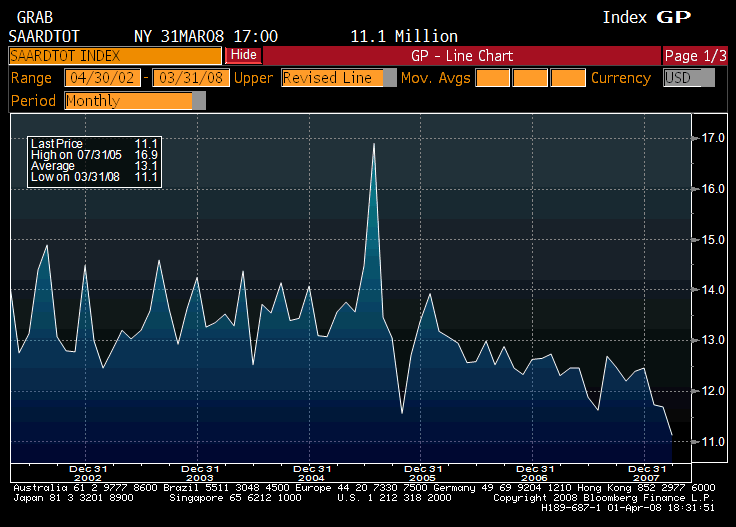
Survey 11.6M
Actual 11.1M
Prior 11.7M
Revised n/a

Still working its way lower.

2008-03-31 JN Highlights

Japan data volatile as usual, but a few interesting bits that are worth a quick look:

Industrial Output Falls 1.2% In Feb

(Dow Jones) Japanese industrial output declined in February, partly due to weaker overseas demand for electronic parts and devices, increasing worries that a downturn exports will slow the economy.

Separate data, meanwhile, showed that Japanese workers’ salaries rose for the second consecutive month. But the rise was mostly canceled out by higher consumer prices, so the higher wages are unlikely to give the broader economy much support.

Higher nominal wages probably represents elevated ‘inflation expectations’ to their mainstream economists.

Industrial output fell 1.2% from the previous month after adjustment for seasonal factors, according to data released Monday by the Ministry of Economy, Trade and Industry.

But better than expected:

The result was better than the 2.2% decline expected by economists surveyed by Dow Jones and Nikkei. The ministry said manufacturers expect their output to rise 2.0% in March, and to decline 1.0% in April.

Lower domestic production for pulp, paper and paper products, which was off 2.7% on month, also pushed overall output down.

Production issues?

Wages up for 2nd straight month
Meanwhile, Japanese workers’ average cash earnings rose for the second straight month in February, growing 1.3% on year to Y274,521, preliminary data from the Labor Ministry showed Monday.

Behind the rise was a 2.4% on-year increase in the number of full-time employees, the government said.

The rise in salaries and full-time employees “reflects businesses’ increasing efforts to secure against mid- to long-term labor shortages” and this could continue for a while, Yamamoto said.

Labor shortages and rising wages? That’s a change from the last fifteen years.

In January, wages climbed a revised 1.6% on year, following a 1.7% fall in December.

Still, “amid current price rises, it may take some time until salary rises help push up private consumption,” Yamamoto said.

Last Friday the government released data showing that the nationwide core consumer price index rose 1.0% on year, the biggest increase in almost a decade.

Average monthly wages excluding special allowances rose 0.9% on year to Y250,347, and average overtime pay also increased 2.6% to Y20,095. Special allowances jumped 28.1% to Y4,079.

Feb Construction Orders Up 18.4% On Year

Maybe they got the permit thing sort of straightened out? If so, most likely a large backlog to start working off.

(Dow Jones) Total construction orders received by Japan’s 50 leading domestic contractors rose 18.4% on year to Y1.221 trillion in February, the Ministry of Land, Infrastructure and Transport said Monday.

Orders fell 5.7% in January and rose 4.7% in December.

Orders from the public sector rose 45.9% to Y337.1 billion. Meanwhile, private sector orders gained 8.9% to Y776.8 billion.

Overseas construction orders rose 51.1% to Y59.1 billion, the ministry said.

Feb Housing Starts Fall 5.0% On Year

(Dow Jones) Japan’s housing starts fell 5.0% in February from a year earlier to 82,962 units, the Ministry of Land, Infrastructure and Transport said Monday.

The decline was larger than the 1.0% drop forecast by a Dow Jones/Nikkei poll of economists.

That was the eighth consecutive month of falls after orders dropped 5.7% in January and 19.2% in December.

Annualized housing starts stood at 1.15 million units.

That’s more than the US with maybe half the population.

Housing starts for individual homes in January fell 2.1% on year to 22,494 units, while rental housing fell 3.1% to 33,063 units.

Multiunit dwellings, meanwhile, declined 9.7% to 26,757 units, including condominiums.

And the drop is part of the permit problem?

The results suggest the fallout from a legal change that created bottlenecks for housing permits is gradually easing. Economists said, however, that a sudden recovery remains unlikely with corporate and household sentiment at multiyear lows.

Oil Imports Rise 8.2% In Feb, Up For 5th Straight Month

Demand remains high at current prices?

(Kyodo) Japan’s crude oil imports in February rose 8.2 percent from a year before to 127.18 million barrels, marking the fifth straight month of expansion, the Natural Resources and Energy Agency said Monday.

Imports from the Middle East accounted for 86.7 percent of the total, down 1.4 percentage points from a year before, the agency, under the Ministry of Economy, Trade and Industry, said in a preliminary report.

By country, Saudi Arabia remained the biggest supplier to Japan, exporting 35.98 million barrels, up 4.2 percent.

The United Arab Emirates stayed second with shipments rising 3.9 percent to 32.65 million barrels.

Iran was in third, exporting 16.48 million barrels, up 28.6 percent, followed by Qatar’s 9.56 million barrels, up 5.3 percent, and Kuwait’s 9.44 million barrels, up 5.7 percent.

Domestic output of petroleum products such as gasoline, naphtha and jet fuel in February rose 5.8 percent to 18.32 million kiloliters for the fifth straight month of increase. One kl equals 6.29 barrels.

Sales of such products in Japan increased 4.2 percent to 20.12 million kl, the second straight month of growth, the agency said.

Number Of Full-Time Workers Posts Highest Rise In 16 Years

(Kyodo) The number of full-time workers at firms with at least five employees in Japan rose 2.4 percent in February from a year earlier to 33.02 million, marking the highest pace of expansion in almost 16 years, the government said Monday.

The number of such workers, including permanent and nonpermanent jobholders, increased by more than 700,000 from a year before, the Ministry of Health, Labor and Welfare said in a preliminary report.

”Many companies are increasingly converting part-time workers to full-time workers, which may be behind” the highest pace of increase since June 1992, a ministry official said.

In contrast, the number of part-time workers at such firms increased by a mere 0.9 percent in February, with the pace of increase being smaller than that of full-time workers for the first time in 16 months, the report said.

The increase in full-time workers is attributable partly to the revised part-time labor law to be implemented Tuesday, which requires firms to take measures to promote shifting of part-timers into full-time employees on the regular payroll, analysts said.

Many companies have already been taking such steps ahead of the implementation of the law, they said.

Also, some big firms have been accelerating efforts to convert part-time and temporary workers into full-time workers amid the continuing expansion of the Japanese economy.

Such development is in contrast with the employment policy of large companies after the bursting of the nation’s asset-inflated economy in the early 1990s, in which they had to trim the number of full-time regular workers and increase the number of part-time workers in order to cut personnel costs.

Large companies including Takashimaya Co., Toyota Motor Corp. and Sumitomo Mitsui Banking Corp. have been increasing the number of full-time workers in a shift from past policy.

The ministry also said in the same report that average winter bonuses at the end of 2007 per regular employee at firms with at least five employees fell 2.8 percent from a year earlier to 417,507 yen for the first decline in four years.

The decline was partly attributable to lingering uncertainty over the Japanese economic outlook, the ministry official said.

Temporary Fall In Road Tax Not Seen Harming Economy

(Nikkei) If the rates on the gasoline and other road-related taxes are lowered from April, Japan’s economic growth may suffer, but the impact would be limited if lower rates are in place for only a few months, according to an estimate by Nikkei Digital Media Inc.

However, reduced taxes for a full year could cause economic growth to decline by up to 0.3 percentage point due to a cutback in road construction.

The firm’s Nikkei Economic Electronic Databank System (NEEDS) service projects that if road-related taxes become lighter, tax revenues for the central and local governments would shrink by a total of 2.6 trillion yen, while disposable income at households would increase by 1.6 trillion yen and corporate revenue would jump by 1 trillion yen. Other factors expected to affect actual economic growth include a reduction in public spending on road construction.

The tax rates are set to fall as a result of political deadlock over a bill to extend the provisional surcharge imposed on gasoline and other items.

The government and ruling parties aim to bring the lowered rates back to the current levels when the ruling coalition-controlled lower house gains the right to vote for the move in late April. If the higher rates are reimposed from the July-September quarter, and a 2.6 trillion yen reduction in public works spending is averted, fiscal 2008 economic growth would expand by 0.1 point. Under such a scenario, the impact from the tax rate change would be limited, with consumer spending estimated to grow by 0.1 point thanks to lowered gasoline prices, among other factors, and corporate capital investment is seen increasing by 0.2 point.

If the road-related taxes remain lower throughout fiscal 2008 and public works spending remains intact, financed by increased issuance of government bonds, economic growth would be boosted by 0.2 point, with consumption and corporate capital spending estimated to grow by 0.3 point and 0.4 point, respectively.

On the other hand, if the tax rates stay lower for the entire year and public spending is reduced, that would likely have a negative impact on economic growth. A 2.6 trillion yen reduction in public investment would hamper GDP growth by 0.3 point, and a 1.3 trillion yen cutback would push growth down by 0.1 point, with the positive effects of increases in consumer spending and corporate capital investment expected to be more than offset by a decrease in public works spending.

Bloomberg: Europe inflation accelerates to 3.5%, sentiment drops

Europe Inflation Accelerates to 3.5%, Sentiment Drops

By Fergal O’Brien

(Bloomberg) European inflation accelerated to the fastest pace in almost 16 years, making it harder for the European Central Bank to cut interest rates as a global credit squeeze saps confidence among executives and consumers.

Consumer-price inflation in the euro area accelerated to 3.5 percent this month, the highest rate since June 1992, the European Union’s statistics office in Luxembourg said today. The euro rose after the publication of the figure, which was higher than economists had forecast. A separate report showed consumer and business confidence declined in March.

And that’s with a strong euro keeping import prices lower than otherwise.

“This will surely dash any residual hopes of a near-term rate cut,” said Dario Perkins, an economist at ABN Amro in London. “With inflation this high, it would take a major deterioration in the real economy to prompt the ECB to lower interest rates this year.”

Yes.

March inflation was faster than the 3.3 percent median forecast of 36 economists in a Bloomberg News survey and the acceleration pushed the rate further above the ECB’s 2 percent ceiling, a target it hasn’t achieved in the last eight years.

The euro rose as high as $1.5834 after the inflation report and was up 0.1 percent to $1.5807 as of 12:15 p.m. in London.

High inflation = Strong currency???

That’s the current paradigm as markets trade as if interest rates are more important for currency pricing rather than purchasing power parity.

Still, there are signs the euro-area economy is so far weathering the U.S.-led slowdown. German and French business confidence climbed in March and unemployment in the euro region was a record low 7.1 percent in January.

Low unemployment scares the ECB a lot.

2008-03-28 US Economic Releases

2008-03-28 Personal Income

Personal Income (Feb)

Survey 0.3%
Actual 0.5%
Prior 0.3%
Revised n/a

This is what supports the economy longer term and cushions downturns.


2008-03-28 Personal Spending

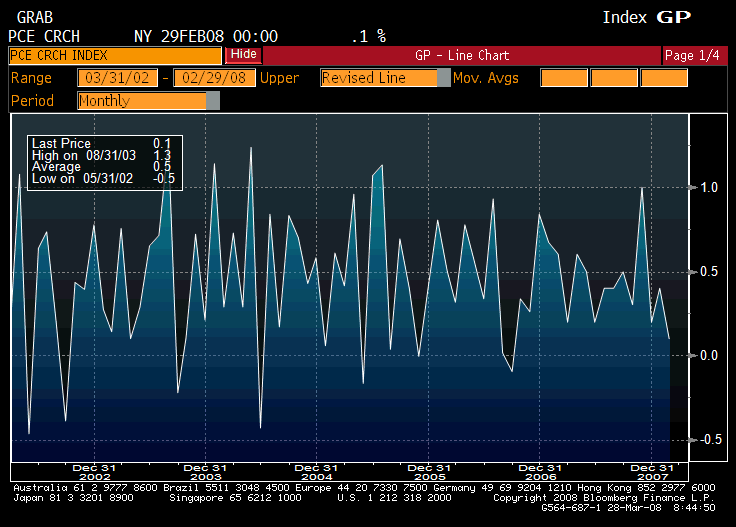
Personal Spending (Feb)

Survey 0.1%
Actual 0.1%
Prior 0.4%
Revised n/a

Down some, but with personal income remaining firm spending is sustained over the medium term.


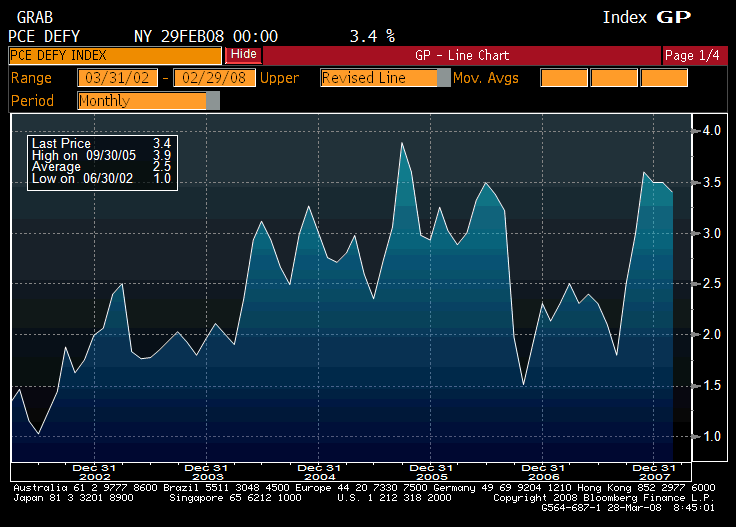
2008-03-28 PCE Deflator YoY

PCE Deflator YoY (Feb)

Survey 3.5%
Actual 3.4%
Prior 3.7%
Revised 3.5%

Not good, and more price increases are in the pipeline.


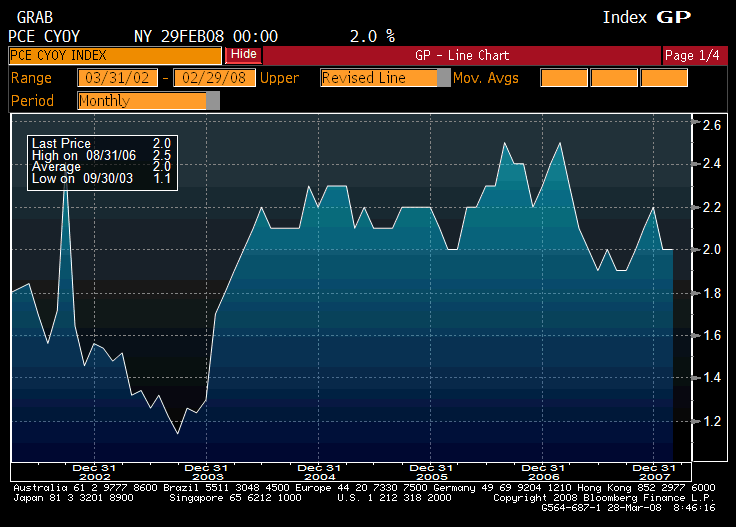
2008-03-28 PCE Core YoY

PCE Core YoY (Feb)

Survey 2.1%
Actual 2.0%
Prior 2.2%
Revised 2.0%

Back to the high end of the Fed’s comfort zone, but with higher prices in the pipeline, it’s looking to move higher.


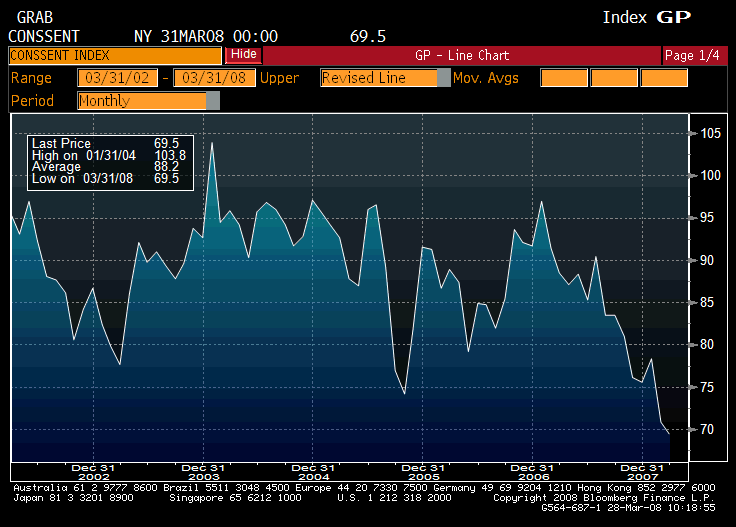
2008-03-28 U. of Michigan Confidence

U. of Michigan Confidence (Mar F)

Survey 70.0
Actual 69.5
Prior 70.5
Revised n/a

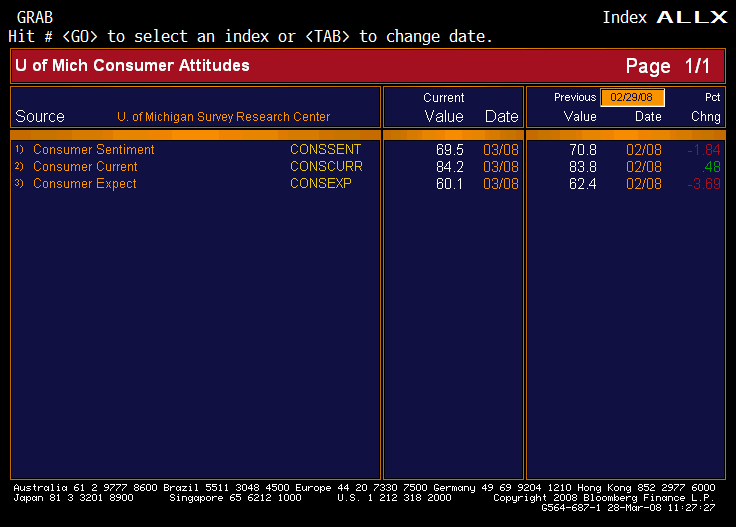
2008-03-28 U. of Michigan Confidence TABLE

U. of Michigan Confidence TABLE

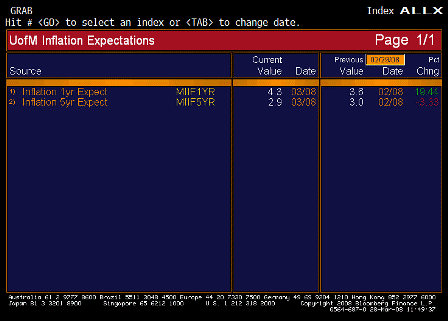
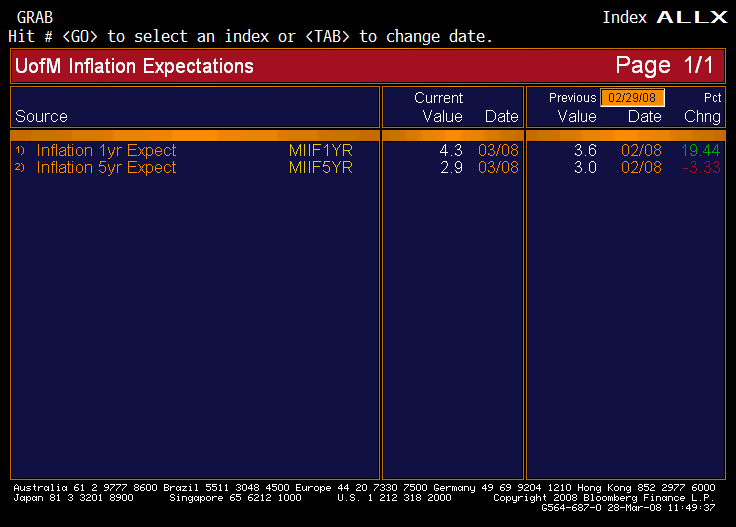
2008-03-28 Inflation Expectations

Inflation Expectations

Current conditions up, expectations down. Sound familiar?

Plosser the hawk

Plosser, Dissenting Fed Voter, Says Price Stability Is Priority

By John Brinsley
March 28 (Bloomberg) — Federal Reserve Bank of Philadelphia President Charles Plosser, who voted against this month’s interest-rate cut, said keeping inflation in check is the “most effective” way of ensuring economic growth and job creation.

“Price stability is not only a worthwhile objective in its own right,” Plosser said in the text of a speech at a conference in Cape Town today. “It is also the most effective way monetary policy can contribute to economic conditions that foster the Federal Reserve’s other two objectives: maximum employment and moderate long-term interest rates.”

Plosser said today that keeping prices steady has to be the primary obligation of the central bank in order to ensure the economy runs as efficiently as possible. Price stability helps an economy’s ability “to achieve its maximum potential growth rate,” he said.

This is the mainstream macro economic position. (Not mine!)

It also addresses the dual mandate in the only logical manner the mainstream theory can address:

Low and stable inflation is the necessary condition for optimal growth and employment.

And they have volumes of maths to back it up.

In an effort to fend off a U.S. recession, Fed Chairman Ben S. Bernanke and his colleagues have slashed the federal funds rate by 2 percentage points this year, the most aggressive easing in two decades, even as surging oil and food costs threaten to stoke inflation. Plosser and Dallas Fed President Richard Fisher opposed the March 18 decision to cut the Fed’s main lending rate by three-quarters of a percentage point to 2.25 percent.

“Stable prices also make it easier for households and businesses to make long-term plans and long-term commitments, since they will know what the long-term value of their money will be,” Plosser said. “Price stability helps a market economy allocate resources efficiently and operate at its peak level of productivity.”

The Fed has lowered its benchmark rate six times in as many months since the collapse of U.S. subprime mortgages started to infect markets around the world in August last year. The world’s biggest financial companies have posted at least $195 billion in writedowns and credit losses tied to American mortgage markets.

“There seems to be a view that monetary policy is the solution to most, if not all, economic ills,” Plosser said. “Not only is this not true, it is a dangerous misconception and runs the risk of setting up expectations that monetary policy can achieve objectives it cannot attain.”

Public misconceptions over what central banks can and cannot do have “risen considerably over the years.” Central banks must therefore effectively communicate their goals and limitations, Plosser said.

The mainstream position is that rather than add to demand to address near term weakness and risk elevating inflation expectations, the government should instead let the output gap (unemployment and excess capacity in general) rise and bring inflation down.

If it does add to demand in an attempt to keep the output gap low and inflation elevates, a much larger output gap will soon be required to reign in the accelerating inflation problem.

The dissenting votes reflect this mainstream view that appears to be playing out in the least desirable way.

2008-03-27 JN Highlights

Highlights:

Fukuda Offers To Free Up Road Revenues For General Spending From FY09

Adds to aggregate demand.

MOF Frets Over Yen, But No Threat Of Action

Don’t want Paulson to call them a currency manipulator.

Suda: Natural For BOJ To Aim For Rate Hike

They see inflation heating up over time.

Some Gas Stations Raise Prices Ahead Of Expiring Surcharge
Toyota, Nissan To Raise Entry-Level Pay For College Graduates
Bonds: End Up On Weak Stocks: CPI, Tankan Eyed

Article:

Bonds: End Up On Weak Stocks: CPI, Tankan Eyed

TOKYO (Dow Jones)–Japanese government bonds ended higher Thursday due to weakness in Tokyo stocks but the upside was limited ahead of the fiscal-year end and major domestic events.

Market participants are now waiting for domestic economic data, including the consumer price index due out Friday, and the Bank of Japan’s quarterly tankan survey on April 1.

“If the CPI figure comes out better than market expectations (and tops 1%), BOJ rate cut views may slightly recede,” said Naomi Hasegawa, senior strategist at Mitsubishi UFJ Securities.

Note the rhetoric that states higher inflation is ‘better’ !!!

I still have a TIBOR short a year out as a bet they don’t cut as much as is priced in.

Japan’s nationwide core CPI, excluding fresh food, is expected to have risen 0.9% on year in February, according to economists surveyed by Dow Jones and Nikkei. The index climbed 0.8% in January. The five-year yield dropped 3.0 basis points to 0.725%. Yields on 10-year and 20-year JGBs were both down 1.0 basis point at 1.265% and 2.010% respectively.

Changing dynamics for the Fed

Cutting 75 basis points rather than the expected 100 basis points gave the Fed positive near term reinforcement from market participants:

  • Dollar went up
  • Food/fuel/commodities went down
  • Stocks did ok, including housing companies
  • Credit did ok

But it’s going to look to the Fed a bit like taking medicine: initial small doses have the desired effect, then things settle back, and it takes ever larger doses to keep moving the needle.

So now crude/food is moving back up, the USD is moving back down, stocks are doing ok, exports are booming, and the fiscal package is about to kick in.

For the Fed to keep moving the needle away from inflation it’s going to keep needing to not give markets all they are anticipating.

So with a 25 cut anticipated, they will realize they need to do no cut for a positive inflation response, and with no cut anticipated they need to hike, etc.

Credit markets will quickly get ahead of this and begin anticipating hikes.

The irony is higher rates will help support demand via the interest income channel.

And higher rates will support price increases via the cost channel.

Demand is being supported by increasing net fed spending and rising exports due to the reduced desires of non-residents to accumulate USD financial assets.

They no longer want to accumulate a net $60 billion a month of US financial assets (negative trade gap) due to the big 4 screaming fire in a crowded theater of previously content patrons:

  1. Paulsen calling CBs that buy USD currency manipulators
  2. Bush making it politically impossible for Muslim nations to further accumulate USD reserves
  3. Bernanke giving inflation a back seat to ‘market functioning’ via deep rate cuts into a triple supply shock
  4. Pension funds diversifying to passive commodity and non US equity strategies

2008-03-21: Valance Chart Review

Twin themes continue: weakness and higher prices.

A substantial pickup in net government spending beginning late Q2 and continued strong exports should keep GDP in positive territory.

Saudis/Russians continue as swing producers and should continue to hike prices.

Pension funds are also continuing to increase allocations to passive commodities and non-US equities.

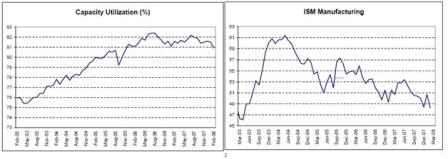
2008-03-21 Capacity Utilization, ISM Manufacturing

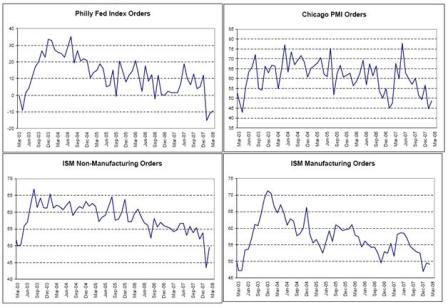
2008-03-21 Philly Fed, Chicago PMI, ISM Manufacturing

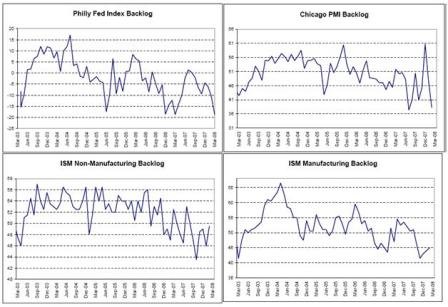
2008-03-21 Philly Fed Backlog, Chicago PMI Backlog, ISM Manufacturing Backlog

All the above charts together indicate a continued slowing of demand that took a blip down for the worse right around year end. There are some signs of a small bounce back, but the general downward bias remains.Rent levels for Q1 suggest real GDP growth is near zero, after growth of 0.6% in Q4.

Also, survey results have been known to reflect current psychology rather than actual results.


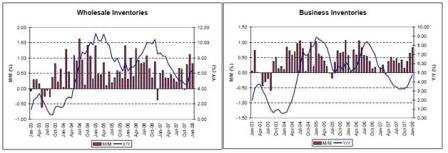
2008-03-21 Wholesale Inventories, Business Inventories

Business inventories have been kept reasonably low (not typical of past recessions).


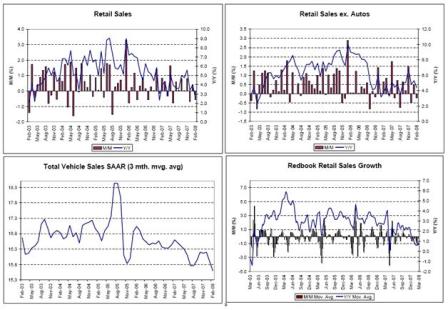
2008-03-21 Retail Sales, Total Vehicle Sales, Redbook Retail Sales

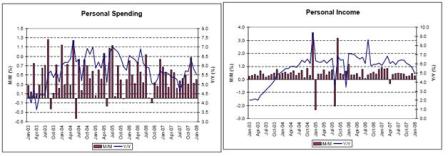
2008-03-21 Personal Spending, Personal Income

Retail sales have been decelerating over the last several months, though still up year over year.Personal income is a bit softer, though still growing and probably not softening as much as aggregate demand has softened and still sufficient to support nominal spending and nominal GDP growth.


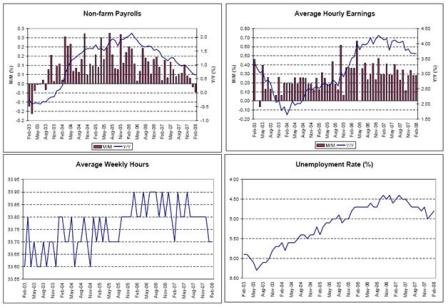
2008-03-21 Non-farm Payrolls, Average Hourly Earnings, Average Weekly Hours, Unemployment Rate

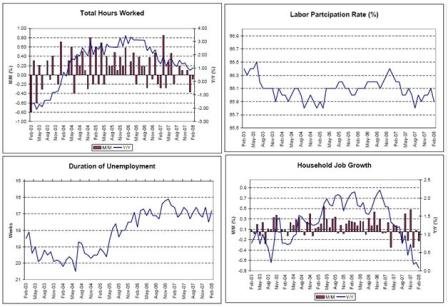
2008-03-21 Total Hours Worked, Labor Participation Rate, Duration of Unemployment, Household Job Growth

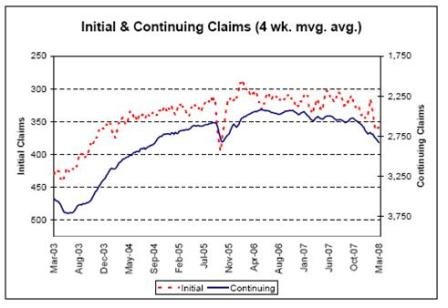
2008-03-21 Initial & Continuing Claims

The labor data taken together tells the same story of a gradual decrease in demand since the middle of 2006, but not yet at previous recession levels.Also, the Fed expects the labor force participation rate to drift lower over time due to demographics.

This means employment growth is population limited, which limits non-inflationary GDP growth to something near productivity growth.

Also, the Fed considers 4.75% the non inflationary full employment level.

The current 4.8% unemployment rate is therefore very close to what the Fed considers to be full-employment.


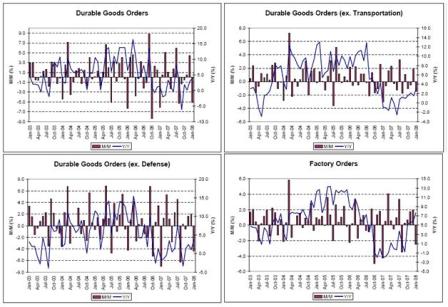
2008-03-21 Durable Goods

These look reasonably good, especially considering manufacturing has been in decline for a long time.Exports have been picking up the slack in demand from weak housing and weak consumer spending.

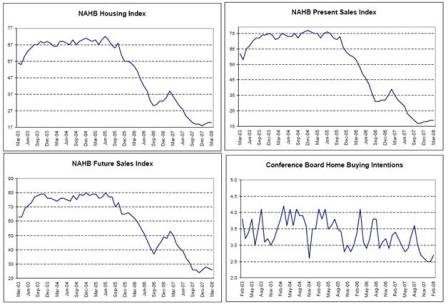
2008-03-21 NAHB, Conference Board Homebuying Intentions

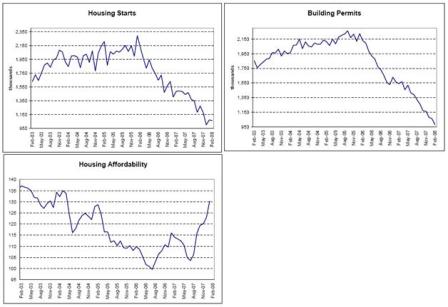
2008-03-21 Housing Starts, Building Starts, Housing Affordability

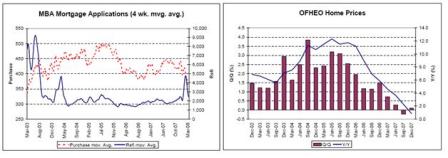
2008-03-21 MBA Mortgage Applications, OFHEO Home Prices

Housing has been the largest drag on GDP, subtracting about 1% for the last several quarters.Should it bottom at these historically very low levels it will stop subtracting from demand and begin to make a positive contribution.

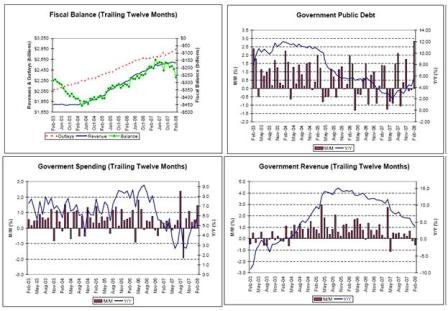
2008-03-21 Fiscal Balance, Government Public Debt, Government Spending, Government Revenue

I expect net government spending to contribute perhaps an additional 2% to GDP vs 2007. The fiscal package will add about 1%, and it looks like 2007 spending may have been moved forward to 2008 as forecast increases in the deficit project additional net spending of 1%.


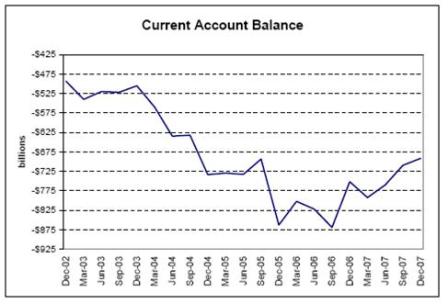
2008-03-21 Current Account Balance

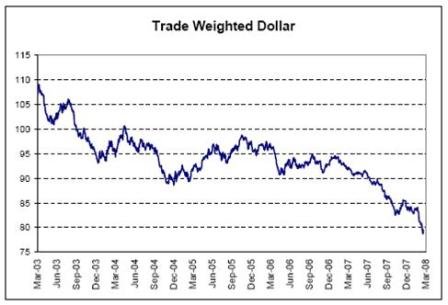
2008-03-21 Trade Weighted Dollar

Exports have picked up much of the slack from housing and consumer spending, and look to be further accelerating as non-residents continue to desire to reduce their accumulation of USD financial assets.


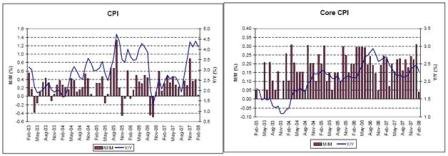
2008-03-21 CPI, Core CPI

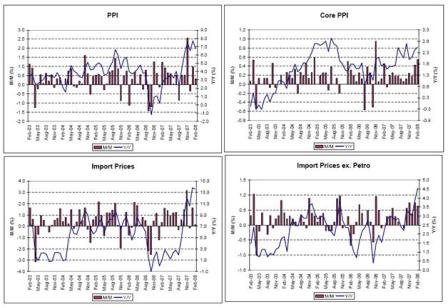
2008-03-21 PPI, Core PPI, Import Prices, Import Prices ex. Petro

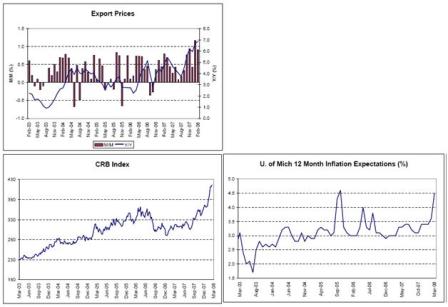
2008-03-21 Export Prices, CRB Index, U. of Mich

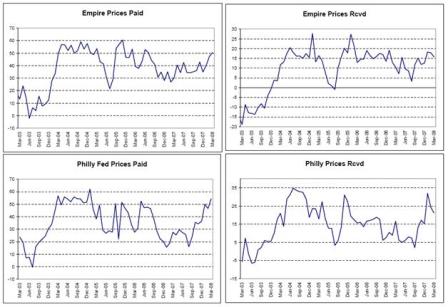
2008-03-21 Empire Prices, Philly Fed Prices

All this is sending prices up to rates not seen since the great inflation of the 1970’s, especially when taking into consideration the changes to measurement of the CPI and other indexes.


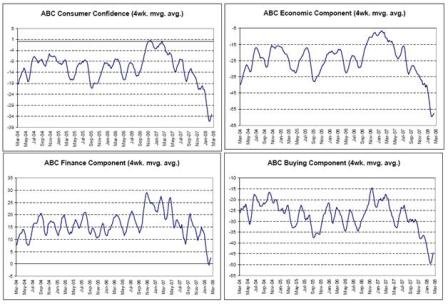
2008-03-21 ABC

Confidence remains at the lows with a small blip up coinciding with slightly less bearish reporting from CNBC.


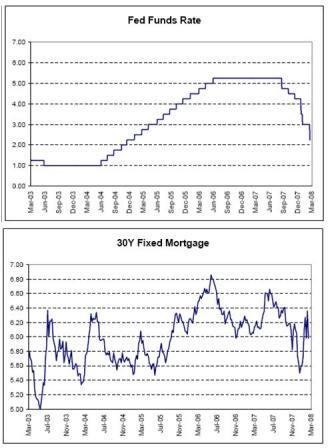
2008-03-21 Fed Funds Rate, 30Y Fixed Mortgage

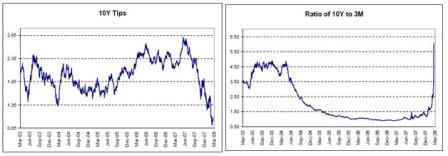
2008-03-21 10Y Tips, Ratio of 10Y to 3M

Even as the Fed cuts the Fed Funds rate, mortgage rates remain unchanged, and the yield curve steepens, as markets anticipate higher rates from the Fed down the road when they expect the Fed to turn to fighting inflation.The lower tips rates indicate markets expect the Fed to keep relatively low real rates for quite a while, even when fighting inflation.