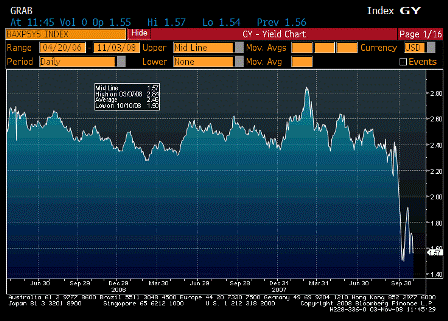
UK’s Brown on the pound


[Skip to the end]

Europeans worry a lot more about inflation from falling currencies than the Fed does.

>   
>   On Wed, Nov 12, 2008 at 7:19 AM, Milo wrote:
>   

  • BOE’s King says he has No Desire for ‘Sharp’ Drop in Pound
  • BoE Signals Rate Cuts Needed as Economy Contracts
  • U.K. Jobless Claims Rise 36,500, Most Since 1992
  • Brown signals imminent tax cuts
  • British retail sales fall for 1st time since 2005
  • U.K. Housing Sales Drop to Record Low as Prices Fall, RICS Says
  • U.K. Banks Pared Mortgages 13% After Rate Cut

BOE’s King Says He Has No Desire for ‘Sharp’ Drop in the Pound

The following are comments by BoE policy makers on inflation, economic growth and interest rates. Governor Mervyn King and colleagues made the remarks at a press conference following the central bank’s inflation report.

“Clearly if sterling falls far enough this will be a concern and it will have an impact on inflation. It’s not surprising that it’s fallen in the past year. We started by going into this with a significant trade deficit. We are seeing a rebalancing of the world economy.”

“That can be a helpful part of rebalancing the economy, provided it doesn’t affect our ability to meet the inflation target. It’s something we keep a very careful eye on. We have no wish to see it fall very sharply.”

“We have to accept that some fall back from the level we saw in 2007 is part of the rebalancing. Central bankers are prepared to worry almost every day, and I’m prepared for that.”

Regarding the current value of the pound, the bank’s Chief Economist Charles Bean said:

“That very considerable stimulus from the exchange rate should help to pull the economy out of its slow period.”


[top]

Re: Obama’s challenge- OPEC, the Saudis, and the Russians


[Skip to the end]

(email exchange)

Yes, that’s the issue when there is more excess capacity than any one producer can afford to ‘allow.’

The excess production capacity (until recently) has been under 2 million barrels per day. This has allowed the Saudis to be ‘price setter’/swing producer as all other producers could produce flat out,
and the Saudis could set price and let their output fill the remaining demand of about 9 million bpd.

In July, however, Mike Masters triggered a massive inventory sell off as passive commodity players and specs hit bids to reduce positions, and the demand for physical inventories also fell as it seems many physical inventories probably had been held at relatively high levels in anticipation of higher prices.

This meant the Saudis could not control price without major and obvious production cuts- maybe $5 million bpd- to speed the inventory adjustment and retain their position as swing producer/price setter.

I looked at (guessed) the latest announced OPEC production cuts as a sign the Saudis thought the inventory liquidation was largely past and that they were again able to set price and let production adjust to the residual demand. With other OPEC members cutting output some, the Saudis could set price and expect the residual demand that determines their output would be that much higher.

Yes, demand is down in many regions, but so far no figures released on world demand for crude has indicated an outright decline in demand. Yes, some supply indicators are up some, but others are down. The balance is not clearly tipping to a large enough cut in net demand to dislodge the Saudis as price setter.

Note that West Texas crude is over $3 higher than Brent- a wider spread than the shipping charges might indicate. This implies a shortage of WTI. But at the same time the WTI futures markets are in contango, indicating comfortable inventory levels. Also, the gasoline crack has gone negative vs WTI, indicating perhaps it is being prices off of Brent which means the marginal supply is currently imported gasoline as domestic refiners continue to produce well below capacity.

Russia is the large non-OPEC exporter, and the recent meetings with the Saudis and the below commentary indicate some form of cooperation is in process.

What the oil exporters should be hoping for is a world wide move to restore aggregate demand without an immediate policy to reduce fuel consumption. That will enable the oil exporters to increase their real terms of trade via price hikes.

The darker side is that instead of looking to optimize their real terms of trade, their primary focus may be on keeping the western economies ‘weak’ to keep them focused inward and allow the Russians freedom to operate as they please in their regions of choice, and hasten the exit of the ‘infidel’ from Iraq and the rest of the middle east. In this case, price hikes will be used to keep the western economies weak and off balance, as they confront inflation, weakness, and deteriorating real terms of trade and standards of living, with real wealth moving towards the oil (and other energy) exporters.

On the other hand it is possible the oil exporters want to keep prices low enough to discourage moves away from petroleum, especially in the auto industry.

Point is, currently and for at least the next several years, the Saudis/Russians control price, and we can only guess to what end.

>   
>   On Tue, Nov 11, 2008 at 7:16 AM, wrote:
>   
>   One bit of news, brought to our attention by our friend, Mr. Elio Ohep, the
>   Editor/Publisher of the always interesting petroleumworld.com, is that of the
>   anger on the part of Russian Prime Minister Putin regarding the current price
>   for crude, and Russia’s apparent inability to do anything about it. Clearly
>   Putin & Company are upset by crude’s weakness, for much of the current
>   military build-up taking place there, and much of the infrastructure growth
>   taking place is predicated upon high priced crude oil. Speaking over the
>   weekend, Mr. Putin said that Russia must do what it can to influence oil
>   prices. He said, in an interview on Russian national television, that We need
>   to work out a whole range of measures that will allow us to actively influence
>   the market…As one of the major exporters and producers of oil and
>   petroleum products, Russia cannot stand aside from formulation of global
>   prices for this natural resource. There is little that Russian can do however
>   other than cut production and hope that others… especially OPEC…follows
>   suit. The problem that Russia, and Venezuela, and Mexico, and Ecuador, and
>   Indonesia, and Saudi Arabia and seemingly all of the oil producing
>   nations….especially Iran…. face is that they need the cash flow from crude
>   oil to keep buying the support of their restive populations. They’ve no choice,
>   and low prices make their jobs all the harder, for in hoping to keep their cash
>   flows high they need to pump more, not less, crude. Putin and Ahmadinejad
>   find themselves as uncomfortable brethren in economic arms, hoping that the
>   other will cut production.
>   


[top]

Re: Obama’s Yuan Calls- NOT GOOD


[Skip to the end]

>   
>   On Thu, Nov 6, 2008 at 7:09 AM, Michael wrote:
>   

Obama’s Yuan Calls May Put U.S. on Collision Course With China

by Judy Chen

Nov. 6 (Bloomberg) — Barack Obama’s calls for changes in China’s yuan policy may put the president-elect on a collision course with the U.S.’s second-largest trade partner, which is holding the currency stable to support its export-led economy.

Obama said China must stop manipulating the currency in a letter to the National Council of Textile Organizations released on Oct. 24.

This is counter productive for the US standard of living.

Obama has yet to discover imports are real benefits and exports real costs.

The People’s Bank of China has kept the yuan almost unchanged against the dollar since mid-July as it shifts focus from countering inflation to sustaining growth amid a global credit crisis. The Foreign Ministry said last week the U.S. shouldn’t blame its trade deficit on exchange rates.

“Obama may exert more pressure on China’s foreign-exchange policy to boost U.S. exports and curb unemployment, but China will first consider its own economic fundamentals,” said Ha Jiming, Hong Kong-based chief economist at China International Capital Corp., the nation’s first Sino-foreign investment bank.

Hopefully, Obama will see the light and it will instead be a case of ‘when the facts change I change’.

Policy of Stability
Paulson said on Oct. 21 that he is “pleased” that China’s currency has appreciated more than 20 percent since a peg against the dollar was abandoned in July 2005.

Paulson either has it backwards, or he’s being subversive.

“It will be emphasized in the next Strategic Economic Dialogue that it is more important than ever that China should rely more on domestic demand rather than its trade surplus to sustain economic growth,” said Nicholas Lardy, senior fellow at the Peterson Institute for International Economics in Washington.

Same- ignorant or subversive are the only possibilities.

“Currency manipulation has been a quite specific implication in law, and no other president has ever used that term,” said Straszheim. If Obama doesn’t take actions following the charge that China is manipulating the yuan, “he will be regarded as another old type politician who promises one thing during the campaign and does another in office,” he added.


[top]

Fed macro policy


[Skip to the end]

(email exchange)

>   
>   On Wed, Oct 29, 2008 at 11:45 PM, Morris wrote:
>   
>   This is the 64,000 dollar question…will unlimited FED lending to ENTIRE
>   world-with IMF help-created recovery? Push on string? Hyper inflation?
>   Question of the day…would love others inputs.
>   

I’d say yes, it’s inflationary and the channels at least as follows:

1. The outstanding international dollar debt was an expansionary force when it was growing, to the extent the USD borrowings were spent. Some of that USD spending was overseas, some in the US.

Growing debt, if directed towards spending, is expansionary.

For example, you may borrow to build a house, or buy a new car.

But if you borrow to fund financial assets, your pension fund, or to buy mortgage backed securities, for example, it’s merely the rearranging of financial assets.

This increased ‘leverage’ and has no direct effect on demand, beyond the demand created by the financial institutions themselves. This includes all the hiring of employees for the financial sector which all counts as GDP.

(While this may not be deemed ‘useful output’ it is accounted for as GDP, like bridges to nowhere, and does function to support people’s livelihood. Yes, better to have employed them doing something deemed useful, but that’s another story)

2. Should the USD loans default, the financial institutions lose capital, meaning the shareholders (and bondholders, depending on the size of the loss) lose their nominal wealth. This may or may not reduce spending. Most studies say it’s a weak effect at best.

And for each institution to continue to function it needs to replace capital.

(In our ‘loans create deposits’ world, infinite capital is available at the right price, if the government has a policy to sustain domestic demand.)

For US institutions with USD denominated capital, losses result in a reduction of their USD capital.

Their liabilities remain the same, but their assets fall.

And any assets sold to reduce USD funding needs are sold for USD.

3. Institutions with capital denominated in other currencies, go through the same fundamental process but with another ‘step.’

When their USD assets are impaired, they are left with their USD liabilities.

They now have a ‘mismatch’ as non dollar assets including non dollar capital are supporting the remaining USD liabilities.

To get back to having their assets and liabilities matched in the same currency, they need to sell their assets in exchange for USD.

Until they do that they are ‘short’ USD vs their local currency, as a rising USD would mean they need to sell more of their local currency assets to cover their USD losses.

Technically, when the assets they need to sell to cover USD losses are denominated in non dollar currencies, this involves an FX transaction- selling local currency to buy USD- which puts downward pressure on their currencies.

Additionally, they need to continue to fund their USD financial assets, which can become problematic as the perception of risk increases.

4. The Fed’s swap lines ($522 billion outstanding, last i saw) help the rest of the world to fund themselves in USD.

In an effectively regulated environment, such as the US banking system, this works reasonably well but still carries a considerable risk that we decide to take as a nation for further public purpose. (it is believed the financial sector helps support useful domestic output, etc.)

Any slip up in regulation can result in the likes of the S&L crisis, and arguably the sub prime crisis, which results in a substantial disruption of real output and a substantial transfer of nominal and real wealth.

The Fed is lending to foreign CB’s in unlimited quantities, secured only by foreign currency deposits, to world banking systems it doesn’t regulate, and where regulation is for foreign public purpose.

The US public purpose of this is (best I can determine) to lower a foreign interest rate set in London called ‘LIBPR,’ and ‘perhaps’ to ‘give away’ USD to support US exports.

The Fed yesterday, for example, announced $30 billion of said lending to Mexico and Brazil for them to lend to their banks. The Fed must be a lot more comfortable with Mexico and Brazil’s bank regulation and supervision than I am, and certainly than Congress would be if they had any say in the matter.

5. The problem is that once the Fed provides funding to these foreign Central Banks, who then lend it all to their banking systems, they remove the foreign ‘funding pressure’ that was causing rates to be a couple of % higher over their (didn’t change our fed funds rate). Taking away the pressure takes away the incentives of the pressure to repay $US’s introduces.

The Fed is engaging in a major transfer of wealth from here to there. Initially its prevents the transfer of wealth back to the US, as would have happened if they had been forced to repay and eliminated their USD liabilities and losses.

That same force if continued develops into large increases in USD spending around the world as this ‘free money’ going to banking systems with even less supervision and regulation than ours soon ‘leaks out’ to facilitate increasing foreign consumption at the expense of USD depreciation.

Note the bias- the ECB gets an unlimited line and Mexico is capped at $30 billion.

This means the Fed is making a credit judgment of Mexico vs the ECB, which means the Fed is aware of the credit issue.

Conclusion, the Fed is beginning to recognize the swap lines are potentially explosively inflationary, as evidenced by not giving Mexico unlimited access.

The swap lines are also problematic to shut down should that start to happen, just like what shutting down lending to emerging markets did in the past.

Shutting down the swap lines would trigger the defaults that the unlimited funding had delayed, and then some, triggering a collapse in the world economies.

It’s a similar dynamic to funding state owned enterprises- the nominal costs go up and the losses go up as well should they get shut down.

Keeping them going is inflationary, shutting them down a major disruption to output and employment.

It is delaying the circumstances that were headed toward a shut down of the European payments system, but leaving the risks in place for the day the swap lines are terminated.

7. Bottom line- it looks to me that the swap lines are a continuation of the weak dollar policy Bernanke (student of the last gold standard depression) and Paulson have been pushing for the last couple of years.

This time they are ‘giving away’ dollars to foreigners, in unlimited quantities, ultimately to buy US goods and services.

They are doing this to support export led growth for the US, at the direct expense of our standard of living. (declining real terms of trade)

They are doing this to increase ‘national savings’- a notion applicable under the gold standard of the early 1930’s to prevent gold outflows, and where wealth is defined as gold hoards. This notion is totally non applicable to today’s convertible currency.

It is a failure to understand the indisputable Econ 101 fundamental that exports are real costs and imports real benefits.

They believe they are doing the right thing and that this is what’s good for us.

The unlimited swap lines are turning me into an inflation hawk longer term.

But the USD may not go down against all currencies, as potentially the inflation will hit other currencies as well.

Where to hide? I’m back to quality rental properties and energy investments.

The world is moving towards increased demand with no policy to make sure that doesn’t result in increased energy consumption and increasing inflation.

Comments welcome!

Warren


[top]

More on latest Fed swap lines


[Skip to the end]

The Fed is able to unilaterally lend (functionally unsecured) $30 million each to Mexico and Brazil?!?!

There are far more sensible ways to restore prosperity.

Last figures I saw indicate $522 billion in these loans that have been advanced so far.

It’s looking more and more to me like this massive USD lending to foreign CB’s who reloan it to entities with the slimmest of collateral, is both a transfer of real wealth away from the US and a highly inflationary bias.

For the moment it’s halting deflation, but once unleashed there’s no telling where it will go.

Fed Opens Swaps With South Korea, Brazil, Mexico

By Steve Matthews and William Sim

Oct. 30 (Bloomberg) — The Federal Reserve agreed to provide $30 billion each to the central banks of Brazil, Mexico, South Korea and Singapore, expanding its effort to unfreeze money markets to emerging nations for the first time.

The Fed set up “liquidity swap facilities with the central banks of these four large systemically important economies” effective until April 30, the central bank said yesterday in a statement. The arrangements aim “to mitigate the spread of difficulties in obtaining U.S. dollar funding.”


[top]

Hungary to meet euro terms earlier


[Skip to the end]

Note the contractionary terms highlighted below:

Hungary Pays With Growth Prospects for IMF-Led Bailout Package

By Zoltan Simon

Oct. 29 (Bloomberg) — Hungary will meet euro-adoption term faster than previously planned after securing a 20 billion-euro ($25.5 billion) aid package to stabilize its recession-bound economy.

The country should adopt the euro “the faster the better,” Economy Minister Gordon Bajnai and Andras Simor, the head of the central bank told reporters today. The aid package will “unequivocally” stem the financial crisis in local markets, Bajnai said.

Hungarian stocks, bonds and the currency plunged this month because of concern that the country may have difficult financing its budget and current account deficits.

The aid package will help Hungary with its balance of payments and increase investor confidence by more than doubling foreign-currency reserves, Simor said.


The central bank, which raised the benchmark interest rate last week to 11.5 percent, the EU’s highest, from 8.5 percent to halt the currency’s plunge, will “think it over” on the direction of monetary policy after the rescue plan, Simor said. The bank continues to aim for price stability, he said.


To reduce country’s reliance on external financing, Prime Minister Ferenc Gyurcsany plans to cut spending next year by freezing salaries and canceling bonuses for public workers and reducing pensions. Hungary today also canceled all government bond auctions through the end of the year.

The standby loan, which Hungary can draw on as needed, will more than double the country’s 17 billion euros worth of foreign currency reserves, Simor said. The loan carries an interest rate of 5 percent to 6 percent, a standby fee of 0.25 percent annually and can be repaid in three to five years. Hungary can access the funds until March 2010, Simor said.

Part of the loan will be used to provide liquidity to banks, Simor said, without elaborating. Banks in Hungary have started to curtail or suspend foreign currency lending because of the difficulty in accessing euros and Swiss francs, the most popular foreign currency loans.

Euro applicants must keep inflation, debt and budget deficits within check. Hungary expects consumer prices to rise 4.5 percent, with a budget deficit at 2.6 percent of gross domestic product and declining debt next year.


[top]

Zero rate!


[Skip to the end]

Yes, but, of course, for the wrong reasons!

They all still act and forecast as if lower rates are expansionary.

This still has no support in theory or practice.

Outstanding government debt means the private (non-government) sectors are net savers.

Households remain net savers.

Lower rates directly cuts personal income.

And lowers costs for businesses including costs of investments that reduce costs.

I do favor a permanent zero interest rate policy.

That would mean the same amount of government spending needs less in taxes to support it (larger deficit).

Ex-Fed Gov. Meyer Makes a Case for a Zero Fed-Funds Rate

By Brian Blackstone

With the U.S. unemployment rate now expected to climb well above 7%, former Federal Reserve governor Laurence Meyer projects that Fed policymakers may have to lower the target federal-funds rate all the way to zero next year.

“However, the expected rise in the unemployment rate, paired with the rising threat of deflation, presents a risk that the FOMC will have to ease even further, perhaps all the way to a zero federal funds rate,” Meyer and Sack wrote in a research note.

Meyer and Sack said they think the jobless rate will rise to as high as 7.5% from 6.1% now. They also expect a significant gross domestic product contraction of 2.8%, at an annual rate, in the fourth quarter, after a projected 0.7% decline in the third. They also expect GDP to fall in the first quarter of next year.

Meyer and Sack expect the Fed’s preferred inflation rate gauge — the price index for personal consumption expenditures excluding food and energy — to moderate to just 1% growth, at an annual rate, by the end of 2010.

“Plugging our interim forecast into our backward-looking policy rule suggests that the federal funds rate should be cut to zero by the middle of next year,” Meyer and Sack wrote.

“Our forward-looking policy rule…gives similar results if we plug in our updated forecast, as it calls for a funds rate of about zero by early 2010,” they wrote.


[top]

UK on track


[Skip to the end]

Brown’s Keynesianism is bankrupt- and will bankrupt us

Almost three months ago, this column described Prime Minister Gordon Brown, and his Chancellor Alistair Darling as “Keynesian”. The last decade of Brownite policy, after all, has featured high public spending, irresponsible borrowing and an ever-growing tax-burden.

by Liam Halligan

Until recently, though, Brown and his entourage have played down their “big government” tendencies – stressing prudence, private enterprise and the joys of lower tax.

But now, with the UK in the grip of the credit crisis New Labour has revealed its true statist colours. “We are spending more to get the economy moving,” said Brown last week. “That’s the right thing to do.”

Agreed.

Well, actually, it isn’t. The last 50 years are riddled with grim episodes of Western governments trying to spend their way out of recession. Every attempt has gone wrong – resulting in spiralling national debts, soaring inflation and a plunging currency.

Those are the financial outcomes, not real outcomes. And the last one was from a failed attempt at a fixed exchange rates- the ERM policy.

In 1976, then Labour Prime Minister Jim Callaghan made a passionate speech to his party conference, telling comrades “in all candour” that the option of reversing a downturn by “deficit-spending” simply “doesn’t exist”.

Callaghan was in a position to know. His Keynesian policies had destabilised the UK economy so seriously we were forced to go cap in hand to the International Monetary Fund.

The UK was forced to the IMF to borrow foreign currency to support the failed fixed exchange rate policy of the firm.

That’s right – the UK’s mid-1970s IMF bail-out, the indisputable nadir of this country’s post-war economic history, was the direct result of Keynesian policy.

No, it was a direct result of the failed ERM policy.

Yet, here we are 22 years on. The young left-wing firebrands who sneered at Callaghan’s brave admission now run the country. To gain power, they had to bury their beliefs, shave off their beards and parrot a faith in free markets.

Since 1997, despite this pretence, New Labour’s “soft Keynesian” concoction of high spending, loose credit controls and more tax has contributed mightily to our current predicament.

Not at all. In fact, tight fiscal have been the rule, and contributed to the current downturn.

But faced with a crisis, and with their backs to the electoral wall, the Brownites are reaching for the intellectual comfort blanket of their youth – the “hard Keynesian” solution of ramping up spending sharply.

Yes, and rightly so. This time with no ERM to trip over.

Because we’re in a crisis, though, Brown’s Keynesian declaration has raised barely any protest. That’s why the letter in today’s Sunday Telegraph is so important – which makes clear Keynesianism is a “misguided and discredited as a tool of economic management”. The economists who signed it cannot be dismissed as parti pris. The economic consensus against Keynesianism is based on evidence, not ideology.

For now, the airwaves are full of economists from investment banks and accounting practices whose firms stand to do quite nicely from a big dollop of extra public infrastructure spending.

These are the type of firms that benefit from the growth and strength of an economy.

Keynesianism? Bring it on, they say.

As should the citizens.

But there are many, many dismal scientists with serious misgivings – but who don’t have “media strategies”, and who perhaps lack the courage to voice their concerns, given that millions of people are frightened about their jobs.

And who doesn’t understand non-convertible currency with floating FX policy.

No one is denying the UK economy is in a bad place. New preliminary data shows the first quarterly output drop for 16 years. Between July and September, GDP fell 0.5 per cent, pushing annual growth down to 0.3 per cent.

Good thing they are looking to spend their way out of it.

As the signatories to our letter make clear, it is “inevitable government expenditure and debt rise in a recession” – as the “automatic stabilisers” kick in, the tax-take falls and benefit spending rises.

Yes, if you don’t do it proactively first.

But Brown’s plan goes way beyond that, posing huge dangers – not least as we’re starting from a position of extreme fiscal weakness.

What difference does that make???

Even last year, when growth was near trend, the Government borrowed £36bn – almost 3 per cent of GDP. And in only the first six months of this financial year, before the slowdown had really begun, we’ve already borrowed £38bn – a colossal 75 per cent up on the same period the year before.

And not nearly enough to support output and employment at the moment more is called for.

Even without Brown’s misty-eyed Keynesian adventure, the public finances are set to deteriorate rapidly. But imagine how bad the numbers will get.

‘Deteriorate’ and ‘bad’ are indicative of his backwards thinking.

as Brown, as he said last week, “brings forward” public spending from future years.

A mistake from Brown to say it that way. Spending is not operationally constrained by revenue. Brown isn’t quite there yet.

That can only lead to much higher taxation,

Maybe, but the same automatic stabilizers usually automatically do that, and usually too much so.

hobbling the private sector and increasing the danger of a drawn-out Japanese-style slump.

Yes, if they raise taxes to cut the deficit like Japan repeatedly did!

Extra Government spending won’t help anyway. Most of it will simply fuel state-sector wage growth – winning Brown a few trade union votes, but boosting wage inflation elsewhere.

‘Wage inflation’ as used here is pathetic. The question is whether demand increases translate into higher sales, output, and employment. If higher wages somehow don’t get spent they don’t contribute to higher output prices.

This is instead a statement against higher wages per se.

The broader macro-economic implications are also alarming. If we keep borrowing, in the end the gilts market will simply dry up.

While possible that they yield could creep up, it’s inaccurate and baseless to predict the market for gilts to dry up.

Japan is a good example, as is Turkey, of two nations at opposite ends of the spectrum, neither constrained by securities sales.

Already, the UK government faces massive age-related liabilities that will undermine our credit-rating over the next few years – before Brown’s final spending spree.

Credit rating is not an issue. UK spending in local currency is operationally not constrained by revenues.

And anyone who tells you inflation isn’t a problem is ignoring that borrowing itself is inflationary,

Huh??? Only spending can be inflationary, particularly if supported by higher costs (including interest rates)

and that the latest bank bail-outs will see the Bank of England printing money on a scale unprecedented in modern times.

The BOE is only exchanging one financial asset for another. It’s ‘printing money’ only if you include some financial assets and not others in the ‘money supply’.

This is the first serious slowdown under Labour – since 1976 – and a moment of acute economic danger. A wounded, desperate Prime Minister is making a final roll of the dice.

Fortunately the right one.

Faced with a desperate electorate, he is reaching for Keynesianism. It serves, also, as a fig-leaf for his previous profligate spending and as a bone to the Labour left.

But it is, indisputably, an immensely dangerous and counter-productive idea. That’s why economists must stand up and be counted.

Yes, especially the ones who support it!

The dismal scientists must speak out.


[top]

Aussies buy their own currency


[Skip to the end]

“Australia’s central bank has intervened to support the tumbling Australian dollar, but failed to prevent its slide to five-year lows against the U.S. currency and its deepest-ever trough against the yen. “

This intervention has two purposes.

One is to keep the decline orderly, the other is anti-inflationary, as the apparent collapse in the currency is immediately passed through to import prices, which play a major role in domestic consumption.

The problem in using intervention to support one’s own currency is that reserves get depleted before the desired level of the currency is achieved.

One core issue is declining real terms of trade due to falling prices of Australia’s exports vs. the prices of their imports.

The other issue is internal distribution.

Australia digs and exports coal, for example, and the boats return full of consumer goods.

A falling currency alters distribution of consumption to those residents in export industries and away from the rest of the population.

The recent US history:

Over one year ago Paulson successfully got foreign CBs to stop buying dollars.

That, along with rising crude prices, sent the dollar to its subsequent lows.

He did this by calling CBs buying dollars currency manipulators and outlaws, insisting they let markets decide currency values.

This was a thinly veiled ploy to get the dollar down to spur exports, as articulated by the Fed chairman in subsequent congressional testimony.

It ‘worked’ as US exports grew at record pace and US GDP muddled through at modestly positive numbers. (A nation net imports exactly to the extent non residents realize their desire to accumulate its net financial assets, as discussed in previous posts)

It also caused a punishing decline in real terms of trade for the US and a decline in the US standard of living, but that was less important to policy makers than ‘pretty trade numbers’ and sustaining domestic demand via sufficiently supportive fiscal policy.

This all caused demand to fall overseas, as governments were (and for the most part remain) in the dark as to sustaining domestic demand, and their economies were directly or indirectly connected to exports to the US.

After Q2 this year rising US exports and falling non-petro imports broke the back of world economies and it has all come crashing down.

Falling crude prices due to ‘the great Mike Masters sell off’ (that I’m still waiting to run its course, and which last week’s OPEC cuts may be signaling), also made dollars a lot tougher to get and created a dollar squeeze on a world that had quietly gotten strung out on dollar borrowings.

Accumulating USD by non-residents to pay off debt in the private sectors is working to strengthen the USD the same way foreign CB accumulation had done.

It is bringing down their currencies and will eventually support foreign exports (at the expense of their real terms of trade, but that’s another story).

The US trade gap will fall substantially for a while as crude prices work their way into the numbers.

But then, should world private sector dollar ‘savings’ get rebuilt via USD debt reduction, make foreign goods cheap enough for US imports to once again start to grow.

A substantial increase in US domestic demand via deficit spending (which should be forthcoming with an Obama presidency and democratic control in both houses of Congress.) can restore domestic output, employment, and US imports, to restore our standard of living to pre-Paulson levels.

If we have a policy that drops energy imports, otherwise we can give it all back in short order.

But that’s all getting ahead of one’s self.

For now, the strong dollar seems to be giving foreign CBs, like the RBA in Australia, an inflation scare even as their economies weaken, housing prices sag, and unemployment rises.

This is typical of emerging market economies- external debt burdens high inflation due to weak currencies (due to debt service from the external debt- they need to sell local currency to meet their external debt payments) high unemployment deteriorating real terms of trade as export prices fail to keep up with import prices.

Again, sorry for the earlier mix-up. Need to get my eyes checked!


[top]