
Foreigners Make Run on US Housing Market

This is what happens when the Fed scares the heck out of global portfolio managers with otherwise benign QE2, and they deallocate dollar holdings to the point where the currency sells off enough to find real buyers of dollars who want them to buy cheap real assets like US real estate. That’s how ‘price discovery’ finds the real bid side for the dollar for large scale selling.

And when the deallocating stops, this process ends, as that selling pressure fades.

And with the Fed’s portfolio removing maybe $10 billion/month in interest income that otherwise would have gone to the economy, and lower crude prices and a narrowing trade gap in general making $US harder to get overseas, market forces then work to find the offered side of the dollar for that much size.

Foreigners Make Run on US Housing Market

By Diana Olick

June 15 (CNBC) — Falling home prices may be plaguing the US economy, but they are candy to foreign investors, who already have a weak dollar on their side.

Buyers from overseas spent roughly $41 billion on US residential real estate last year, a bump up from the previous year. US real estate agents report a surge this Spring especially, as foreign buyers see continued pressure on home prices and ample bargains.

“I don’t think they’re so concerned about the prices dropping as they are about getting value for their money,” says Rick Ambrose, a Coldwell Banker agent in Lake Mohawk, NJ.

Ambrose and his colleague Mary Pat Spekhardt recently hosted two groups of Japanese investors searching for homes on the scenic lake just about an hour outside of New York City.

“They can work here, be close to the city, be close to their corporations and still feel like they’re on vacation. I think that’s really what grabbed everybody. That’s what got them,” says Spekhardt.

The group of about 35 from Japan also toured properties in Las Vegas and Los Angeles, which are more popular choices among foreign investors.

A new survey by Trulia.com that tracks searches from potential foreign buyers found LA ranked number one in potential interest traffic, trailed by New York City, Cape Coral, Fl, Fort Lauderdale, FL and Las Vegas.

The greatest interest is from buyers in the UK, Canada and Australia.

“Prices now in the US are generally 30-40 percent off from the peak.

In addition, the weakness of the dollar gives the Japanese an advantage, as it does the Europeans, of another 20-25 percent off, so they’re seeing real bargains and opportunities,” notes Ambrose.

The interest is pretty widespread, with Brazilians trolling Miami and Russians and Chinese hunting in Chicago, according to Trulia’s survey.

What’s so interesting to me, though, is that foreigners are so much more ready to jump into the market now than US investors. Granted, they have, as noted, the weak dollar on their side, but they also seem to have a longer term view. US buyers are so afraid to a lose a little in the short term on paper, they don’t realize they could gain a lot in the long term. Of course foreign buyers are largely using cash, which many US buyers are lacking. Credit, or lack thereof, is playing against the US investor.

Prices in Miami are actually beginning to recover, especially in the condo market, thanks to foreign buyers, so much so that the foreigners are beating out the Americans.

I remember all the rage a long time ago when the Japanese were buying up commercial real estate in New York City.

Everyone was so appalled. Not so much now, even up in Lake Mohawk, NJ…

“It isn’t popular. It is unforeseen territory, and it’s unique. I think it’s a very smart choice. It’s not where everyone is looking,” says Spekhardt.
Mortgage Applications Fell Last Week

Looks like those low rates aren’t all they’re cracked up to be.

Once again, we need:
a FICA suspension
$500 per capita fed distribution to the state govts
$8/hr federally funded transition job for anyone willing and able to work

And institutional structure that facilitates GDP growth with less energy consumption

Mortgage Applications Fell Last Week

May 25 (Reuters) — Applications for U.S. home mortgages fell last week, pulled lower by a decline in refinancing demand, an industry group said Wednesday.

The Mortgage Bankers Association said its seasonally adjusted index of mortgage application activity, which includes both refinancing and home purchase demand, fell nearly 4 percent in the week ended May 27.

The MBA’s seasonally adjusted index of refinancing applications lost 5.7 percent, even as interest rates tumbled.

“The last time mortgage rates were this low, refinance volume was more than twenty percent higher,” Mike Fratantoni, MBA’s vice president of research and economics, said in a statement. “It is likely that many borrowers still cannot qualify to refinance given the lack of equity in their homes.”

The refinance share of mortgage activity fell to 65.7 percent of total applications from 66.8 percent the week before. The gauge of loan requests for home purchases was essentially unchanged.

Fixed 30-year mortgage rates averaged 4.58 percent in the week, down from 4.69 percent the week before.

Commodities, China and 2012

From Art Patten, Symmetry Capital Management, LLC

A brief overview of our current thinking on the financial market and economic outlook—please see important disclosures at the bottom of this email:


Yesterday’s rally provided a reprieve from strong selling pressures, but was low-conviction judging by trading volumes and bond market behavior. I suspect it will prove temporary and that the current trend will remain negative. Normally we could ascribe that to seasonal dynamics—for example, the old “sell in May and go away” adage—but there are some really strange forces at work, and almost all of them are bearish. They may not cause much damage in the coming quarters, but at some point they will. Our current guess is 2012, but it could start earlier.

  • Recent commodity market volatility indicates to us that the trade is highly levered on the bullish side, and thus increasingly fragile. As long as there’s real demand, the investment (speculative!?) demand from developed world investors can do OK (and then some, in recent quarters). But there are now rumors of commodity supplies being used in China in much the same way that houses were used in some western countries 2005-2007, tech stocks 1998-2000, and so on here), and monetary and credit indicators from China do not bode well for commodity prices right now.
  • There are similarly fragile dynamics in Europe, where continental banks levered up on the debt of countries that now can’t pay their bills, as they surrendered monetary autonomy to join a union with no fiscal authority (and a real anti-fiscal fetish, as embodied in the Maastricht Treaty). Money and credit indicators out of Europe look absolutely horrific at the moment.
  • Either of those fragile equilibria could break hard in 2011, with the usual contagion to financial markets and asset prices. If they are not managed proactively (a serious possibility given (1) the zero-bound on central banks’ interest rate targets and (2) the prevailing deficit and debt phobias around the world) it will spread to the global economy yet again, against a backdrop of already-high unemployment and painful relative price shocks from food and fuel.
  • On a relative basis, the U.S. looks attractive. However, in 2011-2012, the proportion of young adults in the U.S. economy turns negative here), something that is strongly associated with recessions.
  • Fiscal austerity will only worsen things. In fact, we’re not surprised by the softness in U.S. leading indicators, given announcements that federal tax receipts were better than expected. Remember—today, the federal budget deficit is what gold mines were in the 19th century. In an over-levered economy slowly recovering from recession, it would have been very hard to produce too much new gold (money) back then, and the last thing you would have done is re-bury whatever gold was produced. But ‘fiscal discipline’ today amounts to the very same thing! Granted, it’s rational to worry that larger deficits will mean higher tax rates, as few politicians—and far too few economists!—grasp the reality of our monetary system and how it interacts with fiscal policy.
  • The current trajectory of the debt ceiling negotiations is depressing. The GOP believes that government spending crowds out private investment, as though money comes from somewhere ‘out there’ or is still dug out of the ground. The Dems can’t get over their beloved ‘Clinton surpluses,’ ignoring the fact that they, like every other significant federal budget surplus, were followed by a recession. For the last few weeks, a few members of the GOP have been pointing out (correctly) that the U.S. will not default. It will direct revenues to Treasury debt holders first, and be forced to make severe spending cuts elsewhere. This will further undermine an already anemic level of overall demand. In fact, fiscal authorities in most parts of the world are doing all they can to undermine global aggregate demand. The U.S. Congress is just now joining the party.
  • U.S. equity markets aren’t indicating an imminent recession, but keep in mind that they were more of a coincident than a leading indicator when the last one started in December 2007. I expect a similar dynamic this time around, with a sideways trend eventually giving way to one or more financial shocks and the eventual realization that we’ve driven ourselves into the ditch yet again.
  • Longer-term, we’re heading into an environment in which the relative impotence of monetary policy will become a new meme, a 180-degree turn from the last four or five decades. And it will probably take at least a decade for macro policy to adjust (Japan’s policymakers still haven’t, over 20 years later). More lost decades ahead? We’re starting to think it’s a wise bet.
  • The only factors that look benign at the moment are in U.S. credit markets. They imply that the employment picture should continue to improve and that the U.S. economy is not nearing recession. If we had to guess, we’d predict one or two financial market shocks ahead, but depending on their timing, there could be something of an equity market rally after the usual summer doldrums. But it might involve significant sector rotation, and our outlook for 2012 is rather pessimistic at the moment.

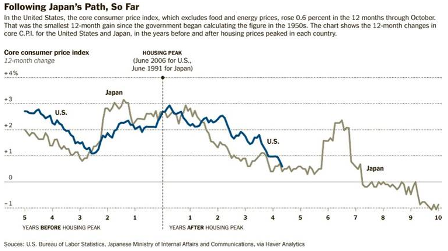
Finally, here’s a chart that the NYT ran in January that makes a compelling case that a 1970s-style inflation is off the table. If time allows, I’ll pen an Idle Speculator piece this summer on why that is. In the meantime:

Symmetry Capital Management, LLC (SCM) is a Pennsylvania-registered investment advisor that offers discretionary investment management to individuals and institutions. This publication is for informational, educational, and entertainment purposes only. It is not an offer to sell or a solicitation to buy securities, nor is it a recommendation to engage in any investment strategy. This material does not take into account your personal investment objectives, financial situation and needs, or personal tolerance for risk. Thus, any investment strategies or securities discussed herein may not be suitable for you. You should be aware of the real risk of loss that accompanies any investment activity, and it is strongly recommended that you consider seeking advice from your own investment advisor(s) when considering any investment strategy or security. SCM does not guarantee any specific outcome from any strategy or security discussed herein. The opinions expressed are based on information believed to be reliable, but SCM does not warrant its completeness or accuracy, and you should not rely on it as such.

Loan requests for home purchases dipped 3.2%

Not even a dead cat bounce in the important component:

Mortgage Applications up on Refinancings

May 18 (CNBC) — Applications for U.S. home mortgages jumped last week for the third week in a row as falling mortgage rates fueled demand for refinancing, an industry group said Wednesday.

The Mortgage Bankers Association said its seasonally adjusted index of mortgage application activity, which includes both refinancing and home purchase demand, climbed 7.8 percent in the week ended May 13.

The MBA’s seasonally adjusted index of refinancing applications surged 13.2 percent, while the gauge of loan requests for home purchases dipped 3.2 percent.

Obama mortgage reform proposal

If this is actually the jist of the proposals they make no sense to me.
For me the starting point is the question,
‘Is there public purpose supporting home ownership for lower income earners?’

Under current institutional arrangements, I’d say yes, and come up with an entirely different set of proposals, as I did
a while back for my website.

As is, looks to me like an obstacle to higher levels of output and employment.

Mortgage Costs to Rise As Government Lessens Role

February 11 (AP) — The Obama administration laid out three broad options Friday for reducing the government’s role in the mortgage market. All three would almost certainly lead to higher interest rates and costs for borrowers.

The administration said in a report that the government should withdraw its support for the mortgage market slowly, over five years or more. The report describes a path for winding down the troubled mortgage giants Fannie Mae and Freddie Mac.

But rather than making a single recommendation, the administration offered Congress three scenarios and will let lawmakers shape the final policy.

The options are:

— No government role, except for existing agencies like the Federal Housing Administration.

— A government guarantee of private mortgages triggered only when the market is in trouble.

— Government insurance for a targeted range of mortgage investments that already are guaranteed by private insurers. The government guarantee would kick in only if those private companies couldn’t pay.

Mortgage apps down

Still no sign of private sector credit expansion from housing.

US Home Loan Demand Drops, Rates at 10-Month High

February 9 (Reuters) — Applications for U.S. home mortgages dropped last week as the highest interest rates in 10 months sapped demand for home loan refinancing, an industry group said Wednesday.

The Mortgage Bankers Association said its seasonally adjusted index of mortgage application activity, which includes both refinancing and home purchase demand, fell 5.5 percent in the week ended Feb. 4.

The MBA’s seasonally adjusted index of refinancing applications fell 7.7 percent last week.

The gauge of loan requests for home purchases was down 1.4 percent.

Fixed 30-year mortgage rates averaged 5.13 percent in the week, up 32 basis points from 4.81 percent the prior week.

It was the highest rate since the week ended April 9, 2010.

Bernanke Excerpts


Karim writes:

Doesn’t seem like someone looking to tighten for a while….but things change and some probability of a hike for later this year or early next needs to be priced in…

Although it is likely that economic growth will pick up this year and that the unemployment rate will decline somewhat, progress toward the Federal Reserve’s statutory objectives of maximum employment and stable prices is expected to remain slow. The projections submitted by Federal Open Market Committee (FOMC) participants in November showed that, notwithstanding forecasts of increased growth in 2011 and 2012, most participants expected the unemployment rate to be close to 8 percent two years from now. At this rate of improvement, it could take four to five more years for the job market to normalize fully.

FOMC participants also projected inflation to be at historically low levels for some time. Very low rates of inflation raise several concerns: First, very low inflation increases the risk that new adverse shocks could push the economy into deflation, that is, a situation involving ongoing declines in prices. Experience shows that deflation induced by economic slack can lead to extended periods of poor economic performance; indeed, even a significant perceived risk of deflation may lead firms to be more cautious about investment and hiring.

I agree that their belief that very low inflation poses the risk of deflation will keep the Bernanke Fed from hiking at least until their inflation forecast picks up, and especially with unemployment north of 8%.

And I don’t see reported inflation picking up without crude oil rising enough and remaining high long enough to drag up core inflation.

Nor do I see any move towards fiscal expansion. Quite the contrary, Congress and the President are in consolidation mode, including cutting Social Security and Medicare expenditures, one way or another.

Nor do I see a burst of domestic credit driven buying anywhere on the horizon.

So still looks to me that fear of being the next Greece continues to work to cause us to be the next Japan.

Mortgage Applications in U.S. Increase for Third Week on Gain in Purchases

Still at extremely low levels, but moving up none the less, along with car sales, as happens at the early stages of a consumer credit expansion, supported by the trillions in financial equity from federal deficit spending that continues to add large quantities of income and savings to the economy.

Risks for equities remain the possibility of a near term dollar reversal, proactive fiscal tightening by Congress, and the ECB changing its mind with regards to supporting member funding needs.

Mortgage Applications in U.S. Increase for Third Week on Gain in Purchases

By Courtney Schlisserman

November 25 (Bloomberg) — The number of mortgage applications in the U.S. rose as purchases increased for a third straight week and refinancing picked up.

The Mortgage Bankers Association’s index increased 5.8 percent in the week ended Nov. 5, the Washington-based group said today. Refinancing rose 6 percent and purchase applications were up 5.5 percent, the most since Oct. 1.

MERS and the mortgage mess

>   
>   (email exchange)
>   
>   Some weekend reading – important but not urgent…
>   

It’s almost a certainty that complaints about foreclosures and requests for repurchases like those filed by The Fed and PIMCO against BoA, here, will increase in the coming year, increasing the likelihood of some form of congressional action to again try and deal with the mortgage foreclosure fallout.

I think we will soon hear a lot about a corporation that is legally involved in the origination of 60% of all mortgage loans in the U.S. yet there is no agreement on what the corporation actually is.

The attached PDF is a paper written by Christopher L. Peterson “Forclosure,Subprime Mortgage Lending, and the Mortgage Electronic Registration System” and is an excellent description of how MERS came to be and the legal controversy regarding it’s standing to file foreclosure notifications.

Some excerpts :

“MERS operates a computer database designed to track servicing and ownership rights of mortgage loans anywhere in the US. Originators and secondary market players pay membership dues and per transaction fees to MErS in exchange for the right to use and access the MERS records.”

“When closing on home mortgages, mortgage lenders now often list MERS as the mortgage of record on the paper mortgage- rather than the lender that is the actual mortgagee … even though MERS does not solicit, fund, service, or actually own any mortgage loans”

MERS was originally set up by mortgage industry insiders to avoid paying the fee charged by counties to cover the cost of maintain property records but its role has evolved.

“… when MERS is listed in county records as the owner of a mortgage, courts have generally made the natural assumption that MERS is the appropriate plaintiff to bring foreclosure action. To move foreclosures along as quickly as possible, MERS has allowed actual mortgagee and loan assignees or their servicers to bring foreclosure actions in MERS’s name, rather than in their own name.”

The contract provision use by mortgage originators in MERS as original mortgagee loan contracts states :

“MERS is a Mortgage Electronic Registration Systems Inc. MERS is a separate corporation that is acting solely as a nominee for Lender and Lender’s successors and assigns. MERS is the mortgagee under this Security Instrument. MERS is organized and existing under the laws of Delaware….”

The second sentence seems to suggest that MERS is some sort of agent – a nominee of the actual mortgage. Yet the third sentence flatly asserts that MERS in the mortgagee.

from Randy Wray

>   
>   From Professor Randall Wray:
>   
>   Here is one analysis; it will take you less than 5 minutes
>   to find many similar reports, many from people with expertise
>   on industry practice.
>   

Mortgage and Foreclosure Wrongdoing: Road Map for Investigating AGs

By Cynthia Kouril

September 26

Dear states attorneys general in Ohio, Texas, Florida and California (and to the rest of you as well):

Let me make it easy for you. It’s much easier to find the wrongdoing if you know where to look, so let me give you a generic road map:

1) The mortgage originator is the entity that met with homeowner (unless there was a mortgage broker involved) and actually did the mortgage transaction with the homeowner, a.k.a. “the closing.” The originator had the wet ink documents in its hands at some time.

In many cases the wet ink documents never left the originator. This creates a problem down the line because often the originators were small short-lived businesses. When businesses went belly-up holding all those wet ink original documents, where did the documents go? . . .

2) Immediately (by which I mean within a very few days, sometimes a very few hours) after the closing, the originator would resell the mortgage to a bigger bank. This would free up cash for the originator to make more origination next week. The originator would electronically scan a copy of the closing documents and email them to a data bank, most often that data bank was called MERS. In later iterations, some originators would upload the scans directly into the data bank.

3) If an assignment was done at all — and very often it was not — it would often be done in blank. That is to say, John Smith, President of Originating Firm would assign to _______. However, a blank assignment is like a check with the payee left blank; it becomes a bearer instrument (and for this reason a rather dangerous item). When it became known to what entity the mortgage should be assigned, John Smith (or his successor at Originating Firm) would be asked to do the assignment after the fact.

4) However, the originating mortgage company may have gone out of business before any assignments were done; who or what was left with legal authority to assign these mortgages, and where did the wet ink originals end up? I know anecdotally that these wet ink originals sometimes ended up going home with the laid-off workers of the mortgage companies. These people worried often that the documents would be destroyed if not kept safe and the lack of paper trail would cause the homeowners all kind of grief if they tried to sell their homes. In some cases, the laid-off mortgage company workers hoped to hold the documents hostage to collect back wages they were owed when the mortgage company failed.

5) All of this could have been avoided, of course, if the mortgages had been recorded in the county clerk’s office or land office, or in other governmental Torrens title system.

6) Sometimes the wet ink originals really were physically transferred to MERS, but MERS appears to have treated the physical files as unimportant because MERS and other electronic database services like it were intended to allow transfer of documents electronically, avoiding costly and time-consuming handling of paper documentation. When challenged to come up with wet ink originals, the electronic filing system has not always worked so smoothly.

7) The bank that thought it bought the mortgage from the originator (it paid money, but what did it actually get in return?) would enter into a “Pooling and Servicing Agreement” in order to create a Residential Mortgage Backed Security (RMBS). The purchasing bank, or another bank that it thought it sold the mortgage to, would become the “depositing bank” and deposit (or so it thought) the mortgage into a trust fund. Except that it didn’t actually have the mortgage to deposit.

8) The trust fund would have a set period during which it could accept deposits, after which the trust fund was “closed” and no additional mortgages could be deposited into it except as swap-outs for mortgages already in the trust. Any assignment of mortgage into the trust executed after the closing of the deposit period would be a legal nullity unless there was a swap with a mortgage already in the trust.

9) The assignments were rarely actually made in a timely fashion, and now it’s too late to do so. In addition the entities which could have made the assignments don’t necessarily even exist anymore.

10) The trustee assigned or sold the right to collect the payments to the “servicer” and the “investors” thereby splitting the interest in land from the debt (mortgage fractionalization). The servicer collects the money from the homeowner, takes its substantial cut and forwards the remainder to the investors. The investors thought they were getting A or better rated bonds and include municipalities, and pension funds.

11) When the foreclosure tsunami first began and the foreclosing banks had no original wet ink documents to prove that they had standing to foreclose, there was a wave of “lost note affidavits”. Judges at the front end of this crisis had no inkling that anything was amiss and relied upon those affidavits. After seeing reams of lost note affidavits, they began asking for better explanations.

12) That’s when the forgeries and perjuries began. There are all sorts of people signing all sorts of documents claiming to be officers of companies for which they do not work. Contact me and I can email you a list.

There are all sorts of signatures that don’t look at all alike, all with the same person’s name. In at least one instance the name of a person who was in jail at the time and not available to be working at the company appears on documents along with his purported signature.

Color scans of mortgage papers are being passed off as wet ink originals; you can see the color printer dot matrix under magnification. Documents are being backdated, which is really fun when you find out the notary was not yet a notary on the date shown on the documents.

13) Adding to the confusion, a bank may believe that it services or is trustee for, or has a particular mortgage in an RMBS solely because a mortgage is included on an inventory list attached to a pooling and servicing agreement. However, any given mortgage might be on the wrong list, either because there was a typo when preparing a list or because an unscrupulous originator “sold” the same loan twice, or a sloppy originator accidently put the same loan on two different lists. If the original wet ink originals had been physically transferred, we would be able to match up payments from the banks with the originals and figure out who owned what.

14) Lastly, depending on the law in your state, separating the interest in land from the right to receive payment — frationalization—may have extinguished the the right to foreclose and turned the mortgage debt into regular unsecured debt. Check out 55 Am. Jur. 2d, Mortgages § 1002