From DB,
Comments below:
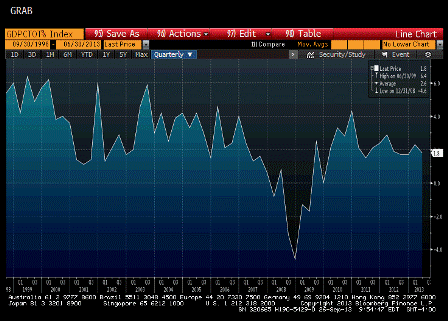
Commentary for friday: the second print on Q2 GDP growth showed a significant upward revision to +2.5% from +1.7% as previously reported. Recall that growth was only +1.1% in Q1.
After the 3rd downward revision
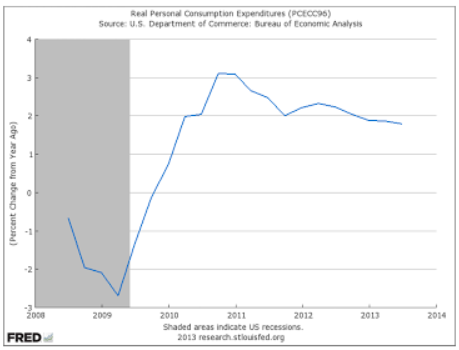
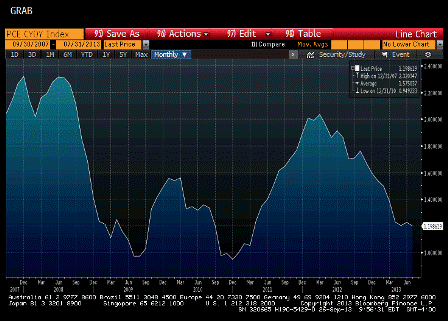
Given that the deflator was revised a tenth higher (0.8% vs. 0.7% as previously reported), the magnitude of the overall revision is even more impressive. Personal consumption was unrevised at +1.8% in Q2,
Down from 2.3% in Q1 if I recall correctly
While business fixed investment was only modestly softer (+4.4% vs. +4.6%). Residential investment was also reduced slightly (+12.9% vs. +13.4%). The big changes to Q2 growth were in inventories and international trade. Inventory accumulation was lifted to $62.6b from $56.7b as first reported, thereby adding 0.6 ppt to growth compared to 0.4 ppt previously.
The question is voluntary to restock from a Q1 dip or sales growth forecast, or involuntary due to lower than expected sales.
In terms of trade, firmer exports and softer imports drove net exports to improve; as a result, the original -0.8 ppt drag from trade was revised up to zero.
Question is whether exports can be sustained through Q3 as the dollar spike vs Japan and then the EM’s hurts ‘competitiveness’
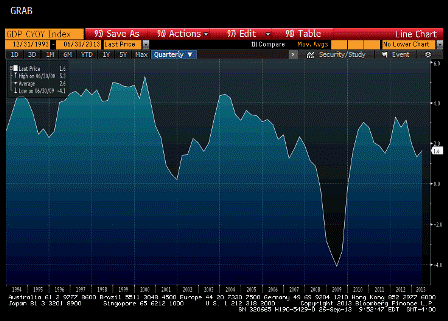
The government drag on Q2 was revised to become slightly larger (-0.2 ppt vs. -0.1 ppt as first reported). Nonetheless, the federal government drag on economic activity has diminished significantly compared to the impact in Q1 (-0.7 ppt) and Q4 2012 (-1.2 ppt). A diminished drag from the public sector should enable overall GDP growth, which was +1.6% year-on-year in Q2, to close the gap with private sector growth, which was +2.5% over the same period.
I see it this way- the govt deficit spending is a net add of spending/income. So with the deficit dropping from 7% of GDP last year to maybe 3% currently, with maybe 2% of the drop from proactive fiscal initiatives, some other agent has to be spending more than his income to sustain sales/incomes etc. If not, output goes unsold/rising inventories and then unproduced. The needed spending to ‘fill the spending gap’ left by govt cutbacks can come from either domestic credit expansion or increased net exports (no resident credit expansion/savings reductions. I don’t detect the domestic credit expansion and net export growth/trade deficit reduction seems likely given the dollar spike and oil price spike?
If we achieve +3.0% growth in the current quarter and +3.5% in Q4, this will push the year-on-year rate to +1.7% in Q3 and +2.5% by yearend. (this is in line with the Fed’s central tendency forecasts, which are due to be updated at the september FOMC meeting.)
In order for our growth forecast to come to fruition, we will need to see a pickup in consumer spending,
Hard to fathom, as personal consumption has been slipping from 2.3 in Q1 to 1.8 in Q2, and walmart and the like sure aren’t seeing any material uptick in sales? Car sales are ok, but further gains from the June high rate seems doubtful as July has already posted a slower annual rate.
homebuilding and business investment relative to first half performance. The first two series are likely to be boosted by sturdier employment gains, and hence faster household income growth.
Seems early Q3 reports show falling mtg purchase applications, home sales falling month to month, and lots of anecdotals showing the spike in mtg rates has slowed things down. So growth from Q2 seems unlikely at this point?
We are confident that the pace of hiring will pick up in the relatively near term, because jobless claims continue to hold near cyclical lows.
New jobs dropped to 160,000 in july, and claims measure people losing their jobs, not new hires. Also, top line growth, the ultimate driver of employment, remains low, so assuming actual productivity hasn’t gone negative a spike in jobs is unlikely?
Given the usefulness of jobless claims as a payroll forecasting tool, it should come as little surprise that they are also significantly correlated with wage and salary growth. In fact, over the past 25 years, the current level of jobless claims has typically coincided with private wage and salary growth above 6% compared to 3.8% in Q2.
As above, claims may have correlated with all that in the past, but the causation isn’t there. Looks to me like claims are more associated with ‘time from the bottom’ as with time after the economy bottoms firings tend to slow, regardless of hiring?
Meanwhile, the third growth driver noted above—business investment—will largely depend on the corporate profit trend. Yesterday’s second print on GDP provided the first look at economy-wide corporate profits, which rose +3.9% in Q2 vs. -1.3% in Q1. Many analysts fretted the decline in profits in Q1, because they tend to drive business investment and hiring plans. We dismissed the Q1 weakness as a temporary development which occurred in lagged response to the growth slowdown in Q4 2012 and Q1 2013. The fact that profits are reaccelerating (+5.0% year-on-year versus +2.1% in Q1) is an encouraging development in this regard.
Profits also are a function of sales, which are a function of ‘deficit spending’ from either govt or other sectors, as previously discussed. And, again, i see no signs of ‘leaping ahead’ in any of those sectors.
Faster GDP growth through yearend should result in even stronger corporate profit growth.
Agreed! But didn’t he just say that the GDP growth would come from business investment that’s a function of profits (and in turn a function of sales/GDP)?
To be sure, the additional growth momentum now evident in the Q2 GDP results makes our 3% target for current quarter growth more easily attainable. –CR
I don’t see how inventory growth is ‘momentum’ and seems there are severe headwinds to Q3 net exports as drivers of growth?
And govt is there with a deficit of only 3% of GDP to help offset the relentless ‘unspent income’/demand leakages inherent in the global institutional structure.