WSJ–economists on stimulus


[Skip to the end]

Mainstream economics is largely a disgrace

Economists Give Fiscal Stimulus Mixed Grades

Jon Hilsenrath

August 22 (WSJ) — Economists at the Federal Reserve’s Jackson Hole Symposium in Wyoming gave the Obama administration’s fiscal-stimulus program a mixed review, saying it wasn’t as well targeted as it could have been and pointing to the challenges of balancing stimulus against long-term deficit worries.

In a paper being presented Saturday at the conference, Alan Auerbach of the University of California at Berkeley and William Gale of the Brookings Institution noted problems the U.S. had in the 1930s and Japan had in its 1990s “Lost Decade” making fiscal policy work.

“The remarkable fact is that sustained fiscal policy expansion was not attempted in either episode,” the economists wrote, in part because policy makers were focused on balancing budgets even as they tried to pump money into the economy.

The U.S. government, for instance, raised taxes in 1932, as did state governments, and a round of fiscal restraint hit in 1936 and 1937. “By the end of the decade, even with output well below potential and the unemployment rate at 17%, the contribution of fiscal policy to aggregate demand in 1939 was 0.6 percentage points larger than in 1929,” they note. In Japan, spending was often offset by tax increases, in part due to concerns about the fiscal outlook.

They spend less time detailing their specific criticisms of the 2009 stimulus plan, but offer up several critiques: tax cuts will stimulate demand but could have been designed better, they say. Research has shown that lower-income, liquidity-constrained households have a higher tendency to consume after getting tax cuts than higher income households, but the authors don’t detail how the program could have been pointed more in their direction. Moreover, the authors write, spending wasn’t well-targeted. “Government investments were part of a longer-term Obama agenda and are probably not best characterized solely as stimulus,” they say.


[top]

Brazil Lula Vetoes Spending Limits for 2010 Budget, Estado Says


[Skip to the end]

Brazil seems to be catching on?

Brazil Lula Vetoes Spending Limits for 2010 Budget, Estado Says

August 14 (Bloomberg) — Brazil’s President Luiz Inacio Lula da Silva vetoed 20 items in the guidelines for next year’s budget that sought to curtail government spending on public
works, O Estado de S. Paulo said.

Lula also vetoed a measure that would have limited the government’s ability to increase investment under its so-called Growth Acceleration Program, which is comprised of infrastructure spending on ports, roads and energy projects, the Sao Paulo-based newspaper reported, citing the official gazette.


[top]

CPI/IP/Michigan


[Skip to the end]

Yes, there’s clearly an ‘unidentified demand leakage’ to have all this deficit spending with demand only holding at very low levels.

I keep coming back to the depressing effects of low interest rates and a large Fed portfolio shifting interest income from savers to govt., banks, and corporate borrowers with consumers who borrow getting very little benefit as incomes at best stagnate.

As Bernanke stated in his 2004 paper, the fiscal drag from lower interest rates can be offset by a tax cut or fed spending increase.


Karim writes:

Biggest news this morning was surprising drop in Michigan survey. Despite equity rally, lower gas prices and labor market becoming ‘less bad’, Michigan survey drops 2.8pts to lowest level since March. Consumer still nowhere to be found in current ‘recovery’.

  • Michigan Survey falls from 66 to 63.2
  • 1y Fwd Inflation expex drop from 3.0 to 2.9; 5-10yr fwd from 2.9 to 2.8
  • IP for July up 0.5%; aided by auto production; ex-autos -0.1%
  • CPI unchanged m/m for both headline and core; headline -2.1% y/y and core +1.5%
  • OER (Unch) and lodging away from home (-2.1%) offset apparel (0.6%), vehicles (0.3%) and tobacco (2.2%).
  • Look for quirks in vehicle pricing to resolve in coming months and help drive core below 1% by yr-end.


[top]

French Non-Farm Payrolls Fall Less Than Expected


[Skip to the end]

Proactive fiscal measures, exports, and very ugly automatic stabilizers seem to have slowed the decline in employment, coupled with productivity increases that are supporting output with lower levels of employment.

French Non-Farm Payrolls Fall Less Than Expected as Slump Eases

August 14 (Bloomberg) — French companies cut fewer jobs than expected in the second quarter as the euro area’s second-largest economy exited its worst recession since World War II.

Payrolls, excluding government employees, farm workers and the self-employed, dropped by 74,100, or 0.5 percent, to 15.65 million, the Paris-based Labor Ministry said today. That was less than the 0.8 percent drop forecast by three economists in a Bloomberg News survey, and compared with a loss of 168,300 jobs in the first quarter.

“The current weakness of domestic demand and excess production capacity account for both the weakness in companies’

pricing power and the continued deterioration of the labor market,” said Caroline Newhouse-Cohen, an economist at BNP Paribas, in a report yesterday. “A lot of uncertainties are still weighing on the French economy.”

The French economy returned to growth in the second quarter as exports rose and 30 billion euros ($42.8 billion) in government spending and tax cuts introduced by President Nicolas Sarkozy helped consumer spending. Companies cut investment at a slower pace than in the two previous quarters.

Rising joblessness in France is curbing government revenue and boosting welfare spending, pushing up the budget deficit.

The budget shortfall will soar to 8.3 percent of gross domestic product next year, more than the 7 percent to 7.5 percent the government expects, according to the Organization for Economic Cooperation and Development.

France’s jobless rate hit a three-year high of 9.4 percent in June, the European Union statistics office said on July 31.

On Aug. 11, Adecco SA, the world’s largest supplier of temporary workers, reported a surprise second-quarter loss and said it will deepen cost cuts as sales decline because fewer companies are hiring. The company, based in Zurich, cut about 2,000 jobs in the quarter and told workers in France that an additional 350 jobs will be cut and 100 branches merged in 2009.

The number of temporary workers in France fell 3.7 percent in the second quarter from the first and 32.1 percent from a year earlier to 419,600, the Labor Ministry said. French monthly wages rose 0.4 percent in the second quarter from the first, when they climbed 0.8 percent, the Labor Ministry also said today. From a year ago, wages rose 2.2 percent.


[top]

Trade/FOMC Preview/China Exports/Stimulus hangups


[Skip to the end]


Karim writes:

Trade: Exports up 2%, Imports up 2.3%. Imports ex-petroleum down 1% and consumer goods imports down 4.8%. Sector strength mainly in industrial goods (restocking), but indicators of final demand still look weak.

Don’t look for dramatic changes to FOMC statement; major focus will be on Treasury purchase language.

1) Econ assessment will turn slightly more positive; May mention signs of a nascent recovery, though underlying demand likely to remain weak for the foreseeable future. Inflation will remain subdued.

2) Exceptionally low FF rate for an ‘extended period’ will remain. I’d expect this phrase to be dropped about 3-4mths before they’d actually hike, with the first move possibly being a hike in the rate they pay banks on excess reserves.

3) Likely to indicate that Treasury purchases will not continue once the $300bn level has been reached, though they may restart the program in the future if needed. Language on other credit easing programs to stay intact.

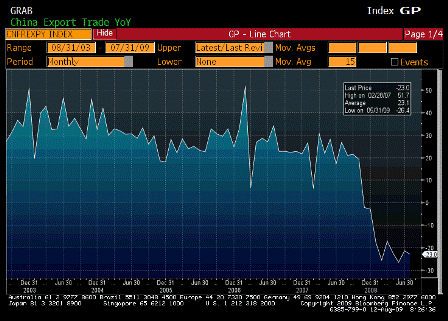
China’s export model showing little bounce (latest data last night)

Some hangups with the stimulus package (courtesy of American General Contractors):

“President Barack Obama’s stimulus spending has run into a problem: A shortage of General Electric Co. water filters,” Bloomberg News reported on Thursday. “GE makes them in Canada. Under the program’s ‘Buy American’ rules, that means the filters can’t be used for work paid for by the $787 billion fund. Contractors are searching the U.S. in vain for filters as well as bolts and manhole covers needed to build wastewater plants, sewers and water pipes financed by the economic stimulus. As officials wait for federal waivers to buy those goods outside the U.S., water projects from Maine to Kansas have been delayed….the Environmental Protection Agency, which administers the water funding, has granted six waivers and has 29 petitions pending….The rules affect water projects most because highways and bridges have been constructed under Buy American regulations for the past 30 years, and not much stimulus money has been spent so far on public housing and schools, said Chris Braddock, the U.S. Chamber of Commerce’s associate director for procurement.”

“Gun-shy [school] administrators might undermine a federal stimulus program that encourages school construction by helping districts pay down debt,” the (Wisconsin) Daily Reporter reported on Monday. “Some district leaders say they gladly are accepting a piece of $125 million in no-interest bonds but are reluctant to invest the savings in new projects. ‘The climate out there is terrible and with the cuts made in the state budget, it’s just really difficult right now,’ said John Whalen, president of the Sun Prairie Area School District Board of Education. ‘I don’t anticipate this will encourage us to do more projects,’ he added. The district received $23 million in federal bonding, more than any other district in the state, though the bonding did not encourage additional construction. Sun Prairie used it to help pay off the $30 million it put on taxpayers for construction of a new high school and conversion of the old high school into a middle school. Both schools are scheduled to open in fall 2010. While Sun Prairie stands pat, other districts might jump at the opportunity. The School District of La Crosse received $6.6 million in bonds to help pay off debt from $18.5 million in expansion, renovation and upgrade projects.”


[top]

Social Security commentary published


[Skip to the end]

Social Security: Another Case of Innocent Fraud?

By Mathew Forstater and Warren Mosler

August 6th — In his recent book, The Economics of Innocent Fraud, John Kenneth Galbraith surveys a number of false beliefs that are being perpetuated among the American people about how our society operates: innocent (and sometimes not-so-innocent) frauds. There is perhaps no greater fraud being committed presently—and none in which the stakes are so high—as the fraud being perpetrated regarding government insolvency and Social Security. President Bush uses the word “bankruptcy” continuously. And the opposition agrees there is a solvency issue, questioning only what to do about it.
Fortunately, there is a powerful voice on our side that takes exception to the notion of government insolvency, and that is none other than the Chairman of the Federal Reserve. The following is from a transcript of a recent interview with Fed Chairman Alan Greenspan:

    RYAN… do you believe that personal retirement accounts can help us achieve solvency for the system and make those future retiree benefits more secure?

    GREENSPAN: Well, I wouldn’t say that the pay-as-you-go benefits are insecure, in the sense that there’s nothing to prevent the federal government from creating as much money as it wants and paying it to somebody. The question is, how do you set up a system which assures that the real assets are created
    which those benefits are employed to purchase. (emphasis added)

For a long time we have been saying there is no solvency issue (see C-FEPS Policy Note 99/02 and the other papers cited in the bibliography at the end of this report). Now with the support of the Fed Chairman, maybe we can gain some traction.

Let us briefly review, operationally, government spending and taxing. When government spends it credits member bank accounts. For example, imagine you turn on your computer, log in to your bank account, and see a balance of $1,000 while waiting for your $1,000 Social Security payment to hit. Suddenly the $1,000 changes to $2,000. What did the government do to make that payment? It did not hammer a gold coin into a wire connected to your account. It did not somehow take someone’s taxes and give them to you. All it did was change a number on a computer screen. This process is operationally independent of, and not operationally constrained by, tax collections or borrowing.

That is what Chairman Greenspan was telling us: constraints on government payment can only be self-imposed.

And what happens when government taxes? If your computer showed a $2,000 balance, and you sent a check for $1,000 to the government for your tax payment, your balance would soon change to $1,000. That is all—the government changed your number downward. It did not “get” anything from you. Nothing jumped out of the government computer into a box to be spent later. Yes, they “account” for it by putting information in an account they may call a “trust fund,” but this is “accounting”—after the fact record-keeping—and has no operational impact on government’s ability to later credit any account (i.e., spend!).

Ever wonder what happens if you pay your taxes in actual=2 0cash? The government shreds it. What if you lend to the government via buying its bonds with actual cash? Yes, the government shreds the cash. Obviously, the government doesn’t actually need your “funds” per se for further operational purpose.

Put another way, Congress ALWAYS can decide to make Social Security payments, previous taxing or spending not withstanding, and, operationally, the Fed can ALWAYS process whatever payments Congress makes. This process is not revenue constrained. Operationally, collecting taxes or borrowing has no operational connection to spending. Solvency is not an issue. Involuntary government bankruptcy has no application whatsoever! Yet “everyone” agrees—in all innocence—that there is a solvency problem, and that it is just a matter of when. Everyone, that is, except us and Chairman Greenspan, and hopefully now you, the reader, as well!

So if solvency is a non-issue, what are the issues? Inflation, for one. Perhaps future spending will drive up future prices. Fine! How much? What are the projections? No one has even attempted this exercise. Well, it is about time they did, so decisions can be made on the relevant facts.

The other issue is how much GDP we want seniors to consume. If we want them to consume more, we can award them larger checks, and vice versa. And we can do this in any year. Yes, it is that simple. It is purely a political question and not one of “finance.”

If we do want seniors to participate in the future profitability of corporate America, one option (currently not on the table) is to simply index their future Social Security checks to the stock market or any other indicator we select—such as worker productivity or inflation, whatever that might mean.

Remember, the government imposes a 30% corporate income tax, which is at least as good as owning 30% of all the equity, and has at least that same present value. If the government wants to take a larger or smaller bite from corporate profits, all it has to do is alter that tax—it has the direct pipe. After all, equity is nothing more than a share of corporate profits. Indexation would give the same results as private accounts, without all the transactional expense and disruption.

Now on to the alleged “deficit issue” of the private accounts plan. The answer first—it’s a non-issue. Note that the obligation to pay Social Security benefits is functionally very much the same as having a government bond outstanding—it is a government promise to make future payments. So when the plan is enacted the reduction of future government payments is substantially offset” by future government payments via the new bonds issued. And the funds to buy those new bonds come (indirectly) from the reductions in the Social Security tax payments—to the penny. The process is circular. Think of it this way. You get a $100 reduction of your Social Security tax payment. You buy $100 of equities. The person who sold the equities to you has your $100 and buys the new government bonds. The government has new bonds outstanding to him or her, but reduced Social Security obligations to you with a present value of about $100. Bottom line: not much has changed. One person has used his or her $100 Social Security tax savings to buy equities and has given up about $100 worth of future Social Security benefits (some might argue how much more or less than $100 is given up, but the point remains). The other person sold the equity and used that $100 to buy the new government bonds. Again, very little has changed at the macro level. Close analysis of the “pieces” reveals this program is nothing but a “wheel spin.”

Never has so much been said by so many about a non-issue. It is a clear case of “innocent fraud.” And what has been left out? Back to Chairman Greenspan’s interview—what are we doing about increasing future output? Certainly nothing in the proposed private account plan. So if we are going to take real action, that is the area of attack. Make s ure we do what we can to make the real investments necessary for tomorrow’s needs, and the first place to start for very long term real gains is education. Our kids will need the smarts when the time comes to deal with the problems at hand.

References

•Galbraith, John Kenneth, 2004, The Economics of Innocent Fraud: Truth for Our Time, Boston: Houghton Mifflin.

•Wray, L. Randall, 1999, “Subway Tokens and Social Security,” C-FEPS Policy Note 99/02, Kansas City, MO: Center for Full Employment and Price Stability, January, (http://www.cfeps.org/pubs/pn/pn9902.html).

•Wray, L. Randall, 2000, “Social Security: Long-Term Financing and Reform,” C-FEPS Working Paper No. 11, Kansas City, MO: Center for Full Employment and Price Stability, August, (http://www.cfeps.org/pubs/wp/wp11.html).

•Wray, L. Randall and Stephanie Bell, 2000, “Financial Aspects of the Social Security ‘Problem’,” C-FEPS Working Paper No. 5, Kansas City, MO: Center for Full Employment and Price Stability, January, (ht tp://www.cfeps.org/pubs/wp/wp5.html).


[top]

Clunker Man- new wage caps


[Skip to the end]

EDIT: AMENDMENT TO IMPOSE AN INCOME LIMIT WAS REJECTED

Wonder what this does to sales? And fraud as well?
And enforcement costs would be very high if they try to do that.

Also, I’d guess people like Larry don’t drive all that much, so the fuel savings are likely over estimated.

>   
>   (email exchange)
>   
>   On Thu, Aug 6, 2009 at 9:39 PM, Russell wrote:
>   
>   They are listening to you. You can only do it now if you make less than $50,000 a year.
>   

Clunker Man

Right, perfect example of how the program’s helping the higher income Americans a lot more than the lower income americans!

>   
>   (email exchange)
>   
>   On Thu, Aug 6, 2009 at 12:22 PM, Larry wrote:
>   
>   Turned my 2001 Durango in for 2009 Toyota Highlander and got the full
>   $4500.00.
>   CLUNKER MAN.
>   


[top]

Deficit Myths doing real damage


[Skip to the end]

While I much prefer my proposal for health care, Increasing the size of the deficit during this period of deficient aggregate demand should not be the reason for rejecting or accepting the proposed health care act.

Deficit myths have moved the discussion off point.

Scrap Health Care Reform If It Adds To Deficit

August 5, 2009 – Scrap Health Care Reform If It Adds To Deficit, U.S. Voters Tell Quinnipiac University National Poll; Voters Disapprove Of Obama’s Handling Of Health Care

American voters, by a 55 – 35 percent margin, are more worried that Congress will spend too much money and add to the deficit than it will not act to overhaul the health care system, according to a Quinnipiac University national poll released today. By a similar 57 – 37 percent margin, voters say health care reform should be dropped if it adds “significantly” to the deficit.


[top]

First Lady Requires More Than 20 Attendants


[Skip to the end]

Yes, seems to be seriously excessive!

First Lady Requires More Than 20 Attendants

By Dr. Paul L. Williams

1. $172,2000 – Sher, Susan (Chief Of Staff)

2. $140,000 – Frye, Jocelyn C. (Deputy Assistant to the President and Director of Policy And Projects For The First Lady)

3. $113,000 – Rogers, Desiree G. (Special Assistant to the President and White House Social Secretary)

4. $102,000 – Johnston, Camille Y. (Special Assistant to the President and Director of Communications for the First Lady)

5. Winter, Melissa E. (Special Assistant to the President and Deputy Chief Of Staff to the First Lady)

6. $90,000 – Medina, David S. (Deputy Chief Of Staff to the First Lady)

7. $84,000 – Lelyveld, Catherine M. (Director and Press Secretary to the First Lady)

8. $75,000 – Starkey, Frances M. (Director of Scheduling and Advance for the First Lady)

9. $70,000 – Sanders, Trooper (Deputy Director of Policy and Projects for the First Lady)

10. $65,000 – Burnough, Erinn J. (Deputy Director and Deputy Social Secretary)

11. Reinstein, Joseph B. (Deputy Director and Deputy Social Secretary)

12. $62,000 – Goodman, Jennifer R. (Deputy Director of Scheduling and Events Coordinator For The First Lady)

13. $60,000 – Fitts, Alan O. (Deputy Director of Advance and Trip Director for the First Lady)

14. Lewis, Dana M. (Special Assistant and Personal Aide to the First Lady)

15. $52,500 – Mustaphi, Semonti M. (Associate Director and Deputy Press Secretary To The First Lady)

16. $50,000 – Jarvis, Kristen E. (Special Assistant for Scheduling and Traveling Aide To The First Lady)

17. $45,000 – Lechtenberg, Tyler A. (Associate Director of Correspondence For The First Lady)

18. Tubman, Samantha (Deputy Associate Director, Social Office)

19. $40,000 – Boswell, Joseph J. (Executive Assistant to the Chief Of Staff to the First Lady)

20. $36,000 – Armbru ster, Sally M. (Staff Assistant to the S ocial Secretary)

21. Bookey, Natalie (Staff Assistant)

22. Jackson, Deilia A. (Deputy Associate Director of Correspondence for the First Lady)

Copyright 2009 Canada Free Press.Com

There has never been anyone in the White House at any time that has created such an army of staffers whose sole duties are the facilitation of the First Lady’s social life. One wonders why she needs so much help, at taxpayer expense, when even Hillary, only had three; Jackie Kennedy one; Laura Bush one; and prior to Mamie Eisenhower social help came from the President’s own pocket.

By the way… his does not include makeup artist Ingrid Grimes-Miles, 49, and “First Hairstylist” Johnny Wright, 31, both of whom traveled aboard Air Force One on her recent trip to Europe!


[top]