Excel:
Sector financial balances
Category Archives: Government Spending
Debt ceiling
Potential economic nightmare coming up. Hoping for the best.
Looks like a total failure on my part to get the word out sufficiently to make a difference in policy.
On Tue, Nov 2, 2010 at 9:42 PM, wrote:
Now, we’re about to see the real risks of the legal constraints placed on gov’t spending via the debt ceiling. Can’t wait to see if the newly elected Tea Party/GOP Senator from Kentucky Rand Paul tries to filibuster the move to raise the debt ceiling. What will the wealthy benefactors of these nutjob Tea Party candidates do if they start acting according to their principles?
The Bernanke Paradox
Just arrived from Professor Tcherneva.
It outlines the paradox between what the Chairman says about govt spending not being operationally constrained by revenues, aggregate demand management, and his stance on fiscal responsibility.
PDF:
Tcherneva: Bernanke’s Paradox
Living with a deficit terrorist majority
>
> (email exchange)
>
> On Wed, Oct 27, 2010 at 8:11 PM, wrote
>
> This kind of talk is not bullish.
>
> If they try to do things too quickly all bets are off.
>
Right. That’s what I see as our biggest risk, though 100 billion isn’t all that much, and it likely be out of future spending.
All these republicans you’ve been cheering on are heck bent on total destruction of our economy via deficit reduction as they’ll have enough votes for a balanced budget amendment. And a lot of democrats as well.
Tea Party leaders Michael Johns and Michael Patrick Leahy do know how it works, and to their credit haven’t been cheer leading balancing the budget, just lower taxes. But now seems they need to take a much more active role in working to keep taxes a lot lower than spending, which means opposing the balanced budget amendment move.
The mess we are in now can be traced to the tax hikes in the early Clinton years that were allowed to persist and drive the budget into surplus in the late 90’s, which reduced the financial equity that supports the credit structure by maybe a trillion, back when that was a lot of money. And, of course, when it collapsed the next year no one understood the obvious move was the likes of a payroll tax holiday to sustain demand from income, rather than wait for private sector credit expansion.
Bush finally did that in 03 shortly after Elizabeth and I met with Andrew Card at the white house pointing this out. His then famous statement when asked about the deficit ‘i don’t look at numbers on a piece of paper, i look at jobs’ followed shortly after our meeting. But that’s another story…
Republicans Plan Budget Cuts as Early Act If They Take Power
By Patrick O’Connor
October 27 (Bloomberg) — U.S. House Republicans plan to try to slash $100 billion from the federal budget as early as January if they wrest power from Democrats in this year’s midterm elections, setting up possible early showdowns with President Barack Obama on taxes and spending.
A Republican House takeover would thrust new committee heads, such as Representative Dave Camp on the Ways and Means panel, into the spotlight within weeks — or days — of seizing their gavels in early January. They would confront quick political tests that could alienate independent voters and Tea Party activists alike, analysts said.
“The major issues are going to be fiscal, and fiscal issues are always contentious,” said Jack Pitney, a political science professor at Claremont McKenna College in Claremont, California.
Carrying out spending cuts that Republicans have pledged to seek — which would amount to 21 percent of the government’s so-called discretionary money pot — could prove politically difficult. Reducing funds for programs such as college loans for low-income students or medical research at the National Institutes of Health is harder than promising to do that on the campaign trail.
‘Political Repercussions’
Republicans “will quickly find out that across-the-board cuts have political repercussions,” Pitney said.
A lame-duck session of Congress convening two weeks after the Nov. 2 elections will try to fund the government next year and deal with Bush-era tax cuts expiring Dec. 31. Prospective Republican House control could be an obstacle to Democrats in finishing that work before adjourning. Camp and other Republicans would then need to grapple with those tasks as they take over, even as they push their promised budget cuts.
The backdrop is a federal deficit that the Congressional Budget Office said totaled $1.29 trillion in the fiscal year that ended Sept. 30. At 8.9 percent of the nation’s gross domestic product, it was the second-biggest shortfall since 1945.
The following reviews the battle lines likely to be drawn in top House committees under Republican rule, and looks at the potential panel leaders who would preside over the fights:
Appropriations
If Democrats fail to fund the government through September 2011, the end of the federal fiscal year, this committee would be the stage for that fight in the new Congress. And settling on the panel’s chairman would be one of the initial tasks facing Republicans.
House Republican leader John Boehner of Ohio, his party’s speaker-in-waiting, called for the $100 billion budget cut on Sept. 23 as part of a governing agenda aimed at wooing voters. The cuts, which weren’t specified, would come from the $477 billion Congress allocated in 2010 for non-defense domestic discretionary programs. Social Security and Medicare are among the programs excluded from the proposed 21 percent reductions in discretionary spending.
Obama’s request for $73.4 billion for the Department of Education in the 2011 budget, including $23 billion for Pell Grants to help low-income students afford college, offers one example of the tough choices the Republicans would face. A 21 percent cut across-the-board would take about $15 billion from education. A 21 percent cut in Pell Grants would subtract almost $5 billion from the program.
HHS Budget
Obama asked Congress for $76.4 billion for the Department of Health and Human Services. Almost half that — $32 billion – -is for NIH, which includes the National Cancer Institute and other research facilities. A 21 percent cut would slash NIH funding by more $6 billion.
The question of which Republican would lead the Appropriations panel is complicated by the six-year limit the party placed on how long a lawmaker could serve as its leading member on a committee.
Representative Jerry Lewis, a California Republican, reaches that limit at year’s end. He has said he will seek a waiver to allow him to take the committee’s helm.
Lewis, 76, initially balked when Boehner pushed House Republicans to embrace a moratorium on lawmaker-sponsored projects, known as earmarks. Lewis reversed his position last year, gaining favor with Boehner.
Representative Hal Rogers, a Kentucky Republican, would be the likely committee head if Lewis fails in his bid. Rogers, 72, is known for steering funding for road improvements and other projects to his state and district. The Lexington, Kentucky, Herald Leader once dubbed him the “Prince of Pork.”
Germany’s Econ Minister Brüderle hits back at French and US criticism
The don’t know the elevated fiscal deficits due to their ‘automatic Keynesian stabilizers’ did the trick, including (temporarily) weakening euro?
So why are they spewing this nonsense?
Class warfare to keep union demands in check and domestic demand suppressed so the well off can optimize their personal real terms of trade?
Expect austerity to continue to work against domestic demand and keep the forces in place that will continue to drive the euro to a level high enough to contain net exports.
Germany hits back at French and US criticism
By Gerrit Wiesmann and Stanley Pignal
October 21 (FT) — “Growing domestic demand shows our recovery is standing on two feet,” said Rainer Brüderle, Germany’s economics minister. Gross domestic product is expected to rise by 3.4 per cent this year, up from a spring forecast of 1.4 per cent, and 1.8 per cent in 2011, up from 1.6 per cent. Mr Brüderle said Germany’s recovery was “a non-Keynesian growth programme” in which fiscal discipline spurred private investment. “It’s a textbook recovery,” Mr Brüderle said, describing how an uptick in foreign demand earlier this year had spurred exports, then investment and finally job creation in Germany itself. Unemployment is expected to fall below 3m this autumn and remain “clearly below” that mark next year. At the start of the year, economists had worried about whether the German upturn would be “V-, W-, L- or U- shaped”, he said. “Now we know that was irrelevant. This has become an XL [extra-large]-recovery.”
Geithner’s Letter to G-20 on ‘External Imbalances’
They’ve always been completely out of paradigm on domestic federal budgets. But this time around their ignorance has already been costly beyond imagination and looks to only get more so.
Geithner is just symptomatic of all that’s wrong with the mainstream’s understanding of monetary operations.
And I haven’t heard a single mainstream economist who’s got it right on the budget issue or the trade issue.
With the hawks and doves agreeing that federal deficits are a long term problem the obvious fundamental that imports are real benefits and exports real costs gets no consideration.
The trade war is a direct result of not understanding that domestic demand can always be continuously sustained by fiscal adjustments to the direct benefit of that economy.
The rest of the world’s desire to net export to us opens the door for unimagined US prosperity. With a full payroll tax (FICA) suspension we’d probably have enough domestic demand to buy all the goods and services we could produce at full employment plus all we wanted to buy from the rest of the world. And, if not, taxes could be lower still.
Geithner’s Letter to G-20 on ‘External Imbalances’: (Full Text)
Oct. 22 (Bloomberg) — The following is a reformatted
letter dated Oct. 20 from U.S. Treasury Secretary Timothy F.
Geithner to other officials in the Group of 20 industrial and
emerging economies. G-20 finance ministers and central bankers
are meeting today and tomorrow in Gyeongju, South Korea.
Dear G-20 Colleagues:
I am writing to offer some suggestions for our meeting later
this week. We are obviously at a moment where the world is
looking to the G-20 to provide a stronger commitment to work
together to address the major challenges to a sustainable global
recovery. I know that some of you will want to reserve any
substantive agreement until the November Leaders’ Summit, but I
think we should take advantage of the presence of the central
bank governors to try to reach agreement on the broad elements
this weekend, and put those in a report to our Leaders.
Building on Pittsburgh’s Framework for Strong, Sustainable, and
Balanced Growth and Toronto’s commitments on addressing
sovereign debt sustainability, here are three specific
suggestions designed to provide a stronger framework of
cooperation on international financial issues:
First, G-20 countries should commit to undertake policies
consistent with reducing external imbalances below a specified
share of GDP over the next few years, recognizing that some
exceptions may be required for countries that are structurally
large exporters of raw materials. This means that G-20 countries
running persistent deficits should boost national savings by
adopting credible medium-term fiscal targets consistent with
sustainable debt levels and by strengthening export performance.
Conversely, G-20 countries with persistent surpluses should
undertake structural, fiscal, and exchange rate policies to
boost domestic sources of growth and support global demand.
Since our current account balances depend on our own policy
choices as well as on the policies pursued by other G-20
countries, these commitments require a cooperative effort.
Second, to facilitate the orderly rebalancing of global demand,
G-20 countries should commit to refrain from exchange rate
policies designed to achieve competitive advantage by either
weakening their currency or preventing appreciation of an
undervalued currency. G-20 emerging market countries with
significantly undervalued currencies and adequate precautionary
reserves need to allow their exchange rates to adjust fully over
time to levels consistent with economic fundamentals. G-20
advanced countries will work to ensure against excessive
volatility and disorderly movements in exchange rates. Together
these actions should reduce the risk of excessive volatility in
capital flows for emerging economies that have flexible exchange
rates.
Third, the G-20 should call on the IMF to assume a special role
in monitoring progress on our commitments. The IMF should
publish a semiannual report assessing G-20 countries’ progress
toward the agreed objectives on external sustainability and the
consistency of countries’ exchange rate, capital account,
structural, and fiscal policies toward meeting those objectives.
With progress on these fronts, we should reach final agreement
on an ambitious package of reforms to strengthen the IMF’s
financial resources and its financial tools, and to reform the
governance structure to increase the voice and representation of
dynamic emerging economies.
Sincerely,
Timothy F. Geithner
Britain to Slash Public Spending in Austerity Gamble
Are they actually going to do this???
Good for us if we realized the right response is to lower our taxes here and letting them export all they want to us.
But we don’t.
Britain to Slash Public Spending in Austerity Gamble
October 20 (AP) — Recession-battered Britain learns the true cost of the global financial crisis Wednesday, as the country’s government outlines the largest cuts to public spending since World War II — slashing benefits and public sector jobs with a five-year austerity plan aimed at clearing the nation’s debts.
After spending billions bailing out indebted banks, and suffering a squeeze on tax revenue and a hike in welfare bills, Treasury chief George Osborne will stake the coalition government’s reputation on fixing the country’s economic ills by the next election in 2015.
In a major address to Parliament, Osborne will announce about 80 billion pounds ($128 billion) in spending cuts, which he claims are necessary alongside tax rises to wipe out Britain’s 156-billion-pound deficit and reduce its huge debt.
It means as many as 500,000 public sector jobs are likely to be lost, while pay for almost all government workers has already been frozen for two years under an initial round of austerity measures announced in June.
Even Queen Elizabeth II has taken a share of the strain, as Osborne froze government funding for her household and staff.
The Treasury chief — seen as a possible future prime minister — has already warned government departments to prepare to cut their budgets by up to 25 percent over four years. While the eventual cuts are likely to be much less severe, they are likely to be the sharpest in about 60 years.
About 1.2 million families will lose child benefit payments beginning in 2013, and tens of thousands more Britons are likely to see their welfare checks trimmed or scrapped.
If the government decides to slash its winter fuel allowance, millions of retirees could lose out on subsidized heating. About 12 million people currently receive the payment.
the mortgage foreclosure mess- just another financial crisis
The latest mortgage foreclosure mess is just another financial crisis.
It’s not a real economic crisis- no houses have been actually destroyed- no fire, hurricane, or earthquake damage, etc.
So the responses aren’t about bulldozers, hammers, concrete pouring, etc.
The question is whether this financial discovery/event spills over into the real economy.
The question is, are the authorities standing by with policy responses as needed to make sure people can still go to work to grow food and eat it, build houses and live in them, make shoes and wear them, go to hospitals and take care of sick people, go to schools and teach classes, maintain the infrastructure, do cancer research, etc. etc. etc?
Of course not. And therefore it all might again needlessly/tragically spill over to the real sector.
Just like in August 2008, we might again let a financial crisis spill over into the real economy and make today’s still very bad economy even worse.
As I said then, yes, it’s critically important to identify and punish the bad guys with a vengeance, alter incentives that support fraud, etc. etc. etc.
And it’s even more important to not let the financial crisis spill over into the real economy by letting aggregate demand fall, sales collapse, and jobs get lost.
And now, as then, interest rate cuts and just about anything else the Fed might do aren’t going to do the trick, and, then as now, will probably just make it worse.
Now, as then, as always, an immediate fiscal adjustment IS the silver bullet that restores demand.
Now, as then, a full payroll tax (FICA) suspension will immediately work to restore private sector aggregate demand, sales, and jobs. For the most part, private sector jobs are a function of sales, directly or indirectly. Capitalism is driven by sales. Businesses large and small compete for consumer dollars. But here has to be consumer dollars to compete for.
Public infrastructure spending works as well, but takes a while, so the answer is to do both. Suspend FICA taxes and put in place desired infrastructure project funding, presumably in a well thought out basis with an eye to efficiency, and not in a blind rush to support aggregate demand.
So why is our government not standing by to suspend FICA taxes?
Why haven’t they already done it?
Especially as It’s a highly regressive punishing tax on the people we need most and the people who are hurting the most- the people actually working for a living who produce all the real goods and services that support our existence.
Yes, it’s the first deadly innocent fraud at work- government thinks it needs those FICA revenues to be able to make Social Security payments.
Our Federal government officials do not understand the function of federal taxes is to regulate the economy, and not to raise revenue.
The don’t understand the function of federal taxes is to take dollars away from us, and not to give them what they need to spend.
Their first clue should be that if we were to pay our taxes with old $20 bills they’d give us a receipt and then shred them. But it isn’t.
(And removing what’s restricting aggregate demand is not getting something for nothing.)
Instead, the deficit terrorists are firmly in control.
The best we can expect is for them not to raise taxes at year end when the tax cuts expire. There is no talk of lowering taxes, under any circumstances.
Even from the media’s ‘deficit doves’ who remain THE problem, agreeing that the ‘long term deficits’ is a problem, pointing to interest rates as evidence markets currently are willing to fund deficit spending, and talking about how austerity now is not the way to bring down deficits longer term- in general, flagrantly violating ‘Lerner’s Law’ and conceding the principle to the deficit hawks.
So will this latest mortgage crisis hurt the real economy?
Probably not, best I can tell. Looks more to me like it’s a potential transfer of dollars from banks and lenders with no propensity to spend to borrowers with high propensity to spend.
But I could easily be wrong. There is the risk that events could result in a further cutback in credit to the real economy.
And while this potential drop in aggregate demand is easily offset by a simple fiscal response, the odds our current gaggle of regulators and elected officials getting it right with an appropriate fiscal response seem slim and none.
deficits vs corporate profits since 97
>
> (email exchange)
>
> On Tue, Oct 12, 2010 at 11:31 PM, Michael wrote:
>
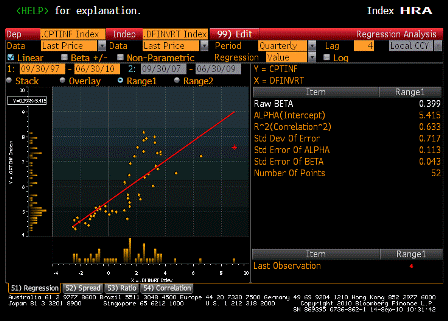
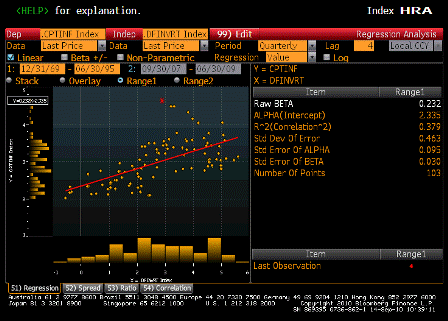
> Thought you might like this. There is a hugely strong relationship between deficit
> spending and corporate profits 1 year later. This is corporate profits with a 1
> year lag, regressed against Quarterly debt to GDP.
>
Yes, the old Levy profit equation from the 30’s maybe!
>
> From 1970 on, this is a strong relationship, except for a few quarters around 1997.
> I’ll follow with another chart in a minute.
>
> The Senate run is improving your visibility – plus I am seeing Chartalism everywhere
> now. It used to be fringe, now many people use it as a given…
>
Good to hear it, thanks!