Barrons Cover Story Spending

>   
>   (email exchange)
>   
>   On Sun, Nov 21, 2010 at 11:50 PM, Bob wrote:
>   
>   Don’t underestimate the amount people will possibly spend this holiday season.
>   
>   90 Percent have jobs, and they are NOT as worried as they were in 2008 and 2009
>   about Losing their jobs. This can create a good environment for stocks going
>   forward.
>   
>   There is a lot of corporate and consumer cash on the sidelines and they could
>   be feeling a bit better about spending it now and going forward.
>   

Moreover, household financial obligations—defined as debt and lease payments, rent, home insurance and property taxes—have fallen to 17% of disposable income, down from an all-time high of 18.9% in the third quarter of 2007 and below the 30-year average of 17.2%, notes James Paulsen, chief investment strategist at Wells Capital Management.

Yes, this is the direct result of the large federal budger deficit.

Reflected in those numbers is a sharp increase in the personal savings rate, which rose to a peak of 8.2% in May 2009 from as little as 0.8% in April 2005. The savings rate—the percentage of personal income that isn’t consumed—since has fallen back to 5.3%.

Yes, this is the direct result of the large federal budger deficit.

The savings rate typically rises during recessions and falls amid recoveries, as the public grows more confident about the future. Economists such as Paulsen expect that the savings rate will plateau around current levels.

Yes, this is the direct result of the large federal budger deficit.

A Better Balance Sheet

Household debt has fallen by about $1 trillion, to $11.5 trillion, since the fourth quarter of 2008…

Yes, this is the direct result of the large federal budger deficit.

If the Bush tax cuts aren’t extended for those making at least $250,000 a year, some $65 billion will start coming out of their paychecks and pockets starting Jan. 1. The potential hit to consumer spending could be significant, because although this group represents only 18% of U.S. taxpayers, they account for 35% of spending, notes ConsumerEdge Research.

Yes, reducing the federal deficit is contractionary.

MANY AMERICAN CONSUMERS still have too much debt, and potential threats such as renewed inflation, rising interest rates and higher taxes could prove formidable obstacles to a recovery in spending. But John Q. Wal-Mart and Jane Q. Saks have worked hard in the past two years—certainly harder than their Uncle Sam—to mend their financial health. They could be in much better shape than you think.

Yes, this is the direct result of the large federal budger deficit.

A failure of theory and practice- comments on Fed Chairman Bernanke’s speech

Emerging from the Crisis: Where Do We Stand?

Chairman Ben S. Bernanke

November 19, 2010

The last time I was here at the European Central Bank (ECB), almost exactly two years ago, I sat on a distinguished panel much like this one to help mark the 10th anniversary of the euro. Even as we celebrated the remarkable achievements of the founders of the common currency, however, the global economy stood near the precipice. Financial markets were volatile and illiquid, and the viability of some of the world’s leading financial institutions had been called into question. With asset prices falling and the flow of credit to the nonfinancial sector constricted, most of the world’s economies had entered what would prove to be a sharp and protracted economic downturn.

By the time of that meeting, the world’s central banks had already taken significant steps to stabilize financial markets and to mitigate the worst effects of the recession, and they would go on to do much more. Very broadly, the responses of central banks to the crisis fell into two classes. First, central banks undertook a range of initiatives to restore normal functioning to financial markets and to strengthen the banking system. They expanded existing lending facilities and created new facilities to provide liquidity to the financial sector. Key examples include the ECB’s one-year long-term refinancing operations, the Federal Reserve’s auctions of discount window credit (via the Term Auction Facility), and the Bank of Japan’s more recent extension of its liquidity supply operations.

He still doesn’t understand that the obvious move is to lend unsecured to member banks in unlimited quantities. The liability side of banking is not the place for market discipline; it’s the asset/capital side.

To help satisfy banks’ funding needs in multiple currencies, central banks established liquidity swap lines that allowed them to draw each other’s currencies and lend those funds to financial institutions in their jurisdictions; the Federal Reserve ultimately established swap lines with 14 other central banks.

He still doesn’t realize what the fed did was to lend approx $600 billion unsecured to foreign governments, for the sole purpose of bringing down LIBOR settings, and that there are far more sensible ways to bring down LIBOR settings. Nor has he realized the public purpose behind prohibiting us banks from using LIBOR in the first place.

Central banks also worked to stabilize financial markets that were important conduits of credit to the nonfinancial sector. For example, the Federal Reserve launched facilities to help stabilize the commercial paper market and the market for asset-backed securities, through which flow much of the funding for student, auto, credit card, and small business loans as well as for commercial mortgages.

Nor has the fed understood how to utilize its member banks, which are public private partnerships, to further public purpose. Rather than buy the collateral in question for its own portfolio, the Fed could have empowered its member banks to do it by such means as, for example, allowing them to put that specific collateral in segregated accounts where the fed would cover losses. This is functionally identical to the fed buying for its own account, but without the costly need for the fed itself to establish trading desks, back office operations, and other associated support structure.

In addition, the Federal Reserve, the ECB, the Bank of England, the Swiss National Bank, and other central banks played important roles in stabilizing and strengthening their respective banking systems. In particular, central banks helped develop and oversee stress tests that assessed banks’ vulnerabilities and capital needs. These tests proved instrumental in reducing investors’ uncertainty about banks’ assets and prospective losses, bolstering confidence in the banking system, and facilitating banks’ raising of private capital.

They did this entirely because they were concerned about the banks’ ability to fund themselves, which again misses the point of the liability side of banking not being the place for market discipline. Again, the right move was to lend fed funds to the banks in unlimited quantities on an unsecured basis.

Central banks are also playing an important ongoing role in the development of new international capital and liquidity standards for the banking system that will help protect against future crises.

Again, misses the purpose of capital requirements, which is the pricing of risk. Risk itself is controlled by regulation and supervision.

Second, beyond necessary measures to stabilize financial markets and banking systems, central banks moved proactively to ease monetary policy to help support their economies. Initially, monetary policy was eased through the conventional means of cuts in short-term policy rates, including a coordinated rate cut in October 2008 by the Federal Reserve, the ECB, and other leading central banks. However, as policy rates approached the zero lower bound, central banks eased policy by additional means. For example, some central banks, including the Federal Reserve, sought to reduce longer-term interest rates by communicating that policy rates were likely to remain low for some time. A prominent example of the use of central bank communication to further ease policy was the Bank of Canada’s conditional commitment to keep rates near zero until the end of the second quarter of 2010.1 To provide additional monetary accommodation, several central banks–among them the Federal Reserve, the Bank of England, the ECB, and the Bank of Japan–purchased significant quantities of financial assets, including government debt, mortgage-backed securities, or covered bonds, depending on the central bank. Asset purchases seem to have been effective in easing financial conditions; for example, the evidence suggests that such purchases significantly lowered longer-term interest rates in both the United States and the United Kingdom.2

Yes, with little or no econometric evidence that lower rates added to aggregate demand. Nor is there any discussion of this controversy.

In fact, it looks to me like lower rates more likely reduced aggregate demand through the interest income channels, and continues to do so.

Although the efforts of central banks to stabilize the financial system and provide monetary accommodation helped set the stage for recovery, economic growth rates in the advanced economies have been relatively weak. Of course, the economic outlook varies importantly by country and region, and the policy responses to these developments among central banks have differed accordingly. In the United States, we have seen a slowing of the pace of expansion since earlier this year. The unemployment rate has remained close to 10 percent since mid-2009, with a substantial fraction of the unemployed out of work for six months or longer. Moreover, inflation has been declining and is currently quite low, with measures of underlying inflation running close to 1 percent. Although we project that economic growth will pick up and unemployment decline somewhat in the coming year, progress thus far has been disappointingly slow.

Yes, the Fed continues to fail to deliver on both of its dual mandates.

In this environment, the Federal Open Market Committee (FOMC) judged that additional monetary policy accommodation was needed to support the economic recovery and help ensure that inflation, over time, is at desired levels.

That is, they were concerned about falling into deflation.

Accordingly, the FOMC announced earlier this month its intention to purchase an additional $600 billion of longer-term Treasury securities by the end of the second quarter of 2011, a pace of about $75 billion per month. The Committee also will maintain its current policy of reinvesting principal payments from its securities holdings in longer-term Treasury securities. Financial conditions eased notably in anticipation of the Committee’s announcement, suggesting that this policy will be effective in promoting recovery. As has been the case with more conventional monetary policy in the past, this policy action will be regularly reviewed in light of the evolving economic outlook and the Committee’s assessment of the effects of its policies on the economy.

Note that comments from FOMC members have repeatedly shown they lack a fundamental understanding of actual monetary operations, and are promoting policy accordingly

I draw several lessons from our collective experience in dealing with the crisis. (My list is by no means exhaustive.) The first lesson is that, in a world in which the consequences of financial crises can be devastating, fostering financial stability is a critical part of overall macroeconomic management. Accordingly, central banks and other financial regulators must be vigilant in monitoring financial markets and institutions for threats to systemic stability and diligent in taking steps to address such threats. Supervision of individual financial institutions, macroprudential monitoring, and monetary policy are mutually reinforcing undertakings, with active involvement in one sphere providing crucial information and expertise for the others. Indeed, at the Federal Reserve, we have restructured our financial supervisory functions so that staff members with expertise in a range of areas–including economics, financial markets, and supervision–work closely together in evaluating potential risks.

Systemic liquidity risk comes from the fed not realizing it should always be offering fed funds at its target rate in unlimited quantities.

That limits risks to bank shareholders (and unsecured debt which is functionally part of the capital structure), and to the FDIC/taxpayers where it has failed to adequately regulate and supervise and losses exceed private equity.

Second, the past two years have demonstrated the value of policy flexibility and openness to new approaches. During the crisis, central banks were creative and innovative, developing programs that played a significant role in easing financial stress and supporting economic activity. As the global financial system and national economies become increasingly complex and interdependent, novel policy challenges will continue to require innovative policy responses.

Unfortunately, it also demonstrated the consequences of not understanding monetary operations and bank fundamentals. For example, there was and continues to be a complete failure to recognize that the treasury buying bank capital under tarp was functionally nothing more than regulatory forbearance, and not an ‘expenditure of tax payer money’

Third, as was the focus of my remarks two years ago, in addressing financial crises, international cooperation can be very helpful; indeed, given the global integration of financial markets, such cooperation is essential.

It is not. This is another example of failure to understand banking fundamentals and monetary operations. The US is best served by independent banking law, regulation, and supervision.

Central bankers worked closely together throughout the crisis and continue to do so. Our frequent contact, whether in bilateral discussions or in international meetings, permits us to share our thinking, compare analyses, and stay informed of developments around the world. It also enables us to move quickly when shared problems call for swift joint responses, such as the coordinated rate cuts and the creation of liquidity swap lines during the crisis. These actions and others we’ve taken over the past few years underscore our resolve to work together to address our common economic challenges.

Sadly, it’s the blind leading the blind, and we all continue to pay the price.

And They’re Off!!!!!

:(

12 billion won’t break the economy but it’s a bad start for sure.

And they still have to act soon to stop the tax hikes coming at year end before withholding goes up.

Unemployment Aid Extension Blocked in House Over Cost Concerns

By Brian Faler

November 18 (Bloomberg) — A bill to extend jobless benefits for three months was defeated today in the U.S. House, increasing the odds that some of the nation’s long-term unemployed will start losing aid.
The measure fell short of the two-thirds majority needed for approval under an expedited process. The vote on the bill was 258 in favor, 154 opposed.

Republican lawmakers complained that the bill’s $12 billion cost would be added to the government’s budget deficit. They demanded offsetting savings elsewhere in the budget.

The vote was a replay of a partisan dispute earlier this year that led to benefits being cut off for some jobless people for more than a month. Aid again is set to expire Nov. 30 for some of the unemployed.

No firm number of those who would be affected was available, though Representative Sander Levin, a Michigan Democrat and chairman of the House Ways and Means committee, estimated almost 2 million Americans could see their aid cut off by the end of this year if Congress does not act.

The nation’s unemployment rate in October was 9.6 percent.

Congress will be out of session next week for the Thanksgiving holiday, which means lawmakers will have little time to find agreement by the end of this month.

“This bill is like déjà vu all over again, and not in a good way,” said Representative Charles Boustany, a Louisiana Republican. “We all want to help those in need but the American people also know someone has to pay when government spends money, and it shouldn’t be our children and grandchildren.”
Levin said, “I don’t see how we can go home for Thanksgiving when as a result of a failure of benefits, hundreds of thousands of people may not have a turkey on their table because they can’t afford it.”

Beyond risk off

So it was buy the rumor, buy the news, then watch it all fall apart a few days later.

QE was a major international event, with the word being that the ‘money printing’ would not only take down the dollar, but also spread ‘liquidity’ to the rest of the world through the US banking system, via some kind of ‘carry trades’ and who knows what else, or needed to know. It was just obvious…

So the entire world was front running QE in every currency, commodity, and equity market.

And the Fed announcement only brought in more international players, with money printing headlines screaming globally.

Then the ‘risk off’ unwinding phase started, reversing what had been driven by maybe three themes:

1. There were those who knew all along QE probably did not do anything of consequence, but went along for the ‘risk on’ ride believing others believed QE worked and would drive prices accordingly.

2. A group that thought originally QE might do something and piled in, but began having second thoughts about how effective QE might actually be after learning more about it, and decided to get out.

3. A third group who continue to believe QE does work, who got cold feed when they started doubting whether the Fed would actually follow through with enough QE, also for two reasons.
   a. the FOMC itself made it clear opinion was highly polarized, often for contradictory reasons
   b. the economy showed signs of modest growth that cast doubts on whether the Fed might
   think something as ‘powerful and risky’ as QE was still needed.

Reminds me some of the old quip- the food was terrible and the portions were small-
(QE is questionable policy and they aren’t going to do enough of it.)

So risk off continues in what have become fundamentally illiquid markets until some time after the speculative longs have been sold and the shorts covered.

Next question, what about after the smoke clears?

A. The dollar could remain strong even after the initial short covering ends- the modest GDP growth is slowly tightening fiscal, and crude oil prices are falling, both of which make dollars ‘harder to get’

It’s starting a kind of virtuous cycle where the stronger dollar moves crude lower which strengthens the dollar.
Also, the J curve works in reverse with other imports as well. As imports get cheaper, initially
the rest of world gets fewer dollars from exports to the US, until/unless volumes pick up.

The euro zone is again struggling with the idea of the ECB supporting the weaker members with secondary market bond purchases, as ECB imposed austerity measures are showing signs of decreasing revenues of the more troubled members. Seems taxpayers of the core members are resisting allowing the ECB to support the weaker members, and the core leaders are groping for something that works politically and financially. All this adds risk to holding euro financial assets, as even a small threat of a breakup jeopardizes the very existence of the euro.

Japan is on the way to fiscal easing while the US, UK, and euro zone are attempting to tighten fiscal.

Falling commodity prices hurt the commodity currencies.

B. Interest rates are moving higher as spec longs who bought the QE rumor and news are getting out.
But it looks to me like term rates could again move back down after this sell off has run its course.
The Fed still failing on both mandates- real growth is still modest at best, and the 0 rate policy is deflationary/contractionary enough for even a 9% budget deficit not to do much more than support gdp at muddling through levels, with a far too high output gap/unemployment rate.
And falling commodities, weak stocks, and a strong dollar give the Fed that much more reason not to hike.

C. A mixed bag for stocks.
Equity values have fallen after running up on the QE rumor/news, further supported by the dollar weakness that came with the QE rumor news, with the equity sell off now exacerbated by the dollar rally which hurts earnings translations and export prospects.

But a 9% federal deficit is still chugging away, adding to incomes and savings of financial assets, and providing for modest top line growth and ok earnings via cost cutting as well.

Fiscal risks include letting the tax cuts expire and proactive spending cuts by the new Congress which seems committed to austerity type measures.

Low interest rates help valuations but reduce the economy’s interest income.

China acting more like the inflation problem is serious. Hearing talk of price controls, as they struggle to sustain employment and keep a lid on prices, in a nation where inflation or unemployment have meant regime change. Looks to me like a slowdown can’t be avoided with the western educated kids now mostly in charge.

>   
>   (email exchange)
>   
>   On Wed, Nov 17, 2010 at 1:05 AM, Paul wrote:
>   
>   Very interesting — but I have a question:
>   
>   What if the deficit causes “saving” increase in financial assets held by
>   foreigners (via the trade imbalance) rather than US domestic households?
>   

Hi Paul!

That would mean we would get the additional benefit of enjoying a larger trade deficit, which means for a given size govt taxes can be that much lower.

Or, if we get sufficient domestic private sector deficit spending, govt deficit spending can remain the same and we benefit by the enhanced real terms of trade supported by the increased foreign savings desires.

Except of course policy makers don’t get it and squander the benefit of a larger trade deficit/better real terms of trade with a too low federal deficit (taxes too high for the given level of govt) that sadly results in domestic unemployment- currently a real cost beyond imagination.

Fundamentally, exports are real costs and imports real benefits, and net imports are a function of foreign savings desires.

So the higher the foreign savings desires the better the real terms of trade.

Also, with floating exchange rates, the way I see it, it’s always ‘in balance’ as the trade deficit = foreign savings desires.

Best!
Warren

Greenspan: High US Deficits Could Spark Bond Crisis

Something that’s never happened even once in the history of the world with fiat money and floating fx policy.

Greenspan: High US Deficits Could Spark Bond Crisis

November 14 (Reuters) — The United States must move to rein in its massive budget deficits or it faces the risk of a bond market crisis, former Federal Reserve Chairman Alan Greenspan said Sunday.

“We’ve got to resolve this issue,” Greenspan said of the ballooning U.S. debt levels.

He spoke about the issue as a panel, chaired by former White House chief of staff Erskine Bowles and former U.S. Senator Alan Simpson, is due to deliver a report on debt and deficits by Dec. 1.

A draft report made public last week offered a series of politically tough tax and spending choices that would seek to reduce the debt by $4 trillion by 2020.

The report received a lukewarm reception from some politicians and outright condemnation by others, including House of Representatives Speaker Nancy Pelosi, who pronounced the ideas “simply unacceptable.”

Greenspan, who spoke on NBC’s “Meet the Press,” said he believed “something equivalent to what Bowles and Simpson put out is going to be approved by Congress. But the only question
is whether it is before or after a crisis in the bond market.”

He said the risk is that the deficit, which hit $1.3 trillion this year, could spook the bond market. That would result in long-term interest rates moving up rapidly and could lead to a double-dip recession.

John Taylor (Mr Hedge Fubd FX — not Mr. Hoover Institute Economist :))

The highlighted part is what I was getting at previously.
The idea that QE does nothing is now reasonably well distributed.
Those holding positions include a lot of managers who highly suspect QE does nothing.
But they believe others who do believe QE is ‘inflationary money printing’ will keep driving prices.

Same with austerity. The idea that it makes things worse is taking hold, but those who believe it is a good thing- that govt borrowing takes away money from the private sector and all that nonsense- still have the upper hand.

But ‘reality’ is working against those out of paradigm, as the dollar is firming and the rest showing signs of coming apart as well.

As for Europe, it all holds as long as the ECB keeps buying bonds in the secondary market in sufficient size to keep shorter term yields reasonable. And comes apart when they don’t.

The problem is politically it isn’t ‘fair’ to spend euro resources on targeted nations, which carries with it the notion that all the others are ultimately paying for it, though they don’t know exactly how that will play out. So you see the core addressing that with loud noises of restructuring, etc. which may or may not happen. But the real possibility is there.

My proposal of the ECB making per capita distributions to all the member nations of, say 10% of GDP in the first round, would not carry that notion of ‘unfairness’

And as long as member nation spending was appropriately constrained politically there would be no inflation or monetary ramifications, apart from better credit ratings and the ability to fund existing deficits at lower risk premiums.

But it’s still not even a consideration, best I can tell.

Fasten Your Seatbelt
November 11, 2010
By John R. Taylor, Jr.
Chief Investment Officer, FX Concepts

‘… Although the world believes that QE2 is there to push the dollar sharply lower, Bernanke argued that his goal was something else. On the day after the Fed’s move, he wrote in a Washington Post editorial piece that QE2 would push up the equity market, bonds, and other risky securities thereby stimulating consumption and economic activity. Even Greenspan did not publicly proclaim his “put,” but now Bernanke has made it the centerpiece of US strategy. Equities are already overpriced, with profit margins at all-time highs and PE ratios far above average. Speculation is now more American than apple pie – but this is a very risky time to practice it. As one highly respected analyst noted about Bernanke’s article, “these are undoubtedly among the most ignorant remarks ever made by a central banker.” As we and many others have noted that QE has shown little or no positive impact on actual economic activity, so the Fed has taken a big gamble, and if it fails as we expect it will have nowhere else to go. With the Republican victory tainted by the Tea Party “starve the beast” mentality, austerity has come to Washington. This next year will be a terrible one for the world’s biggest economy, so we would go against Bernanke on the equity side, but buy government bonds along with him…’

Consumer Borrowing Posts Rare Gain in September

This is how it all starts.
The $10.1 billion gain in non revolving is the key.
That, along with housing, is the borrowing to spend the drives consumer credit expansions.
And the ongoing federal deficit spending continues to add to savings via less credit card debt that’s generally used for current consumption.

It’s only one month, and the series has volatility, but it does fit with the financial burdens ratios.

Without the external risks, the Obama boom that began in Jan 09 (before he added a bit with his fiscal package) looks intact and ready to accelerate.

Unfortunately there are risks.

Taxes are scheduled to go up at year end if gridlock isn’t broken. And even if they do extend the current tax structure, it’s not a tax cut, just not an increase.
Congress is bent on ‘paying for’ everything and proactively reducing the federal deficit, one way or another, including paying for not letting taxes rise should that happen.
The sustainability report is due Dec 1 which could further scare everyone into more proactive deficit reduction.

This kind of stuff. There are probably enough votes for the balanced budget constitutional amendment to pass Congress:

Sen.-elect Paul: GOP must consider military cuts

November 7 (AP) — Republican Sen.-elect Rand Paul says GOP lawmakers must be open to cutting military spending as Congress tries to reduce government spending.

The tea party favorite from Kentucky says compromise with Democrats over where to cut spending must include the military as well as social programs. Paul says all government spending must be “on the table.”

Paul tells ABC’s “This Week” that he supports a constitutional amendment calling for a balanced budget.

The rising crude oil price is like a tax hike for us.

The $US could head north in a ‘hey, QE doesn’t in fact weaken the dollar and we’re all caught short with no newly printed money to take us out of our trade’ rally, further fueled by the automatic fiscal tightening that comes with the modest GDP growth reducing spending via transfer payments and increasing tax revenues, making dollars ‘harder to get.’

Also an even modestly growing US economy does attract foreign direct investment as well as equity investors in a big way.
And, real US labor costs are low enough for us to be exporting cars- who would have thought we would have sunk this low!
On the other hand, higher crude prices does make $US ‘easier to get’ overseas and tend to weaken it fundamentally.
The falling dollar was supporting a good part of the latest equity rally- better foreign earnings translations, more exports, etc.- so a dollar reversal could create a set back for the same reasons.

China is looking at maybe 10% inflation, and their currency fix seems to be closer to ‘neutral’ as their fx holdings seem to have stabilized.

It’s possible their currency adjustment has come via internal inflation, and now the question could be whether and how they ‘fight’ their inflation. In the past inflation has been a regime changer, so political pressures are probably intense.

Euro zone austerity is resulting in ‘political imbalances’ as Germany sort of booms and the periphery suffers.
It’s all muddling through with high and rising over all unemployment, modest growth, and the ECB dictating terms and conditions for its support.

Conclusion- clear sailing, Obama boom intact, unless the ‘external’ risks kick in. The most immediate risk is a dollar rally, closely followed by fiscal tightening

Consumer Borrowing Posts Rare Gain in September

November 5 (AP) — Consumer borrowing increased in September for the first time since January even though the category that includes credit cards dropped for a record 25th straight month.

The Federal Reserve said Friday that consumer credit increased at an annual rate of $2.1 billion in September after having fallen at a rate of $4.9 billion in August. It was only the second increase in the past 20 months.
Americans have been reducing their borrowing for nearly two years as they try to repair their balance sheets in the wake of a steep recession and high unemployment.

For September, revolving credit, the category that includes credit cards, fell for a record 25th consecutive month, dropping by an annual rate of $8.3 billion, or 12.1 percent.

The category that includes student loans and auto loans, rose by $10.4 billion, or an annual rate of 7.9 percent.

The $2.1 billion rise in overall borrowing pushed consumer debt to a seasonally adjusted $2.4 trillion in September, down 2.9 percent from where consumer credit stood a year ago.

Analysts said that consumer credit is continuing to be constrained by all the problems facing households, including high unemployment and tighter lending standards on the part of banks struggling with high loan losses.

Households are borrowing less and saving more and that has acted as a drag on the overall economy by lowering consumer spending, which accounts for 70 percent of total economic activity.

The economy, as measured by the gross domestic product, grew at a lackluster annual rate of 2 percent in the July-September quarter, up only slightly from 1.7 percent GDP growth in the April-June period.

from John Mauldin

>   
>   (email exchange)
>   
>   On Sat, Nov 6, 2010 at 7:10 AM, wrote:
>   
>   The yield spreads on Irish and Spanish bonds are blowing out even as we speak, as
>   well as those on the rest of the periphery. While all eyes are on the Fed, the real action
>   may be in Europe.
>   

Agreed! The question remains, is the ECB still there to backstop short term funding. So far seems yes.
It’s entirely a political decision. Think of the euro zone as an under water city, with the ECB controlling the air supply.

Also, I like the next chart. A 9% federal budget deficit is so far been enough to muddle through with very modest GDP growth and stabilize employment, albeit at very low levels. With a proactive fiscal adjustment, it doesn’t get much better until consumer credit expansion kicks in, which could be quite a while.

It also looks to me like a dollar rally that will revive deflation fears might still be in the cards, as it’s been sold mainly based on a misunderstanding of QE.

A Few Thoughts on the Employment Numbers

By Dr. Lacy Hunt, Hoisington Investment Mgt. Co.

The October employment situation was dramatically weaker than the headline 159k increase in the payroll employment measure. The broader household employment fell 330k. The only reason that the unemployment rate held steady is that 254k dropped out of the labor force. The civilian labor force participation rate fell to a new low of 64.5%, indicating that people do not believe that jobs are available, but this serves to hold the unemployment rate down. In addition, the employment-to-population ratio fell to 58.3%, the lowest level in nearly 30 years.

While not actually knowing what happened to the net job change in the non-surveyed small business sector, the Labor Department assumed that 61k jobs were created in that sector. This assumption is not supported by such important private surveys as those from the National Federation of Independent Business or by ADP. Just a month ago the Labor Department had to revise downward the job totals due to a serious overcount of their statistical artifact known as the Birth/Death Model.


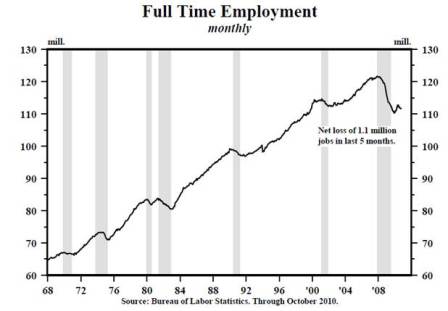
The most distressing aspect of this report is that the US economy lost another 124K full-time jobs, thus bringing the five-month loss to 1.1 million in this most critical of all employment categories. In an even more significant sign, the level of full-time employment in October was at the same level that was reached originally in December 1999, almost 11 years ago (see attached chart). An economy cannot generate income growth by continuing to substitute part-time work for full-time employment. This loss of full-time jobs goes a long way to explain why real personal income less transfer payments has been unchanged since May.

The weakness in real income is probably lost in an environment in which the Fed is touting the gain in stock prices and consumer wealth resulting from the latest quantitative easing (QE), but QE has unintended negative consequences for real household income. Due to higher prices of energy and food commodities, QE may result in less funds for discretionary spending for consumers whose incomes are stagnant. Also, with five-year yields falling below 1%, rates on CDs and other types of short-term bank deposits will decline, also cutting into household income. At the end of the day these effects will be more powerful than any stock-price boost in consumer spending, which, as always, will be very small and slow to materialize.

To have a broad-based recovery, the manufacturing sector must participate. Contrary to the ISM survey, manufacturing jobs fell 7k, the third consecutive drop, resulting in a net loss over the past three months of 35k.

In summary, the latest economic developments indicate a slight worsening of underlying fundamental conditions.

Payrolls


Karim writes:
Very solid number in many respects

  • NFP +151k plus Net revisions +110k
  • Private sector job gwth +159k
  • Average hourly earnings +0.2% and index of aggregate hours +0.4% will combine with the jobs increase to produce a very strong personal income number for October
  • Hours data will also show up in stronger industrial production, cap u, etc.
  • Unemployment rate unch at 9.6% but that is well understood to be the last labor market indicator to turn
  • Some industry highlights in terms of net job changes: Construction +13k; Retail +16k; Temp +11k; Leisure and Hospitality -24k
  • Diffusion index roughly unch at 55 (from 55.6)
  • Median duration of unemployment at 21.2 from 20.4; U6 measure at 17% from 17.1%

The income gains generated from this number plus recent equity gains put consumer balance sheets in much better shape; the mix between spending, savings and debt reduction remains to be seen, but the outlook for spending is certainly better than it appeared before today.

So it looks like a 9% budget deficit is sufficient to overcome the drag from the 0 interest rate policy and the size of the Fed’s portfolio to support GDP at modest levels of growth, perhaps just above levels of productivity increases, which means a very modestly improving employment outlook.

But not enough for a meaningful reduction in the output gap, which probably requires a fiscal adjustment like a payroll tax suspension, or a jump in private sector credit expansion via houses and cars.

QE2 will add a bit more drag, but probably not enough to make much difference.

Extending the tax cuts is a positive for demand versus letting them expire.
But that would not be a tax cut, just not a tax hike.

And there’s a chance it would get ‘paid for’ with a spending cut elsewhere, maybe social security or medicare after the sustainability committee reports Dec 1 and scares them all.

Still looks like fear that we might be the next Greece is turning us into the next Japan.

Bernanke Op-Ed

What the Fed did and why: supporting the recovery and sustaining price stability

By Ben S. Bernanke

November 4 (Washington Post) — Two years have passed since the worst financial crisis since the 1930s dealt a body blow to the world economy.

Only because policy makers failed to respond with an appropriate fiscal adjustment.

And, worse, they continue to fail to recognize this policy blunder.

Working with policymakers at home and abroad, the Federal Reserve responded with strong and creative measures to help stabilize the financial system and the economy. Among the Fed’s responses was a dramatic easing of monetary policy – reducing short-term interest rates nearly to zero. The Fed also purchased more than a trillion dollars’ worth of Treasury securities and U.S.-backed mortgage-related securities, which helped reduce longer-term interest rates, such as those for mortgages and corporate bonds. These steps helped end the economic free fall and set the stage for a resumption of economic growth in mid-2009.

In Q3 08 the Fed failed to provide sufficient routine bank liquidity for several critical months while it experimented with a variety of poorly thought out open market operations that progressively accepted more and more bank collateral until they eventually did what they should have all along- lend to member banks at their target rate on a continuous, as needed basis. Yet even now they fail to do this to the smaller community banks, whose cost of funds remains at least 1% over the fed funds rate.

They also continue to fail to recognize that their role is setting the term structure of risk free rates, which can be done directly.
By simply offering to buy tsy securities at their target rates in unlimited quantities.
However, they have yet to fully appreciate that it’s the resulting interest rates and not the quantities they purchase that are of further economic consequence. And if they wish to specifically target mortgage rates, this is readily done by lending to their member banks specifically for this purpose at the Fed’s desired target for mortgage rates, with the Fed assuming the ‘convexity’ risk.

Additionally, while the Fed did address the ‘market functioning’ issues that were caused by the Fed’s own initial lack of liquidity provision, they failed to recognize that monetary policy was not going to restore aggregate demand. In fact, they were all but certain it would, as evidenced by their concern their policies carried the risk of generating ‘inflation, etc.’ this led other policy makers to take a ‘wait and see’ attitude which has been monumentally costly with regards to lost real output and all the real costs of unemployment.

Notwithstanding the progress that has been made,

After more than two years the output gap in general remains at near record levels.

when the Fed’s monetary policymaking committee – the Federal Open Market Committee (FOMC) – met this week to review the economic situation, we could hardly be satisfied. The Federal Reserve’s objectives – its dual mandate, set by Congress – are to promote a high level of employment and low, stable inflation. Unfortunately, the job market remains quite weak; the national unemployment rate is nearly 10 percent, a large number of people can find only part-time work, and a substantial fraction of the unemployed have been out of work six months or longer. The heavy costs of unemployment include intense strains on family finances, more foreclosures and the loss of job skills.

The fed’s responsibility for this is largely that of its failure to do its job of providing continuous and unlimited liquidity to its member banks and to not recognize that monetary policy was not capable of restoring the aggregate demand necessary to support full employment.

Today, most measures of underlying inflation are running somewhat below 2 percent, or a bit lower than the rate most Fed policymakers see as being most consistent with healthy economic growth in the long run. Although low inflation is generally good, inflation that is too low can pose risks to the economy – especially when the economy is struggling. In the most extreme case, very low inflation can morph into deflation (falling prices and wages), which can contribute to long periods of economic stagnation.

Morph? Inflation deteriorates to unwelcome deflation with a lack of aggregate demand. There is no mystery here.

Even absent such risks, low and falling inflation indicate that the economy has considerable spare capacity, implying that there is scope for monetary policy to support further gains in employment without risking economic overheating.

Note the continued failure to recognize monetary policy has no tools to support demand at desired levels.

The FOMC decided this week that, with unemployment high and inflation very low, further support to the economy is needed. With short-term interest rates already about as low as they can go, the FOMC agreed to deliver that support by purchasing additional longer-term securities, as it did in 2008 and 2009. The FOMC intends to buy an additional $600 billion of longer-term Treasury securities by mid-2011 and will continue to reinvest repayments of principal on its holdings of securities, as it has been doing since August.

This approach eased financial conditions in the past and, so far, looks to be effective again. Stock prices rose and long-term interest rates fell when investors began to anticipate the most recent action. Easier financial conditions will promote economic growth. For example, lower mortgage rates will make housing more affordable and allow more homeowners to refinance. Lower corporate bond rates will encourage investment. And higher stock prices will boost consumer wealth and help increase confidence, which can also spur spending. Increased spending will lead to higher incomes and profits that, in a virtuous circle, will further support economic expansion.

These are all very weak channels at best.

What is hoped for is that lower interest rates encourage private credit expansion, where consumers return to borrowing to spend. And while this can happen, and may already be happening to a small degree, there is no reason to believe that QE will promote this outcome.

What the chairman knows and fails to discuss are the interest income channels, which he wrote about in a published paper in 2004. Lower rates cause the treasury to pay less interest on its treasury securities, and the interest the Fed earns on its newly purchased securities is interest no longer earned by the economy which previously held those securities. This reduced interest income paid by govt to the non govt sectors is much like a tax increase that to some degree neutralizes the modest positive effects the Fed is hoping for.

Also ignored is the fact that Japan has had near 0 rates and much lower long rates than the US, also helped by massive QE, and has also had very large net exports helping to support GDP, something the Fed and the US administration aspires to as well, yet has failed to restore desired aggregate demand, growth, and employment.

While they have been used successfully in the United States and elsewhere, purchases of longer-term securities are a less familiar monetary policy tool than cutting short-term interest rates. That is one reason the FOMC has been cautious, balancing the costs and benefits before acting.

Costs?

As monopoly provider of net clearing balances (reserves) for the payments system, the Fed is necessarily ‘price setter’ of the term structure of risk free rates. Their notion of ‘cost’ is inapplicable. And all QE does is alter the duration of total govt liabilities. It doesn’t change the quantity of non govt net financial assets.

We will review the purchase program regularly to ensure it is working as intended and to assess whether adjustments are needed as economic conditions change.

Although asset purchases are relatively unfamiliar as a tool of monetary policy, some concerns about this approach are overstated. Critics have, for example, worried that it will lead to excessive increases in the money supply and ultimately to significant increases in inflation.

Agreed! Yet their expressed motivation all along is to prevent deflation, which is the same as ‘causing inflation.’

A problem here is they believe that inflation is caused by rising inflation expectations, and not aggregate demand per se. That is, rising demand per se doesn’t cause inflation until that demand starts to drive inflation expectations.

Until this confused theory of inflation is discarded policy will continue to be confused as well.

Our earlier use of this policy approach had little effect on the amount of currency in circulation or on other broad measures of the money supply, such as bank deposits. Nor did it result in higher inflation.

Correct, which also means the policy failed to generate the desired results.

We have made all necessary preparations, and we are confident that we have the tools to unwind these policies at the appropriate time.

Agreed.

The Fed is committed to both parts of its dual mandate and will take all measures necessary to keep inflation low and stable.

The Federal Reserve cannot solve all the economy’s problems on its own. That will take time and the combined efforts of many parties, including the central bank, Congress, the administration, regulators and the private sector. But the Federal Reserve has a particular obligation to help promote increased employment and sustain price stability. Steps taken this week should help us fulfill that obligation.

How about an obligation to support a sufficient fiscal adjustment to eliminate the output gap rather than supporting deficit reduction?