Japan’s Noda: Need To Curb Spending From Sept If Bond Bill Not Enacted

Monkey see, monkey do…

Noda: Need To Curb Spending From Sept If Bond Bill Not Enacted

July 4 (Dow Jones) — Japan’s finance minister Tuesday urged opposition parties to quickly approve a key bond issuance bill, saying the government would have to curb spending as early as September with the economy still struggling to recover from the March 11 disaster.

Finance Minister Yoshihiko Noda’s plea comes as the opposition continues to block the passage of a bill that would enable the government to issue new debt to fund roughly 40% of the spending in the annual budget for the current fiscal year, started April.

“If the deficit-financing bond issuance bill isn’t passed, we would start having trouble smoothly implementing the budget in September or later, and would have to make an agonizing decision to curb spending,” Noda said at a news conference after a regular Cabinet meeting.

Comment

Comment:

Side note: I called “on point” on NPR last week to challenge the guest viz his talk of US default, etc. The guy who manages the phone calls told me I don’t know anything about money, and that of course the debt crisis is just that and that the US could certainly default. He would not put my call on the air. The obstacles to getting the message out are everywhere.

US stimulus efforts curbed by deficit: Geithner

Leave it to Geithner to compound the absurdity in new directions:

US stimulus efforts curbed by deficit: Geithner

The massive US budget deficit means the United States will be unable to use deficit spending to stimulate the economy for many years to come, Treasury Secretary Timothy Geithner said Friday.

“It’s not going to be possible in the next decade. We’ve lost the chance,” Geithner told a conference in New Hampshire.
“We no longer have the luxury of that approach.”

Geithner said the $787 billion dollar economic stimulus passed in 2009 by Congress “was absolutely timely” but a temporary effort in response to the economic crisis.

“We’ll have at some point to pay that debt,” he said.

His comments come amid an impasse between the US administration and Republican lawmakers on curbing the budget deficit and lifting the debt ceiling to allow additional US borrowing.

The collapse of the talks on Thursday sparked fears that Congress will fail to raise the $14.29 trillion debt ceiling by an August 2 deadline and force the United States into a default which could trigger global economic shockwaves.

Currently, the US budget deficit is forecast to reach $1.6 trillion this year.

Majority Leader Eric Cantor (R-VA) regarding a balanced budget amendment

RIP
USA
:(

House Majority Leader Eric Cantor (R-VA) today issued the following statement regarding House consideration of a balanced budget amendment, H.J. Res. 1, sponsored by Congressman Bob Goodlatte:

“We are being asked by the Obama Administration to approve a debt limit increase. While President Obama inherited a bad economy, his overspending and failure to enact pro-growth policies have made it worse and now our national debt is currently more than $14 trillion. House Republicans have made clear that we will not agree to raise the debt limit without real spending cuts and binding budget process reforms to ensure that we don’t continue to max out the credit card. One option to ensure that we begin to get our fiscal house in order is a balanced budget amendment to the Constitution, and I expect to schedule such a measure for the House to consider during the week of July 25th. I have no doubt that my Republican colleagues will overwhelmingly support this common sense measure and I urge Democrats to as well in order to get our fiscal house in order.”

CBO Congressional Report- U.S. Could Face European-Style Debt Crisis

How about the accounts sticking to accounting.

Just in case you thought there was any hope:

But most ominously, the CBO report warns of a “sudden fiscal crisis” in which investors would lose faith in the U.S. government’s ability to manage its fiscal affairs. In such a fiscal panic, investors might abandon U.S. bonds and force the government to pay unaffordable interest rates. In turn, the report warns, Washington policymakers would have to win back the confidence of the markets by imposing spending cuts and tax increases far more severe than if they were to take action now.

U.S. Could Face European-Style Debt Crisis: Congressional Report

June 22 (AP) — The rapidly growing national debt could soon spark a European-style crisis unless Congress moves forcefully, the Congressional Budget Office warned Wednesday in a study that underscores the stakes for a bipartisan group working on a plan to reduce red ink.

Republicans seized on the non-partisan report to renew their push to reduce costs in federal benefit programs such as Medicare — the federal government health care program that benefits the elderly.

The report said the national debt, now $14.3 trillion, is on pace to equal the annual size of the economy within a decade. It warned of a possible “sudden fiscal crisis” if it is left unchecked, with investors losing faith in the U.S. government’s ability to manage its fiscal affairs.

Democrats and Republicans have been stepping up budget talks aimed at averting what could be the disastrous first-ever default on U.S. government debt. A bipartisan group led by Vice President Joe Biden tasked with reaching an agreement has not made the politically difficult compromises on the larger issues, such as changes in Medicare, or tax increases.

The study reverberated throughout the Capitol as Biden and negotiators and senior lawmakers spent several hours behind closed doors. The talks are aimed at outlining about $2 trillion in deficit cuts over the next decade, part of an attempt to generate enough support in Congress to allow the Treasury to take on new borrowing.

Biden made no comment as he departed, except to say the group would meet again on Thursday and probably Friday as well.

The CBO, the non-partisan agency that calculates the cost and economic impact of legislation and government policy, says the nation’s rapidly growing debt burden increases the probability of a fiscal crisis in which investors lose faith in U.S. bonds and force policymakers to make drastic spending cuts or tax increases.

“As Congress debates the president’s request for an increase in the statutory debt ceiling, the CBO warns of a more ominous credit cliff — a sudden drop-off in our ability to borrow imposed by credit markets in a state of panic,” said Republican House Budget Committee Chairman Paul Ryan.

The findings aren’t dramatically new, but the budget office’s analysis underscores the magnitude of the nation’s fiscal problems as negotiators struggle to lift the current $14.3 trillion debt limit and avoid a first-ever, market-rattling default on U.S. obligations. The Biden-led talks have proceeded slowly and are at a critical stage, as Democrats and Republicans remain at loggerheads over revenues and domestic programs like Medicare and Medicaid.

With Republicans insisting that the level of deficit cuts at least equal the amount of any increase in the debt limit, it would take more than $2 trillion in cuts to carry past next year’s elections. House Republican leaders have made it plain they only want a single vote before the elections.

That $2 trillion-plus goal is proving elusive. And a top Senate Democrat warned Wednesday that it would be insufficient anyway.

“While I am encouraged by the bipartisan nature of the leadership negotiations being led by Vice President Biden, I am concerned by reports the group may be focusing on a limited package that will not fundamentally change the fiscal trajectory of the nation,” said Senate budget Committee Chairman Kent Conrad, a Democrat. “That would be a mistake.”

Democratic leaders, however, held a news conference Wednesday to argue for more economic stimulus measures such as a proposal floated by the White House to extend a payroll tax cut enacted last year. The move demonstrates the continuing appeal of deficit-financed policy solutions — suggested even as warnings of the dangers of mounting debt grow louder and louder.

“We absolutely need to reduce our deficit. We know that,” said Demoratic Senate Majority Leader Harry Reid. “But economists tell us that reducing spending is only half the equation. The other half is measures to create jobs.

President Barack Obama planned to meet with House Democratic leaders Thursday to discuss the status of the deficit reduction talks. The meeting comes as Democrats want the president to rule out Medicare benefit cuts as part of any budget deal.

The White House said the meeting will address deficit reduction through a “balanced framework,” a term the White House uses to describe cuts in spending coupled with increased tax revenue.

With the fiscal imbalance requiring the government to borrow more than 40 cents of every dollar it spends, the CBO predicts that without a change of course the national debt will rocket from 69 percent of gross domestic product this year to 109 percent of GDP — the record set in World War II — by 2023.

The CBO’s projections are based on a scenario that anticipates Bush-era tax cuts are extended and other current policies such as maintaining doctors’ fees under Medicare are continued as well. The debt would be far more stable under the budget office’s official “baseline” that assumes taxes return to Clinton-era rates and that doctors absorb unrealistic fee cuts.

Economists warn that rising debt threatens to devastate the economy by forcing interest rates higher, squeezing domestic investment, and limiting the government’s ability to respond to unexpected challenges like an economic downturn.

But most ominously, the CBO report warns of a “sudden fiscal crisis” in which investors would lose faith in the U.S. government’s ability to manage its fiscal affairs. In such a fiscal panic, investors might abandon U.S. bonds and force the government to pay unaffordable interest rates. In turn, the report warns, Washington policymakers would have to win back the confidence of the markets by imposing spending cuts and tax increases far more severe than if they were to take action now.

Japan- Noda Pledges to Build Consensus on Doubling Japan Sales Tax

You’d think they’d know better by now:

Noda Pledges to Build Consensus on Doubling Japan Sales Tax

By Toru Fujioka

June 21 (Bloomberg) — Japanese Finance Minister Yoshihiko Noda said he wants to work on building a consensus to double the nation’s 5 percent sales tax as his country tries to contain the largest debt burden in the world.

Government and ruling party officials have decided to postpone approving a panel recommendation to raise the consumption tax to 10 percent by fiscal 2015 to pay for social welfare, the Yomiuri newspaper reported today, without citing where it obtained the information.

“The issue is whether we can get approval for the core elements of our proposal,” Noda said at a press conference in Tokyo today, when asked whether the reference to doubling the sales tax could be removed to win approval for the recommendations. “We should make efforts to gain an understanding” for the recommendations, he said.

Prime Minister Naoto Kan, who chaired panel charged with examining social welfare, was scheduled to release a blueprint for tax policy this month to keep the budget sustainable.

Moody’s Investors Service, Standard & Poor’s and Fitch Ratings have all warned that Japan risks a downgrade in its credit grade if it fails to push through changes.

A record earthquake, nuclear crisis and political wrangling within Kan’s ruling Democratic Party of Japan have complicated his efforts to restore Japan’s fiscal health. The nation’s debt burden is about 200 percent of gross domestic product, a load that will come under more pressure as the population ages.

Recent comments

Two quality recent comments:

Max says:

“If you make a list of the countries in the world that have the biggest homework in restoring their public finances to a reasonable situation in terms of debt levels, you find four countries: Greece, Ireland, Japan and the United States,” Vinals said.

Vinals = Jose Vinals, director of the IMF’s monetary and capital markets department.

IMF cuts U.S. growth forecast, warns of crisis

The IMF is a menace.

TC Says:

People believe the Government Budget Constraint must hold. They are wrong.

The intertemporal government budget constraint (ITBC) is “the government must balance its budget at some point in the future, and pay off all the debt it has accumulated.”

There is a reason I went after this exact part of economics. If you do believe in the fantasy of the Government Budget constraint, you’ll think the United States is doomed.

This single idea is absolutely toxic. The entire edifice of conventional government budget math is based on it. The words “Bond Vigilante” can only make sense because people believe this wrong idea.

This is why I went after it.

The Concise Way to Destroy the IGBC, and Why to Destroy it

As long as the ITBC has any followers, we are literally worse off than if we didn’t know anything. As long as the ITBC has followers at the IMF, we are going to be fighting with people who cannot and do not know the most basic facts about our economy.

Greece on the slippery slope

First, I think there isn’t enough political or popular support to leave the euro and go back to the drachma.

As previously discussed, it’s not obvious to the population or the political leadership that there is anything wrong with the euro itself.

Instead, it probably seems obvious the problem is the result of irresponsible leadership, and now they are all paying the price.

So staying with the euro, Greece has two immediate choices:

1. Negotiate the best austerity terms and conditions they can, and continue to muddle through.

2. Don’t accept them and default

Accepting the terms of the austerity package offered means some combination of spending cuts, tax hikes, assets sales, etc. that still leaves a sizable deficit for the next few years, with a glide path to some presumably sustainable level of deficit spending.

Defaulting means no more borrowing at all for most likely a considerable period of time, which means at least for a while they will only be able to spend the actual tax revenue they take in, which means immediately going to a 0 deficit.

What matters to Greece, on a practical level, is how large a deficit they are allowed to run. This makes default a lot more painful than any austerity package that allows for the funding of at least some size deficit.

Therefore it’s makes the most sense for Greece to accept the best package they can negotiate, rather than to refuse and default.

Additionally, the funding Greece will need to keep going is probably funding to pay for goods and services from Germany and some of the other euro member nations.

In other words, if Germany wants to get paid for its stream of exports to Greece it must approve some kind of funding package.

Reminds me of a an old story Woody Allen popularized a while back:

Doctor: So what’s the problem?

Patient: It’s my brother. He thinks he’s a chicken.

Doctor: Have you tried to talk to him about it?

Patient: No

Doctor: Why not?

Patient: Well, we need the eggs

Likewise the euro zone needs the eggs, and so the most likely path continues to be some manner of ECB funding of the banking system and the national govt’s, as needed, last minute, kicking and screaming about how they need an exit strategy, etc. etc. etc. And the unspoken pressure relief valve is inflation, with a falling euro leading the march. It’s unspoken because the ECB has a single mandate of price stability, which is not compatible with a continuously falling euro, and because a strong euro is an important part of the union’s ideology. But a weak euro that adjusts the price level, as a practical matter, is nonetheless the only pressure relief valve they have for their debt issues in general. And, also as previously discussed, it looks like market forces may be conspiring to move it all in that direction.

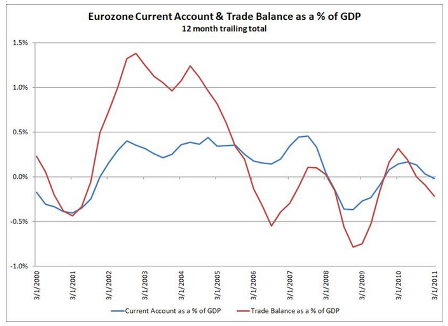
Euro trade data

So looks to me that China shifted to buying more euro just as the trade flows were turning the other way and might have otherwise been weakening the euro.

This means that when they stop buying there could be serious gap down until it gets to where it would have gotten had China not been buying. (Kind of like taking your finger out of the hole in the dam.)

Which is maybe what happened when it peaked a few weeks ago at the time of Bernanke’s first strong dollar speech?

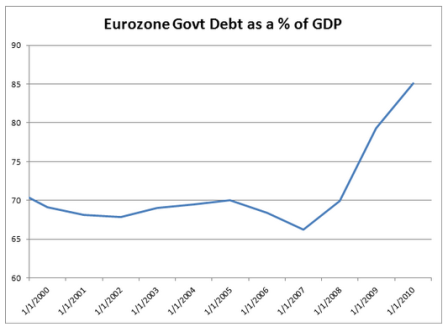
And the rising euro zone debt to GDP ratio (which is only through 2010 on the below chart) though falling some this year with austerity, may now be rising again due to new weakness created by that same austerity.

It’s all starting to look a lot like the beginnings of the traditional banana republic model- high unemployment, high ‘bad’ deficits from weak economies, and a falling currency that keeps debt to gdp ratios capped as ‘inflation’ floods in through the fx window.