
Bill Dudley’s Speech


[Skip to the end]

>   
>   (email exchange)
>   
>   On Tue, Dec 15, 2009 at 8:36 AM, wrote:
>   
>   I was reading Bill Dudley’s speech from last week and can’t figure out why he’s saying
>   some things that are at best misleading.
>   
>   Mr. Dudley’s overall remarks were interesting, helpful and encouraging in many ways,
>   but I was quite concerned by what he said towards the end about excess reserves:
>   

“If we raise the interest rate on excess reserves, we can incentivize banks to hold the excess reserves with us rather than lend them out”

>   
>   It’s difficult to make sense of this statement, because banks, in the aggregate, don’t in
>   effect “lend” or “not lend” excess reserves. I realize that there is a lot of confusion in
>   the financial press surrounding the issue of excess reserves. Unfortunately, Mr. Dudley’s
>   choice of words seems likely to perpetuate some of these misunderstandings and also
>   seems inconsistent with Fed staff papers on this matter.
>   
>   In the hope that it might prove useful at some point, I would like to offer the following
>   assertions:
>   
>   1. In our system, banks are never reserve-constrained in their lending activities – the
>   Fed will always add as many reserves as are needed to maintain its interest rate target.
>   

Yes, and more so. If the Fed doesn’t proactively add reserves to alleviate a shortage the result is an overdraft in at least one member bank’s reserve account, and an overdraft *is* a loan from the Fed, so in any case needed reserves are necessarily added as an ‘automatic’ matter of accounting. The Fed’s decision is about pricing the overdraft.

So it’s always about price and not quantity.

>   
>   Bank lending decisions are independent of reserves.
>   

Yes, completely.

>   
>   2. Now that the Fed is paying interest on excess reserves, their quantity is irrelevant –
>   monetary policy objectives can be pursued completely independently from any
>   accounting measure of excess reserves in the system.
>   

Yes, apart from a small glitch- the agencies have reserve accounts that don’t earn interest. The Fed is on this and working to get it changed so all reserve accounts pay interest.

>   
>   3. The private sector cannot create or extinguish reserves. See Fed paper
>   http://www.newyorkfed.org/research/staff_reports/sr380.pdf
>   

Yes!!!


[top]
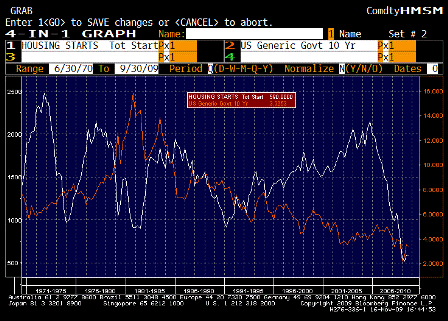
Housing starts and 10 year tsy rates


[Skip to the end]

Interesting how high housing starts were when interest rates were a lot higher than they are now.

And if you ‘population adjust’ the housing starts the ‘Greenspan super bubble’ fell far short of previous highs, even with much higher mtg rates back then. (add about 2% to the 10 year note rates to approximate mortgage rates.)

In fact, it’s hard to attribute housing performance to interest rates in general.

I saw a graph from Goldman a couple of years ago showing how housing related to the fiscal cycle and at that time it was forecasting a decline. And interest rates were nowhere to be found in that model. While I did criticize some of the policies of the Greenspan era, I never have ‘blamed’ him for the housing bubble. Ironically he’s watched this destroy his reputation and largely believes it himself.

Interest rates didn’t get us into this and they won’t get us out, as the late John Kenneth Galbraith stated in his last book, ‘The Economics of Innocent Fraud.’


[top]

bernanke


[Skip to the end]


Karim writes:

DOVISH-Focus largely on headwinds to growth; token paragraph (new) on the dollar; repeats the ‘2Es’ (exceptionally low for an extended period)

Excerpts

* Today, financial conditions are considerably better than they were then, but significant economic challenges remain. The flow of credit remains constrained, economic activity weak, and unemployment much too high. Future setbacks are possible.

* My own view is that the recent pickup reflects more than purely temporary factors and that continued growth next year is likely. However, some important headwinds–in particular, constrained bank lending and a weak job market–likely will prevent the expansion from being as robust as we would hope.

* access to credit remains strained for borrowers who are particularly dependent on banks, such as households and small businesses.. the fraction of small businesses reporting difficulty in obtaining credit is near a record high, and many of these businesses expect credit conditions to tighten further.

* With the job market so weak, businesses have been able to find or retain all the workers they need with minimal wage increases, or even with wage cuts. Indeed, standard measures of wages show significant slowing in wage gains over the past year. Together with the reduction in hours worked, slower wage growth has led to stagnation in labor income. Weak income growth, should it persist, will restrain household spending. The best thing we can say about the labor market right now is that it may be getting worse more slowly… a number of factors suggest that employment gains may be modest during the early stages of the expansion.

* I expect moderate economic growth to continue next year. Final demand shows signs of strengthening, supported by the broad improvement in financial conditions. Additionally, the beneficial influence of the inventory cycle on production should continue for somewhat longer. Housing faces important problems, including continuing high foreclosure rates, but residential investment should become a small positive for growth next year rather than a significant drag, as has been the case for the past several years. Prospects for nonresidential construction are poor, however, given weak fundamentals and tight financing conditions.

* The foreign exchange value of the dollar has moved over a wide range during the past year or so. When financial stresses were most pronounced, a flight to the deepest and most liquid capital markets resulted in a marked increase in the dollar. More recently, as financial market functioning has improved and global economic activity has stabilized, these safe haven flows have abated, and the dollar has accordingly retraced its gains. The Federal Reserve will continue to monitor these developments closely. We are attentive to the implications of changes in the value of the dollar and will continue to formulate policy to guard against risks to our dual mandate to foster both maximum employment and price stability. Our commitment to our dual objectives, together with the underlying strengths of the U.S. economy, will help ensure that the dollar is strong and a source of global financial stability.

* The Federal Open Market Committee continues to anticipate that economic conditions, including low rates of resource utilization, subdued inflation trends, and stable inflation expectations, are likely to warrant exceptionally low levels of the federal funds rate for an extended period.


[top]

Paul Davidson response to more NY Fed payroll tax holiday comments


[Skip to the end]

On Sun, Nov 15, 2009 at 10:47 AM, Davidson, Paul wrote:

I agree with Warren on his entire argument except for one point. He calls these New Keynesians and neoclassical people “relatively intelligent”. Ha! As an academic who has been challenging their assumptions for more than 35 years, I reject the idea that they are relatively intelligent!!


Paul


[top]

more NY Fed payroll tax holiday comments


[Skip to the end]

>   
>   (email exchange)
>   
>   On Sun, Nov 15, 2009 at 12:12 AM, Roger > wrote:
>   
>   One can almost imagine the Rubin camp is trying to head off a
>   possible move to follow logic – by baffling people with bull.
>   Coming from the NYFed, this paper makes little sense. Could they really have a
>   manipulative agenda?
>   

No, not at all. This just somehow slipped through. They rejected full Ricardian equivalence years ago.

Ricardian equivalence states that a tax cut won’t get spent because people will ‘know’ it just means higher taxes later as they ‘know’ the federal budget ultimately has to be balanced, and therefore they will simply set aside any payroll tax holiday money in a savings account and not spend it.

This means, for example, that if you are behind on your mtg payment and your take home pay goes up due to a tax cut you will put that extra pay in a savings account and not bring your mtg up to date.

As I said, the Fed rejected all this many years ago.

I do agree the first take home pay increases received from a payroll tax holiday would largely be used to make mtg payments to avoid foreclosures, etc., and pay off other outstanding obligations, all of which is called ‘adding to savings’ which is what we need to happen in many cases before consumption can resume. And it also ‘fixes’ the banking system by stemming delinquencies and defaults.

And the longer we wait the deeper the hole we need to get out of.

>   
>   How does one call the Fed economists on such bull?
>   

It would take a letter from a recognized scholar precisely pointing out the errors.

Meanwhile, unfortunately, it’s delaying consideration of what’s needed to restore output and employment.

One last thing-

In the neo classic (math) model, which doesn’t recognize the currency itself as a public monopoly, prices and wages instantly adjust such that there is never any unemployment.

The ‘New Keynesian’ school of thought pretty much agrees, except that they believe we get unemployment like what we have now because prices (and wages) are slow to adjust. So even they believe that we will gradually ‘automatically’ return to full employment.

Keynes, however, argued that if elevated ‘savings desires’ persist low aggregate demand and high levels high unemployment can persist even if prices and wages continue to fall, and it all can only be reversed by deficit spending to restore demand.

In this administration the ‘New Keynesians’ and neo classics are clearly winning, as they are seeing forecasts of slow, gradual, long term improvement in output and employment which fit with their understanding that this is a how the adjustment works, and that prices and wages will slowly adjust and automatically return us to full employment. The reason it takes so long is that prices and wages are ‘sticky’ and slow to adjust.

They are not willing to use the likes of a payroll tax holiday to restore aggregate demand because the believe that would be ‘borrowing from china and leaving our children that debt to pay’ and all that gold standard nonsense. Further to that point, they believe we’ve already done too much of that, though probably a necessary evil due to the circumstances, and we are rising falling into the ‘debt trap’ and all the rest of that type of fiscal nonsense.

Hence the recent pronouncements from the Obama administration proposing 5% across the board cuts in federal spending for next year.

As well as pronouncements that he wants less consumption, more savings, and more exports, which means lower standards of living in the face of the greatest and rapidly growing abundance of real goods and services in history.

>   
>   Assume, assume, assume – they obviously assume too much, which is no
>   way to direct national policy.
>   

They are relatively intelligent people who happen to be wrong in their basic assumptions, and they have near universal academic support. The few academics who do understand the monetary system (less then 30) are called ‘heterodox’ vs ‘orthodox’ and not taken seriously.

I call it a massive case of what Galbraith called ‘innocent fraud.’


[top]

NY Fed research report- a payroll tax holiday will make the economy worse


[Skip to the end]

Just read through it quickly.

Assumptions:

First, they use a full Ricardian assumption- lower taxes now ‘price in’ the higher taxes later to keep the budget balanced long term

Second, because real rates go up as nominal rates hit zero expectations are for lower prices and therefore spending goes down.

Third, as real wages go up with payroll tax cuts, the desire to work is assumed to go higher, putting downward pressure on wages and costs, reducing prices on the supply side, also raising real rates as the nominal rate can’t go any lower.

Without the Ricardian assumption it all comes apart, best i can tell so far.

And most economists reject that assumption as it means you could cut taxes all you want with no effect as people don’t spend in anticipation of higher taxes later. So that argues for cutting taxes to 0, since it won’t change spending.

So what they do is break the world into Ricardian and non Ricardian agents, and then try to determine effects of deficit changes, etc.

It gets very silly. Especially when recognizing there is no ‘natural force’ that balances the budget over time, while there are ‘natural forces’ (further influenced by institutional structure) that promote the accumulation of net financial assets in the non govt sectors which can only be supplied by govt deficit spending.

It comes from not understanding the currency itself is a (simple) public monopoly, and not just a numeraire in a relative value new Keynesian model.

A new analytical low for the cycle and a black mark for the NY Fed:

Link

Federal Reserve Bank of New York
Staff Reports
What Fiscal Policy Is Effective at Zero Interest Rates?
Gauti B. Eggertsson

Staff Report no. 402
November 2009

Abstract
Tax cuts can deepen a recession if the short-term nominal interest rate is zero, according to a standard New Keynesian business cycle model. An example of a contractionary tax cut is a reduction in taxes on wages. This tax cut deepens a recession because it increases deflationary pressures. Another example is a cut in capital taxes. This tax cut deepens a recession because it encourages people to save instead of spend at a time when more spending is needed. Fiscal policies aimed directly at stimulating aggregate demand work better. These policies include 1) a temporary increase in government spending; and 2) tax cuts aimed directly at stimulating aggregate demand rather than aggregate supply, such as an investment tax credit or a cut in sales taxes. The results are specific to an environment in which the interest rate is close to zero, as observed in large parts of the world today.


[top]

China hopes U.S. keeps deficit to appropriate size


[Skip to the end]

Translation:  China threatens to liquidate it’s dollars to keep the dollar weak so China can peg to it and increase global exports??? 

China hopes U.S. keeps deficit to appropriate size

(Reuters) – China hopes that the United States will keep its deficit to an appropriate size to ensure basic stability in the U.S. dollar exchange rate, Chinese Premier Wen Jiabao said on Sunday.

“We have seen some signs of recovery in the U.S. economy … I hope that as the largest economy in the world and an issuing country of a major reserve currency, the United States will effectively discharge its responsibilities,” Wen told a news conference in Egypt.

“Most importantly, we hope the United States will keep an appropriate size to its deficit so that there will be basic stability in the exchange rate, and that is conducive to stability and the recovery of the global economy,” he added.

The premier had expressed concern in March that massive U.S. deficit spending and near-zero interest rates would erode the value of China’s huge U.S. bond holdings.

China is the biggest holder of U.S. government debt and has invested an estimated 70 percent of its more than $2 trillion stockpile of foreign exchange reserves, the world’s largest, in dollar assets.

“I follow very closely Chinese holdings of U.S. assets because that constitutes a very important part of our national wealth. Our consistent principle when it comes to foreign exchange reserves is to ensure the safety, liquidity and good value of the reserves,” Wen said.


[top]

Short-Rate Thoughts: DEFLATION – Radical Thesis Turnaround


[Skip to the end]

Well stated!

*Not house view.

Since March I have been arguing that the world was a better place than people thought. I am now shifting my core view, which still might take several months to develop in the marketplace.

Skipping to the Conclusions

1. Deflation will be the surprise theme of 2010, when Congress will go into a pre-election deadlock; elections have only underscored this is the public direction

2. Excess Reserves will neither generate new lending nor generate inflation; actually, the quantity of reserves (M0) basically has no real economic effect

3. ZIRP and QE actually CONTRIBUTE to the deflation mostly by depriving the spending public of much-needed coupon income

4. When Federal Tax Rates increase in 2011 this problem will become even more severe

5. The overall level of public indebtedness (vs GDP) will not put upward pressure on yields in this backdrop and there will be a reckoning in the high-rates/deficit hawk community

6. Strong possibility that QE will actually be upsized next year rather than ended when the Fed observes these effects (and this might actually make things WORSE)

The Explanation (a Journey)

It seemed fairly intuitive and obvious for thousands of years that the Earth was at rest and the Sun moving around it. Likewise, it has seemed that the Fed controls the money supply, balances the economy by setting interest rates and fixing reserves which power bank lending, that more Fed money means less buying power per dollar (inflation), that the federal government needs to borrow this same money from The People in order to be able to spend, and that it needs to grow its way out of its debt burden or risks fiscal insolvency. I have, in just a fortnight, been COMPLETELY disabused of all these well-entrenched notions. Starting from the beginning, here is how I now think it works:

1. The first dollar is created when Treasury gives it to someone in exchange for something ammo, a bridge, labor. It is a coupon. In exchange for your bridge, here is something you or anyone you trade it with can give me back to cover your taxes. In the mean time, it goes from person A to person B, gets deposited in a bank, which then deposits it at the Fed, which then records the whole thing in a giant spreadsheet. Liability: One overnight reserve/demand deposit/tax coupon. Asset: IOU from Treasury general account. Tax day comes, Person A pulls his deposit, cashes in the coupon, the Treasury scraps it, and POOF, everything is back to even.

2. For various reasons (either a gold-standard relic or a conscious power restraint, depending who you ask), we make the Treasury cover its shortfall at the Fed and SWAP one type of tax-coupon (a deposit or reserve) for another by selling a Treasury note. Either the Fed (in the absence of enough reserves well get to this) or a Bank (to earn risk-free interest) or Person A (who sets a price for his need to save) is forced out his demand deposit dollar and into a treasury note at the auction clearing price. What about the fact that treasuries aren’t fungible like currency? On an overnight basis, that doesn’t really constrain anyones behavior. A reserve or a deposit means you get your money back the next day. Same thing with a treasury. Functionally its cash and wont influence your decision to buy a car. Likewise for the bank. In the overnight duration example, it does NOT affect their term lending decisions if they have more reserves and few overnight bills, or more bills and fewer reserves. Its even possible to imagine a world (W. J.Bryans dream) where the Fed, with its scorekeeping spreadsheet, combines the line-items we call treasuries and reserves.

3. Total public sector dissavings is equal to private sector savings (plus overseas holdings) as a matter of accounting identity. This really means that the only money available to buy treasuries came from government itself (here I am being a bit loose combining Tres+Fed), from its own tax coupons. If there arent enough ready coupons at settlement time for those Treasuries, the Fed MUST supply them by doing a repo (trading deposits/coupons for a treasury by purchasing one themselves at least temporarily). They dont really have a choice in the matter, however, because if the reserves in the banking system didnt cover it, overnight rates would go to the moon. So in setting interest rates they MUST do a recording on their spreadsheet and the Fedwire and shift around some reserve-coupons (usable as cash) for treasury-coupons (usable for savings but functionally identical).

4. Thus monetizing the deficit is actually just the Feds daily recordkeeping combined with its interest rate targetting, just keeping the score in balance. However, duration is real, as only overnight bills are usable as currency, and because people (and pensions!) need savings, they need to be able to pay taxes or trade tax-coupons for goods when they retire, and so there is a price for long-term money known as interest rates. The Fed CAN affect this by settings rates and by shifting between overnight reserves, longer-term treasuries, and cash in circulation. When the Fed does a term repo or a coupon sale, they shift around the banking and private sectors duration, trading overnight coupons for longer-term ones as needed to keep the balance in order.

5. But all this activity doesnt influence the real economy or even the amount of money out there. The amount of money out there dictates the recordkeeping that the Fed must do.

6. This is where QE comes in to play. In QE, aside from its usual recordkeeping activities, the Fed converts overnight reserves into treasuries, forcing the private sector out of its savings and into cash. This is just a large-scale version of the coupon-passes it needed to do all along. Again, they force people out of treasuries and into cash and reserves.

7. The private sector is net saving, by definition. It has saved everything the Treasury ever spent, in cash and in treasuries and in deposits. In fact, Treasuries outstanding plus cash in circulation plus reserves are just the tangible record of the cumulative deficit spending, also by IDENTITY.

8. So when QE is going on, there is some combination of savers getting fewer coupons which constrains their aggregate demand just like a lower social security check would, and banks being forced out of duration instruments and into cash reserves. I do not think this makes them lend more their lending decision was not a function of their cashflow but rather a function of their capital and the opportunities out there (even when you judge a banks asset/equity capital ratio, there is no duration in accounting, so a reserve asset and a treasury asset both cost the same). If they had the capital and the opportunities, they would keep lending and force the Fed to give them the cash (via coupon passes and repos, which we then wouldnt call QE but rather preventing overnight rates from going to infinity). As far as I can tell, excess reserves is a meaningless operational overhang that has no impact on the economy or prices. The Fed is actually powering rates (cost of money) not supply (amount of money) which is coming from everyone else in the economy (Tres spending and private loan demand).

9. Ill grant there is a psychological component to inflation phenomenon, as well as a preponderance of ignorance about what reserves are, and that might result in some type of inflationary event in another universe, but not in the one we are in where interest rates are low and taxes are going up and the demand for savings is therefore rising rather than falling.

10. One can now retell history through this better lens. Big surpluses in 97-01, then a big tax cut in 03. Big surpluses in 27-30, then a huge deficit in 40-41. Was an aging Japanese public shocked into its savings rate or is that savings just the record of the recessionary deficit spending that came after 97? It will be interesting to watch what happens there as the demographic story forces households to live moreso off JGB income will this force the BOJ to push rates higher or will they never get it and force the deflation deeper?

11. There are, as always mitigating factors. Unlike in the Japan example, a huge chunk of US fixed income is held abroad, so lower rates are depriving less exported coupon income which is actually a benefit. There is of course some benefit from lower private sector borrowing rates as well MEW, lower startup costs for new capital investment, etc. Also, even if one denies that higher debt/gdp ratios are what weakened it (rather than Chinas decisions again something unavailable to Japan), the dollar IS weaker now which is inflationary. But this is all more than offset, I think, by ppls expectation that higher taxes are coming, and thats hugely deflationary and curbs aggregate demand via multiple channels.

12. Additionally, there seems to be a finite amount of political capital that can be spent via the deficit, and that amount seems to be rapidly running out. See https://portal.gs.com/gs/portal/home/fdh/?st=1&d=8055164. The period of deficit stimulus is mostly behind us. Instead, people are depending upon ZIRP and the Fed to stimulate the economy, and in fact there is marginal, and possible negative, stimulation coming from that channel. The Fed is taking away the social security checks knowns as coupon interest.

13. Finally, there is a huge caveat that I cant get around, which is whether we are measuring inflation correctly. It happens that I don’t think we are strange effects like declining inventory will provide upward pressure and lagged-accounting for rents providing downward pressure in the CPI. This is an unfortunate, untradeable fact about the universe that I think will be offset by other indicators (Core PCE) sending a better signal. But this is part of the reason this whole story will take time to develop in the marketplace. As a massive importer of goods and exporter of debts we are not quite Japan, but the path of misunderstanding is remarkably similar.

* Credit due Warren Mosler and moslereconomics.com for guiding my logic.

J. J. Lando


[top]

Goldman- Excess Reserves Irrelevant and the FED does not need to execute Reverse Repos with Non-Primary Dealers


[Skip to the end]
Hopefully, when Goldman talks, people listen:
Clarification from author Franesco Cafagna: Views expressed in this piece are his own and are not necessarily reflect the view of Goldman Sachs

1. Do excess reserves really matter and does the FED really need to drain them?

The short answer is: I don’t think so. The total amount of reserves currently in the banking system is the sum of all Required Reserves (including a certain amount that banks hold for precautionary reasons) and Excess Reserves. The FED HAS to provide the banking system with the amount of Required Reserves it needs otherwise rates spike higher (potentially to infinity if the discount window or other forms of “marginal lending facilities” did not exist): the amount required is the result of banks’ individual credit decisions (how many loans they make) and the FED’s job is to estimate that amount and provide it to the system. But the FED does not control this number. When it comes to Excess Reserves, lots of people worry about the potential long-term inflationary impact they may have. The truth is that they don’t matter because they bear no weight in banks’ credit decisions (how many new loans they make). They simply appear on banks’ balance sheets as an Asset that gets “invested” every night in the form of a deposit that they leave at the FED and on which they currently get a 25bps remuneration. If the FED decided to drain excess reserves via Reverse Repo the impact on the system as a whole would be zero because the system as a whole is “self contained”. To understand this let’s think of the most extreme case: the FED drains all excess reserves via one giant Overnight Reverse Repo executed with all the
banks in the banking system. At a macro level all that’s happened is that each bank has changed its Excess Reserve asset (which is effectively an O/N asset) into and O/N Reverse Repo and the two are virtually identical. Another way to think of this is that Excess Reserves are ALREADY being drained every night because banks leave them on their account at the FED every night. The only thing that will change is the liquidity profile of banks IF the FED decided to execute Reverse Repos longer than 1 day: in that case a 1-day assets (excess reserve) would be transformed into a longer asset (Reverse Repo longer than 1 day). Whilst this may affect individual institutions, the system as a whole is unaffected because this amount “extra cash” in the system (excess reserves) is NOT being used for anything. It just sits at the FED every night. So effectively it’s being “drained” already every night. So all this talk about excess reserves and their potential inflationary impact seems misplaced: they are just irrelevant and the FED simply does not need to drain them because they are “self-drained” every night anyway.

2. Does the FED really need to execute Reverse Repos with Non-Primary dealers?

This item has gained press coverage following the Fed’s release of the last Fomc minutes in which it was clear that it debated the possibility of executing large scale reverse repo operations with non-primary dealers: the motivation behind this discussion is the perceived balance-sheet capacity constraint that the 16 Primary dealers might face (a Reverse Repo increases the assets of the broker-dealer entity facing the Fed). This statement by the Fed has created all kind of debate across the street with various dealers coming up with all kinds of estimates of the overall size that the Primary dealers can handle (with some estimates being as low as 100-150bn out of a total of over 800bn that the Fed might want to execute). Leaving aside the actual need to execute Reverse Repo in the first place (point 1 above) and assuming that the Fed will, in fact, choose to execute these operations because it has stated that they are part of the exit strategy policy, I think the alleged Primary Dealers’ balance sheet capacity constraint has been VASTLY exaggerated. It’s true that a Reverse Repo increases the assets of a broker-dealer entity, but this is an issue only for stand-alone broker-dealers (Jeffreys and alike). For Primary Dealers with big commercial banks operations (JPM, Citi, BOA) I don’t believe that this is an issue at all: since they are already sitting on big amounts of Excess Reserves and because 23A (which regulates the activity between a bank entity and its affiliates) does not impose any restriction on the amount of UST, Agencies and Agencies MBS repos that a bank can execute with an affiliate broker-dealer entity, this means that the JPMs of the world could potentially execute reverse repo operations with the Fed up to the amount of excess reserves they are already sitting on without increasing their balance sheet by 1 single cent: it would simply be a transformation of an asset (excess reserves of the bank entity) into another (reverse repo of the broker-dealer entity). So, in my view, the conclusion has to be that the Primary Dealers can in fact absorb a much bigger amount of Reverse Repo than originally thought even by the Fed itself and that realistically the only other counterparties that the Fed might engage directly for these kind of operations are the GSEs: but in this case the reason would not be balance sheet driven but would be driven by the distortion that the GSEs’ participation in the fed funds mkt creates (call me if you would like to discuss this further).

By Franesco Cafagna


[top]

Valance Weekly Economic Chart Book


[Skip to the end]

Valance Weekly Economic Chart Book

A bit disorganized, but these are my impressions as of month end.
(Look for the usual couple of days or so of month end allocations driving the technicals.)

I don’t see much to get encouraged about on almost all of these charts.

In general, demand was trending lower since maybe mid 2006, took a sharp dip in mid 2008 with the great Mike Masters Inventory Liquidation that ended in late Dec 2008, after which the rate of decline stopped accelerating (second derivative change), and now were are, for the most part, back on the ‘trend line’ of the slow decline in demand that started in mid 2006.

Personal income looks very weak, hurt by falling interest income as previously discussed. The clunker lift has reversed, and housing remains very week with no real signs of recovery yet. (about 2% of GDP was clunkers and inventories)

The deficit got large enough due to the automatic stabilizers around year end, market functioning returned as the Fed eventually accepted enough different kinds of collateral from its banks to adequately fund them. (should have been lending unsecured to its member banks all along, etc.)

But while the Obama fiscal package added some demand, and GDP stabilized, the zero interest rate policy continued to shift savings incomes to widening bank net interest margins, and the Fed’s $2 T portfolio began draining another maybe 60 billion a year in private sector interest income. Additionally, interest rates on tsy secs have declined sharply with the Fed rate cuts. (While I fully support a zero rate policy I also recognize the need to sustain demand with a payroll tax holiday, per capita revenue sharing, and an $8/hr fed funded job for anyone willing and able to work.)

And now with productivity higher than real GDP growth, employment continues to fall, though at a lower rate, and capacity utilization in general remains at very low levels. Prices remain very weak, apart from gold, which could be a bubble driven by the misconception that the Fed’s ‘quantitative easing’ policy is inflationary. In fact, it’s nothing but an asset shift that modestly reduces term interest rates at the cost of draining billions in interest income from the private sector.

If gold does turn out to have been a bubble and collapse, it could be highly demoralizing as it would reveal the Fed does not have the tools to ‘reflate’ at will. Dollar shorts could start covering, further taking away the bid from stocks (also as previously discussed). And if the Saudis have left the prices to their refiners below current levels, crude and products will fall as well.

All major foreign govts. seem to be continuing to favor export led growth, which will also keep US domestic demand in check.

And, in general, it looks like most of the world is looking to tighten up fiscal policy, believing in the like of the ‘debt trap’ and also that monetary policy is expansionary and inflationary.


[top]