QE and the wealth effect

>   
>   (email exchange)
>   
>   On Thu, Nov 4, 2010 at 11:26 PM, wrote:
>   
>   Do you have any thoughts on this supposed wealth effect?
>   

There is one but I see it as coming from deficit spending, and probably not QE.

Federal deficits support income and add to net financial assets,
which is the financial equity and income that supports the credit structure.

The question is whether QE net adds to nominal wealth via the equity price channel, via ‘valuation’ due to lower long term risk free rates/higher pe’s.

First, the evidence isn’t clear that QE results in higher equity prices, with Japan as the leading example.

Second, there’s the question of whether the maybe 75 billion of annual income- about 1/2% of gdp removed from the private sector- is a stronger force than the valuation benefits of the lower discount rates.

Third, let me suggest that by doing QE on a quantity basis rather than targeting a rate, the change in rates on a ‘bang for the buck’ basis could be a lot lower than if the rate was directly targeted.

Let me give a possible example. Let’s say the Fed simply targeted the 10 year tsy at 2.25%. They would have a bid at that level and buy all the secs the market didn’t want to buy at that level. They may in fact buy a lot or a very few, and possibly none at all, depending on tsy issuance, investor demand, and market expectations. But let’s say for this example they did that and bought a total of $1 T 10 year notes defending the 2.25% level.

Now let’s say that instead, the FOMC had limited the Fed to buying $900 billion. The question then is how high would 10 year notes trade with that $100 billion free to trade at market levels?

What I’m saying is it could be at much higher yields, as the market expectation component of demand does its thing. The yield would simply be the same as if the Tsy had issued $900 billion fewer 10 year notes.

Note that we went for years with no issuance of 30 year t bonds, and 30 years t bond rates on the outstanding bonds did not fall to 0.

Yes, the curve flattened maybe 50 basis points, and steepened again when issuance resumed, but in the scheme of things it was a factor for the macro economy.

In other words, qe, without a rate target, qe might actually reduce rates very little.

It’s all about how much net govt issuance alters the term structure of rates.

So is there a wealth effect?

Yes, but in both directions- removing income lowers it and valuations help it.

And, recognizing QW when done the way they are doing it probably doesn’t reduce rates all that much, the cost of QE in lost income is more likely to be higher than the valuation gains.

Hope this helps!

Also:

Looks like it was buy the rumor and then double up on the news.

Either it all sticks or it all unwinds that much more intensely.

Still looks like the latter to me as the notion that QE doesn’t work sinks in. The mood now is there will be QE 3,4,5 or whatever it takes until it does work.

Like the kid in his car seat who keeps turning his toy steering wheel as much as it takes to turn the car.

QE still driving portfolio shifting

I’ve been watching for a ‘buy the rumor sell the news’ ‘risk off’ reversal, but it happened at best only momentarily after the Fed announcement, when the 10 year tsy note dipped to maybe 2.62 very briefly, stocks dipped, the dollar sort of held, gold was off a touch, etc. But now it looks like it’s ‘risk back on’ with a vengeance as both believers in QE and those who believe others believe in QE are piling on.

The fact remains that QE does nothing apart from alter the term structure of rates.

There are no ‘quantity’ effects, though from the following article and market reactions much of the world still believes there are substantial quantity effects.

And what we are seeing are the effects of ongoing portfolio shifting and trading based on the false notions about QE.

To review,

QE is not ‘money printing’ of any consequence. It just alters the duration of outstanding govt liabilities which alters the term structure of risk free rates.

QE removes some interest income from the economy which the Fed turns over to the Tsy. This works against ‘earnings’ in general.

QE alters the discount rates that price assets, helping valuations.

Japan has done enough QE to keep 10 year jgb’s below 1%, without triggering inflation or supporting aggregate demand in any meaningful way. Japan’s economy remains relatively flat, even with substantial net exports, which help domestic demand, a policy to which we are now aspiring.

QE does not increase commodity consumption or oil consumption.

QE does not provide liquidity for the rest of the world.

QE does cause a lot of portfolio shifting which one way or another is functionally ‘getting short the dollar’

This is much like what happened when panicked money paid up to move out of the euro, driving it briefly down to 118, if I recall correctly.

No telling how long this QE ride will last.

What’s reasonably certain is the Fed will do what it can to keep rates low until it looks like it’s meeting at least one of its dual mandates.

Asians Gird for Bubble Threat, Criticize Fed Move

By Michael Heath

November 4 Bloomberg) — Asia-Pacific officials are preparing
for stronger currencies and asset-price inflation as they blamed
the U.S. Federal Reserve’s expanded monetary stimulus for
threatening to escalate an inflow of capital into the region.

Chinese central bank adviser Xia Bin said Fed quantitative
easing is “uncontrolled” money printing,
and Japan’s Prime
Minister Naoto Kan cited the U.S. pursuing a “weak-dollar
policy.”
The Hong Kong Monetary Authority warned the city’s
property prices could surge and Malaysia’s central bank chief
said nations are prepared to act jointly on capital flows.

“Extra liquidity due to quantitative easing will spill
into Asian markets,”
said Patrick Bennett, a Hong Kong-based
strategist at Standard Bank Group Ltd. “It will put increased
pressure on all currencies to appreciate, the yuan in particular

has been appreciating at a slower rate than others.”

The International Monetary Fund last month urged Asia-
Pacific nations to withdraw policy stimulus to head off asset-
price pressures, as their world-leading economies draw capital
because of low interest rates in the U.S. and other advanced
countries. Today’s reactions of regional policy makers reflect
the international ramifications of the Fed’s decision yesterday
to inject $600 billion into the U.S. economy.

Bernanke Op-Ed

What the Fed did and why: supporting the recovery and sustaining price stability

By Ben S. Bernanke

November 4 (Washington Post) — Two years have passed since the worst financial crisis since the 1930s dealt a body blow to the world economy.

Only because policy makers failed to respond with an appropriate fiscal adjustment.

And, worse, they continue to fail to recognize this policy blunder.

Working with policymakers at home and abroad, the Federal Reserve responded with strong and creative measures to help stabilize the financial system and the economy. Among the Fed’s responses was a dramatic easing of monetary policy – reducing short-term interest rates nearly to zero. The Fed also purchased more than a trillion dollars’ worth of Treasury securities and U.S.-backed mortgage-related securities, which helped reduce longer-term interest rates, such as those for mortgages and corporate bonds. These steps helped end the economic free fall and set the stage for a resumption of economic growth in mid-2009.

In Q3 08 the Fed failed to provide sufficient routine bank liquidity for several critical months while it experimented with a variety of poorly thought out open market operations that progressively accepted more and more bank collateral until they eventually did what they should have all along- lend to member banks at their target rate on a continuous, as needed basis. Yet even now they fail to do this to the smaller community banks, whose cost of funds remains at least 1% over the fed funds rate.

They also continue to fail to recognize that their role is setting the term structure of risk free rates, which can be done directly.
By simply offering to buy tsy securities at their target rates in unlimited quantities.
However, they have yet to fully appreciate that it’s the resulting interest rates and not the quantities they purchase that are of further economic consequence. And if they wish to specifically target mortgage rates, this is readily done by lending to their member banks specifically for this purpose at the Fed’s desired target for mortgage rates, with the Fed assuming the ‘convexity’ risk.

Additionally, while the Fed did address the ‘market functioning’ issues that were caused by the Fed’s own initial lack of liquidity provision, they failed to recognize that monetary policy was not going to restore aggregate demand. In fact, they were all but certain it would, as evidenced by their concern their policies carried the risk of generating ‘inflation, etc.’ this led other policy makers to take a ‘wait and see’ attitude which has been monumentally costly with regards to lost real output and all the real costs of unemployment.

Notwithstanding the progress that has been made,

After more than two years the output gap in general remains at near record levels.

when the Fed’s monetary policymaking committee – the Federal Open Market Committee (FOMC) – met this week to review the economic situation, we could hardly be satisfied. The Federal Reserve’s objectives – its dual mandate, set by Congress – are to promote a high level of employment and low, stable inflation. Unfortunately, the job market remains quite weak; the national unemployment rate is nearly 10 percent, a large number of people can find only part-time work, and a substantial fraction of the unemployed have been out of work six months or longer. The heavy costs of unemployment include intense strains on family finances, more foreclosures and the loss of job skills.

The fed’s responsibility for this is largely that of its failure to do its job of providing continuous and unlimited liquidity to its member banks and to not recognize that monetary policy was not capable of restoring the aggregate demand necessary to support full employment.

Today, most measures of underlying inflation are running somewhat below 2 percent, or a bit lower than the rate most Fed policymakers see as being most consistent with healthy economic growth in the long run. Although low inflation is generally good, inflation that is too low can pose risks to the economy – especially when the economy is struggling. In the most extreme case, very low inflation can morph into deflation (falling prices and wages), which can contribute to long periods of economic stagnation.

Morph? Inflation deteriorates to unwelcome deflation with a lack of aggregate demand. There is no mystery here.

Even absent such risks, low and falling inflation indicate that the economy has considerable spare capacity, implying that there is scope for monetary policy to support further gains in employment without risking economic overheating.

Note the continued failure to recognize monetary policy has no tools to support demand at desired levels.

The FOMC decided this week that, with unemployment high and inflation very low, further support to the economy is needed. With short-term interest rates already about as low as they can go, the FOMC agreed to deliver that support by purchasing additional longer-term securities, as it did in 2008 and 2009. The FOMC intends to buy an additional $600 billion of longer-term Treasury securities by mid-2011 and will continue to reinvest repayments of principal on its holdings of securities, as it has been doing since August.

This approach eased financial conditions in the past and, so far, looks to be effective again. Stock prices rose and long-term interest rates fell when investors began to anticipate the most recent action. Easier financial conditions will promote economic growth. For example, lower mortgage rates will make housing more affordable and allow more homeowners to refinance. Lower corporate bond rates will encourage investment. And higher stock prices will boost consumer wealth and help increase confidence, which can also spur spending. Increased spending will lead to higher incomes and profits that, in a virtuous circle, will further support economic expansion.

These are all very weak channels at best.

What is hoped for is that lower interest rates encourage private credit expansion, where consumers return to borrowing to spend. And while this can happen, and may already be happening to a small degree, there is no reason to believe that QE will promote this outcome.

What the chairman knows and fails to discuss are the interest income channels, which he wrote about in a published paper in 2004. Lower rates cause the treasury to pay less interest on its treasury securities, and the interest the Fed earns on its newly purchased securities is interest no longer earned by the economy which previously held those securities. This reduced interest income paid by govt to the non govt sectors is much like a tax increase that to some degree neutralizes the modest positive effects the Fed is hoping for.

Also ignored is the fact that Japan has had near 0 rates and much lower long rates than the US, also helped by massive QE, and has also had very large net exports helping to support GDP, something the Fed and the US administration aspires to as well, yet has failed to restore desired aggregate demand, growth, and employment.

While they have been used successfully in the United States and elsewhere, purchases of longer-term securities are a less familiar monetary policy tool than cutting short-term interest rates. That is one reason the FOMC has been cautious, balancing the costs and benefits before acting.

Costs?

As monopoly provider of net clearing balances (reserves) for the payments system, the Fed is necessarily ‘price setter’ of the term structure of risk free rates. Their notion of ‘cost’ is inapplicable. And all QE does is alter the duration of total govt liabilities. It doesn’t change the quantity of non govt net financial assets.

We will review the purchase program regularly to ensure it is working as intended and to assess whether adjustments are needed as economic conditions change.

Although asset purchases are relatively unfamiliar as a tool of monetary policy, some concerns about this approach are overstated. Critics have, for example, worried that it will lead to excessive increases in the money supply and ultimately to significant increases in inflation.

Agreed! Yet their expressed motivation all along is to prevent deflation, which is the same as ‘causing inflation.’

A problem here is they believe that inflation is caused by rising inflation expectations, and not aggregate demand per se. That is, rising demand per se doesn’t cause inflation until that demand starts to drive inflation expectations.

Until this confused theory of inflation is discarded policy will continue to be confused as well.

Our earlier use of this policy approach had little effect on the amount of currency in circulation or on other broad measures of the money supply, such as bank deposits. Nor did it result in higher inflation.

Correct, which also means the policy failed to generate the desired results.

We have made all necessary preparations, and we are confident that we have the tools to unwind these policies at the appropriate time.

Agreed.

The Fed is committed to both parts of its dual mandate and will take all measures necessary to keep inflation low and stable.

The Federal Reserve cannot solve all the economy’s problems on its own. That will take time and the combined efforts of many parties, including the central bank, Congress, the administration, regulators and the private sector. But the Federal Reserve has a particular obligation to help promote increased employment and sustain price stability. Steps taken this week should help us fulfill that obligation.

How about an obligation to support a sufficient fiscal adjustment to eliminate the output gap rather than supporting deficit reduction?

FOMC


Karim writes:

  • Statement dropped reference to bank credit contracting
  • Several references to inflation being too low; 2nd paragraph completely overhauled to specify that Fed is missing both parts of the dual mandate and also characterizes progress towards objectives as ‘disappointingly slow’
  • Buying 600bn thru end of Q2-2011; added to reinvestment of MBS proceeds, total purchases estimated at 110bn/mth.
  • Increasing avg duration of purchases from 4yrs in ‘QE1’ to 5-6yrs link
  • ‘Regular review’ of total size of program and ‘will adjust’ to meet its dual mandate opens possibility of increasing pace of purchases and lengthening period in which they are buying past next June

Release Date: November 3, 2010
For immediate release

Information received since the Federal Open Market Committee met in September confirms that the pace of recovery in output and employment continues to be slow. Household spending is increasing gradually, but remains constrained by high unemployment, modest income growth, lower housing wealth, and tight credit. Business spending on equipment and software is rising, though less rapidly than earlier in the year, while investment in nonresidential structures continues to be weak. Employers remain reluctant to add to payrolls. Housing starts continue to be depressed. Longer-term inflation expectations have remained stable, but measures of underlying inflation have trended lower in recent quarters.

Consistent with its statutory mandate, the Committee seeks to foster maximum employment and price stability. Currently, the unemployment rate is elevated, and measures of underlying inflation are somewhat low, relative to levels that the Committee judges to be consistent, over the longer run, with its dual mandate. Although the Committee anticipates a gradual return to higher levels of resource utilization in a context of price stability, progress toward its objectives has been disappointingly slow.

To promote a stronger pace of economic recovery and to help ensure that inflation, over time, is at levels consistent with its mandate, the Committee decided today to expand its holdings of securities. The Committee will maintain its existing policy of reinvesting principal payments from its securities holdings. In addition, the Committee intends to purchase a further $600 billion of longer-term Treasury securities by the end of the second quarter of 2011, a pace of about $75 billion per month. The Committee will regularly review the pace of its securities purchases and the overall size of the asset-purchase program in light of incoming information and will adjust the program as needed to best foster maximum employment and price stability.

The Committee will maintain the target range for the federal funds rate at 0 to 1/4 percent and continues to anticipate that economic conditions, including low rates of resource utilization, subdued inflation trends, and stable inflation expectations, are likely to warrant exceptionally low levels for the federal funds rate for an extended period.

The Committee will continue to monitor the economic outlook and financial developments and will employ its policy tools as necessary to support the economic recovery and to help ensure that inflation, over time, is at levels consistent with its mandate.

Voting for the FOMC monetary policy action were: Ben S. Bernanke, Chairman; William C. Dudley, Vice Chairman; James Bullard; Elizabeth A. Duke; Sandra Pianalto; Sarah Bloom Raskin; Eric S. Rosengren; Daniel K. Tarullo; Kevin M. Warsh; and Janet L. Yellen.

Voting against the policy was Thomas M. Hoenig. Mr. Hoenig believed the risks of additional securities purchases outweighed the benefits. Mr. Hoenig also was concerned that this continued high level of monetary accommodation increased the risks of future financial imbalances and, over time, would cause an increase in long-term inflation expectations that could destabilize the economy.

Release Date: September 21, 2010
For immediate release

Information received since the Federal Open Market Committee met in August indicates that the pace of recovery in output and employment has slowed in recent months. Household spending is increasing gradually, but remains constrained by high unemployment, modest income growth, lower housing wealth, and tight credit. Business spending on equipment and software is rising, though less rapidly than earlier in the year, while investment in nonresidential structures continues to be weak. Employers remain reluctant to add to payrolls. Housing starts are at a depressed level. Bank lending has continued to contract, but at a reduced rate in recent months. The Committee anticipates a gradual return to higher levels of resource utilization in a context of price stability, although the pace of economic recovery is likely to be modest in the near term.

Measures of underlying inflation are currently at levels somewhat below those the Committee judges most consistent, over the longer run, with its mandate to promote maximum employment and price stability. With substantial resource slack continuing to restrain cost pressures and longer-term inflation expectations stable, inflation is likely to remain subdued for some time before rising to levels the Committee considers consistent with its mandate.

The Committee will maintain the target range for the federal funds rate at 0 to 1/4 percent and continues to anticipate that economic conditions, including low rates of resource utilization, subdued inflation trends, and stable inflation expectations, are likely to warrant exceptionally low levels for the federal funds rate for an extended period. The Committee also will maintain its existing policy of reinvesting principal payments from its securities holdings.

The Committee will continue to monitor the economic outlook and financial developments and is prepared to provide additional accommodation if needed to support the economic recovery and to return inflation, over time, to levels consistent with its mandate.

Voting for the FOMC monetary policy action were: Ben S. Bernanke, Chairman; William C. Dudley, Vice Chairman; James Bullard; Elizabeth A. Duke; Sandra Pianalto; Eric S. Rosengren; Daniel K. Tarullo; and Kevin M. Warsh.

Voting against the policy was Thomas M. Hoenig, who judged that the economy continues to recover at a moderate pace. Accordingly, he believed that continuing to express the expectation of exceptionally low levels of the federal funds rate for an extended period was no longer warranted and will lead to future imbalances that undermine stable long-run growth. In addition, given economic and financial conditions, Mr. Hoenig did not believe that continuing to reinvest principal payments from its securities holdings was required to support the Committee’s policy objectives.

next week….

Getting really bad feelings for the next week or so:

QE believed to be inflationary money printing but doesn’t actually do anything

Gridlock presumed good but is actually bad as it could mean taxes rise at year end

Republican fiscal conservatives deemed ‘good’ but in fact bad with their spending cuts and budget balancing bias.

So three big ‘buy the rumor sell the news’ things coming together?

Could be a reversal of risk on, or even a confused reshuffle of what’s risk on and what isn’t.

For example, could be lower 10 year tsy yields as it will all be perceived to keep the Fed on hold that much longer, as well as gold and commodities and commodity currencies selling off due to the realization that the fed can’t reflate even if it wants to.

That means crude could be selling off and the dollar getting stronger, even with rates lower.

Not a good time to have any risk on, in my humble opinion.

Old Greenspan Quote

The following is from an interview with Chairman Greenspan:

RYAN: “Do you believe that personal retirement accounts can help us achieve solvency for the system and make those future retiree benefits more secure?”

GREENSPAN: “Well, I wouldn’t say that the pay-as-you-go benefits are insecure, in the sense that there’s nothing to prevent the federal government from creating as much money as it wants and paying it to somebody. The question is, how do you set up a system which assures that the real assets are created which those benefits are employed to purchase.”

Posted in Fed

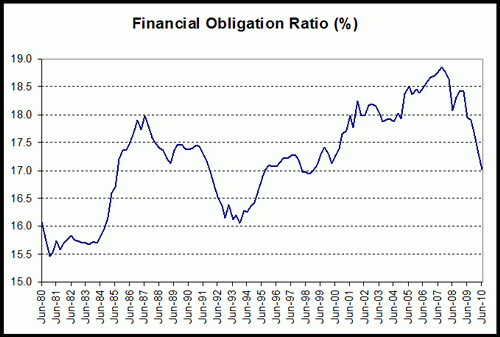
Fed Financial Obligations Ratio

This includes home owners and renters, and includes rent as a financial obligation.

And it’s gone down further since the June data point as the Federal budget deficit remains at around 9% of gdp.

The general drift higher over time is probably due fewer ‘no debt’ people rather than people with debt getting over extended, so I expect this to turn up well before it gets to the 16% level.

So looks to me like consumer batteries are very close to recharged which will be evidenced by this ratio moving sideways for a while before again turning up in the later stage of what will someday be later called the Obama boom, if they don’t do something stupid like a major deficit reduction program or a trade war. And just as interesting is what they then attribute the boom to. In the Clinton years it was the surplus (which actually ended the boom) and, of, course the Fed always gets most of the credit. But never the deficit that preceded all of our expansions.
graph

Posted in Fed

MERS and the mortgage mess

>   
>   (email exchange)
>   
>   Some weekend reading – important but not urgent…
>   

It’s almost a certainty that complaints about foreclosures and requests for repurchases like those filed by The Fed and PIMCO against BoA, here, will increase in the coming year, increasing the likelihood of some form of congressional action to again try and deal with the mortgage foreclosure fallout.

I think we will soon hear a lot about a corporation that is legally involved in the origination of 60% of all mortgage loans in the U.S. yet there is no agreement on what the corporation actually is.

The attached PDF is a paper written by Christopher L. Peterson “Forclosure,Subprime Mortgage Lending, and the Mortgage Electronic Registration System” and is an excellent description of how MERS came to be and the legal controversy regarding it’s standing to file foreclosure notifications.

Some excerpts :

“MERS operates a computer database designed to track servicing and ownership rights of mortgage loans anywhere in the US. Originators and secondary market players pay membership dues and per transaction fees to MErS in exchange for the right to use and access the MERS records.”

“When closing on home mortgages, mortgage lenders now often list MERS as the mortgage of record on the paper mortgage- rather than the lender that is the actual mortgagee … even though MERS does not solicit, fund, service, or actually own any mortgage loans”

MERS was originally set up by mortgage industry insiders to avoid paying the fee charged by counties to cover the cost of maintain property records but its role has evolved.

“… when MERS is listed in county records as the owner of a mortgage, courts have generally made the natural assumption that MERS is the appropriate plaintiff to bring foreclosure action. To move foreclosures along as quickly as possible, MERS has allowed actual mortgagee and loan assignees or their servicers to bring foreclosure actions in MERS’s name, rather than in their own name.”

The contract provision use by mortgage originators in MERS as original mortgagee loan contracts states :

“MERS is a Mortgage Electronic Registration Systems Inc. MERS is a separate corporation that is acting solely as a nominee for Lender and Lender’s successors and assigns. MERS is the mortgagee under this Security Instrument. MERS is organized and existing under the laws of Delaware….”

The second sentence seems to suggest that MERS is some sort of agent – a nominee of the actual mortgage. Yet the third sentence flatly asserts that MERS in the mortgagee.

If initial claims fall again

If today’s initial claims fall again, indicating underlying employment improvement, there is a lot to think about.

The Fed might decide QE isn’t needed- yields back up due to the Fed not buying and the concern rates might not be low for all that long.
The low for long/QE 2 scenario is almost entirely based on employment showing no signs of life.

The dollar might suddenly reverse as short dollar positions that were placed due to qe2/low for long outlooks are reversed.

Messages more mixed for stocks and commodities.
Employment growth indicates more demand is possible.
But fears of money printing induced inflation (whatever that actually means doesn’t matter for short term trading) subside.
Dollar strength causes dollar prices of commodities to fall.
Commodity stocks hurt by falling prices, internationals hurt by rising dollar/earnings translations/falling export margins, etc.
Valuations hurt by higher term structure of rates.

Basically a partial unwinding of the massive qe2/low forever/weak dollar market of the recent past.