U.S. Data/Dudley


Karim writes:

Data: General impression is manufacturing is slowing but ‘building blocks’ for consumer getting better (sorry for delay)

Consumer

  • Personal income up 0.5% in Aug and now running 3.3% y/y


This is a very significant positive. With personal income rising at this rate the chances of negative growth are slim and none.

  • Savings rate back up to 5.8% from 5.7%


Funded by the ongoing federal deficit.

  • Also of interest is core PCE at 0.1%, keeps Y/Y rate at 1.4% for the 3rd straight month-pretty far from deflation territory and close to the Fed’s desired 1.5-2.0% range

Coupled with the unemployment rate keeps the Fed on hold for now.

Also, watch car sales as today’s data looks pretty good. Cars and housing would be the signal that domestic credit expansion is beginning to kick in.

    ISM

  • “Business results (top and bottom line) continue to meet or exceed our operating plan and exceed prior year performance by double digits.” (Chemical Products)
  • “Business continues flat relative to prior month and is expected to remain flat. Commodities continue to be the main concern heading into 2011.” (Food, Beverage & Tobacco Products)
  • “Our business is softening due to seasonal considerations. Overall, our situation is much better than 2009.” (Machinery)
  • “Customers seem to be pulling back on orders. I suspect that they are trying to reduce their inventory for the approaching year-end.” (Transportation Equipment)
  • “Strategic customers reducing order quantities.” (Computer & Electronic Products)

Most ISM categories weaker, but still in expansion mode; New Orders vs Inventories Spread not looking great


ISM Sept Aug
Index 54.4 56.3
Prices paid 70.5 61.5
Production 56.5 59.9
New Orders 51.1 53.1
Inventories 55.6 51.4
Employment 56.5 60.4
Export Orders 54.5 55.5
Imports 56.5 56.5


Dudley

  • Key line in speech today: “further action is likely to be warranted unless the economic outlook evolves in away that makes me more confident that we will see better outcomes for both employment and inflation before too long.”
  • Doesn’t sound too patient!


And looks to me like better days are coming.

Financial Obligation Ratios

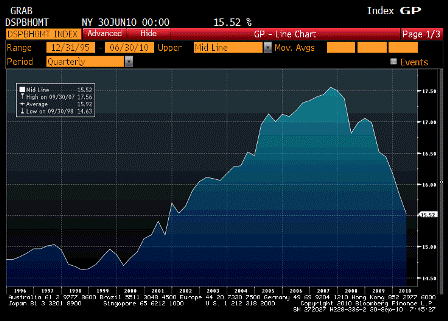
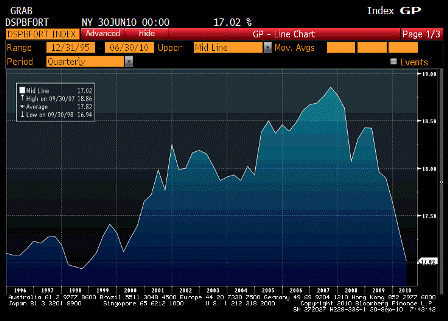
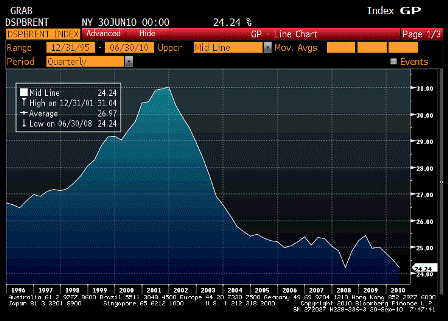
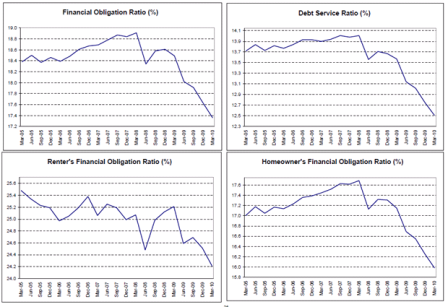
The charts are Fed numbers that show how high debt is compared to incomes. What it shows is that as the govt. deficits increased they added income and savings to the economy which resulted in higher incomes and lower total private debt. In the past the next credit expansion began after the financial obligations ratios came down in this manner.

These are June numbers, and federal deficit spending is what brings them down, so they should be that much lower today.

So while it’s impossible to say exactly how far the ratio of debt to income needs to fall before the next credit expansion will begin, I expect modest growth to continue as it has with very modest job growth and unemployment remaining too high until consumer credit expansion does begin to kick in, which could be anytime now, that the debt ratios are no longer an obstacle.

The right move in August 2008 was a full payroll tax (FICA) holiday which would have sustained demand and prevented the recession and kept unemployment at desired levels.
It was nothing more than policy response that allowed a financial crisis to spill over to the real economy.

The interest rate cuts unfortunately (but predictably) served mainly to reduce spendable interest income as income was transfered from savers to bank net interest margins, and as govt. interest payments to the economy were reduced by the lower rates.

Lowering rates was not ‘wrong,’ as there are positive supply side and distributional effects from lower rates, but what was missed was that lower rates needed to be accompanied by even lower taxes to offset the induced drag of the lower rates.

To date we remain grossly over taxed for the size govt we have and for the current credit conditions, as evidenced by the too large output gap and far too high unemployment rate.

So with China not collapsing as many feared, and the euro zone muddling through with ECB support, my outlook remains positive for the US economy, though from unfortunately high levels of unemployment and true misery due solely to policy blunders.

The Republicans got us into this and the Democrats failed to get us out, and all for the same reason- non of them understand how their own monetary system works.

So thanks in advance for kindly directing everyone you know ‘The 7 Deadly Innocent Frauds of Economic Policy’ here.

Homeowners Financial Obligation Ratio

Financial Obligation Ratio with Rental Payments

Financial Obligation Ratio for Renters

Warren Mosler: Obama’s China Policy Will Destroy U.S. Jobs and Create Inflation


Warren Mosler: Obama’s China Policy Will Destroy
U.S. Jobs and Create Inflation

Noted Economist and Senate Candidate: Forcing The Yuan Up and The Dollar Down Is The Worst Possible Option For Creating U.S. Jobs


Middletown, CT. – September 28, 2010 – Warren Mosler, internationally renowned financial and job creation expert and Connecticut’s Independent Party Candidate for the US Senate lashed out today at the Obama administration’s weak dollar policy in relation to China. “The first thing forcing China to revalue its currency will do is destroy US jobs, not create them,” said Mosler. “When China causes its currency to appreciate against the dollar, thus driving the value of the dollar down, it gives Chinese workers what amounts to a pay raise which will be passed along to U.S. consumers in the form of higher prices – in other words, inflation. These higher prices mean U.S. consumers can buy less, which results in fewer American jobs.”

According to available data, the U.S. lost approximately 8 million jobs two years ago because sales fell. When sales are restored, jobs will be restored. “A restaurant, department store, or any other business doesn’t lay off staff when they are filled with customers. So, giving Chinese workers a pay raise that will kill U.S. sales, cause inflation, and cut Americans’ spending power is not the way to bring this economy back from the brink or create the American jobs we desperately need!” asserted Mosler. In contrast, Mosler’s plan to create good-paying private sector jobs features a full payroll tax (FICA) holiday. That will make sure our consumers have enough spending power to be able to buy both whatever we can produce here at home with full employment, plus whatever the rest of the world wants to sell us, just like a decade ago when unemployment was under 4%, growth was strong, inflation low, and net imports were at record levels. Additionally, Mosler is concerned that Obama’s current inflationary policy can rapidly escalate into a debilitating trade war with China. In fact, in what amounts to a dangerous, high stakes international game of chicken, China has already announced it was placing a tariff on US poultry exports in retaliation for U.S. demands for currency revaluation.

Richard Blumenthal’s lock-step position with the Obama White House on China and Linda McMahon’s conspicuous silence on this critical issue vividly show that they are simply not qualified to create the 20 million new jobs we desperately need. “If you needed heart surgery, you wouldn’t let just anyone do it. In this time of economic emergency, I am the candidate that has the necessary knowledge, experience and in-depth understanding of our economy on a nuts and bolts level to make effective policy,” said Mosler. Quite simply, now is the time to take decisive action and Warren Mosler is the only candidate in this race who is qualified for the job.

About Warren Mosler
Warren Mosler is running as an Independent. His populist economic message features: 1) a full payroll tax (FICA) holiday so that people working for a living can afford to buy the goods and services they produce. 2) $500 per capita Federal revenue distribution for the states 3) An $8/hr federally funded job to anyone willing and able to work to facilitate the transition from unemployment to private sector employment. He has also pledged never to vote for cuts in Social Security payments or benefits. Warren is a native of Manchester, Conn., where his father worked in a small insurance office and his mother was a night-shift nurse. After graduating from the University of Connecticut (BA Economics, 1971), and working on financial trading desks in NYC and Chicago, Warren started his current investment firm in 1982. For the last twenty years, Warren has also been involved in the academic community, publishing numerous journal articles, and giving conference presentations around the globe. Mosler’s new book “The 7 Deadly Innocent Frauds of Economic Policy” is a non technical guide to the actual workings of the monetary system and exposes the most commonly held misconceptions. He also founded Mosler Automotive, which builds the Mosler MT900, the world’s top performance car that also gets 30 mpg at 55 mph.

Boehner says he’d support a middle-class tax cut

As previously suggested, Boehner reverses course and does what should have been his obvious choice.

This gives everyone in Congress a pre election window to try to tax cut their way to victory before the election.

With the current level of deficit spending already supportive of modest GDP growth, and these latest developments taking away the risk of fiscal tightening through tax hikes, look for prospects for a double dip to be all but forgotten, and equities to firm accordingly.

In sum, federal deficits are supporting enough income/savings/agg demand for modest gdp growth even with a relatively weak consumer and no credit expansion,
corps have already demonstrated the ability to generate reasonably good cost cutting/profits with very modest gdp growth,
high unemployment keeps unit labor costs under control, and relatively low term interest rates continue to support valuations,
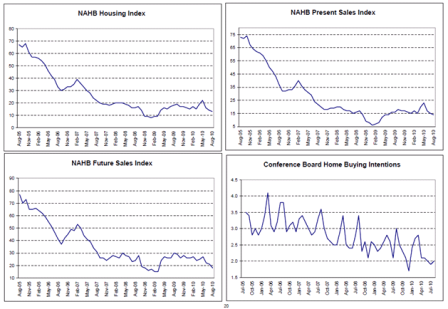
housing can’t go any lower and even if starts doubled they would still be relatively modest,
and same goes for cars and lots of other areas of deferred consumption and deferred investment.

Boehner says he’d support a middle-class tax cut

September 12 (AP) — House Minority Leader John Boehner says he would vote for President Obama’s plan to extend tax cuts only for middle-class earners, not the wealthy, if that were the only option available to House Republicans.

Boehner, R-Ohio, said it is “bad policy” to exclude the highest-earning Americans from tax relief during the recession. But he said he wouldn’t block the breaks for middle-income individuals and families if Democrats won’t support the full package.

Income tax cuts passed under President George W. Bush will expire at the end of this year unless Congress acts and Obama signs the bill. Obama said he would support continuing the lower tax rates for couples earning up to $250,000 or single taxpayers making up to $200,000. But he and the Democratic leadership in Congress refused to back continued lower rates for the fewer than 3 percent of Americans who make more than that.

The cost of extending the tax cuts for everyone for the next 10 years would approach $4 trillion, according to congressional estimates. Eliminating the breaks for the top earners would reduce that bill by about $700 billion.

Boehner’s comments signaled a possible break in the logjam that has prevented passage of a tax bill, although Republicans would still force Democrats to vote on their bigger tax-cut package in the final weeks before the November congressional elections.

“I want to do something for all Americans who pay taxes,” Boehner said in an interview taped Saturday for “Face the Nation” on CBS. “If the only option I have is to vote for some of those tax reductions, I’ll vote for it. … If that’s what we can get done, but I think that’s bad policy. I don’t think that’s going to help our economy.”

Austan Goolsbee, new chairman of the White House Council of Economic Advisers, said on ABC’s “This Week” that he hopes that Democratic lawmakers who also want an across-the-board extension will join Obama and others in the party in supporting legislation aimed at the middle class before the November elections.

In response to Boehner’s comments, Goolsbee said, “If he’s for that, I would be happy.”

With congressional elections less than two months away, both parties have been working to score points with voters generally unhappy with Congress. Democrats are bearing the brunt of voter anger over a stubborn recession, a weak job market and a high-spending government, giving the GOP an opening for taking back control of the House and possibly the Senate.

Democratic leaders would relish putting up a bill that extends only the middle-class tax cuts and then daring Republicans to oppose it. In response, GOP lawmakers probably would try to force votes on amendments to extend all the tax cuts, arguing that it would be a boost to the economy, and then point to those who rejected them.

A compromise over the tax-cut extensions had been suggested by some senior Democrats. In a speech last week in Cleveland, Obama rejected the idea of temporarily extending all the tax cuts for one to two years.

The tax-cut argument between Obama and Republican lawmakers focuses on whether the debt-ridden country can afford to continue Bush’s tax breaks, which were designed to expire next year. Republicans contend that cutting back on government spending ought to be the focus of efforts aimed at beginning to balance the federal budget.

GS Skinny: The Administration’s New Fiscal Proposals

The President’s proposal is now looking anemic at best.

Like I think Woody Allen once said, the food was bad and the portions were small.

This will cost the Dems even more seats in November.

Fortunately the federal deficit is already large enough to support a bit of modest growth.

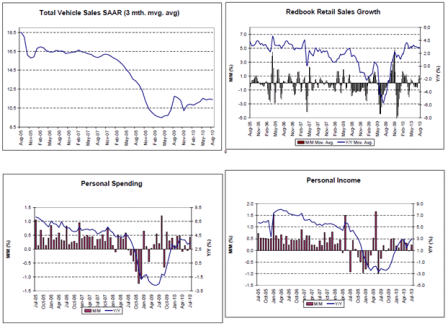
All looking very L shaped to me, with a hint of growth.

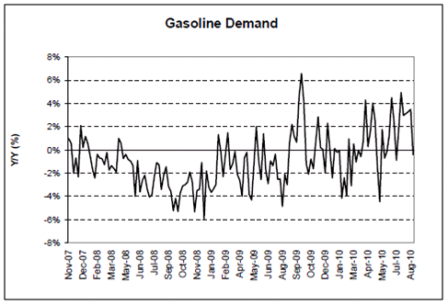
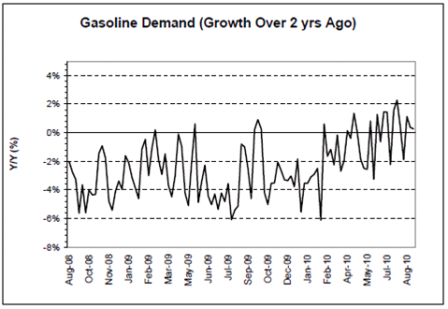
Gasoline consumption has recovered and showing signs of growth year over year, but very modest.

Modest recoveries from the lows and leveling off.

Continued modest improvement from the lows

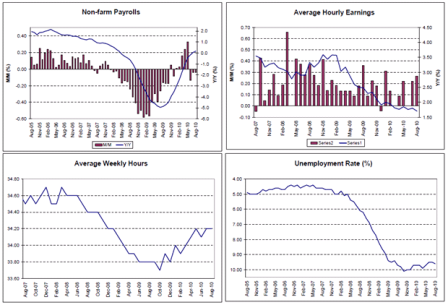
Manufacturing, the smaller component of GDP, led from very low levels

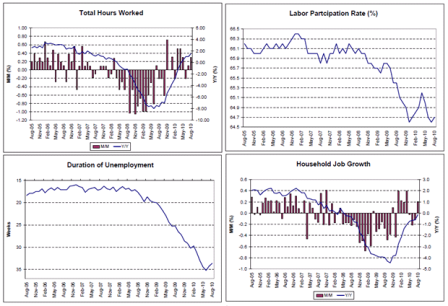
Looking very L shaped.

These are March numbers, June should be out soon and show further balance sheet repair as deficit spending continues are relatively high levels, adding income and net financial assets to the non govt. sectors.

Lots of signs of leveling off at modest levels of top line growth.

Waiting for the handoff to private sector credit expansion as balance sheets repair, or another fiscal adjustment.

GS Skinny: The Administration’s New Fiscal Proposals
(CLEARED FOR EXTERNAL USE)

September 7, 2010

The White House has announced three new measures to stimulate growth: 100% up-front depreciation of capital investments; a permanent and slightly expanded R&D tax credit; and $50 bn in infrastructure spending. They could be helpful but are unlikely to have a large effect on growth for four reasons: (1) some of them cover multiple years, spreading out the fiscal impulse; (2) the incremental effect is smaller than the headline numbers imply, as some are modifications of existing proposals or policies and one is essentially an interest free loan; (3) the president proposes offsetting the cost of some of the proposals with targeted corporate tax increases of an equal amount; and (4) the likelihood of enactment of some of these proposals is low.

Key points:

1. Bonus depreciation. The president proposes to allow companies to deduct 100% of the cost of capital investments (not including real estate) made in 2010 and 2011. Press reports cite White House estimates that the proposal would lower corporate tax receipts by $200bn. However, almost all of this revenue loss would be temporary, since the additional deductions taken now would lower deductions in future years, effectively making this an interest free loan. Given current low levels of capacity utilization, the benefit of additional investment is low to begin with. Our previous analysis indicated that the 50% bonus depreciation provision effective for 2008 and 2009 had a relatively small effect on investment. To the extent it does have an effect, it is likely to pull forward demand into the quarter just before expiration (in this case Q4 2011) so the near term effect should be even more modest (and indeed the effect in early 2012 would be negative). Whatever effect the provision would have would also be weakened somewhat by the proposal to raise corporate tax revenues (through closing of “loopholes”) to offset the proposal’s cost.

2. R&D Tax credit. The president is expected to propose to increase and make permanent the research and development tax credit, at a cost of $100bn over ten years. This proposal is somewhat less than meets the eye, since the president has already proposed to make the credit permanent at a cost of $80bn. This leaves an incremental proposal worth around $20bn, or $2bn per year. Nevertheless, enactment of this proposal would be helpful on the margin, since the existing R&D credit lapsed at the end of last year and has yet to be renewed by Congress.

3. Infrastructure. The president proposes to spend $50bn on transportation infrastructure projects, as part of a six-year plan. We take this to mean a front-loading or incremental investment on top of the six-year reauthorization of surface transportation spending programs that has been pending in Congress for most of the year. For context, a $50bn addition to infrastructure spending is roughly on par with the investments made in that sector in the 2009 Recovery Act. If enacted, this could provide an important boost to growth, particularly in 2011. However, the likelihood of enactment in the near term appears low. Also, offsetting the otherwise positive effect is the proposal to offset the entire cost with the repeal of tax incentives for oil and gas companies.

4. Process from here. There are two likely scenarios for consideration of the tax-based measures. First, the Senate will vote on small business legislation next week, which already includes a 50% depreciation bonus for 2010. This provision could simply be modified, to bring it into line with the president’s depreciation proposal, in which case it could be enacted in the next few weeks. The second scenario is that the tax measures could be added to upcoming legislation to extend the expiring 2001/2003 tax cuts, which will be debated in late September. Adding corporate tax cuts to that legislation might allow Democratic leaders to attract enough votes for passage without extending the upper-income tax rates that most Republicans support. However, given that legislation’s uncertain prospects, adding these measures to it could also risk delaying enactment until after the November election. Infrastructure spending would be dealt with separately from the tax measures; the most likely scenario is that it could be considered after the election as part of the next stop-gap extension of the highway program, which expires December 31.

Obama to Push Tax Break

Hard to believe that a Democratic administration is proposing only support for business and none for consumption.

While it might be an election ploy the fact that it’s been a pattern all along just adds more weight to the notion that this administration is a tool of big business as it works to keep unemployment high and domestic consumption down along the lines of the classic gold standard export model of growth. This notion is further supported by the official goal of doubling exports, and Bernanke stated before Congress a couple of years ago that he prefers exports to domestic consumption (not that anything he does actually matters for that purpose).

News Alert from The Wall Street Journal

President Barack Obama, in one of his most dramatic gestures to business, will propose that companies be allowed to write off 100% of their new investment in plant and equipment through 2011, a plan that White House economists say would cut business taxes by nearly $200 billion over two years.

The proposal, to be laid out Wednesday in a speech in Cleveland, tops a raft of announcements, from a proposed expansion of the research and experimentation tax credit to $50 billion in additional spending on roads, railways and runways.

Payrolls


Karim writes:

  • Better than expected overall; private payrolls up 67k, consistent with recent trend.
  • Net revisions up 123k (July private payrolls revised from +71k to +107k)
  • UE rate up from 9.51% to 9.64%
  • Hours flat but July revised up from 0.3% to 0.4%
  • Avg hourly earnings up 0.3%
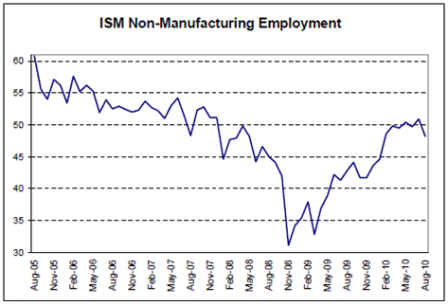
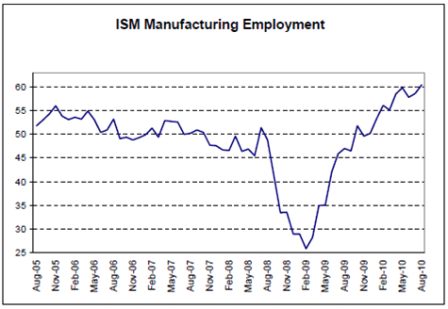
  • Private payroll strength even more impressive considering -61k swing in mfg employment (totally out of synch w/ism employment indicator)
  • Median duration of unemployment down to 19.9 weeks, from 22.2 last mth and high of 25.5 in June
  • U6 UE measure up to 16.7% from 16.5%

Conclusion: Beneath the surface, solid gains this quarter in the components that drive personal income: jobs+wages+hours. Politically, the headline UE rate and the U6 measure are a problem and will make the various fiscal stimulus measures more likely. So really may be best of both worlds for economy.

Agreed!

UE up as people reenter the labor force, which happens as jobs open up in this part of the cycle.

And low/negative productivity last quarter could be telling us businesses critically understaffed due to uncertainty are finally being forced to get to where they need to be to service current sales/client bases. So hiring rises faster than output for a while. This is also a good sign as that supports personal income and consumption.

There never was a double dip in the cards. It would have had to come from an outside shock. The federal deficit now seems more than large enough to continue to support modest top line growth, and any further increase will offer further support.

The ongoing federal deficits have also largely repaired household balance sheets, adding income and savings of financial assets to the non govt sectors, and continue to do so.

This sets us up for the ‘hand off’ to private sector deficit spending (credit expansion) taking over from govt sector deficit spending, usually via cars and houses. Car sales seem to already be improving, and housing has nowhere to go than up as well. Starts could double and still be at historically low levels.

So the outlook remains very good for equities, not so good for rates, and not so good for large share of the population that needs to work for a living, as most of the incremental wealth flows to the top.

Obama speech- not your father’s Democrats

There is a quick fix, a full payroll tax holiday for employees and employers.

His small business proposals show he and the rest of Congress still don’t understand that employment is a function of sales.

There is nothing in their proposals to support consumption, which is the only point of any economy.

I suspect they are afraid of the trade gap and fear domestic consumption will hurt net export growth.

Their goal is to have us be the world’s slaves via rising net exports.

This is all very good for business and the stock market, not so good for people who need to work for a living.

These are not your father’s Democrats.

Bernanke speech


Karim writes:

  • Very substantive speech from Bernanke
  • Message is basically, ‘growth has slowed more than we expected’ BUT ‘conditions are ALREADY in place for a pick-up’ and if we are wrong, we are ready to take action, which contrary to some perceptions, will be effective


Yes, contrary to my opinion. This about managing expectations. With falling inflation and unemployment this high it makes no sense that they would be holding back something that could make a material difference.

  • To me, they lay out very credible factors for a pick-up in growth.


Agreed.

  • The risk of either an undesirable rise in inflation or of significant further disinflation seems low-THIS LINE ARGUES AGAINST ANY NEAR-TERM ACTION


Again, if they did have anything that would substantially increase agg demand they’d have done it.

  • When listing available options for further action if needed, he clearly favors further ‘credit easing’ relative to the other choices. He states why they reinvested in USTs vs MBS.


Yes, and, again, it’s doubtful lower credit spreads will do much for the macro economy but would shift a lot of credit risks to the Fed for very little gain.

  • Selected excerpts in italics, with key comments in bold.

FRB: Bernanke, The Economic Outlook and Monetary Policy

At best, though, fiscal impetus and the inventory cycle can drive recovery only temporarily.

That is not correct. Fiscal adjustment can sustain demand at any politically desired level.

For a sustained expansion to take hold, growth in private final demand–notably, consumer spending and business fixed investment–must ultimately take the lead. On the whole, in the United States, that critical handoff appears to be under way.

Agreed that hand off is slowly materializing and private sector debt expansion will then drive additional growth. But sustained expansion could come immediately from a fiscal adjustment as well.

However,although private final demand, output, and employment have indeed been growing for more than a year, the pace of that growth recently appears somewhat less vigorous than we expected.

Agreed.


Among the most notable results to emerge from the recent revision of the U.S. national income data is that, in recent quarters, household saving has been higher than we thought–averaging near 6 percent of disposable income rather than 4 percent, as the earlier data showed.

Non govt net savings of financial assets = govt deficit spending by identity, and with foreign sector savings relatively constant, the majority of the increase is in the domestic economy, either businesses or households.

That means in general household savings goes up with the deficit regardless of the level of consumer spending.

However, when household savings does start to fall, it’s due to household credit expansion, at which time, if the deficit is unchanged, the savings of financial assets is shifted to either the business or the foreign sector.

And, as growth accelerates, the automatic fiscal stabilizers- increased federal revenues and falling transfer payments- reduce the deficit and therefore reduce the growth in the total net savings of the other sectors.

So the hand off process is usually characterized by the federal deficit falling as private sector debt expands to ‘replace it.’

This continues until the private sector again necessarily gets over leveraged, ending the expansion.

3 On the one hand, this finding suggests that households, collectively, are even more cautious about the economic outlook and their own prospects than we previously believed.

At best his means that he thinks with this much savings households would start leveraging more.


But on the other hand, the upward revision to the saving rate also implies greater progress in the repair of household balance sheets. Stronger balance sheets should in turn allow households to increase their spending more rapidly as credit conditions ease and the overall economy improves.

Yes, as I explained. He seems to understand the sequence of the data but doesn’t seem to be quite there on the causation.

Going forward, improved affordability–the result of lower house prices and record-low mortgage rates–should boost the demand for housing. However, the overhang of foreclosed-upon and vacant housing and the difficulties of many households in obtaining mortgage financing are likely to continue to weigh on the pace of residential investment for some time yet

Yes, which is a traditional source of private sector credit expansion, along with cars, that drives the process.

Generally speaking, large firms in good financial condition can obtain credit easily and on favorable terms; moreover, many large firms are holding exceptionally large amounts of cash on their balance sheets. For these firms, willingness to expand–and, in particular, to add permanent employees–depends primarily on expected increases in demand for their products, not on financing costs.

I couldn’t agree more!
Employment is primarily a function of sales as discussed in prior posts.

Bank-dependent smaller firms, by contrast, have faced significantly greater problems obtaining credit, according to surveys and anecdotes. The Federal Reserve, together with other regulators, has been engaged in significant efforts to improve the credit environment for small businesses. For example, through the provision of specific guidance and extensive examiner training, we are working to help banks strike a good balance between appropriate prudence and reasonable willingness to make loans to creditworthy borrowers. We have also engaged in extensive outreach efforts to banks and small businesses. There is some hopeful news on this front: For the most part, bank lending terms and conditions appear to be stabilizing and are even beginning to ease in some cases, and banks reportedly have become more proactive in seeking out creditworthy borrowers.

Another problem is that the regulators are forcing small banks to reduce what’s called ‘non core funding’ in a confused strategy to enhance small bank ‘deposit stability.’ Unfortunately, at the local level the regulators have interpreted the rules to mean, for example, it’s better for a small bank’s financial stability to fund, for example, a 3 year business loan with 1 year local deposits, vs funding it with a 5 year advance from the Federal Home loan bank. It’s also a fallacy of composition, as at the macro level there aren’t enough core deposits to fund local small businesses, as many larger corporations and individuals use money center banks and leave their deposits with them. The regulatory insistence on small banks using ‘core deposits’ rather than ‘wholesale funding’ recycled from the larger banks causes a shortage of local deposits and forces the small banks to pay substantially higher rates as they compete with each other for funding artificially limited by regulation.

In lieu of adding permanent workers, some firms have increased labor input by increasing workweeks, offering full-time work to part-time workers, and making extensive use of temporary workers.

Yes, and when you include this growth in employment the economy is doing better than most analysts seem to think.

Like others, we were surprised by the sharp deterioration in the U.S. trade balance in the second quarter. However, that deterioration seems to have reflected a number of temporary and special factors. Generally, the arithmetic contribution of net exports to growth in the gross domestic product tends to be much closer to zero, and that is likely to be the case in coming quarters.

Also, part of the hand off will be US consumers going into debt (reducing savings) to buy foreign goods and services, which increases foreign sector savings of financial assets.

Overall, the incoming data suggest that the recovery of output and employment in the United States has slowed in recent months, to a pace somewhat weaker than most FOMC participants projected earlier this year. Much of the unexpected slowing is attributable to the household sector, where consumer spending and the demand for housing have both grown less quickly than was anticipated. Consumer spending may continue to grow relatively slowly in the near term as households focus on repairing their balance sheets. I expect the economy to continue to expand in the second half of this year, albeit at a relatively modest pace.

Agreed.

Despite the weaker data seen recently, the preconditions for a pickup in growth in 2011 appear to remain in place.

Agreed.

Monetary policy remains very accommodative,

Yes, for many borrowers, but the lower rates have also net reduced incomes. QE alone resulted in some $50 billion of ‘profits’ transfered to the Treasury from the Fed that would have been private sector income, for example.

and financial conditions have become more supportive of growth, in part because a concerted effort by policymakers in Europe has reduced fears related to sovereign debts and the banking system there.

Agreed.

Banks are improving their balance sheets and appear more willing to lend.

Agreed, though via a reduction in interest earned by savers that’s gone to increased net interest margins for banks.

Consumers are reducing their debt and building savings, returning household wealth-to-income ratios near to longer-term historical norms.

Yes, ‘funded’ by the federal deficit spending.

Stronger household finances, rising incomes, and some easing of credit conditions will provide the basis for more-rapid growth in household spending next year.

Yes, and that basis is credit expansion.

On the fiscal front, state and local governments continue to be under pressure; but with tax receipts showing signs of recovery, their spending should decline less rapidly than it has in the past few years. Federal fiscal stimulus seems set to continue to fade but likely not so quickly as to derail growth in coming quarters.

Yes, and traditionally matched or exceeded by private sector credit expansion as above.

Recently, inflation has declined to a level that is slightly below that which FOMC participants view as most conducive to a healthy economy in the long run. With inflation expectations reasonably stable and the economy growing, inflation should remain near current readings for some time before rising slowly toward levels more consistent with the Committee’s objectives. At this juncture, the risk of either an undesirable rise in inflation or of significant further disinflation seems low. Of course, the Federal Reserve will monitor price developments closely.

The channels through which the Fed’s purchases affect longer-term interest rates and financial conditions more generally have been subject to debate.

With the debate subsiding as more FOMC participants, but far from all of them, seem to be coming to understand the quantity of the reserves per se has no consequences.

I see the evidence as most favorable to the view that such purchases work primarily through the so-called portfolio balance channel, which holds that once short-term interest rates have reached zero, the Federal Reserve’s purchases of longer-term securities affect financial conditions by changing the quantity and mix of financial assets held by the public. Specifically, the Fed’s strategy relies on the presumption that different financial assets are not perfect substitutes in investors’ portfolios, so that changes in the net supply of an asset available to investors affect its yield and those of broadly similar assets. Thus, our purchases of Treasury, agency debt, and agency MBS likely both reduced the yields on those securities and also pushed investors into holding other assets with similar characteristics, such as credit risk and duration. For example, some investors who sold MBS to the Fed may have replaced them in their portfolios with longer-term, high-quality corporate bonds, depressing the yields on those assets as well.

This is evidence Bernanke himself has come around to the understanding that the quantity of reserves at the Fed per se is of no further economic consequence.

We decided to reinvest in Treasury securities rather than agency securities because the Federal Reserve already owns a very large share of available agency securities, suggesting that reinvestment in Treasury securities might be more effective in reducing longer-term interest rates and improving financial conditions with less chance of adverse effects on market functioning.

Again, it shows the understanding that QE channel is price (interest rates) and not quantities.
This is a very constructive move from understanding indicated in prior statements.

Also, as I already noted, reinvestment in Treasury securities is more consistent with the Committee’s longer-term objective of a portfolio made up principally of Treasury securities. We do not rule out changing the reinvestment strategy if circumstances warrant, however.

In particular, the Committee is prepared to provide additional monetary accommodation through unconventional measures if it proves necessary, especially if the outlook were to deteriorate significantly. The issue at this stage is not whether we have the tools to help support economic activity and guard against disinflation. We do. As I will discuss next, the issue is instead whether, at any given juncture, the benefits of each tool, in terms of additional stimulus, outweigh the associated costs or risks of using the tool.

Notwithstanding the fact that the policy rate is near its zero lower bound, the Federal Reserve retains a number of tools and strategies for providing additional stimulus. I will focus here on three that have been part of recent staff analyses and discussion at FOMC meetings: (1) conducting additional purchases of longer-term securities, (2) modifying the Committee’s communication, and (3) reducing the interest paid on excess reserves. I will also comment on a fourth strategy, proposed by several economists–namely, that the FOMC increase its inflation goals.

In my humble opinion those tools carry no risk and provide no reward to the macro economy.