US Consumer Credit Falls by $3.34 Billion in August

With a federal budget deficit of roughly $100 billion/month adding that much in savings (and income) to the economy total spending can be done with less additions to debt than when the deficit was a lot smaller.

Because of the deficit spending, consumers have been able to support maybe 2-3% growth in consumption and at the same time pay down credit cards and other debt, and debt continues to fall as a % of income as well.

Note below that new debt for non revolving credit has been inching up for the last 4 months, a sign that modest improvement continues.

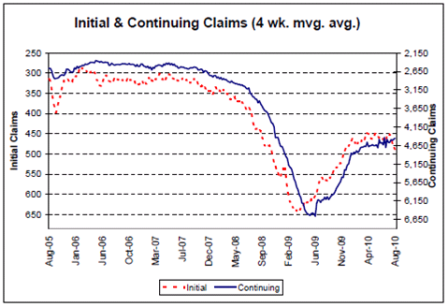
With weekly initial claims now below 450,000 it looks like the spike to 500,000 most likely was some kind of statistical blip.
And at current levels, which seem to be drifting lower, we could be looking at 150,000- 200,000 new jobs per month.
This would mean the unemployment rate would fall only very slowly, but it’s still an upside surprise, and with 7 year treasury yields closing in on 7 year JGB’s we could also see US equity PE’s now around 12 adjust upward towards Japan’s PE’s of about 23.

I have no idea what’s going to happen with QE, except it will have very little or more likely no effect on the economy.
But there will be a lot of trading around the prospects and outcome of the Fed’s decision.

The term structure of risk free rates is always and in the Fed’s hands, and subject to the Fed’s reaction function and not to market forces. And with the talk of the Fed targeting longer term rates they may be coming around to it, as best I can tell knowledge of actual monetary operations seems to be slowly gravitating from the monetary operations staff to the actual leadership.

US Consumer Credit Falls by $3.34 Billion in August

October 25 (Reuters) — Total U.S. consumer credit outstanding declined for the seventh straight month in August as credit card debt continued to fall.

The Federal Reserve said on Thursday total outstanding credit, which covers everything from car loans to credit cards, fell by $3.34 billion after dropping $4.09 billion in July.

Analysts polled by Reuters had forecast consumer credit contracting $3 billion in August.

So-called revolving, or credit-card credit, fell $4.99 billion in August after a $4.98 billion fall the prior month.

That marked the 24th consecutive month credit-card debt decreased.

Non-revolving credit, which includes closed-end loans for big-ticket items like cars, boats, college education and vacations, increased $1.65 billion after increasing $888.59 million in July. It was the fourth straight month of gains.

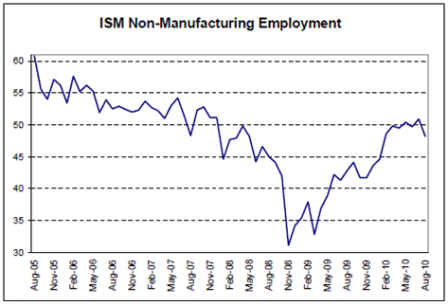
Non-Mfg ISM

With a federal budget deficit still as large as it is, not all that much of a surprise.


Karim writes:

Nice upside surprise:

  • Orders and employment both up on the month; export orders up sharply (but not seasonally adjusted)


Sept Aug
Composite 53.2 51.5
Activity 52.8 54.4
Prices Paid 60.1 60.3
New Orders 54.9 52.4
Employment 50.2 48.2
Export orders 58.0 46.5
Imports 53.0 50.5
  • “General state of the business has not changed in the last three months. The market is still soft for new sales due to financing requirements.” (Construction)
  • “Business seems to be flat from last month.” (Finance & Insurance)
  • “Signs that the economy may be improving, but our sector is still flat or declining.” (Professional, Scientific & Technical Services)
  • “Business activity is generally stable — slightly better than last year.” (Accommodation & Food Services)
  • “Third quarter is looking profitable with improving confidence and expectations in the economy. Capital expenditures are being approved.” (Wholesale Trade)

U.S. Data/Dudley


Karim writes:

Data: General impression is manufacturing is slowing but ‘building blocks’ for consumer getting better (sorry for delay)

Consumer

  • Personal income up 0.5% in Aug and now running 3.3% y/y


This is a very significant positive. With personal income rising at this rate the chances of negative growth are slim and none.

  • Savings rate back up to 5.8% from 5.7%


Funded by the ongoing federal deficit.

  • Also of interest is core PCE at 0.1%, keeps Y/Y rate at 1.4% for the 3rd straight month-pretty far from deflation territory and close to the Fed’s desired 1.5-2.0% range

Coupled with the unemployment rate keeps the Fed on hold for now.

Also, watch car sales as today’s data looks pretty good. Cars and housing would be the signal that domestic credit expansion is beginning to kick in.

    ISM

  • “Business results (top and bottom line) continue to meet or exceed our operating plan and exceed prior year performance by double digits.” (Chemical Products)
  • “Business continues flat relative to prior month and is expected to remain flat. Commodities continue to be the main concern heading into 2011.” (Food, Beverage & Tobacco Products)
  • “Our business is softening due to seasonal considerations. Overall, our situation is much better than 2009.” (Machinery)
  • “Customers seem to be pulling back on orders. I suspect that they are trying to reduce their inventory for the approaching year-end.” (Transportation Equipment)
  • “Strategic customers reducing order quantities.” (Computer & Electronic Products)

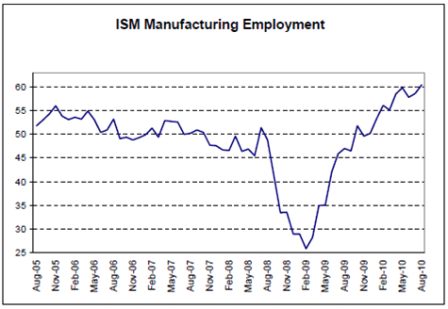
Most ISM categories weaker, but still in expansion mode; New Orders vs Inventories Spread not looking great


ISM Sept Aug
Index 54.4 56.3
Prices paid 70.5 61.5
Production 56.5 59.9
New Orders 51.1 53.1
Inventories 55.6 51.4
Employment 56.5 60.4
Export Orders 54.5 55.5
Imports 56.5 56.5


Dudley

  • Key line in speech today: “further action is likely to be warranted unless the economic outlook evolves in away that makes me more confident that we will see better outcomes for both employment and inflation before too long.”
  • Doesn’t sound too patient!


And looks to me like better days are coming.

Japan Recap- Prime Minister Says Huge Public Debt Unsustainable

More modest signs of improvement in Japan, with employment and spending improving.

Unfortunately, the Prime Minister seems be about to make the same mistake of past Prime Ministers and take action to reduce the govt’s deficit.

In contrast, China seems to have recognized govt spending spending (and lending by state owned banks that is in fact thinly disguised govt spending) is not operationally dependent on revenue, and that there is no solvency issue nor external constraints on local currency expenditure. China seems to understand the risks are inflation, making adjustments as they see that political threat arise.

See comments below.

Aug Job-To-Applicant Ratio: 0.54% vs 0.54% (expect) / 0.53% (last)

Aug Jobless Rate: 5.1% vs 5.1% (expect) / 5.2% (last)

Aug Household Spending (YoY): 1.7% vs 1.4% (expect) / 1.1% (last)

Sep Tokyo CPI (YoY): -0.6% vs -0.9% (expect) / -1.0% (last)

Sep Tokyo CPI Ex-Fresh Food (YoY): -1.0% vs -1.0% (expect) / -1.1% (last)

Sep Tokyo CPI Ex-Fresh Food & Energy (YoY): -1.3% vs -1.4% (expect) / -1.4% (last)

Aug National CPI (YoY): -0.9% vs -0.9% (expect) / -0.9% (last)

Aug National CPI Ex-Fresh Food (YoY): -1.0% vs -1.0% (expect) / -1.1% (last)

Aug National CPI Ex-Fresh Food & Energy (YoY): -1.5% vs -1.5% (expect) / -1.5% (last)

Japan Prime Minister Says Huge Public Debt Unsustainable

October (Reuters) — Japan’s prime minister warned on Friday that the country’s fiscal situation was unsustainable given its huge public debt, and called for multiparty tax reform talks as he struggles with a fragile economy and a divided parliament.

With perhaps the world’s largest public debt, severe prior downgrades by the ratings agencies, perhaps the strongest currency in the world, mild deflation, and yet ten year JGB’s hovering around 1%, you’d think the historical evidence alone would convince them there is no solvency or funding or ‘sustainability’ issue. But clearly it doesn’t. And while those in monetary operations at the BOJ understand there is no sustainability issue, it is not their place to mention it (much like the US).

Naoto Kan also repeated his resolve to curb a rise in the yen that threatens to derail Japan’s export-led economic recovery, urged the central bank to do more to fight deflation, and expressed hope that opposition parties would join in talks on a extra budget he wants to enact soon.

This seems to indicate he’s pushing for a higher deficit? Or will there be a new tax to ‘pay for it?’ And the only way to weaken the yen vs the dollar is to buy dollars, which is what I call off balance sheet deficit spending. It ‘works’ and there are no operational limits to the amount of fx a CB can buy. But it’s a poor second choice to a domestic tax cut or spending increase.

Japan’s core consumer prices marked their 18th straight month of annual declines in August, as deflation grips an economy struggling with a rising yen, slowing exports and a surprise decline in output. But the jobless rate fell and the availability of jobs improved slightly, data showed on Friday.

Yes, the deficit did go up in the financial crisis slowdown and got large enough to support growth. The question is whether they allow that to continue.

Kan, who took office in June as Japan’s fifth leader in three years, faces a tough time wooing the opposition support that is vital to enact laws since his Democratic Party of Japan (DPJ) and a tiny partner lack a majority in parliament’s upper house.

The government faces the delicate task of reining in debt while keeping the economy going. Japan has built up a huge public debt burden, now nearly twice the size of its $5 trillion economy, during two decades of economic stagnation.

It might help if the media stopped calling it a burden, as it’s clearly not a burden in any sense. particularly with a 0 rate policy (not that it matters for solvency).

“If the current fiscal situation is left alone, it will be unsustainable at some point,” Kan said in a speech at the start of an extra session of parliament.

I doubt he could define ‘unsustainable’ but no one asks as the errant sustainability assumption is pervasive.

He also vowed to achieve Tokyo’s goal of bringing the primary budget balance, which excludes revenue from bond sales and debt-servicing costs, into the black within a decade.

Extra Budget

Kan, whose past calls for debating a hike in the 5 percent sales tax had contributed to a July upper house election defeat, said Japan needs a social welfare system that citizens could trust even if that meants added financial burden on the public.

Multiparty debate on tax reform including the sales tax is thus indispensable, Kan said, reiterating that he would seek a mandate from voters before deciding on the sale tax rise.

The government is crafting an extra budget for the fiscal year to March 31 to stimulate the economy by supporting job seekers and families with children, but has sent mixed signals about the size of the package and how it will fund it.

It does look like they plan on ‘funding it’

Some in the cabinet, such as the economics minister, have said new debt issuance should not be ruled out, but the finance minister is firmly against the idea.

National Strategy Minister Koichiro Gemba has said Japan could fund measures worth around 4.6 trillion yen ($55 billion) by tapping reserves, thereby avoiding new bond issuance.

Functionally this would be the same as deficit spending.

“The biggest task for this parliamentary session is enacting a supplementary budget to finance economic steps. I sincerely hope for constructive debate among ruling and opposition parties,” Kan said in the speech.

Efforts to gain such opposition support will be complicated by a bitter feud with China.

Kan is under fire for appearing to cave in to Beijing’s demands to free a Chinese fishing boat captain detained last month after his trawler collided with Japanese patrol boats near disputed islands in the East China Sea.

The prime minister on Friday reiterated that good ties with China, in the process of replacing Japan as the world’s second-biggest economy, were vital but also expressed concern about Beijing’s military buildup and aggressive maritime activities.

China still has bitter memories of the last war with Japan.

Financial Obligation Ratios

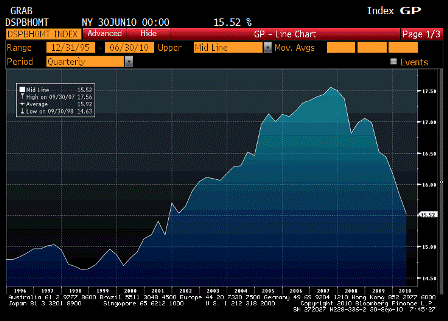
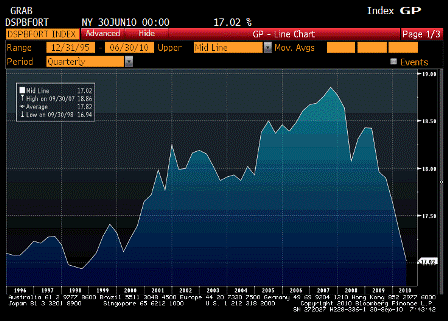
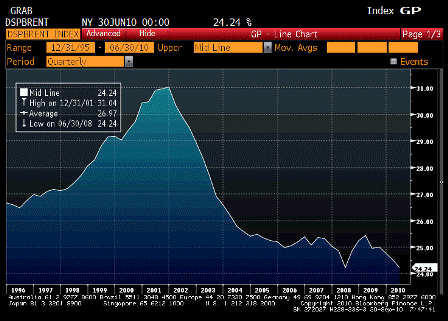
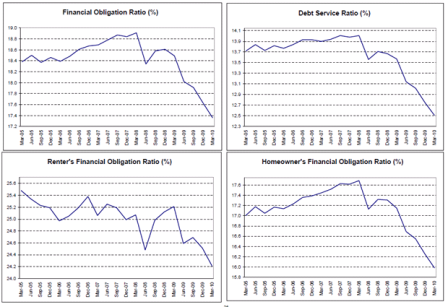
The charts are Fed numbers that show how high debt is compared to incomes. What it shows is that as the govt. deficits increased they added income and savings to the economy which resulted in higher incomes and lower total private debt. In the past the next credit expansion began after the financial obligations ratios came down in this manner.

These are June numbers, and federal deficit spending is what brings them down, so they should be that much lower today.

So while it’s impossible to say exactly how far the ratio of debt to income needs to fall before the next credit expansion will begin, I expect modest growth to continue as it has with very modest job growth and unemployment remaining too high until consumer credit expansion does begin to kick in, which could be anytime now, that the debt ratios are no longer an obstacle.

The right move in August 2008 was a full payroll tax (FICA) holiday which would have sustained demand and prevented the recession and kept unemployment at desired levels.
It was nothing more than policy response that allowed a financial crisis to spill over to the real economy.

The interest rate cuts unfortunately (but predictably) served mainly to reduce spendable interest income as income was transfered from savers to bank net interest margins, and as govt. interest payments to the economy were reduced by the lower rates.

Lowering rates was not ‘wrong,’ as there are positive supply side and distributional effects from lower rates, but what was missed was that lower rates needed to be accompanied by even lower taxes to offset the induced drag of the lower rates.

To date we remain grossly over taxed for the size govt we have and for the current credit conditions, as evidenced by the too large output gap and far too high unemployment rate.

So with China not collapsing as many feared, and the euro zone muddling through with ECB support, my outlook remains positive for the US economy, though from unfortunately high levels of unemployment and true misery due solely to policy blunders.

The Republicans got us into this and the Democrats failed to get us out, and all for the same reason- non of them understand how their own monetary system works.

So thanks in advance for kindly directing everyone you know ‘The 7 Deadly Innocent Frauds of Economic Policy’ here.

Homeowners Financial Obligation Ratio

Financial Obligation Ratio with Rental Payments

Financial Obligation Ratio for Renters

Fears Grow over the Fate of Irish Economy, Banks

The two external shocks of the summer were China, which historically has had second half slowdowns due to State lending front loaded to the first half, and the euro zone which became a ward of the ECB. China’s growth has slowed some, but not collapsed, and the ECB has continued its support of euro member solvency and funding capability in the short term markets.

There was no credible deposit insurance for the euro zone banks until the ECB ‘wrote the check’ by buying national govt debt in the secondary markets. It’s not the most efficient way to do things, but it does work to facilitate national govts being able to fund themselves, though mainly in the very short term markets (I still see my per capita distribution proposal as the better policy response). And that ability of the member nations to fund themselves means they can write the check for deposit insurance as needed.

The ECB also imposed ‘terms and conditions’ along with funding assistance, and as long as Ireland is in compliance, the ECB is for the most part responsible for the outcomes, so it seems logical the ECB will continue its support, perhaps changing its terms and conditions if not pleased with the outcomes. Additionally, the ECB will continue to supply liquidity directly to the banks, again, as with Ireland complying with the terms and conditions the ECB is now responsible for the outcomes.

But there is no question it is all a precarious brew, and there is no telling what might result in the ECB withdrawing support, so at this time steep yield curves for euro member nations due to credit risk make perfect sense.

Also, Europe and the rest of the world would like nothing more than to increase net exports to the US.

It’s all a golden opportunity for a decade or more of unparalleled US prosperity if we knew enough to again become the ‘engine of growth’ and implement the likes of a full payroll tax (FICA) holiday to provide Americans working for a living enough spending power to buy both everything we could produce at full employment and all the rest of the world wants to net sell us.

Unfortunately the deficit myths continue to cast a wet blanket over domestic demand as our leaders continue to let us down.

And with maybe 100 new Congressmen on the way, with most supporting a balanced budget and a balanced budget amendment which already has maybe 125 votes, there’s more than enough fiscal responsibility looming to create a true depression.

Hopefully their tax cutting agenda outweighs their balanced budget agenda.

And hopefully we get some kind of energy policy to decouple GDP growth from a spike in energy consumption.

Fears Grow over the Fate of Irish Economy, Banks

By Patrick Allen

September 8(CNBC) — The fate of the Irish economy is back in focus for investors across the world, after the former Celtic Tiger extended guarantees to its banking industry and depositors and with the spread on Irish bonds hitting record highs.

The country is also waiting for a decision from the European Commission on the fate of Anglo Irish, the troubled bank that was nationalized two years ago; uncertainty on whether Anglo Irish will be wound down or allowed to survive has weighed on sentiment towards the country.

Ireland is an example of a Western economy adjusting to both the banking crisis and, crucially, the emergence of Asia, Amit Kara, an economist at Morgan Stanley, said.

“Ireland has taken steps to overcome the hangover from the credit boom, but a successful outcome requires the economy to become more competitive and also, and more crucially, a global economic recovery,” Kara said.

He is confident the Irish economy will be able to roll over debt in the coming weeks and sees the chance for Irish debt to outperform the likes of Spain.

“Though Ireland faces serious long-term challenges, its liquidity position is healthy and its banks should have sufficient ECB-eligible collateral to significantly offset the funding impact of upcoming debt redemptions,” Kara explained.

“Given the underperformance of recent weeks, we see scope for Irish bonds to regain some ground against Portugal and Spain in particular, once the initial round of government-guaranteed bond redemptions has taken place over the first two weeks of September,” he added.

What is on Ireland’s Books?

The Irish banking system remains hooked on European Central Bank funding and investors are also worried about the risks posed by the scale of liabilities following Ireland’s decision to guarantee the country’s lenders.

GS Skinny: The Administration’s New Fiscal Proposals

The President’s proposal is now looking anemic at best.

Like I think Woody Allen once said, the food was bad and the portions were small.

This will cost the Dems even more seats in November.

Fortunately the federal deficit is already large enough to support a bit of modest growth.

All looking very L shaped to me, with a hint of growth.

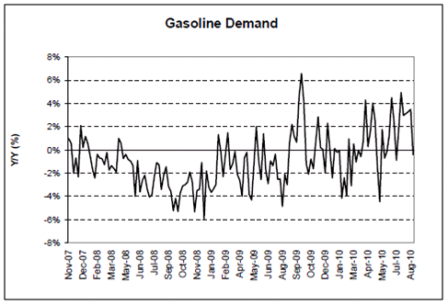
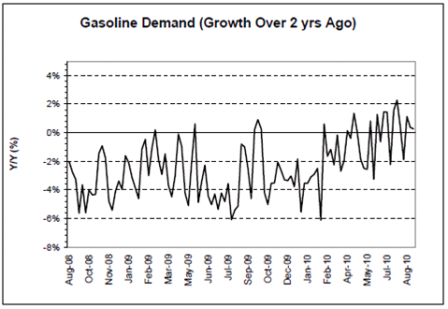
Gasoline consumption has recovered and showing signs of growth year over year, but very modest.

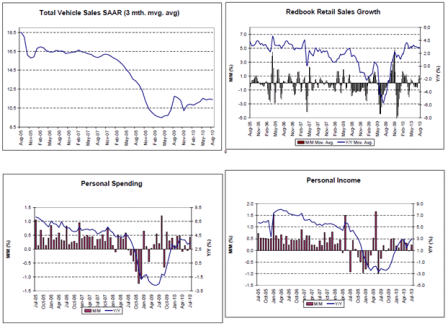
Modest recoveries from the lows and leveling off.

Continued modest improvement from the lows

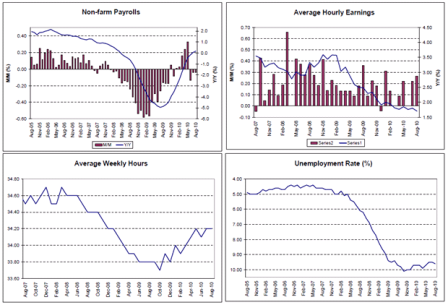
Manufacturing, the smaller component of GDP, led from very low levels

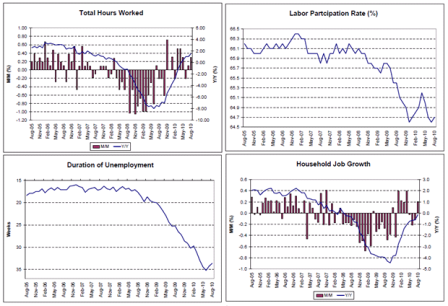
Looking very L shaped.

These are March numbers, June should be out soon and show further balance sheet repair as deficit spending continues are relatively high levels, adding income and net financial assets to the non govt. sectors.

Lots of signs of leveling off at modest levels of top line growth.

Waiting for the handoff to private sector credit expansion as balance sheets repair, or another fiscal adjustment.

GS Skinny: The Administration’s New Fiscal Proposals
(CLEARED FOR EXTERNAL USE)

September 7, 2010

The White House has announced three new measures to stimulate growth: 100% up-front depreciation of capital investments; a permanent and slightly expanded R&D tax credit; and $50 bn in infrastructure spending. They could be helpful but are unlikely to have a large effect on growth for four reasons: (1) some of them cover multiple years, spreading out the fiscal impulse; (2) the incremental effect is smaller than the headline numbers imply, as some are modifications of existing proposals or policies and one is essentially an interest free loan; (3) the president proposes offsetting the cost of some of the proposals with targeted corporate tax increases of an equal amount; and (4) the likelihood of enactment of some of these proposals is low.

Key points:

1. Bonus depreciation. The president proposes to allow companies to deduct 100% of the cost of capital investments (not including real estate) made in 2010 and 2011. Press reports cite White House estimates that the proposal would lower corporate tax receipts by $200bn. However, almost all of this revenue loss would be temporary, since the additional deductions taken now would lower deductions in future years, effectively making this an interest free loan. Given current low levels of capacity utilization, the benefit of additional investment is low to begin with. Our previous analysis indicated that the 50% bonus depreciation provision effective for 2008 and 2009 had a relatively small effect on investment. To the extent it does have an effect, it is likely to pull forward demand into the quarter just before expiration (in this case Q4 2011) so the near term effect should be even more modest (and indeed the effect in early 2012 would be negative). Whatever effect the provision would have would also be weakened somewhat by the proposal to raise corporate tax revenues (through closing of “loopholes”) to offset the proposal’s cost.

2. R&D Tax credit. The president is expected to propose to increase and make permanent the research and development tax credit, at a cost of $100bn over ten years. This proposal is somewhat less than meets the eye, since the president has already proposed to make the credit permanent at a cost of $80bn. This leaves an incremental proposal worth around $20bn, or $2bn per year. Nevertheless, enactment of this proposal would be helpful on the margin, since the existing R&D credit lapsed at the end of last year and has yet to be renewed by Congress.

3. Infrastructure. The president proposes to spend $50bn on transportation infrastructure projects, as part of a six-year plan. We take this to mean a front-loading or incremental investment on top of the six-year reauthorization of surface transportation spending programs that has been pending in Congress for most of the year. For context, a $50bn addition to infrastructure spending is roughly on par with the investments made in that sector in the 2009 Recovery Act. If enacted, this could provide an important boost to growth, particularly in 2011. However, the likelihood of enactment in the near term appears low. Also, offsetting the otherwise positive effect is the proposal to offset the entire cost with the repeal of tax incentives for oil and gas companies.

4. Process from here. There are two likely scenarios for consideration of the tax-based measures. First, the Senate will vote on small business legislation next week, which already includes a 50% depreciation bonus for 2010. This provision could simply be modified, to bring it into line with the president’s depreciation proposal, in which case it could be enacted in the next few weeks. The second scenario is that the tax measures could be added to upcoming legislation to extend the expiring 2001/2003 tax cuts, which will be debated in late September. Adding corporate tax cuts to that legislation might allow Democratic leaders to attract enough votes for passage without extending the upper-income tax rates that most Republicans support. However, given that legislation’s uncertain prospects, adding these measures to it could also risk delaying enactment until after the November election. Infrastructure spending would be dealt with separately from the tax measures; the most likely scenario is that it could be considered after the election as part of the next stop-gap extension of the highway program, which expires December 31.

1938 in 2010

1938 in 2010

By Paul Krugman

September 5 (Bloomberg) — Here’s the situation: The U.S. economy has been crippled by a financial crisis. The president’s policies have limited the damage, but they were too cautious, and unemployment remains disastrously high. More action is clearly needed. Yet the public has soured on government activism, and seems poised to deal Democrats a severe defeat in the midterm elections.

The president in question is Franklin Delano Roosevelt; the year is 1938. Within a few years, of course, the Great Depression was over. But it’s both instructive and discouraging to look at the state of America circa 1938 — instructive because the nature of the recovery that followed refutes the arguments dominating today’s public debate, discouraging because it’s hard to see anything like the miracle of the 1940s happening again.

Now, we weren’t supposed to find ourselves replaying the late 1930s. President Obama’s economists promised not to repeat the mistakes of 1937, when F.D.R. pulled back fiscal stimulus too soon. But by making his program too small and too short-lived, Mr. Obama did just that: the stimulus raised growth while it lasted, but it made only a small dent in unemployment — and now it’s fading out.

And just as some of us feared, the inadequacy of the administration’s initial economic plan has landed it — and the nation — in a political trap. More stimulus is desperately needed, but in the public’s eyes the failure of the initial program to deliver a convincing recovery has discredited government action to create jobs.

In short, welcome to 1938.

The story of 1937, of F.D.R.’s disastrous decision to heed those who said that it was time to slash the deficit, is well known. What’s less well known is the extent to which the public drew the wrong conclusions from the recession that followed: far from calling for a resumption of New Deal programs, voters lost faith in fiscal expansion.

Consider Gallup polling from March 1938. Asked whether government spending should be increased to fight the slump, 63 percent of those polled said no. Asked whether it would be better to increase spending or to cut business taxes, only 15 percent favored spending; 63 percent favored tax cuts. And the 1938 election was a disaster for the Democrats, who lost 70 seats in the House and seven in the Senate.

Most interesting!

Then came the war.

From an economic point of view World War II was, above all, a burst of deficit-financed government spending, on a scale that would never have been approved otherwise. Over the course of the war the federal government borrowed an amount equal to roughly twice the value of G.D.P. in 1940 — the equivalent of roughly $30 trillion today.

Had anyone proposed spending even a fraction that much before the war, people would have said the same things they’re saying today. They would have warned about crushing debt and runaway inflation. They would also have said, rightly, that the Depression was in large part caused by excess debt — and then have declared that it was impossible to fix this problem by issuing even more debt.

Agreed! The deficit per se was of no consequence. The risks were and remain inflation from excess demand, which is not an easy channel to use to generate what we call inflation in today’s world. Our CPI problems have tended to come in through the cost channel and propagated by govt indexation of one form or another.

But guess what? Deficit spending created an economic boom — and the boom laid the foundation for long-run prosperity.

Agreed. Though the way I say it, for a given size govt. and given set of credit conditions there is a level of taxes that coincides with full employment, and that level is generally well below the level of govt spending.

Overall debt in the economy — public plus private — actually fell as a percentage of G.D.P., thanks to economic growth and, yes, some inflation, which reduced the real value of outstanding debts. And after the war, thanks to the improved financial position of the private sector, the economy was able to thrive without continuing deficits.

What??? Here, sadly, Paul’s implication that the actual level of the govt debt per se matters, and that his bent that lower deficits are somehow ‘better’ shines through, keeping him in the camp of being part of the problem rather than part of the answer.

(Good article for MMT’s to earn some hearts!)

Obama to Push Tax Break

Hard to believe that a Democratic administration is proposing only support for business and none for consumption.

While it might be an election ploy the fact that it’s been a pattern all along just adds more weight to the notion that this administration is a tool of big business as it works to keep unemployment high and domestic consumption down along the lines of the classic gold standard export model of growth. This notion is further supported by the official goal of doubling exports, and Bernanke stated before Congress a couple of years ago that he prefers exports to domestic consumption (not that anything he does actually matters for that purpose).

News Alert from The Wall Street Journal

President Barack Obama, in one of his most dramatic gestures to business, will propose that companies be allowed to write off 100% of their new investment in plant and equipment through 2011, a plan that White House economists say would cut business taxes by nearly $200 billion over two years.

The proposal, to be laid out Wednesday in a speech in Cleveland, tops a raft of announcements, from a proposed expansion of the research and experimentation tax credit to $50 billion in additional spending on roads, railways and runways.