2008-11-14 USER


[Skip to the end]


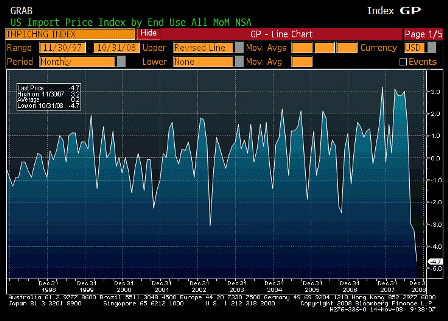
Import Price Index MoM (Oct)

Survey -4.4%
Actual -4.7%
Prior -3.0%
Revised -3.3%

 
Decelerating rapidly!

[top][end]

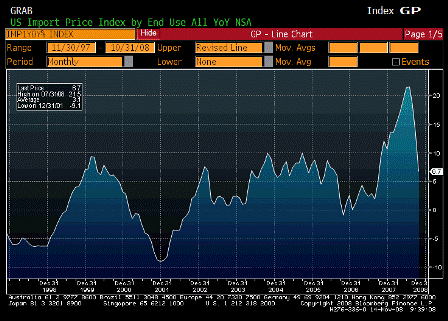
Import Price Index YoY (Oct)

Survey 8.2%
Actual 6.7%
Prior 14.5%
Revised 13.6%

 
Decelerating rapidly!

Karim writes:

Price pressures continue to fall sharply:

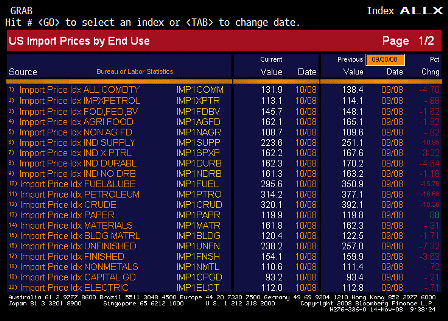
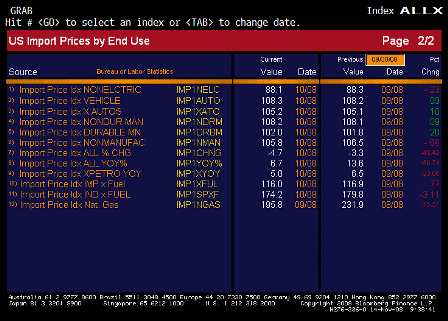
  • Import prices -4.7% m/m; -0.9% m/m ex-petroleum; yr/yr slows from 13.6% to 6.7%
  • Prices of industrial supplies -25.1% over past 3mths
  • Import prices from China -0.3% over past 2mths

[top][end]

Import Price Index ALLX 1 (Oct)

[top][end]

Import Price Index ALLX 2 (Oct)

[top][end]


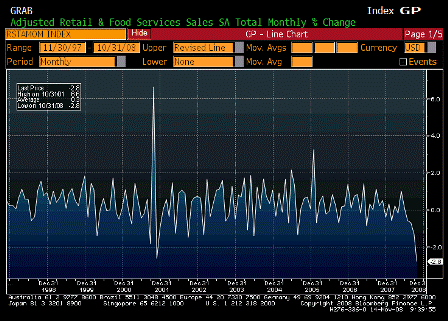
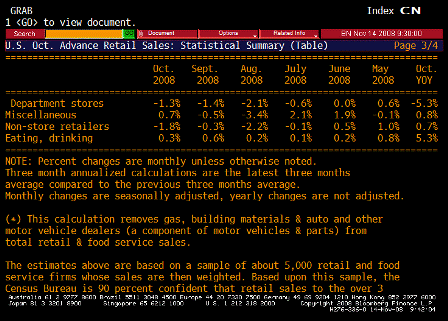
Advance Retail Sales (Oct)

Survey -2.1%
Actual -2.8%
Prior -1.2%
Revised -1.3%

 
This is a severe dropoff!

Karim writes:

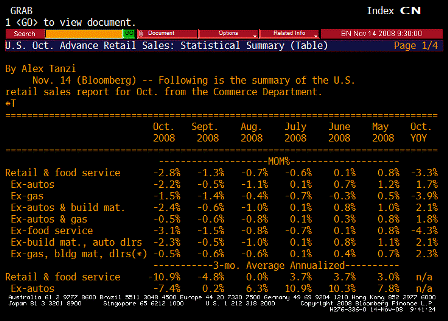
Largest ever monthly drop in U.S. retail sales:

  • -2.8% m/m headline, -2.2% ex-autos, -1.5% ex-gas (prior mth headline revised from -1.2% to -1.3%)
  • 3mth annualized rate of change in headline now at -10.9%; yr/yr change -3.3%

[top][end]

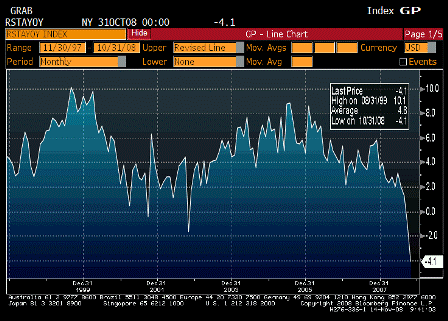
Advance Retail Sales YoY (Oct)

Survey n/a
Actual -4.1%
Prior -1.1%
Revised n/a

 
Looks very bad!

[top][end]

Advance Retail Sales TABLE 1 (Oct)

[top][end]

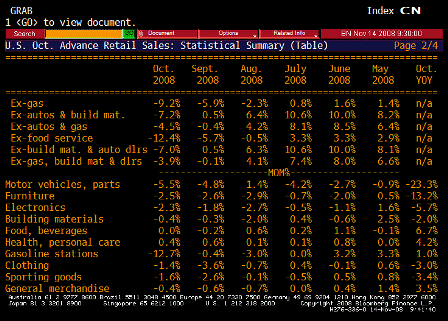
Advance Retail Sales TABLE 2 (Oct)

[top][end]

Advance Retail Sales TABLE 3 (Oct)

[top][end]

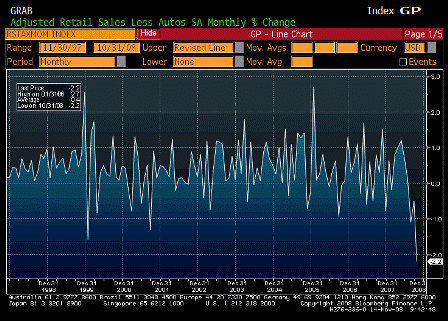
Retail Sales Less Autos (Oct)

Survey -1.2%
Actual -2.2%
Prior -0.6%
Revised -0.5%

 
Same!

[top][end]


Business Inventories MoM (Sep)

Survey -0.1%
Actual -0.2%
Prior 0.3%
Revised 0.2%

 
Interesting drop- not recession like at all.

[top][end]

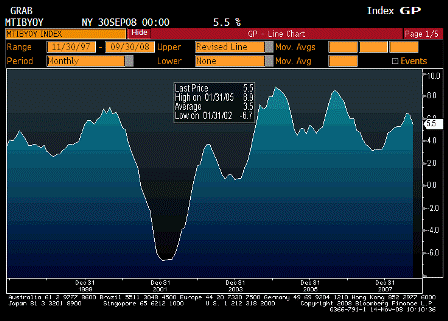
Business Inventories YoY (Sep)

Survey n/a
Actual 5.5%
Prior 6.3%
Revised n/a


[top]

Treasury Secretary choices


[Skip to the end]

(email exchange)

>   
>   On Fri, Nov 7, 2008 at 11:12 PM, wrote:
>   
>   Geithner’s very smart,
>   

Then why couldn’t he even hit his Fed funds target? When I asked operations people at the NY Fed why they can’t just make a one basis point market around the target they said that would mean continuous ‘intervention’ all day which would be a lot of ‘work.’ They said they only wanted to intervene once in the late morning so were trying to ‘guess’ the right amount to intervene then. This is a ridiculous way to run policy!

It took them three tries on paying interest on reserves to get the ‘right’ level which was the obvious- set it at the Fed funds target.

They are the ones passing along the swap line requests and must know or should know the likely consequences of this madness and that the FOMC doesn’t fathom what’s going on, as part what could be the biggest blunder in ‘monetary policy history.’ How does the Fed even get to loan 30 billion to Mexico secured only by pesos without Congressional discussion of any kind? The total advanced is now up to some $580 billion, with the biggest chunk to the ECB, completely under any radar screen.

>   
>   But at a time when backbone might be nice along with brains, he’s not
>   exactly worry-free. Or perhaps I should say that backbone would have
>   been nice along with his brains at the New York Fed: I think he saw all
>   too clearly the disaster in the making which hugely leveraged Wall
>   Street balance sheets represented, but was way too go along to get
>   along to put his foot down.
>   

Worse. He was part of the decisions to not give ‘depositors’ their funds back in the Lehman failure, and part of the ‘lie’ that the Fed loaned Bear $31 billion when in fact it bought the securities.

>   
>   His testimony during the Bear hearings are a model of velvet-gloved
>   disingenuousness, although in that it differs little from the testimony of
>   his fellow savior of the banking system, Dr. Bernanke.
>   

Exactly. I’ll give them the benefit of the doubt as the overwhelming evidence is they didn’t comprehend the subject matter.

>   
>   As you know, I’m all for Corzine, of the three rumored frontrunners.
>   

The least worst. Remember his ‘whispers’ caught by mics during an address with the black clergy in NJ?

Also, I met with him a couple of years back to discuss how to question then Chairman Greenspan. He agreed with what I was saying but chose not to do it for reasons unknown. I subsequently wrote ‘Interview with the Chairman’ as a guide to any congressman questioning the Fed chairman.

An Interview with the Chairman

At best he’s seriously ‘intellectually dishonest.’

Also note the TARP belonged in the Fed, not Treasury. The Fed ‘spending’ is monetary as it routinely buys securities/financial assets (like the $31 billion from Bear), while treasury federal spending is ‘fiscal’ like paying the soldiers and the postal workers, etc. If they put the TARP where it belonged it would not be part of the ‘budget’ and the spending not accounted for as part of the ‘deficit.’ I’m not so cynical to think the reason they gave it to Treasury was to allow it to show up as increased deficit spending and hopefully put a cap on ‘social programs’ to a misguided Congress. Instead I’d just call it more evidence of ignorance of monetary operations and public accounting.

Just one more thing- the Obama talk yesterday shows a continuing ‘upside down’ approach to the economic ‘problem.’ Seems to me both GM and the Banks, for example, need a population that can afford to buy cars and make payments (aka aggregate demand), which all the ‘investment loans’ and ‘financial injections’ don’t address at all.

Government always has a choice of providing additional public goods and/or supporting private consumption oriented output. For me the move to support private sector output such as cars and financial services would best be done with a ‘payroll tax holiday’ where the treasury makes all the fiscal payments which would immediately (and progressively) give working people an immediate, ongoing, and substantial increase in income to facilitate the payment of mortgages and the buying of cars. (If they don’t want to buy cars for non financial reasons so be it- let the industry shut down.) If instead government wants more public goods, it can facilitate the various public projects it’s been discussing to increase the output of public goods, and not necessarily for the further purpose of increasing the real output of private sector goods (always meaning to include services for both sectors, of course). When using up real excess capacity we can also have both, but at the macro level there is a real choice between public and private goods and services.

While it’s far to early to lose hope, all I saw with the first press conference yesterday was what looked like an undistinguished senator with no specific ideas as to what to do making a ‘sing songy’ presentation with very odd ‘mispeaks’ such as he talked to the living ex presidents, and something like he had a good transition team because it was given a lot of thought, etc. And marching up reps of corporate America to do nothing but stand in line behind him was to me an insulting piece of showmanship. The message was this is going to take time- he needs to talk to a lot of advisors, try to grasp the issues, and then decide on what to do. And with both deficit hawks and doves in his ‘inner circle’ and seemingly no personal conviction either way there’s no telling what will happen or when it will happen. What’s also clear ‘change’ so far is change back to the fossils of past Dem admins and the introduction of Chicago Dem politics to the federal level. And his two expressed policy statements- about China and currency manipulation October 24 and yesterday’s statement that Iran will not be permitted nuclear weapons- are both continuations of the Bush regime.

Yes, even the worst case is still better than what we had, or might have had, so this is not to say he wasn’t the best choice.

I’d better stop here!

All the best!
Warren


[top]

Re: Obama’s Yuan Calls- NOT GOOD


[Skip to the end]

>   
>   On Thu, Nov 6, 2008 at 7:09 AM, Michael wrote:
>   

Obama’s Yuan Calls May Put U.S. on Collision Course With China

by Judy Chen

Nov. 6 (Bloomberg) — Barack Obama’s calls for changes in China’s yuan policy may put the president-elect on a collision course with the U.S.’s second-largest trade partner, which is holding the currency stable to support its export-led economy.

Obama said China must stop manipulating the currency in a letter to the National Council of Textile Organizations released on Oct. 24.

This is counter productive for the US standard of living.

Obama has yet to discover imports are real benefits and exports real costs.

The People’s Bank of China has kept the yuan almost unchanged against the dollar since mid-July as it shifts focus from countering inflation to sustaining growth amid a global credit crisis. The Foreign Ministry said last week the U.S. shouldn’t blame its trade deficit on exchange rates.

“Obama may exert more pressure on China’s foreign-exchange policy to boost U.S. exports and curb unemployment, but China will first consider its own economic fundamentals,” said Ha Jiming, Hong Kong-based chief economist at China International Capital Corp., the nation’s first Sino-foreign investment bank.

Hopefully, Obama will see the light and it will instead be a case of ‘when the facts change I change’.

Policy of Stability
Paulson said on Oct. 21 that he is “pleased” that China’s currency has appreciated more than 20 percent since a peg against the dollar was abandoned in July 2005.

Paulson either has it backwards, or he’s being subversive.

“It will be emphasized in the next Strategic Economic Dialogue that it is more important than ever that China should rely more on domestic demand rather than its trade surplus to sustain economic growth,” said Nicholas Lardy, senior fellow at the Peterson Institute for International Economics in Washington.

Same- ignorant or subversive are the only possibilities.

“Currency manipulation has been a quite specific implication in law, and no other president has ever used that term,” said Straszheim. If Obama doesn’t take actions following the charge that China is manipulating the yuan, “he will be regarded as another old type politician who promises one thing during the campaign and does another in office,” he added.


[top]

Re: Commentary


[Skip to the end]

>   
>   The banks using the ECB’s liquidity program deposited a record 160
>   billion Euros with the ECB overnight, rather than lend them to other
>   banks or market participants.
>   

Jeff, ‘lending them out’ wouldn’t have changed that number. At most it would have moved the funds from one bank’s reserve account to another. So maybe, they did ‘lend them out’. Best indication is the interbank rates, but even that’s not definitive.

>   
>   Russia is going to base missiles on EU border. That should go well. In
>   unrelated news, they are also planning to build a deep-water port in
>   Venezuela that will allow Russian warships to dock there. Hamas
>   militants pounded southern Israel today with a massive barrage of 35
>   rockets, after Israeli forces killed six gunmen. So much for the
>   five-month truce. China has so far sentenced 55 people for riots
>   against Beijing’s rule that broke out in Tibet in March. No word yet on
>   the other 147 people who stood trial. Iran has warned the US again
>   not to violate its airspace.
>   

Good luck to us!


[top]

China News Highlights


[Skip to the end]

Much of the world seems to be going this way.

Enough fiscal will turn this around.

China’s Hu Calls for Efforts to Increase Demand, Xinhua Says

By Wang Ying

Nov. 1 (Bloomberg) — Chinese President Hu Jintao said the government needs to continue efforts to boost domestic demand to bolster financial stability and counter the impact of the global credit crisis, the state-run Xinhua News Agency reported.

The authorities will continue to consolidate the “foundational position” of agriculture and to deepen economic reforms and openness, Hu was quoted as saying. Hu spoke during a visit to the northwestern province of Shaanxi between Oct. 28 and Oct. 29, according to the report late yesterday.

China’s economy, the world’s fourth largest, expanded in the third quarter by 9 percent from a year earlier, the slowest pace since 2003. The government lowered interest rates three times in the past two months, increased export rebates and cut property transaction taxes.


[top]

Energy issues have not gone away yet


[Skip to the end]

It’s too early to say for sure the Mike Master’s sell off has run its course.

I looked at the announced OPEC supply cut as evidence they think it has.

Net supply issues remain and at least so far demand destruction has only meant a slowing growth of consumption.

Crude Oil Rises on Surge in Global Equities, Possible Fed Cut

By Alexander Kwiatkowski

Supply Declines

Global crude-oil output is falling faster than expected, leaving producers struggling to meet demand without extra investment, the Financial Times said, citing a draft of an International Energy Agency report.

Annual production is set to drop by 9.1 percent in the absence of additional investment, according to the draft of the agency’s World Energy Outlook obtained by the newspaper, the FT reported. Even with investment, output will slide by 6.4 percent a year, it said.

The shortfall will become more acute as prices fall and investment decisions are delayed, the newspaper said. The IEA forecasts that the rising consumption of China, India and other developing nations requires investments of $360 billion a year until 2030, it said.

OPEC Considers Meeting

The Organization of Petroleum Exporting Countries’ decision last week to trim production for the first time in almost two years failed to stop prices falling yesterday.

“If circumstances dictate we have another meeting, of course we will meet,” OPEC Secretary-General Abdalla el-Badri said at the Oil & Money conference in London. He said he expects a market response to last week’s output cut after about a week.

Shokri Ghanem, chairman of Libya’s National Oil Corp., echoed el-Badri’s comments, saying he’s watching the market to see whether it’s deteriorating or stabilizing.


[top]

EU/China


[Skip to the end]

ECB on inflation- while interest rate cuts are likely (and in my honest opinion, won’t help anything), what they consider low unemployment and wage gains still a factor and making headlines and have been causing some footdragging.

Trichet May Need to Prove ECB’s Inflation Credentials (Update1)

By Ben Sills

“Whether that means inflation is suddenly going to fall enough is highly doubtful,” said Broux. “Unemployment is the lowest in a generation.”

While oil prices have halved in the past three months and inflation slowed to 3.6 percent in September, workers are demanding compensation for higher costs.

Germany’s IG Metall labor union is seeking an 8 percent pay increase, the largest in 16 years, and workers at Ireland’s Electricity Supply Board last month demanded 11.3 percent.

Germany preparing some kind of fiscal package, but still no details. The government and bond issuance is already set to gap up, and this will add to the systemic risk:

Germany is preparing a package of economic measures to support consumption and help selected industries as growth in Europe’s largest economy rapidly loses steam, government officials said on Wednesday.

The fiscal package is considered more than just an economic response to the financial crisis; it is also a political move aimed at making Berlin’s €500bn ($644bn, £395bn) rescue package for its banks more palatable to voters, a year ahead of a general election at risk of becoming overshadowed by the abrupt slowdown.

The government reduced its 2009 gross domestic product growth forecast last week from 1.2 to 0.2 per cent and several economists fear the economy could even shrink next year.

Meaning higher deficits.

Although details of what will be included are yet to be announced, the move confirms that Berlin is no longer aiming to balance the federal budget by 2011, once a central goal of Angela Merkel, the chancellor.

Government officials said on Wednesday Ms Merkel had appointed Jörg Asmussen, deputy finance minister, and Walther Otremba, deputy economics minister, to prepare a list of measures to support consumers and business that could be adopted as early as next week.

The growth-supporting efforts are thought to be tax incentives to encourage consumption of German products, such as new cleaner cars or energy-efficient heating systems for homes.

“We need measures that have leverage,” said Joachim Poss, a Social Democratic MP and public finance expert, adding that these should be limited in the time they were available.

One option would be to increase the budget of a 2006 programme of tax incentives to encourage consumers to insulate their homes.

The economics ministry is also keen for KfW Group, the public sector development bank, to provide 100 per cent loans to small and mid-sized companies, as they struggle to secure credit in the financial turbulence.

More controversial is the issue of tax cuts, largely because of Ms Merkel’s concerns, shared by Peer Steinbrück, the finance minister, that these could fail to increase consumption at a time the downturn is beginning toaffect tax revenues.

However, an economics ministry official said Mr Asmussen and Mr Otremba had not abandoned the notion of income tax cuts.

Alternatively, the government could decide to bring forward by one year a decision to allow taxpayers to deduct the cost of their health insurance from their tax bills, the official said.

The decision, forced upon the government by a court ruling, was due to apply from 2010 and would cost the federal and regional governments €9bn a year in total.

In contrast, China, with its own fiscal authority and non-convertible currency, has no solvency issue and can get the job done if they aren’t shy about it:

China says domestic demand boost can help economy

BEIJING, Oct 23 (Reuters) – China can overcome the tightening in economic conditions by boosting domestic demand, Chinese Premier Wen Jiabao said on Thursday.

“We can overcome the current difficulties through stimulating domestic demand,” said Wen after meeting German Chancellor Angela Merkel.

Merkel added: “We want to use the chances (we have) through an intense cooperation.”


[top]

2008-10-07 China Daily News Highlights


[Skip to the end]

Highlights

China to Slash Rates, Spend to Fuel Growth, Morgan Stanley Says

China to Slash Rates, Spend to Fuel Growth, Morgan Stanley Says

2008-10-07 03:11:05.320 GMT
By Kevin Hamlin

Oct. 7 (Bloomberg) — China will cut interest rates as many as five times by the end of 2009 and will step up spending to limit the effect of the “global financial tsunami” on the nation’s economic growth, Morgan Stanley said.

The central bank will cut borrowing costs by 27 basis points each time, reducing the one-year lending rate to as low as 5.85 percent next year from 7.2 percent now, Qing Wang, a Hong Kong- based economist, said in a note today. Government spending may add as much as 3 percentage points to economic growth, he said.

Global growth is slowing after the collapse and bailout of banks in the U.S. and Europe propelled the cost of borrowing in money markets to the highest ever. Slowing economic growth in Europe and the U.S., which account for 40 percent of China’s total exports, will translate into lackluster exports, falling corporate profit and easing inflation, Wang said.

“A substantial improvement in the inflation outlook should help ease the lingering concerns about the inflationary consequences of an expansionary macroeconomic policy,” Wang said. “We expect a decisive policy shift toward boosting growth in the coming weeks and months.”

Wang cut his forecast for inflation next year to 2.5 percent from 4 percent. He lowered his estimate for economic growth in China next year to 8.2 percent from 9 percent and lowered his forecast for this year to 9.8 percent from 10 percent.

More spending and tax cuts would contribute between 1 and 3 percentage points to growth, Wang said.

China can “afford to run multiyear fiscal deficits without running into debt sustainability problems,” because it has public debt of only 30 percent of gross domestic product, Wang said.

Property Market Risk

The main risk to his forecast was a “meltdown” in the property sector across the country, “which would lead to a massive collapse in real-estate investment, Wang said.

The consequences would be so serious that even pro-growth policies wouldn’t prevent the economy growing less than 7 percent, he said.

The probability of this happening is less than 25 percent, Wang estimated, contradicting a Sept. 12 report by Jerry Lou, a Morgan Stanley strategist, who said the “likelihood of a property sector meltdown is high.”

China thus has ample room for monetary and fiscal initiatives to help offset the impact of slower global growth, he added. This would entail “unwinding” tightening measures introduced since last year, including “the 162 basis points interest rate hike, the 850 basis points hike of the required reserves ratio, and stringent administration bank lending quotas,” he said.

The People’s Bank of China cut the one-year lending rate to 7.20 percent from 7.47 percent, the first reduction in six years, last month.

Morgan Stanley forecasts that the U.S. economy will contract by 0.2 percent next year and that growth in the Europe will reach only 0.2 percent. It expects a 1 percent contraction in Japan.


[top]

2008-10-06 China News Highlights


[Skip to the end]

Looks like our loss is going to be their gain due to our leaders being in this way over their heads.

Highlights

Premier: China’s steady growth can help
China May Move to Revive Sagging Property Market, JPMorgan Says
China May Maintain Fast Growth Amid Crisis, Premier Wen Says
China Should Prepare for Dollar Fall, Securities Journal Says
UBS Cuts Economic Growth Forecast for Asia, China
China’s Retail Sales Rise During Week Holiday, China Daily Says

Premier: China’s steady growth can help

Oct 6. (China Daily) Maintaining “steady and fast” growth is the largest contribution China can make to help the world overcome the current financial crisis stemming from the United States, Premier Wen Jiabao said Sunday.

“It will be the biggest contribution to the world for a huge country with 1.3 billion people to maintain steady and fast growth in the long term,” Wen said during an inspection to the Guangxi Zhuang autonomous region.


[top]

EU leaders to agree to relax stability rules


[Skip to the end]

This will only move them closer to brink of investors refusing to buy their debt.

EU leaders agree to relax Stability Pact rules (Roundup)

by Siegfried Mortkowitz

Paris – To help prop up their banking systems, European leaders meeting Saturday in Paris agreed to loosen the requirements of the European Union’s Stability and Growth Pact, which imposes rules on member states regarding their public spending.

French President Nicolas Sarkozy, German Chancellor Angela Merkel, British Prime Minister Gordon Brown and Italian Prime Minister Silvio Berlusconi also called for an international conference of the 14 largest industrial nations to ‘rebuild the international finance system,’ as Sarkozy phrased it.

Also attending the mini-summit of the EU’s four members of the G8 group of industrial nations were European Commission head Jose Manuel Barroso, European Central Bank (ECB) president Jean-Claude Trichet and the head of the Eurogroup, Luxembourg Prime Minister Jean-Claude Juncker.

The meeting was called by Sarkozy, currently president of the EU, to formulate a common European position to surmount the finance crisis.

A statement released after the talks said, ‘The application of the Stability and Growth Pact should also reflect the current exceptional circumstances.’

This was a victory for Sarkozy, whose closest advisor, Henry Guaino, earlier this week had declared: ‘Temporarily, (the Stability Pact) is not the priority of priorities. The priority is to save the world banking system and therefore save citizens’ savings.’

The criteria, set out in the Treaty of Maastricht, include a national budget deficit totalling less than 3 per cent of gross domestic product (GDP) and public debt not exceeding 60 per cent of GDP.

The leaders at the meeting also called for an international conference on the financial crisis that would include the G8 countries and large developing economies such as China, India, Brazil and South Africa.

‘We will work with all major economies to rebuild the international banking system,’ Berlusconi told journalists when asked about the purpose of the meeting of the so-called G14.

Sarkozy said the aim of the international conference would be to construct ‘the foundation of an entrepreneurial capitalism instead of a speculative capitalism. We want to build the beginning of a new financial world as they did in Bretton Woods.’

The 1944 international meeting in Bretton Woods established the rules for commercial and financial relations among the world’s major industrial states.

The EU leaders also agreed to work to change European accounting rules, increase regulation of credit rating agencies and hedge funds and alter the way executives are rewarded, in order to prevent the payment of ‘golden handshakes’ – that is, exorbitant severance payments – to executives who have created risk for their companies.

‘Executives who failed must be penalized,’ Sarkozy said.

The summit was preceded by a controversy over a proposal to create a 300-billion-euro (413-billion-dollar) fund to bail out struggling financial insitutions, similar to the plan passed by the US House of Representatives and signed into law by President George W Bush late Friday.

Reportedly supported by the Dutch and the French, the idea was summarily rejected by Germany and Britain, and was not on the summit’s agenda.

Sarkozy told journalists that the idea was not his.

‘I never assumed it, I never proposed it, I never imagined it,’ Sarkozy said.

Instead, in line with German and British wishes, each EU member state is to aid its troubled banks with its own funds, but after discussions with other countries, a reference to the unilateral decision by the Irish government to establish a 100-per-cent guarantee for depositors in the six largest Irish-owned banks.

The move, made without consultation with the European Commission, has already attracted investors away from British banks, and has put pressure on the Brown government government to match it.

Merkel said that the European Commission and the ECB would talk to the Irish about their move, which contravenes the EU’s state aid and competition requirements.

‘But my satisfaction about (this solution) is limited,’ the German chancellor said.

Decisions taken at Saturday’s mini-summit are to be further elaborated at Tuesday’s meeting of EU finance ministers and at the October 15-16 EU summit in Brussels.


[top]