Mtg purchase apps, Fed’s beige book report, Trump comments

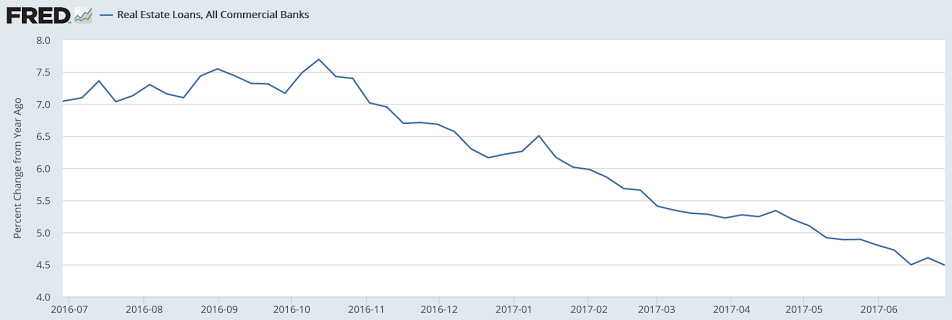
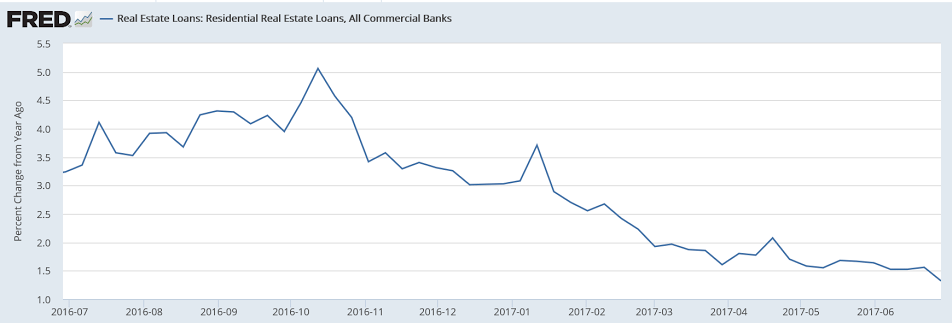
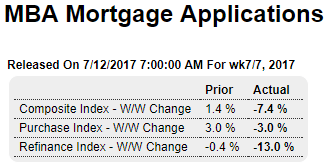
Still soft, also somewhat in line with decelerating bank mortgage lending:
Highlights

Purchase applications for home mortgages fell a seasonally adjusted 3 percent in the July 7 week, while applications for refinancing fell 13 percent from the previous week to the lowest level since January 2017. The refinance share of mortgage activity fell 2.8 percentage points to 42.1 percent. The decline in applications was registered despite adjustments for the Fourth of July holiday. On an unadjusted basis, purchase applications were down a much sharper 22 percent from the previous week. The weekly decline shaved the year-on-year purchase index gain by 3 percentage points to 3 percent. Along with the midweek holiday, rising mortgage undoubtedly took their toll on mortgage application activity. After rising 7 basis points in the prior week, the average interest rate on 30-year fixed rate conforming mortgages ($424,000 or less) rose another 2 basis points to 4.22 percent.

First ‘weak’ report in a long time. And not to forget the Fed sees it their role to manage expectations…
Highlights

Wages are on the rise but only a modest-to-moderate rise, with economic growth described as slight-to-moderate across the Federal Reserve’s 12 districts. And a few of the districts are now saying that overall price pressures have eased. Consumer spending is rising in most districts but at a slower pace. Two districts, Cleveland and Philadelphia, are reporting slowing in overall growth. Two other districts, Atlanta and St. Louis, are reporting flat employment levels.

This edition, especially the descriptions of inflation and the introduction of the word “slight” for the downside description of growth, is perhaps the weakest Beige Book so far this year. There are, however, indications of strength with the report noting that qualified workers are in short supply and the labor market is continuing to tighten for both skilled and unskilled labor and especially in the construction and high-tech sectors.

Still no evidence he’s capable of any adult thought whatsoever:

Trump says he’s doing ‘many things’ that are the ‘exact opposite’ of what Putin wants

  • Donald Trump claims Russia’s Vladimir Putin would be happier with a Hillary Clinton presidency.
  • The president claims that his 2016 election opponent would have spent less on the military and focused less on the traditional energy sector.
  • His comments come amid renewed focus on his campaign’s interactions with individuals tied to the Kremlin.
  • Consumer credit, French fiscal policy, Mtg mkt index

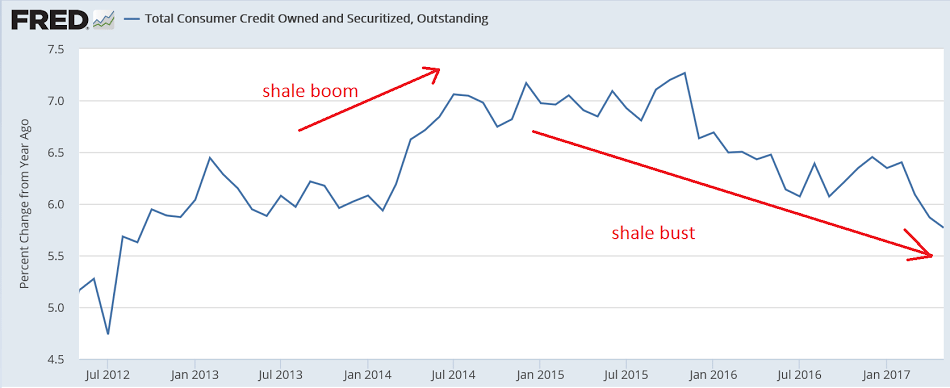
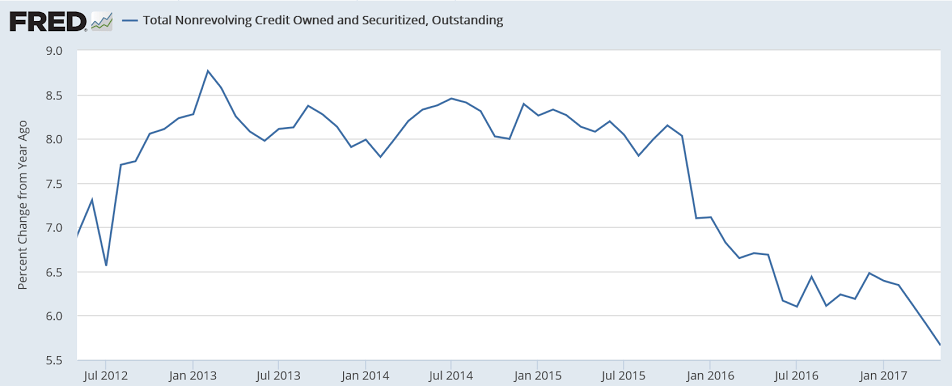
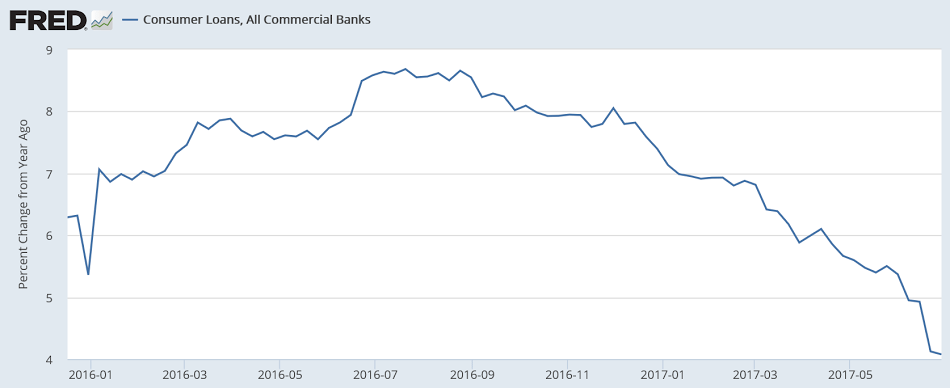
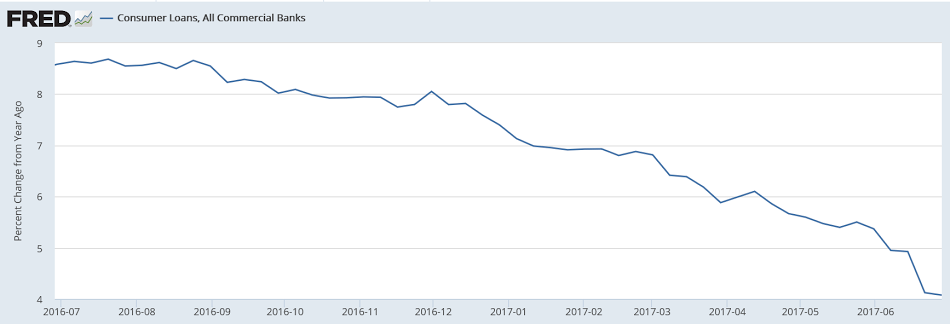
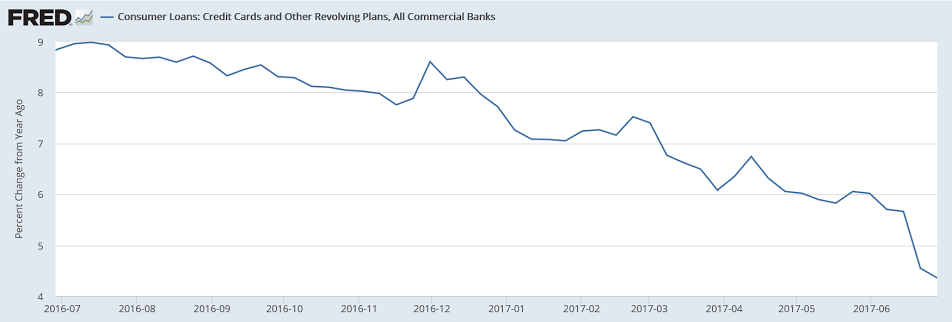
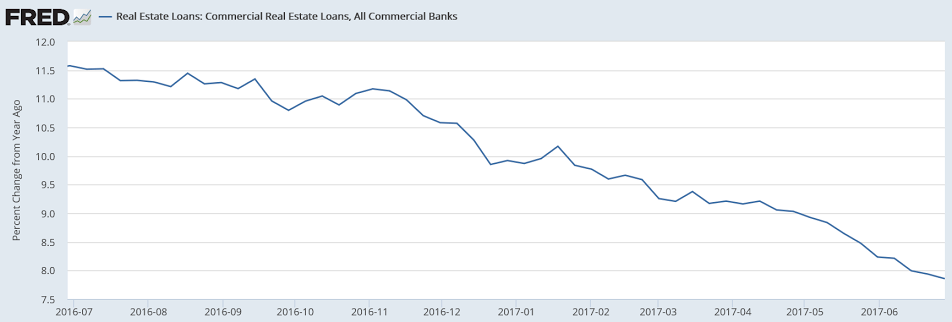
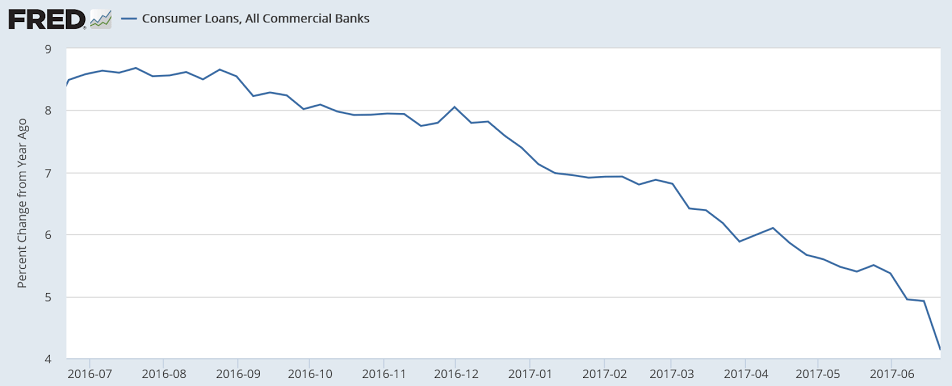
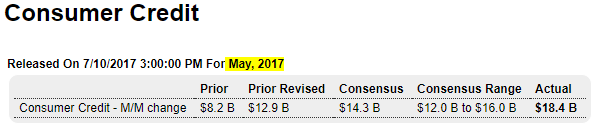
    Higher than expected, and last month revised up, however the trend is still lower. This report is only through May. The weekly bank loan report is as of June 28, and shows the down trend continuing, which generally reflects a deceleration in consumer spending:

    Highlights

    Consumer spending has been modest but consumers did run up their credit-card debt in May helping to lift consumer credit outstanding by a larger-than-expected $18.4 billion. Revolving credit, which is where credit cards are tracked, rose $7.4 billion vs only $1.2 billion in April. Nonrevolving credit, where auto financing and student loans are the biggest factors, posted yet another sizable increase of $11.0 billion in May. Credit card debt may not be a plus for long-term consumer health, but it is one for near-term consumer spending and GDP.

    Though May:


    Weekly through June 28:

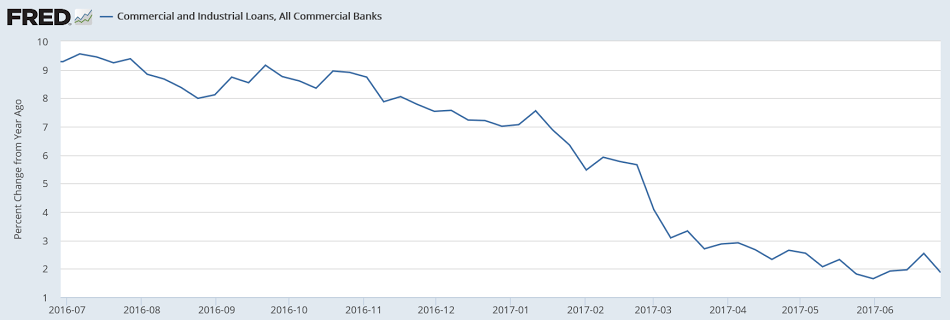
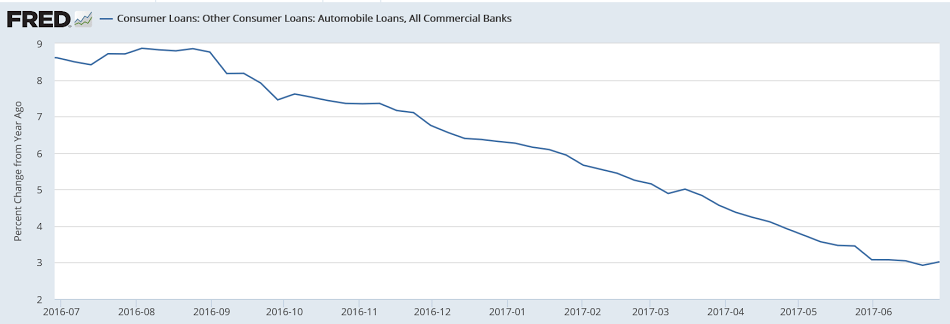
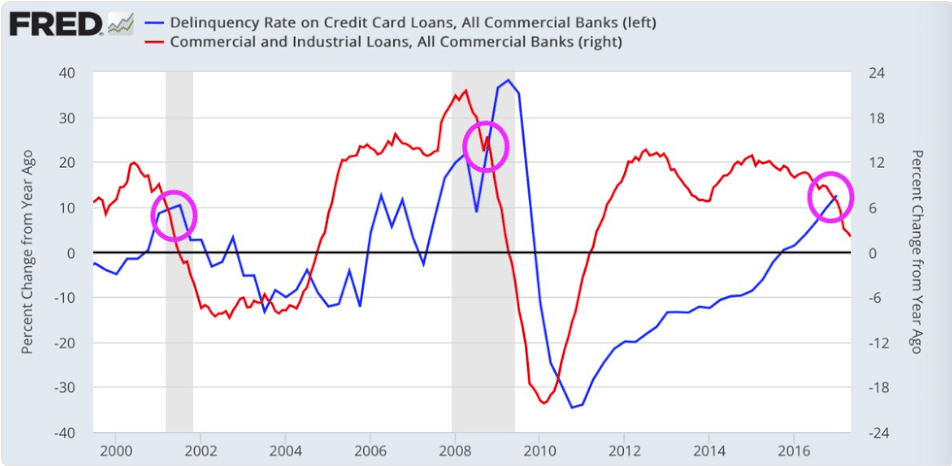
    Analysts are looking how the drop in lending might affect banks, but nothing about how the lending deceleration reflects events in the macro economy:

    Bank stocks are about to face another major hurdle

  • Financials are expected to show 6 percent profit growth when bank earnings season starts Friday.
  • JPMorgan Chase, Citigroup and Wells Fargo report Friday, with other industry heavyweights set for next week.
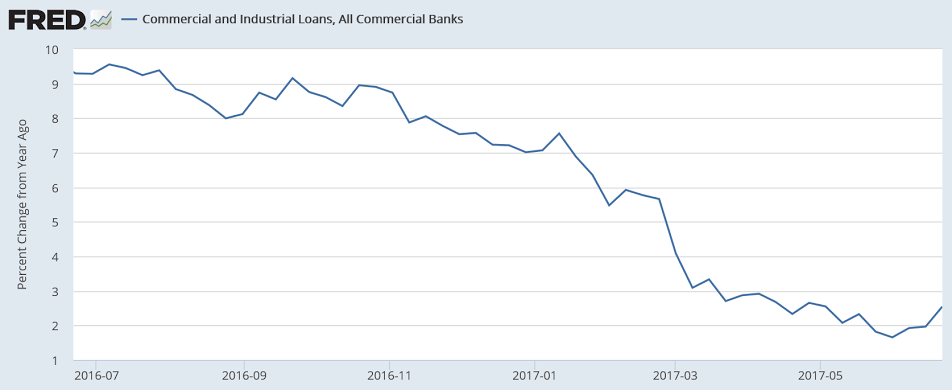
  • M&A as well as commercial and industrial lending have been problem points for banks.
  • As previously discussed, this is more of ‘the beatings will continue until morale improves’ policy:

    French deficit pledge will help euro zone budget discussions, ECB’s Coeure says

    The French government has committed to stick to plans to cut the deficit to 3 percent of economic output this year despite overspending this year by its predecessor.

    “One of the constraints facing the government is to keep its commitments on the budget and in particular on the three percent. This is something that we welcome in part because of the consequences for the rest of Europe,” Coeure said.

    Again, this is inline with the deceleration in the weekly bank lending reports:

    Weekly Mortgage Market Index Sinks from Year Earlier

    Mortgage Market Index down 28%

    DALLAS — (July 10, 2017) During the week that included Independence Day, new mortgage activity significantly declined. A substantial drop from a year earlier was also recorded. Jumbo business, however, mostly held up.

    As of the week ended July 7, the Mortgage Market Index from Mortgage Daily, which provides insight into upcoming originations based or rate-lock volume by clients of OpenClose, was 107.

    That turned out to be the lowest level for the index, which is not adjusted to account for seasonal factors, since the week ended Jan. 6, 2017.

    New business plunged 28 percent from the preceding week. Even more telling was the comparison with the same holiday week in 2016, with a 36 percent year-over-year tumble.

    Rate locks for adjustable-rate mortgages plummeted from the week ended June 30 by 44 percent — the most of any category. At 7.3 percent, ARM share was thinner than 9.3 percent the previous week.

    A 34 percent week-over-week reduction was recorded for refinance business. Refinance share was cut to 28 percent from the previous week’s 30 percent.
    After that was the Purchase MMI, which declined 26 percent to 77.

    The Government MMI was 45, retreating 21 percent from seven days prior. Government share widened to 42 percent from 38 percent.

    Sporting the smallest week-over-week drop were rate locks for jumbo mortgages: 2 percent. Jumbo share widened to 10 percent from 7 percent a week earlier. Rates on jumbo mortgages were 17 basis points higher than conforming rates. The jumbo-conforming spread widened from 12 BPS in the preceding report.

    Employment, Health care

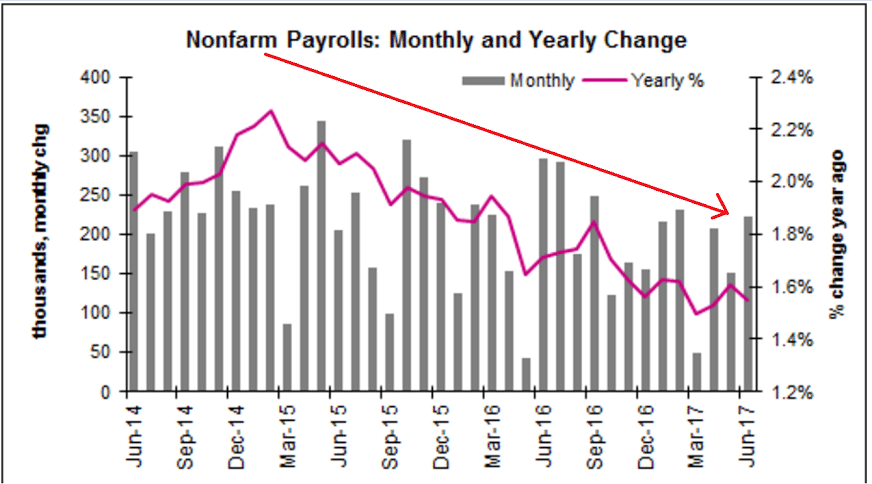
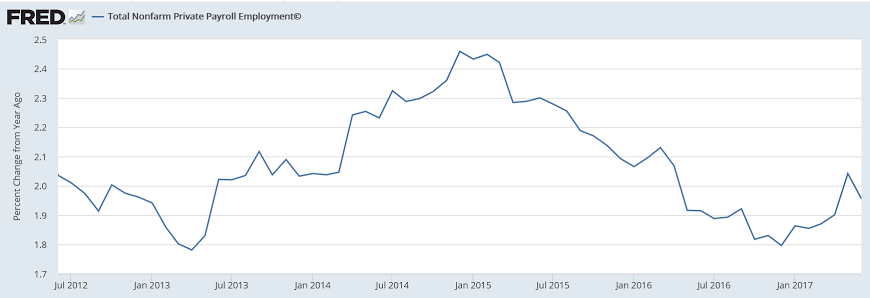
    A better than expected number but as per the chart, the year over year rate of growth continued its downtrend which began about 2.5 years ago when oil capital expenditures collapsed.

    Since GDP growth is the sum of the ‘pieces’ that make up GDP, if any piece contributes less to growth than it did last year, another must contribute more or the growth of GDP will be lower. So far this year we’ve seen a slowing of growth vs last year in vehicle sales, home sales, consumer spending, etc. as well as employment growth, all mirrored in the deceleration of bank lending that intensified about 6 months ago:

    Highlights

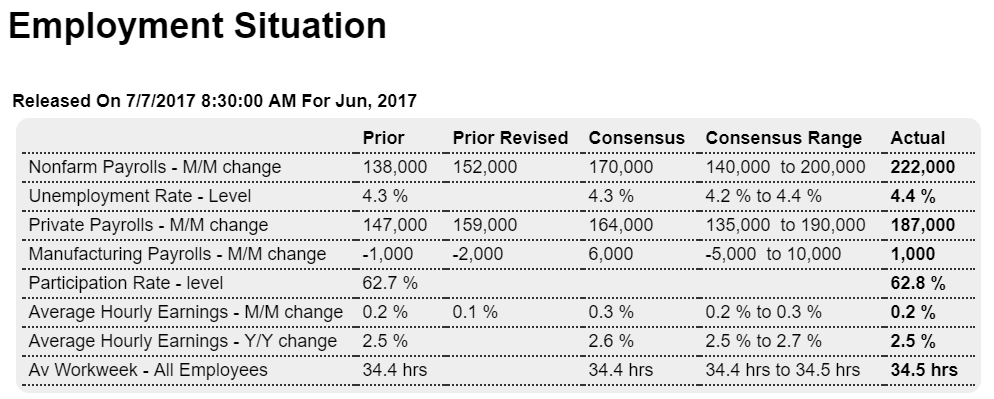
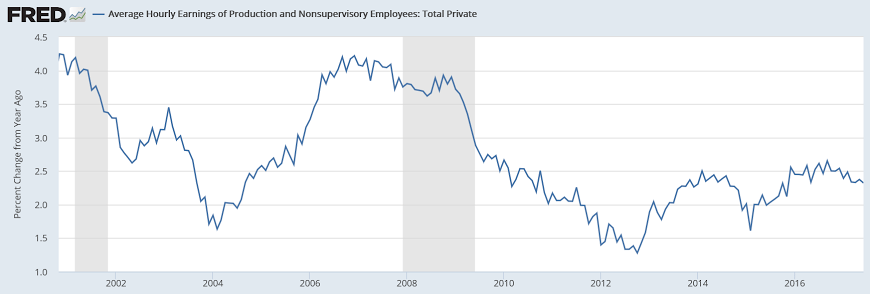
    The split between strength in demand for labor and weakness in wages is more acute than ever after the June employment report which shows a significant upgrade to payroll growth but a flat line for average hourly earnings. Nonfarm payrolls surged 222,000 in June with revisions to prior months adding another 47,000. The last 3 months of payroll growth had been very soft but have now have been revised away. Not revised away is earnings which could manage only a 0.2 percent gain in June with May, which was already weak, revised down 1 tenth to only a 0.1 percent monthly gain. Year-on-year, wages are lifeless at 2.5 percent. The weakness points to low wage, low productivity jobs.
    No sign of excess demand pressures building here:

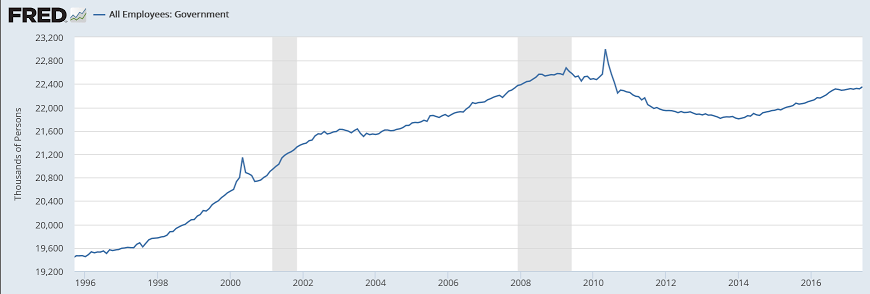
    Without growth of govt. employees there’s a lot more room for growth of private sector employment, but it requires an appropriate fiscal balance:

    This sounds like a shift to patches for what we have now, rather than ‘repeal and replace’? Problem is, the patches will only be temporary, as what we have now is logically unsound, as was what we had before and what’s been proposed so far…

    McConnell no longer rejecting bipartisan health care talks

    Jul 7 (Axios) — Senate Majority Leader Mitch McConnell has made it clear he doesn’t want to negotiate with Democrats on health care — but he’s no longer dismissing the option. Here’s what he said today at a Rotary Club lunch in Kentucky when asked whether he might need bipartisan cooperation to pass a health care bill, per AP: “If my side is unable to agree on an adequate replacement, then some kind of action with regard to the private health insurance market must occur … We’ve got the insurance markets imploding all over the country, including in this state.”
    This reads to me as total nonsense as well. If you’re not going to let people ‘die in the streets’ as a point of logic you’ve got single payer, which most of Congress is ideologically against. No telling how long it will take them to come around to that but it doesn’t seem like it’s anytime soon:
    Mike Lee takes harder stance on conservative health care amendment

    Jul 7 (Axios) — Sen. Mike Lee won’t vote for the Senate GOP health care bill without the addition of a controversial amendment he’s championing with Sen. Ted Cruz — a position he has made clear to the White House and Senate Republican leaders. “The entire bill is unacceptable without the Consumer Freedom Option,” Conn Carroll, Lee’s spokesman, wrote in an email. This proposal would allow insurers to sell health plans that don’t comply with Affordable Care Act rules, like pre-existing conditions protections or essential health benefits, as long as they also sell plans that meet all of those rules.

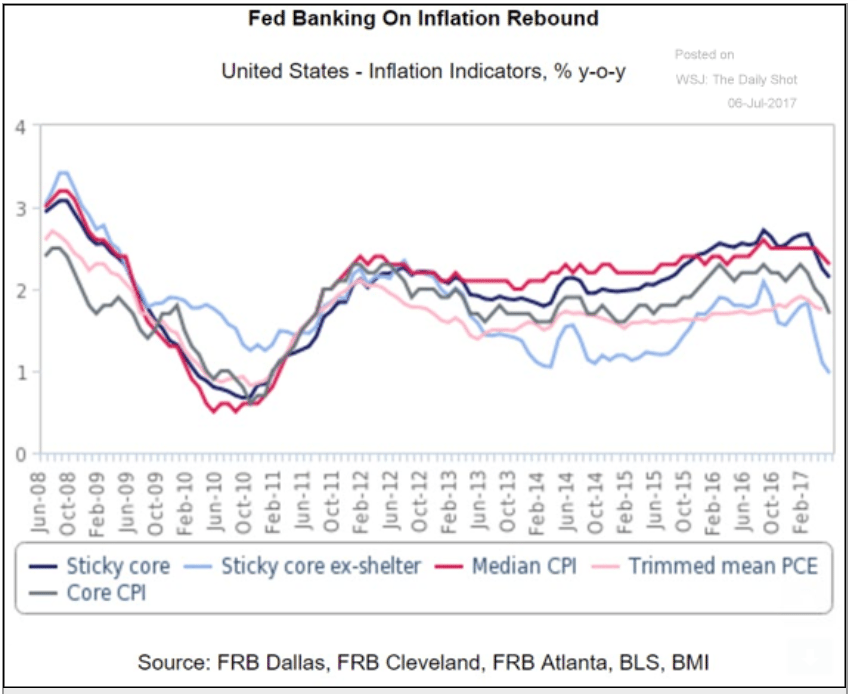
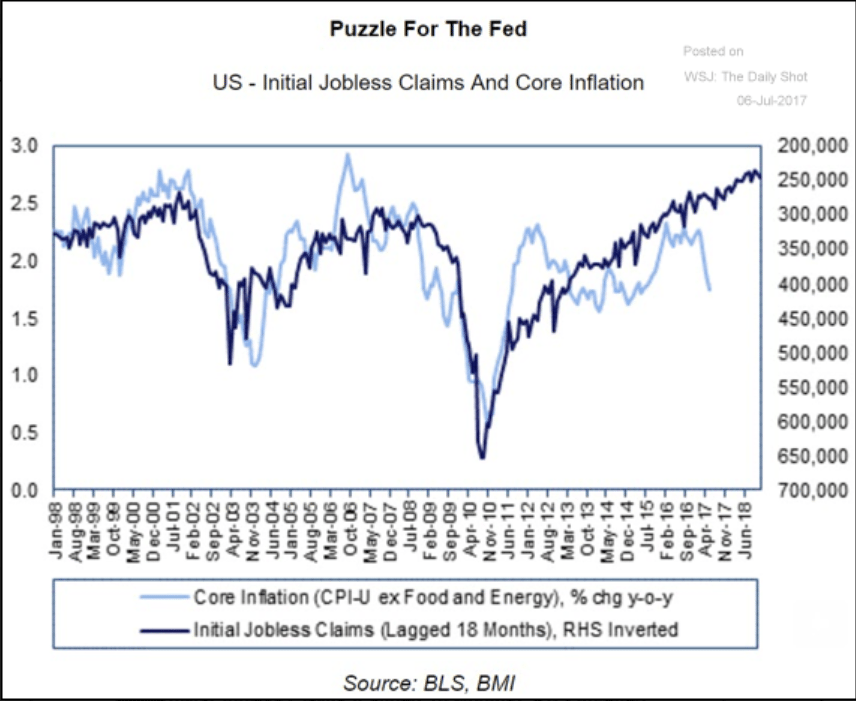
    ADP, ISM non manufacturing, Interview, Saudi output, credit chart, Inflation chart, claims chart, Mueller team news

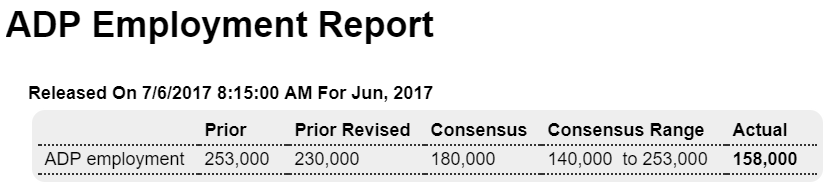
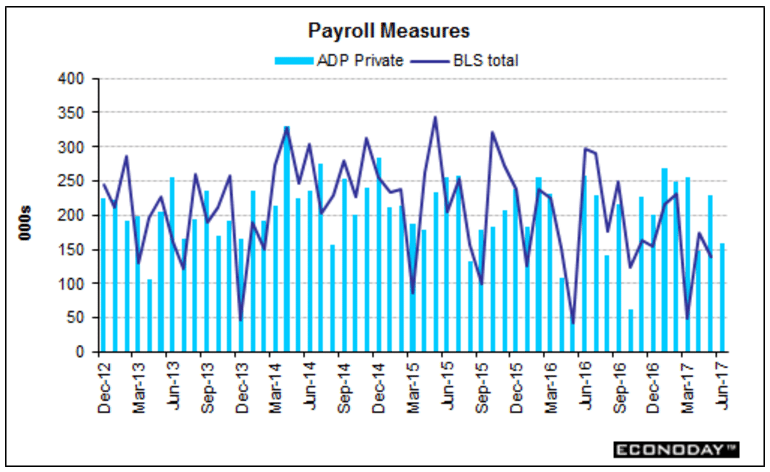
    Lower than expected and last month revised lower:

    Highlights

    ADP sees June private payrolls rising 158,000 which misses Econoday’s ADP consensus of 180,000. Econoday’s consensus for actual private payrolls in Friday’s employment report is 164,000 which isn’t likely to shift following ADP’s results. Estimates this year from ADP have been hit and miss with a wild upside miss in May.

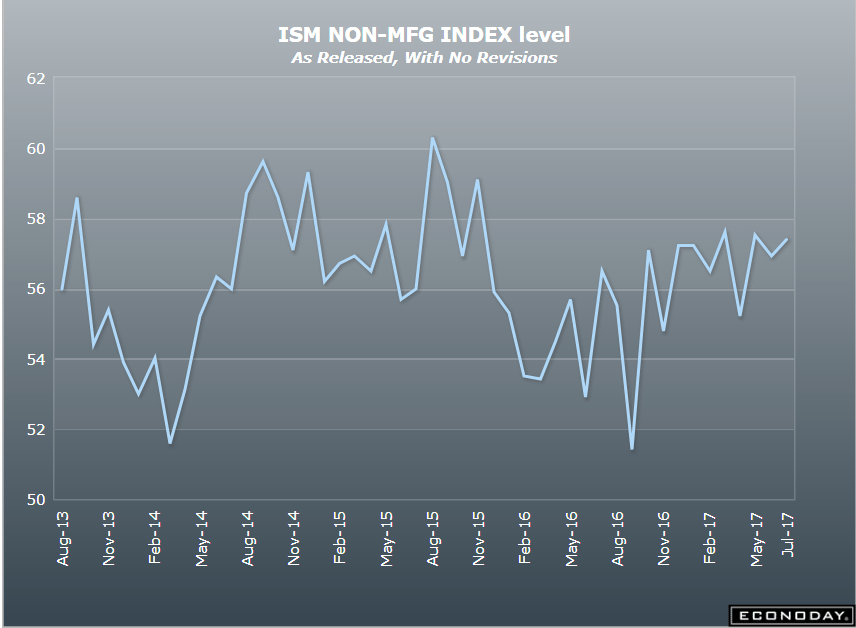
    Decent number for this survey but still reflects trumped up expectations:

    Highlights

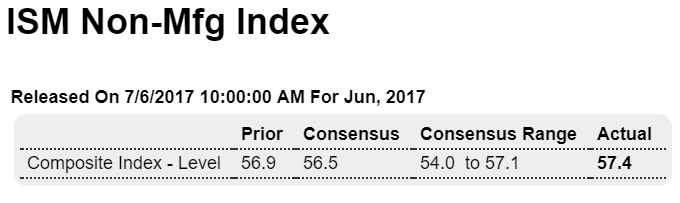
    ISM’s non-manufacturing sample continues to report extending strength with the index up 5 tenths in June to 57.4 which tops Econoday’s high estimate for 57.1. New orders, at 60.5, remain unusually strong with backlog orders, at 52.0, also rising in the month. New orders for export, at 55.0, are also up solidly though to a lesser degree than domestic orders.

    Employment growth is very solid at 55.8 but is down slightly from May’s unusually strong 57.8 in results that won’t disturb expectations for improving strength in tomorrow’s employment report. Business activity (output) is very strong at 60.8 with inventories, at 57.5, on the rise in further confirmation of the sample’s confidence.

    The strength in this report continues to be impressive but has yet to pan out to similar strength in government data.

    My recent radio interview:

    https://soundcloud.com/financialexchange/warren-mosler-2

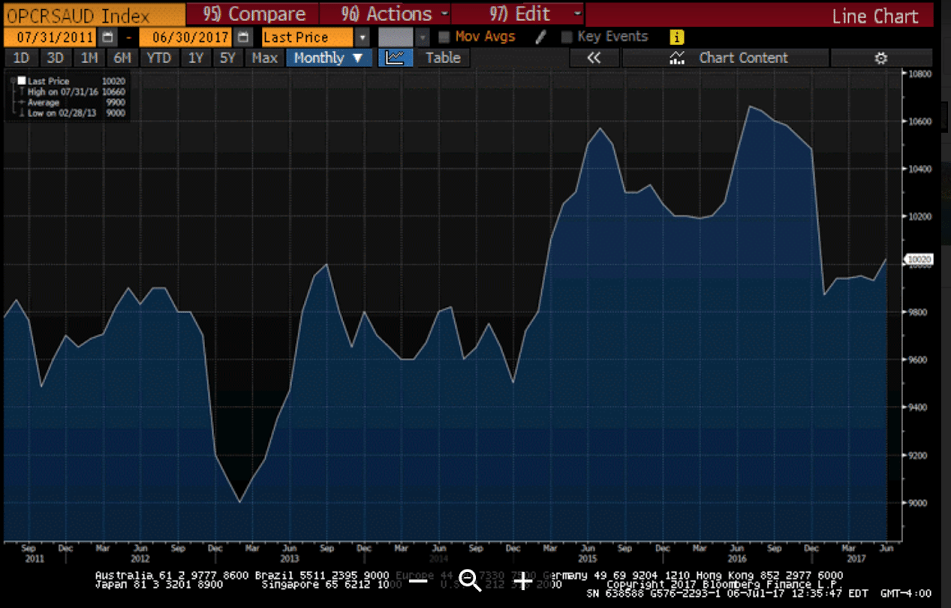
    Saudi output shows they remain swing producer and price setter:

    Another way to look at where we might be in the cycle:
    https://twitter.com/northmantrader/status/882670288177172480

    Factory orders, Small business hires, Redbook retail sales

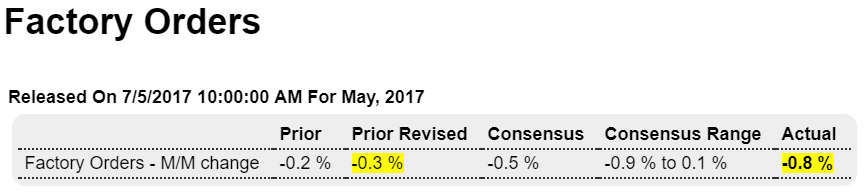
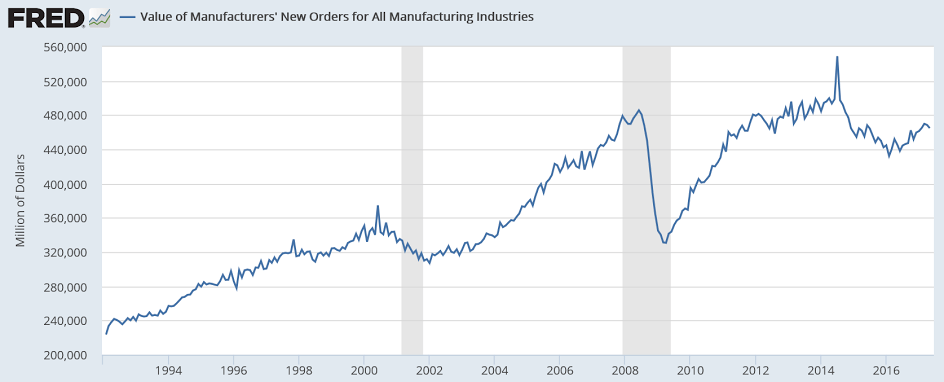
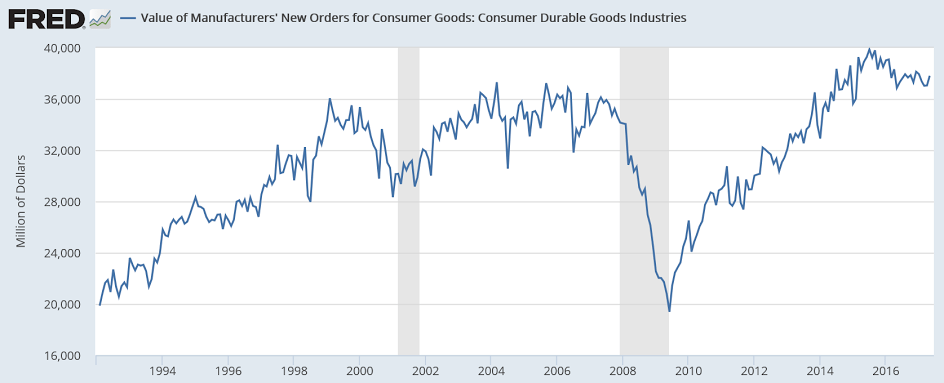
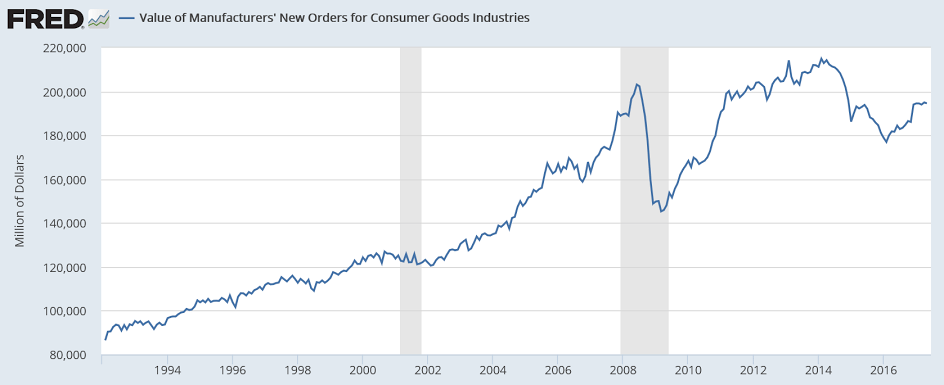
    Weaker q2 vs q1, and muddling along at about 3% year over year as previously discussed:

    Highlights

    Forecasters thought factory orders would get a lift from nondurables but they didn’t as total orders fell 0.8 percent in May vs Econoday’s consensus for minus 0.5 percent. Nondurable orders, held down by weakness in petroleum and coal, also fell 0.8 percent as did durable orders where last week’s advance data showed a 1.1 percent decline.

    But there are positives in today’s report and they include a small lift for core capital goods orders (nondefense ex-aircraft) which, boosted by a jump in mining equipment, rose 0.2 percent vs last week’s initial estimate for a 0.2 percent decline. A small plus is a 1 tenth upward revision to April which is now at plus 0.3 percent. Shipments for core capital goods, which are inputs into second-quarter business investment, are similarly revised upward, now at plus 0.1 percent and 0.2 percent in May and April.

    Weakness in the report includes aircraft orders with both commercial and defense falling in the double digits in the month. Orders for motor vehicle & parts rose a very solid 1.2 percent though consumer goods fell 0.2 percent.

    But manufacturing activity, as described in last week’s PMI manufacturing report, is no better than subdued as total shipments rose only 0.1 percent following no change and minus 0.2 percent in the two prior months. A clear negative is a 0.2 percent decline in unfilled orders. Inventories fell 0.1 percent following no change in April, keeping inventories-to-shipments steady at a lean 1.38 ratio that points, however, to a defensive outlook that won’t be helping second-quarter GDP.

    There are bright spots in this report which overall, however, is consistent with a sector that is struggling to find momentum.

    Also in line with weak demand

    Small business hires dropped in June, but employees saw wages rise, Paychex survey shows

  • Small business hiring fell in June, but wages continued to increase, Paychex says.
  • The Small Business Jobs Index is at its lowest level since late 2011.
  • “The decline in this month’s index and modest growth in wages seem to reflect an unclear regulatory picture combined with a narrowing labor market,” Paychex President and CEO Martin Mucci says.
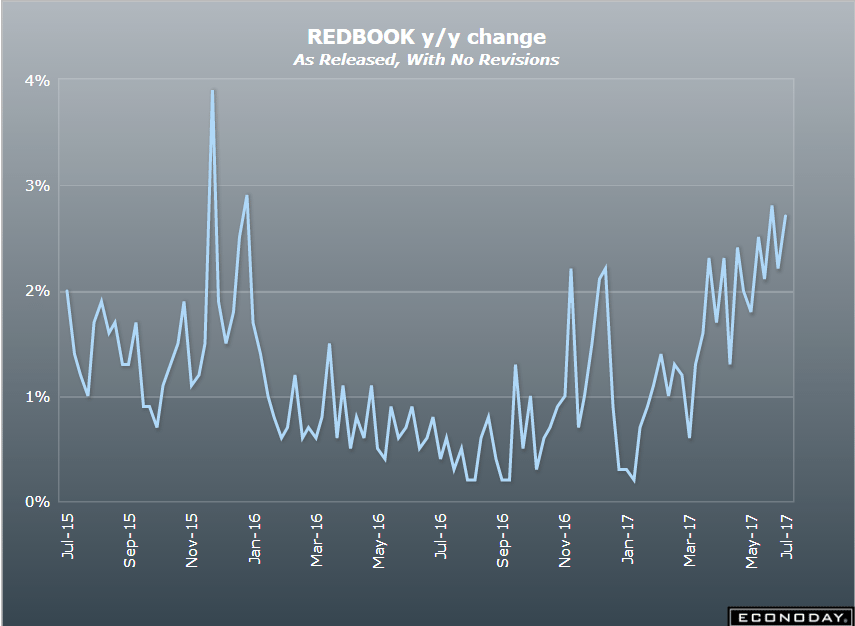
  • Definitely looking up some, though probably a lot fewer of these types of retailers now:

    Highlights

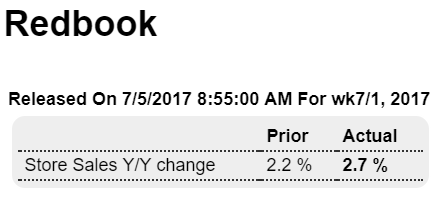
    Same store sales were up 2.7 percent year-on-year in the July 1 week, picking up the pace by 0.5 percentage points from the previous week to a tick below the strongest growth since January 2016 posted two weeks ago. Month-to-date same store sales versus the prior month also strengthened and were up 0.7 percent, an 0.1 percentage point improvement from the prior week. Full month year-on-year same store sales were up 2.5 percent, back up to the strongest pace in at least year also seen in the June 3 and June 17 weeks. The week’s survey results put a strong finish on a very good month for retailers in Redbook’s sample, who are reporting the best sales performance comparisons in 17 months after faltering sales in May, and suggest strong ex-auto less gas retail sales for the month.

    Motor vehicle sales, Holiday spending

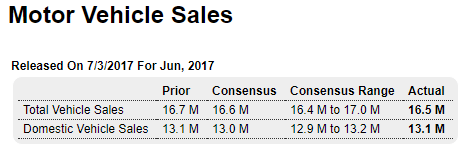
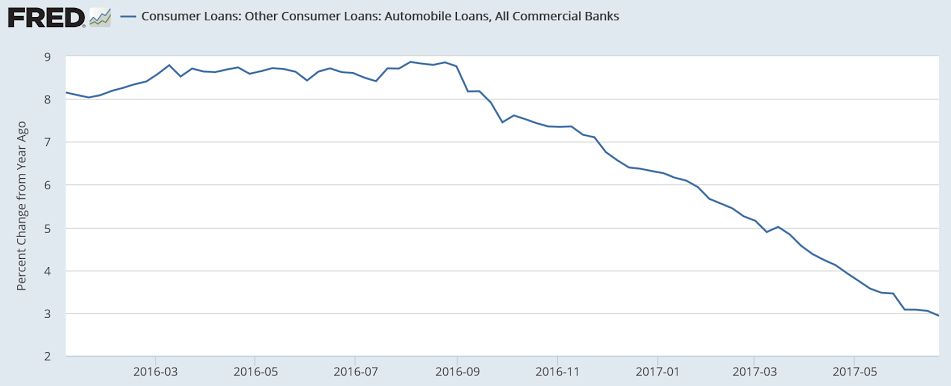
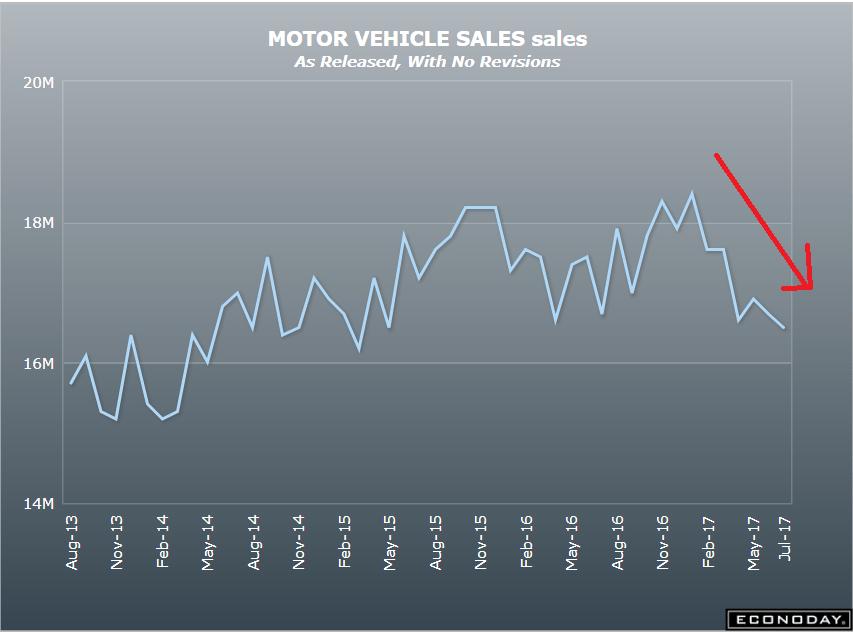
    Also decelerating in line with deceleration of bank auto lending. One by one the data releases seem to be confirming the last 6 month’s rapid deceleration of bank lending:

    Highlights

    The consumer remains disengaged based on vehicle sales where weakness extended into June, at a 16.5 million annualized rate vs what were modest expectations for 16.6 million and against 16.7 million in May. North American-made sales edged up to 13.1 million from 13.0 million though the gain is due more to rounding than improvement, at 13.05 vs 13.03 million out to two decimals. These results do not point to strength for what has been a very weak autos component of the retail sales report.

    Good news here! ;)
    Happy 4th!

    WASHINGTON – Americans are expected to spend $7.1 billion on food for cookouts and picnics as they celebrate the Fourth of July this year, up from $6.8 billion in 2016, according to the annual survey released today by the National Retail Federation and conducted by Prosper Insight & Analytics.

    According to the survey, 219 million Americans plan to celebrate the holiday, or 88 percent of those surveyed. A total of 162 million — 66 percent of those surveyed — plan to take part in a cookout or picnic, spending an average $73.42 per person, up from last year’s $71.34. The numbers cover only food items, not other holiday-related spending.

    Construction spending, Manufacturing

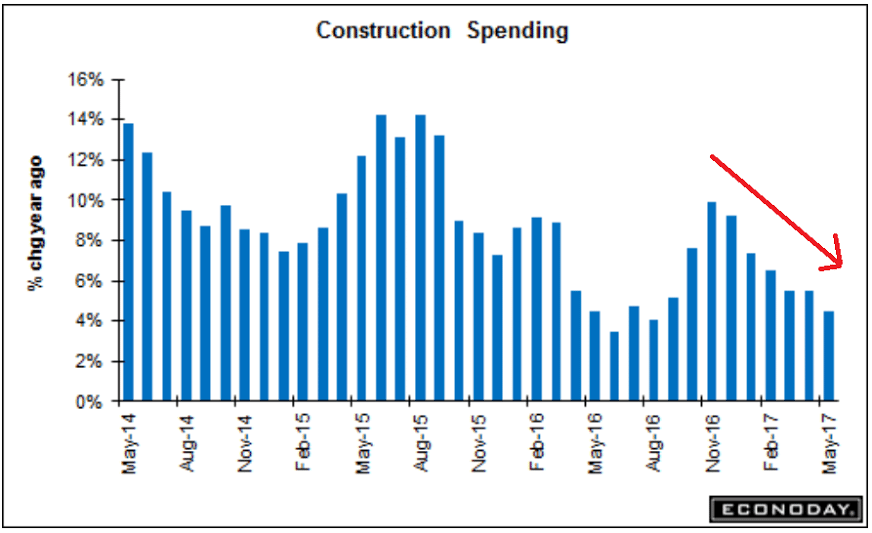
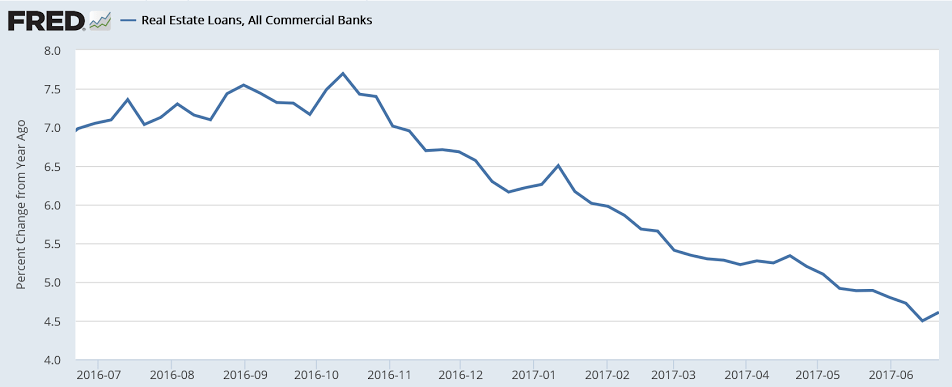
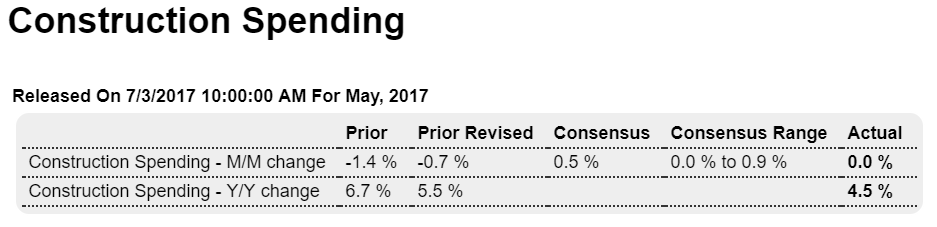
    As per the chart, decelerating in line with the deceleration in real estate related bank lending:

    Highlights

    Spring 2017 was not the greatest for the nation’s housing sector where data have been mixed at best. Permits have been down and spending data are flat to down with construction spending unchanged in May which hits the very lowest estimate in Econoday’s consensus range.

    And the weakness is in residential spending, down 0.6 percent overall and including declines for single-family homes, residential improvements, and especially in May for multi-family units.

    Private nonresidential spending fell 0.7 percent, with declines in transportation, manufacturing, and commercial. An offset is public nonresidential, up sharply after 2 prior months of declines with the gain centered in education, up 5.1 percent, as roads fell 0.9 percent for a second straight dip.

    Public spending in May aside, the slowing in construction spending is not a positive signal for the housing sector nor for second-quarter GDP. The housing sector moved higher at the beginning of the year but has stumbled since.

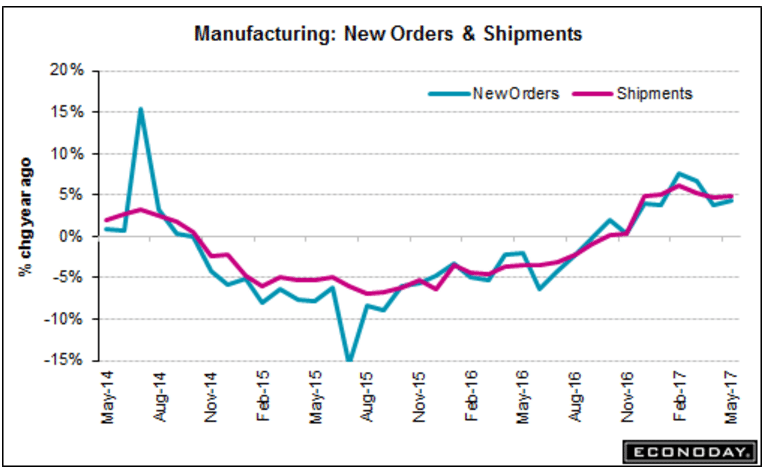
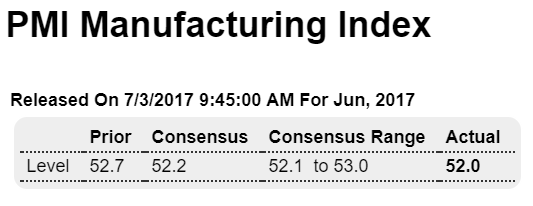
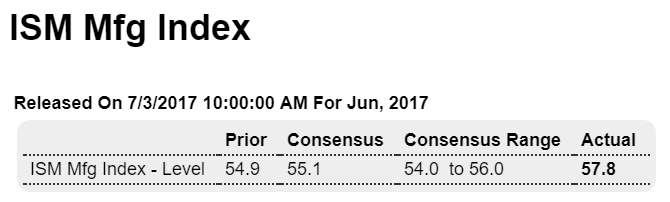
    Manufacturing surveys showing modest growth, as previously discussed:

    If this report tracked better with government data, expectations would be building for a second-half surge in the factory sector. But this report like other private data, with the notable exclusion of the PMI manufacturing report the latest edition of which was released earlier this morning, have been pointing to unusually strong levels of activity all year long, acceleration that has yet to appear in actual data from the government.

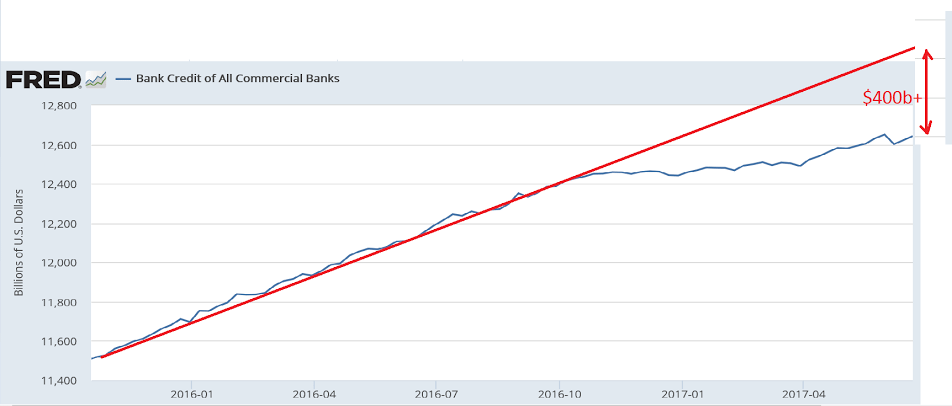
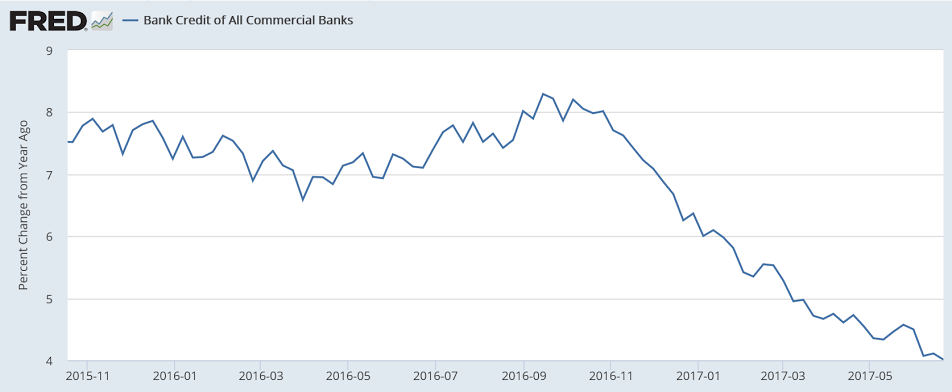
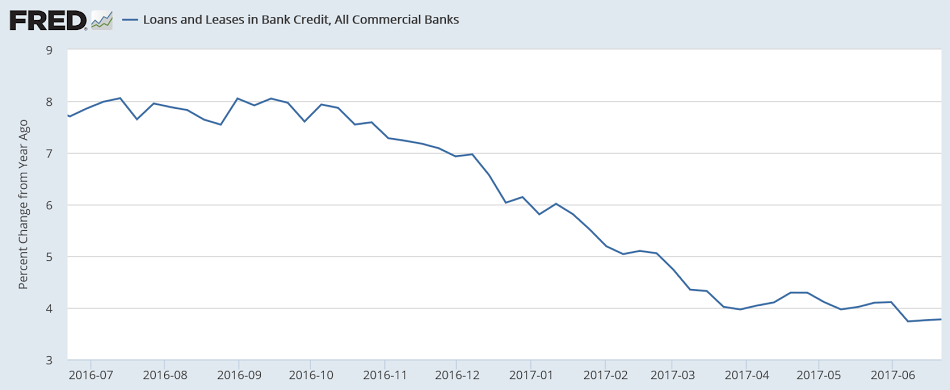
    First, let’s look at total bank credit. On this chart you can see that the cumulative growth of bank credit is more than $400 billion less than it would have been if it hadn’t slowed down.

    That is, last year’s economy was supported by that much more growth of bank credit than this year’s economy as the annual rate of growth has slowed from over 8% to about 4%:


    We’ve most recently had a few weeks of increase. A hopeful sign but the annual growth rate is still way down from last year:


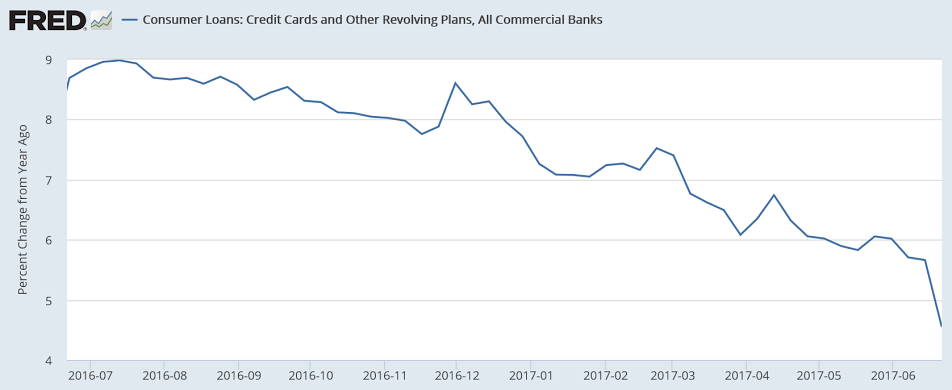
    In line with the recent drop in consumer spending:


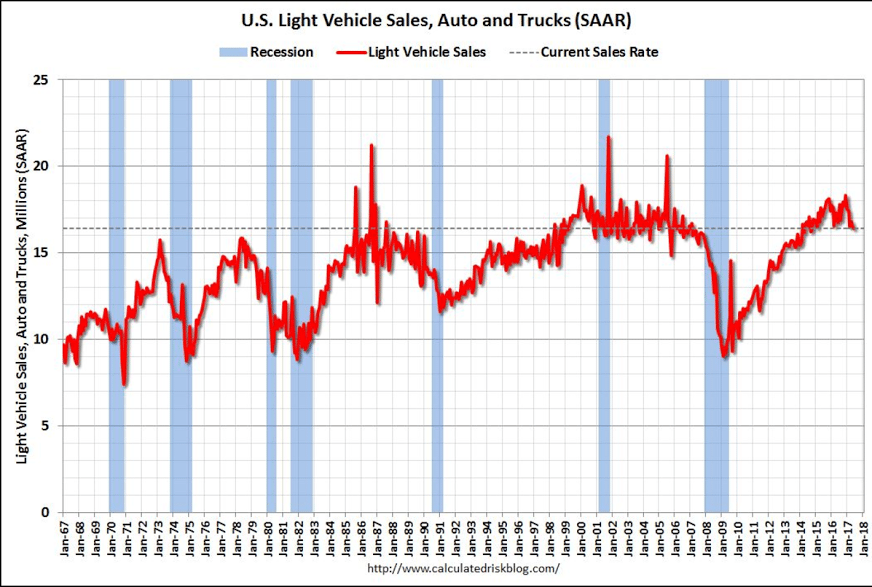
    In line with the drop in new automobile sales:

    Vehicle Sales Forecast: “Sixth Consecutive Decline in June”

    The automakers will report June vehicle sales on Monday, July 3rd.

    From Reuters: U.S. auto sales seen down 2 percent in June: JD Power and LMC

    The seasonally adjusted annualized rate for the month will be 16.5 million vehicles, down nearly 2 percent from 16.8 million units in the same month in 2016.

    On q1 GDP revisions:

    Healthcare is Boosting GDP Growth

    Summary and Commentary

    This revision boosts the headline growth about a quarter percent to +1.42% — better but still tepid. The notable takeaways from this report are:
    The largest upward revision was in consumer spending for healthcare and insurance.
    The growth rate for consumer spending on goods remains anemic.
    The inventory contraction worsened, possibly in anticipation of softer future consumer spending.
    Foreign trade remained a bright spot and is not a drag on the headline number.
    The US consumer may be spending more, but that increased spending is not on discretionary “life-style” goods.

    And as per usual, the Fed is once again projecting a return to “normalcy” in the form of 3% growth in future quarters — with consumer spending leading the way. But if this past quarter’s pattern persists those consumers may continue to face a toxic mix of stagnant disposable income, rising insurance costs and shrinking savings — not exactly a formula for happy campers.

    Slowing revenues indicates economic weakness:

    CBO Update to the Budget and Economic Outlook: 2017 to 2027

    “The deficit estimated for 2017 is $693 billion, $134 billion more than CBO projected in January. Surprisingly weak tax collections since then have led the agency to lower its projection of revenues by $89 billion. At the same time, CBO raised its estimate of outlays by $45 billion, mainly because agencies have increased the estimated subsidy costs of past loans and loan guarantees, particularly for education and housing.”

    “One reason for the sharp rise in the deficit in 2017 is the slow growth in revenue collections through May and the slow growth expected for the rest of the year: Revenues in 2017 are projected to rise only by about 1 percent as a result. That modest rate is below CBO’s estimate of growth in the economy, and thus revenues are expected to fall relative to GDP, from 17.8 percent in fiscal year 2016 to 17.3 percent this year”

    ‘It has to be something, but it could be infinity’: Trump ponders space in strange ceremony

    “This is going to launch a whole new chapter for our great country,” Trump said near the end of his speech.

    Then he sat down at a table and opened the executive order.

    “I know what this is,” he said. “Space!”

    Beside him, Aldrin chimed in with a quote from the astronaut character Buzz Lightyear from the movie “Toy Story.”

    “Infinity and beyond!” Aldrin said.

    Everyone laughed.

    Then Trump added some lines of his own.

    “This is infinity here,” he said. “It could be infinity. We don’t really don’t know. But it could be. It has to be something — but it could be infinity, right?”

    Trump then signed the order and revived the National Space Council, leaving his final words on the subject a mystery.