Fed comments, Trump watching stocks

A falling stock market will get the Fed’s attention and trigger real economic weakness and aggressive rate cuts. But those rate cuts remove interest income from the macro economy, which doesn’t recover until after net deficit spending (public or private) gets high enough to support aggregate demand growth. And the last recession didn’t reverse until after the federal deficit rose to over 10% of GDP:

President Donald Trump has been consulting with his advisors to see if his trade policies are responsible for the volatility that has hammered markets in recent weeks, according to The Wall Street Journal.

The president still sees the Dow Jones Industrial Average as a significant benchmark for his performance, the report said, citing sources close to Trump. The blue chip index is up about 23 percent since Trump’s inauguration but turned negative for the year during another rough market session Friday.

One person close to the White House told the WSJ that the president is “glued” to the stock market.

Employment, NYSE margin debt

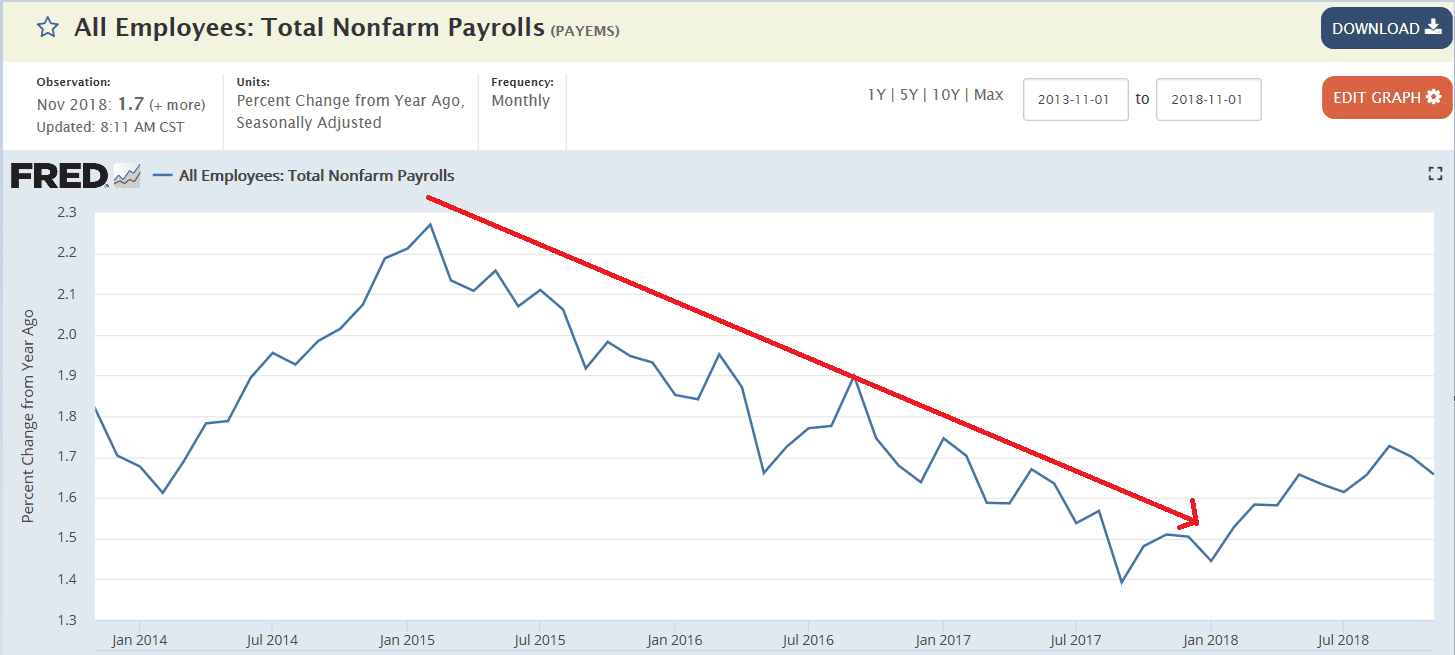
Employment growth had been decelerating with the collapse in oil capex in Dec. 2014, but had started to accelerate with the initial impact of the year-end tax cuts, which now look to be fading:

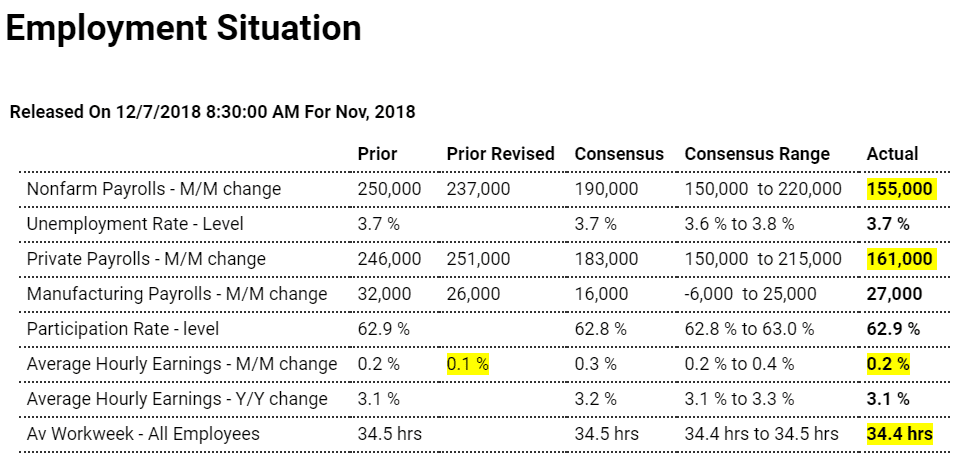
Highlights

Sustainable non-inflationary strength is the indication from the November employment report as payroll growth proved favorable and moderate and wage pressures modest. Nonfarm payrolls rose 155,000 which is on the low side of expectations while average hourly earnings increased 0.2 percent, also on the low side of expectations. The year-on-year rate for earnings held unchanged at 3.1 percent, again on the low side of expectations.

The unemployment rate, at 3.7 percent, is also unchanged as is the labor participation rate at 62.9 percent, both matching Econoday’s consensus. A sign of moderation comes from average weekly hours which, at 34.4, is at the low end of expectations to hint at easing capacity stress. Manufacturing hours and overtime are soft which points to moderate results for the upcoming industrial production report.

Turning back to payrolls, manufacturing rose a very solid 27,000 in the only reading in today’s report that tops Econoday’s consensus. Trade & transportation, where capacity stress has been elevated, added a very strong 53,000 jobs with professional & business services up 32,000 which is solid but still low for this reading to suggest that the scramble to find full-time employees may be easing.

This report does not raise any urgency for the Federal Reserve to tighten monetary policy and may well raise talk of fewer rate hikes to come in 2019.

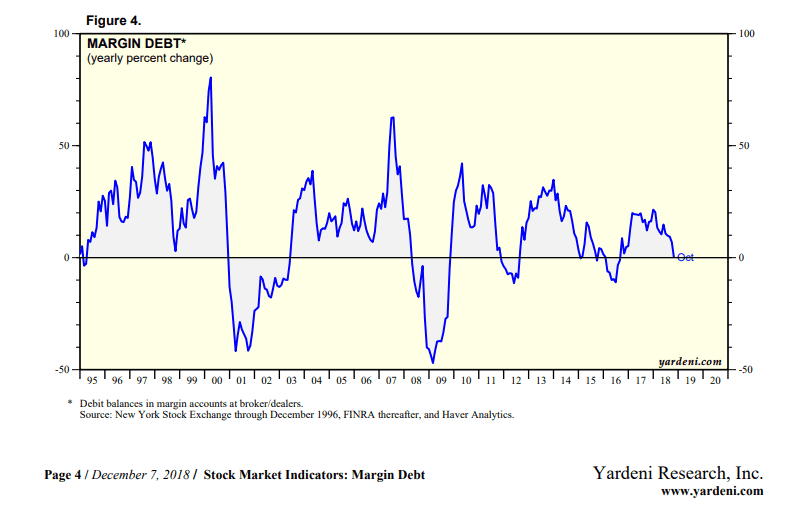
A rising stock market coincides with rising margin debt that seems to provide support for the macro economy. And a drop in the stock market causes a drop in margin debt that removes that support. Additionally, a similar thing happens with other lenders who accept stock as collateral:

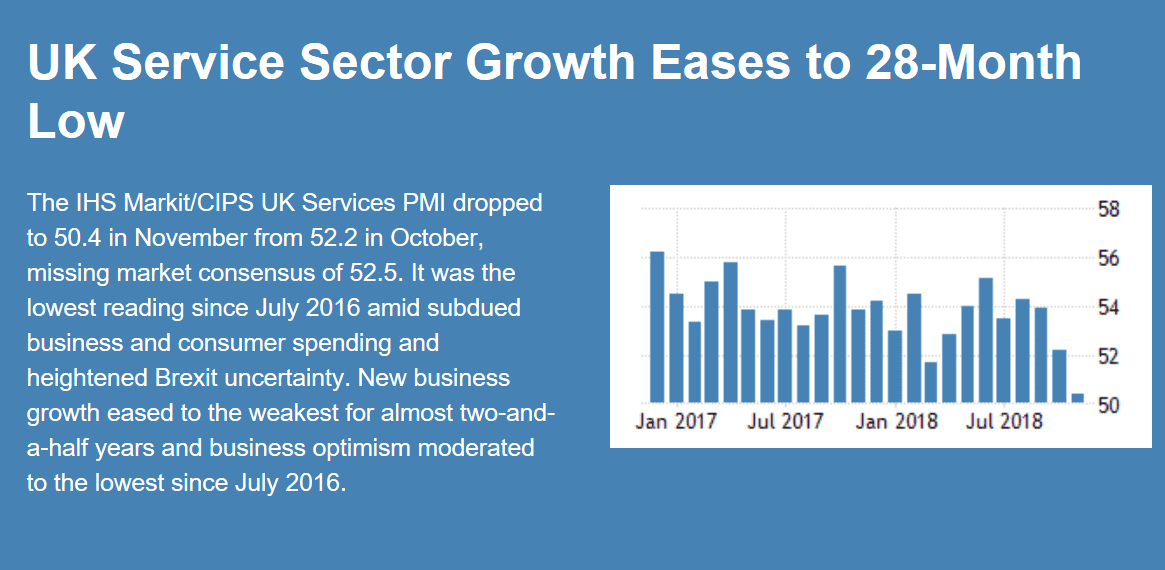
Trade, Factory orders, Vehicle sales, UK service sector, German PMI

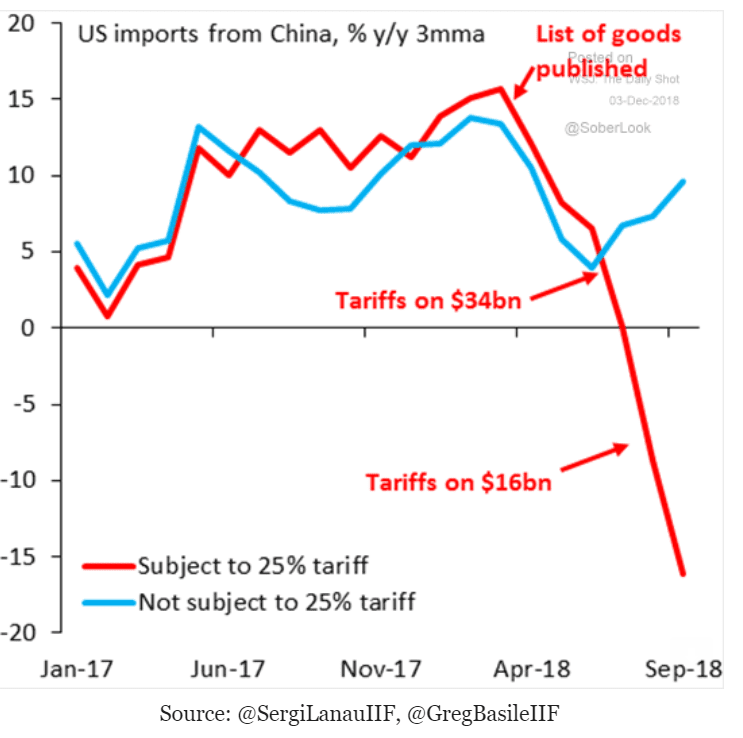
Deficit growing despite tariffs. Could be J curve effect:
Highlights

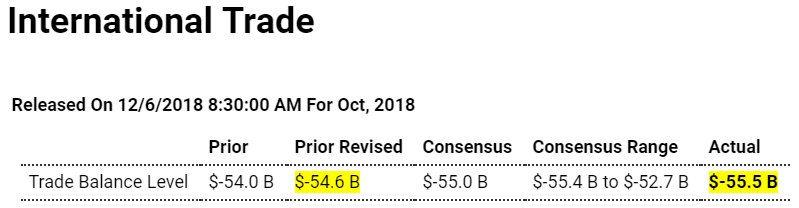
A slight 0.1 percent decline in exports and a slight 0.2 percent gain in imports made for a sizable 1.7 percent deepening in the nation’s trade deficit in October to $55.5 billion which is just outside Econoday’s consensus range.

The deficit with China was very deep, at $43.1 billion in October vs $40.2 billion in September for a year-to-date deficit of $420.8 billion that is 23 percent deeper than this time last year. This is important data for ongoing trade talks between the U.S. and China.

October’s deficit with the EU, at $17 billion, also deepened as did the deficit with Japan at $6.2 billion. The deficit with Mexico, at $7.2 billion, eased slightly while the deficit with Canada, at $1.9 billion, widened slightly. Note that country balances, unlike other data in this report, are not adjusted for calendar or seasonal effects.

Exports, in possible tariff effects, show another sizable drop in foods, feeds & beverages, to $10.3 billion vs September’s $11.0 billion. Exports of civilian aircraft were also weak, at $4.9 billion vs September’s $5.2 billion. Services exports, an area of strength for the U.S., edged higher in the month to $69.6 billion.

Foods, feeds & beverages on the import side rose slightly to $12.3 billion with imports of consumer goods, which are a special sore spot in the U.S. trade picture, rising $2.0 billion to $57.4 billion. Imports of services rose modestly to $47.0 billion.

October’s $55.5 billion headline deficit compares with a monthly average in the third-quarter of $52.8 billion and unfortunately marks a very weak opening for fourth-quarter net exports.

Tariffs taking their toll:
Highlights

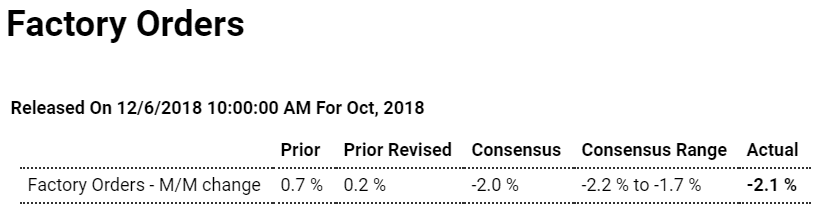
Held down by downturns in the defense goods and also civilian aircraft, factory orders sank 2.1 percent in October. The split between the report’s two main components shows a modest 0.3 percent increase for nondurable goods — the new data in today’s report where the gain is tied to printing and petroleum — and a 4.3 percent drop for durable orders vs 4.4 percent in last week’s advance report for this component.

Orders for defense goods have fallen 16.4 and 16.2 percent the last two reports but follow a giant 48.8 percent surge in August that was tied to aircraft. Orders for civilian aircraft in October and September have fallen 22.2 and 19.1 percent but here too follows an outsized gain in August, of 63.7 percent.

Core capital goods (nondefense ex-aircraft) are mostly weak in today’s report, with orders unchanged following declines of 0.6 and 0.2 percent in the prior two months. But core shipments, which are direct inputs into fourth-quarter GDP, did rise 0.3 percent for a respectable opening to fourth-quarter business investment.

Areas of strength in October include sharp order gains for fabrications, computers & electronics, and also electrical equipment. Other readings include a marginal 0.1 percent rise in factory inventories which will offset very strong October builds for retailers and wholesalers and will limit October’s contribution to GDP inventory. Both total shipments and also total unfilled orders posted soft 0.1 percent declines.

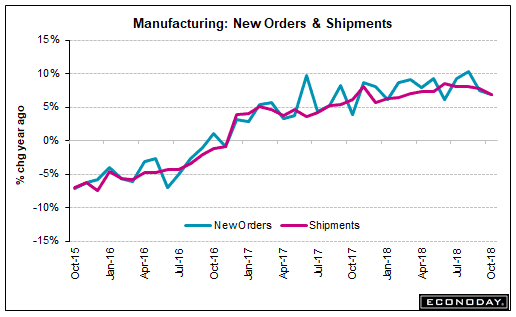
Monthly swings in aircraft can badly cloud results this report which focuses attention on the smoother reading of year-on-year change. This remains solidly positive at a 6.9 percent gain for total orders which, however, is down from 7.5 percent in September and a 4-year high of 10.3 percent in August. But a little slowing at year-end won’t dim manufacturing’s central contribution to the strength of the 2018 economy.

Still flat to down, much like housing:
Highlights

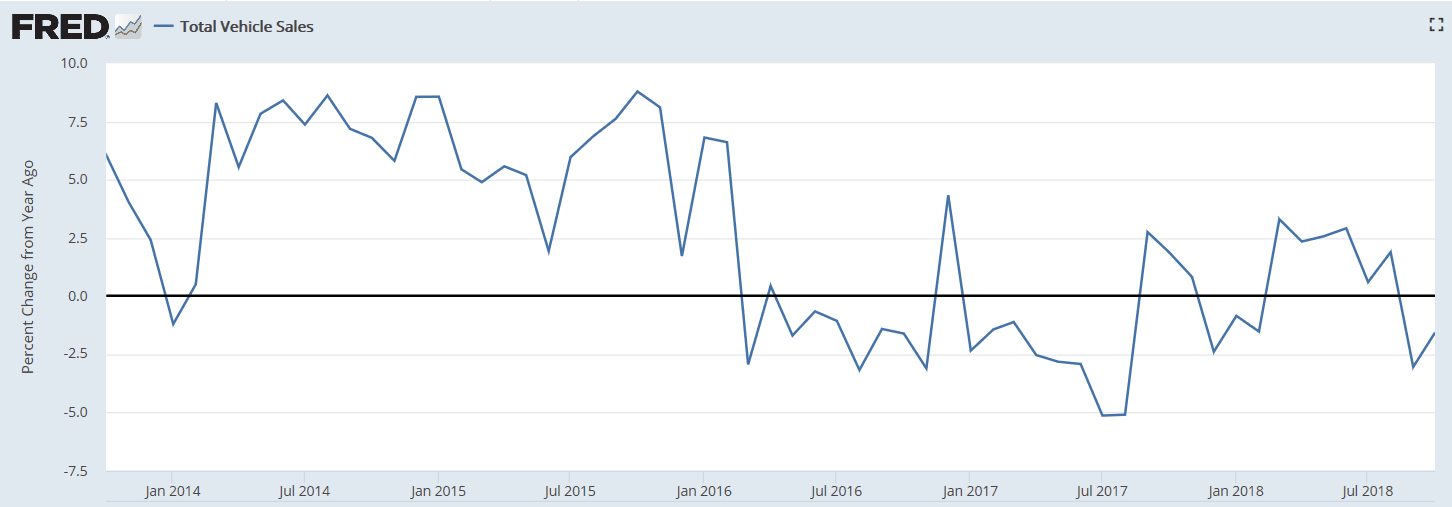
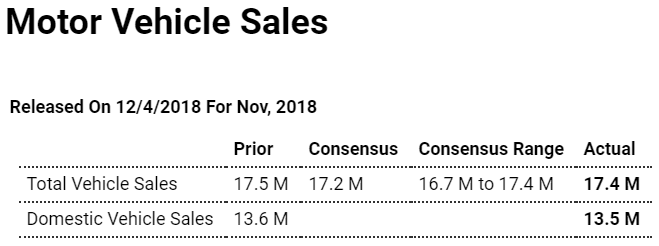
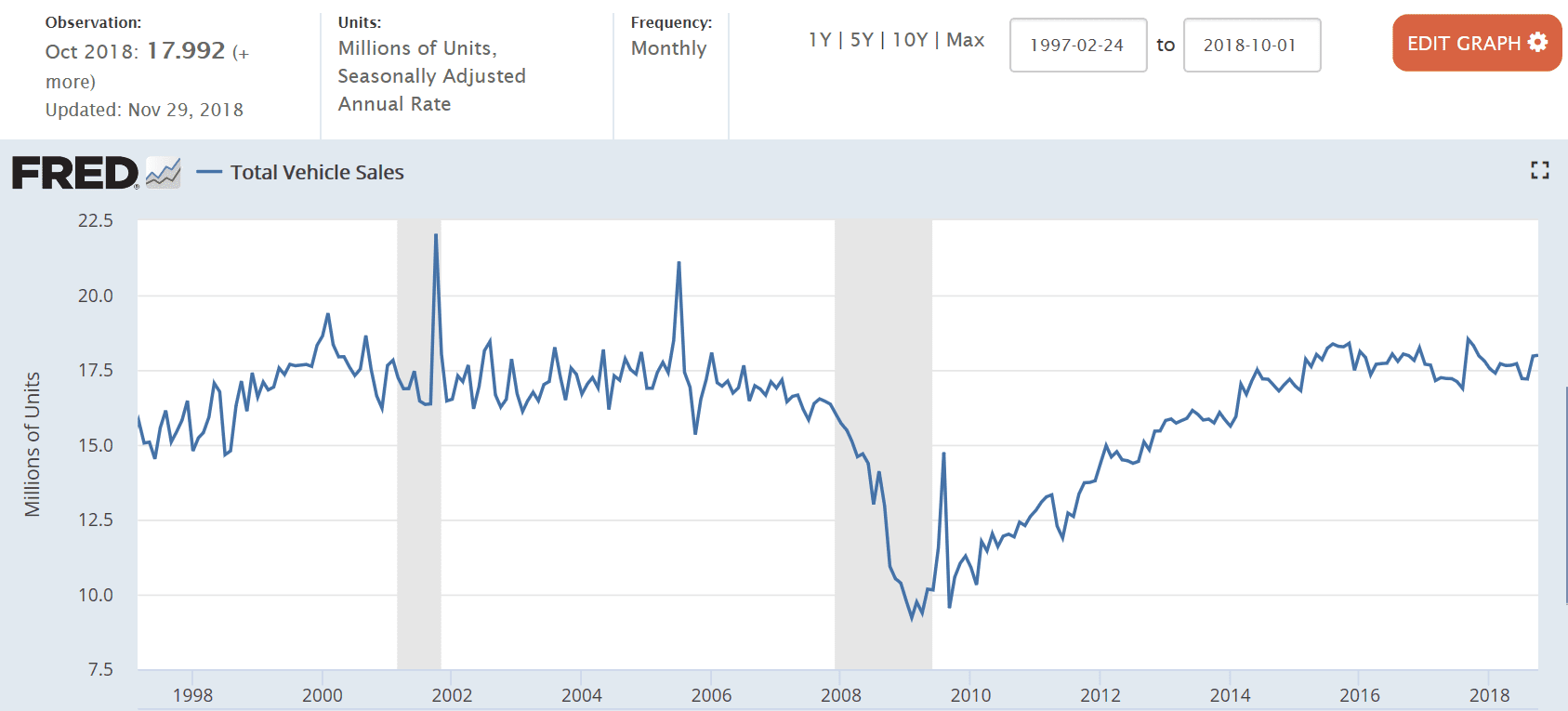
Unit vehicle sales in November came in on the high end of expectations but, at a 17.4 million annualized rate, still fell just short of October’s 17.5 million rate. The results do not point to a back-to-back monthly gain for motor vehicles which make up about 1/5 of total retail sales and which in October ended two months of declines. Yet November did come in at a very healthy rate with strength concentrated in light trucks which typically have high sticker prices and which help dollar totals of the retail sales report.
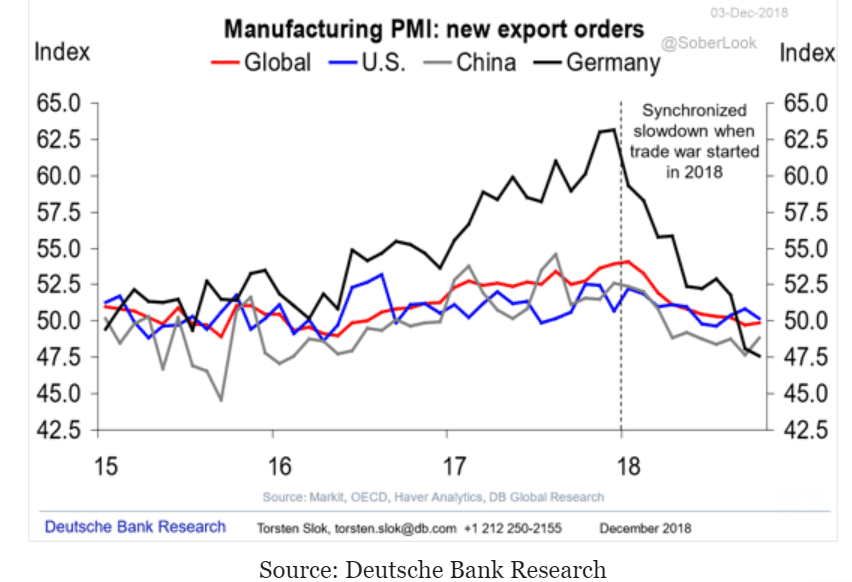
The IHS Markit Germany Composite PMI stood at 52.3 in November 2018, compared to a preliminary reading of 52.2 and October’s final 53.4. The latest reading pointed to the weakest pace of expansion in the private sector in nearly four years amid slower growth in service sector and a slight rise in manufacturing output that was the weakest for over five-and-a-half years. New orders rose the least since the start of 2015, with export orders falling for the third straight month, and job creation slowed. On the price front, output charge inflation eased to an 11-month low. Looking ahead, business confidence towards the outlook remained close to the lowest in almost four years. Composite Pmi in Germany is reported by Markit Economics.


Construction spending, Smart phones

Looking very weak:

Highlights

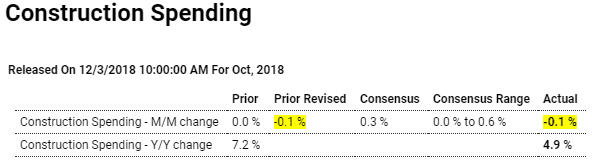
Construction has been a soft spot of the economy evident once again in October where spending fell 0.1 percent for the third straight decline and the fourth decline in five months. Spending on new single-family homes in October fell 0.5 percent with home-improvement spending down 0.9 percent, both offsetting a strong 1.0 percent rise in multi-family homes.

Private nonresidential construction fell 0.3 percent in October with declines in power, manufacturing, transportation and commercial components offsetting another strong gain for office building.

Public building has been a strength for the construction sector as it was again in October. Educational building rose 2.6 percent in the month though highway & street spending did edge 0.1 percent lower.

But the year-on-year rates really tell the story with education up 9.2 percent and highway & streets up 5.2 percent. Private nonresidential spending is up a very solid 6.4 percent led by office building at 16.3 percent with the commercial subcomponent bringing up the rear at a 0.6 percent gain.

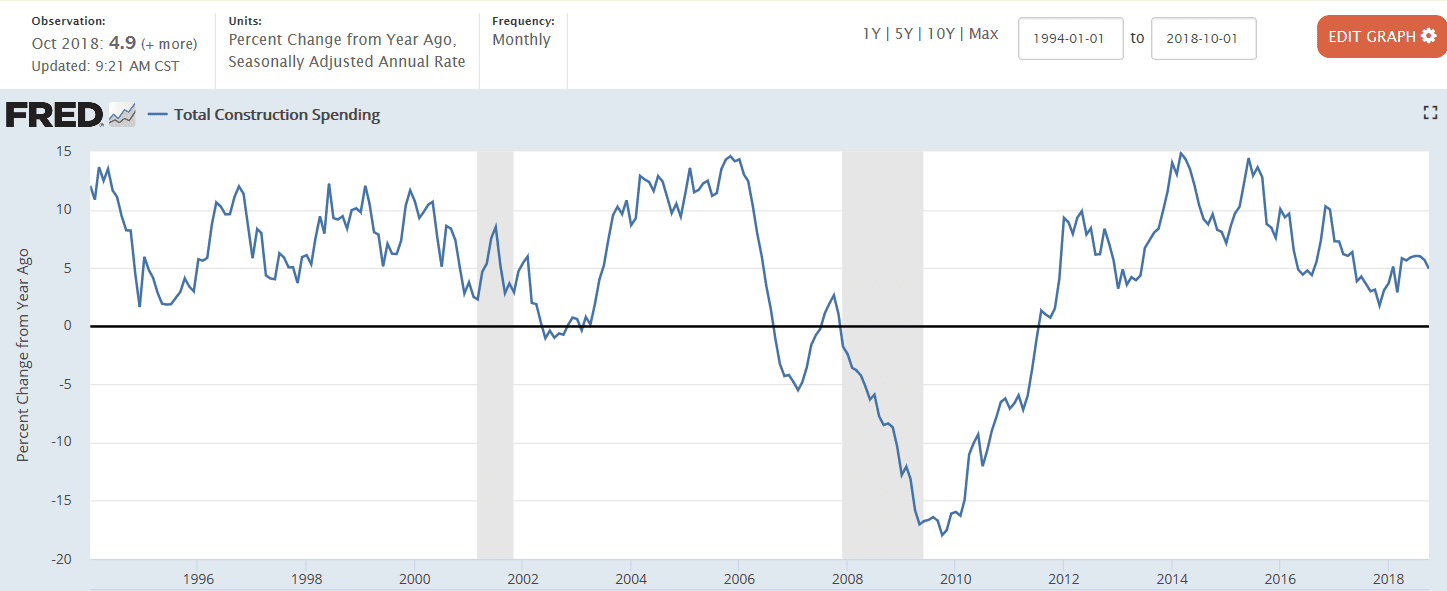
Total residential spending is up only 1.8 percent year-on-year with single-family up 2.4 percent, home improvements up only 0.4 percent, and multi-family up 3.2 percent. The softness on the residential side is limiting overall construction spending to a 4.9 percent yearly gain.

Nonresidential and public building have been solid this year but the rise underway in mortgage rates appears to be taking the steam out of what was already an exhausted looking housing sector.

According to latest estimates from market research firm IDC, global smartphone shipments amounted to 355.2 million units in the third quarter of 2018, marking the fourth straight quarter of negative growth for the smartphone market. For the first nine months of 2018, global shipments added up to 1.03 billion units, down 3.6 percent from the same period last year.

Personal income and spending, Pending home sales

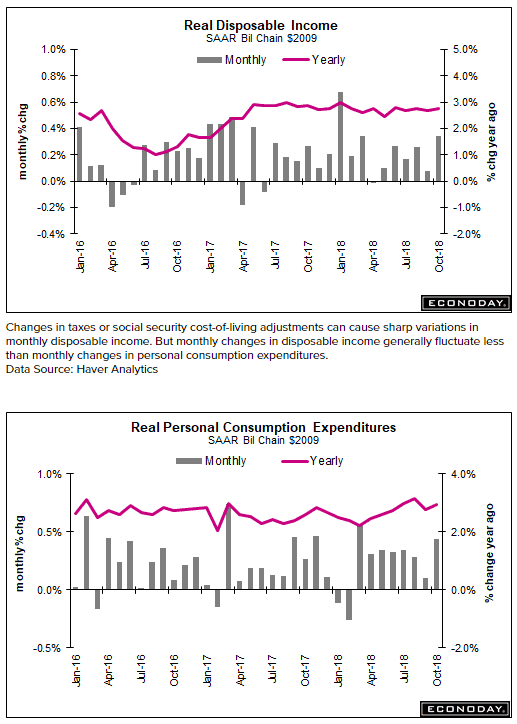
No drama here:

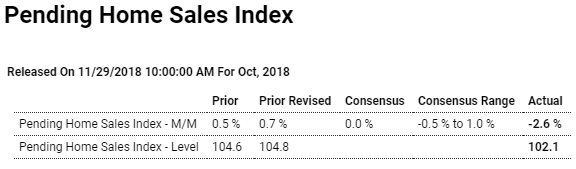
More housing weakness news:

Highlights

This has not been a good run for housing data. Pending home sales fell a very steep 2.6 percent in October which is far below Econoday’s consensus range. Existing home sales did end a long downturn in last week’s report but today’s results point strongly to another leg down for final sales.

The West is the weakest region with pending sales falling very sharply in the month for a year-on-year decline of 8.9 percent. The Midwest and South show single-digit declines with the Northeast a marginal yearly gain. The overall year-on-year rate for pending sales is minus 6.7 percent.

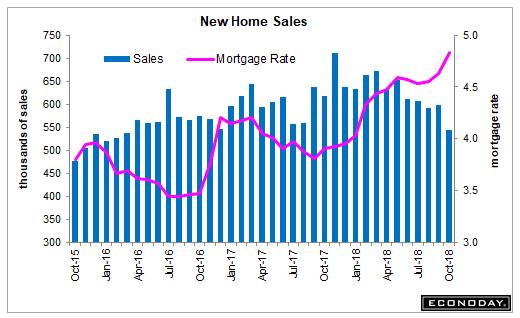
Case-Shiller and FHFA home price data opened the week showing softness followed by yesterday’s tumble for new home sales followed now by a tumble for pending resales. Housing has had a flat year and looks to be limping badly into year end.

Trade, New home sales, Federal interest payments

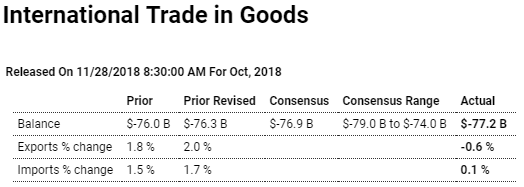
Trade deficit still increasing:

Highlights

The goods portion of October’s trade deficit is deeper than expected, at $77.2 billion vs expectations for $76.9 billion and compared with a monthly average in the third-quarter of $74.6 billion. October’s data opens fourth-quarter net exports on a negative note following the third quarter when trade pulled down GDP pace by nearly 2 percentage points. Today’s results point to further downward pressure for the fourth quarter.

Exports open the quarter down 0.6 percent to $140.5 billion in October yet are still up 7.8 percent from a year ago. In a possible tariff effect, exports of food, feeds & beverages continue to turn lower, down 6.8 percent in the month to $10.3 billion with this year-on-year rate negative at minus 2.8 percent. Exports of capital goods also fell as did auto exports with consumer goods and industrial supplies showing gains.

Imports, at $217.8 billion, rose only 0.1 percent in October for a year-on-year gain of 10.0 percent. Imports of consumer goods, at $57.4 billion and a sensitive topic in the trade wars, rose an outsized 3.5 percent in October with auto imports up 2.3 percent. Imports of capital goods fell sharply in the month in a negative sign for business investment.

Tariffs effects have been elusive in the nation’s economic data but may now be appearing in the trade data, and the initial results may be holding down GDP.

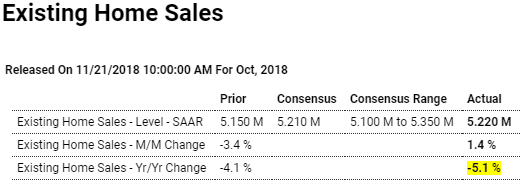
The housing decline continues:


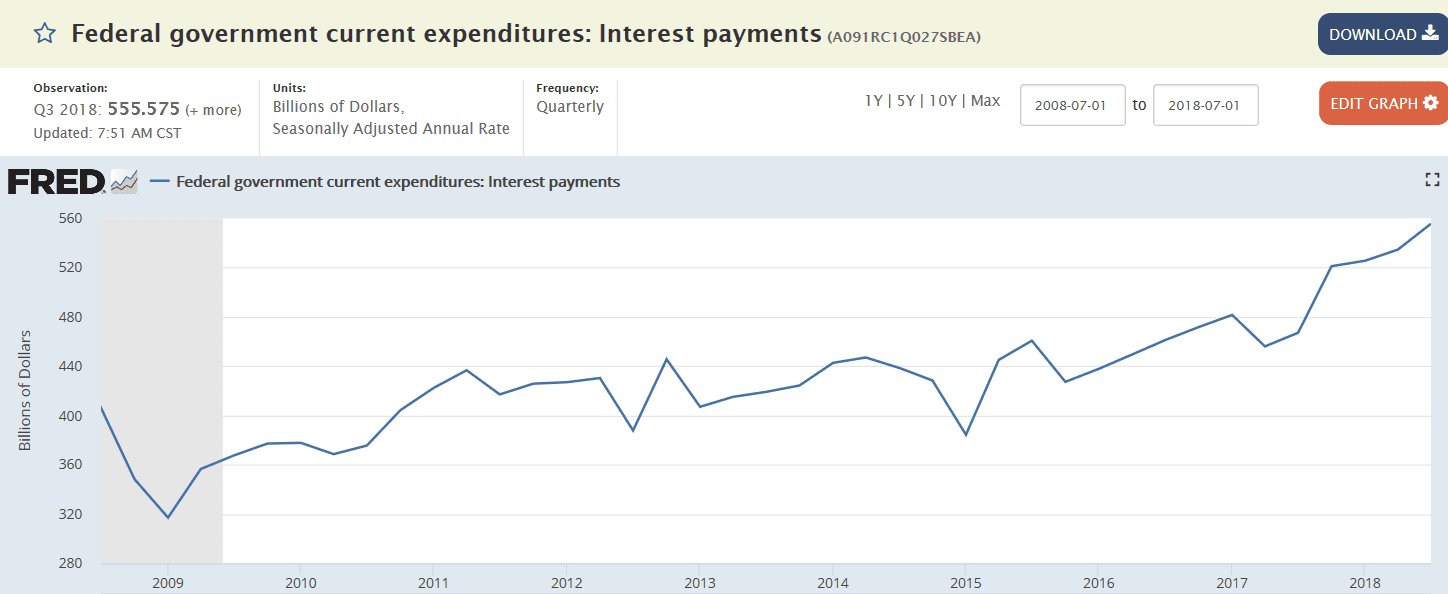
Rate hikes cause gov interest payments to rise and provide income that works to support the economy:

Home sales, Durable goods, Philly Fed index


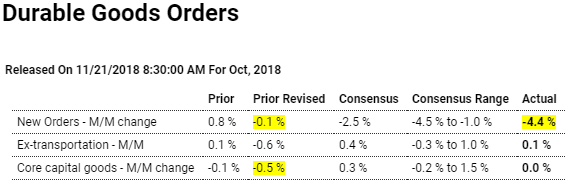
Last month revised lower and looking weak:

Highlights

A drop for primary metals, a sharp drop for machinery, and a reversal for defense aircraft all pulled down durable goods orders in October which fell a sharper-than-expected 4.4 percent. A very sharp downward revision to September, revised from a 0.8 percent gain to a 0.1 percent decline, is another unfavorable headline in today’s report.

Orders for primary metals, down 2.3 and 1.2 percent the past two reports, continue to weaken following tariff-related pre-buying earlier in the year, while orders for machinery — which are at the center of the capital-goods group — fell 0.5 percent in October following lifeless gains of 0.1 and 0.2 percent in September and August.

Defense aircraft was the star of the September report, more than doubling but orders in the latest month fell 59 percent. Civilian aircraft, which had been on the climb, has been pulling down the last two reports, down 21 and 19 percent. When excluding aircraft and all other transportation equipment, orders managed only a 0.1 percent gain to fall 3 tenths short of consensus.

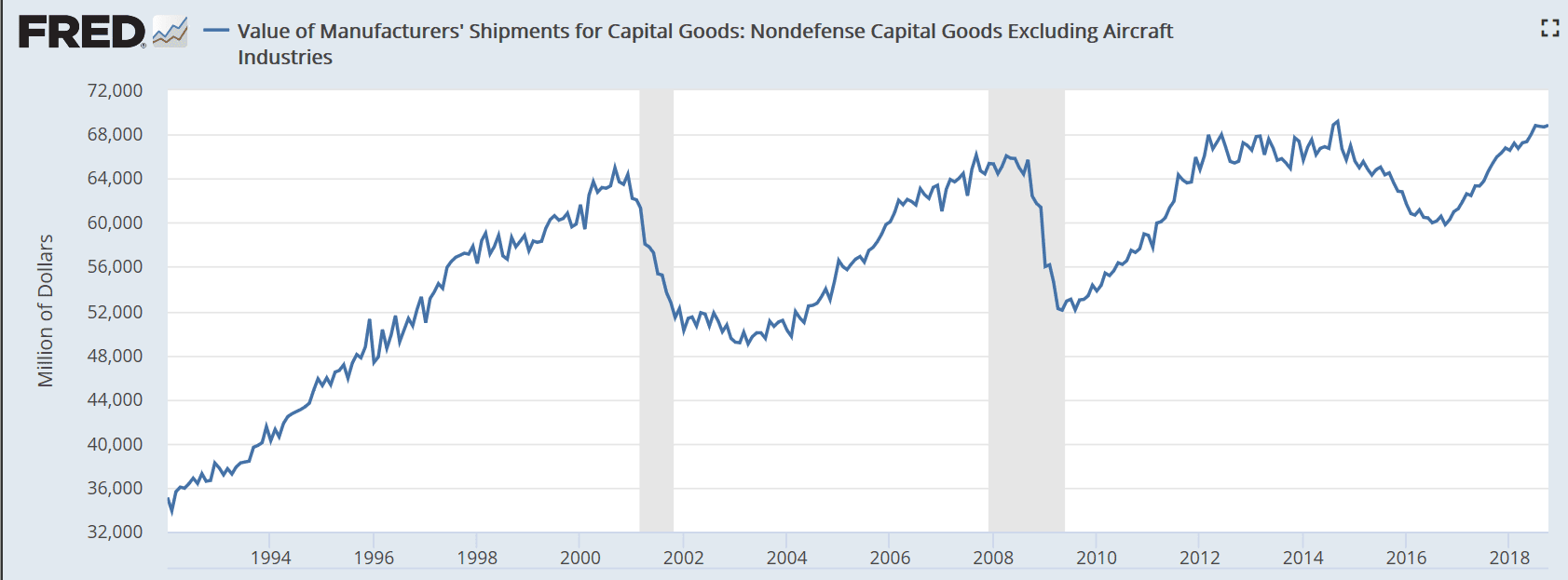
Orders and shipments for capital goods (nondefense ex-aircraft) are key indications for GDP business investment and the readings in this report are not pointing to much of a rebound for fourth-quarter nonresidential fixed investment. Orders here came in unchanged in October to miss Econoday’s consensus by 3 tenths with September revised 4 tenths lower to a 0.5 percent decline. Shipments in October, which will be a direct input into fourth-quarter GDP, did rise a respectable 0.3 percent though September is revised 1 tenth lower to a 0.2 percent decline which will be marginal negative for third-quarter GDP revisions.

But there are solid positives in the report including sharp order gains for electrical equipment, communications equipment, computers, and also fabrications. Yet moderation is nevertheless today’s theme with total shipments falling 0.6 percent, inventories showing no growth, and unfilled orders, after two strong prior months, slipping 0.2 percent.


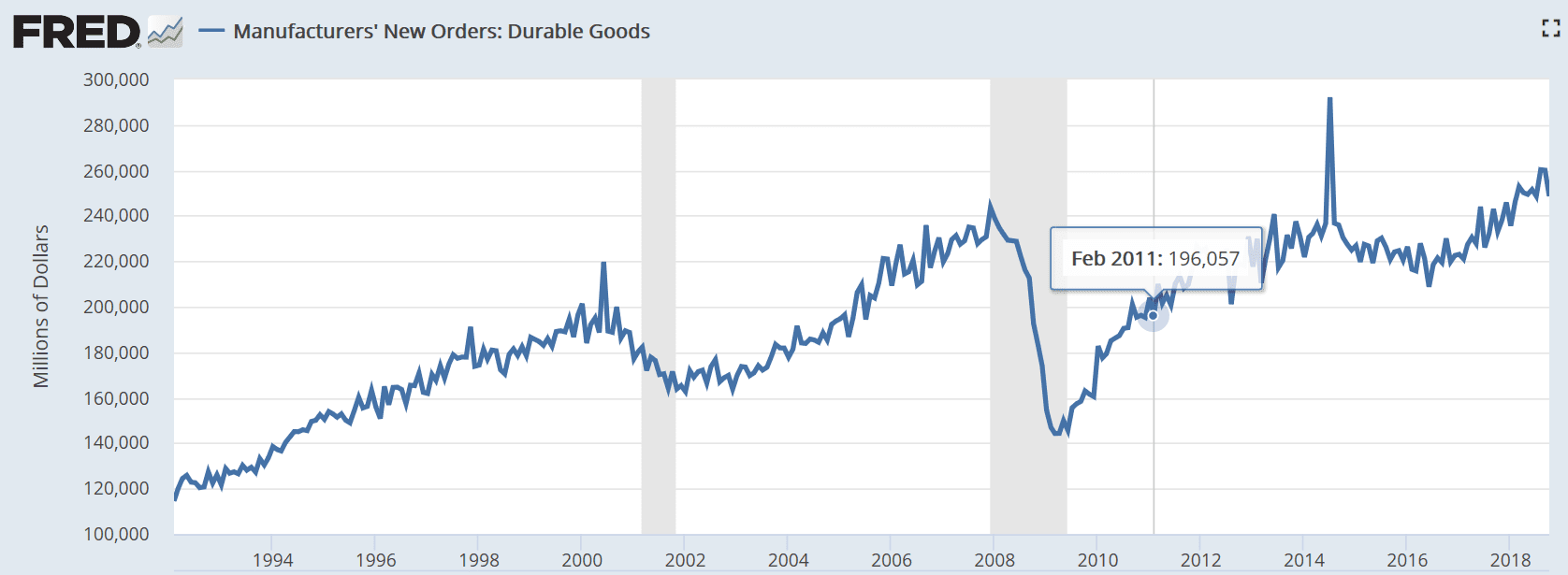
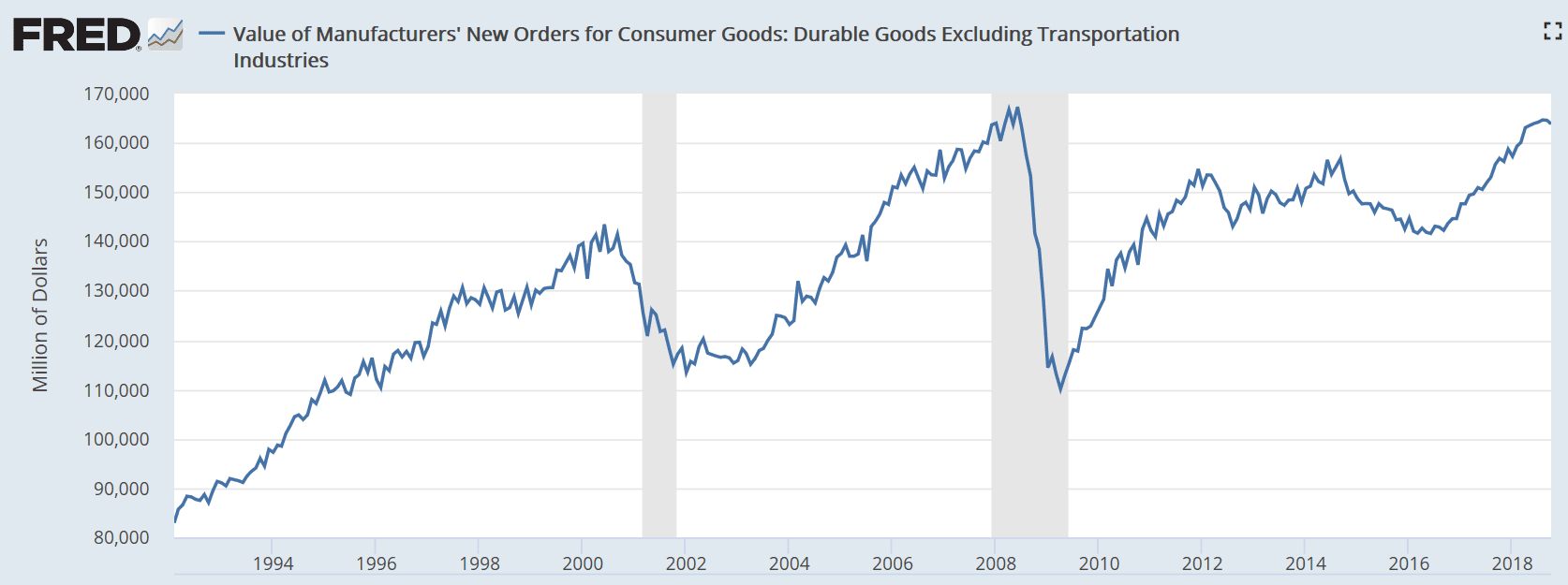
Consumer goods remain weak and below 2008 levels, and the chart is not inflation adjusted:

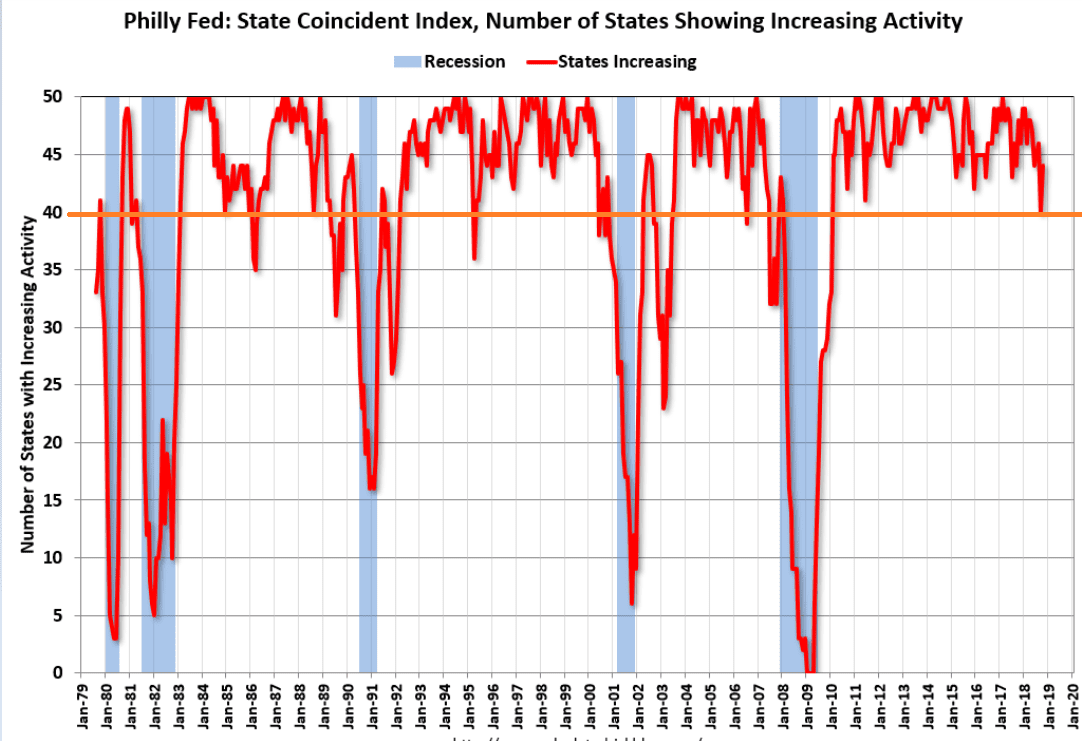
Once again this index has fallen to levels associated with entering recession. But last time this happened a few years back they revised the numbers a few months later to where they are now in the chart:

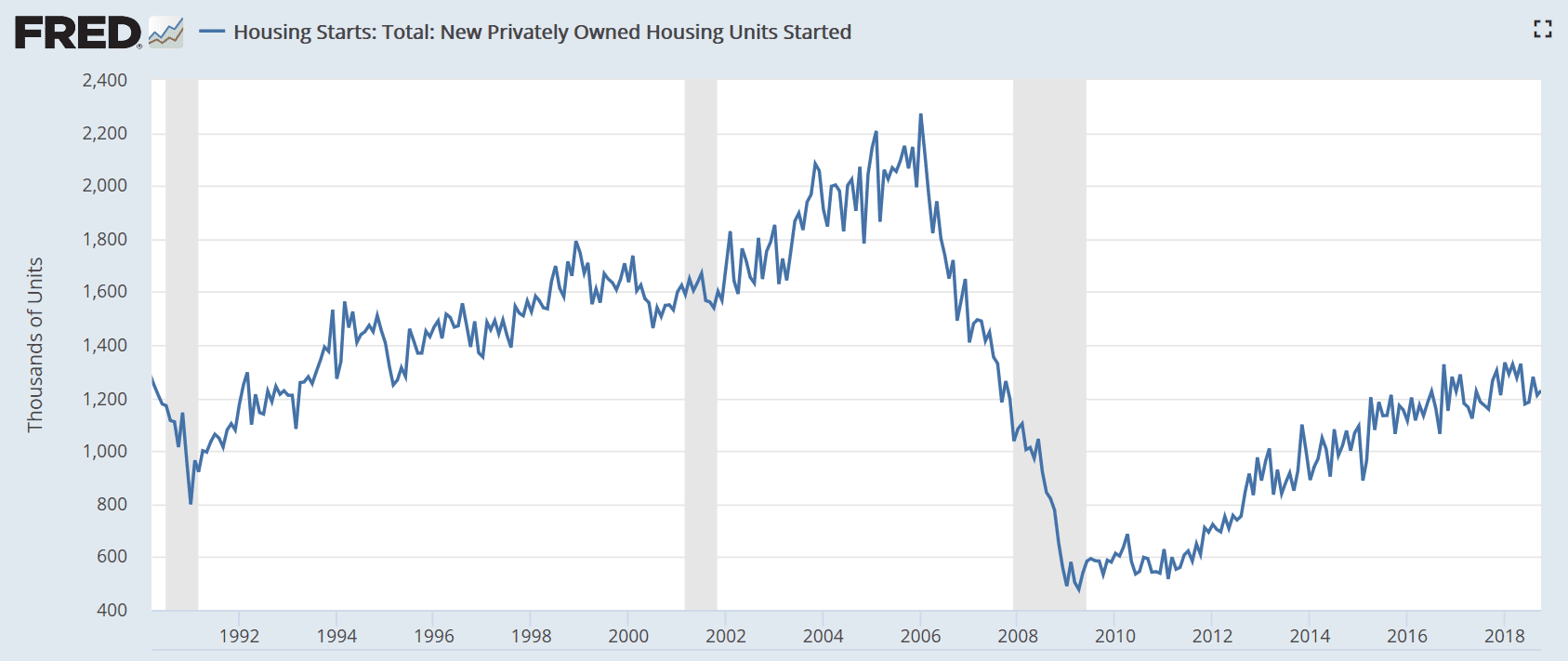
Housing starts

Not good:

Highlights

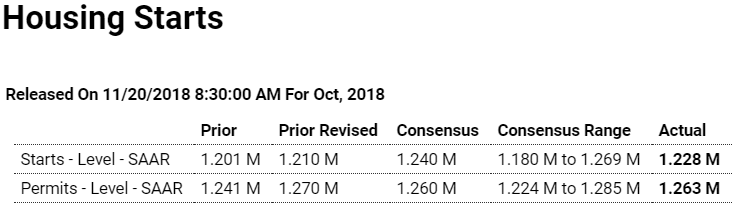
Yesterday’s housing market index may have unexpectedly plummeted but today’s housing starts and permits report, though soft, at least is in the ballpark of expectations. Starts in October rose 1.5 percent to a 1.228 million annualized rate that compares with Econoday’s consensus for 1.240 million. Permits edged past expectations, at a 1.263 million rate vs a consensus for 1.260 million though down 0.6 percent from September.

The good news on starts comes from multi-family units, jumping 10.3 percent to a 363,000 rate which offsets a second straight decline for single-family starts which slipped 1.8 percent to an 865,000 rate. Hurricane Michael which struck Florida and Georgia during October but did not skew the data as starts in the South rose 4.7 percent. Starts were also strong in the Midwest with the West and Northeast posting declines.

Permits show nearly equal declines for single-family and multi-units, down 0.6 percent and 0.5 percent respectively. The bad news on the permit side comes from the West which is a focused region for home builders and which declined 7.9 percent for a 17.2 percent year-on-year drop.

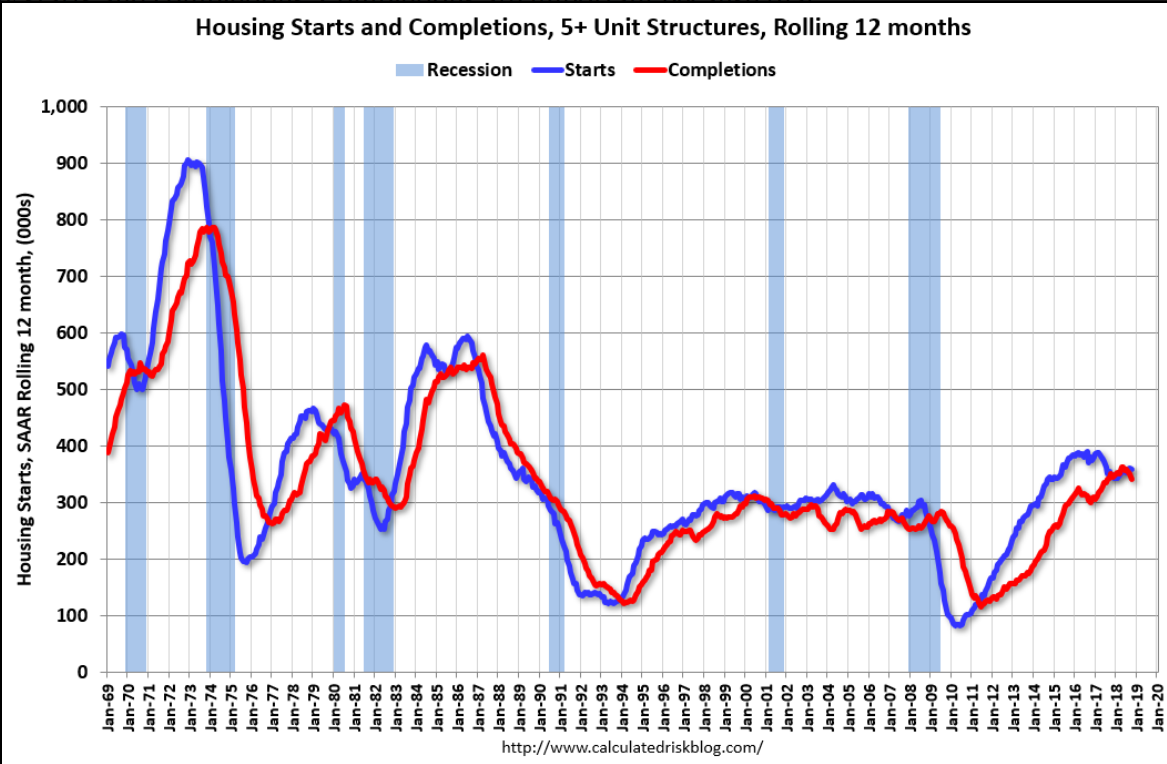
And the year-on-year rates do underscore the weakness in housing with total starts down 2.9 percent and total permits down 6.0 percent. Completions aren’t doing much better, down 3.3 percent overall in the month for a year-on-year drop of 6.5 percent. Single-family completions fell 1.2 percent in the month with multi-family completions down 9.1 percent in results that won’t be giving any boost to underlying sales.

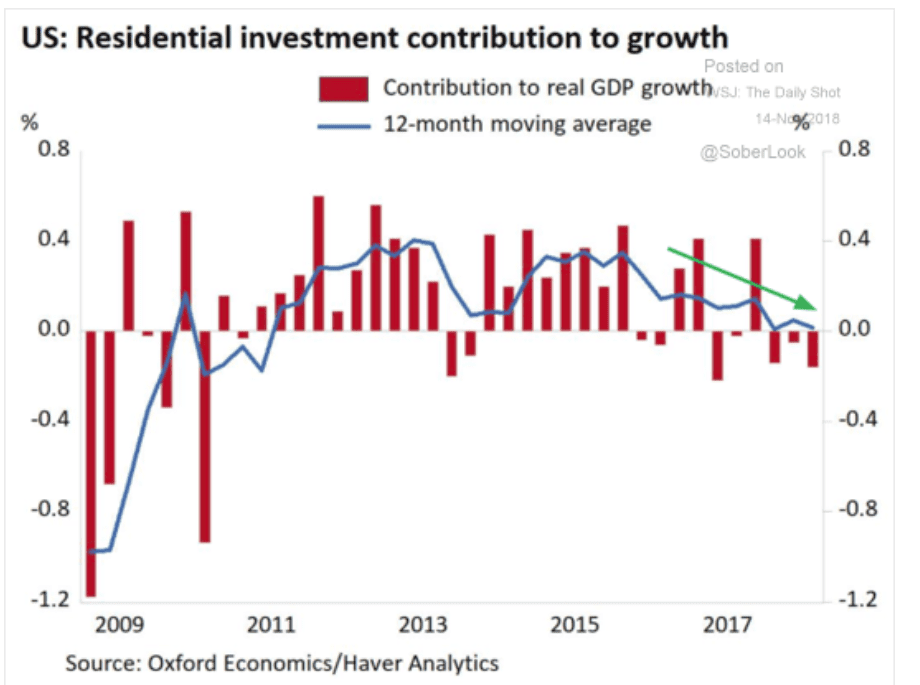
Rising mortgage rates, tied directly to Federal Reserve rate hikes, are proving a major headwind for housing as are material and labor shortages. However strong the 2018 economy has been, housing is not part of the success story.