Economists in favor of payroll tax holiday


[Skip to the end]

Thanks, at least it got a mention.

The bang for the buck thing is pathetic. That has nothing to do with anything.

>   
>   On Sat, Jan 10, 2009 at 9:36 PM, Scott wrote:
>   
>   FYI, the below has only copied in those
>   economists specifically naming a payroll tax
>   holiday. Many of the comments here and in
>   the proposals not included demonstrate an
>   unfortunate lack of understanding of sovereign
>   money. On the other hand, those copied
>   below demonstrate that the payroll tax holiday
>   is supported by at least some economists from
>   just about every political and economic
>   persuasion.
>   

The Ideal Stimulus Package

by Catherine Rampell

Dec 16 (Economix) &#8212 President-elect Barack Obama and members of Congress are considering a fiscal stimulus package that’s reportedly in the ballpark of $500 billion. How should that money be spent?

We asked a group of economists how they would use the money if they had their druthers. For simplicity’s sake, we gave them the condition that they had to use every penny of the $500 billion on government spending or tax cuts or both. A collection of their responses is below.


Tyler Cowen, professor at George Mason University: “I would modernize the few critical bottleneck airports in the U.S., most of all La Guardia and Kennedy. That would not cost a fortune.

“I would try to ensure that state and local governments do not cut funding which they will later restore. To me that is more important, and more conducive to macroeconomic stability, than embarking on new and potentially dubious programs. That will cost most of the money. It’s not that I think state and local governments are always so efficient and wise, but rather this is a very simple and direct way to prevent the economy from being hit by yet another sectoral shock when it is already reeling.

“There are many good ideas, such as electronic medical records, that will not benefit the economy as macroeconomic stimulus. And so they do not make the list as you have phrased the question.

“If there is money left over I would spend it on cutting the Social Security payroll tax for specified groups of lower- to middle-income workers, thus encouraging the resumption of hiring.”


Mark Zandi, chief economist at Moody’s Economy.com:

“The package includes $300 billion in government spending and $200 billion in tax cuts. Government spending provides the largest economic bang for the buck, particularly infrastructure spending, as it immediately adds to output and jobs here in the U.S. Aid to state governments will also forestall immediate cuts in programs and jobs that states have to undertake to satisfy their balanced budget requirements. Infrastructure spending will take time to benefit the economy, and a tax cut is necessary to provide some quick support to the economy. A payroll tax holiday and a permanent payroll tax credit would be effective tax cuts, particularly if designed to help harder-pressed lower- and middle-income households and smaller businesses. If I had my druthers, however, the recovery package would be measurably larger than $500 billion. It is important for policy makers to send a strong and clear signal that they will do whatever is necessary to revive the economy. Only a concerted, comprehensive and consistent policy response stands between a severe recession and another depression.”


Edward L. Glaeser, professor at Harvard University:

  • “(1)…I would certainly put money into scholarships, but you can’t spend 500 billion that way. I haven’t even tried to cost it out. I would — by the way — accompany these things with a certain amount of living assistance that would be conditional on good performance in the program (getting a degree if appropriate).
  • “(2) There must be good transportation and infrastructure projects out there — I would do this probably with states proposing things that are then evaluated by an independent committee to look at cost/benefit analysis. Then make the money contingent on getting highly rated by this group. I presume broadband makes sense.
  • “(3) Aid to states, as a form of revenue-sharing, is O.K. I would also tie this to good performance in other areas…
  • “(4) Ramp up the Earned Income Tax Credit.
  • “(5) Temporarily have the federal government pay the Social Security taxes of poorer Americans. The key is to get money in the hands of people who will spend it — both for that reason and conventional equity grounds — it makes sense to target money towards the poor. They aren’t paying regular taxes (mostly) — the only taxes that can be cut for this group are the S.S.D.I.-type payments — so let’s cut these. Obviously, it needs to be done in such a way that minimizes any distortions not to work.”

Laura Tyson, professor at the University of California, Berkeley, Haas School of Business and chair of the National Economic Council and President’s Council of Economic Advisers under Bill Clinton: “The U.S. economy is caught in three related crises that are reinforcing one another in a downward spiral: a crisis in the housing and mortgage market; a credit crisis; and a crisis of collapsing private demand. These three crises are not self-correcting. They are self-reinforcing. They can be mitigated and reversed only with bold government policies that include: a fiscal economic stimulus package of government spending and tax cuts to fill the gap caused by the shortfall in private demand; policies to stem the mortgage and foreclosure crisis; and policies to stem the credit crisis by recapitalizing the banks and acquiring assets not currently trading among private actors.

“There are three broad goals of fiscal stimulus measures: to reduce the depth and severity of the recession caused by the sharp fall in private demand; to help those most hurt by the recession; and to encourage economic activity that provides a basis for sustainable growth and prosperity in the future.

“Four principles should guide the choice of stimulus measures:

  • “They should be timely in the sense that they increase demand as quickly as possible: examples include federal grants and loans to state and local governments and temporary tax relief.
  • “They should have a significant impact on spending and employment: examples include extended jobless benefits and infrastructure spending on already approved projects.
  • “They should provide relief for those who are most adversely affected by the recession: examples include extended jobless benefits and food stamps and support for state Medicaid programs.
  • “They should focus on growth-enhancing investments in education, infrastructure and alternative/green energy development: examples include: increased support for work-study programs and Pell grants; infrastructure spending on mass transit programs; and enhanced tax credits for the production and utilization of alternative energy.

“The size of the stimulus package depends on how deep and long the recession turns out to be. A 4 percent reduction in G.D.P. indicates a stimulus package of about $600 billion spread out over two years, with the lion’s share spent in the first two quarters of 2009. Based on current economic forecasts, I think a stimulus package of at least this magnitude is warranted. Given the sharp drop in economic activity, I think the dangers of doing too little outweigh the dangers of doing too much.

“For a $500 billion stimulus package, I would include the following policies:

  • $40 billion for additional UI and food stamp benefits
  • $175 billion of infrastructure spending, including about $90 billion for alternative energy and green initiatives
  • $120 billion for grants and loans to state and local governments
  • $165 for household and business tax relief (including a temporary payroll tax holiday)

“I would also support additional government spending of $40-$50 billion for a foreclosure relief/loan modification program. According to scholars at the Center for American Progress, this amount could prevent more than 3 million foreclosures on $640 billion of mortgages and help ease overall credit market conditions. This amount of foreclosure relief could be financed out of the TARP program or included in a larger stimulus package.

“Finally, I would also support a bridge loan for the auto companies in the range of $15-$20 billion. This could also be financed out of the TARP program or included in a larger stimulus package.”


[top]
Updated Proposals


[Skip to the end]

Proposals for the Monetary System

The Federal Reserve should immediately lend to its member banks on an unsecured basis, rather than demanding collateral for its loans. Demanding collateral is both redundant and obstructive. It is redundant because member banks already can raise government insured deposits and issue government insured securities in unlimited quantities without pledging specific collateral to secure those borrowings.

In return, banks are subject to strict government regulation regarding what they can do with those insured funds they raise, and the government continuously examines and supervises all of its member banks for compliance. With the government already insuring bank deposits and making sure only solvent banks continue to function, the government is taking no additional risk by allowing the Federal Reserve to lend to its member banks on an unsecured basis.

With the Federal Reserve lending unsecured to its member bank liquidity would immediately be normalized and would no longer be a factor contributing to the current financial crisis or any future financial crisis.

The government should also remove the $250,000 cap on insured bank deposits, as well as remove regulations pertaining to bank liquidity, at the same time it allows the Federal Reserve to lend unsecured to member banks, as individual bank liquidity will no longer be an issue.

The Federal Reserve should lower the discount rate to the Fed funds rate (and, as above, remove the current collateral requirements). The notion of a ‘penalty’ rate is inapplicable with today’s non-convertible currency and floating exchange rate policy.

An interbank market serves no public purpose. It can be eliminated by having the Federal Reserve offer loans to member banks for up to 6 months, with the FOMC setting the term structure of rates at its regular meetings. This would also replace many of the various other lending facilities the FOMC has been experimenting with.

To address the current financial crisis I recommend the following:

  • Declare an immediate ‘payroll tax holiday’ whereby the US Treasury makes all FICA Medicare, and other Federal payroll tax deductions for all employees and employers.
  • Give the U.S. State an immediate, unrestricted $300 billion of revenue sharing on a per capita basis.
  • Fund an $8 national service job for anyone willing and able to work, that includes child care, current Federal medical coverage, and all other standard benefits of Federal employees.
  • Have the Treasury directly fund the debt of the FHLB and FNMA, the U. S. Federal housing agencies. This will serve to reduce their funding costs which will be entirely passed through to qualifying home buyers.

    There is no reason to give investors today’s excess funding costs currently paid by those Federal Housing agencies when the full faith and credit of the U.S. government is backing them.
  • I would also have FNMA and the FHLB ‘originate and hold’ any mortgages they make, and thereby eliminate that portion of the secondary mortgage market. With Treasury funding, secondary markets do not serve public purpose.
  • Penalties for mortgage fraud with Federal agencies should be increased and vigorously enforced.


[top]

NFP: 13.5%!


[Skip to the end]

From Karim:

Total unemployed, plus all marginally attached workers, plus total employed part time for economic reasons, as a percent of the civilian labor force:

This measure rose from 12.6% to 13.5% in December. It was 8.7% in December 2007.

As for NFP/UE:

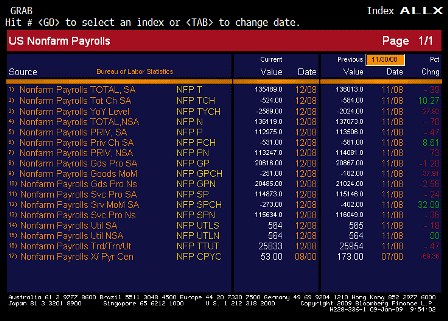
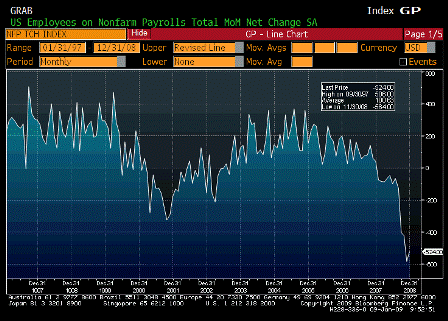
  • -524k; net revisions -154k
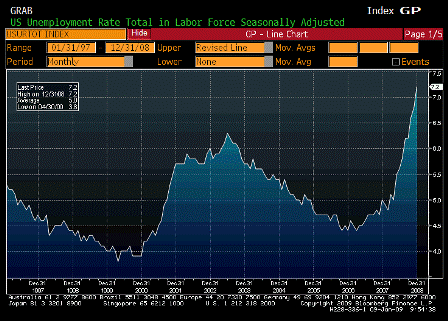
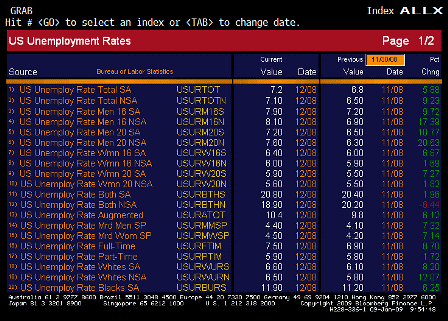
  • Unemployment rate rises from 6.8% to 7.2%
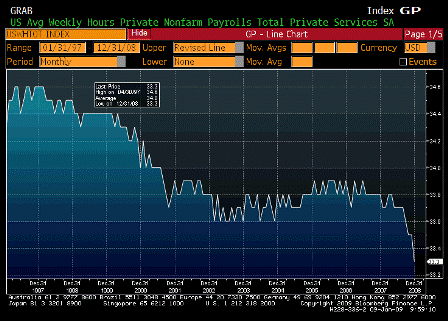
  • Hours fall another 1.1% (negative for production and a precursor to more layoffs)
  • Average duration of unemployment up from 18.9 weeks to 19.7
  • Diffusion index down from 27.2 to 25.4
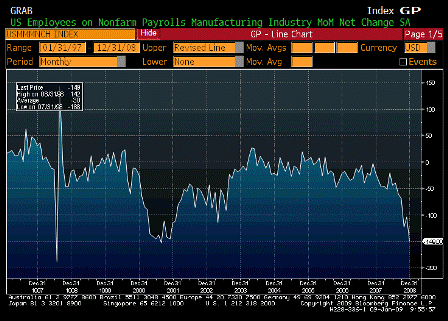
  • Manufacturing (-149k), construction (-101k), temp help (-81k) and retail (-67k) lead the way lower.


[top]

Re: Auction result history in Germany


[Skip to the end]

(email exchange)

Thanks, Dave, as we thought, the ECB isn’t involved. The CB is an arm of the national government, so, when they do sell the excess securities, the government is then and thereby funded without ECB involvement of any kind. A more serious ‘failure’ would be when the dealers won’t/can’t buy the excess from the CB.

>   
>   Warren,
>   
>   In terms of Germany’s failed auction, the
>   German Central Bank at their discretion will call
>   up one of leading primary dealers and sell the
>   bonds they bought at the auction directly to
>   the dealer. According to ML, they hold bonds
>   back in every auction so they have quite a bit
>   of flexibility to sell other bonds they hold in
>   their portfolio in order to meet the auction
>   shortfall if necessary. I am getting some
>   history for the last year on German auction
>   results and will pass it along when I get it.
>   

>   
>   On Fri, Jan 9, 2009 at 8:13 AM, Dave wrote:
>   
>   Average amount of bonds bought by German
>   Central Bank (BBK) over last 12-15 auctions:
>   
>   2yr: 1.2 bb vs. average announced
>   issue size of 7.2 bb, 17%
>   5yr: 0.7 bb vs. average announced issue
>   size of 5.3 bb, 13%
>   10yr: 1.5 bb vs. average announced issue
>   size of 6.7 bb, 22%
>   30yr: 0.7 bb vs. average announced issue
>   size of 5.1 bb, 14%
>   
>   Bonds were bought by BBK at every one of
>   these auctions and for each maturity
>   
>   The 2yr auction has failed total bids
>   (announced issue size) 2x in the last 13
>   auctions, the 5yr has failed 2x in the last 15
>   auctions, the 10yr auction has failed 5x in the
>   last 11 auctions (note that the last 2 auctions
>   have failed), and for the 30yr 3x in the last 12
>   auctions.
>   
>   DV
>   


[top]

S&P cuts Republic of Ireland OTLK from stable to negative


[Skip to the end]

Thanks!

The ratings agencies could be the catalyst that destabilizes finance for the eurozone national governments, driving up spreads, rates, and ultimately, the ability limiting their ability to fund at any cost.

Downgrades can also do the same for banks in the eurozone.

This would come as a surprise as downgrades of Japan, for example, didn’t alter their ability to issue JGBs as if they were still AAA.

Meanwhile, eurozone economic performance seems to be worsening by the day, as the lack of aggregate demand takes its toll.

>   
>   On Fri, Jan 9, 2009 at 7:30 AM, Dave wrote:
>   
>   One bit of news explaining why there 3yr bond
>   came at L+90 when Austria also a AAA rating
>   came at L+15
>   
>   DV
>   

*S&P CUTS REPUBLIC OF IRELAND OTLK FROM STABLE TO NEGATIVE
*S&P: IRELAND OTLK TO NEG ON CONCERNS ABOUT PUBLIC FINANCES


[top]

2009-01-09 USER


[Skip to the end]


Change in Nonfarm Payrolls (Dec)

Survey -525K
Actual -524K
Prior -533K
Revised -584K

[top][end]

Change in Nonfarm Payrolls YoY (Dec)

Survey n/a
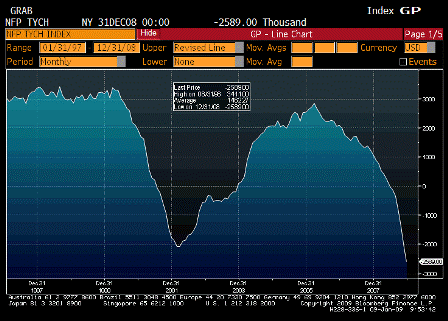
Actual -2589K
Prior -2024K
Revised n/a

[top][end]

Nonfarm Payrolls ALLX (Dec)

[top][end]

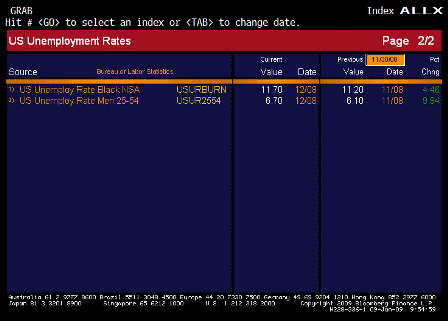
Unemployment Rate (Dec)

Survey 7.0%
Actual 7.2%
Prior 6.7%
Revised 6.8%

[top][end]

Unemployment Rate ALLX 1 (Dec)

[top][end]

Unemployment Rate ALLX 2 (Dec)

[top][end]

Change in Manufacturing Payrolls (Dec)

Survey -100K
Actual -149K
Prior -85K
Revised -104K

[top][end]

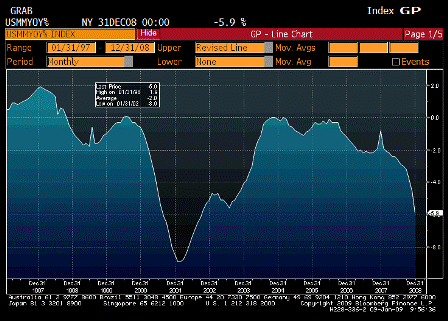
Change in Manufacturing Payrolls YoY (Dec)

Survey n/a
Actual -5.9%
Prior -4.6%
Revised n/a

[top][end]

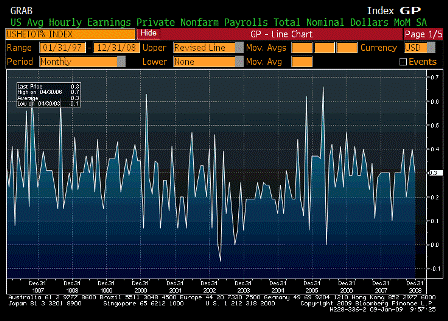
Average Hourly Earnings MoM (Dec)

Survey 0.2%
Actual 0.3%
Prior 0.4%
Revised n/a

[top][end]

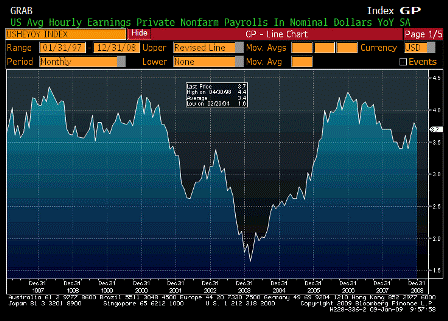
Average Hourly Earnings YoY (Dec)

Survey 3.6%
Actual 3.7%
Prior 3.7%
Revised 3.8%

[top][end]

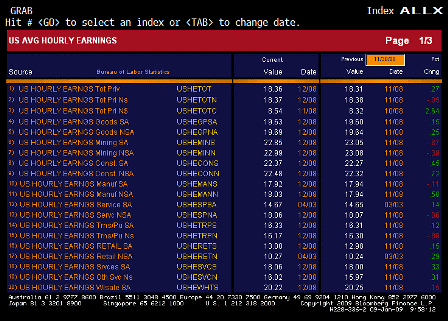
Average Hourly Earnings ALLX 1 (Dec)

[top][end]

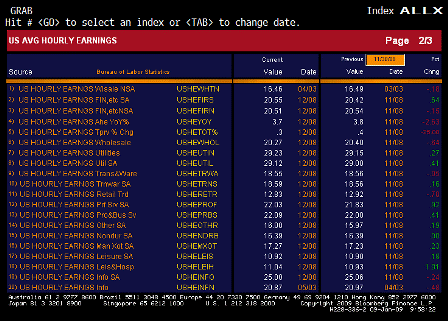
Average Hourly Earnings ALLX 2 (Dec)

[top][end]

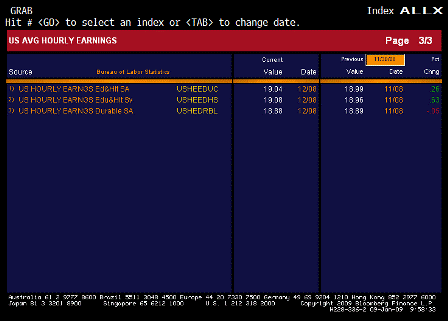
Average Hourly Earnings ALLX 3 (Dec)

[top][end]

Average Weekly Hours (Dec)

Survey 33.5
Actual 33.3
Prior 33.5
Revised n/a

[top][end]

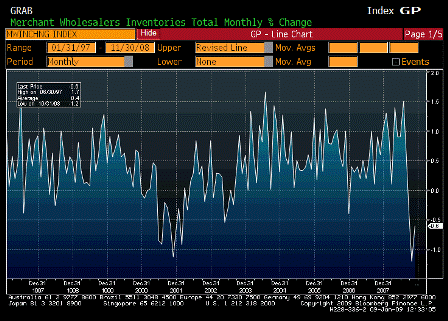
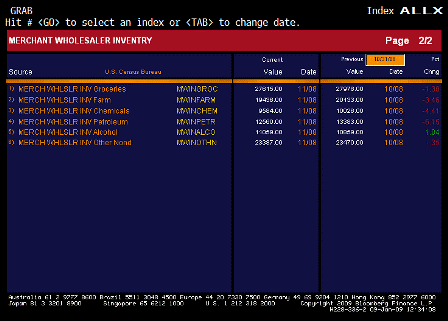
Wholesale Inventories MoM (Nov)

Survey -0.7%
Actual -0.6%
Prior -1.1%
Revised -1.2%

[top][end]

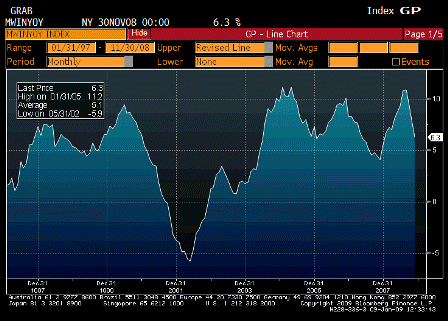
Wholesale Inventories YoY (Nov)

Survey n/a
Actual 6.3%
Prior 7.9%
Revised n/a

[top][end]

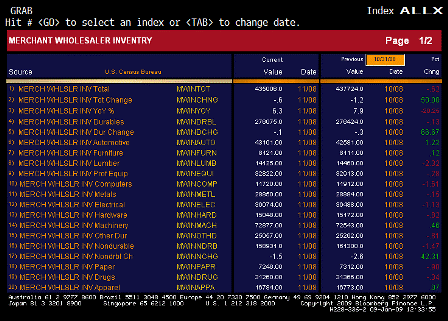
Wholesale Inventories ALLX 1 (Nov)

[top][end]

Wholesale Inventories ALLX 2 (Nov)


[top]

Re: Unemployment!


[Skip to the end]

(email exchange)

Thanks,

It’s all coming apart.

Need that full payroll tax holiday now!

(Treasury makes all contributions for employees and employers to keep the accounting in order)

>   
>   On Thu, Jan 8, 2009 at 2:27 PM, Morris wrote:
>   
>   It seems the problems with unemployment
>   claims system overload this week is even more
>   severe than we thought. To recap, NY state’s
>   internet and phone systems went down on
>   Monday due to unusually high applicant
>   volumes. Ohio and North Carolina had volume-
>   related problems that caused their internet
>   system to go down, Kentucky’s system
>   crashed, Massachusetts reported problems
>   getting through for thousands of callers and
>   internet filers and New Mexico, Pennsylvania,
>   Oklahoma and Washington all added additional
>   operators to deal with the spike in call volumes.
>   
>   To recap, all of these problems happened this
>   week, so they will affect next Thursday’s
>   report, not this morning’s. They suggest an
>   unusual spike in layoffs which suggests the
>   difficulty seasonally adjusting data around the
>   year-end holidays may have caused the claims
>   data of the past two weeks to be understated.
>   
>   Based on a quick web search, we could not
>   find any evidence of similar problems in the
>   past.
>   
>   Thanks to all of you who sent links.
>   


[top]

Saudi production falls


[Skip to the end]

Saudi’s production falls as they work to regain control of price after the Great Masters Inventory Liquidation runs its course.

OPEC Oil Output Fell 1.5% in December, Survey Shows

by Diane Munro and Margot Habiby

Jan. 6 (Bloomberg) &#8212 Crude-oil production from the 13 OPEC members in December declined 475,000 barrels a day from November, the latest Bloomberg survey of producers, oil companies and industry analysts shows. Figures are in the thousands of barrels a day.

Opec Production
December 2008

Opec Country Dec Est. Nov. Output Monthly Change Nov. 1 Target Est. vs. Target Est. Cap. (@)
Algeria 1,330 1,360r -30 1,286 44 1,450
Angola 1,820 1,850 -30 1,801 19 2,000
Ecuador 500 500 0 493 7 500
Indonesia* 840 850 -10 900
Iran 3,850 3,820 30 3,618 232 4,100
Iraq* 2,345 2,320 25 2,500
Kuwait# 2,500 2,550 -50 2,399 101 2,650
Libya 1,690 1,710 -20 1,623 67 1,800
Nigeria 1,900 1,880 20 2,050 -150 2,500
Qatar 790 790 0 785 5 900
Saudi Arabia# 8,400 8,800r -400 8,477 -77 10,800
U.A.E 2,350 2,350 0 2,433 -83 2,800
Venezuela 2,320 2,330 -10 2,341 -21 2,500
Total OPEC-13 30,635 31,110r -475 35,400
Total OPEC-11* 27,450 27,940r -490 27,308 142 32,000

*Quotas effective Nov. 1, 2008. OPEC agreed at its Dec. 17 meeting in Algeria to cut its quota target by 2.463 million barrels a day from the previous level, to 24.845 million barrels daily from Jan. 1. The quota target excludes Iraq, which has no formal quota, and Indonesia which left OPEC at end-2008.

>   
>   On Thu, Jan 8, 2009 at 9:56 AM, David wrote:
>   
>   I honestly don’t like or trust a lot of the “World
>   Oil Demand” stats that many people look at.
>   I think perhaps the EIA/DOE figures compiled
>   below are most realistic, if not a bit lagged.
>   Seems to show steady decline in US/OECD,
>   rising China and flat/rising ME and rest. Wish
>   they had an India bucket to be frank, have
>   requested a few times already.
>   

Thanks, still looks like the world is reasonably close to the edge, and any pickup in world economic activity could be problematic.

Saudi Production (Dec)


[top]

2009-01-09 EU News Highlights


[Skip to the end]

Highlights

Trichet Sees ‘Significant’ Economic Worsening, II Magazine Says
European Confidence Drops to Record Low; Unemployment Increases
German Exports Drop 10.6% as Recession Hurts Orders
German Ministry Seeks $136 Billion Fund to Ease Company Credit
German bond sale’s fate signals trouble ahead

‘Bond failures’ are not all that uncommon in the eurozone and more of a debt management issue at this point.

However a rising deficit due to falling revenues and rising transfer payments as GDP weakens could cause the ability to fund to deteriorate rapidly.

Bank failures that require national government funding don’t help either, and the eurozone seems long overdue for multiple major bank failures.

German Builders See 2% Drop in Revenue in 2009, HDB Group Says
Steinmeier Casts Doubt on German Deficit Limit, Rundschau Says
Sarkozy Says France to Provide More Capital to Banks
Spain December Jobless Claims Rise as Economy Enters Recession
European Two-Year Government Notes Decline, Reversing Gains

German bond sale’s fate signals trouble ahead

by David Oakley

A German sovereign bond auction failed on Wednesday as investors shunned one of the most liquid and safe assets in the world in a warning for governments seeking to raise record amounts of debt to stimulate slowing economies.

The fate of the first eurozone bond auction of 2009 signals trouble ahead as governments around the world hope to issue an estimated $3,000bn in debt this year, three times more than in 2008.

The 10-year bonds failed to attract enough bids to reach the €6bn the German government wanted. Bids of €5.24bn, a cover of only 87 per cent, amounted to the second worst auction on record in terms of demand.

Such developments were rare before the credit crisis. Before the seven German bond auctions that failed last year, the last German bond auction to fail was in July 2000 after the dotcom crash.

Analysts said the vast amount of supply is deterring investors and a growing number of countries, including those with deep and mature bond markets, such as Germany, the UK and Italy, are struggling to attract buyers.

The Netherlands has seen bond auctions fail, the UK and Italy have been forced to offer investors higher yields to meet their auction targets, while Spain and Belgium have cancelled offerings because of a lack of demand.

The German finance agency admitted that investor appetite for government debt had waned, although insisted the auction was “not a disappointment”.

Meyrick Chapman, a UBS fixed-income strategist, said when a German bond auction failed it “does suggest there may be trouble ahead for other governments wanting to raise money in the debt markets. Before the financial crisis, German bond auctions just did not fail.”


[top]

Credit card risks


[Skip to the end]

>   
>   Matt writes;
>   
>   …But as far as credit card debt, I think that
>   the negative reporting may be overblown by
>   debt doomsday types. Ive always suspected
>   so, and may finally have found the proof in a
>   column I read by Gene Epstein in Barrons back
>   in October. Excerpt: “…But according to a
>   source at CreditCards.com, approximately
>   $400 billion of the nearly $1 trillion in
>   outstanding credit- card debt is paid down
>   completely each month, essentially used as a
>   short-term interest-free loan. More than $500
>   billion of the rest is owed by users who pay
>   somewhere between the full amount and the
>   minimum due. Only about 6% of the total is
>   owed by customers who pay only the
>   minimum.”
>   
>   The $500B he identifies as carry over debt is
>   the real credit card debt (to me), and is
>   equivalent to about only 6 weeks of US retail
>   sales. It also probably includes much business
>   wholesale trade as many businesses are using
>   AMEX Corp Card and VISA Business for small
>   purchasing nowadays, often for the “rewards”
>   programs.
>   
>   I think the government and media reports on
>   credit card debt are only taking a snapshot of
>   balances at a given time in a month, and as
>   monthly closing dates on the cards can vary
>   from one cardholder to another, and the cards
>   are continuously used throughout the month,
>   the number looks larger ($900B) than what I
>   think they are trying to track, which I think is
>   the $500B amount (true credit card “debt”).
>   $500B is about $1650 per capita. I dont think
>   this will be a much of a drag for the US
>   economy.
>   
>   Perhaps this perspective will give you some
>   hope that the large stimulus package is going
>   to help improve the economy this year.
>   


[top]