The Mosler Palestinian Development Plan has been added to MANDATORY READINGS!
Read it HERE!
[top]

(email exchange)
Yes, as well as this:
Pros Say: German Stimulus ‘Irrelevant’
Jan 13 (CNBC) — The euro remained under pressure Tuesday despite the German government approving a second stimulus package worth $64 billion to help Europe’s largest economy.
Experts tell CNBC the rescue package is “irrelevant” and that the euro will remain under pressure ahead of the European Central Bank rate decision on Thursday.
It’s irrelevant regarding economic recovery, but can accelerate the rate of credit deterioration of the German state.
And the falling euro once again distorts USD exposure as a percentage of capital that is expressed in euros.
>
> On Tue, Jan 13, 2009 at 8:01 AM, Dave wrote:
>
> France and Italy under performing Germany 5
> bps today and Greece under performing 12 bps
> in 10yrs
>
> DV
>
Greeks Bearing Gifts
by John Authers
Jan 12 (FT) – The market fears the Greeks, even when bearing gifts. It is also scared about the Irish and the Spanish.
Greece has always been treated as a peripheral eurozone member, not only in geography. Even before last year’s civil unrest, its bonds traded at a significantly higher yield than those of Germany – showing a higher perceived default risk.
A eurozone country defaulting and leaving the euro is close to an
unthinkable event. But Friday’s news from Standard & Poor’s that Greece and Ireland were on review for a possible downgrade, followed on Monday by Spain, left many thinking the unthinkable.
The spread of Greek bonds over German bunds is 2.32 percentage points, almost 10 times its level of two years ago. Spanish spreads on Monday rose above 90 for the first time. An Intrade prediction market future puts the odds on a current eurozone member leaving the euro by the end of next year at about 30 per cent.
And German default swaps cost nearly 10 times as much as they did not long ago as well.
The euro dropped more than 1 per cent against the dollar within minutes of the Spanish news, and is down 9.8 per cent in the last few weeks.
A crisis over Greece might be the euro’s ultimate “stress test” (to
borrow a phrase from Daniel Katzive of Credit Suisse). If the eurozone
could find a way to deal with a default, that might confirm the euro’s
status as the world’s next reserve currency.
[top]
(email exchange)
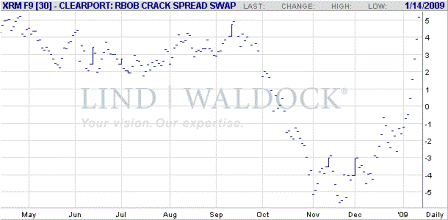
RBOB Crack moving out again as well.
>
> On Mon, Jan 12, 2009 at 5:25 PM, David
> wrote:
>
> DJ just reporting 10c jump in gasoline retail
> w-o-w, pretty big move in % terms (+6%).
>
[top]
China Dec crude imports at 3.38 mln bpd – source
by Jim Bai
Jan 12 (Reuters) — China’s imported 14.37 million tonnes of crude oil in December, or 3.38 million barrels per day, a source familiar with the data said on Monday.
The rate would be 11.6 percent higher than a year earlier, and 4 percent higher than in November 2008 on a daily basis, according to a Reuters calculation.
The imports would bring China’s annual imports to a record high of 178.89 million tonnes, or 3.58 million barrels per day, a rate 9.6 percent higher than a year earlier.
[top]
[top]
In case you thought Krugman isn’t part of the problem.
From his recent column:
Ideas for Obama
by Paul Krugman
Jan 12 (New York Times) — OK, I’ll bite  although as I’ll explain shortly, the “jump-start” metaphor is part of the problem.
First, Mr. Obama should scrap his proposal for $150 billion in business tax cuts, which would do little to help the economy. Ideally he’d scrap the proposed $150 billion payroll tax cut as well, though I’m aware that it was a campaign promise.
Money not squandered on ineffective tax cuts could be used to provide further relief to Americans in distress  enhanced unemployment benefits, expanded Medicaid and more.
If he understood non-convertible currency, he wouldn’t make this statement.
First, it’s not a trade off.
Second, tax cuts not spent indicate the tax had no value in reducing demand in the first place.
Third, a tax cut that goes unspent is not ‘squandered’. Government squandering would take the form of wasting real goods and services (which does happen too often but that’s another story), not the funds spent per se.
There is not a finite pot of funds that government can spend. The limits of government spending are inflation tolerance, not any specific quantity. Government can do both tax cuts and relief payments if the political will is there, and if the tax cuts are ‘ineffective’ all the better as other government spending can be higher than otherwise without any extra movement of the inflation needle.
And why not get an early start on the insurance subsidies  probably running at $100 billion or more per year  that will be essential if we’re going to achieve universal health care?
Krugman is contributing to more real damage than the dynamite that funded his nobel prize.
If anyone reading this knows him, please forward, thanks!
[top]
(email exchange)
>
> On Mon, Jan 12, 2009 at 11:49 AM, Russell
> wrote:
>
> Very compelling argument. Still believe it is the
> Saudis controlling price?
>
Has to be, within a range of net demand.
Notice their ‘production increase’ right before the big sell off in July?
>
> Makes sense: I remember the Kuwait oil
> minister saying that he could not explain $140
> oil. He was not seeing any new demand to
> drive up price. Everyone said he was lying.
>
> A friend was telling me that there was no
> shortage. In March he was trying to find
> storage along the Mississippi River. There was
> no. All tanks full.
>
Right, never has been a shortage. Just price setting. And the price setters were happy to accommodate the run up until it cut demand, as they were running out of capacity as well.
>
> So today we have global demand declining 1
> million barrels per day.
>
Right, no big deal. Nothing OPEC hasn’t already adjusted for.
The problem has been the inventory liquidation as prices fell. No telling when that has run it’s course. Futures markets are saying not yet, but getting closer to the end.
The Masters Inventory Liquidation is probably the largest inventory liquidation of all time.
Hopefully it leads to pension funds not being allowed to use passive commodity strategies as investments, but not sure it won’t all come back. There’s still a lot of it going on. I’d vote to have it outlawed.
>
> Supply is being cut back. We have the Chinese
> economy tanking. So are we looking at $25 oil?
>
Not impossible until the inventory liquidation has run its course. It took about this long in 2006. I didn’t think it would last that long this time, but the liquidation has been a lot larger than back then.
>
> If so, we are going to see a violent world at a
> time of global economic weakness. Russian is
> struggling, so is Venezuela and Iran. Potential
> uprisings there.
>
Yes.
>
> Here is the USA it is a true blessing. Without
> lower oil prices, we would be a serious
> economic quandary.
>
It’s already pretty serious! While consumers are being helped, the energy related companies have gotten hurt and helped bring stocks down. Lower crude also makes stronger/USD harder to get overseas, so they stop buying our stuff like they were before. Domestics should pick up that slack as their oil bills go down, but there’s a big lag due to rising unemployment general economic disruption.
>
> Who said markets were understandable let
> alone logical.
>
Can’t remember. Probably me!
[top]
[top]
The consumption numbers I’ve seen show the US now about flat year over year, but markets have been telling us there’s been an inventory liquidation in progress. The contango in crude has recently come in some, but remains at what is probably ‘full carry’, and last I checked WTI was below Brent.
The gasoline contango has also narrowed, and the RBOB crack is moving out to near zero from trading quite a bit negative for a while.
Saudis to Cut Oil Output Below OPEC Target
Jan 12 (Reuters) — Top exporter Saudi Arabia plans to cut oil output by up to 300,000 barrels per day below its agreed OPEC target — a proactive step to prop up a collapsing market, industry sources said on Sunday.
OPEC’s most influential member has lowered supply this month to 8 million bpd, meeting its target under OPEC’s pact to reduce overall production by a record amount from Jan. 1.
But strict Saudi discipline has failed to boost oil prices–which at close to $40 are far from the $75 a barrel named by Saudi King Abdullah as a fair price. So Riyadh is prepared, from February, to go beyond what is required by OPEC, the sources said.
“We’ve been told Saudi Arabia will cut to about 7.7 million in February,” said a senior oil executive. “They want to prevent a huge stock build up and a further decline in the oil price.”
The kingdom had increased production unilaterally to about 9.7 million bpd in August last year to calm an oil market that had shot to a record of nearly $150 in July.
But by February, it will have reduced its supply to world markets by a fifth as recession steadily erodes demand for fuel.
[top]
[top]
The term ‘innocent fraud’ was introduced by Professor John Kenneth Galbraith in ‘The Economics of Innocent Fraud’, which was the last book he wrote before he died. He used the term to describe fraudulent concepts that were being sustained by the ‘conventional wisdom’ (a term he created in a previous book). The presumption of innocence by those perpetrating the frauds is characteristic of Professor Galbraith’s cynically gracious approach.
This book reviews 7 ‘innocent frauds’ that I suggest are THE most imbedded obstacles to national prosperity. The first 4 concern the federal government budget deficit, the 5th addresses social security, the 6th international trade, and the 7th savings and investment.
I begin with the innocent frauds of the budget deficit, because they are the most pervasive and most damaging to both the US and the rest of the world’s standard of living.
[top]