pending home sales

Talk about spin!

Highlights


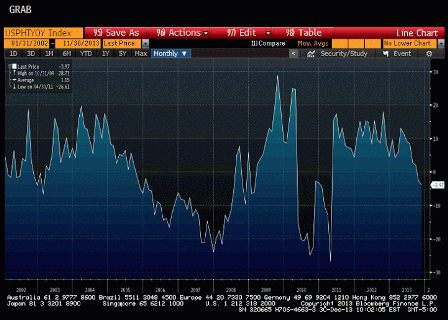
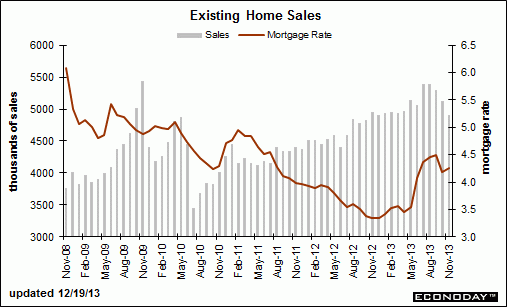
Pending home sales posted a fractional gain of 0.2 percent in November, a weaker-than-expected result but one that nevertheless ends 5 straight months of declines going all the way back to June. The year-on-year rate, at minus 1.6 percent, is weak but at least steady.

The two strongest regions are mixed with the South up 2.3 percent in the month but the Midwest down 3.1 percent. The two weakest regions are also mixed with the West up 1.8 percent but the Northeast down 2.7 percent.

Final sales of existing homes have been one of 2013’s biggest economic disappointments, sliding through the second half of the year as rising mortgage rates, low supply of homes on the market, and high home prices have held down sales. And today’s report doesn’t point to much improvement. Watch for Case-Shiller home price data on tomorrow’s calendar, data that are expected to show continuing gains in what would be another negative indication for sales.


Full size image

today’s releases- Happy Holidays to All!!!

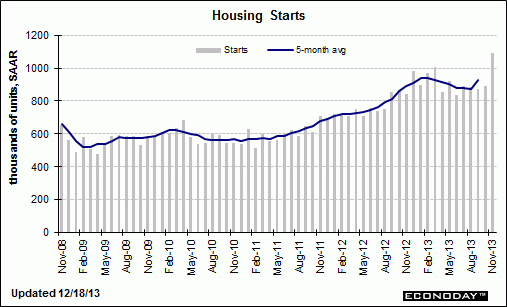
This release along with the Chicago Fed report that November housing starts were down, and anecdotal evidence from home builder reports and various mortgage originators seems to indicate the reported 22% jump in November housing starts reported last week is at best subject to downward revision.

MBA Purchase Applications

Highlights
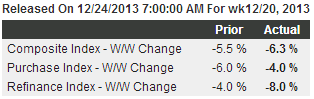
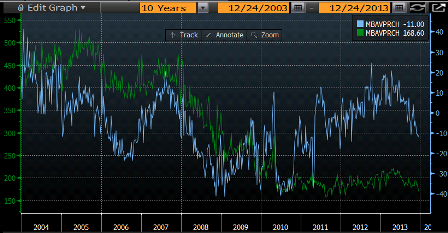
The rise in mortgage rates, this time following the Fed’s decision to begin tapering stimulus, is increasingly reducing mortgage activity. The purchase index fell 4.0 percent in the December 20 week for a year-on-year decrease of 11.0 percent, tangible contraction that underscores the importance of all-cash buyers in the home market.

The rise in mortgage rates is also sharply reducing refinancing activity with the refinance index down 8.0 percent in the week to its lowest level of the recovery. The average rate for conforming mortgages ($417,500 or less) rose 2 basis points in the week to 4.64 percent.

MBA Purchase Applications, Y/Y and level:


Full size image

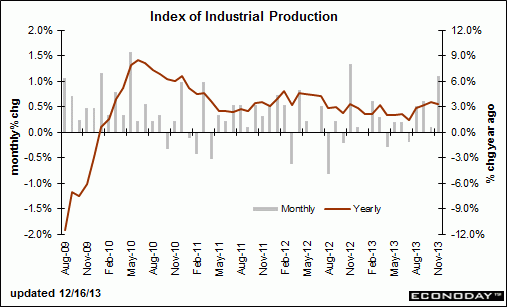
Durables were up nicely as per yesterday’s release as well, with a boost from November’s elevated vehicle sales rate of 16.4 million units. But December car sales are currently forecast to be down to about a 15.5-16 million pace, vs month’s 16.4 million and October’s govt shutdown limited 15.2 million. This also brings the year over year growth rate down to maybe 4% as things flattened out in 2013 from higher prior growth rates. Also, as you can see from the chart, durables don’t tell you much about what might happen next. For example, we had about the same increase in Q1 2008:


Full size image

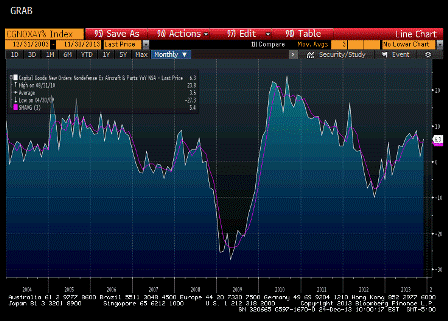
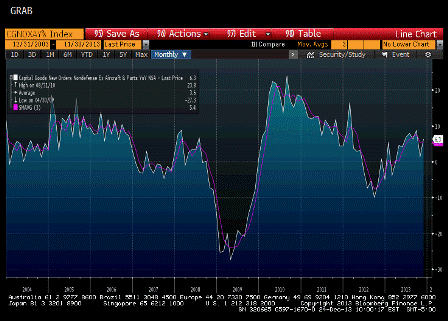
And the Capital goods non defense ex aircraft year over year chart speaks for itself as well:


Full size image

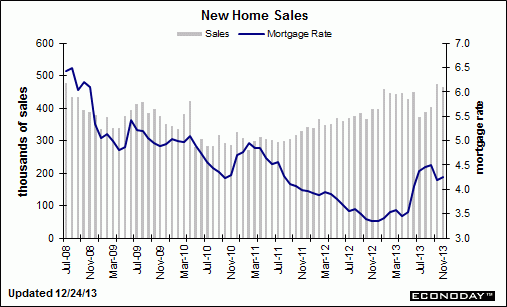
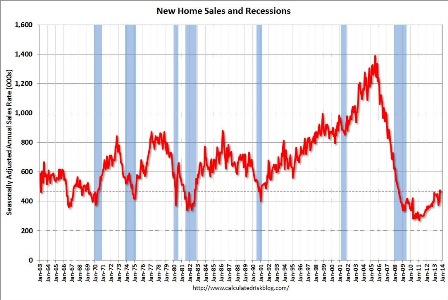
New home sales also just out, with a whopping upward 120,000 revision to last month causing today’s initial November print to be down tic. Seems it’s going to take a few more months of releases and revisions to see what’s actually been happening.


Full size image

Chicago Fed report

Up more than expected, etc.

But interesting that November housing starts were reported lower when the national headline number was up 22%:

Highlights

Most economic data have been turning higher, reflected in the national activity index which jumped to plus 0.60 in November from an upwardly revised minus 0.07 in October. The 3-month average is also rising, to plus 0.25 in November vs an upwardly revised plus 0.12 in October. Readings in the plus column indicate that the economy is growing above its historical trend.

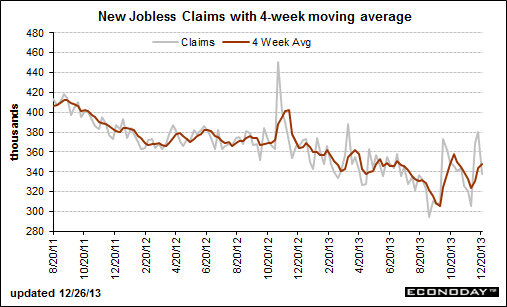
The employment component added 0.28 to the index after subtracting 0.05 in October. The gain reflects the 3 tenths decline in the employment rate to 7.0 percent and the 3,000 rise in non-farm payroll growth to 203,000. But it also reflects a roughly 25,000 improvement in initial jobless claims, an improvement however that reflects special problems in October with the government shutdown and counting problems in California.

The production component contributed the most to the index in November, at plus 0.39 as industrial production rose and capacity utilization went up. The sales/orders/inventories component also contributed to the index, but just barely at plus 0.06 vs plus 0.04 in October.

Consumption & housing was the only component subtracting from the index, at minus 0.12 vs October’s minus 0.13. The main factors here were declines in both housing starts and housing permits.

Another look at Q3 GDP

Third-Quarter Growth in U.S. Revised Higher on Services

By Victoria Stilwell

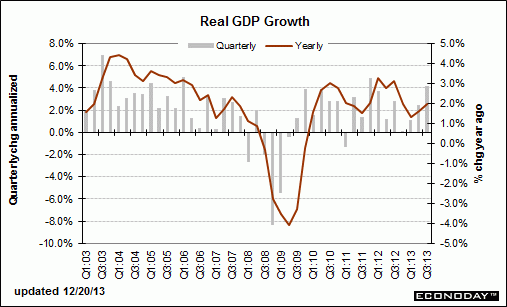
Decmeber 20 (Bloomberg) — The economy expanded in the third quarter at the fastest rate in almost two years as Americans stepped up spending on services such as health care and companies invested more in software.

Jump in healthcare??? And the software gain was the new ‘intellectual’ category.

Gross domestic product climbed at a revised 4.1 percent annualized rate, the strongest since the final three months of 2011 and up from a previous estimate of 3.6 percent, Commerce Department data showed today in Washington. The gain exceeded the most optimistic projection in a Bloomberg survey.

Inventories accounted for a third of the increase in GDP in the third quarter, showing companies were confident about the prospects for demand. Stronger retail sales in October and November underscore the Federal Reserves view that the worlds largest economy is improving.

Right, a boom in unsold inventories. Especially cars, where the inventory was on the high side even for the November spike in sales to 16.4 million (annual rate) from a shutdown depressed 15.2 million for October. And it looks like December total vehicle sales are back down below the two month average, which means the inventory to sales ratio is even worse. No surprise Jan auto production cutbacks have already been announced.

You have equity markets supporting household net worth, rising home values and also payroll gains and falling unemployment, so we do really look for consumption to start picking up, said Robert Rosener, associate economist at Credit Agricole CIB in New York, whose forecast for growth of 3.8 percent was the highest in the Bloomberg survey. This is a very good sign for momentum going into the fourth quarter.

The median forecast of 72 economists surveyed by Bloomberg projected a 3.6 percent gain in GDP, the value of all goods and services produced in the U.S. Forecasts ranged from 3.3 percent to 3.8 percent. Stocks rose after the figures, with the Standard & Poors 500 Index advancing 0.6 percent to 1,820.78 at 11:46 a.m. in New York.

Services Spending

Consumer purchases, which account for almost 70 percent of the economy, increased 2 percent, more than the previously reported 1.4 percent, the revised data showed.

Better but still weak year over year, and, again, healthcare spending of some sort accounted for much of the upward revision.

Spending on services contributed 0.32 percentage point to third-quarter growth, up from a previously reported 0.02 percentage point. In addition to the pickup in outlays for health care, Americans spent more on recreational services.

Outlays for non-durable goods climbed at a 2.9 percent rate in the third quarter, led by more spending on gasoline.

Inventories increased at a $115.7 billion annualized pace in the third quarter, the most in three years, after a previously reported $116.5 billion annualized rate. In the second quarter, they rose at a $56.6 billion pace.

Stockpiles added 1.67 percentage points to GDP last quarter, little changed from the 1.68 percentage-point contribution in the previous reading.

More Optimistic

While economists grew more optimistic about demand in the fourth quarter, GDP will nonetheless be restrained as the pace of inventory growth cools.

JPMorgan Chase & Co. economists project the economy will grow 2 percent from October through December, up from the 1.5 percent rate they had penciled in prior to the Commerce Departments Dec. 12 retail sales report. Barclays Plc has raised its fourth-quarter tracking estimate to 2.3 percent from 2 percent before the retail figures.

Domestic final sales, which exclude inventories, increased 2.5 percent in the third quarter compared with a previously reported 1.9 percent increase.

Corporate spending on equipment rose 0.2 percent, compared with a previous reading of no change. Business investment in intellectual property was revised up to a 5.8 percent increase from 1.7 percent, reflecting more spending on software.

Further investment will depend on how much confidence companies have that the economy will accelerate.

Capital Spending

Honeywell International Inc., whose products range from cockpit controls to thermostats, expects capital expenditures in the range of $1.2 billion or more in 2014, up about 30 percent from this year.

Were very disciplined in terms of cap-ex, Chief Financial Officer David Anderson said on the companys 2014 guidance call on Dec. 17, referring to capital expenditures. We really have to see the whites of the eyes of the economic return characteristics to really commit.

Economic indicators are pointing to just a continued resilience, not exuberance, but resilience and expansion in the U.S. economy, Anderson added.

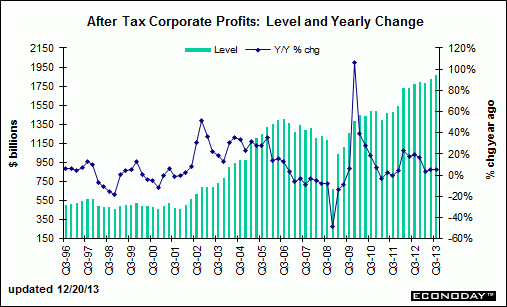
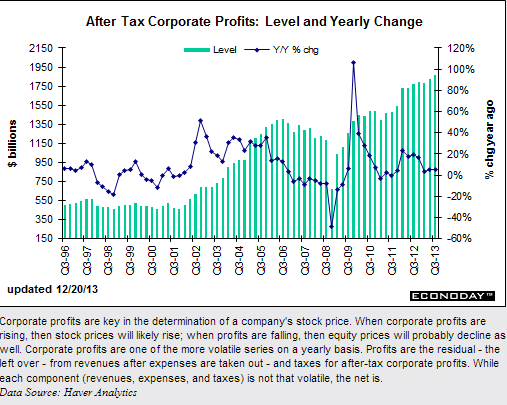
Todays report also included corporate profits. Before-tax earnings rose at a 1.9 percent rate after climbing at a 3.3 percent pace in the prior period. They increased 5.7 percent from the same time last year.

Profit growth continues to slow, even with the higher GDP.

Residential real estate is underpinning the economy, as rising prices boost household wealth and growing demand helps the industry overcome rising mortgage rates.

Home Construction

Home construction increased at a 10.3 percent annualized rate in the third quarter. While slower than the 13 percent pace previously reported, the figure primarily reflected revisions to brokers commissions and other ownership transfer costs, todays report showed.

Data from the Commerce Department this week showed that housing starts jumped 22.7 percent to a 1.09 million annualized rate, the most since February 2008, while permits for future projects also held near a five-year high, indicating that the pickup will be sustained into next year.

Slower growth in home construction and most homebuilders reporting flattish sales, especially after mortgage rates went up, and mortgage purchase apps continue to be down about 10% from last year as well. Let me suggest that 22% jump of the initial release of November housing starts seems suspect as there are no reports of a leap higher in home sales or construction from the housing companies or mortgage originators. And permits were in fact down.

Other signs show that fiscal drag, which weighed on growth during 2013, will start to ease. U.S. lawmakers this week passed the first bipartisan federal budget produced by a divided Congress in 27 years, easing $63 billion in automatic spending cuts and averting another government shutdown.

Yes, it could have been worse, but a variety of tax cuts do expire at year end, as do extended unemployment benefits. But the bottom line is the federal deficit (the ‘allowance’ the economy gets from Uncle Sam) is likely to fall to under $500 billion in 2014, after falling from just under $1 trillion in 2012 to just over 600 billion in 2013. And worse, the automatic stabilizers are extremely aggressive this time around, where 2% growth cuts the deficit maybe by as much as 4% growth cut it in past cycles.

Government outlays increased 0.4 percent in the third quarter, led by a 1.7 percent gain in state and local spending that was the same as the previous reading. Federal spending decreased 1.5 percent.

They fail to mention that state and local tax receipts also rose, so overall the closing of the state and local budget deficits from the recession means there is less fiscal support from the states.

Tighter fiscal policy has made stimulating the U.S. economy even more of an uphill battle for the Fed. The central bank this week announced it would scale back its bond-purchase program by $10 billion, to $75 billion a month, after seeing an improved outlook for the labor market.

This has been done in the face of a very tight, unusually tight fiscal policy for a recovery period, Chairman Ben S. Bernanke said Dec. 18 during a press conference at the conclusion of a meeting of the Federal Open Market Committee.

I’m hoping for a good economy as well, but with housing and cars- the main engines of domestic credit growth- coming off the boil, and Uncle Sam’s allowance payments to the economy (deficit spending) down to less than $50 billion/mo (3% of GDP%) and falling from closer to $80 billion/mo not long ago, seems to me the jury is still out.

A few of last week’s charts:

Personal Income and Consumption, Employment reports and productivity


Full size image

Highlights
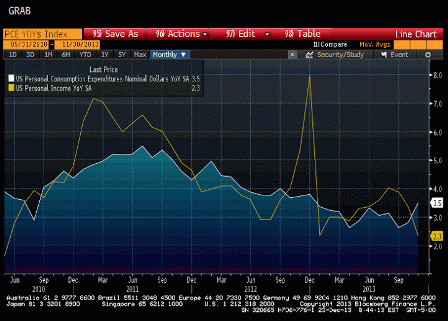
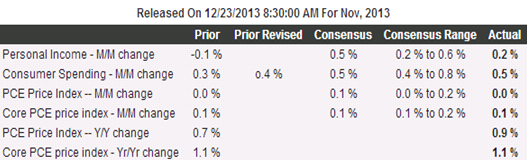
November was an uncertain month for the consumer in terms of sentiment. But in terms of hard numbers, it was a good month. Personal income rebounded 0.2 percent, following a 0.1 percent dip in October. But the important wages and salaries component improved to a 0.4 percent gain in November after rising 0.1 percent the month before.

Spending also accelerated a bit, jumping 0.5 percent after a 0.4 percent boost in October. No surprise, the latest gain was led by durables (largely motor vehicles) up 1.9 percent, following a 1.0 percent increase in October. Nondurable declined 0.4 percent after a 0.4 percent decrease in October. Lower gasoline prices likely played a role in November. Services jumped 0.6 in November, following a 0.3 percent rise the prior month.

Employment and Productivity

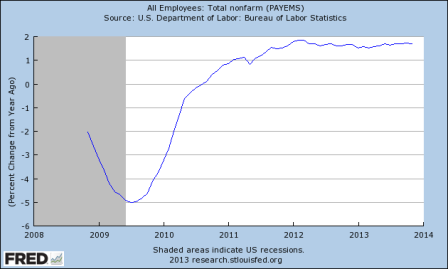
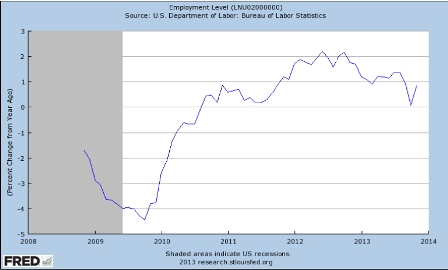
The Non Farm Payroll chart shows employment growth of about 1.7%. The Household survey has been indicating less than 1%.

And while the Payroll chart is arguably the far more reliable indicator because it’s far larger with about 145,000 businesses reporting, vs a survey of 60,000 households, and is actual reports vs survey questions. Also, the household survey is just about how many people are working, while the payroll survey is the number of jobs, even if one person is holding down more than one job.

But with year over year real GDP growth of about 2%, the Payroll report is implying near 0 productivity increases, while the household survey is implying and overall productivity gain of over 1%.


Full size image


Full size image

Yes, the Fed can set mortgage rates if it wants to!

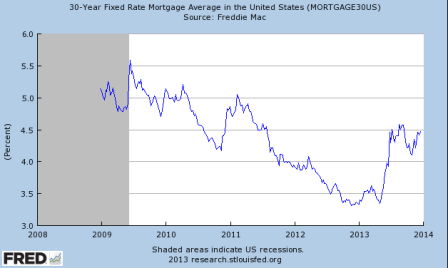
One of the main reasons for the Fed’s (near) 0 rate policy is to support the housing market. And after nearly 5 years of 0 rates, and mortgage rates dipping below 3.5%, though ‘off the bottom’ housing remains far below what would be considered ‘normal’.

And then, not long ago, and immediately after the Fed first hinted at reducing its QE purchases, mortgage rates spike by over 1%:

Full size image

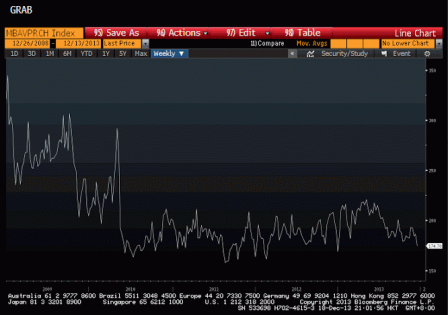
And, since then, mortgage refinance activity has all but vanished, and the number of mortgage applications for the purchase of homes swung from increasing nicely to decreasing alarmingly:

Full size image

The ‘Fed speak’ for this rise in rates ‘tightening financial conditions’. And one of the Fed’s concerns about tapering QE purchases was the concern that higher mortgage rates would slow the recovery. Therefore, in addition to announcing the reduction in purchases of Treasury securities and mortgage backed securities, they were careful to emphasize what’s called their ‘forward guidance’ with regard to the Fed funds rate. That is, they stated that they expected to be keeping short term rates low for the next couple of years or so, and maybe even longer than that, maybe even after unemployment goes below 6.5%, and presuming their inflation measure stops decelerating and moves back up towards their target.

Unfortunately for the Fed mortgage rates moved higher after the announcement, and not due to a burst of mortgage applications (see above charts), and not due to any immediate drop in Fed purchases, which continue in large size. Instead, what the Fed sees is a market that believes the Fed changed course because it believes the economy is recovering, and with recovery just around the corner rate hikes will come sooner rather than later. And with rate hikes on the way, investors would rather wait for the higher yields they believe are just down the road, than take the lower yields today.

Therefore, if you want to borrow today to buy a house, you have to pay investors a higher interest rate. And if you don’t want to pay the higher rate today, investors are willing to wait for those higher rates, and the house doesn’t get sold. And when the house doesn’t get sold the Fed leaves rates low for that much longer and their forecast again (they’ve been over estimating growth for 5 years now) turns out to be wrong.

So with ‘forward guidance’ not doing the trick, is there anything else can the Fed can do if it wants mortgage rates back down? Yes!

First, they can simply announce that they are buyers of 10 year treasury notes at, say, a yield of 2%, in unlimited quantities.

This would immediately bring the 10 year yield down from 2.92% to no more than 2%, and most likely the Fed would buy few if any at that price. That’s because when people know the Fed will buy at a price, they know they can then buy at a slightly lower interest rate, knowing that ‘worst case’ they can always sell to the Fed at a very small loss. That way they can earn the, say, 1.99% yield for as long as they hold the 10 year Treasury note. And there’s always a chance yields come down further as well, which means their securities increased in value as well.

And the lower 10 year rate would quickly translate into much lower mortgage rates as well. And, of course, the Fed could also do the same thing with the mortgage backed securities its already buying, which more directly targets mortgage rates.

So why isn’t the Fed doing this? Probably out of fear of offering to buy unlimited quantities might lead to them buying ‘too many’ Treasury securities. This fear, unfortunately, stems from their lack of understanding of their own monetary operations. Treasury securities are simply dollar balances in securities accounts at the Fed. When the Fed buys these securities they just debit the owner’s securities account and credit the reserve account of his bank. And when the Treasury issues and sells new securities, the Fed debits the buyer’s bank’s reserve account and credits his securities account. Whether the dollars are in reserve accounts or securities accounts is of no operational consequence and imposes no particular risk for the Fed, so those fears are groundless.

Second, the Fed (or Treasury or the Federal Financing Bank) could lend directly to the housing agencies at a fixed rate of say, 3% for the further purpose of funding their mortgage portfolio of newly originated agency mortgages. The agencies would then pass along this fixed rate, with some permitted ‘markup’ and fees to the borrowers. The Fed would then be repaid by the pass through of the monthly payments including prepayments made by the new mortgages. This would target mortgage rates directly and, as these mortgages would be held by the agencies and not sold in the market place, dramatically reduce what I call parasitic secondary market activity.

Has any of this been discussed? Not publicly or seriously that I know of.

Here’s a piece I wrote several years ago on these and other proposals:
Proposals for the Banking System, Treasury, Fed, and FDIC

And this which includes why it’s the Fed that sets rates, and not markets:
The Natural Rate of Interest Is Zero