housing starts

Continues to look to me like the blip in November was from the likes of expiring tax incentives, and that growth fell off in 2013 and at least so far remains flattish, though the weather story won’t clear for another couple of months or so. Same with cars. And real disposable personal income growth near 0 as well.

Housing Starts


Highlights
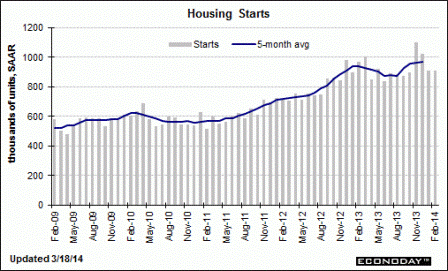
Housing starts came in much as expected for February but permits topped the consensus forecast. Overall starts nudged down 0.2 percent to a 907,000 annual rate from an upwardly revised 909,000 rate for January which followed a downwardly revised December number of 1.024 million. Analysts expected 910,000 units for February. January and December previously were 880,000 and 1.048 million, respectively.

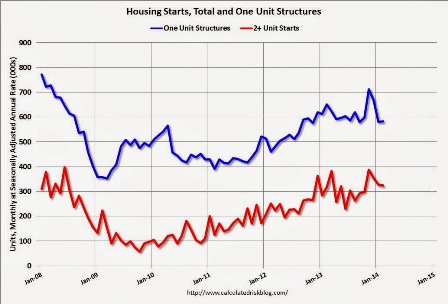
Single-family starts rose 0.3 percent after a 13.2 percent plunge in January. Multifamily starts dipped 1.2 percent in February after a 7.6 percent decline the month before.

Overall permits jumped 7.7 percent to a 1.018 million unit pace after decreasing 4.6 percent in January. Expectations were for 960,000. The increase was largely from a 24.3 percent spike in multifamily units while single-family permits eased 1.8 percent in both February and January.


Full size image


Full size image
factory orders and Italy

U.S. factories flex muscle after severe winter chill

March 17 (Reuters) — U.S. manufacturing output recorded its largest increase in six months in February. Factory production increased 0.8 percent in February after a 0.9 percent January drop.

Quite the bounce- not even back to where it was.

Motor vehicle output rebounded 4.8 percent last month after tumbling 5.2 percent in January, the Fed said in its report.

Same.

There were also notable gains in the production of machinery and fabricated metal products. Mining output rose 0.3 percent last month, but utilities production fell 0.2 percent. The rise in manufacturing and mining output helped to lift overall industrial production 0.6 percent in February. It had slumped 0.2 percent in January. The amount of industrial capacity in use increased to 78.8 percent in February from 78.5 percent. Still, it remained 1.3 percentage points below its long-run average.

Renzi tells Merkel Italy will respect EU budget rules

March 17 (Reuters) — Italian Prime Minister Matteo Renzi on Monday assured German Chancellor Angela Merkel that he aimed to accelerate growth while respecting deficit spending limits.

:(

Renzi last week announced a sweeping package of tax cuts, including 10 billion euros ($13.9 billion) in income-tax reductions, to help spur consumer demand, saying spending cuts and extra borrowing would fund the measures.

Since spending cuts tend to be higher multiple than tax cuts, doesn’t seem all this is likely to help, and might hurt.

“Italy is not asking to exceed treaty limits,” Renzi told reporters after his a meeting with Merkel in Berlin.

They are still a bit above the 60% debt/gdp limit…

On top of the income-tax cuts, Renzi said he would reduce a regional business tax and increase hiring flexibility for companies. Renzi said Italian debt has risen as a percentage of output in recent years even though spending has been kept in check because growth has been stagnant. Domestic demand has “collapsed,” he said.

Empire survey, IP, homebuilder’s survey

Empire State Mfg Survey


Highlights
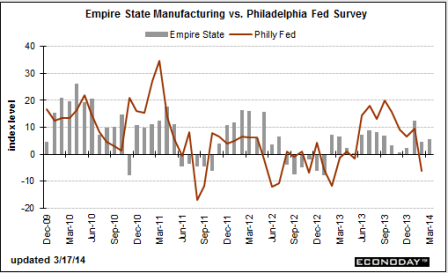
Steady but slow is the indication from the Empire State index which is up slightly this month, to 5.61 from 4.48 in February. New orders also show a slight increase, to 3.13 vs last month’s slightly contractionary reading of minus 0.21, as do shipments, at 3.97 vs 2.13. Growth in the sample’s employment reading slowed, to 5.88 from 11.25.

Other readings include a rise in inventories and a sizable draw in backlog orders. Price readings, despite this month’s rise in fuel costs, show easing pressure. Readings on the six-month outlook are a little less optimistic than prior months.


Full size image

This always seems to chug along at about 3% and doesn’t say much about anything else:

Industrial Production


Highlights
Capacity utilization Consensus Forecast for February 14: 78.6 percent
Range: 78.4 to 78.8 percent

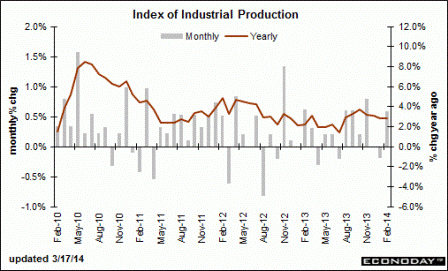
Industrial production was unexpectedly strong in February and utilities actually tugged down on the latest number. Industrial production rebounded 0.6 percent after dipping 0.2 percent in January. Market expectations were for a 0.3 percent gain.

By major components, manufacturing jumped 0.8 percent in February, following a 0.9 percent drop the month before. Mining rose 0.3 percent, following a 0.5 percent boost in January. Utilities slipped 0.2 percent after a 3.8 percent surge the prior month.


Full size image

So the challenge for 2014, at least so far, is to overcome drops in the growth of autos and housing vs 2013:

Housing Market Index


Highlights
The housing market index failed to bounce back much from February’s record loss, coming in at a lower-than-expected 47 for only a 1 point gain. Details for March once again show serious weakness in traffic, at 33 vs February’s 31. Weakness in traffic points to a lack of first-time buyers and underscores the continued importance of all cash buyers in the housing market.

Other details are on the plus side of 50 to indicate monthly growth but just barely, at 52 for current sales and 53 for future sales. The regional breakdown shows little separation except for the Northeast which lags badly but which however is by far the smallest region for new homes.

New home sales, which had been badly depressed, surged in January but this report points only to incremental growth for February and March. And the traffic component of this report points to a lack of sales growth in the months ahead. Watch for housing starts and permit data tomorrow morning on the Econoday calendar, both of which are expected to bounce back.

PBOC Yuan comments

Reads more and more like they are paving the way for it to go down to ‘rejoin’ the rest of the EM’s and Japan etc?

The reason they give for it not going down is their fx reserves which could be used as a buffer. That implies it goes down otherwise?

“There is no basis for big appreciation of the renminbi,” the PBOC said, noting that China’s trade surplus now represents only 2.1% of its gross domestic product. At the same time, “there is no basis for big depreciation of renminbi,” the central bank added, saying that risks in China’s financial system are “under control” and the country’s big foreign-exchange reserves can serve as a big buffer against any external shocks. While pledging to give the market a bigger role in setting the yuan’s exchange rate, the PBOC said it would still implement “necessary adjustments” to prevent big, abnormal fluctuations in the yuan’s exchange rate.

concern over euro strength

As previously discussed, the ‘missing piece’ from the standard export model is buying the currency of your target market, as Germany used to do, and as the EU can’t do for ideological reasons- they don’t want to give the appearance that dollar reserves back the euro, and they want the euro to be the reserve currency. And they want to net export… whatever!

Spanish Central Bank Joins Chorus of Concern Over Euro’s Strength

By Paul Hannon

March 12 (WSJ) — In a news conference Thursday after the ECB’s decision to leave its policy unchanged, the bank’s president Mario Draghi said the euro’s 9% appreciation against the U.S. dollar since mid-2012 had been “a factor that is affecting in a significant way” the inflation rate, likely responsible for lowering it by almost half a percentage point. SpeakingMonday, Bank of France Governor Christian Noyer—who also sits on the ECB’s governing council—said that a strong euro lowers the inflation rate. “We are clearly not very happy at the moment,” he said.On Wednesday, Bank of Spain Governor Luis Maria Linde joined the chorus, making an explicit connection between the currency’s gains and possible future action by the ECB. “A stronger euro may lead to an easier policy, or a drop in inflation,” said Mr. Linde said. “We would like to have a little bit more inflation in the euro zone.”

Wholesale trade

Worse than expected, and only one number subject to revision, with the govt deficit at only 3% of GDP this kind of slowdown can turn pro cyclical:

Wholesale Trade


Highlights
Rising inventories, tied in part to weather-related shipping snags, are a rising threat to economic growth. Wholesale inventories rose 0.6 percent in January against a 1.9 percent plunge in sales, a heavy mismatch that drives the sector’s stock-to-sales ratio up 2 notches to 1.20 which is one of the heaviest readings of the recovery.

Details show large builds in autos, metals, and machinery, three groups where January sales were weak. Nondurable goods show especially large builds against especially soft sales including paper, drugs and petroleum.

Data on factory inventories, which were released last week with the factory orders report, showed an unwanted build and a dip in sales that pushed the stock-to-sales ratio near its heaviest level of the whole recovery. Inventories in the retail sector, with December the latest available report, are the heaviest of the recovery and are building at a time when sales are slowing — not accelerating. Retail data for January will be posted with the business inventories report on Thursday.

Market Consensus before announcement
Wholesale inventories showed a 0.3 percent build in December and were well matched by a 0.5 percent rise in wholesale sales that left the stock-to-sales ratio for the wholesale sector unchanged at 1.17. This ratio has held between 1.18 and 1.17 since May.

Yuan weakness

May be a fundamental shift in trade flows?

They don’t want to spend fx to defend?

Looking to let it go to get back to where it was vs yen at 80/$ as other EM’s seem to be doing?

China Weakens Yuan by Largest Degree Since 2012

By Anjani Trivedi

March 10 (WSJ) — The People’s Bank of China set the daily reference rate Monday at 6.1312 to the dollar, compared with 6.1201 to the dollar on Friday. The 0.18% change represented the largest one-day move in the rate since July 2012. The central bank determines the rate each day, and then allows the currency to trade as much as 1% higher or lower. Since 2005, it has gradually moved the rate up, allowing the yuan to strengthen 33%, but in the last month has pushed it lower, seeking to discourage speculators who have channeled money into the economy in hopes of benefiting from the currency’s rise. On Monday, the yuan touched 6.1458 against the dollar, compared with 6.1260 late Friday in New York. The offshore yuan, which is freely traded outside China, weakened as far as 6.1309 from a closing level of 6.1095 on Friday. Premier Li Keqiang said last week at the National People’s Congress, China’s annual legislative session, that Beijing would expand the currency-trading band.

NFIB Small Business Optimism Index

Weather worse than expected.
;)

This is a lesser indicator that only matters if it goes up…
;)

NFIB Small Business Optimism Index

Highlights
The small business optimism index, which had been on a rebound, fell sharply in February, down 2.7 points to 91.4. A weakening in sales expectations pulled the index down the most followed by economic expectations and hiring plans.Respondents continue to reduce inventories and are reporting no more than limited pricing power.

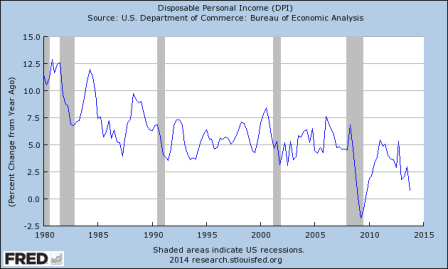
proactive fiscal tightening damages income growth


Full size image


Full size image

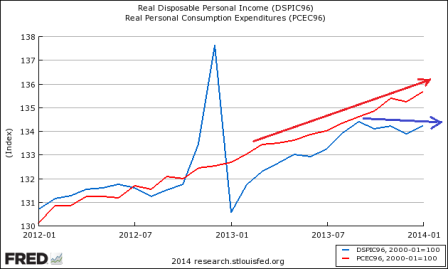
Mind the gap:

Full size image

This is below prior recession levels!

Full size image

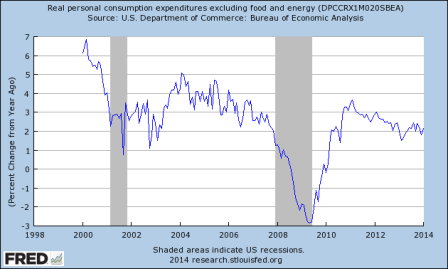
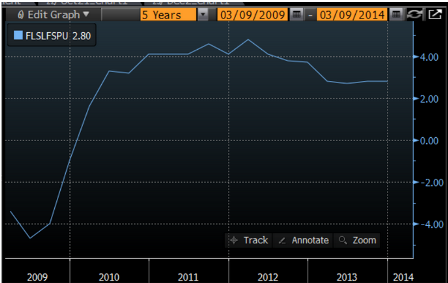
This is year over year growth in consumption of domestic product, which is GDP less capex less exports.

It shows how much ‘the consumer’ is spending on domestically produced goods and services:

Full size image

The underlying narrative is that proactive austerity damages income growth and thereafter requires a ‘jump’ in ‘borrowing to spend’/reduction in savings’ to sustain the prior levels of growth.

When growth itself brings the govt deficit down via the auto fiscal stabilizers, the needed credit growth/savings drop to replace the lost govt deficit spending is ‘already there proactively’ as it’s what drove the growth in the first place. So while the credit expansion/savings reduction needs to continue to grow to support GDP growth, the credit expansion/savings reduction doesn’t need to ‘spike up’ proactively as it does when the fiscal tightening is proactive.

So note that q3’s higher GDP growth included over 1% from additions to inventories. That represents a reduction in corporate savings from what it would have been if they had not net added to inventories. That is, consumers didn’t ‘jump the gap’ created by the ongoing increase in FICA vs the prior year, and the sequester cuts, that together proactively reduced govt deficit spending by over 1.5% of GDP (with the FICA hike adding to the automatic stabilizers as well). And Q4’s consumer spending on domestic product grew at a lower rate even as capex was higher. Also note that while capex growth for 2014 is forecast at about the same 5% as 2013, even with the high levels of energy investments, ultimately it’s largely a function of top line sales.

The reduction in net imports is a reduction in the growth of foreign savings of $ denominated financial assets, which does ‘make up’ for the reduction in govt deficit spending, depending on foreign demand. But it’s been ongoing and doesn’t look to be ‘jumping the spending gap.’

And note too that the running US deficit of about 3% of GDP is about the same as the euro zone’s and the Maastricht limit. So for me the question is whether this will make our economies converge as US income growth continues to decline?

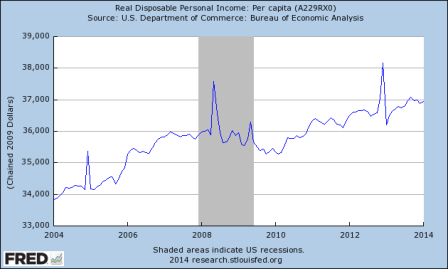
And, as previously discussed, the 0 rate policy has worked to directly bring down personal income. Also note that personal income growth has slowed coincidentally with the approx 200,000/mo additions to total employment.

So seems that the income added by that much new employment isn’t enough to keep overall (after tax) personal income growth positive.


small business lending up some

Weather related…
;)

Evidence that small business lending has improved is piling up. Banks had $287.64 billion in outstanding loans to small businesses as of Dec. 31, up 1.4 percent from a year earlier, according to the Federal Deposit Insurance Corp. In January, the dollars loaned to small businesses by banks, independent commercial finance companies and corporations, increased 4 percent from last year, according to Thomson Reuters and PayNet. And a February survey by Pepperdine University’s Graziadio School of Business and Management found that 39 percent of small business owners who applied for bank loans in the previous three months were successful, up from 34 percent in a survey taken in October and November.