Employment report

A lot better than expected, and markets reacting accordingly, and the narrative about the 1.2 million people losing benefits at year end ‘inflating’ the jobs number seems not material based on the numbers so far released:

Employment Situation


Highlights
The labor market improved in September for the most part. Job growth topped expectations, The unemployment rate declined. However, wage inflation is oscillating but remaining on a low trajectory.

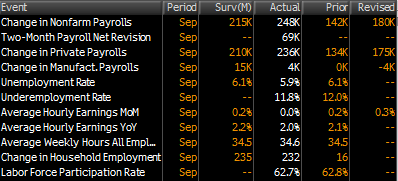
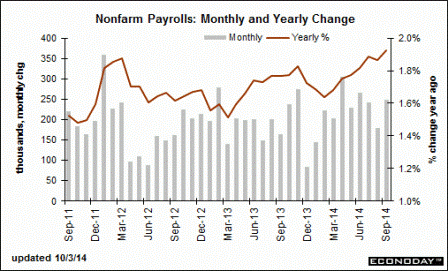
Nonfarm payroll jobs gained 248,000, after a 180,000 rise in August and 243,000 increase in July. Net revisions for July and August were up a sharp 69,000. The median market forecast for September was for a 215,000 gain.

The unemployment rate declined to 5.9 percent from 6.1 percent in August. Expectations were for 6.1 percent.

Going back to the payroll report, private payrolls advanced 236,000 in September after a 175,000 boost in August. Expectations were for 236,000.

Average hourly earnings were unchanged in September after a 0.3 percent rise the month before. Average weekly hours ticked up to 34.6 hours versus 34.5 hours in August and expectations for 34.5 hours.

Overall, job growth improved while wage inflation remained soft. The Fed still has many options for policy.
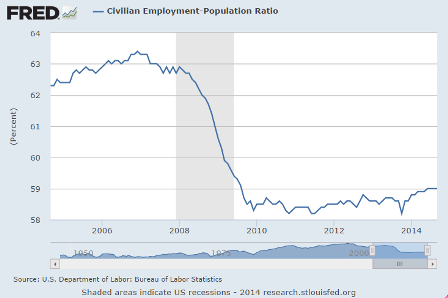
While there were more net new hires, seems the working age population went up quite a bit as well, as the % of the population working remained at relatively low 59% for the third month:
Mortgage Apps, Saudi oil output

Not good!

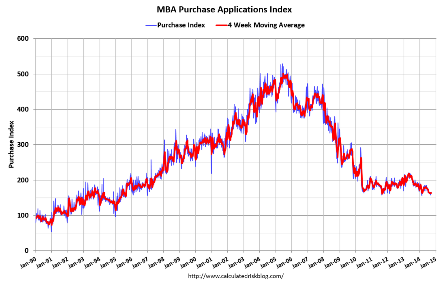
MBA Purchase Applications


Highlights
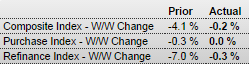
Mortgage activity was steady in the September 26 week, unchanged for the purchase index and down 0.3 percent for the refinance index. The purchase index remains depressed compared to last year, down 11 percent. A move lower in rates during the week didn’t help activity. The average 30-year conforming mortgage ($417,000 or less) fell 6 basis points to 4.33 percent.

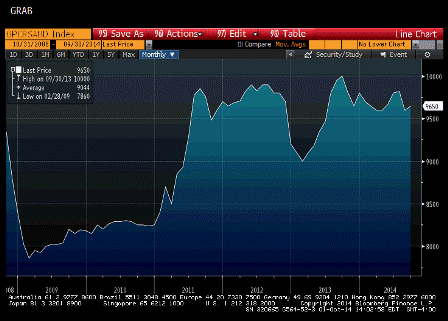
Still strong demand for Saudi crude as they set price and let quantity adjust.

The question is what price they set.


Full size image

Construction spending, ISM Manufacturing, ADP

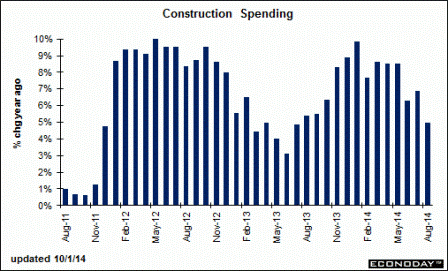
Came in less than expected and the chart looks bad as well, having topped out prior to year end as tax credits expired:

Construction Spending


Recent History Of This Indicator
Construction spending saw a broad-based gain in July. Construction spending rebounded 1.8 percent after a 0.9 percent dip in June. While all broad categories advanced, July’s increase was led by the public sector-up 3.0 percent, following a 1.8 percent decrease in June. Private nonresidential spending rebounded 2.1 percent in July after slipping 0.8 percent the month before. Private residential outlays gained 0.7 percent, following a 0.4 percent dip in June.

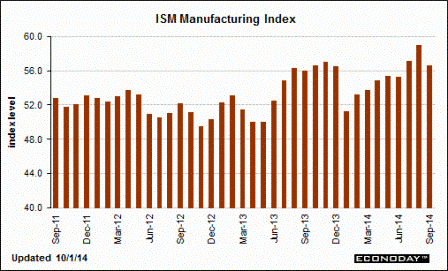
ISM manufacturing less then expected but still at reasonable levels:

ADP Employment Report


Highlights
ADP’s estimate for private payroll growth for September is 213,000 vs the Econoday consensus for 200,000 and vs a revised 202,000 for August. The corresponding consensus for Friday’s jobs report from the government is 215,000 vs August’s 134,000.

ADP contracted with Moody’s Analytics to compute a monthly report that would ultimately help to predict monthly nonfarm payrolls from the Bureau of Labor Statistic’s employment situation.

ADP used to report it’s payroll number, but a while ago ‘switched’ to using its internal numbers to try to forecast Friday’s non farm payroll report, so now we don’t see their actual payroll numbers, just their forecast for Friday

It’s all looking more and more like the ‘unspent income’ is winning, as happened in Q1, and it’s all on the verge of going into reverse.

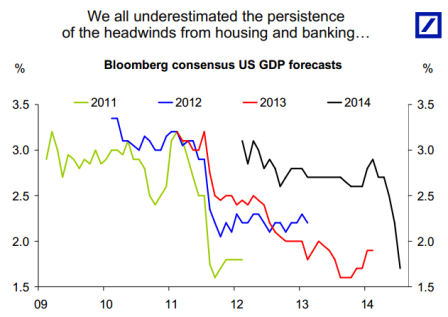
Q3 GDP estimates hovering around +3%

Current estimates for Q3 GDP are hovering around +3%.

So how wrong can they be? Well, the actual range on Bloomberg is from 1.2-4%

And here’s the April 30 release for Q1, with estimates ranging from +.5- 2.0. The latest revision has it at -2.1.

Just saying it’s not uncommon for estimates to be off by a full 3% or more!


Highlights
Economic growth came to a standstill in the first quarter, largely due to adverse weather slowing production. First quarter GDP rose a meager 0.1 percent annualized after a 2.6 percent gain in the fourth quarter. The advance estimate fell well short of market expectations for a soft 1.1 percent rise.

Posted in GDP

Preview of Friday’s employment report

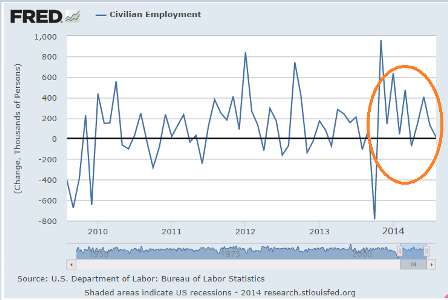
The household survey has been in decline for several months, with lower highs and lower lows:

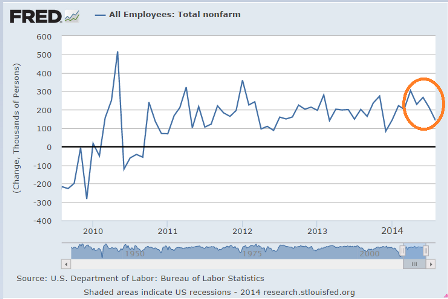
Same with the non farm payroll report:

Analysts are counting on Friday’s report showing August being revised up substantially and September payrolls to be up over 200,000.

Anything could happen, of course, but something less than that would be in line with the narrative about the 1.2 million who lost benefits at year end taking menial jobs best they could earlier this year, causing those prints to be higher than otherwise, etc.

Case-Shiller housing price index

Looks to me like this business cycle is over?

This is a lack of demand story.

The FICA hike in Jan 2013, followed by the sequesters in April, and the aggressive automatic fiscal stabilizers doing their thing to reduce govt net spending add up to the walls coming in on the economy:

S&P Case-Shiller HPI


Highlights
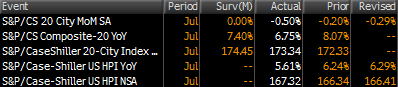
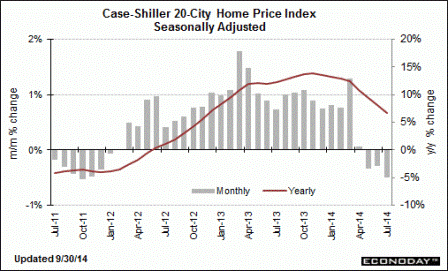
Home prices were contracting sharply in July, down 0.5 percent for the third straight decline and the steepest monthly decline in Case-Shiller 20-city seasonally adjusted data going all the way back to November 2011. The reading is below the low end of the Econoday consensus and far below the 0.1 percent gain that was expected. The year-on-year rate, which has been coming down steadily all year from the low double digits, is at plus 6.7 percent for the lowest reading since November 2012 and down sharply from 8.0 percent in June.

Fourteen for the 20-city sample show declines in the month with Chicago and Minneapolis showing the most severe declines, at minus 1.6 percent in the month. Three cities show no change leaving three with gains led by Las Vegas at only plus 0.3 percent.