School and Unemployment, Spain Conference Link

How Have Prime-Age Workers in School Affected the Labor Market?

Just one of several possible factors keeping the participation rate down and the reported unemployment rate lower than otherwise, which in my narrative are the consequences of low aggregate demand/the federal deficit is too small, etc.

From the St. Louis Fed:

In the first scenario, we kept the increase in schooling of the population 16-21 that has occurred over the past 10 years. But we kept the share of the population 22 and older that attends school in 2015 at its 2005 levels. In this scenario, the May unemployment rate would have been 6.6 percent instead of the 5.5 percent observed that month.

And this:

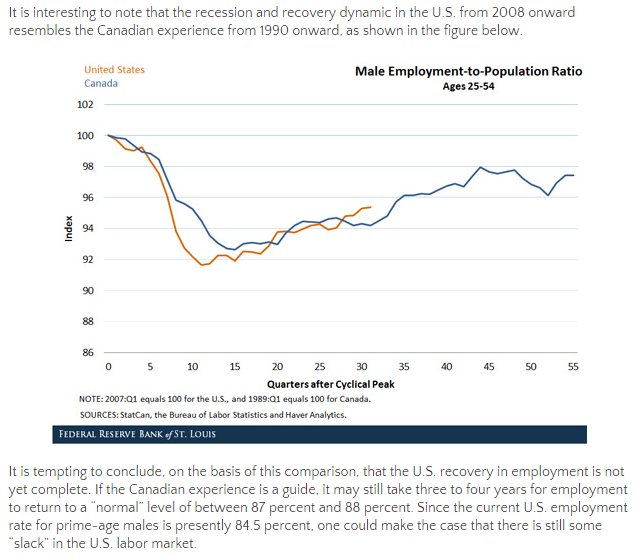
How Long Until “Slack” Is Out of the Labor Market?

male-emp-pop-ratio

Presentation in Vila-real:

Los 7 fraudes inocentes capitales de la política económica

Existing Home Sales, Household Equity, Credit Check

Reversing as suspected after rush to buy before possible Fed hikes:

Existing Home Sales
er-9-91-1
Highlights
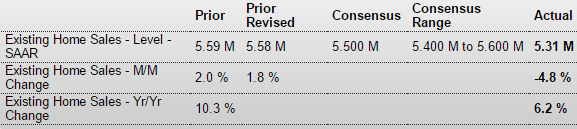
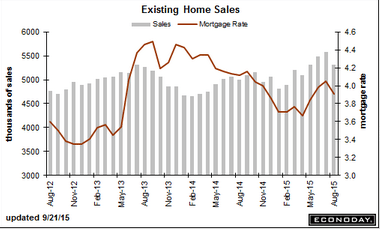
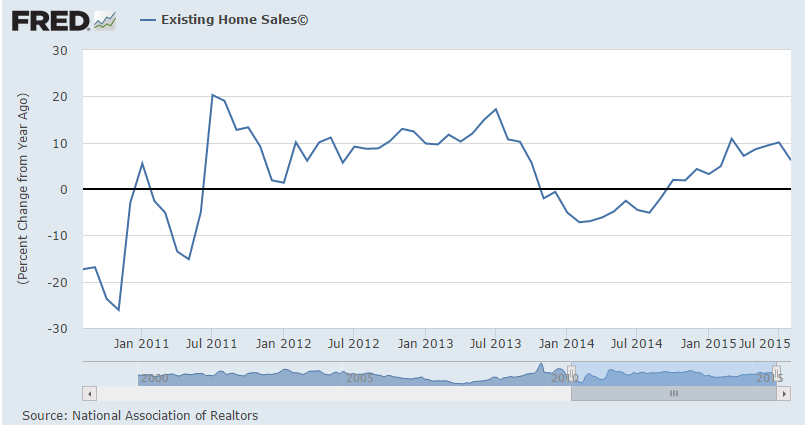
Though slowing in August, existing home sales are still healthy and trending higher. Existing home sales came in at a lower-than-expected 5.31 million annual rate in August which is the lowest since April. July was revised down just slightly but is still an 8-year high at 5.58 million. At 6.2 percent, growth in year-on-year sales is the lowest since February. The year-on-year median price, up only 4.7 percent to $228,700, is the lowest since August 2014. The report cites no special reasons behind August’s softness, but notes that it follows prior strength, in fact six months of strength.

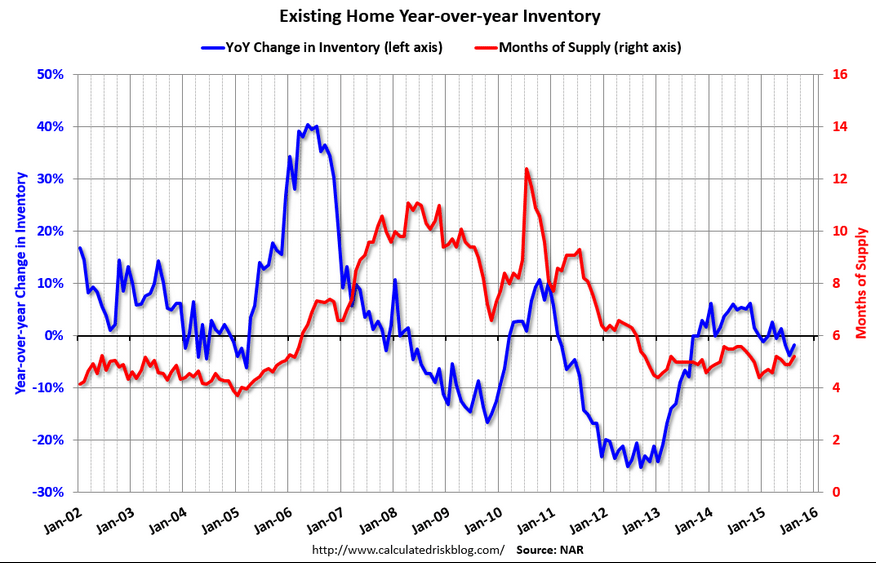
With the in dip sales, supply relative to sales is less tight, at 5.2 months from 4.9 months in the prior two months. But there’s still a lack of homes on the market, evidenced by a comparison with the year-ago supply at 5.6 months.

Details show high mid-single digit declines across regions except the Northeast where the August sales rate was unchanged. Year-on-year, data are very well balanced with high mid-single gains for all.

Despite low mortgage rates and soft prices, the housing sector isn’t exactly on fire. Watch for FHFA house prices on tomorrow’s calendar, which are expected to rise, and also for new home sales on Thursday which are also expected to rise.
er-9-91-2

Lower inventories tend to reduce sales:
er-9-91-3
er-9-91-4
Returning to ‘normal’ but not there yet:
er-9-91-5

This growth rate continues to slip:
er-9-91-6
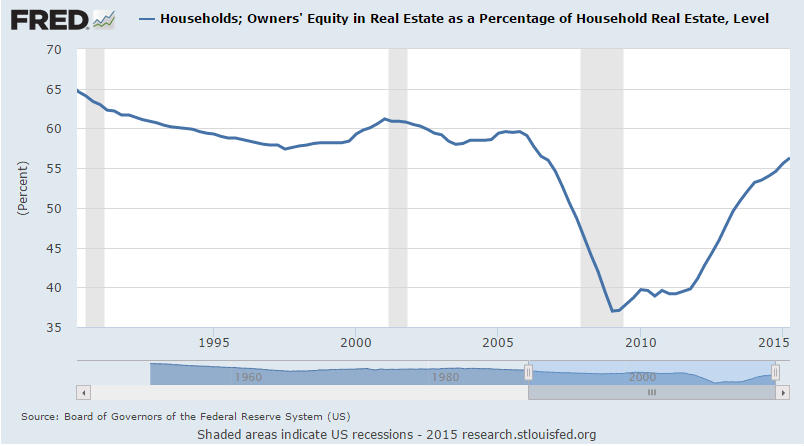
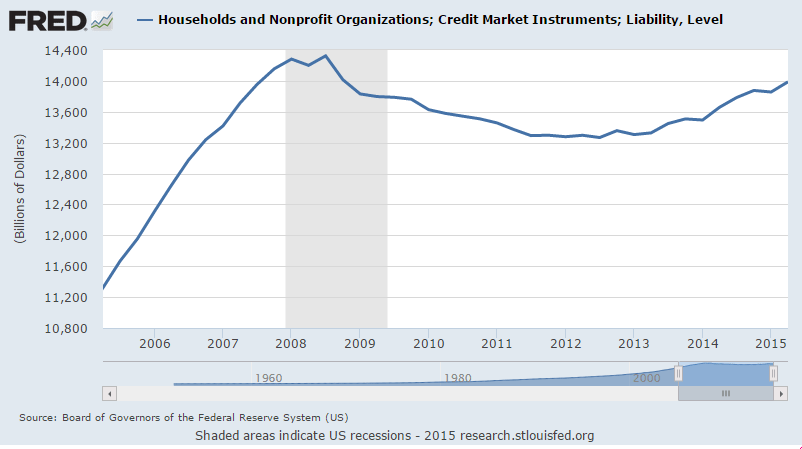
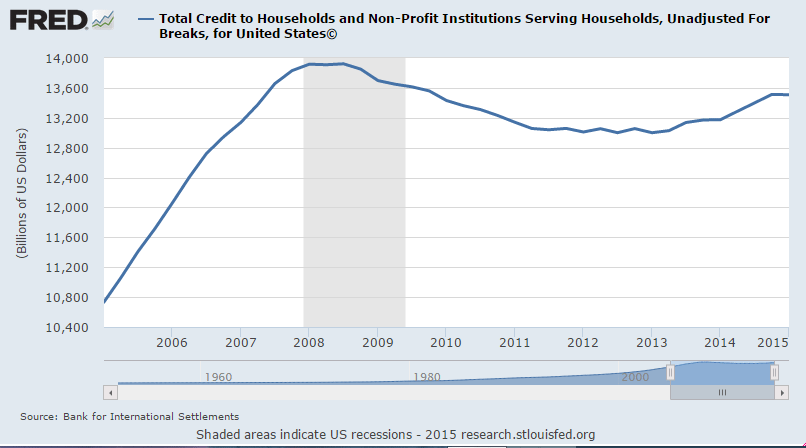
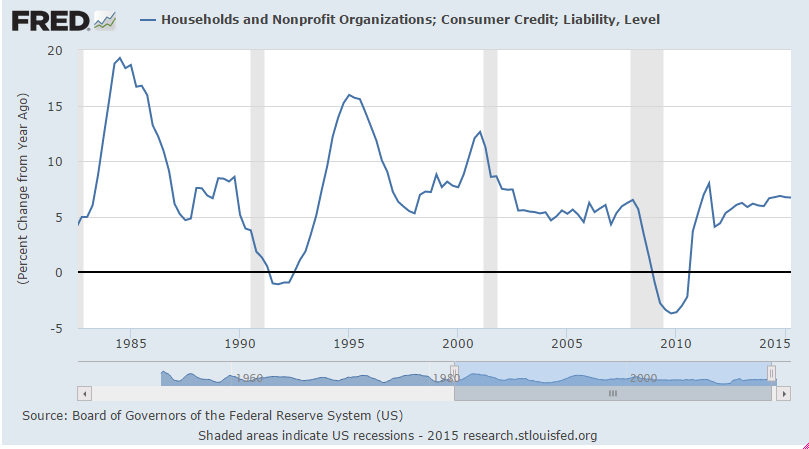
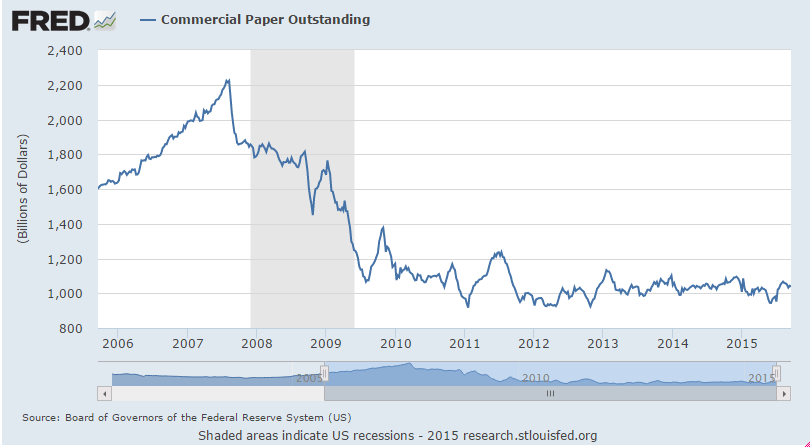
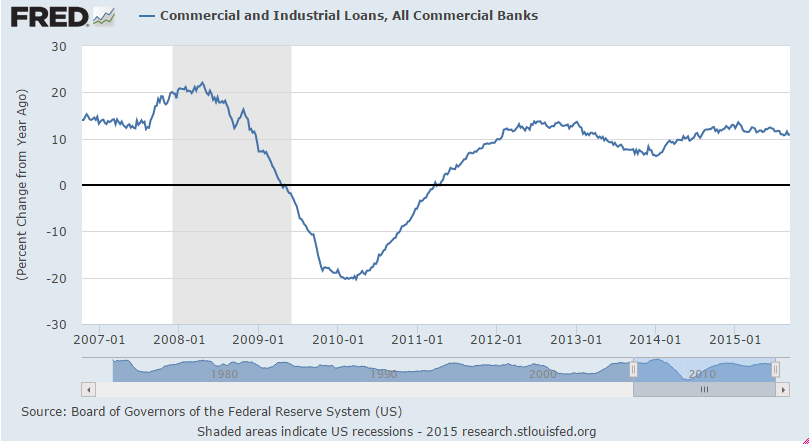
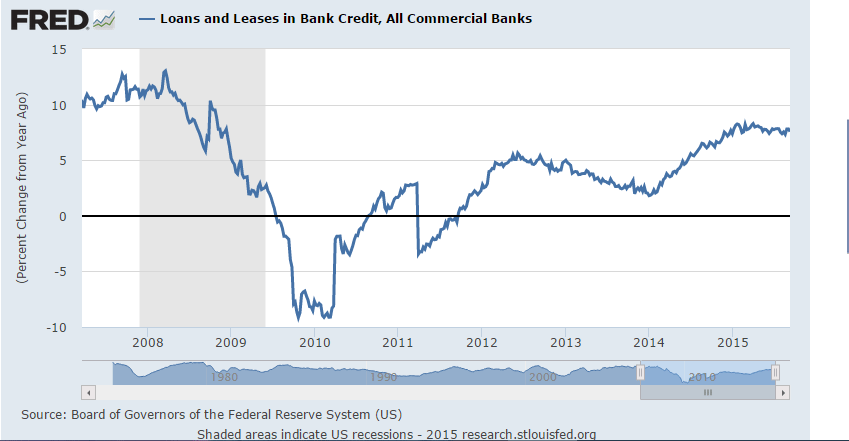
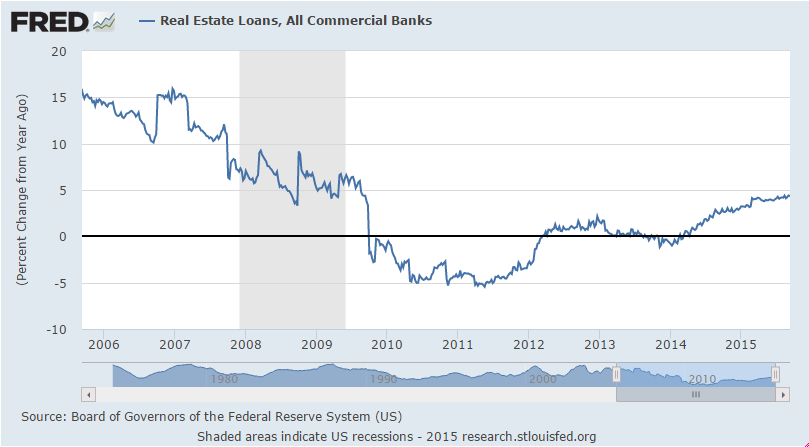
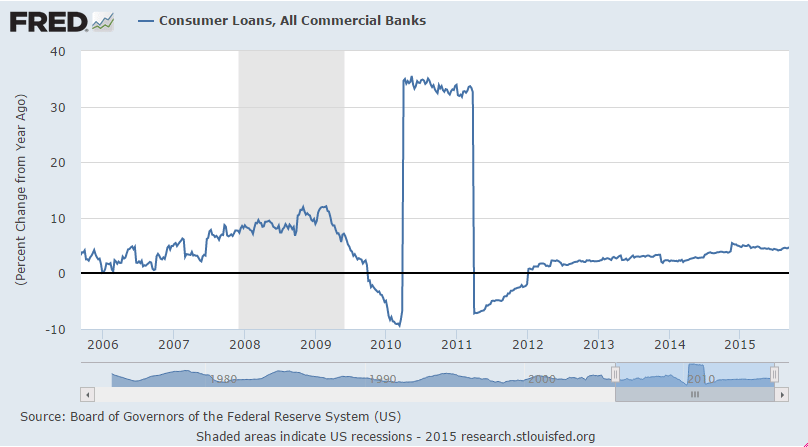
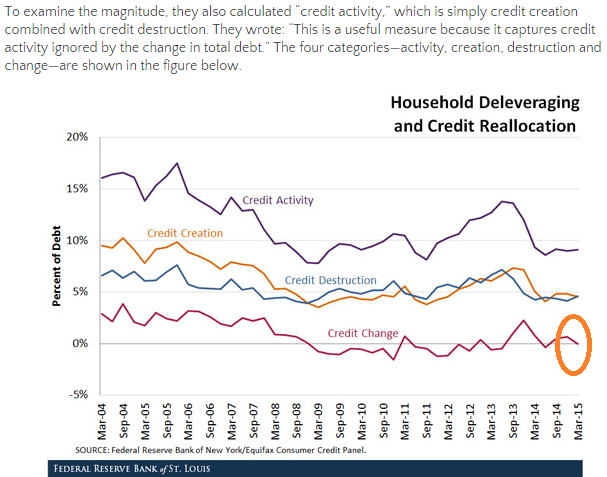
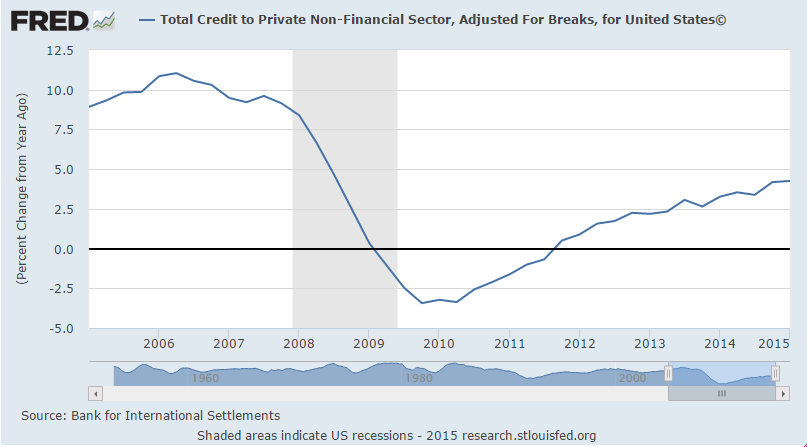
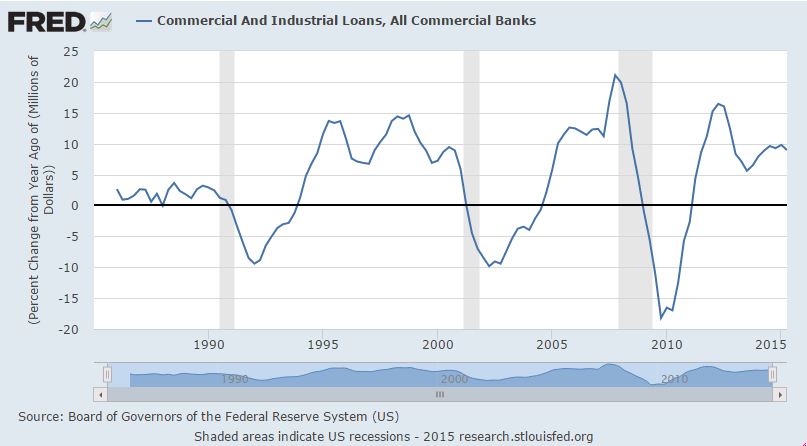
Minimal credit expansion:
er-9-91-7
er-9-91-8
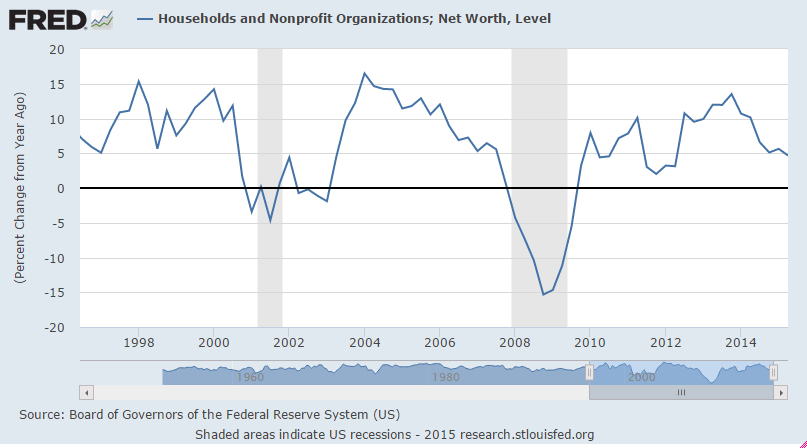
Not accelerating:
er-9-91-9
Nothing happening here, either:
er-9-91-10
er-9-91-11
er-9-91-13
er-9-91-14
er-9-91-15

The Fed’s Sort of Right Move for the Wrong Reasons

The Fed did not raise rates because the FOMC concluded this was not the time to remove accommodation.

I agree this is not the time to remove accommodation. But I do not agree lower rates and QE are accommodative.

Changing rates shifts income between borrowers and savers, and with the federal debt just over 100% of GDP, the state is a large net payer of interest to the economy. So lowering rates reduces interest income paid by the state to the economy. Therefore that aspect of lowering rates imparts a contractionary bias and, yes, raising rates would impart an expansionary bias. In other words, the Fed has the ‘easing’ and ‘tightening’ thing backwards, and if it wants to impart an expansionary and inflationary bias a rate increase would be in order.

Paying more interest, however, does have distributional consequences, as the additional income paid to the economy goes to those holding government securities. Alternatively, a fiscal adjustment (tax cut and spending increase) directs additional spending power to other constituencies. So the remedies for a weak, deflationary outlook come down to some combination of rate hikes, tax cuts, or spending increases.

And given those choices, I think most of us would vote to leave rates at 0 and either cut taxes or increase public spending.

Additionally, the rate selected by the Fed translates into the term structure of prices presented to the economy, as forward pricing is necessarily a function of Fed rate policy. So in that sense, the term structure of rates put in place by Fed policy *is* the rate of inflation presented to the economy at any point in time.

Let me also add that setting a range for fed funds rather than a single interest rate gives the appearance of ignorance. A combination of paying interest on reserves and a few (reverse) repurchase agreements to pay interest on any residual funds not subject to interest on reserves would both do the trick and improve the optics.

And as for QE, the Fed buying secs is functionally identical to the tsy never having issued them, and instead letting tsy payments remain as reserve balances. That is, QE shifts duration but not quantity, and there is little to no evidence that shifting duration has a material effect on aggregate demand, inflation, or employment.

So while QE is just a placebo, like any placebo, it does impact the decisions of portfolio managers, corporations, central bankers, etc. who believe otherwise.

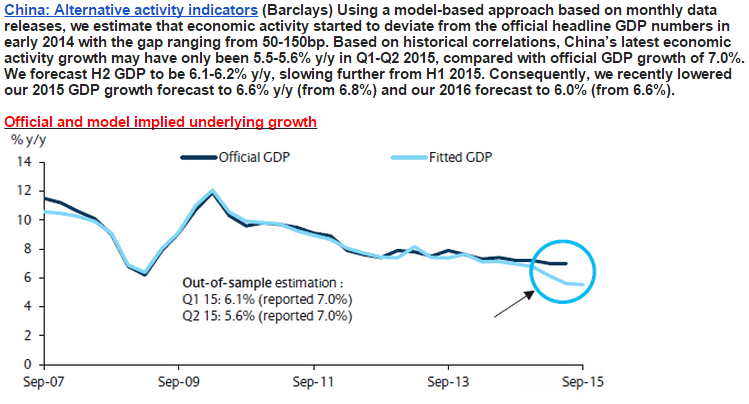
Japan Downgrade, China GDP Model, Earnings Reports, Italian Trade, Housing Starts, Rail Traffic, Fed Comment

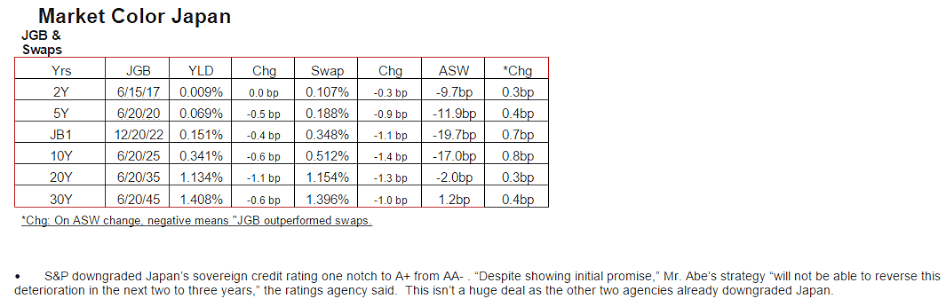
Yields on JGB’s fall a bit with S&P downgrade. I’ve spoken to S&P. They know better. They are intellectually dishonest.
er-9-18-1
er-9-18-2

I included these as they give some indication of the macro outlook:

FedEx Trims Outlook on Weak Freight Demand

Sept 16 (WSJ) — FedEx said it expects adjusted earnings of $10.40 to $10.90 a share for the year ending May 31, down from its previous guidance of $10.60 to $11.10 a share. Average daily volume for Ground’s package business grew 4% in the quarter, which was about in line with the company’s expectations. Ground’s operating income slipped 1% to $537 million, while revenue shot up 29% to $3.83 billion in part from the addition of GENCO. For the first quarter ended Aug. 31, FedEx posted a profit of $692 million, or $2.42 a share, up from $653 million, or $2.26 a share, a year earlier. Revenue increased 5% to $12.3 billion.

Oracle Reports Decline in Profits

Sept 16 (WSJ) — Oracle said net income fell 20% in the period ended Aug. 31, but was off only 8% excluding currency effects. Total revenue, off 2%, was up 7% on a constant-currency basis, Oracle said. Oracle said new licenses declined 16% in dollars, or 9% in constant currency. Overall, Oracle reported a profit of $1.75 billion, or 40 cents a share, down from $2.18 billion, or 48 cents a share, a year earlier. Excluding stock-based compensation and other items, profit would have been 53 cents a share, compared with 62 cents a year earlier. Total revenue declined to $8.45 billion from $8.6 billion a year earlier.

Euro friendly:

Italy : Merchandise Trade
er-9-18-3
Highlights
The seasonally adjusted trade balance was in a E3.7 billion surplus in July, up from an unrevised E2.6 billion excess in June.

However, the headline improvement masked contractions in both sides of the balance sheet. Hence, exports fell 0.4 percent on the month, their third decline since March but only due to weakness in energy (ex-energy exports grew 0.4 percent). Imports were off a steeper 3.7 percent (minus 4.0 percent ex-energy). Compared with a year ago, exports were up 6.3 percent after a 9.4 percent rise in June and imports 4.2 percent higher following a 12.2 percent gain last time.

The July black ink was more than 6 percent above its average level in the second quarter. This suggests that net exports could provide a boost to real GDP this quarter having been a drag in the previous period.

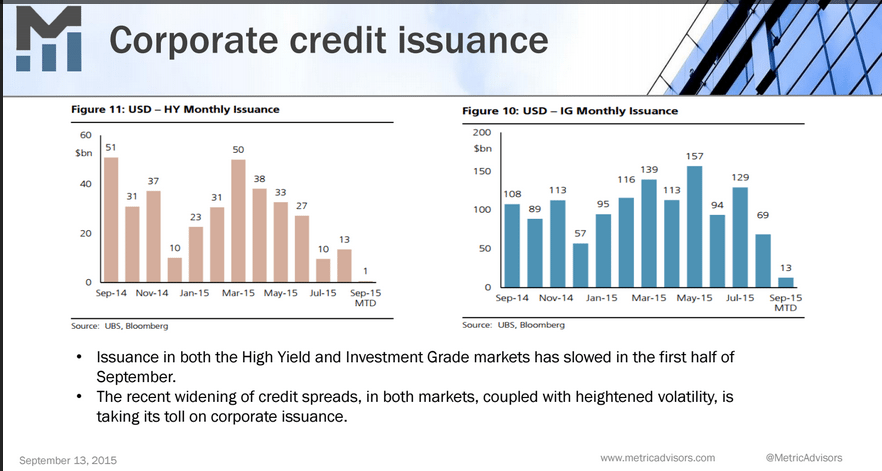
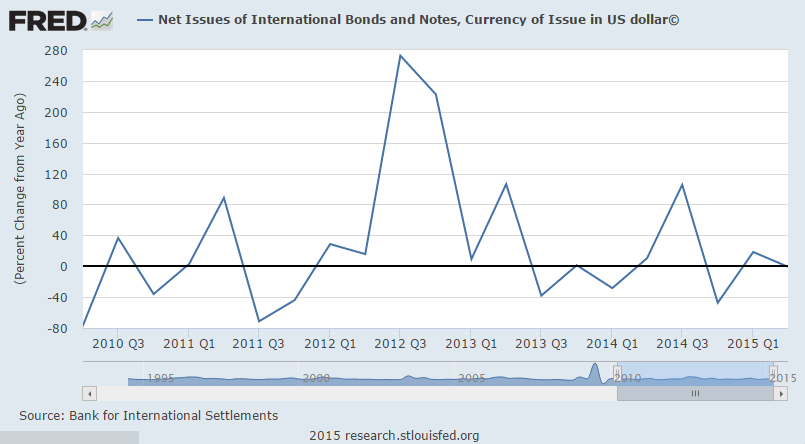
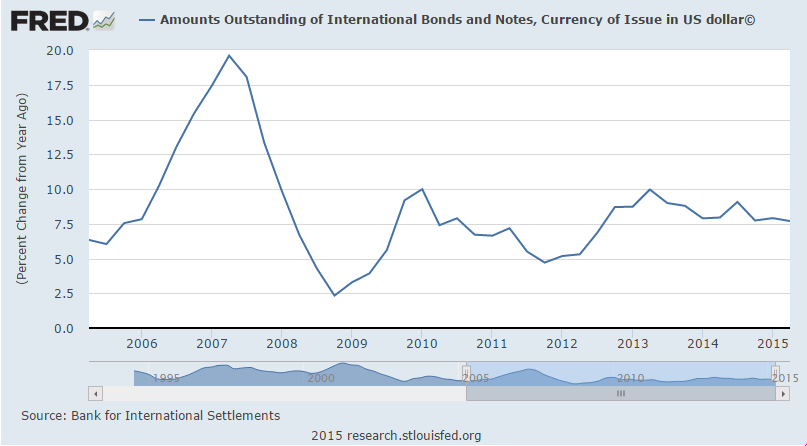
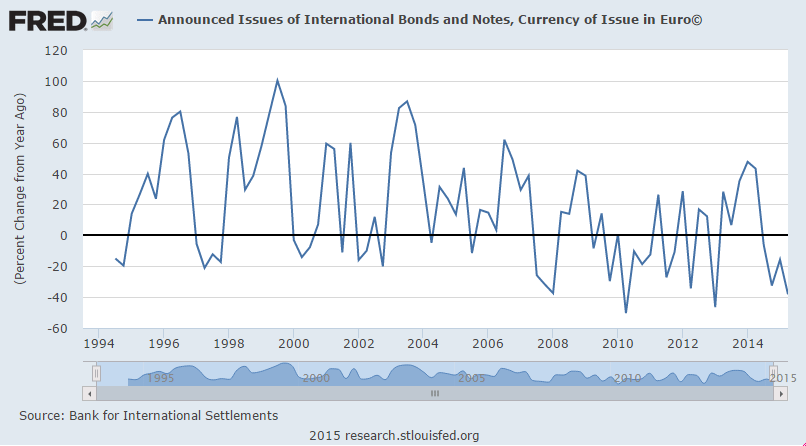
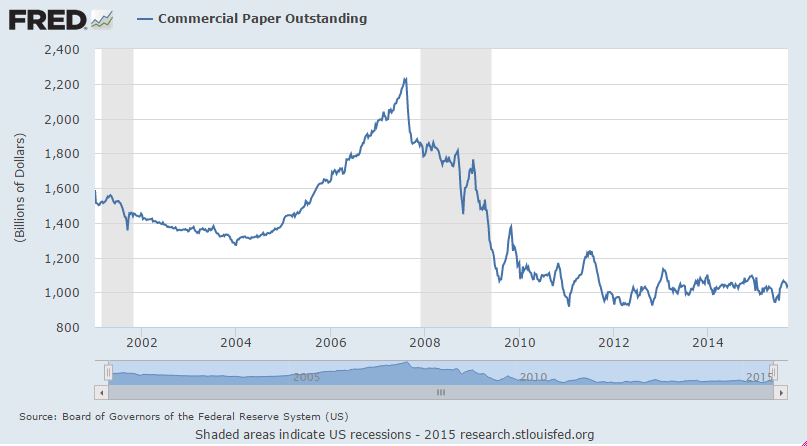
They talk about the ‘portfolio balance channel’ meaning investors shifting to ‘riskier assets’ due to QE, etc. But at the macro level, it’s about the total ‘risky assets’ available, and it looks like the growth rate is declining:
er-9-18-4
No sign of a burst in issuance here:
er-9-18-5
er-9-18-6
er-9-18-7

Housing Starts
er-9-18-8

Highlights
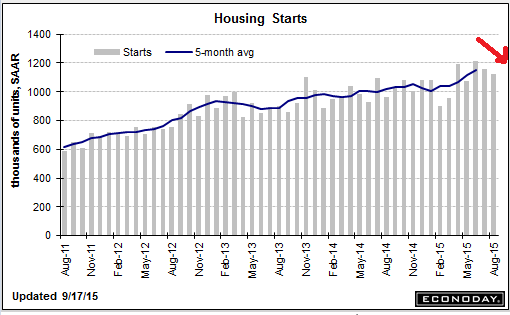
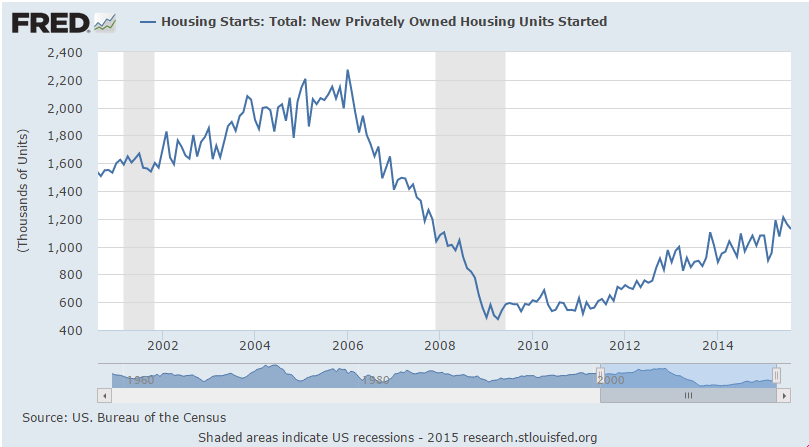
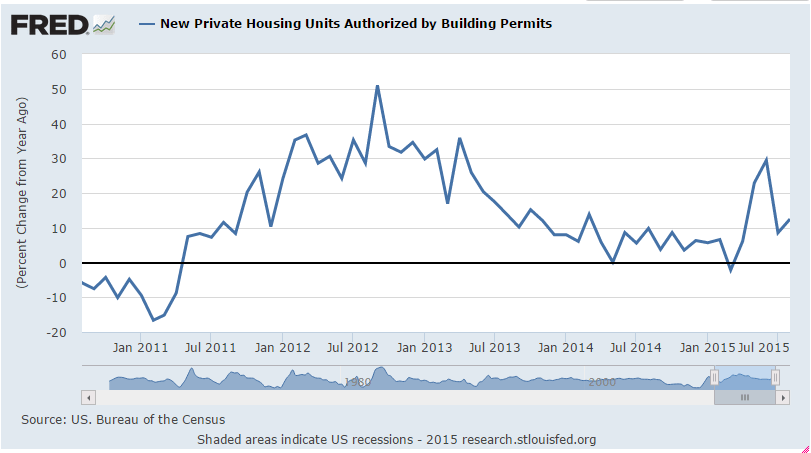
Housing starts fell back in August but not permits which gained and point to strength for starts ahead. Starts fell 3.0 percent in the month to a lower-than-expected 1.126 million annual pace while permits rose 3.5 percent to a higher-than-expected 1.170 million. Starts for single-family homes, like the headline for starts, also fell 3.0 percent in August but follow a 10.9 percent surge in July. Permits for single-family homes rose 2.8 percent in the latest month to 699,000 which is the highest since 2008.

Housing under construction is also at a 2008 high, at 920,000 vs 908,000 in July. But completions were down in the month, from July’s 966,000 pace to a still healthy 935,000.

By region, starts data show increasing strength for the South which is by far the largest region, up 7.1 percent in the month. Permits in the South rose 2.4 percent for a 10 percent year-on-year gain. Permits in the West are the strongest of any region, up 9.6 percent in the month for a year-on-year rate surge of 36 percent.

Revisions to July were mixed with starts revised lower but permits higher. On net, this report is another positive for housing which is proving to be a key sector for the 2015 economy.
er-9-18-9

Steady progress but still depressed and still well below the lows of the 2001 recession:
er-9-18-10

Too soon to tell if the prior spike will be followed by a more serious collapse:
er-9-18-11

Philadelphia Fed Business Outlook Survey
er-9-18-12

Highlights
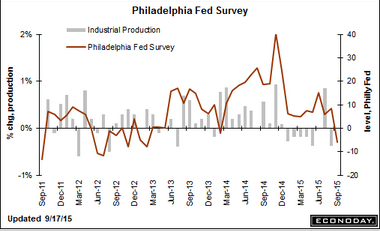
There may very well be something wrong with the manufacturing sector, at least in the Northeast where the Empire State index has been in deep negative ground for the last two months followed now by a minus 6.0 headline for the Philly Fed index. This is the first negative reading since February 2014.

But the headlines for both of these reports, which are not composite scores of separate components, are sentiment scores of sorts, rough month-to-month assessments of general conditions. A key positive in today’s is continued strength in new orders which rose 3.6 points to 9.4. Unfilled orders, nevertheless, have been trending into contraction, at minus 6.6 for the third straight negative reading.

But some details are very strong with shipments at plus 14.8 and employment at plus 10.2 for a 5-month high. In a negative signal also seen in the Empire State report, prices received, that is prices for final goods, is in contraction at minus 5.0.

The Fed is wondering whether global volatility and stock market losses are affecting consumer confidence. Early data this month from regional Feds suggest the effects may also be extending to business sentiment.
er-9-18-13

Rail Week Ending 12 September 2015: Tremendous Unimprovement After Previous Week’s Improvement

Sept 17 (Econintersect) — Week 36 of 2015 shows same week total rail traffic (from same week one year ago) collapsed according to the Association of American Railroads (AAR) traffic data. Intermodal traffic significantly declined year-over-year, which accounts for approximately half of movements. and weekly railcar counts continued in contraction. It could be that the data last week was screwed up – and the data this week was an adjustment.

And so how good can the US economy be if the Fed thinks the appropriate fed funds rate is still near 0%?

;)

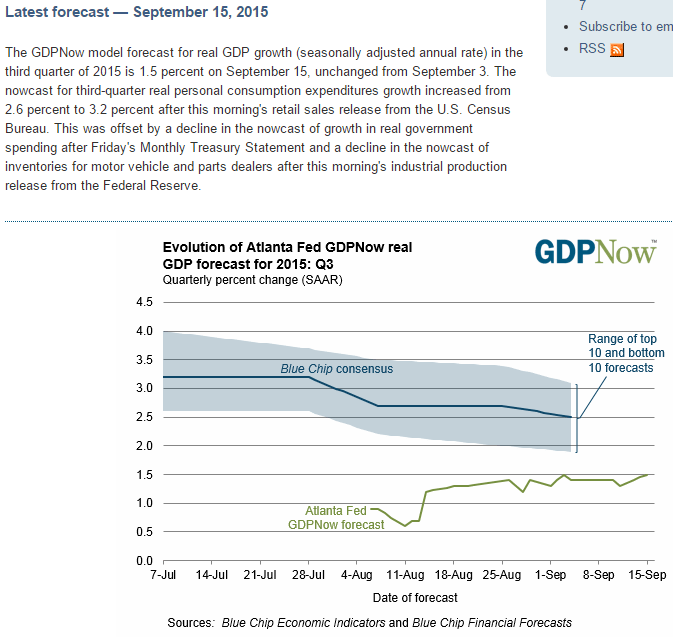
Autos and export related anecdotes, Atlanta Fed GDP forecast

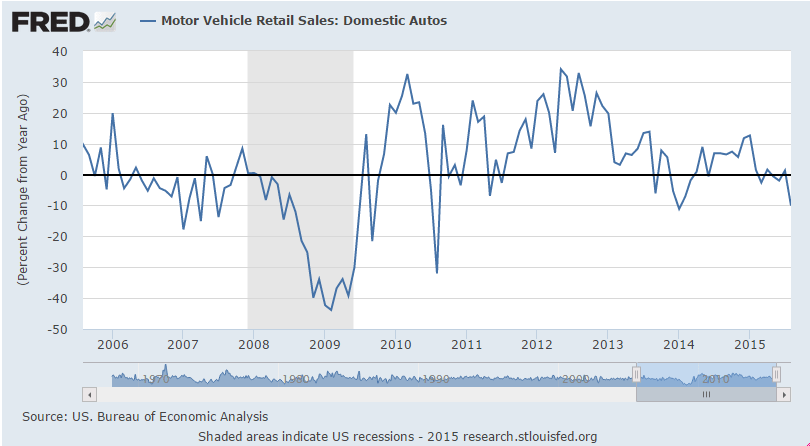
This is consistent with the US production and inventory numbers.

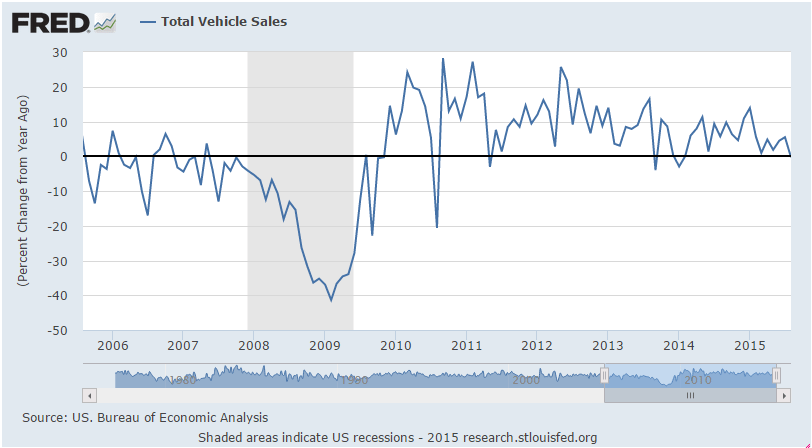
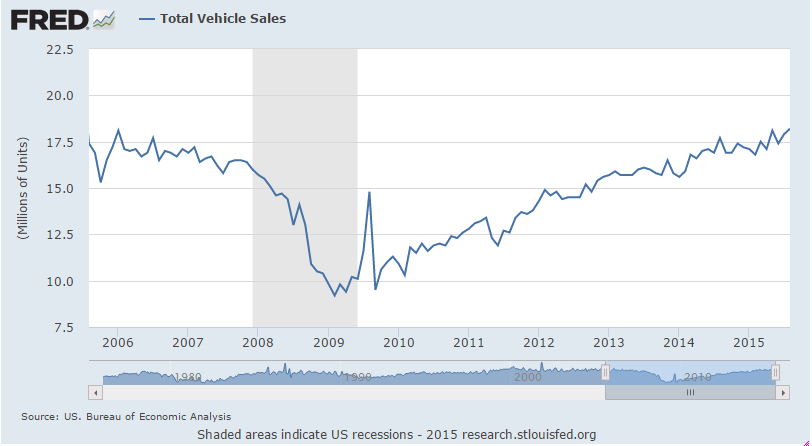
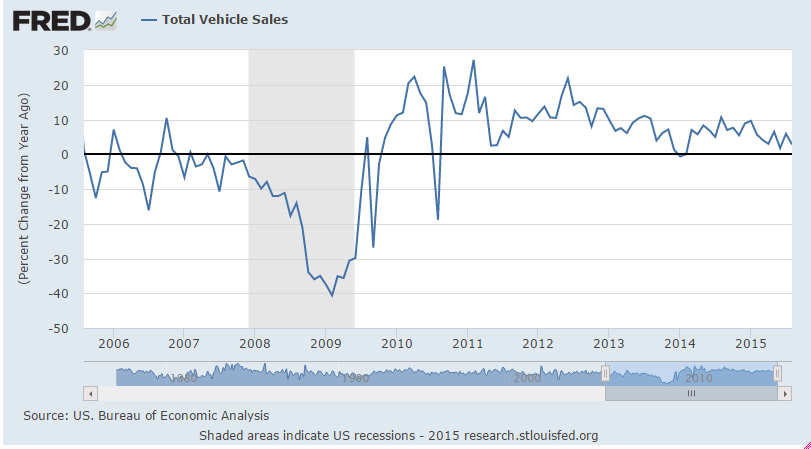
While the total vehicle sales rate was up a bit, the gains seem to be entirely in imported vehicles:
er-9-17-1
er-9-17-2
er-9-17-3
er-9-17-4
More anecdotal evidence of export softness:
er-9-17-5

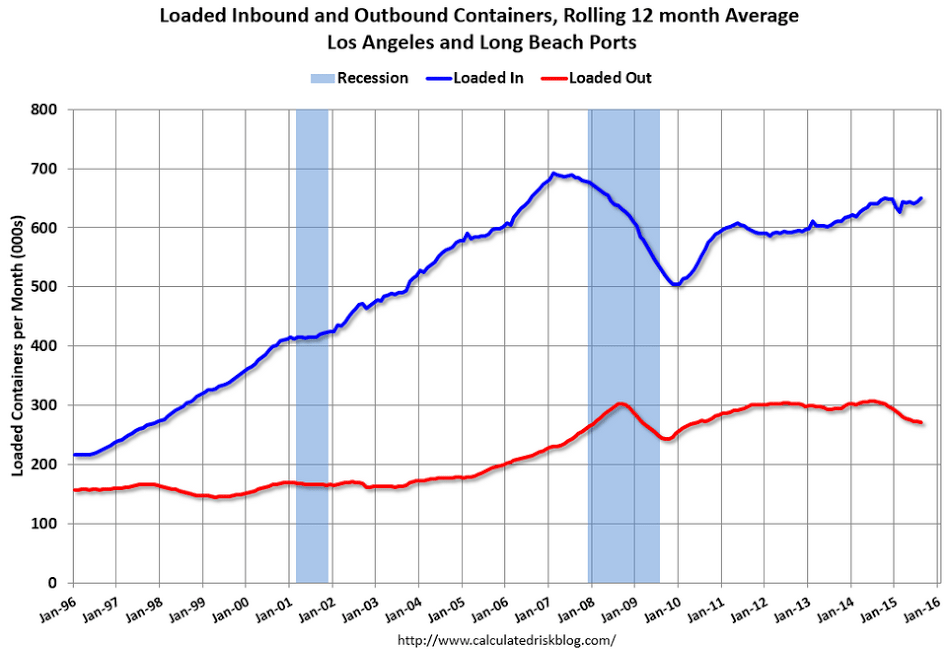
August 2015 Sea Container Exports Still Lagging

By Steven Hansen

The data for this series continues to be less than spectacular – but imports improved this month while exports degraded. The year-to-date volumes are contracting for exports but imports are now in the green.

This continues to indicate weak economic conditions domestically and globally. Consider that imports final sales are added to GDP usually several months after import – while the import cost itself is subtracted from GDP in the month of import. Export final sales occur around the date of export. Container counts do not include bulk commodities such as oil or autos which are not shipped in containers.

Japan : Merchandise Trade
er-9-17-6
Highlights
August’s merchandise trade deficit was a greater than anticipated ¥569.7 billion, much larger than July’s revised deficit of ¥268.4 billion. It was the fifth consecutive month that balance was negative. On the year, exports were up 3.1 percent while imports retreated 3.1 percent. Expectations were for an increase of 4 percent for exports and a decline of 2.2 percent for imports.

Exports to Asia were up 1.1 percent for the sixth straight increase. However, exports to China sank 4.6 percent for the first decline in six months. Exports to the EU slipped 0.2 percent for the first drop in nine months. Exports to the U.S. jumped 11.1 percent for the 12 straight increase.
er-9-17-7

Mtg Purchase Apps, CPI, Home Builder’s Index, Euro Area Balance of Trade, CEO Outlook

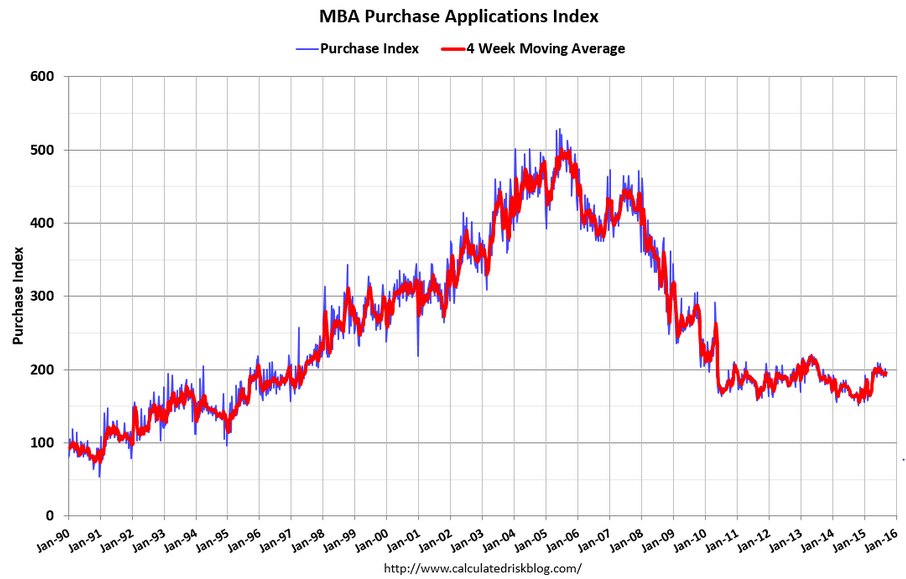
Looking like it’s turned south:

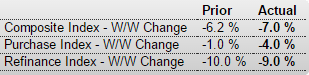
MBA Mortgage Applications
er-9-16-1
er-9-16-2

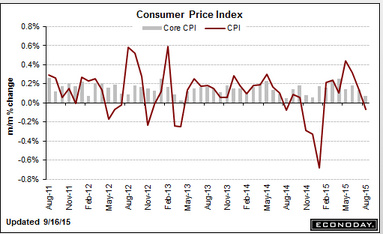
Fed continues to fail to sustain enough aggregate demand to meet it’s 2% inflation target:

Consumer Price Index
er-9-16-3
Highlights
Consumer prices came in soft in August and will not be turning up the heat on the doves at the FOMC. Pressured by gasoline, the CPI fell 0.1 percent in August with the year-on-year rate up only 0.2 percent. The core, which excludes energy and food, rose only 0.1 percent with the year-on-year rate steady at plus 1.8 percent and still under the Fed’s 2 percent goal.
And details are soft. Energy prices fell 2.0 percent in the month including a 4.1 percent decline for gasoline. Airfares were down sharply for a second month, 3.1 percent lower. Owners equivalent rent, which had been hot, rose only 0.2 percent in the month.

Showing some pressure is apparel, up 0.3 percent for a second straight month in what hints at back-to-school price traction. Otherwise, components are flat to steady such as food at plus 0.2 percent or medical care at no change.

The 1.8 percent year-on-year core rate does catch the eye but with commodity prices soft and foreign economies weak, the outlook for price acceleration remains elusive.
er-9-16-4

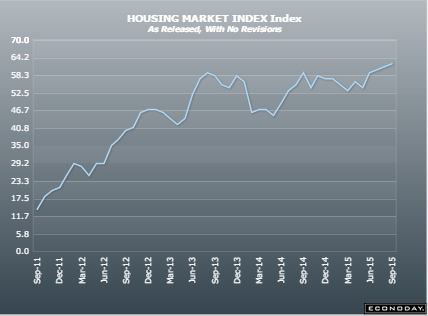
Up a bit! The new home builders are still optimistic:
er-9-16-5
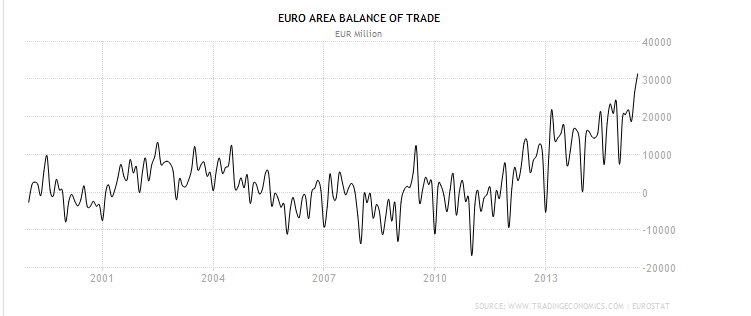
New record high- very euro friendly…
er-9-16-6

CEOs’ Outlook for U.S. Economy Dims Ahead of Fed Rate Decision

(Bloomberg) — The Business Roundtable CEO Economic Outlook Index fell to 74.1 in a quarterly survey, down from 81.3. The survey was completed between Aug. 5-26. The CEOs projected U.S. economic growth of 2.4 percent this year, down 0.1 percentage point from the previous forecast. The share of CEOs expecting a decrease in their companies’ U.S. capital spending in the next six months rose to 20 percent in the latest survey from 13 percent in the previous one. Thirty-two percent said their firms’ U.S. employment will decline, compared with 26 percent in the prior survey.

Empire State, Industrial Production, Business Inventories, Retail Sales

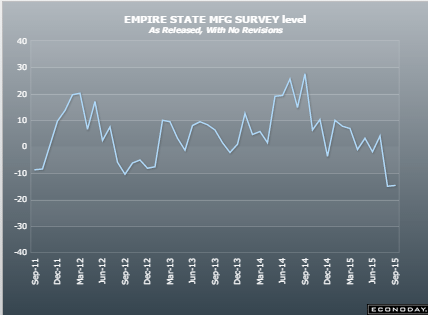
Ugly:

Empire State Mfg Survey
er-9-15-1
Highlights
The shocking weakness in August was no fluke as the Empire State index came in far below expectations for September, at minus 14.67. Next only to August’s minus 14.92, September’s reading is the weakest of the recovery, since April 2009. And, unfortunately, judging by new orders, activity in October may prove to be just as weak. New orders are deeply negative this month, at minus 12.91 vs minus 15.70 in August and the fourth straight negative reading. And manufacturers in the New York region won’t be able to turn to backlogs which are extending their long run of contraction at minus 8.25.

Searching for positives in this report is difficult. Negative signs sweep components including shipments, at minus 7.98 following August’s minus 13.79. If extended to national data, these results point to trouble for third-quarter GDP. Employment is at minus 6.19 which is the first negative reading since all the way back in January 2013. The workweek, reflecting the weakness in shipments, is down very steeply at minus 10.31. Price data show outright contraction for finished goods at minus 5.15 — the first negative reading since November 2013. And rounding things out is a 10 point loss in the 6-month outlook to 23.21 which is the weakest since, once again, January 2013.

The negative signals from this report from August were not confirmed by other regional indications but could be confirmed as early as this morning with the August industrial production report. Strength in the auto sector gave manufacturing a lift in June and July but this lift, given weakness in foreign markets and the energy sector, may not have extended too far, at least based on this report.
er-9-15-2

Bad here too, as excess prior inventory building led to production cuts:

Industrial Production
er-9-15-3
Highlights
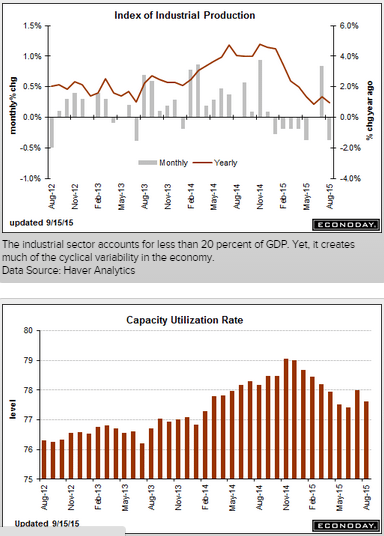
A reversal in the auto sector pulled down industrial production in August, falling 0.4 percent vs the Econoday consensus for a 0.2 percent decline. The manufacturing component fell 0.5 percent, also deeper than the consensus at minus 0.3 percent. In an offset, gains in July proved more robust than initially reported with total industrial production revised 3 tenths higher to plus 0.9 percent and manufacturing revised 1 tenth higher, now also at plus 0.9 percent.

Motor vehicle production is August’s disappointment, down 6.4 percent following July’s giant 10.6 percent spike. When excluding motor vehicle production, however, industrial production was unchanged in August following respectable gains of 0.3 percent in the prior two months. But these readings are far from spectacular and the weakness in the latest month could be a signal of retrenchment tied to Chinese-based volatility.

Turning to the report’s other two components, utility production rose 0.6 percent in August with mining at minus 0.6 percent. Mining, hit by weak commodity prices, has been hurting all year with the year-on-year reading at minus 3.2 percent. Utilities, however, are up 3.2 percent year-on-year which leads the major components as manufacturing’s year-on-year rate is a soft looking plus 1.4 percent. Total industrial production is up only 0.9 percent year-on-year.

This weakness is reflected in capacity utilization which is at 77.6 percent in the August report, down 4 tenths in the month and 2 tenths lower than consensus. Manufacturing utilization is at a soft 75.8 percent vs an unrevised 76.2 percent in July.

The vehicle-led burst in the manufacturing sector faded noticeably by summer’s end, a reminder that foreign demand for U.S. goods is weak and that the domestic energy sector is suffering. The consumer is the lead horse for the economy, making up for factory slack that the doves are certain to cite at this week’s FOMC.
er-9-15-4

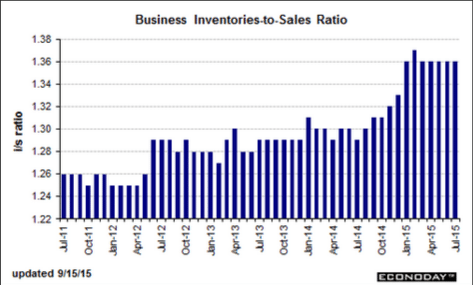
The inventory build was small, but weak sales kept inventory to sales ratio too high.

Note the July inventory build in autos led to the August cutback in production just reported:

Business Inventories
er-9-15-5
Highlights
The nation’s inventories remain slightly on the heavy side, up an as-expected 0.1 percent in July vs a 0.1 percent gain in sales that leaves the stock-to-sales ratio at 1.36, substantially higher than 1.29 a year ago.

Retail inventories rose 0.6 percent in July with the build, however, centered in vehicles which is positive given the strength, evident in this morning’s retail sales report, of strong consumer demand for vehicles. Excluding vehicles, retail inventories rose a manageable 0.2 percent. Building materials rose 0.6 percent which may be a problem given weakness for this component in the August retail sales report. The stock-to-sales ratio for retail is unchanged at 1.46.
er-9-15-6

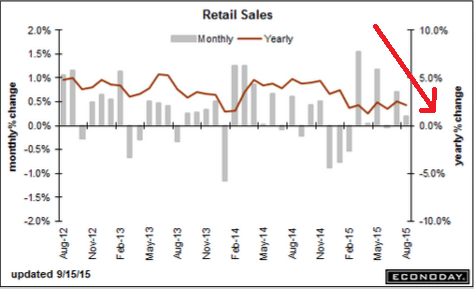
I don’t see this as good news:

Retail Sales
er-9-15-7
Highlights
For a second report in a row, upward revisions highlight solid growth in retail sales. Retail sales rose 0.2 percent in August with ex-auto at plus 0.1 percent and ex-auto ex-gas at plus 0.3 percent. These are all 1 tenth below consensus. July, however, shows broad upward revisions with total sales at a very strong plus 0.7 percent vs an initial plus 0.6 percent. Ex-auto for July is revised upward by 2 tenths to plus 0.6 percent and ex-auto ex-gas revised upward by 3 tenths to plus 0.7 percent.

Turning first to strength in the August data, motor vehicles rose 0.7 percent on top of July’s 1.4 percent gain. These are very solid readings for a very important component that points squarely at a healthy and confident consumer. Restaurants, another component tied to discretionary health, rose a very strong 0.7 percent to extend a run of gains. On the weak side are gasoline stations where, due to lower gas prices, sales fell 1.8 percent. But this decline actually underscores one of the reasons behind the consumer’s health unlike, however, declines in building materials, down 1.8 percent, and furniture, down 0.9 percent. Yet both of these declines follow very strong gains in the prior month.

Taken together, July and August point to a very strong start to the third quarter for the consumer, a fact that plays into the hands of the hawks at this week’s FOMC. Still, the doves can argue that slowing in August could point to negative effects from China-based volatility.
er-9-15-8

Producer Price Index, Consumer sentiment, Italy IP

United States : PPI-FD
er-9-11-1

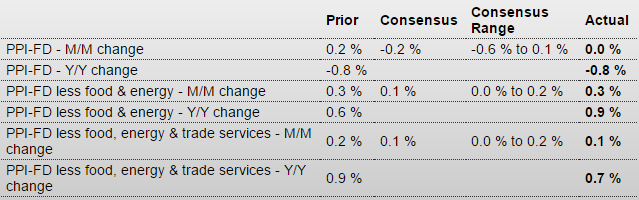
Down again, and not wrong to say it peaked shortly after oil prices collapsed. See chart below:

United States : Consumer Sentiment
er-9-11-2
Highlights
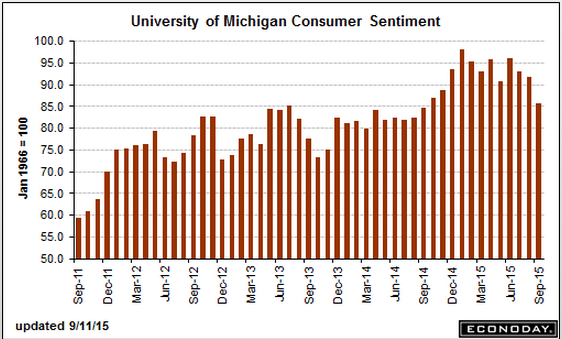
Just when you think you’ve gotten through the week, consumer sentiment dives and, perhaps, tips the balance against a rate hike. The mid-month September flash for the consumer sentiment index is down more than 6 points to 85.7 which is below Econoday’s low-end forecast. The index is now at its lowest point since September last year.

Weakness is centered in the expectations component which is down more than 7 points to 76.4, also the lowest reading since last September. Weakness in this component points to a downgrade for the outlook on jobs and income. The current conditions component also fell, down nearly 5 points to 100.3 for its weakest reading since October. Weakness here points to weakness for September consumer spending. Inflation readings are quiet but did tick 1 tenth higher for both the 1-year outlook, at 2.9 percent, and the 5-year, at 2.8 percent.

New York Fed President William Dudley himself has said he is focused on this report as an early indication of how U.S. consumers are responding to Chinese-based market turbulence. These results offer a rallying cry for the doves at next week’s FOMC meeting.
er-9-11-3

Low euro helping Italy:

Italy : Industrial Production
er-9-11-4
Highlights
The goods producing sector comfortably exceeded expectations in July. A 1.1 percent monthly increase in output ex-construction followed a minimally smaller revised 1.0 percent drop in June for annual workday adjusted growth of 2.7 percent, up from minus 0.3 percent at the end of the second quarter. The monthly profile remains volatile but the trend at least appears to be mildly positive.

July’s monthly bounce, the sharpest since June 2014, was reassuringly broad-based. The erratic energy subsector (7.1 percent) led the way but there were tidy gains too in consumer goods (1.0 percent), capital goods (0.3 percent) and intermediates (0.6 percent).

July’s data put overall industrial production (ex-construction) 0.7 percent above its average level in the second quarter when it climbed 0.5 percent versus the January-March period. Moreover, while August’s manufacturing PMI (53.8) saw its lowest level since April, it still indicated further healthy increases in both output and, importantly, new orders. Accordingly it looks as if goods production should provide useful support to third quarter GDP growth. That said, the sector still has a long way to go to get anywhere near its pre-Great Recession peak in April 2008. Compared with then, output is still down some 24 percent.