FOMC preview

My guess is the GDP forecast the Fed is now getting from it’s staff is not a downgrade from previous forecasts, and may even be an upgrade due to:

  • The blowout durable goods numbers
  • The drops in claims following the high unemployment number
  • The private forecasts on average show 65,000 new jobs and unemployment falling to 4.9 on Friday
  • Anecdotal reports from big cap old line corps show no recession in sight
  • But still data dependent with ADP, GDP, and deflator tomorrow am

Yes, it has been about domestic demand, but they now realize exports have taken up the slack and are holding up employment and real gdp, as well as contributing to inflation.

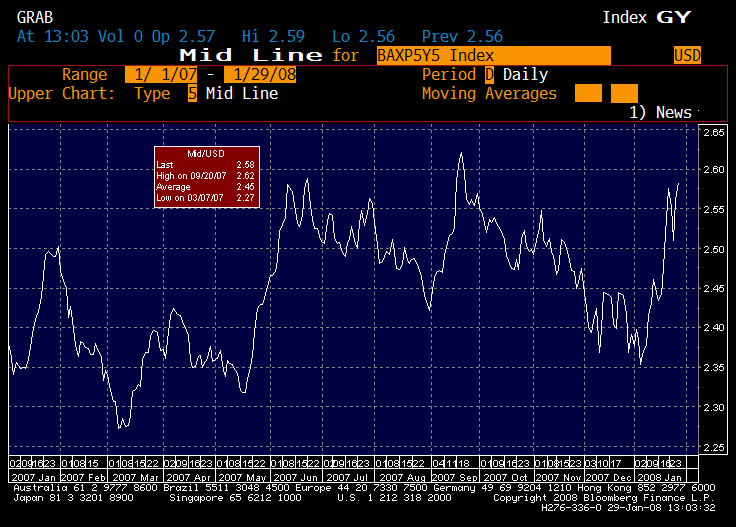
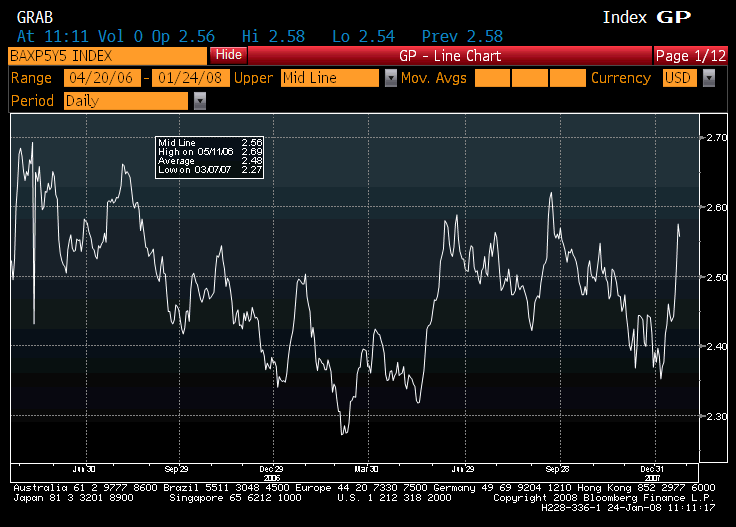
Staff inflation report will show deterioration of both headline CPI and core measures, along with tips fwd breakevens moving higher and survey info showing elevating prices paid and received. And food/fuel/import and export prices all trending higher, risking core converging to headline CPI.

Higher crude prices are now attributed to higher US demand by the markets and the Fed.

Many ‘financial conditions’ have eased:

  • LIBOR has come down over 150 bp since the Dec 18 meeting even as FF are down only 75. mtg rates way down as well, and at very low levels.
  • Commercial mortgage rates somewhat higher, but from very low levels previously
  • Equities have firmed up since the soc gen liquidations (and look very cheap to me)

The last bit of system risk is from a downgrade of the monolines and that risk seems to be diminishing.

The ratings agencies have been reviewing them intensely for 6 months, and both the capital of the monolines and the credit quality of the insured bonds must still be adequate for the AAA rating. And in any case the risk is to go to AA, not to junk, meaning that credit per se isn’t the issue at all. The issue is forced selling by those who can’t legally hold insured bonds if the rating drops. That’s a very different issue.

Wouldn’t surprise me that if tomorrows numbers are as expected, and the fed cuts 50, markets start to look at that as possibly the last move, and reprice accordingly, with FF futures trading closer to a 3% trough than a 2% trough.

An unchanged decision may also result in a near 3% FF futures trough, with a couple of 25 cuts priced in.


♥

Responses to comments on the ‘Comments on Brian Wesbury article’ post

Post: Comments on Brian Wesbury article

Comment by ‘Hoover Printing Press‘:

Warren congrats on your new website.

Thanks!

I keep reading that the bond insurers have let banks keep lots of “accounting issues” off the books – thus affecting tier 1 capital requirements – currently to the banks advantage. Without the bond insurers and their AAA rating by moody and sp (fitch has already lowered ratings down from AAA) the banks will have to scramble for lots of capital without the insurance, barclays recent estimate upwards of 150 billion. I remember Buffet referring to Financial WMD’s.

Yes, but that’s a matter of institutional structure. The government has several options.

For example:

  • The government could change bank ‘haircuts’ to capital by allowing AA insured bonds to have the same or only marginally higher capital charges as AAA bonds. The capital requirements are somewhat arbitrary to being with and meant to serve public purpose.
  • The government could offer some for of supplemental insurance at a fee to investors holding the AAA insured bonds in question. Again, for example, the fee could perhaps be 1%, and the government could guarantee a price of 97 to any investor who paid the fee. The government will probably make a profit on this type of program, as the monolines’ capital will still be in first lost position, and even if they are downgraded to AA, the implication is they will have more than sufficient capital to cover all losses. That is what AA means.

I read articles that NY is in a mad scramble to get buffet and others to bring some assurances to the bond insurance industry because the muni debt market is going to seize up without bond insurance and what the AAA ratings of that insurance lends to capital requirements and “accounting issues.”

Yes. There are some institutional ‘land mines’ in place that the government can either prevent from being tripped or defuse directly (for a fee), as above.

In hoover’s time I remember reading from Rothbard’s great depression I believe that he printed but the banks used the money to shore up their reserves, they did not want to lend and spur the economy at the cost of their own survival.

Under that gold standard regime, the government was limited in what it could do. Deficit spending carried the risk of loss of gold reserves, for example. And, in fact, the US was forced off the gold standard in 1934 domestically and devalued for foreign holders of $. This was the only actual default in US history.

So why is Bush and congress giving joe six pack 150B when he could have used that to back the bond insurers and the banks?

No comment.. You must be new here??? :)

Possibly getting the ratings agency to save some face and for fitch to bring AAA ratings back to the bond insurers?

Or the supplemental plan, above, that doesn’t bail out the insurers.

On another point, you claim a large difference between hoover’s problems and our problems today is the gold standard and floating exchange rates. Unfortunately I must press you as to how that is so when the folks at the top of this chart (china) http://en.wikipedia.org/wiki/List_of_countries_by_current_account_balance have fixed exchange rates relating to the folks at the bottome of it (USA). Soros is claiming the USA will soon lose reserve currency status.

A fixed exchange rate ‘forces’ you to run a trade surplus to sustain sufficient reserves of gold or the reserve currency of choice. It also limits the ability to conduct countercyclical deficit spending as that leads to loss of reserves and default/devaluation/etc.

China has a ‘dirty float’, which means the currency is not convertible, but instead they intervene at various prices.

Not at all the same thing.

I am not so sure the Euro will be able to weather a global financial meltdown and perhaps in economic warfare, keeping reserve currency status is worth fighting over.

What is it, and why do you care?

With bush selling lots of scatter bombs to the house of Saud, at least we are trying to keep friends who have control over oil.

Still with the USA’s current account balance the worst of any country on the planet,

Imports are real benefits, exports real costs. In general, the larger your trade deficit, the higher your standard of living.

40K nukular bombs and a war machine that eats up large domestic resources, and a consumer base whose only skill is to shop till princess drops,

Consumption is the only point of economics.

I am not so sure what you are trying to save to get USA to deficit spend even MORE?

Right now, more deficit spending of the type proposed will mainly increase inflation.

Would it be so bad if that guy “dfense” from the mike douglas movie “FALLING DOWN” gets put out of a missle building job and starts fishing on the dock of the bay wasting time?


Comment by Scott Fullwiler:

Wesbury’s basically a monetarist (everything that goes wrong is the Fed’s fault for creating either too much or too little “liquidity”) operating with a gold standard model.

Yes, that’s where we don’t agree on causation and risks. But interesting that even in that paradigm, he doesn’t see the risks the Fed does, as they are in the same gold standard paradigm.

That said, he’s been bullish on the economy since 2002, and he’s been mostly right in that, except that he’s also been saying inflation is right around the corner since then, too, given weak dollar, strong gold.

And I’ve seen inflation underway due to Saudis acting as the swing producer and hiking price continuously.

And I see the weak $ as a change in preferences of non-resident holdings of financial assets.

Until a year and a half ago he was also claiming that the large spread b/n st and lt Treasuries was another a sign of inflation,

And I say it’s a sign of what investors think the Fed will be doing next. So to that extent, the curve reflects investor expectations. But there is also a lot of institutional structure that steers maturity preferences; so, the result is a mix of the two.

though he decided bond markets were being irrational once the yield curve inverted (again, if inflation is right around the corner).

Again, that reflects investor expectations.

I’ve used him in my classes for several years as a “balance” to the Levy view of “debt deflation’s around the corner.” Interesting to see that you and he are on the same page now at least regarding state of the economy, since you’ve been pessimistic (at least in long run, given small govt deficit) while he’s been a non-stop bull.

Yes, I’ve been expecting lower domestic demand since the financial obligations ratio go to where it go in Q2 2006, due to the shrinking budget deficit. What I missed was how strong exports would be, mainly on our three pronged weak dollar policy that has been scaring foreigners away from holding $US financial assets.

This includes calling CB’s currency manipulators if they buy $US, aggressive Middle Eastern policy, and the Fed’s apparent lack of concern for the value of the currency (inflation). Fundamentally, the falling budget deficit is good for the $US, but technically government policy has triggered an ‘inventory liquidation’ over seas that is causing exports to boom.

And now we are learning the hard way (or should be) what an export driven economy looks like – weak domestic demand due to high prices and full employment as we build goods and services for others.


♥

Comments on Brian Wesbury article

He’s got the data right, and I agree with all he concludes from it. All he’s missing is the difference he points two between now (unlimited funds available) and The Great Depression (banks short of lendable funds), including what the Fed presumably ‘did’ each time, are the differences between the constraints of the gold standard of that time vs today’s floating fx policy.

The Economy Is Fine (Really)

by Brian Wesbury

It is hard to imagine any time in history when such rampant pessimism about the economy has existed with so little evidence of serious trouble.

True, retail sales fell 0.4% in December and fourth-quarter real GDP probably grew at only a 1.5% annual rate. It is also true that in the past six months manufacturing production has been flat, new orders for durable goods have fallen at a 0.8% annual rate, and unemployment blipped up to 5%. Soft data for sure, but nowhere near the end of the world.

It is most likely that this recent weakness is a payback for previous strength. Real GDP surged at a 4.9% annual rate in the third quarter, while retail sales jumped 1.1% in November. A one-month drop in retail sales is not unusual. In each of the past five years, retail sales have reported at least three negative months. These declines are part of the normal volatility of the data, caused by wild swings in oil prices, seasonal adjustments, or weather. Over-reacting is a mistake.

A year ago, most economic data looked much worse than they do today. Industrial production fell 1.1% during the six months ending February 2007, while new orders for durable goods fell 3.9% at an annual rate during the six months ending in November 2006. Real GDP grew just 0.6% in the first quarter of 2007 and retail sales fell in January and again in April. But the economy came back and roared in the middle of the year — real GDP expanded 4.4% at an annual rate between April and September.

With housing so weak, the recent softness in production and durable goods orders is understandable. But housing is now a small share of GDP (4.5%). And it has fallen so much already that it is highly unlikely to drive the economy into recession all by itself. Exports are 12% of the economy, and are growing at a 13.6% rate. The boom in exports is overwhelming the loss from housing.

Personal income is up 6.1% during the year ending in November, while small-business income accelerated in October and November, during the height of the credit crisis. In fact, after subtracting income taxes, rent, mortgages, car leases and loans, debt service on credit cards and property taxes, incomes rose 3.9% faster than inflation in the year through September. Commercial paper issuance is rising again, as are mortgage applications.

Some large companies outside of finance and home building are reporting lower profits, but the over-reaction to very spotty negative news is astounding. For example, Intel’s earnings disappointed, creating a great deal of fear about technology. Lost in the pessimism is the fact that 20 out of 24 S&P 500 technology companies that have reported earnings so far have beaten Wall Street estimates.

Models based on recent monetary and tax policy suggest real GDP will grow at a 3% to 3.5% rate in 2008, while the probability of recession this year is 10%. This was true before recent rate cuts and stimulus packages. Now that the Fed has cut interest rates by 175 basis points, the odds of a huge surge in growth later in 2008 have grown. The biggest threat to the economy is still inflation, not recession.

Yet many believe that a recession has already begun because credit markets have seized up. This pessimistic view argues that losses from the subprime arena are the tip of the iceberg. An economic downturn, combined with a weakened financial system, will result in a perfect storm for the multi-trillion dollar derivatives market. It is feared that cascading problems with inter-connected counterparty risk, swaps and excessive leverage will cause the entire “house of cards,” otherwise known as the U.S. financial system, to collapse. At a minimum, they fear credit will contract, causing a major economic slowdown.

For many, this catastrophic outlook brings back memories of the Great Depression, when bank failures begot more bank failures, money was scarce, credit was impossible to obtain, and economic problems spread like wildfire.

This outlook is both perplexing and worrisome. Perplexing, because it is hard to see how a campfire of a problem can spread to burn down the entire forest. What Federal Reserve Chairman Ben Bernanke recently estimated as a $100 billion loss on subprime loans would represent only 0.1% of the $100 trillion in combined assets of all U.S. households and U.S. non-farm, non-financial corporations. Even if losses ballooned to $300 billion, it would represent less than 0.3% of total U.S. assets.

Beneath every dollar of counterparty risk, and every swap, derivative, or leveraged loan, is a real economic asset. The only way credit troubles could spread to take down the entire system is if the economy completely fell apart. And that only happens when government policy goes wildly off track.

In the Great Depression, the Federal Reserve allowed the money supply to collapse by 25%, which caused a dangerous deflation. In turn, this deflation caused massive bank failures. The Smoot-Hawley Tariff Act of 1930, Herbert Hoover’s tax hike passed in 1932, and then FDR’s alphabet soup of new agencies, regulations and anticapitalist government activity provided the coup de grace. No wonder thousands of banks failed and unemployment ballooned to 20%.

But in the U.S. today, the Federal Reserve is extremely accommodative. Not only is the federal funds rate well below the trend in nominal GDP growth, but real interest rates are low and getting lower. In addition, gold prices have almost quadrupled during the past six years, while the consumer price index rose more than 4% last year.

These monetary conditions are not conducive to a collapse of credit markets and financial institutions. Any financial institution that goes under does so because of its own mistakes, not because money was too tight. Trade protectionism has not become a reality, and while tax hikes have been proposed, Congress has been unable to push one through.

Which brings up an interesting thought: If the U.S. financial system is really as fragile as many people say, why should we go to such lengths to save it? If a $100 billion, or even $300 billion, loss in the subprime loan world can cause the entire system to collapse, maybe we should be working hard to build a better system that is stronger and more reliable.

Pumping massive amounts of liquidity into the economy and pumping up government spending by giving money away through rebates may create more problems than it helps to solve. Kicking the can down the road is not a positive policy.

The irony is almost too much to take. Yesterday everyone was worried about excessive consumer spending, a lack of saving, exploding debt levels, and federal budget deficits. Today, our government is doing just about everything in its power to help consumers borrow more at low rates, while it is running up the budget deficit to get people to spend more. This is the tyranny of the urgent in an election year and it’s the development that investors should really worry about. It reads just like the 1970s.

The good news is that the U.S. financial system is not as fragile as many pundits suggest. Nor is the economy showing anything other than normal signs of stress. Assuming a 1.5% annualized growth rate in the fourth quarter, real GDP will have grown by 2.8% in the year ending in December 2007 and 3.2% in the second half during the height of the so-called credit crunch. Initial unemployment claims, a very consistent canary in the coal mine for recessions, are nowhere near a level of concern.

Because all debt rests on a foundation of real economic activity, and the real economy is still resilient, the current red alert about a crashing house of cards looks like another false alarm. Warren Buffett, Wilbur Ross and Bank of America are buying, and there is
still $1.1 trillion in corporate cash on the books. The bench of potential buyers on the sidelines is deep and strong. Dow 15,000 looks much more likely than Dow 10,000. Keep the faith and stay invested. It’s a wonderful buying opportunity.

Mr. Wesbury is chief economist for First Trust Portfolios, L.P.


Nobel economist Joseph Stiglitz warns of 1930 STYLE LIQUIDITY TRAP

US Slides into Dangerous 1930s ‘Liquidity Trap’

The Daily Telegraph’s Ambrose Evans-Pritchard details interesting insights from Joseph Stiglitz.

No, common errors.

The United States is sliding towards a dangerous 1930s-style “liquidity trap”

Probably not – rare with floating exchange rates.

that cannot easily be stopped by drastic cuts in interest rates, Nobel economist Joseph Stiglitz has warned.

That part is true. Interest rates don’t matter much. It was the TAF that narrowed FF/LIBOR, for example, not rate cuts.

“The biggest fear is that long-term bond rates won’t come down in line with short-term rates. We’ll have the reverse of what we’ve seen in recent years, and that is what is frightening the markets,” he told the Daily Telegraph, while trudging through ice and snow in Davos.

Hardly the biggest fear.

Also, note that when the curve went negative, the media flashed recession warnings. When it went positive, they didn’t report the opposite.

“The mechanism of monetary policy is ineffective in these circumstances.

Fed and ECB research shows changes in interest rates don’t do much in any case.

I’m not saying it won’t work at all: it will help the banking system but the credit squeeze is going to go on because nobody trusts anybody else. The Fed is pushing on a string,” he said.

This is very different from the early 1930s.

The grim comments came as markets continued to suffer wild gyrations, reacting to every sign of contagion spreading to Europe, Asia, and emerging markets.

Wall Street has begun to stabilize on talk of a rescue for the embattled bond insurers, MBIA and Ambac.

Another issue that interest rates have nothing to do with.

The Fed’s 75 basis point rate cut allows the banks to replenish their balance sheet by borrowing at short-term rates and lending longer term, playing the credit ‘carry trade’,

Banks are not allowed to take that kind of interest rate risk. The regulators have strict ‘gap’ limits for banks and monitor it on a regular basis.

hence the 9pc rise in the US financials index yesterday. But confidence remains fragile.

I think that was on the monoline rumors as well as prospects for strong earnings. And they were sold down to very low levels previously.

Professor Stiglitz, former chair of the White House Council of Economic Advisers, said it takes far too long for monetary policy to work its magic. This will not gain much traction in the midst of a housing crash.

True. Not much is a very strong function of interest rates.

“People have been drawing home equity out of the houses at a rate of $700bn or $800bn a year. It’s been a huge boost to consumption, but that game is now up.

Most studies don’t show much of a wealth effect or ‘cash out’ effect. The Fed has a three cents on the dollar rule of thumb on the way up, maybe less on the way down.

House prices are going to continue falling,

Maybe.

and lower rates won’t stop that this point,” he said.

As above.

“As a Keynesian,

Keynes wrote in the context of the gold standard of the time, though it probably wasn’t his first choice of regimes.

I’d say the biggest back for the buck in terms of immediate stimulus would be unemployment assistance and tax rebates for the poor. That will feed through quickly, but set against the magnitude of the problem, even a fiscal stimulus package of $150bn is not going to be enough,” he said

Enough for what? It’s about 1% of GDP. If exports are strong, GDP may be running at 2% or more without the fiscal package.

And it will add demand when demand is already enough to drive up CPI faster than the Fed likes.

(Way less inflationary and way more beneficial to offer a job at a non disruptive wage to anyone willing and able to work to sustain full employment by ‘hiring off the bottom’ rather than simply adding to demand as planned.)

“The distress is going to be very severe. Around 2m people have lost all their savings,” he did.

How does he know that? Guessing from his projections of home prices?

NASDAQ president Bob Greifeld expressed a rare note of optimism at the World Economic Forum, predicting a swift rally as the double effects of the monetary and fiscal boost lift spirits.

“I think the stimulus package that’s been proposed by the President, to the extent that this is passed in rapid fashion by Congress, has the ability to forestall a recession,” he said.

True, and if there wasn’t going to be a recession, it will magnify the expansion and inflation.

“At the moment, our business is doing better than it ever has because the volumes have been incredibly high. So, it’s been very good for us,” he said.

No recession there.

There were scattered signs of improvement across the world today, with Germany’s IFO confidence index defying expectations with a slight rise in January. Japan’s quarterly export volume held up better than expected.

Recession is currently mostly an expectation, not a current condition.

Even so, the global downturn may already have acquired an unstoppable momentum, requiring months or even years to purge the excesses from the bubble.

Precious few signs of a real economic downturn yet. Just some possible weakening.

Professor Stiglitz blamed the whole US economic establishment for failing to regulate the housing and credit markets adequately, allowing huge imbalances to build up.

Institutional structure provided incentives for lender fraud that resulted in a lot of aggregate demand from high risk borrowers getting credit for a while.

“The Federal Reserve and the Bush Administration didn’t want to hear anything about these problems. The Fed has finally got around to closing the stable door (on subprime lending), but the after the horse has already bolted,” he said.

Whatever that means.


♥

Fed cuts increasing demand and lowering the dollar support crude prices

Oil futures jump back above $90 a barrel

by John Wilen

Oil futures jumped back above $90 a barrel Friday, adding to the previous session’s sharp gains on a view that the recession worries that pulled prices lower in recent weeks may have been overblown.

So markets are now linking rising oil prices to a stronger economy? This is a change in rhetoric from the previous talk that high oil prices were slowing demand, to the current talk that high demand is driving up oil prices.

This would signal to the Fed that markets are saying the economy is now strong enough to cause further inflation.

Energy investors were heartened by recent moves by the Federal Reserve and Congress to shore up the economy, which could prevent oil demand from slowing as much as many had feared.

The Fed doesn’t want this to happen – markets seeing their moves as supportive of higher inflation.

“This week’s emergency interest rate cut by the Fed and the economic stimulus plan proffered by Congress appear to have, for now, stemmed fears of a looming recession in the U.S.,” said Addison Armstrong, director of exchange traded markets at TFS Energy Futures LLC, of Stamford, Conn., in a research note.

Word that Chinese oil demand grew by 6.4 percent in December, the highest rate in months, contributed to oil’s advance.

Concerns that demand from the booming Chinese and Indian economies is outstripping global oil supplies helped push oil to records above $100 earlier this month.

Rising oil prices are also signaling that India and China continue to grow quickly enough to drive up prices.

Light, sweet crude for March delivery rose $1.30 to settle at $90.71 on the New York Mercantile Exchange after rising as high as $91.38. Oil futures last closed above $90 last Friday.

While investors believe the government’s $150 billion stimulus plan and the Fed’s rate cuts will stave off a serious economic slowdown, rate cuts also tend to weaken the dollar, giving investors another reason to buy oil futures. Crude futures offer a hedge against a falling dollar, and oil futures bought and sold in dollars are more attractive to foreign investors when the greenback is falling.

And the Fed’s cuts have weakened the dollar and also contributed to the higher oil prices.

In other words, the article is stating that the rate cuts caused both strong demand and a weak dollar, both driving up inflation.

The financial media is beginning to look past recession fears and to inflation.

Look for article about how the Fed is falling behind the inflation curve.

“When (investors in foreign) countries go to buy oil, they’re buying it on sale,” said James Cordier, president of Liberty Trading Corp., in Tampa, Fla.

Many analysts believe the weakening dollar helped draw speculative investors into oil markets this fall and winter, driving oil prices
above the $100 mark.

Other energy futures also rose Friday. February heating oil futures jumped 4.28 cents to settle at $2.5191 a gallon on the Nymex while February gasoline futures added 3.54 cents to settle at $2.3182 a gallon. Heating oil and gasoline prices were supported by news that Valero Energy Corp.’s 255,000 barrel a day refinery in Aruba was shut down due to a fire.

February natural gas futures rose 18.1 cents to settle at $7.983 per 1,000 cubic feet.

In London, March Brent crude rose $1.83 to settle at $90.90 a barrel Friday on the ICE Futures exchange.


♥

Refi madness

Homeowners rushing to refinance mortgages

Federal Reserve’s surprise rate cut sparked a refinancing boom

This week’s surprise rate cut by the Federal Reserve not only held Wall Street and investors in thrall, it’s also kicked into high gear a rush by homeowners across the country to refinance their mortgages at today’s lower rates.

Thirty-year fixed-rate mortgages now carry an average interest rate of 5.57 percent, down from 5.75 percent last week and from 6.32 percent a year ago, according to a Bankrate.com national survey. That’s bringing them within shouting distance of the historic low of 5.21 percent set in June 2003, when the housing sector was expanding quickly and there was a stampede of mortgage refinancings.

(snip)

The Mortgage Bankers Association said refinancings last week reached their highest levels since April, 2004. The trade group’s Market Composite Index, a measure of mortgage loan application volume, rose 8.3 percent from the previous week’s level.

David Motley, president of Fort Worth-based Colonial National Mortgage, which originates loans in all 50 states, is expecting an even larger applications surge this week and beyond.

“For the last six to eight months all people have heard about is the subprime crunch,” he said. “There is an incorrect impression that because of the subprime mess regular people can’t get a loan or a refinancing right now.”

Seems the door is wide open now and seems a lot of potential defaults analysts were predicting may not happen.

Refinancing rush

The rush to refinance could get a further boost from the government’s tentative economic stimulus package. The package would allow government-sponsored Fannie Mae and Freddie Mac to buy mortgages worth as much as $729,750, up from a prior cap of $417,000 limit. This would make refinancing more feasible for some owners of expensive mortgages.

Yes, the government measures are all coming to bear from a variety of angles.

Colonial National’s Motley noted that mortgage rates were attractive before this week’s Fed action, but “the Fed move got everyone’s attention and people are now looking at rates again,” he said, adding that refinancing funds are “readily available to many Americans.”

Even so, experts say that securing refinancings at terms they want may prove difficult for owners whose homes have slumped in value.

Joe Dougherty, a media relations officer for RAND Corp. said his family’s four-bedroom colonial home in Haymarket, Va., was appraised at $500,000 several years ago, but he fears it is now worth only $450,000.

Dougherty hopes to refinance two home loans he holds on the house. He would like to combine them into a single 30-year fixed-rate mortgage and has discussed his situation with a loan officer friend. Dougherty’s calculations indicate a lower valuation that would nix the deal he wants, but he has scheduled a home appraisal.

What to do with stimulus rebate?

There also are fears that many banks, stung by losses on home loans to subprime borrowers, have adopted lending standards that will be too tough or taxing to meet. This is particularly worrisome for those whose credit scores have been hurt by heavy use of credit cards in recent years.

But for owners with good credit, the issue now may be more one of timing.

And that’s still the majority.

“I’m definitely interested in refinancing my mortgage, but I wonder if I should wait until after the Fed meeting next week,” said Matt Schmidt, a market specialist with Computer Task Group Inc. in Buffalo, N.Y. who bought a $150,000 Lewiston, N.Y., home three years ago.

Schmidt noted that the Fed, which holds a two-day meeting starting Tuesday, has signaled it is disposed to further rate cuts that could send mortgage rates still lower. So he doesn’t want to refinance too soon if even better rates will be available shortly.

This is very common.. When the Fed pauses, these people pull the trigger.

Also, the bond rally caused a lot of mortgage securities to shorten and hedges got bought in.

A sell off in bonds will have the reverse effect, and with the increased low coupon production, the convexity selling could be a lot more severe than the buying was on the way down.


♥

The Fed’s next move

If I were a mainstream economist and on the FOMC (I’m not either, they are both), and world equity markets were firm going into the meeting next week with the monoline issue put to bed, I’d opt for no cut.

That would be expected to rally the $, take down gold and most other commodities, and be taken as a strong move to ‘keep expectations well anchored’ before they had a chance to elevate.

Equities might sell off initially, but be encouraged with the knowledge the Fed was keeping inflation under control, and therefore not get involved into a prolonged, rate hiking fight against inflation down the road.

Also, confidence in the economy would be conveyed, as the no cut decision would be taken as a statement from the Fed that the economy didn’t need further rate cuts.