CNBC: Government in way over their heads as earnings estimates are lowered


[Skip to the end]

Things have come apart very quickly as government officials have demonstrated they are in this way over their heads.

Especially as it becomes clear the enormous efforts expended to get the TARP passed will do little if anything to address any of the current woes.

Government, including the Fed, has lost what little credibility it may have had.

While they have the ‘silver bullet’ at hand with fiscal policy, they are reluctant to use it due to deficit myths left over from the gold standard that are no longer applicable.

Note earnings growth has moderated but not yet gone negative, ex financials.

Not reported is that core earnings for financials (ex writeoffs) are probably reasonably strong.

Q3 Earnings: Not So Pretty

by Juan Aruego

This earnings season is looking ugly and there hasn’t been much talk about which sectors are bringing the pain.

What’s different this quarter is that expectations for everyone are falling.

Until now, the weakness has been concentrated in banks. But this quarter, the consumer discretionary sector is getting crushed. Estimates have plunged from +15% on July 1st to -9% today.

Other depressing factoids:

  • Four sectors are now expected to see earnings fall. Together they make up 27% of all earnings
  • Only one sector, energy, is looking at growth above seven percent. Oh, for the days when double-digit growth was de rigueur.
  • Can you believe that just three months ago, analysts thought Q3 financials’ earnings would be nearly unchanged from last year? How times have changed.

Amazingly, the ex-financials growth rate is still in the double digits, but it has fallen from 16.7% on July 1st to 11.3% now. As good as that sounds, excluding financials from the overall number is starting to feel a lot like paying attention to core CPI because it’s not as bad as overall CPI… especially since most of the upward drive is coming from the energy sector. Pull out the energy sector and the “growth” consensus plunges to -14.7%.

Here are all the numbers for you earnings wonks out there:

Q3 2008 Earnings Growth Estimates

Sector

Today

July 1st

Consumer Discretionary -9% 15%
Consumer Staples -1% 1%
Energy 53% 58%
Financials -67% -4%
Health Care 6% 8%
Industrials 3% 6%
Materials 5% 11%
Information Technology 7% 12%
Telecomm. Services -5% -4%
Utilities 3% 7%
S&P 500 Overall -4.3% 12.6%
Without Energy Firms -14.7% 4.7%
Without Financials 11.3% 16.7%

 
Special thanks to Thomson Reuters and its earnings gurus for the data to back up this story.


[top]

Where do we go after these toxic assets problem?


[Skip to the end]

Seems at this late hour the payroll tax adjustment is about all that can get the job done to immediately support demand.

Yes, the banking model is to make loans to individuals and business that become illiquid assets and match that with liabilities that are not at risk either.

So if markets put a discount on bank assets due to liquidity, implied is a premium on the liability side of banking due to its unlimited ability to fund itself.

And yes, it’s when, via securitization, for example, relatively illiquid assets are not ‘match funded’ to maturity, liquidity risk is there.

This same liquidity risk is also there when banks are not provided with secure funding due to errant institutional structure that misses that point regarding the banking model.

Beyond that is the risk of default which is a separate matter.

In the banking model this is determined by credit analysis, rather than market prices.

This is a political decision, entered into for further public purpose, and requires regulation and supervision of asset quality, capital requirements, and other rules to limit risks banks can take with their government-insured deposits.

When banks are deemed insolvent by the FDIC due to asset deterioration, they shut them down, reorganize, sell the assets and liabilities, etc.

When it’s due to excessive risk due to a failure of regulation, regulations are (at least in theory) modified. It’s all a work in progress.

I see this crisis differently than most.

We had two thing happening at once.

First, by 2006 the federal deficit had once again become too small to support the credit structure as financial obligations ratios reached limits, all due to the countercyclical tax structure that works to end expansions by reducing federal deficits as it works to reverse slowdowns by increasing federal deficits.

At the same time, while the expansion was still under way, delinquencies on sub prime mortgages suddenly shot up and it was discovered that many lenders had been defrauded by lending on the basis of fraudulent income statements and fraudulent appraisals.

Substantial bank capital was lost due to the higher projected actual losses reducing the present value of their mtg based assets. This is how the banking model works. The banks were, generally, able to account for these losses due to projected defaults and remain solvent with adequate capital.

Outside of the banking system (including bank owned SIV’s – one of many failures of regulation) market prices of these securities fell, and unregulated entities supported by investors (who took more risk to earn higher returns) failed as losses quickly exceeded capital. And with this non-bank funding model quickly losing credibility, all of the assets in that sector were repriced down to yields high enough to be absorbed by those with stable funding sources – mainly the banking system.

But the banking system moves very slowly to accommodate this ‘great repricing of risk’, and all the while the fiscal squeeze was continuing to sap aggregate demand. The fiscal package added about 1% to gdp, but it hasn’t been enough, as evidenced by the most recent downturn in Q3 GDP, which is largely the result of individuals and businesses petrified by the financial crisis.

So yes, there are both issues: the financial sector stress and the lack of demand. While they were triggered by two different forces (loan quality deteriorating due to fraud and the budget deficit getting too small), it is the combination of the two that is now suppressing demand.

The TARP may eventually alleviate some of the lending issues but only addresses the demand issue very indirectly and even then with a very long lag. Just because a bank sells some assets (at relatively low prices) doesn’t mean it will suddenly lend to borrowers who want to spend. Nor does it mean they will want to fund euro banks caught short USDs that have no fiscal authority behind their deposit insurance and bank solvency, and now appear to be in a worse downward spiral than the US. The slowing US economy has reduced the world’s aggregate demand, which was never sufficient to begin with due to too small budget deficits, via reduced exports directly or indirectly to the US.

In other words, I don’t see how the TARP will restore US or world aggregate demand in a meaningful way.

Yes, the US budget deficit has been increasing, but not nearly enough. It’s only maybe 3% of GDP currently, while the US demand shortfall is currently maybe in excess of 6% of GDP.

Cutting the payroll taxes (social security and medicare deductions, etc.) is large enough (about 5% of GDP) and returns income to the ‘right’ people who are highly likely to immediately support demand as they spend and also make their payments on their mortgages and other obligations to thereby support the financial sector in a way the TARP can’t address.

It is the ‘silver bullet’ that immediately restores output and employment. But we all know what stands in the way – deficit myths left over from the days of the gold standard that are now inapplicable with our non-convertible currency.

The line between economic failure and prosperity is 100% imaginary.

And not to forget that if we do restore output and employment (without an effective energy policy) we increase energy consumption and quickly support the forces behind much higher energy prices, which reduces are real terms of trade and works against our standard of living.


[top]

10.03 Sarkozy recoils from EU plan


[Skip to the end]

(email exchange)

Right, thanks!

>   
>   On Fri, Oct 3, 2008 at 10:01 AM, wrote:
>   
>   In a message dated 10/3/2008 01:00:23 Mountain Daylight
>   Time, wrote:
>   
>   Jean-Claude Trichet, president of the European Central Bank,
>   said the EU’s structure was ill-suited to a common bail-out
>   scheme.
>   
>   ”We do not have a federal budget, so the idea that we could
>   do the same as what is done on the other side of the Atlantic
>   doesn’t fit with the political structure of Europe.” Silvio
>   Berlusconi, the Italian prime minister, will want to be seen
>   supporting Mr Sarkozy in proposals for greater regulation. But
>   with the desperate state of Italy’s public finances – debts of
>   more than 103 per cent of gross domestic product – he will
>   not be in a position to offer much in terms of an EU bail-out
>   package.
>   
>   Bingo! Berlusconi gets it!


[top]

Payrolls


[Skip to the end]

From Karim:

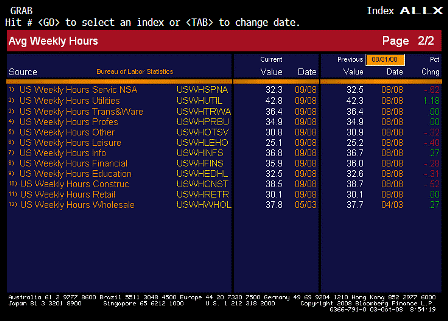
Broad-based weakness.

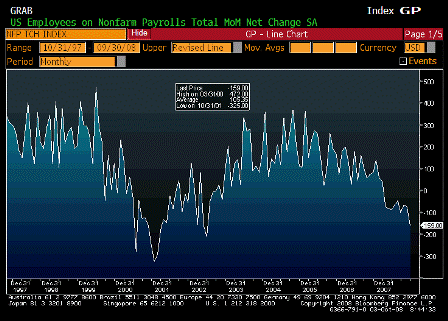
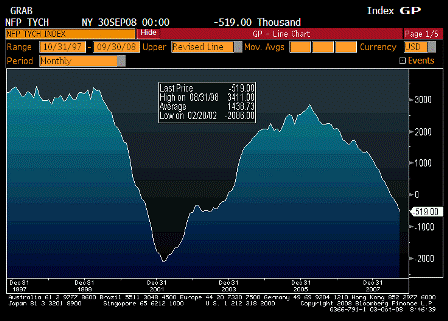
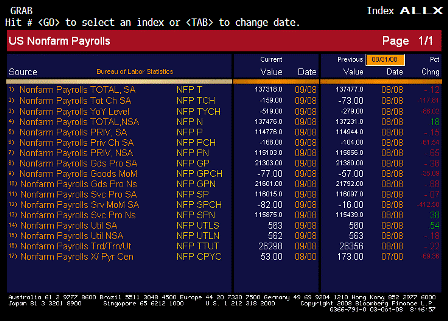
  • Payrolls -159k, net revisions +4k.
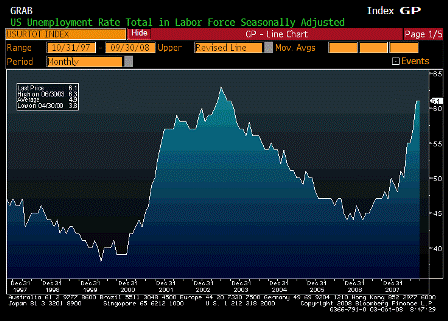
  • Unemployment rate rises from 6.055% to 6.125%.
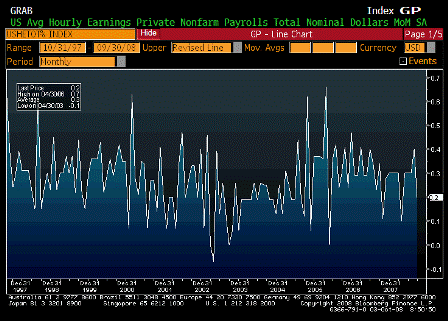
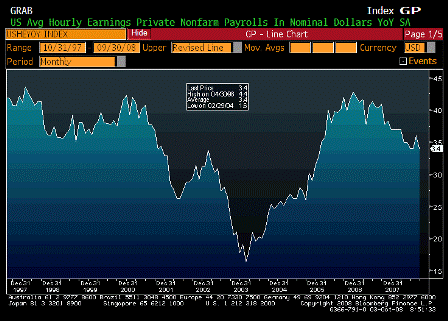
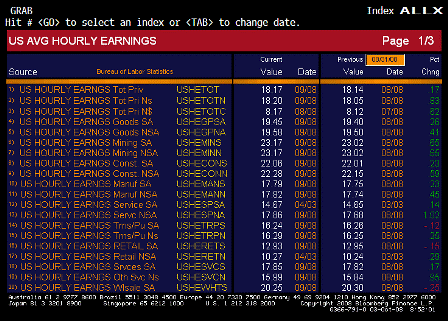
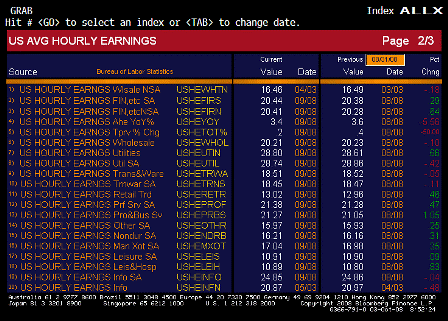
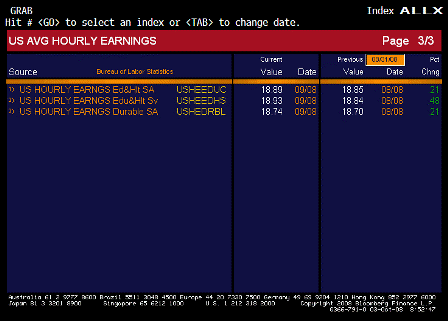
  • Avg hourly earnings up 0.2%.
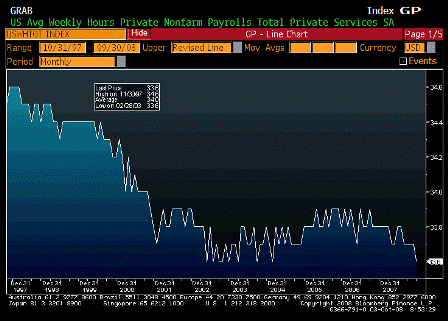
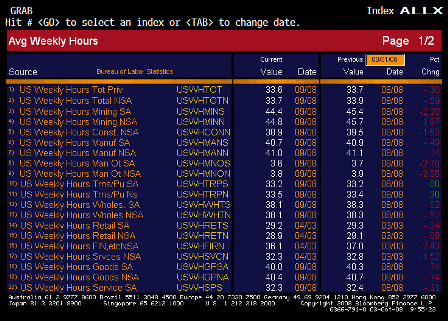
  • The shocker was hours worked down 0.5% and down 2% at annualized rate in Q3.
  • Labor income = payrolls X average hourly earnings X hours worked.
  • Hours data implies negative GDP in Q3 and very weak handoff to Q4, where some forecasts are already in -2% to -3% area for real GDP.
  • Diffusion Index down from 44.7 to 38.1.
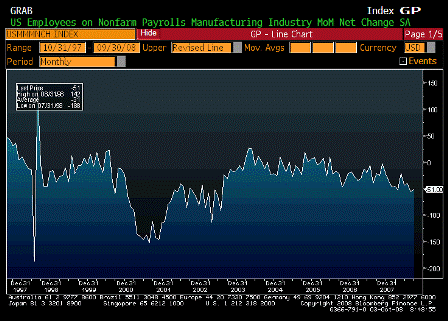
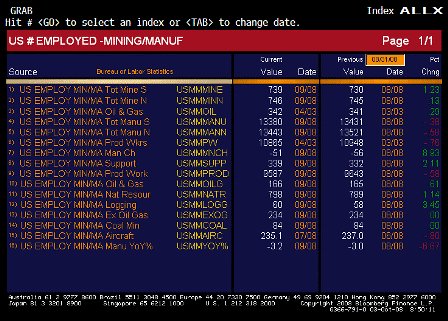
  • Manufacturing -51k
  • Retail -40k
  • Construction -35k
  • Finance -17k
  • Temp Services -24k
  • Education +25k
  • Government +9k

BLS stated weather did not have ‘substantial’ effect on number.


[top]

Ominous warnings from Trichet


[Skip to the end]

(email exchange)

He gets it!

>   
>   On Fri, Oct 3, 2008 at 8:49 AM, Karim wrote:
>   
>   Trichet says solvency is an issue
>   for governments.

>   

Yes!

>   
>   Trichet: West passing through
>   most serious time since WWII.

>   

The largest systemic risk is in the eurozone.

>   
>   Trichet: We must do everything
>   to preserve unity in Europe.

>   

Good luck to them!


[top]

Eurozone on the brink, cont.


[Skip to the end]

There is only one immediate response that will turn the tide that I know of.

The US Congress can declare a ‘tax holiday’ and lower the ‘payroll taxes’ (social security, medicare, payroll deductions) at least temporarily to 0%.

This tax is currently killing about $80 billion a month in aggregate demand- about $1 trillion per year.

This would IMMEDIATELY add maybe 5% to GDP.

The financial sector is immediately supported as the increase in after tax incomes allows workers to make their mortgage payments and pay their other costs of living.

This is ‘trickle up’ economics at work.

Politically, it would look like this:

Rather than Congress taking $700+ billion from taxpayers (and removing that much aggregate demand) and allocating $700+ billion to buy securities from the financial sector which adds no aggregate demand), and hoping for this to somehow ‘trickle down’ to the real economy.

Congress instead lets workers keep their $700+ billion so they can make their mortgage payments and support the real economy as the funds ‘trickle up’ to the financial sector.

There are no ‘scare resources’ causing this financial crisis and slow down.

It’s a purely ‘nominal’ event that’s causing the problems.

That’s why a ‘solution’ is necessarily ‘easy’ and immediately executable.

All we need to do is change numbers on spreadsheets.

It is only a vote to change those tax rates that is separating the world from an instant return to prosperity.

And once again that vote probably won’t happen due to the absurd myths about government deficits that should have fallen by the wayside decades ago.

Warren


[top]

2008-10-03 USER


[Skip to the end]


Unemployment Rate (Sep)

Survey 6.1%
Actual 6.1%
Prior 6.1%
Revised n/a

[top][end]

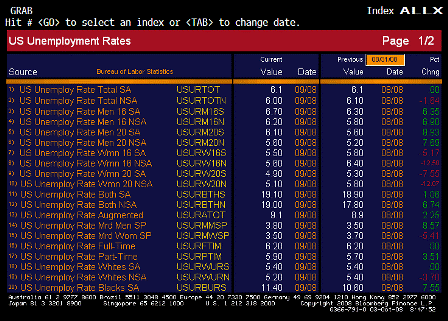
Unemployment Rate ALLX 1 (Sep)

[top][end]

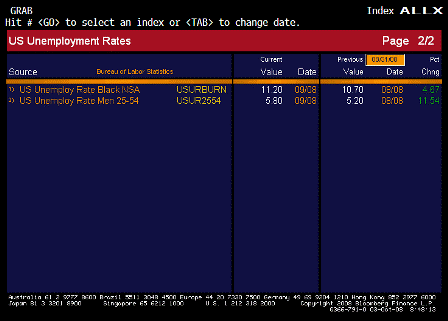
Unemployment Rate ALLX 2 (Sep)

[top][end]


Change in Nonfarm Payrolls (Sep)

Survey -105k
Actual -159k
Prior -84k
Revised -73k

[top][end]

Change in Nonfarm Payrolls YoY (Sep)

Survey n/a
Actual -519.00
Prior -279.00
Revised n/a

[top][end]

Nonfarm Payrolls ALLX (Sep)

[top][end]

Change in Manufacturing Payrolls (Sep)

Survey -57k
Actual -51k
Prior -61k
Revised -56k

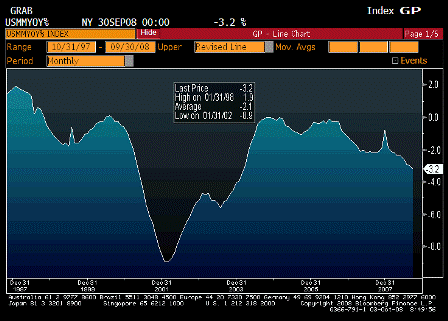
[top][end]

Change in Manufacturing Payrolls YoY (Sep)

Survey n/a
Actual -3.2%
Prior -3.0%
Revised n/a

[top][end]

Manufacturing Payrolls ALLX (Sep)

[top][end]


Average Hourly Earnings MoM (Sep)

Survey 0.3%
Actual 0.2%
Prior 0.4%
Revised n/a

[top][end]

Average Hourly Earnings YoY (Sep)

Survey 3.6%
Actual 3.4%
Prior 3.6%
Revised n/a

[top][end]

Average Hourly Earnings ALLX 1 (Sep)

[top][end]

Average Hourly Earnings ALLX 2 (Sep)

[top][end]

Average Hourly Earnings ALLX 3 (Sep)

[top][end]


Average Weekly Hours (Sep)

Survey 33.7
Actual 33.6
Prior 33.7
Revised n/a

[top][end]

Average Weekly Hours ALLX 1 (Sep)

[top][end]

Average Weekly Hours ALLX 2 (Sep)

[top][end]


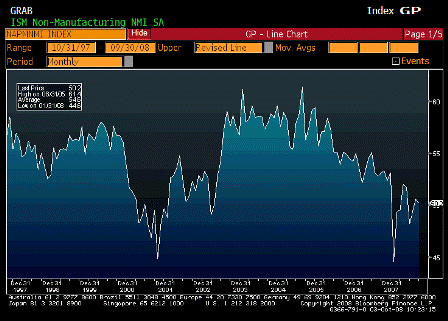
ISM Non Manufacturing Composite (Sep)

Survey 50.0
Actual 50.2
Prior 50.6
Revised n/a


[top]

Unicredito


[Skip to the end]

(email exchange)

Anyone hearing about issues at Unibank in Italy?

>   
>   On Thu, Oct 2, 2008 at 11:17 AM, Kevin wrote:
>   
>   If you mean Unicredito (UCG IM), yesterday there was talk they were to call an
>   EGM, with a rumor that the CEO Profumo was to resign and talk the bank was
>   suffering from liquidity issues. They subsequently announced some real estate
>   sales improving their tier 1 capital ratio. At the same time Italy suspended
>   short sales. Today I see they are looking to raise euro 2.3bn, through the
>   sales senior bonds, aimed at retail investors.
>   
>   Having been regarded as one of Europes strongest banks, market has been
>   concerned that Profumo has persistently claimed they have no balance sheet
>   problems, despite worsening financial environment.
>   
>   Senior cds is trading at 140bp (5yr), it was 80/90 on sept 25th.
>   
>   Kevin

Thanks, heard they are very big and having issues.

US market action seems to be spreading to the eurozone where it can do a lot more damage than it’s doing here.


[top]

Proposal


[Skip to the end]

The short version of my current alternative proposal to the TARP remains:

  1. Normalize bank liquidity by allowing Fed member banks to borrow unsecured from the Fed in unlimited quantities.
  2. Have the Fed set term lending rates out to 3 months in addition to the Fed funds rate.
  3. Extend FDIC insurance to Fed deposits at member banks to keep any insolvency losses at the FDIC.
  4. Remove the cap on FDIC insurance to eliminate the need for money market funds.
  5. Declare a ‘payroll tax holiday’ and reduce social security and medicare payroll deduction rates to 0% until aggregate demand is sufficiently restored.

This would immediately end the current crisis.

Remaining issues include the increased demand for energy consumption as the economy recovers, and associated price pressures.

[top]