Krugman on ‘The Phantom Menace’


[Skip to the end]

Thanks, problem areas in yellow that tend to discredit what he’s saying.

He needs our help bad!

The Phantom Menace

By Paul Krugman

Nov 22 (NYT) — A funny thing happened on the way to a new New Deal. A year ago, the only thing we had to fear was fear itself; today, the reigning doctrine in Washington appears to be “Be afraid. Be very afraid.”

What happened? To be sure, “centrists” in the Senate have hobbled efforts to rescue the economy. But the evidence suggests that in addition to facing political opposition, President Obama and his inner circle have been intimidated by scare stories from Wall Street.

Consider the contrast between what Mr. Obama’s advisers were saying on the eve of his inauguration, and what he himself is saying now.

In December 2008 Lawrence Summers, soon to become the administration’s highest-ranking economist, called for decisive action. “Many experts,” he warned, “believe that unemployment could reach 10 percent by the end of next year.” In the face of that prospect, he continued, “doing too little poses a greater threat than doing too much.”

Ten months later unemployment reached 10.2 percent, suggesting that despite his warning the administration hadn’t done enough to create jobs. You might have expected, then, a determination to do more.

But in a recent interview with Fox News, the president sounded diffident and nervous about his economic policy. He spoke vaguely about possible tax incentives for job creation. But “it is important though to recognize,” he went on, “that if we keep on adding to the debt, even in the midst of this recovery, that at some point, people could lose confidence in the U.S. economy in a way that could actually lead to a double-dip recession.”

What? Huh?

Most economists I talk to believe that the big risk to recovery comes from the inadequacy of government efforts: the stimulus was too small, and it will fade out next year, while high unemployment is undermining both consumer and business confidence.

Now, it’s politically difficult for the Obama administration to enact a full-scale second stimulus. Still, he should be trying to push through as much aid to the economy as possible. And remember, Mr. Obama has the bully pulpit; it’s his job to persuade America to do what needs to be done.

Instead, however, Mr. Obama is lending his voice to those who say that we can’t create more jobs. And a report on Politico.com suggests that deficit reduction, not job creation, will be the centerpiece of his first State of the Union address. What happened?

It took me a while to puzzle this out. But the concerns Mr. Obama expressed become comprehensible if you suppose that he’s getting his views, directly or indirectly, from Wall Street.

Ever since the Great Recession began economic analysts at some (not all) major Wall Street firms have warned that efforts to fight the slump will produce even worse economic evils. In particular, they say, never mind the current ability of the U.S. government to borrow long term at remarkably low interest rates — any day now, budget deficits will lead to a collapse in investor confidence, and rates will soar.

And it’s this latter claim that Mr. Obama echoed in that Fox News interview. Is he right to be worried?

Well, spikes in long-term interest rates have happened in the past, most famously in 1994. But in 1994 the U.S. economy was adding 300,000 jobs a month, and the Fed was steadily raising short-term rates. It’s hard to see why anything similar should happen now, with the economy still bleeding jobs and the Fed showing no desire to raise rates anytime soon.

He’s conceding it is a risk, though small. Allows the critics that opening and it actually supports them.

A better model, I’d argue, is Japan in the 1990s, which ran persistent large budget deficits, but also had a persistently depressed economy — and saw long-term interest rates fall almost steadily. There’s a good chance that officials are being terrorized by a phantom menace — a threat that exists only in their minds.

Again, he concedes they may be right, and that all he has is a theory that with a weak economy blah blah blah.

And shouldn’t we consider the source? As far as I can tell, the analysts now warning about soaring interest rates tend to be the same people who insisted, months after the Great Recession began, that the biggest threat facing the economy was inflation. And let’s not forget that Wall Street — which somehow failed to recognize the biggest housing bubble in history — has a less than stellar record at predicting market behavior.

Same thing. These are not decisive arguments, and can’t be until he gets our of gold standard paradigm into non convertible currency paradigm.

Still, let’s grant that there is some risk that doing more about double-digit unemployment would undermine confidence in the bond markets. This risk must be set against the certainty of mass suffering if we don’t do more — and the possibility, as I said, of a collapse of confidence among ordinary workers and businesses.

Resorting to the ‘bleeding heart’ argument is a sign of desperation.

Unfortunately he’s part of the problem rather than part of the answer even though his heart may be in the right place.

And Mr. Summers was right the first time: in the face of the greatest economic catastrophe since the Great Depression, it’s much riskier to do too little than it is to do too much. It’s sad, and unfortunate, that the administration appears to have lost sight of that truth.


[top]
Consumer Confidence


[Skip to the end]

Not looking good. Looks like something bad did happen back in July.

The combo of modestly rising GDP, with rising unemployment due to productivity is very unattractive politically.

Deficit myths keep them doing anything substantive.

Still wouldn’t surprise me if they announce something dramatic, like they are going to pay for healthcare by cutting back in Afghanistan and elsewhere, which, program merits aside, will not be supportive to demand.

And if gold turns south (no sign of that reversal yet)/dollar spikes whatever optimism is left vanishes with the realization that all the Fed’s horses and men are irrelevant regarding deflation.


Karim writes:

  • As expected, Q3 GDP revised down to 2.8% from 3.5%; inventories close to initial estimate, so no major implications for Q4
  • Case-Shiller home prices up 0.33% m/m; slowest monthly gain since April
  • Richmond fed survey down from 7 to 1; # of employees falls from 2 to -9

Conf Board Survey

  • Headline up from 48.7 to 49.5
  • Labor market differential makes new cycle low: -45.9 to -46.6
  • Plan to buy auto w/in 6mths down from 4.7 to 4.4 (lowest since March)
  • Plan to buy home w/in 6mths from 2.3 to 2.0 (new low for cycle, and lowest since 1982); that’s what you get for $1trn in MBS purchases?!


[top]

Orszag attending Obama Afghan meetings


[Skip to the end]

Yes, the deficit reduction polls are likely having a lot of influence on policy going into the 2010 elections and are a major obstacle to any kind of meaningful recovery.

And, worst of all, it was reported that Budget Director Peter Orszag was also sitting in on these discussions:

Obama to Give Afghan Strategy Decision on Dec. 1, Official Says

By Tony Capaccio and Roger Runningen

Nov. 24 (Bloomberg) — President Barack Obama will announce his decision on the next steps in the war in Afghanistan on or about Dec. 1, according to a U.S. official familiar with the issue.

Defense Secretary Robert Gates, Secretary of State Hillary Clinton and Admiral Michael Mullen, chairman of the Joint Chiefs of Staff, are expected to discuss the decision before Congress that same week, and General Stanley McChrystal, the top U.S. commander in Afghanistan, would testify the following week, the official said.

White House Budget Director Peter Orszag has estimated that each additional soldier in Afghanistan could cost $1 million, for a total that could reach $40 billion if 40,000 more troops are added.

This is clear evidence that budget myths are, indeed, influencing national security issues, and therefore posing a security risk. I’d go so far as to say the deficit terrorists are currently the greatest risk to both national security and national prosperity.

Voters Continue to See Deficit Reduction as Top Priority (Rasmussen) While official Washington has seen many twists and turns in the legislative process this year, voter priorities have remained unchanged. Deficit reduction has remained number one for voters ever since President Obama listed his four top budget priorities in a speech to Congress in February. Forty-two percent (42%) say cutting the deficit in half by the end of the president’s first term is most important, followed by 24% who say health care reform should be the top priority. Fifteen percent (15%) say the emphasis should be on the development of new energy sources, while 13% say the same about education.

1 in 4 Borrowers Under Water (WSJ) The proportion of U.S. homeowners who owe more on their mortgages than the properties are worth has swelled to about 23%. Nearly 10.7 million households had negative equity in their homes in the third quarter, according to First American CoreLogic. Home prices have fallen so far that 5.3 million U.S. households are tied to mortgages that are at least 20% higher than their home’s value, the First American report said. More than 520,000 of these borrowers have received a notice of default, according to First American. Most U.S. homeowners still have some equity, and nearly 24 million owner-occupied homes don’t have any mortgage, according to the Census Bureau. More than 40% of borrowers who took out a mortgage in 2006 are under water. Even recent bargain hunters have been hit: 11% of borrowers who took out mortgages in 2009 already owe more than their home’s value.


AP-GfK Poll: Debt turning shoppers into Scrooges (AP) 93 percent of Americans say they’ll spend less or about the same as last year, according to an Associated Press-GfK poll. Half of all those polled say they’re suffering at least some debt-related stress, and 22 percent say they’re feeling it greatly or quite a bit. That second figure is up from 17 percent just last spring. 80 percent say they’ll use mostly cash to pay for their holiday shopping.


PC shipment forecast raised as 3Q sales pick up (AP) A rebound in purchases of personal computers worldwide will lead to a 2.8 percent increase in shipments this year. Gartner Inc. sees worldwide PC shipments topping 298.9 million in 2009, a reversal from its prior forecast of a 2 percent decline. PC shipments fell in the first half of this year. Gartner sees shipments for 2010 rising 12.6 percent to 336.6 million. But the value of computer sales is expected to drop by 10.7 percent to $217 billion this year because manufacturers are cutting prices to move product.

Businesses still cautious on borrowing (Reuters) The Equipment Leasing and Finance Association’s capex financing index fell to $4.3 billion in October, down 32.8 percent from last October and down 8.5 percent from September. The group said the percentage of borrowers delinquent 30 days or more on their capex loans, leases or lines of credit rose to 4.2 percent last month, up from 3.6 percent last year but down from 5.6 percent in September. Charge-offs as a percentage of all receivables rose to 1.7 percent in October, from 1.36 percent last year but down from 3.01 percent in September. Only 66.2 percent of applicants got the green light from lenders in October, down from 71.7 percent last year and 67.9 percent in September. More than half the money invested in plants, equipment and software in the United States in any given year is financed with loans, leases and lines of credit.


[top]

Galbraith on what can be done


[Skip to the end]

Old Mistakes Die Hard

As part of the Roosevelt Institute’s 10-part series on the Jobs Crisis, running on the New Deal 2.0 blog from Nov. 12-25, I was asked to reflect on what can be done to get Americans working again. Here’s my take.

I’m tempted to say that the United States is plainly unable to cope with the economic crisis in a serious way. The barriers are philosophical, procedural, and constitutional. So long as economic thinking is mired in a world that disappeared with the collapse of the Bretton Woods system in 1971, so long as any action requires 60 Senate votes, and so long as political capital erodes from the start of a fixed four-year presidential term, we’re stuck.

Technically it would have been fairly easy, 10 months ago, to get this bus back on the road. There could have been open-ended fiscal assistance to stop the budget hemorrhage of the states and cities. There could have been a jobs program and effective foreclosure relief. There could have been a payroll tax holiday. There could have been a strategy for sustained massive effort on infrastructure, energy and climate. There could have been prompt corrective action to resolve, instead of coddle, the worst of the banks.

I mostly don’t blame President Obama; he and his team went as far as they felt they could. I blame the head-in-the-sand politicians in Congress, the over-optimistic forecasters, the half-educated press, and the power of the financial lobby. I blame the avatars of fiscal virtue, the public debt scare-mongerers, the astrologers for whom thirteen significant digits (a trillion) for the stimulus package was just too much. I blame the Senate, which hands the balance of power to small states at the expense of disaster areas like California, Florida and New York. I do blame the Bush-Obama financial policy team, who either believed that “credit would flow again” if you stuffed the banks with money, or knew that it wouldn’t.

The Bretton Woods point deserves another word. According to the system established in 1944, the U.S. current account deficit — and by extension our public budget deficit — was limited by an obligation to exchange foreign-held dollars for gold. Richard Nixon abolished that arrangement. Since the early 1980s, the world has held the Treasury bonds that the U.S. chose to issue. The system is fragile. But so long as it lasts, it doesn’t discipline our budget (and if it broke, we could replace it). Low interest rates prove this: despite all the dire predictions, there is no difficulty in placing Treasury debt. Hence, we are free to pursue high employment, if we choose to do it.

Can anything be done now? Well yes, technically: the same steps that could have been taken in January 2009 could be taken in January 2010. But they won’t be, because for the moment we are seeing the inventory bounce, a productivity surge, real GDP growth, and other “good signs.” So we’ll be told to wait, to be patient, and to make sure we don’t buy what we can’t afford. And double-digit joblessness will linger on, breeding frustration and anger — perhaps all the way through to the mid-term elections. After which, what will be possible is anyone’s guess.

Sorry to be defeatist — it’s the way I feel. Prove me wrong.


[top]

Existing Home Sales


[Skip to the end]

Wonderful, we contrive policy to drive up unemployment and foreclose vast numbers of people out of their homes at firesale prices so others can move in with subsidized down payments to buy them.

The lower prices could be a sign of bid hitting rather than offer lifting.


U.S. Economy: Existing Home Sales Jump 10% as Prices Decline

By Shobhana Chandra

Nov. 23 (Bloomberg) — Sales of existing U.S. homes jumped 10 percent in October to the highest level since February 2007 as Americans rushed to take advantage of a tax credit, cheaper properties and lower mortgage rates.

Purchases rose more than forecast to a 6.1 million annual rate from a 5.54 million pace in September, the National Association of Realtors said today in Washington. The median sales price decreased 7.1 percent from October 2008.

Stocks extended gains on signs the industry at the center of the deepest recession since the 1930s may contribute to a recovery. The extension of a tax credit originally due to expire Nov. 30 and its expansion beyond first-time buyers may fuel further gains in home sales, helping to overcome the drag from rising foreclosures and unemployment.

Existing home sales were forecast to rise to a 5.7 million annual rate, according to the median estimate of 66 economists in a Bloomberg News survey. Estimates ranged from 5.2 million to 6 million, after an initially reported 5.57 million rate in September.

Condos, Co-ops

Sales of existing single-family homes rose 9.7 percent, the biggest gain since 1983, to an annual rate of 5.33 million. Sales of condos and co-ops increased 13.2 percent to a 770,000 rate.

The share of homes sold as foreclosures or otherwise distressed properties rose to 30 percent from 29 percent in September, NAR chief economist Lawrence Yun said in a press conference today.

A “similarly robust” sales gain may occur this month, he said. “With such a sales spike, a measurable decline should be anticipated in December and early next year before another surge in spring and early summer,” Yun said.

The number of previously owned unsold homes on the market fell 3.7 percent to 3.57 million. At the current sales pace, it would take 7 months to sell those houses, compared with 8 months at the end of the prior month. The months’ supply is the lowest since February 2007.

New-Home Sales

Sales of previously owned homes, which make up more than 90 percent of the market, are compiled from contract closings and may reflect purchases agreed upon weeks or months earlier. Many economists consider new-home sales, recorded when a contract is signed, a more timely barometer.

The Commerce Department may report on Nov. 25 that new home sales rebounded to a 405,000 annual rate in October, according to the Bloomberg survey.

Home construction seized up last month as builders waited to find out if the first-time homebuyer tax credit would end, a Commerce Department report showed last week. Builders in October broke ground on the fewest houses since April’s record low annual pace.

Sales and construction may get another boost after President Barack Obama on Nov. 6 extended the incentive until April 30. Earlier, buyers had to close the transaction by Nov. 30 to be eligible. The government also expanded the program to include some current owners.

Debt Purchases

Mortgage rates held down by Federal Reserve purchases of housing debt are also spurring a recovery in the housing market. The average rate on a 30-year fixed mortgage fell last week to 4.83 percent, the lowest since May, according to Freddie Mac.

Borrowing costs may remain low as the Fed has signaled it will keep the benchmark interest rate near zero for an “extended period.”

“Activity in the housing sector has increased over recent months,” Fed policy makers said in their Nov. 4 statement. “Household spending appears to be expanding but remains constrained by ongoing job losses, sluggish income growth, lower housing wealth, and tight credit.”

The labor market remains a risk for housing. The unemployment rate, which rose to a 26-year high of 10.2 percent last month, will stay above 10 percent through the first half of 2010, a Bloomberg survey showed.

Foreclosure Filings

Foreclosure filings surpassed 300,000 for an eighth straight month in October as rising joblessness made it tougher for homeowners to pay bills, according to RealtyTrac Inc. data.

Some companies see a potential for stronger demand. Hovnanian Enterprises Inc., New Jersey’s largest homebuilder, has signed contracts or options to buy 4,000 land lots in preparation for a market recovery, said Chief Executive Officer Ara K. Hovnanian. The Red Bank, New Jersey-based builder had reduced its land holdings during the recession.

“Prices are ridiculously low in some markets,” he said at a conference in New York on Nov. 17. “That’s not going to stay.”

Sales of existing homes were led by a 14.4 percent jump in the Midwest, today’s report showed. Purchases rose 12.7 percent in the South, 11.6 percent in the Northeast and 1.6 percent in the West.

Sales had reached a 4.49 million pace in January, their lowest level since comparable records began in 1999.

Purchases of existing homes rose 23.5 percent in October compared with a year earlier. The median price fell 7.1 percent from a year earlier, to $173,100.


[top]

JF Kennedy 1962 speech


[Skip to the end]

JFKennedy in his 1962 speech at Yale addressed these very same issues:

“For the great enemy of truth is very often not the lie–deliberate, contrived and dishonest–but the myth–persistent, persuasive, and unrealistic. Too often we hold fast to the cliches of our forebears. We subject all facts to a prefabricated set of interpretations. We enjoy the comfort of opinion without the discomfort of thought. Mythology distracts us everywhere–in government as in business, in politics as in economics, in foreign affairs as in domestic affairs. But today I want to particularly consider the myth and reality in our national economy…..”


[top]

Today’s Data


[Skip to the end]


Karim writes:

Data on the weak side:

CPI

  • Initial claims unch at 505k (prior week revised up 3k)
  • Total ongoing benefits up 81k
  • Some saying that standard error of claims-based model as a predictor of NFP may lead to a CHANCE of positive payroll growth in November

Housing

  • Philly Fed up 5.2pts to 16.7
  • Prices paid down 6.4, orders up 8.6, inventories up 14.5, employees up 6.3
  • Going in opposite direction to Empire survey earlier in week, but converging to similar levels
  • Modest expansion in manufacturing

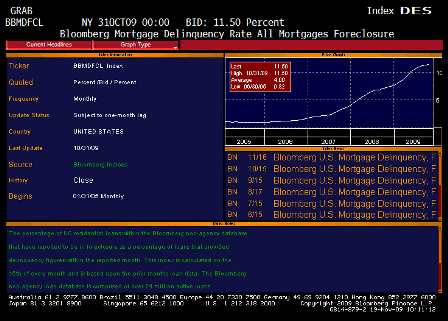
Latest foreclosure chart (loans in foreclosure as a % of total loans)


[top]

CPI/Housing


[Skip to the end]


Karim writes:

Data on the weak side:

CPI

  • Headline CPI driven by energy, up .275%
  • Core CPI driven by car (new model year) seasonals, up 0.182%; ex-vehicles, core close to unch
  • Trend sectors generally weak: OER unch, apparel -0.4%, recreation -0.4%, medical 0.2%

Housing

  • Housing starts down 10.6%, with single-family down 6.8%, lowest level since May
  • Permits down 4%


[top]

Obama: Too much debt could fuel double-dip recession


[Skip to the end]

This is getting depressing.
I thought McCain was bad when he said he’d cut spending to help the economy:


Obama: Too much debt could fuel double-dip recession

By Deborah Solomon and Jonathan Weisman

Nov. 18 (Reuters) — President Barack Obama gave his sternest warning yet about the need to contain rising U.S. deficits, saying on Wednesday that if government debt were to pile up too much, it could lead to a double-dip recession.

With the U.S. unemployment rate at 10.2 percent, Obama told Fox News his administration faces a delicate balance of trying to boost the economy and spur job creation while putting the economy on a path toward long-term deficit reduction.

His administration was considering ways to accelerate economic growth, with tax measures among the options to give companies incentives to hire, Obama said in the interview with Fox conducted in Beijing during his nine-day trip to Asia.

“It is important though to recognize if we keep on adding to the debt, even in the midst of this recovery, that at some point, people could lose confidence in the U.S. economy in a way that could actually lead to a double-dip recession,” he said.

Fox News, which released a transcript of the interview, showed that comment by Obama on Wednesday morning and said the full discussion would be broadcast later in the day. (Reporting by Caren Bohan; Editing by John O’Callaghan)


[top]

Housing starts and 10 year tsy rates


[Skip to the end]

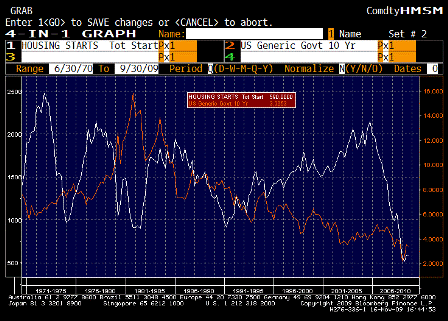
Interesting how high housing starts were when interest rates were a lot higher than they are now.

And if you ‘population adjust’ the housing starts the ‘Greenspan super bubble’ fell far short of previous highs, even with much higher mtg rates back then. (add about 2% to the 10 year note rates to approximate mortgage rates.)

In fact, it’s hard to attribute housing performance to interest rates in general.

I saw a graph from Goldman a couple of years ago showing how housing related to the fiscal cycle and at that time it was forecasting a decline. And interest rates were nowhere to be found in that model. While I did criticize some of the policies of the Greenspan era, I never have ‘blamed’ him for the housing bubble. Ironically he’s watched this destroy his reputation and largely believes it himself.

Interest rates didn’t get us into this and they won’t get us out, as the late John Kenneth Galbraith stated in his last book, ‘The Economics of Innocent Fraud.’


[top]