
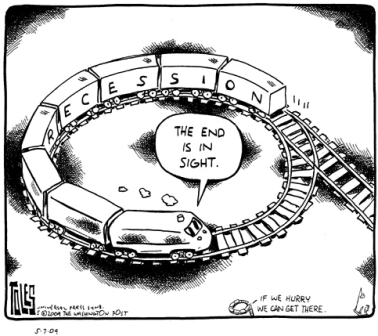

CNBC’s Kudlow: Take Away Washington’s Credit Card
The economists with the financial media are a complete disgrace.
And they don’t want to know better.
They just want to sell news.
How does that go again about capitalism selling the rope that it gets hung with?
The Debt Bomb Is Coming Due
By Larry Kudlow
April 12 (CNBC) — White House press secretary Jay Carney said Republicans should not “play chicken with the economy.” The administration wants a prompt vote to raise the federal debt ceiling quickly. Carney went on to say, “The consequences of not raising the debt ceiling would be Armageddon-like in terms of the economy.”
But then again, if the federal debt limit keeps getting raised without any real new spending-limitation rules, Armageddon for the economy may come just as quickly.
The problem with the rising debt burden is too much spending and too little growth. A spending-limitation of 20 percent to GDP would go a long way toward fixing the debt-bomb problem.
A number of Republicans are proposing such a limit, with real teeth to force automatic spending cuts across the board if the limit is violated. House and Senate Republicans will not agree to an increase in the debt limit without these kinds of serious spending reforms. As they say, it’s time to stop maxing out the credit card. There has to be some discipline in the fiscal system.
The current $14.3 trillion debt ceiling will run up against the wall sometime early this summer. As of the end of March, there’s a $76.1 billion borrowing limit left. Treasury man Tim Geithner says all measures to postpone a U.S. default on its obligations will end approximately July 8, 2011. At that point, government payments — including interest on the Treasury debt — would be stopped.
So the message for investors is tighten your seatbelts. The hard-driving politics of spending reform and debt limits will go down to the wire. At virtually the same time, the Fed will probably have ended QE2. So debt-default worries, along with possible inflation fears, could drive up interest rates and hurt the stock market as well.
But let’s not forget, the debt bomb is coming due, sooner or later. Better for Washington to cancel its summer vacation and put some serious disciplined limits on federal spending and borrowing. Take away Washington’s credit card.
SAUDI ARABIA HAS CUT OIL PRODUCTION ON WEAK DEMAND
As discussed, what they actually do is set price for their refiners and then let them buy as much as they want at that price.
They use ‘speculation’ and the like for ‘cover’ for raising and lowering their prices.
SAUDI ARABIA HAS CUT OIL PRODUCTION BACK TO APPROXIMATELY 8.5 MLN BPD ON WEAK DEMAND – SAUDI INDUSTRY SOURCES
SAUDI HAD PRODUCED UP TO 9.2 MLN BPD FOR AT LEAST PART OF MARCH ON LIBYA DISRUPTION – SAUDI INDUSTRY SOURCES
SAUDI PREPARED TO BOOST OUTPUT IF THE MARKET REQUIRES MORE CRUDE – SAUDI INDUSTRY SOURCES
Stiglitz Calls for New Global Reserve Currency to Prevent Trade Imbalances
>
> (email exchange)
>
> Hi Warren,
>
> Do you have any thoughts on Stiglitz calling for a new reserve currency?
> Is this something you see as a problem or is Stiglitz getting it wrong?
>
Yes, my advice for Joe is to stop talking about these things entirely.
He’s in it all way over his head.
Stiglitz Calls for New Global Reserve Currency to Prevent Trade Imbalances
By John Detrixhe and Sara Eisen
April 10 (Bloomberg) — The world economy needs a new global reserve currency to help prevent trade imbalances that are reflected in the national debt of the U.S., said Nobel-prize winning economist Joseph Stiglitz.
He doesn’t seem to grasp the notion that imports are real benefits and exports real costs, nor that the national debt is nothing more than dollar balances in Fed securities accounts that are ‘paid back’ by debiting the securities accounts and crediting reserve accounts, also at the Fed. No grandchildren writing checks involved.
A “global system” is needed to replace the dollar as a reserve currency and help avoid a weakening of U.S. credit quality, said Stiglitz, a professor at Columbia University in New York.
There is no such thing as weakening the ability of the US to make US dollar payments. All that’s involved is crediting reserve accounts at the fed.
The dollar fell to an almost 15-month low against the euro last week, and the U.S. trade deficitwidened more than forecast in January to the highest level in seven months.
“By taking off the burden of any single country, we don’t have to have trade deficits,” Stiglitz said in an interview in Bretton Woods, New Hampshire.
He just assumes there’s some problem with a nation running trade deficits, not realizing it’s a sign of success- improved real terms of trade- and not failure.
“Things would be much worse if it were not the case that Europe was having even more of a problem, but winning a negative beauty pageant is not the way to create a strong economy.”
The benchmark 10-year Treasury note yield was at 3.58 percent on April 8, below the average of 7 percent since 1980.
Deficits per se obviously don’t drive up interest rates.
“Reserves are IOU’s,” Stiglitz said. “When IOU’s get big enough, people start saying maybe you’re not a good credit risk. Or at least, they would change in their sentiment about credit risk.”
Doesn’t matter with a currency issuer like the US, Japan and UK.
Japan’s ‘debt’ is nearly 3x ours, has had multiple downgrades, and their 10 year rate just ‘skyrocketed’ to about 1.3%, for example.
The existing monetary system means “there’s a very good risk of an extended period of low growth, inflationary bias, instability,” Stiglitz said.
Agreed, because nations don’t realize that their taxes function to regulate their aggregate demand, and not to raise revenue per se. And seems Stiglitz doesn’t get it either.
It’s “a system that’s fundamentally unfair because it means that poor countries are lending to the U.S. at close to zero interest rates.”
It’s unfair for a lot of reasons, except that one.
Death by 1000 cuts: The economics of innocent subversion
Even NY Fed Chief Bill Dudley, well aware of his role as a manager of expectations, is worried:
Dudley Headlines:
DUDLEY SAYS IMPORTANT NOT TO OVERREACT TO RISING INFLATION
DUDLEY ATTRIBUTES LOSS OF MOMENTUM TO RISING OIL PRICES
DUDLEY SAYS U.S. ECONOMY LOST SOME MOMENTUM IN PAST TWO MONTHS
Last I heard Congress agreed cut $38 billion in spending from this year’s budget as a ‘down payment’ on reducing the federal deficit.
Followed by every economic forecaster on Wall St. and Main St. reducing estimates for this years’s GDP by maybe 1/2% or more. (These are people who get paid to be right, and not to produce propaganda.)
I have no problem with cutting wasteful and unnecessary spending, but when we have this kind of shortage of aggregate demand said cuts would be more than matched with either tax cuts and/or other spending increases, to sustain aggregate demand.
(Aggregate demand is the total spending, private and public, that supports employment and output).
The proposals are now to get to work on more serious deficit reduction- maybe $5 trillion over the next 10 years, or about $500 billion or so per year.
Ask your favorite forecasters what that does to GDP. I’ll guess they’ll tell you it would be a proactive reduction of more than 3% per year. Plus multipliers. And maybe a 50% increase in unemployment as the output gap skyrockets from already insanely high levels.
In other words, maybe 10 years of negative growth, unless private sector (including non residents) spending somehow increases at least by that much.
For domestic sector spending to increase to fill what my mate Bill Mitchell likes to call the spending gap, there would need to be an increase in private sector debt (which is likewise measured as a drop in private sector savings).
With today’s credit conditions, I don’t see where that could possibly come from. Borrowing to spend on houses and cars- the traditional engine of consumer growth- rising to levels sufficient to close the output gap seems highly unlikely. Particularly when federal deficit reduction is cutting incomes and savings.
For the foreign sector (non residents) to fill that spending gap, the trade gap would have to somehow stop going up and suddenly drop down by that amount. Not impossible, but a very ugly process (for us)- massive decline in our real terms of trade, etc.- should that actually happen.
So why is this happening? Why are we drinking the hemlock?
Because both sides- Democrats and Republicans- have it all dead wrong.
They both agree the federal deficit is too large and is a dire threat to our well being.
When, in fact, the exact opposite is the case- the output gap/unemployment is telling us- screaming at us- that the federal deficit is too small, and that Congress should be arguing over whether they should cut taxes and/or increase spending.
(And throw in an energy policy, and fast, but that’s for another post).
But because they think we could be the next Greece and face a federal funding crisis, they continue to work to turn us into the next Japan with two lost decades- and worse.
It’s either ignorance or subversion, so let me take the liberty to again borrow from John Kenneth Galbraith and call it innocent subversion.
“The worst part is that, because both sides have no clue about the real functioning of the monetary system, they have both been hard at work misinforming the public. And, since they both watch and react to daily polling numbers, unless something is done, they will continue to react to the reflections of their own ignorance.”
Atty Donovan Hamm
Mosler virtual MMT interview
FED Fisher’s comments embody all that’s wrong with the FOMC
Fisher headlines:
DJ Fed’s Fisher: Continued QE2 Buying Creating ‘Significant Risks’
The risks they envision do not exist.
DJ Fisher: Possible Fed Should Stop Short On QE2 Buying Goal
This would be the case only if they thought mortgage rates should be higher than otherwise.
DJ Fisher: Absolutely Opposed To Expanding QE2 Beyond Current Plan
Only if he is concerned mortgage rates are too low.
DJ Fisher: Firms May Soon Pass On Input Price Increases
This is about what’s called cost push inflation, vs demand pull inflation, and represents shifts in relative value.
DJ Fisher: See ‘Unpleasant’ Inflation Data On Horizon
DJ Fisher: More Fed Liquidity May Exacerbate Inflation Problem
What he calls inflation is not a function of what he calls Fed liquidity.
*DJ Fisher: See Signs Fed Bond Buying Creating Market Imbalances
Fed bond buying can cause financial market alterations but not imbalances.
There could in theory be real imbalances, for example a Fed induced housing shortage due to too low mortgage rates, but this is not the point he’s making.
DJ Fisher: US Government Must Get Fiscal House In Order
Here’s the big one. The FOMC seems to be on complete agreement that there is at least a long term deficit problem
They don’t seem to understand it’s about aggregate demand and not finance per se.
*DJ Fisher: Failure To Fix Deficit May Wound Economy’s Prospects
The make these kinds of statements without identifying the specific channels from deficit spending to the economy’s prospects. Nor are they ever questioned on this and pressed to identify said channels.
(The only one I’ve heard is the interest rate channel which always fails the test of close examination.)
This rhetoric from the FOMC is supportive of the position of both sides of the debate that the federal deficit is an immediate problem, with fears that the US could be the next Greece as proclaimed by Congressman Ryan appearing daily in the popular media, which elevates the real risk of proactive deficit reduction that could undermine the current modest levels of GDP growth and employment growth.
U.S. Consumer Spending/Credit
This is a good sign top line growth was continuing it’s modest growth in March.
Federal deficit spending continues to work to add the income and savings that allows consumers to both reduce their credit card debt and expand their consumption.
Deficit spending continues to be sufficient to support the modest GDP growth and employment growth we’ve been experiencing.
However, the risks remain as discussed at year end:
US deficit reduction efforts, with both sides agreeing that the deficit is THE problem, with some of the proposed cuts more than sufficient to trigger negative GDP growth and rising unemployment.
China’s fight against inflation leading to a hard landing.
UK and euro zone austerity measures passing the tipping point where further austerity measures slow growth sufficiently to increase national govt deficits.
Saudi crude oil price hikes both slowing world demand and triggering anti inflation responses that remove demand.
Additionally, world growth should slow by an unknown amount due to supply disruptions form the earthquake in Japan.
Consumers borrow more for student loans, new cars
April 7 (AP) — U.S. consumers borrowed more money in February to buy new cars and attend school, but they cut back on using their credit cards to make purchases. Borrowing increased by $7.6 billion, or 3.8 percent, in February. It was the fifth consecutive monthly gain. The category that includes car loans and student loans increased 7.7 percent. Borrowing in the category that covers credit cards fell 4.1 percent. That has risen only once in the more than two years since the 2008 financial crisis peaked. The gains pushed total borrowing up to a seasonally adjusted annual rate of $2.42 trillion in February. That’s 1 percent from the three-year low hit in September.
UMKC Honor Roll: MMT/PH.D Graduate Students
A very special thanks to all of you who help support our grad students.
As you can see from the attached list, many are now out spreading the word at the university level.
Also, Jim is still open to donations to the UMKC Ph.D program.
Hi Warren
I hope this finds you well.
I confess to exasperation with the economic nonsense about debt and deficits—and much else. I don’t know if its mendacity or stupidity—both perhaps. Those in office who know better, or should, are not stepping up and the steam roller moves on.
On a brighter note our department is a joy. The faculty are busy and doing good things and our students are the best ever. We now have 52 Ph.D. students, the largest program in the region, and have admitted several for next year. The masters program has 84 students, an all time high. The best master’s students often apply for the Ph.D. The faculty and students in our department have invested a great deal to build what we consider a highly successful program. I have attached a list of our Ph.D. graduates. You can see from the list they are doing well. Many are teaching and helping spread the ideas they learned at UMKC. They also send us students so we have a positive feedback going. With your support and intellectual commitment our department occupies an important spot in economics education.
Also I wanted you to know that 2011-12 will be my last year as chair. I am going to teach more and try to finish several papers and a book that have languished too long.
Warmest regards
Jim
Ph.D Grads
Willadee Waymeyer – Mid America Nazerene University
Jennifer Golec
Lana Ellis
Zarniah Hamid – University of Malayasia
Zohrah Nikina – University of California-Berkeley
Mutaz Nabulsi – Sprint Corporation
Nickolas Pologeorgous
Jason White – Northwest Missouri State University
Kurt Kruger – John Ward Associates
Doug Bowles – University of Missouri-Kansas City
Myles Gartland – Rockhurst University
Linwood Tauheed – University of Missouri-Kansas City
John Jumara – Park University
Robert Scott – Monmouth State
Jairo Parada – Colombia Federal University
Joelle Leclaire – Buffalo State University
Eric Tymoigne – Lewis and Clark College
Fadell Kaboub – Denison College
Robert Spalding – U.S. Air Force
Zadravka Todorova – Wright State University
Doug Meador – St. Francis University
Yan Liang – Willamette University
Ta He Jo – Buffalo State University
Linda Hauner – Commerce bank
David Harris – Benedictine College
Pavlina Tcherneva – Franklin & Marshall College
Michael Murray – Central College, Iowa
Jeremy O’Connor – Rockhurst University
Felipe Rezende – Hobart & William Smith
Flavia Dantes – Cortland College, New York
Wray- the currency as a public monopoly
Good to see this- been suggesting it for quite a while.
Working Paper No. 658, March 2011
Keynes after 75 Years: Rethinking Money as a Public Monopoly
L. Randall Wray
Economists and government policymakers fail to recognize that money is a public monopoly. The result of this misunderstanding is unemployment and inflation, says Senior Scholar L. Randall Wray. The best way to operate a money monopoly is to set the “price” and let the “quantity” float, as exemplified by Hyman P. Minsky’s universal employer-of-last-resort program.
Understanding how a monopoly money works would advance public policy formation a great deal, says Wray. And since banks are given the power to issue government money, failure to constrain what they purchase fuels speculative bubbles that are ultimately followed by a crash. The real debate should be over the proper role of government—how it should use the monetary system to achieve the public purpose.
ABSTRACT:
In this paper I first provide an overview of alternative approaches to money, contrasting the orthodox approach, in which money is neutral, at least in the long run; and the MarxVeblen-Keynes approach, or the monetary theory of production. I then focus in more detail on two main categories: the orthodox approach that views money as an efficiency enhancing innovation of markets, and the Chartalist approach that defines money as a creature of the state. As the state’s “creature,” money should be seen as a public monopoly. I then move on to the implications of viewing money as a public monopoly and link that view back to Keynes, arguing that extending Keynes along these lines would bring his theory up to date.