My big fat Greek MMT exit strategy

Due to popular demand, I’ve begun outlining a Greek exit strategy to exit the euro currency,
and instead use its own new currency to provision itself:

1. The Greek government would announce that it will begin taxing exclusively in the new currency.
2. The Greek government would announce that it will make all payments in the new currency.

That’s it, deed done!
The govt can now provision itself and continue to function on a sustainable basis.

Now some Q and A:

Q. How will the new currency exchange for euro?
A. The new currency will be freely floating, with exchange between willing buyers and sellers at market prices.

Q. What about the existing euro debt?
A. Announce that it will consider it on a ‘when and if’ basis with no specific payment plans.

Q. What about existing govt contracts for goods and services?
A. They will be redenominated in the new currency.

Q. What about euro bank deposits and euro bank loans?
A. They remain in place.

Q. What about foreign trade?
A. Markets forces will function to adjust the trade balance to reflect foreign desires to accumulate financial assets denominated in the new currency.

To maintain full employment and internal price stability, I would further recommend the following:

1. The govt would fund a minimum wage job for anyone willing and able to work.

2. For any given size government, taxes should be adjusted to ensure the labor force that works for that minimum wage be kept to a minimum.

3. I would recommend the govt levy only a tax on real estate for the following reasons:
   a. Compliance is maximized and compliance costs and related issues are minimized- if the
       tax isn’t paid the property can be simply sold at auction.
   b. Everyone contributes as either an owner of the property or as a renter as the owner’s costs
       are ultimately passed through to renters.
   c. Transactions taxes are eliminated, thereby removing those restrictions on transactions.
       Freedom to transact is the source of that substantial contribution to real wealth.

4. A zero rate policy where govt deficit spending remains as non interest bearing balances held by counter parties at the Bank of Greece, and no govt securities are permitted.

5. All bank deposits in the new currency will be fully insured by the govt.

6. Banks will be govt regulated and supervised, which will include a 15% capital requirement, govt guaranteed liquidity, and a prohibition from any secondary market activity.

Comments welcome with additional questions, thanks!
Signs of Disinflation (Hatzius)

And this Fed fears deflation a lot more than inflation:

  • We see signs that the upside inflation surprises of 2011 have ended. Our new statistical summary of the price components of business surveys such as the ISM, Philly Fed, and NFIB points to decelerating inflation. In addition, our unweighted CPI diffusion index, which measures the breadth of price changes across 178 detailed price categories, fell to its lowest level since late 2010.

Inflation has been above our expectations in 2011, but we expect a substantial part of this surprise to reverse and see core inflation clearly below the Fed’s “mandate-consistent” level of 2% or a bit less by the end of 2012. The reasons are straightforward. There is still a large amount of slack in the US economy; nominal wage inflation remains very low; and much of the inflation pickup of 2011 can be traced to temporary factors such as short-term commodity price pass-through and upward pressure on motor vehicle prices in the wake of the Japanese earthquake. (We do not expect a full reversal of the core inflation pickup because the increase in rent inflation is likely to be more persistent.)

The recent inflation data have started to look more consistent with our view of moderating core inflation. The consumer price index (CPI) excluding food and energy has risen at an annualized rate of just 1.2% over the past two months, the lowest rate since December 2010 Statistically based measures of core inflation such as the Cleveland Fed’s weighted-median and 16% trimmed-mean CPI send a similar message.

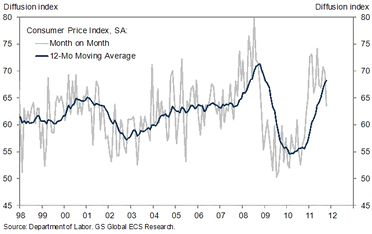
Our unweighted CPI diffusion index is also starting to look a bit more benign again. It is constructed by seasonally adjusting all 178 individual CPI categories for which we have sufficient data, calculating the month-to-month change, and then reporting the percentage of categories showing price increases plus half the percentage showing no change. That is, values above 50 indicate that more categories are seeing price increases than decreases; the higher above 50, the greater the breadth of price increases relative to price decreases. (We perform our own seasonal adjustment because the Labor Department only provides seasonally adjusted CPI data for a subset of product categories.) Exhibit 1 below shows our diffusion index. While it is still clearly above the levels of 2009 and 2010, the October 2011 reading was the lowest since November 2010.

Exhibit 1: CPI Diffusion Index Has Started to Slow

chart


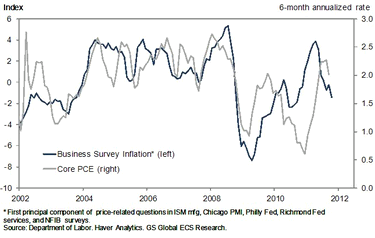
To gain more insight into future inflation trends, we have constructed a new measure that summarizes the inflation signal from various business surveys. Specifically, we calculated the first principal components of the price-related questions in the monthly ISM, Chicago PMI, Philly Fed, NFIB, Kansas City Fed, and Richmond Fed business surveys. These questions refer to prices paid, prices received, or wages and salaries and are generally reported as the difference between the percentage of respondents saying that prices rose in the survey month and the percentage saying that prices fell. (Focusing only on prices paid or prices received indexes does not make a significant difference to the results.)

The results are shown in Exhibit 2 below. In general, our business survey indicator of inflation tracks the ups and downs of the core PCE index–the Fed’s favorite measure of underlying inflation–reasonably well. After a significant acceleration in early 2011, the indicator has declined notably in recent months and is now consistent with a deceleration in core PCE inflation from the recent 2%+ level to somewhere closer to 1.5%. This is also consistent with our forecast that inflation will slow over the next year.

Exhibit 2: Business Survey Inflation Shows Recent Deceleration
chart

(RNC) Chairman Reince Priebus on the deficit

With the Republicans now willing to hike taxes out of fear of becoming the next Greece, the odds of the super committee going super big are increasing.

“America has crossed an unthinkable threshold: our national debt now exceeds $15 trillion dollars. That’s more than $48,000 per citizen,” Republican National Committee (RNC) Chairman Reince Priebus said. “In 2009, President Obama promised to cut the deficit in half by the end of his first term. Instead, he further accelerated its growth, producing three years of record deficits.”

Peter Schiff Show

Warren will be on the Peter Schiff Show tomorrow, 11/17/2011, at 10:33 am EST.

Find your local station here, to listen live.

Or stream here.

Otherwise this loop will play for 24 hours after the conclusion of the show.

Topic:

>   
>   As for topics, I thought we could talk about your piece on inflation failing to manifest
>   despite the dire warnings.
>   

Japan’s Hidden Jobless Hits 4.69mn, Worse Than After Lehman Shock

Japan’s Hidden Jobless Hits 4.69mn, Worse Than After Lehman Shock

November 16 (Nikkei) —The number of Japanese that want to work but are not actively seeking employment has surpassed levels from after the global financial crisis erupted, according to government data released on Tuesday.

Some people have given up searching for work because they believe that the jobs they desire are not available. Known as hidden unemployment, such individuals are not reflected in official unemployment statistics, which cover those actively hunting for jobs by going to employment centers, for example.

The hidden jobless in Japan jumped by 190,000 from a year earlier to 4.69 million in the July-September quarter, excluding the three prefectures hit hardest by the March 11 disaster, the Internal Affairs Ministry said.

The figure is nearly 70% larger than the number of officially unemployed people. It is also higher than the 4.61 million in the July-September quarter of 2009, when the employment market deteriorated sharply after the financial crisis.

Of the hidden jobless, the number of women grew by 60,000 while men surged by 130,000. Asked why they are not seeking work, more people replied that there are no jobs that match their skills or their desired conditions such as pay and work hours. The strong yen and concerns over power shortages are seen as factors resulting in a dearth of openings for good jobs.

The number of unemployed people fell 430,000 on the year to 2.77 million for the July-September quarter, excluding the three disaster-hit prefectures. Of this figure, those that have been out of work for at least a year declined by 190,000 to 1.03 million, down for the second straight quarter. While this suggests that fewer people are without work over the long term, some may have exited the employment market by giving up on the job search.

Republicans, fearing Greece, agreeing to tax hikes

Shows the Republicans truly do fear the US becoming the next Greece,
as they begin to lean towards tax hikes.

Meanwhile, they continue keeping us on the road to Japan.
Or worse.
A lot worse.

Republicans Consider Breaking No-Tax Vow as Deadline Looms

By Brian Faler

November 15 (Bloomberg) — For Senator John Cornyn, it was the situation in Greece.

The Texas Republican said he is willing to back tax increases as part of a major deficit-reduction deal because he fears the European debt crisis could spread to the U.S.

“We’ve never been in this spot before,” said Cornyn, who also leads his party’s effort to elect more Republicans to the Senate. “We’re looking over at Europe and what’s happening in Greece and Italy — we risk having another huge financial crisis in this country, and we’ve got to try to solve the problem.”

He is one of a growing number of Republicans, many with otherwise impeccable anti-tax credentials, who say they are willing to raise taxes to reach a big deficit-reduction deal with Democrats.

That may help insulate them from charges of stubbornness if Congress’s bipartisan supercommittee doesn’t meet its Nov. 23 deadline to find a way to cut $1.5 trillion. For now, it’s helped shift Washington’s debate to how much, rather than whether, to raise taxes.

Senate Budget Committee Chairman Kent Conrad, a North Dakota Democrat, said he is encouraged by the shift even as Democrats scoff at a specific Republican proposal.

“It’s a step in the right direction for them to just rhetorically cross that line,” said Conrad.

‘Real Trouble’

Asked if Republicans were trying to set up a blame game should the supercommittee fail, Conrad said, “I hope not” because “if we aren’t beyond that, we are in real trouble.”

Democrats say the Republican deficit plan relies too heavily on spending cuts and would give the wealthy too much of a tax break. Some question whether its numbers add up.

At issue is a proposal by the supercommittee’s Republicans to trade permanent cuts in income tax rates, with the top rate dropping to as little as 28 percent, for new limits on deductions, exclusions and other tax breaks. They estimate that it would produce $300 billion to reduce the deficit.

The plan’s principal author is Senator Pat Toomey, a Pennsylvania Republican who previously led the Club for Growth, a Washington anti-tax group. House Speaker John Boehner, an Ohio Republican, today endorsed the proposal, calling it a “fair offer.”

Some conservative organizations are accusing Republicans of trying to hide tax increases through the Toomey plan.

Norquist Reaction

“Closing tax loopholes is all well and good,” said Americans for Tax Reform president Grover Norquist in an opinion article in Politico. “But doing so to raise revenues is just as much a tax hike as raising tax rates.” He added, “Any congressman who wants to keep his promise to voters to oppose tax increases” must oppose the plan.

Many Republican lawmakers are also unhappy with the proposal. “We don’t have a tax problem — we have a spending problem,” said Senator Jim DeMint, a South Carolina Republican. “For us to get lulled into ‘how much to raise taxes’ in this thing is foolish.”

Senator Orrin Hatch, the top Republican on the tax-writing Finance Committee, said, “Some of these loopholes really aren’t loopholes.” He called them “important policy provisions, like the home interest mortgage deduction.”

Republican supporters of the plan say they are trying to lock in lower income-tax rates that will otherwise jump if, as is currently scheduled, the tax cuts enacted in President George W. Bush’s administration expire at the end of next year. President Barack Obama opposes extending the Bush-era cuts for those earning more than $250,000, and Republicans are unlikely in the 2012 elections to win the Senate votes they would need to keep the tax cuts in effect.

‘Biggest Tax Increase’

“What we’re trying to do is avoid the biggest tax increase in the history of the country,” Senator Charles Grassley, an Iowa Republican, said of Toomey’s plan.

Toomey declined to comment other than to point to a Nov. 10 Wall Street Journal editorial quoting him as calling his proposal a “bitter pill” that is “justified to prevent the tax increase that’s coming.”

A number of Republicans are playing down anti-tax pledges they signed with Norquist’s group. “We take an oath to uphold the Constitution” and “that trumps any and every consideration,” said Cornyn.

“I didn’t know I was signing a marriage vow,” said Representative Mike Simpson of Idaho, one of 40 House Republicans who recently signed a letter signaling willingness to raise taxes as part of a major deficit-cutting deal.

Shifting Opinion

Senator Lamar Alexander of Tennessee, the chamber’s third- ranking Republican, said he saw a sign of shifting opinion when three of the supercommittee Republican members — Toomey, Rob Portman of Ohio and Arizona’s Jon Kyl — briefed Senate colleagues on their plan and no one complained.

“For Pat Toomey and Portman and Kyl to come in and tell a whole roomful of Republicans that ‘we’ve put $250 billion of tax increases on the table’ and not get a murmur of dissent is remarkable,” said Alexander.

Senator Saxby Chambliss, a Georgia Republican, said his party’s lawmakers should consider bigger tax increases if it would lead to a larger debt-reduction deal, because the political price they would pay will essentially be the same.

“You’re going to be criticized by the same people irrespective of what the number is,” said Chambliss.

Retail Sales/Empire/PPI/Evans- GDP remains firm

As previously discussed, GDP looks to be growing sequentially, and should do fine next year if fiscal policy doesn’t tighten.

But still not so good for people working for a living, pretty good for corporate earnings.

And risks remain- Europe, China, Super Committee, etc. etc.

And look for a relief rally if Europe all agrees the ECB writes the check,
followed by a sell off due to the austerity that accompanies it.


Karim writes:

Data confirms Q4 GDP growth tracking 3.25%.; slight boost to Q1 estimate; more like 2.75% vs 2.5% previously.

RETAIL SALES

  • Up 0.5% headline and 0.6% control group
  • Iphone 4s definitely helped as electronics sales rise 3.7% for the month, largest gain since 11/09

EMPIRE

  • Rises to 6mth high of 0.6 from -8.48 in October; but 0.6 still weak historically.
  • Also, new orders and employment component both soften in the month.

PPI

  • Pipeline pressures receding as -0.3% headline, -0.4% on consumer goods, -1.1% intermediate stage, and -2.5% crude stage

EVANS AND BULLARD

  • Evans advocating 3% inflation target and linking policy guidance to unemployment/inflation objective
  • Also acknowledges he is ‘sufficiently outside’ consensus at the Fed
  • Bullard rejects linking policy to numerical objectives and states would need to see evidence of deterioration in U.S. economy to support additional easing

A note from S&P’s John Chambers

This makes me sleep a lot better…

November 15, 2011

Dear Warren,

On Nov. 11-12, I spoke at the Caixin Summit 2011 in Beijing on the subject of who will solve the debt crisis. My comments pertained to the euro area and to the rest of the world, and I stated that, in Standard & Poor’s view:

  • External imbalances are as much at the root of the current crisis as fiscal imbalances;
  • Better coordination among international policymakers can help to attenuate these external imbalances;
  • Prior domestic economic reforms will facilitate coordination;
  • Generally, a high level of financial claims is more of a symptom of past failures to reform than the disease itself;
  • If international cooperation and economic reform come up short (which is not our base case), global growth could sputter, public and private sector indebtedness could remain high, and some speculative-grade sovereigns could resolve their fiscal difficulties through default.

Standard & Poor’s believes that what is taking place in the euro area, in several respects, is a microcosm of what is happening globally.

To read my full comments, please click here to access the article.

Please contact me with any comments or questions.
Sincerely,

John Chambers
Chairman of the Sovereign Ratings Committee