Full size image

>
> (email exchange)
>
> On May 16, 2013 8:31 AM, wrote:
>
> Weak data and lower CPI, bond positive
>
Yes
Very bad news
Confirming my fears
>
> PHILLY FED AWFUL -5.2 VS +2 EXPECTED
>
:(
Credit accelerator going into reverse?
Too small deficit to get larger the ugly way?
My Two (Per)cents: How Are American Workers Dealing with the Payroll Tax Hike?
By Basit Zafar, Max Livingston, and Wilbert van der Klaauw
Overall, our analysis suggests that the payroll tax cut during 2011-12 led to a substantial increase in consumer spending and facilitated the consumer deleveraging process. Based on consumers responses to our recent survey, expiration of the tax cuts is likely to lead to a substantial reduction in spending as well as contribute to a slowdown or possibly a reversal in the paydown of consumer debt. These effects are also likely to be heterogeneous, with groups that are more credit and liquidity constrained more likely to be adversely affected. Such nuances may be lost in the aggregate macroeconomic statistics, but theyre important for policymakers to consider as they debate fiscal policy.
April revised lower and still well under 50:
Homebuilder Confidence in U.S. Climbs as Outlook Improves
Updated Budget Projections: Fiscal Years 2013 to 2023
Karim writes:
Deficit projected 200bn less than 3mths ago for current fiscal year. Projected at 2.1% of GDP for 2014-15, or 600bn less than 3mtgs ago.
No more grand bargain talk?
Maybe, but this is still being said:
For the 20142023 period, deficits in CBOs baseline projections total $6.3 trillion. With such deficits, federal debt held by the public is projected to remain above 70 percent of GDPfar higher than the 39 percent average seen over the past four decades. (As recently as the end of 2007, federal debt equaled 36 percent of GDP.) Under current law, the debt is projected to decline from about 76 percent of GDP in 2014 to slightly below 71 percent in 2018 but then to start rising again; by 2023, if current laws remain in place, debt will equal 74 percent of GDP and continue to be on an upward path (see figure below).
And it all begs the question of whether the proactive tax hikes and spending cuts will through the credit accelerators into reverse, as nominal GDP growth continues to decelerate.
I sat next to Al Gore at dinner at Monty Friedkin’s house in Boca for 45 minutes in front of that election. Cliff was there as well. Al asked me how we should spend the $5.6 trillion surplus projected for the next 10 years. I told him there wasn’t going to be a $5.6 trillion surplus as that implied a reduction of that much of net global $US financial assets, to the penny. Instead, a $5.6 trillion deficit was more likely to bring deficit spending back in line with ‘savings desires’ which I also described. He’s a pretty good student, went through the numbers, and agreed with the logic. He then said something like ‘You know I can’t get up and say any of this’ as he got up and explained how he was going to spend the $5.6 trillion surplus.
Point is, the CBO makes assumptions about growth that don’t recognize that growth can be a function of fiscal balance.
In other words the tax hikes and spending cuts (aka ‘austerity’) initially cause the deficit to fall, but if the deficit is proactively brought down too much then undermines private sector credit expansion/spending causing sales/output/employment to slow sufficiently for the deficit to rise to where it ‘needs to be’ from suddenly falling revenues and rising transfer payments. As demonstrated by proactive fiscal tightening in the UK, Europe, and Japan, for example.
This is not to say the tax hikes and spending cuts in the US have crossed that line.
Nor is it to say they haven’t.
For me the jury is still out.
Today’s Tepper rally apparently was based on the idea that the ‘QE money has to be invested somewhere’ which is of course total nonsense.
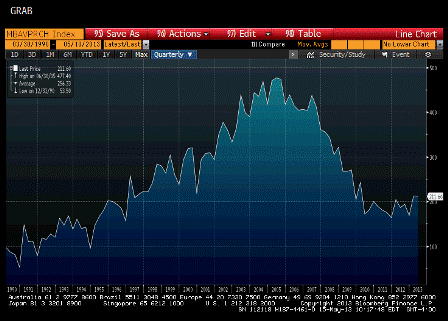
(See if you can spot any sign of QE in the attached nominal GDP chart)
But it moved the market nonetheless.

Google Translate:
Paul Barnard and Warren Mosler meet the activists of local groups on a tour that will begin on June 10 in Montalto Uffugo (Cosenza) and will end on 22 June in Cant (Como).
In this route there will be public meetings of which we will detail shortly.
It will also be available in the next few days, the material event disclosure.
It is a unique event: the economist who says “The eurozone is a crime against humanity, because unemployment creates social horrors and is kept on purpose” will be in Italy alongside Paul Barnard and activists ME-MMT .
The local groups are already working to organize the individual stages: contribute to the organization by donating a contribution.

You can see on the chart that year over year the growth in nominal GDP- actual dollars spent- slowed in Q1 2013 from Q4 2012, while ‘real’, price adjusted spending went up.
That is, dollars spent grew at a slower rate while the goods and services purchased grew at a higher rate, all because of year over year changes in prices.
And note that the rate of nominal growth seems to have been modestly decelerating for the last several years as well.
No sign of any ‘run away money printing’ here…
;)
Karim writes:
Lower commodity prices unequivocally positive for U.S. consumers.
Yes, agreed, lower prices in fact help consumers offset the lower rate of nominal income growth.
And yes, the Fed is concerned about the output gap which is real GDP.
And also price stability, as a secondary policy mandate…
;)
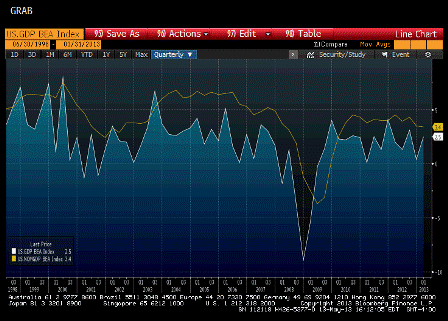
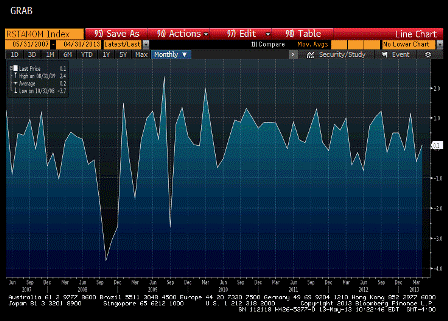
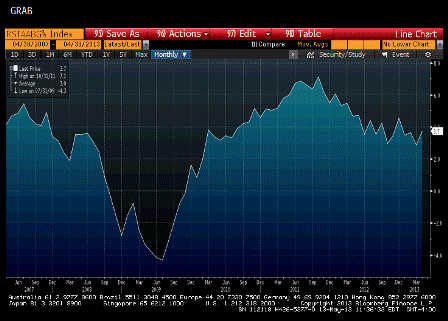
I know it was better than expected, but sure doesn’t look like anything that would cause a Fed member to ‘taper’? In fact, the slope still looks negative to me?
Yes, it looks a little better if you exclude autos, gasoline and building materials, but autos are leveraged purchases, representing purchases that exceed income, and weekly Redbook retail sales still looking deceleration as well.
To sustain GDP growth, private sector credit expansion plus govt spending more than its income need to ‘overcome’ the demand leakages of contributions and earnings of pension funds, the trade deficit/foreign central bank dollar accumulation, unspent corporate income, etc. etc. Cars and housing have been the drivers behind the private sector credit expansion that’s gotten us this far, overcoming the retreating govt deficit.
The question remains whether the private sector credit expansion can survive the austerity measures of the year end tax hikes and the sequesters.
Still looks like a ‘maybe not’ to me?
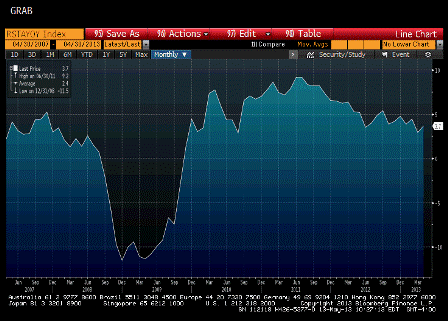
Retail Sales Y/Y:
Retail Sales M/M:
Core Retail Sales Y/Y:
Annualized Auto Sales: