
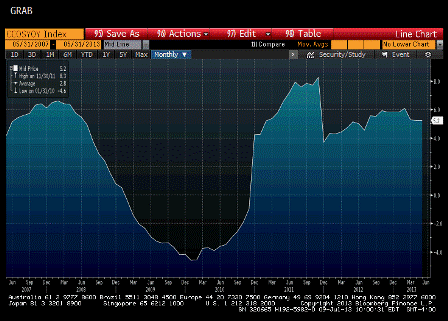
Consumer Credit Year Over Year

I keep looking for domestic credit expansion, to fill the ‘spending gap’ left by the tax hikes and sequesters.

The headline uptick in consumer credit looked promising, but seems there’s some kind of ‘seasonal’ factor at work, as it’s done this every year for the last three years, so the year over year change isn’t showing any signs of life.

Nor is mortgage debt outstanding or any other measure of lending that I’ve seen showing any material growth.

I’m now hearing Q2 GDP growth estimates are down to +1 to + 1.5% or so. This is to be expected when the federal deficit reduction measures aren’t being ‘offset’ by domestic credit expansion and/or increased net exports. In fact, the higher than expected trade deficit was the latest thing to pushing down GDP estimates.

Worse, with a bit of a lag, lower GDP growth = lower sales growth= lower job growth (presuming ‘productivity’ doesn’t collapse) and then the lower job growth feeds back into lower sales, etc.

So yes, more jobs mean more income for those working, but without sales and earnings growth their paychecks reduce corporate incomes which then drives ‘negative adjustments’ in hiring policy, etc.

The answer, as always, is quite simple- cut taxes and/or increase govt spending, depending on one’s politics.

Unfortunately govt- and not just our govt, but all govt that I know of- is still going the other way and continuing to make things worse.

Full size image

51 Dead, 435 Hurt in Clashes Near Pro-Morsi Sit-in

As feared, Egypt is turning into Somalia, and the rest of the world is heading in the same direction

51 Dead, 435 Hurt in Clashes Near Pro-Morsi Sit-in

July 8 (NBC) — At least 51 people were killed and 435 injured in clashes early Monday near the Republican Guard headquarters in the Egyptian capital, the Ministry of Health said.

Supporters of deposed President Mohammed Morsi had been holding a sit-in near the compound.

Reuters cited the Egyptian military as saying “a terrorist group” had tried to storm the building early Monday. A Ministry of Defense official said that 200 people were arrested after protesters attacked the site around 4 a.m. local time (10 p.m. ET on Sunday). Some were armed with guns, Molotov cocktails and knives, according to the official. One officer was killed and six troops wounded, the military said.

However, Morsi’s Muslim Brotherhood and its allies accused security forces of attacking protesters. NBC News was not immediately able to reconcile the differing accounts.

Members of the Muslim Brotherhood have been protesting near the Republican Guard headquarters since Morsi was removed from office, amid speculation he may be under house arrest at the site.

Jobless About to Take a Big Hit From the Sequester

Jobless About to Take a Big Hit From the Sequester

By Jeff Cox

July 6 (CNBC) — The 11.7 million Americans still unemployed are finding their wallets getting even lighter as the sequester federal spending cuts kick in.

While the mandated decreases have been slow to trickle into the real economy, the unemployed are feeling perhaps the first big jolt.

As of July 1, the average weekly benefit of $289 will fall by $43 a week, adding pressure at a time when the labor market is trying to find its bearings but has yet to generate the kind of employment that would indicate a strong recovery.

Jobs, one more time

Does anyone see anything other than jobs going sideways, and personal consumption expenditures and GDP, if anything decelerating?

Including cars and housing, which look to have flattened this year, and need to steepen to keep it all going. And employment does tend to lag some?

And same with most indicators, apart from some ‘confidence’ indicators?
Nor do the credit aggregates show any expansion that would change things?

Except for govt, which is going backwards with tax hikes and spending cuts, and automatic stabilizers offering front line resistance to even modest levels of growth? Exports going backwards, imports up, and recent oil price hikes are GDP/employment negatives as well?

I’m not saying the Fed doesn’t like what’s happening. They do, and odds are that with another two sideways months they will be tapering in Sept. As if that matter for anything fundamental.

And take another look at this chart. Can you detect the influence of $85 billion/mo of QE? No, because there isn’t any, and don’t tell me it would have been worse otherwise.

Jobs

Hopefully employment, historically a lagging indicator, somehow leads consumption and GDPthis time.

(As always, I could be wrong, but I wouldn’t bet even your money on it…)

;)

But seems more than enough for the Fed to ‘taper’ which of course is of no further economic consequence of substance.

Of more concern is rising gasoline prices, for example.
And this latest Egyptian drama has only just begun.
Seems the revenge of the Brotherhood is inevitable.

Randy Wray’s response to NYT article

Warren Mosler & MMT: Deficit Lovers?

By L. Randall Wray

July 5 — Here’s a piece from yesterday’s NYTimes by Annie Lowrey: Warren Mosler, a Deficit Lover With a Following.

While this is a mostly good piece on Warren, Lowrey gets enough of it wrong to call into question her ability as a reporter. Yes, Warren designed and built a yacht, and he designed and built great race cars (even if his first model was called one of the fifty worst cars ever–for its unorthodox looks, not for its performance). It is also true that Modern Money Theory has taken off in the blogosphere, where it has picked up tens of thousands of followers. And Warren just completed a whirlwind speaking tour in Italy that attracted hundreds of listeners even in small towns. (Try that, any other American economist!)

The rest of her piece is filled with bias and mistakes. First, while it is true that Warren’s former hedge fund lost money in a Russian deal, he had already sold out his stake and was not involved. Warren knew the risks of pegging a currency and opposed the deal from the beginning. Note however, that the deal was much more complicated than Lowrey implies. As I recall, the position was hedged but some major international banks defaulted on their promises; eventually Warren’s former firm collected damages. In any event, the risks of pegging a currency are well-known by followers of MMT and the Russian default is perfectly consistent with MMT’s teachings.

Lowrey also quotes Stephanie Kelton as saying ““These ideas definitely aren’t disseminated through published academic journals.” “It’s all on the Internet.” Stephanie said no such thing. And of course, it is pure nonsense. There are dozens and dozens of scholarly papers published in the academic journals on MMT. There are critiques of MMT and responses to the critics. The ideas have been debated since the mid 1990s by PhD economists. Lowrey is a lazy reporter as this would have been easy to check; or she came to the story with a bias, trying to paint MMT as silly. Indeed, she likens MMT to Ron Paul’s gold buggism–which has no academic support at all. Yes, the internet blogs have been essential to spreading the ideas of MMT outside academia–and that is a good thing–but Lowrey’s attempt to dismiss it stinks of bias. One wonders if her famous NYTimes Nobel winning economics columnist colleague put her up to this.

She also quotes blogger Mark Thoma as follows:

“They deny the fact that the government use of real resources can drive the real interest rate up,” said Mark Thoma, an economics professor and widely followed blogger who teaches at the University of Oregon. After delving into the technical details of modern monetary theory for a few minutes, he paused, then added, “I think it’s just nuts.”

The last part rings true–I don’t think Thoma has spent more than a few minutes to try to understand MMT (and he doesn’t understand any of it). But if he did say that “government use of real resources” might “drive the real interest rate up”, then he’s far more confused about macroeconomics than I ever suspected. It is one of the dumbest statements I’ve ever seen in print, so I suppose she made it up. What nonsense.

The “real interest rate” is a compound term, comprised of the nominal interest rate and the rate of inflation. Technically, the real rate is the nominal rate less expected inflation. As we know, the Fed sets the overnight nominal rate. The real rate is then the Fed’s target rate less expected inflation.

Now it is possible that “government use of real resources” MIGHT raise expectations of inflation. That is what gold buggism is all about. So let us say Ron Paul whips up inflationary expectations. What happens to the real rate? Well, we are subtracting a bigger expected inflation number from the Fed’s target rate. SO THE REAL RATE GOES DOWN! Now, Thoma might think the Fed will also react to Ron Paul’s gold buggism and so increase its target rate. How much? Who knows. Is there any guarantee the Fed will raise it MORE than Ron Paul raises inflation expectations? I see no reason why one would jump to that conclusion. And historically, the ex post real rate does often fall when inflation rises (it even goes massively negative).

That is not proof that it is impossible for the real rate to rise when government uses real resources, but there’s no reason to think the real rate automatically goes up. It depends. On whether inflation expectations increase by less than the Fed raises the nominal rate target.

Finally, Warren and “Deficit Owls” are by no means “deficit lovers”–so Lowrey’s title is misleading. There’s a time for deficits, a time for balanced budgets, and even a time for budget surpluses. It all depends on the other two sectors (reminder: Government Balance + Private Domestic Balance + Foreign Balance = 0). A more accurate title would have been: Warren Mosler: Not Afraid of Deficits.

At least Lowrey had the good sense to interview Jamie Galbraith. This is a nice statement:

“There’s a whole deficit lobby of Peterson-funded groups arguing we’re turning into Greece,” said James K. Galbraith, an economist at the University of Texas at Austin. “They’re blowing smoke and the M.M.T. group has patiently explained why.”

Precisely. MMT tries to expose Peterson as running a dishonest scare campaign in order to push through his policy to gut the social safety net. It is not that we “love deficits”. It is that we hate dishonesty.