Bannon, DB on repatriation, The $

The big stupid continues uninterrupted from regime to regime:

Documentary Of The Week: Stephen Bannon Explains America’s Problems

By John Lounsburry

Nov 15 (Econintersect) — Econintersect: This lecture was presented to the inaugural session of the Liberty Restoration Foundation in Orlando, FL October, 2011.

111701

Stephen Bannon, the CEO of Donald Trump’s successful presidential campaign and to-be Chief Strategist in the Trump White House, describes his view of what is wrong with America in 2011. He maintains that:

The U.S. cannot meet its future obligations.

The Fed makes payments by crediting member bank accounts. There is no operational constraint on this process

Government spending is sucking money out of “everything else”.

Government spends via the fed crediting a member bank account. Total dollar bank balances are increased by exactly that amount. Nothing is ‘sucked out’.

The trade deficit is the “beating heart” of our economic problems.

As for the trade deficit, imports are real benefits, exports real cost. Real wealth is domestic production + imports – exports. It’s the policy response to imports that turns a good thing into a bad thing, not the import per se. When unemployment goes up due to imports (or for any other reason), the constructive policy response is to support aggregate demand/sales/output/employment with a fiscal adjustment – lower taxes or higher public spending. That is, net imports give a nation ‘fiscal space’ to make a fiscal adjustment that sustains domestic full employment, and with better jobs than the ones that were lost. And that way we also optimize what’s called our ‘real terms of trade’, which is what we can import vs what we have to export.

The Tea Party understands what’s wrong with America because members know the price of a bag of groceries.

Whatever!!!

We are passing on zero net worth to our children.

The public debt is the total dollars spent by govt that have not yet been used to pay taxes, which constitutes the net financial assets of the economy, aka ‘net nominal dollar savings’ of the economy.

This man is the new president’s Chief Strategist.

Mercy…. :(

FROM DB:

A reform of the US corporate tax code is very high on Donald Trump’s agenda. With trillions of American corporate profits sitting offshore due to punitive repatriation rates, a potential change in policy could have material market implications. In this report we attempt to answer some frequently asked questions on the topic. While the amounts involved may be smaller than what is commonly assumed, we argue there would be material implications for both the dollar and particularly the cost of dollar funding. In the event the tax reform is permanent, it is the absence of a future pool of reliable dollar liquidity for European and other foreign banks that will likely have the biggest impact in particular.

Link: http://pull.db-gmresearch.com/p/11390-5D2D/86468804/DB_SpecialReport_2016-11-17_0900b8c08c0effb3.pdf

1. How much offshore earnings can US corporates bring back?

Answer: about $1 trillion
It is important to distinguish between unrepatriated earnings and cash. A substantial portion of US profits are re-invested into foreign operations and capital expenditure and are therefore very sticky. Cash and liquid assets are a subset of unrepatriated earnings and are the most relevant metric to look at: it is this pool of dormant savings that is the most likely to be brought back to the US in the event of a change in tax treatment.

How big are the numbers? The upper bound can be calculated by looking at re-invested earnings from the US national accounts. Cumulative re-invested earnings since 1999 currently stand at more than $3 trillion according to the BEA (chart 1). The number is not reflective of the amounts that can be brought back however. A bottom up analysis of S&P 500 companies by our equity analysts estimates that the total amount of liquid assets held offshore is closer to $1 trillion.* We would consider this as a reasonable lower bound given that S&P 500 reporting companies only account for a portion of US total market capitalization but include the vast majority of US listed multinationals. The number is also broadly consistent in order of magnitude with the “currency and deposits” item on the US international investment position, currently about $1.7trn

2. What currency are these earnings denominated in?

Answer: 90% is probably in dollars
It is difficult to provide an accurate answer to this question because the vast majority of companies don’t outline the currency composition of their holdings. Three of the largest tech companies that disclose some detail indicate that the majority of foreign earnings are already denominated in dollars. Oracle has an explicit currency breakdown in its reports with 10% of offshore profits denominated in foreign currency. Microsoft has a similar breakdown. Apple states that foreign subsidiary cash is “generally based in US dollar-denominated holdings” but doesn’t give a figure. Broadly speaking, expectations of a medium-term dollar appreciation trend, poorly yielding alternatives, the desire to avoid balance sheet mismatches and the availability of dollar-denominated assets offshore all point to most foreign profits as already being converted into USD.

3. Where are these earnings located?

Answer: mostly in Europe
Data on the location of foreign unrepatriated cash is also hard to come by. A top-down metric can be obtained from the BEA re-invested earnings data broken down by region. Cumulating earnings over the last five years, we find that the vast majority is located in the Eurozone, followed by the UK. An alternative bottom-up analysis that looked at IRS data and earnings of Fortune 500 companies leads to the same conclusion, with most profits held in the Netherlands, Ireland and Luxembourg.**

111702

4. How much of the earnings are in cash?

Answer: probably about 25%, with the rest in other financial assets, mostly US fixed income

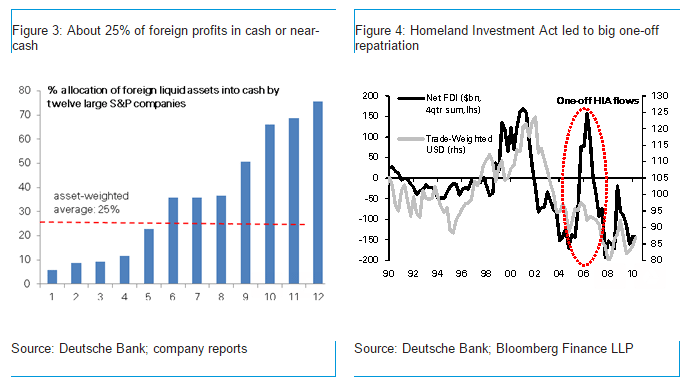
Whether corporate profits are held in cash compared to other liquid assets has important market implications. There is no top-down data available, but our analysis of twelve companies with some of the largest offshore cash balances suggests that close to 75% of balances are in investments, and only 25% are held in cash or cash equivalents. These primarily consist of deposits held at major banks, tier-1 commercial paper and money market instruments with original maturities of less than 90 days. The securities that these companies invest tend to be liquid, short term instruments.

For instance, 83% of Microsoft’s investments consisting of US government and agency securities. Similarly, Oracle’s investments are ‘generally held with large, diverse financial institutions’ that meet investment grade criteria. All securities are ‘high quality’ with 28% having maturities within a year and 72% having maturities between 1-6 years.

5. What are the market implications?

Answer: it depends on the US corporate tax reform. Positive for the dollar and negative for dollar funding. The impact is less than the headline numbers suggest but still material given how large the numbers involved are.

The closest parallel to the impact of corporate tax repatriation is the 2005 US Homeland Investment Act (HIA). This temporarily allowed companies to bring back foreign profits at a 5.25% tax rate. US FDI spiked during that year and the dollar rallied by 7%. A number of lessons can be learnt from that episode. First, a temporary tax holiday is likely to have a more material upfront impact as it would force repatriation within a shorter time frame. A permanent change would lessen the immediate impact but is likely to be bigger medium-term as it would apply to future earnings as well. Second, the tax rate applied to foreign earnings matters. The lower this is the bigger the likely repatriation. Finally, the broader context and market narrative matters: a number of positive dollar stories took place in 2005, inclusive of a Fed hiking cycle.
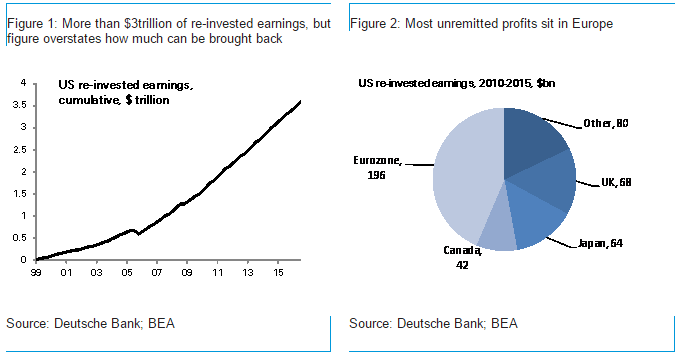
First, a 7% dollar rally for the year isn’t all that much, and it reads like even DB agrees it can be attributed to other factors.

We see a corporate tax reform as having a material impact on both the dollar and the cost of dollar funding.

  • Dollar The indirect impact on the dollar is just as important as the direct “conversion” impact. With 90% of profits already held in the greenback we are left with an (upper bound) estimate of 100bn dollars that may need to be converted. Even if much smaller than the headline reported and even if a smaller portion is converted, this amount is material compared to an annual US current account deficit of $500bn. More importantly, the second-order effect may be even greater. A profit repatriation that boosts business confidence and is deployed into capital spending will be positive for the dollar via higher growth and Fed expectations.
  • First, earnings can be ‘repatriated’ without converting anything, as my understanding is it’s just a matter of reporting and accounting for the dollar value of past earnings as domestic income.

    Second, I see no reason why any company would increase capital spending just because foreign earnings from past years are suddenly accounted for as domestic earnings at a lower tax rate. DB is implying that companies have been deferring capital spending due to current tax law, even with adequate liquidity and access to funding.

  • Tighter funding, wider cross-currency basis Even if foreign profits are held in dollars, the impact on the cost of offshore dollar funding can be material if a repatriation shifts liquidity away from European and other foreign banks to the US. The implication is that cross-currency dollar basis would be pushed wider. Our bottom-up analysis in section 4 suggests that about 250bn dollars currently sit in cash or near-cash dollar liquidity that has the potential to be moved back to the US. Compared to the approximately 200bn withdrawal of dollar liquidity from Eurozone and Japanese prime money market issuers following recent US reforms the amounts are material. Most importantly, this is likely a lower bound on the potential liquidity impact. While corporate may be able to shift the custodial location of Treasury holdings onshore without pulling liquidity from offshore banking systems, it is not clear this can be achieved for asset manager mandates or holdings of non-US resident issuers such as Eurodollar corporate bonds. In the event that the corporate tax reform is permanent, it is likely the absence of future dollar liquidity from US corporate profits will have the most material medium-term impact: approximately 300bn of US earnings are re-invested each year, and the shift of parts of this flow of reliable dollar liquidity to the US would be a negative supply shock for offshore dollar funding.
  • Allow an example: assume a client has $100 billion in DB NYC, and $100 billion in DB London. Repatriation simply means he shifts the $100 billion in his DB London account to DB NYC account. And DB now has the entire $200 billion in its account at the Fed. DB’s overall liquidity has not changed. And if a DB client in the Euro zone wants to borrow $ from DB, DB is just as able to make that loan as before the repatriation.

    111703

    [The author would like to acknowledge Suhaib Chowdhary for his invaluable assistance]

    George Saravelos
    FX Research

    Deutsche Bank AG, Filiale London
    Global Markets
    1 Great Winchester Street, EC2N 2DB, London, United Kingdom
    Tel. +44 20 754-79118
    My conclusion remains. Repatriation as a source of funds is being grossly over estimated

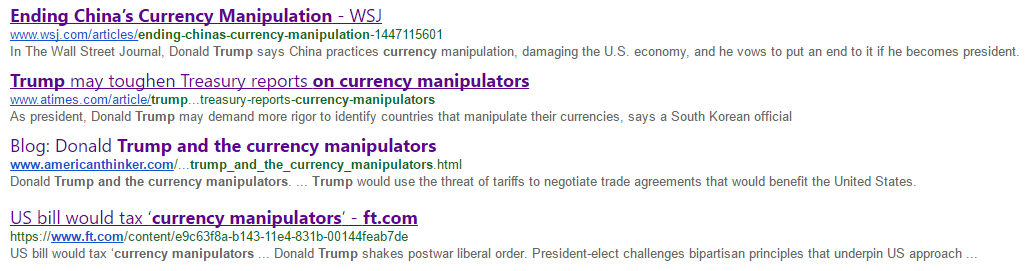
    Trump has been big (huge) on threatening the likes of China with currency manipulation, aka yuan depreciation vs the $. Same with yen, euro, etc. all threatening the Trump rust belt revival constituency, etc.
    111706
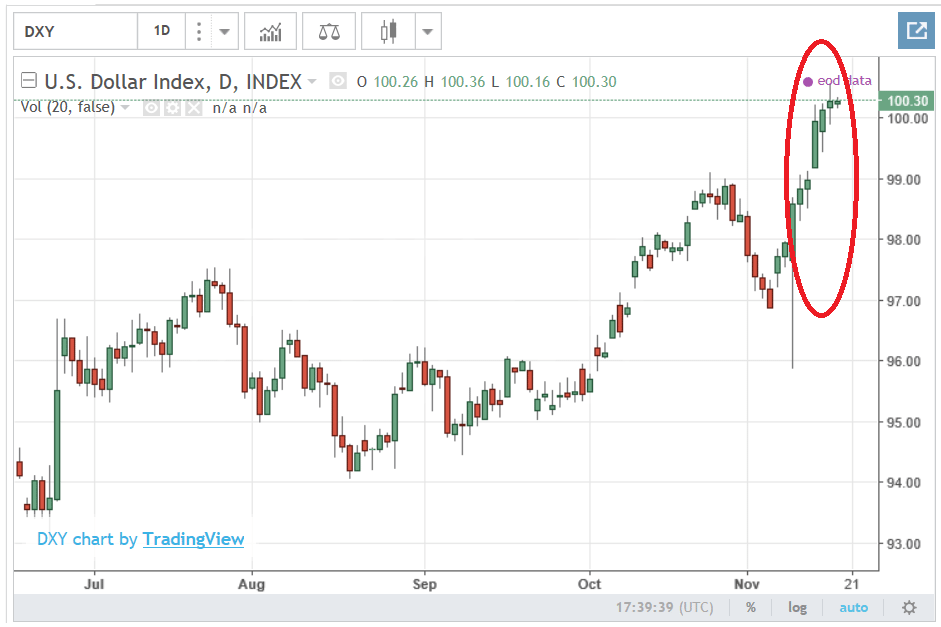
    So now, a week after his election, the gauntlet has been throw, as the $US reaches new highs, and I suspect we’ll soon see how the big guy responds:

    111704

    111705

    Taper tantrum redux, Repatriating rhetoric, Architectural billings index

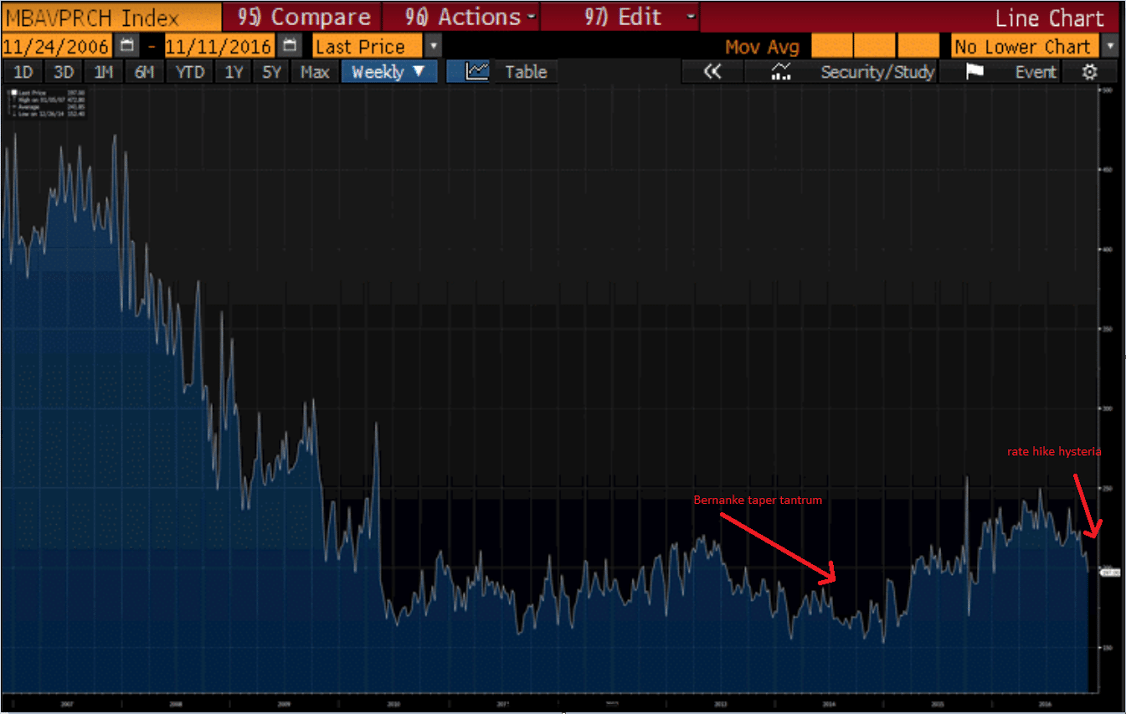
    With the Bernanke taper tantrum a housing market showing at least some signs of recovery immediately reversed course and headed south. The shale boom got things going again, and the shale bust saw some softening. But with the latest anticipatory spike in mtg rates and still not much underlying effective demand, we’re seeing the beginnings of another setback. This is the chart for the index for mortgage applications for home purchases:
    111604

    I haven’t yet seen any reason for a corporation to pay any tax on foreign earnings held in ‘offshore’ bank accounts? Nor does anything in the macro economy change with so called ‘repatriation’ as proponents have claimed. There are no CEO’s that I’ve ever heard of thinking ‘If only that part of our cash was in a domestic bank account rather than an offshore account I’d invest or otherwise spend more’:
    House Republicans Aim to Cut Taxes Without Increasing Deficits

    By Richard Rubin

    Nov 15 (WSJ) — The House Republican overhaul of the tax code is being written to expand the economy and avoid increasing budget deficits. “We designed our blueprint to break even within the budget, considering that economic growth,” Rep. Kevin Brady (R., Texas), chairman of the House Ways and Means Committee, said. If there are some deficits, he said he would accept them if the result was stronger growth. Mr. Brady also rejected an idea that had some traction before Donald Trump won—using a one-time tax on more than $2 trillion in U.S. companies’ stockpiled foreign earnings to pay for U.S. infrastructure. The House plan, Mr. Brady said, uses that money to lower tax rates and remove the tax burden on U.S. companies’ foreign sales.

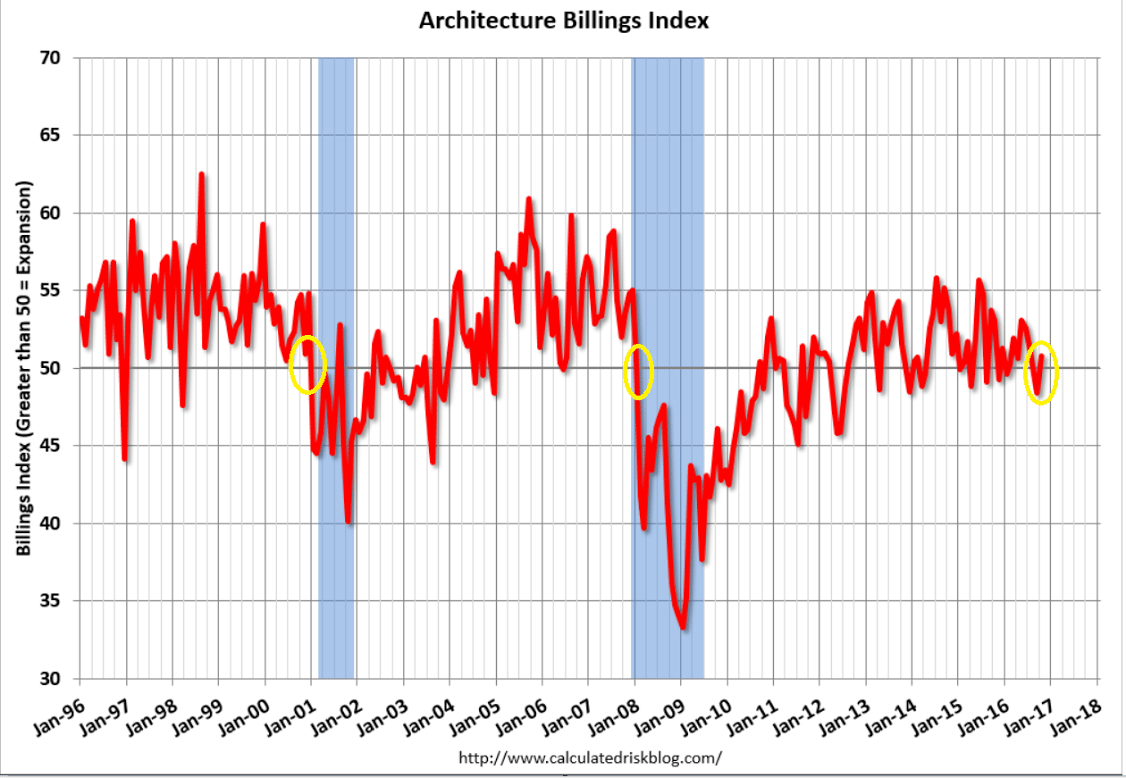
    Up a bit, but hovering around levels historically associated with recessions:
    111605

    From the AIA: Architecture Billings Index rebounds after two down months

    After seeing consecutive months of contracting demand for the first time in four years, the Architecture Billings Index (ABI) saw a modest increase demand for design services. As a leading economic indicator of construction activity, the ABI reflects the approximate nine to twelve month lead time between architecture billings and construction spending. The American Institute of Architects (AIA) reported the October ABI score was 50.8, up from the mark of 48.4 in the previous month. This score reflects a slight increase in design services (any score above 50 indicates an increase in billings). The new projects inquiry index was 55.4, down sharply from a reading of 59.4 the previous month.

    Read more at http://www.calculatedriskblog.com/#wbo1cEkMiuw3lKMZ.99

    Mtg rates, Industrial production

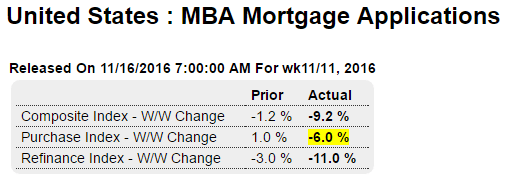
    If rates were being raised due to excess demand for mortgages the higher rates wouldn’t likely slow things down. But in this case demand has been relatively low, so the jump in rates not due to demand will likely slow demand:

    111601

    Highlights

    Purchase applications for home mortgages fell a seasonally adjusted 6 percent in the November 11 week as a sharp increase in mortgage rates took its toll on application activity. The rise in rates had an even greater impact on refinancing, where applications fell by 11 percent from the prior week. The weekly decline put the Purchase Index just 3 percent above the level a year ago, down 8 percentage points from the prior week. The average interest rate on 30-year fixed-rate conforming mortgages ($417,000 or less) rose 18 basis points to 3.95 percent.

    Spike in Mortgage Rates Throws a Wrench Into U.S. Housing Market

    By Vince Golle
    Prashant Gopal

    Nov 15 (Bloomberg) —

  • Higher borrowing costs limit some buyers, could slow building
  • Price gains may weaken as people seek smaller, cheaper homes
  • The spike in borrowing costs in response to President-elect Donald Trump’s pro-growth agenda is causing some heartburn in America’s housing industry.

    San Diego mortgage broker Shanne Sleder said a third of his clients, many of whom were already stretching budgets to buy homes in pricey southern California, are having to reconsider what they can afford as rates soar.

    “With a number of the people we were in the middle of pre-approving, as rates are going up, it’s getting tighter and tighter qualifying them,” Sleder said. He’s urging them to lock in rates. “In some cases, the higher rates are making it so they are not as comfortable with the payment.”

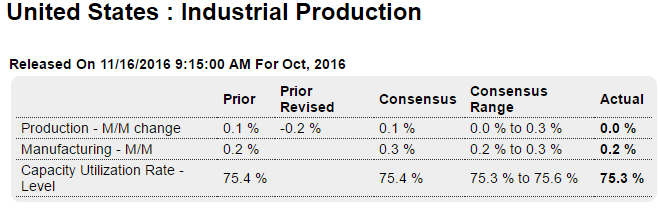
    Not so good here either:

    111602

    Highlights

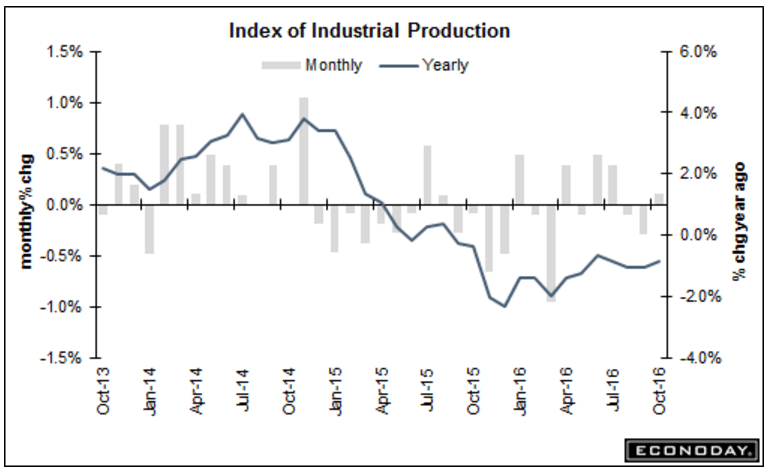
    The headline isn’t as bad as it looks as the manufacturing component of the industrial production report moved forward for a second month. Industrial production was unchanged in October with September, reflecting downgrades to both utility and mining production, revised a sharp 3 tenths lower to minus 0.2 percent. But manufacturing volumes firmed again, up 0.2 percent for a second straight month.

    Vehicle production was very strong in October, up 0.9 percent to extend a long line of impressive gains. Year-on-year, vehicles are up a very solid 5.0 percent and are eclipsed only by the 6.7 percent gain for the selected hi-tech component which rose 1.0 percent in October to extend its run of impressive gains. Another positive is a 0.2 percent gain for business equipment which has otherwise been weak most of the year.

    September’s mining output is revised to a 0.4 percent decline from an initial 0.4 percent gain. But October was a very good month for the sector as output jumped 2.1 percent for the largest monthly increase in 2-1/2 years and reflecting gains for coal. Mining’s year-on-year rate, however, remains well underwater at minus 7.0 percent. Utilities output, reflecting the nation’s unseasonably warm weather, fell 2.6 percent in October with September revised to minus 3.0 percent from an initial minus 1.0 percent.

    Overall capacity utilization fell 1 tenth in the month to 75.3 percent though manufacturing, once gain, is positive, up 1 tenth to 74.9 percent. The factory sector has been flat all year but there have been recent signs of life, from this report as well as regional reports including from the Philly Fed whose November’s data will be posted tomorrow.

    111603

    Fed Atlanta wage tracker, Layoffs, State 2017 spending cuts, misc. charts

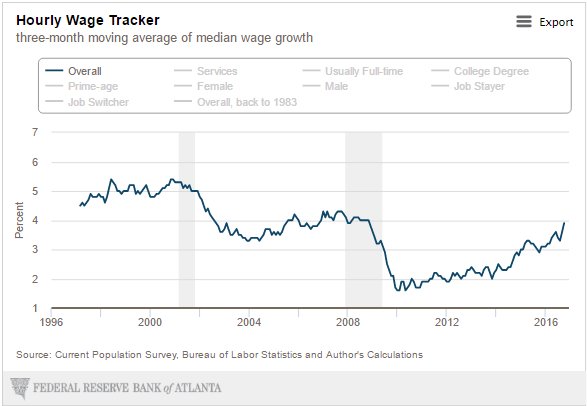
    So if new hires are at the lowest end of the wage scale, a reduction in the growth of new hires increases the average growth rate? Also note the large ‘dip’ in growth to less than 2% from the last recession. The ‘lost wage growth’ doesn’t even begin to get ‘made up’ until the rate of growth exceeds the prior average of about 4%:

    111514a
    Aggregate demand is still being lost as the cutbacks from the collapse of oil capex 2 years ago continue:

    U.S.-based energy companies announced plans to send 103,000 workers packing in the first 10 months of 2016, compared with 90,000 in the same period last year, according to global outplacement firm Challenger, Gray & Christmas.

    Reminder from 6 months ago:

    Alaska House Passes Reduced FY2017 State Operating Budget

    Majority plan, led by Co-Chair Neuman, cuts 10% in day-to-day government

    Published: March 13, 2016

    Friday, March 11, 2016, Juneau, Alaska – The Alaska House of Representatives today approved a Fiscal Year 2017 statewide operating budget that shaves 10-percent from the current year’s spending levels for day-to-day government services, a historic cut on top of last year’s equal reduction.

    Just saw these charts a friend sent:

    111515

    111516

    111517

    Retail sales, Empire manufacturing, Redbook retail sales, Business inventories

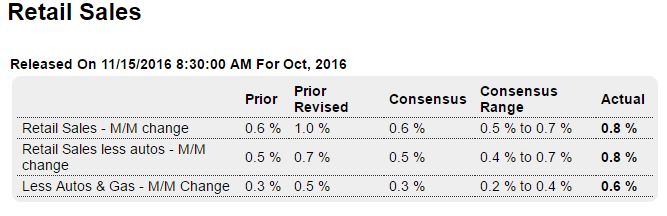
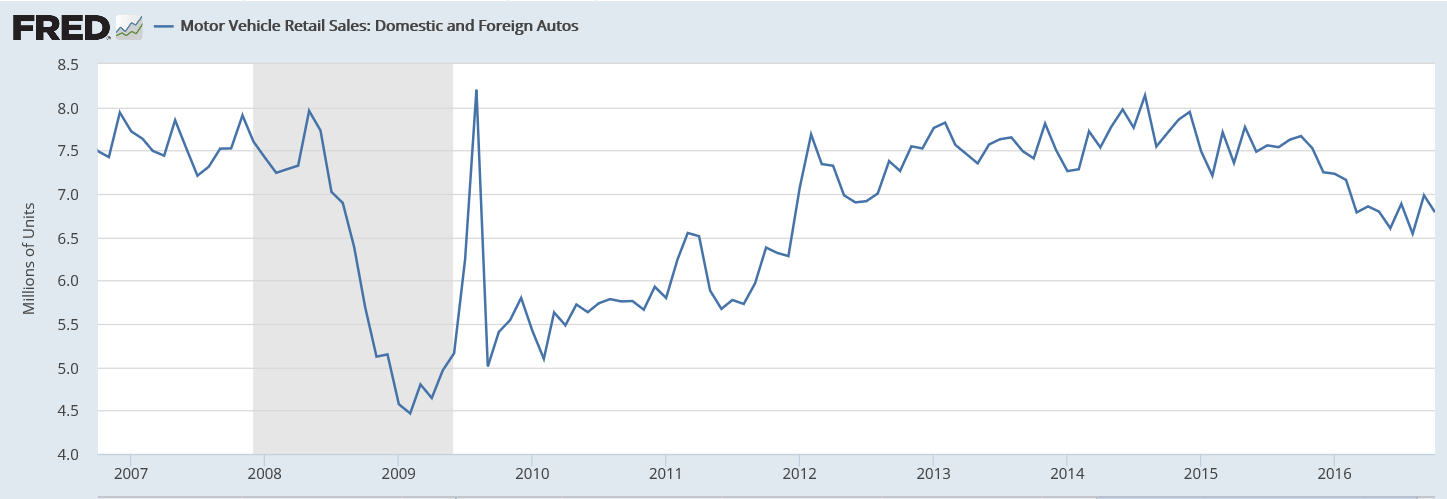
    Good report, driven by autos, which were up from last month though down from last year. However, on a year over year basis vehicles sales if anything seem to be moderately declining, and so won’t be contributing to growth as they had in the past. So a glimmer of hope here, but guarded to say the least:

    111501

    Highlights

    The consumer started the fourth-quarter better than expected and finished the third-quarter even stronger than that. Retail sales jumped 0.8 percent in October with September revised 4 tenths higher to plus 1.0 percent. The data show wide gains for both months led by the most important component of all, autos which rose 1.1 percent in October on top of September’s 1.9 percent surge. Building materials & garden equipment are also very strong, up 1.1 percent following September’s 1.8 percent gain with both pointing to strength for residential investment. Non-store retailers are also a standout and reflect strength in e-commerce, up 1.5 percent and up 0.9 percent in the two months.

    Excluding autos doesn’t pull down the gain at all in October, at plus 0.8 percent, and only shaves 3 tenths from September where the ex-auto reading is a revised plus 0.7 percent. Price effects for gasoline are giving the data a boost but nothing severe with the ex-auto ex-gas gains at 0.6 percent and 0.5 percent for September.

    This is a very impressive report and will raise estimates for fourth-quarter GDP and raise revision estimates for third-quarter GDP. Strength in the labor market is having its positive effects on the consumer.

    Retail sales also received a boost from receipts at service stations, which advanced 2.2 percent on rising gasoline prices.

    7.6% jump in health care related sales, 10 months this year vs last year:

    111513

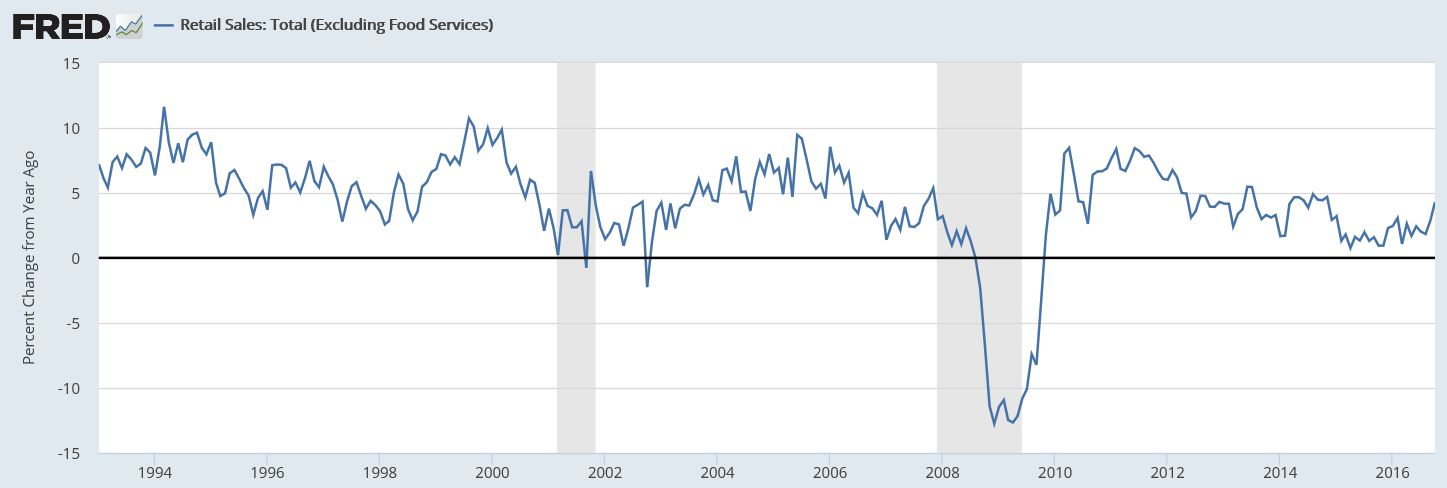
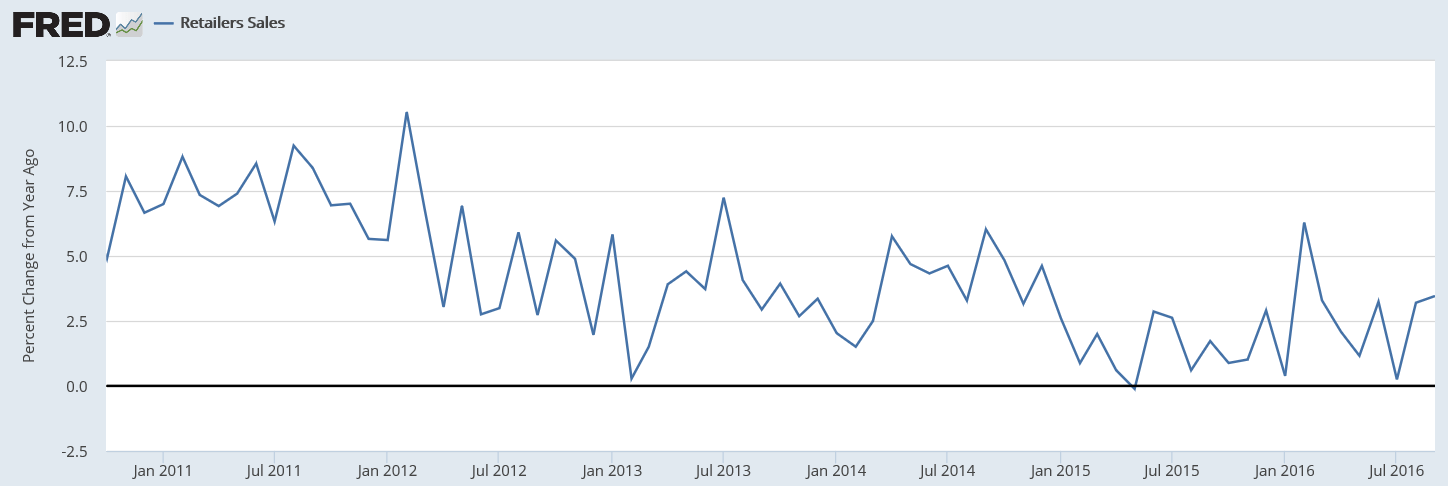
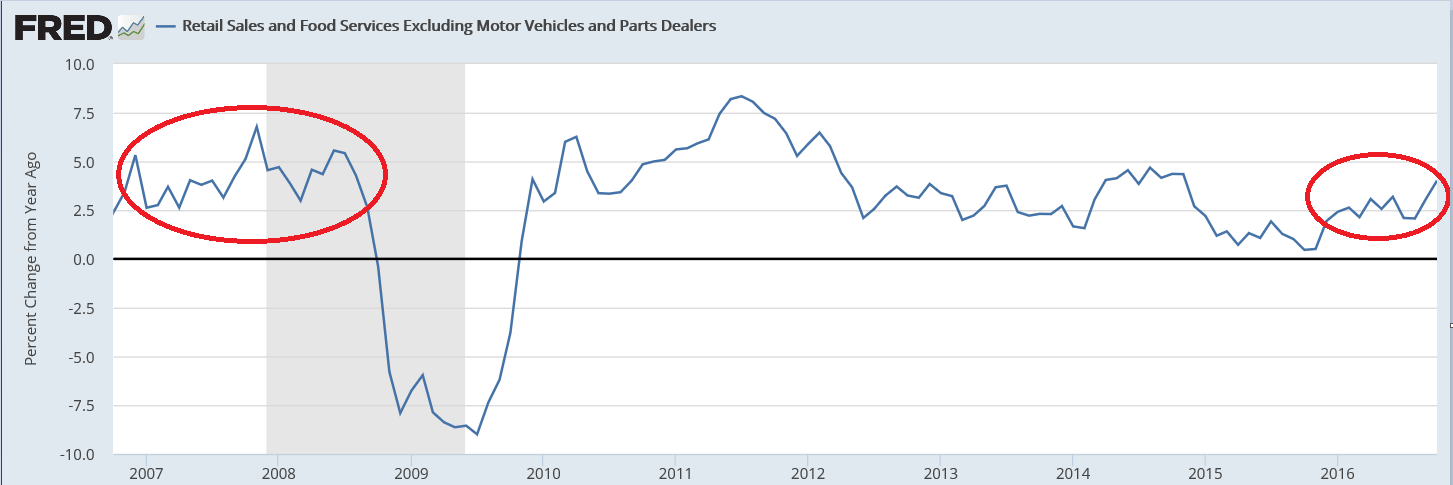
    The chart shows retail sales, not adjusted for inflation, have been running near ‘stall speed’ for a while, and blips up like this tend to revert back, so best to reserve judgement here regarding strength of the economy:

    111502

    111503
    Just making the point here that these types of levels of growth have been consistent with recession in the past:

    111504
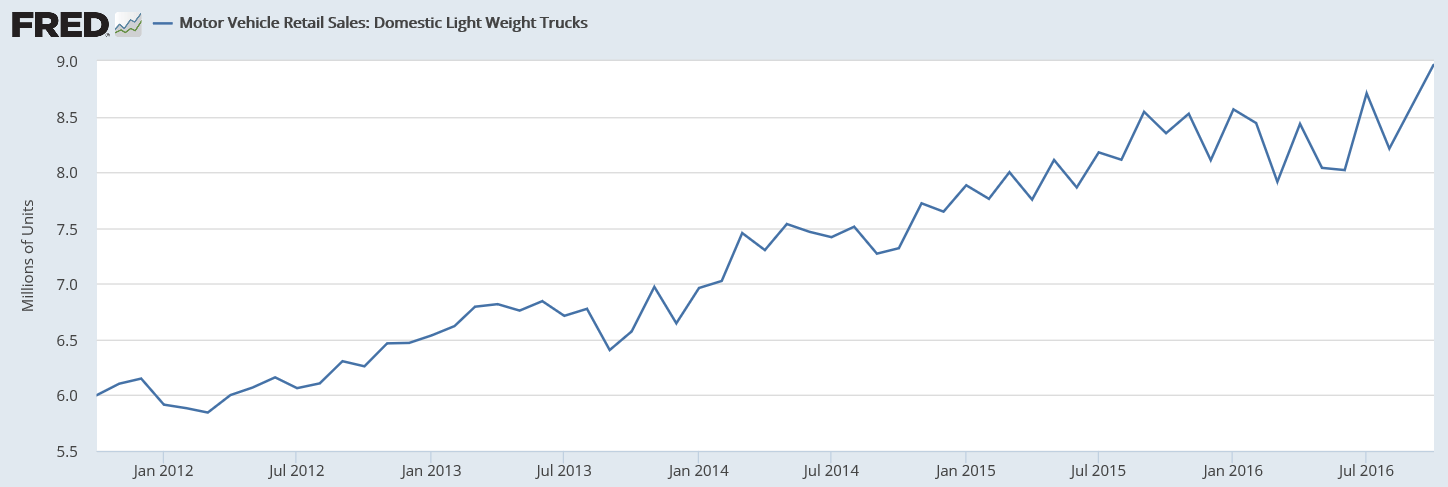
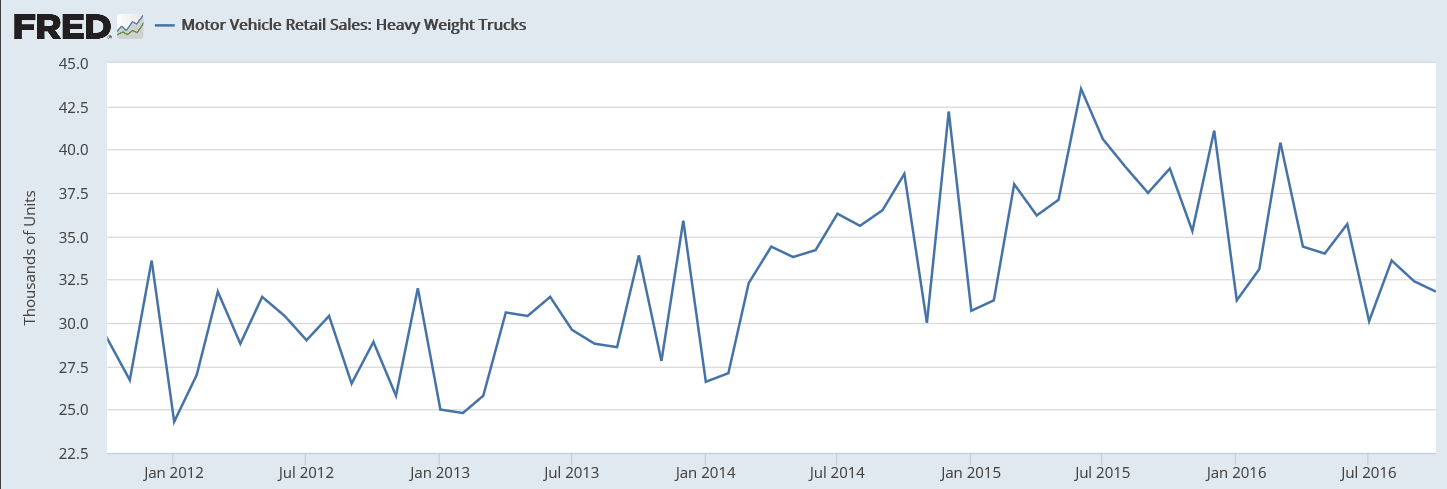
    The move up in autos was in light weight truck, which the chart shows zig zags up and down, though generally moving higher:

    111505

    111506

    111507
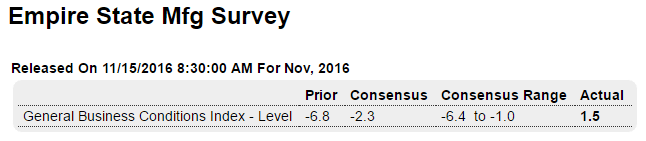
    Another better than expected report, but note that employment isn’t looking so good:

    111508

    Highlights

    The Empire State report has been soft but is showing life this month, at a headline 1.5 for November for the first positive reading since July. New orders are up a modest but still constructive 3.1 in November though unfilled orders remain deeply in the negative column at minus 12.7. Shipments are up, at plus 8.5 following two months of decline, but employment continues to contract, at minus 10.9. Costs and selling prices are in the plus column but moderating. Also moderating is the 6-month outlook, down 7.1 points to 29.9 which is on the soft side for this reading. Still, the gain for new orders and shipments are important positives in this report which, if confirmed by strength in Thursday’s Philly Fed report, may begin to lift expectations for what has been a stubbornly flat factory sector.

    111509

    Highlights

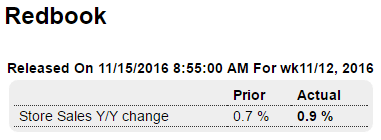
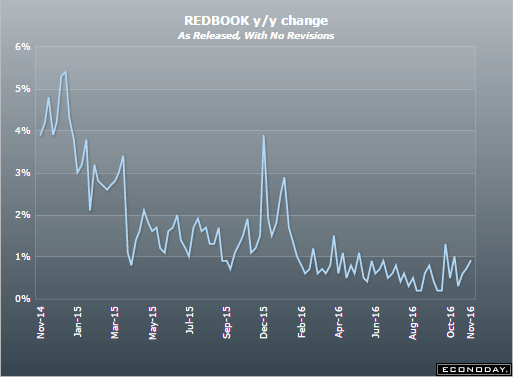
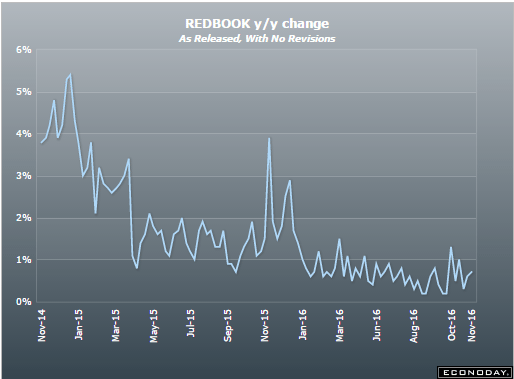
    This morning’s October retail sales report is very strong, in contrast to Redbook’s same-store sample which remains soft, at a year-on-year plus 0.9 percent in the November 12 week. Still, the gain is the best since mid-October and if extended to the coming weeks could point to another strong retail sales report for November.

    111510
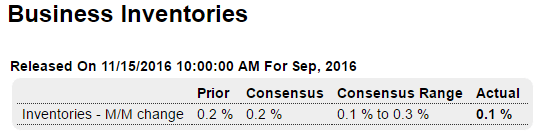
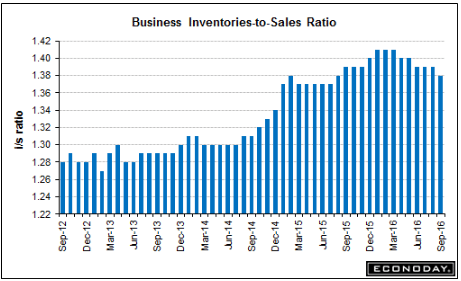
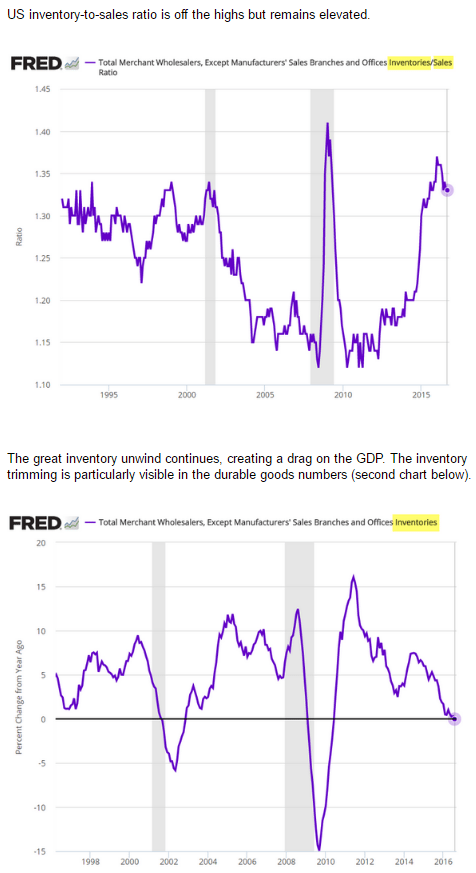
    Inventories are working their way lower, but still too high, and so continue to be a drag on output:

    111511

    Highlights

    Inventories proved tame in September, rising only 0.1 percent against a sharp 0.7 percent gain in sales that pulls the inventory-to-sales ratio one notch leaner to 1.38 from 1.39. High levels of inventories were a concern going into the fourth quarter but this morning’s very strong retail sales report may in fact point to the need to build inventories further.

    111512

    Consumer sentiment, Retail employment

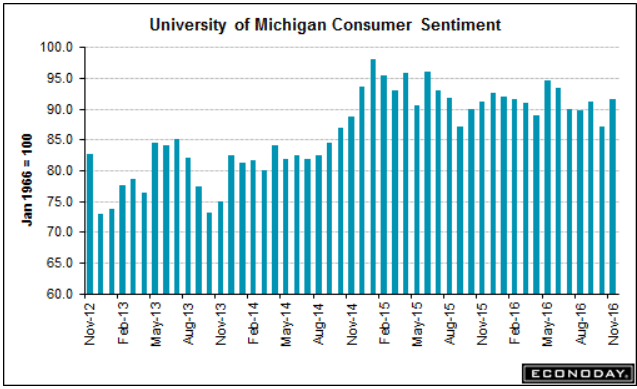
    A bit of a Trump boost, but the general downtrend of the last couple of years is still intact:
    111101

    Retail Employment Gains Fall 21% From A Year Ago

    By Challenger Gray and Christmas

    Nov 10 (Econintersect) — Despite largescale hiring announcements from numerous major retailers, the number of October employment gains in the sector declined 21 percent from a year ago to 154,600. That was the fewest job gains to kick off the holiday hiring season since 2012.

    Saudi output and pricing update

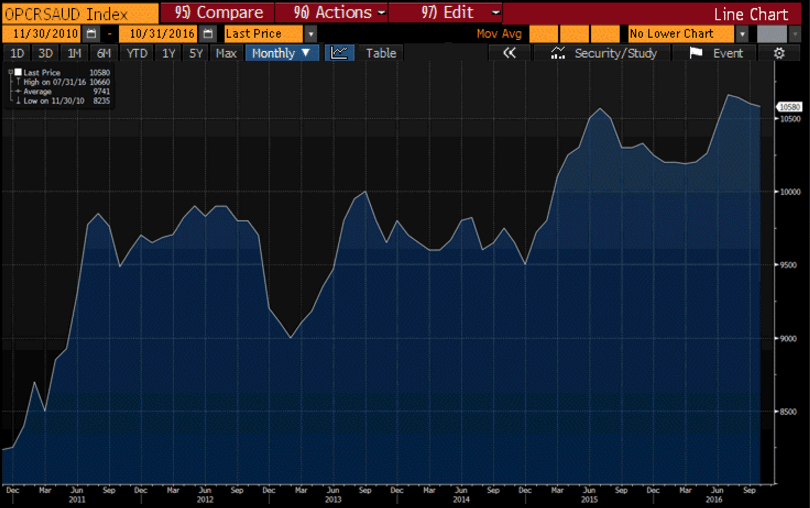
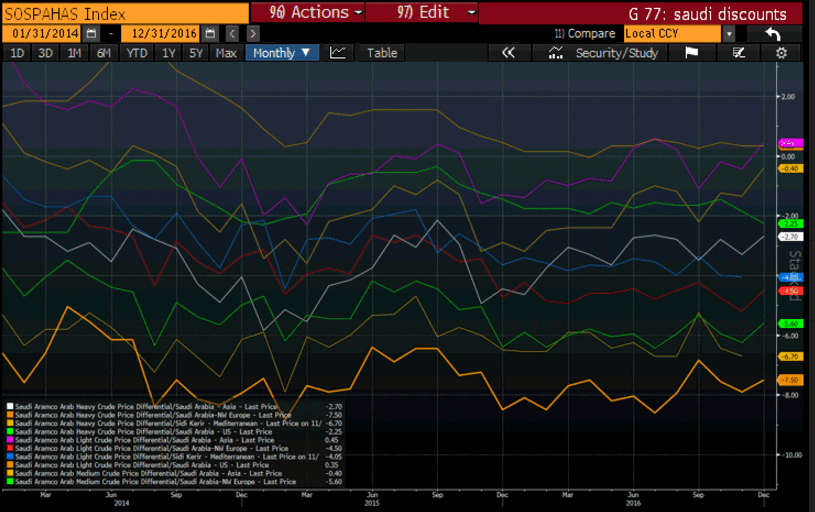
    The Saudis set prices via discounts to benchmarks, which will trigger either price appreciation or depreciation, or, if they happen to get the discounts ‘exactly neutral,’ at least near term stability.

    They then allow their clients, who are all refiners, to buy all they want at the posted prices. To date the total purchased has been less than their presumed 12 million barrel per day production capacity. the chart shows that the price cut a couple of years ago, from over $100 to under $50, has resulted in increased sales of about 1 million barrels per day, and that sales remain well below presumed capacity. That could be due to increased total demand for crude oil, or output reductions of other producers:

    110903
    This is the most recent chart of Saudi pricing. Note that in general discounts to benchmarks have been reduced, which works to firm prices, which tells me they are looking to keep prices stable at maybe $50/barrel, probably because they are concerned that if prices are any higher than that global development and output would increase. And note that US inventories, excess or otherwise, do not ultimately alter price:

    110904

    Retail sales, NFIB sales, Election comments

    Online sales growth now decelerating as well:
    110901
    NFIB small business sales

    110902
    Trump won largely because people couldn’t bring themselves to vote for Clinton, and not so much because anyone like him or his presumed agenda. And along the way he destroyed the Republican party, which may or may not sit
    so well with Republicans in Congress.

    So it’s not like he has a mandate to do anything or that he can rely on Republican support for anything.

    Regarding his proposed tax cuts, under current law bills can’t be introduced in Congress unless they are ‘paid for’, so, for example, to introduce a tax cut it has to be paid for by spending cuts. Yes, Congress could change the law or override
    it but that would require Senate approval, and that takes a 60% majority that Republicans don’t have.

    So my point is that at best it’s going to take a very long time to get anything done. And the way all the charts are decelerating it could all get pretty ugly waiting for the kind of fiscal adjustment needed to reverse course.

    Jolts, Small business index, Redbook retail sales

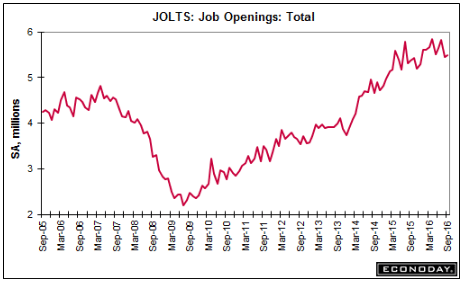
    When this chart heads lower as it’s doing it’s all over:

    110801
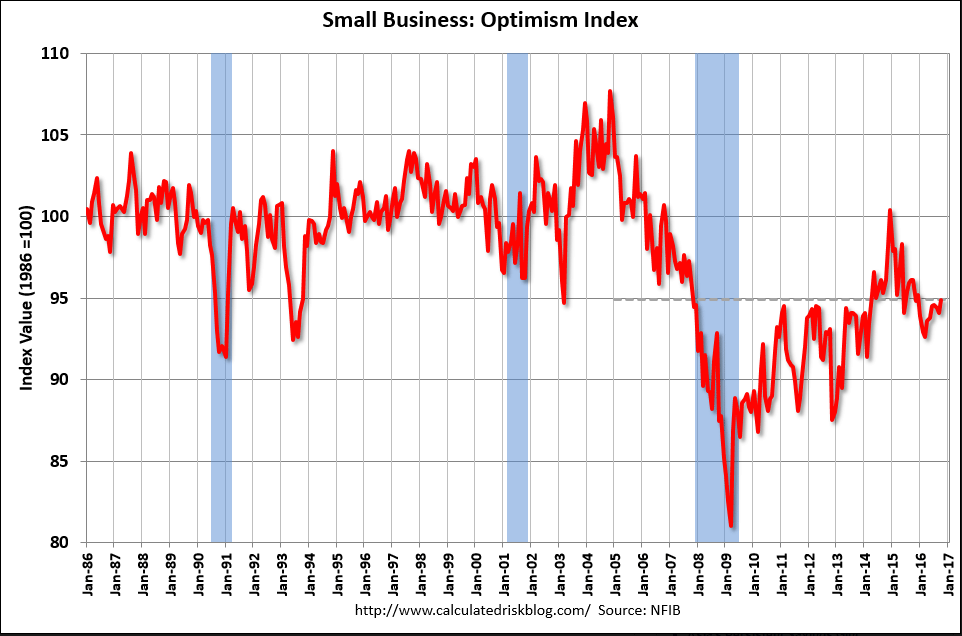
    The chart is well below what in the past were recession levels, and still looking like it can go a lot lower:

    110802

    Highlights

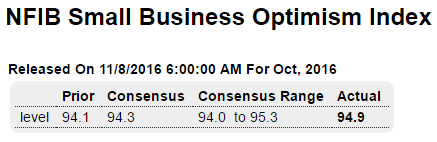
    The small business optimism index rose 0.8 points in October to 94.9, slightly exceeding expectations and extending a rebound from the 2-year low at 92.6 set in April. Of the 10 components of the index, 5 posted gains, 3 were down and 2 remained unchanged. The largest gain was recorded in plans to increase inventories, which rose a strong 9 points from the September level to a net 2 percent. The net percent of owners considering stocks too low also rose by 3 points to a net negative 4 percent, reflecting stronger consumer spending in the third quarter. And the already tight labor market tightened further, with 28 percent of owners reporting jobs they could not fill, up 4 points from September. A net 25 percent of owners reported raising worker compensation, a 3 point increase from September. Capital outlays, a leading strength of the index recently and important for future growth, remained at a strong 27 percent, the second highest reading of the recovery.

    But after a 12-point jump in expectations of improvement in business conditions to 0 percent in September, small business owners revised their optimism back down in October, with the index falling 7 points to a net minus 7 percent. Expectations of future increases in sales dimmed by 3 points for a net negative 4 percent of owners. Despite this, a net 9 percent still thought that now was a good time to expand, up 2 points from the prior month. Earnings, however, continued as the biggest source of pessimism and the weakest component of the index, worsening by 1 point as a net negative 21 percent of owners reported an improvement in quarter on quarter profits.

    Prices remained subdued, as a net 2 percent of owners reported raising prices, up 3 points from September, and a net 15 percent plan to hike prices, down 3 points.

    110803
    This measure of retail sales remains depressed, maybe because health care premiums have diverted retail consumption?

    110804

    110805

    110806