GDP revision, Phily Fed state index

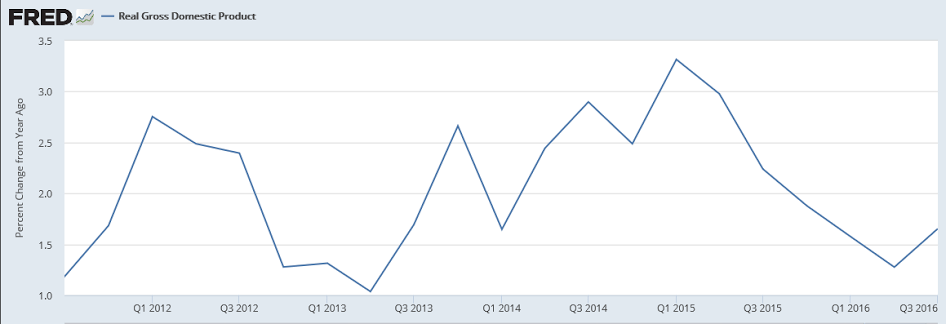
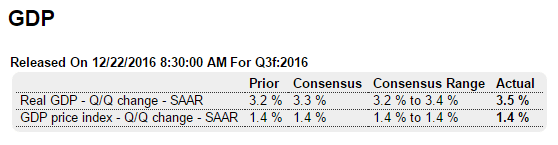
The Q3 blip up remains a soybean export, inventory building and healthcare premium story likely to be reversed in q4, as it all continues it’s general deceleration since oil capex peaked a couple of years ago:

GDP 3.5% in Q3. The acceleration in real GDP in the third quarter primarily reflected an upturn in private inventory investment, an acceleration in exports, a smaller decrease in state and local government spending, an upturn in federal government spending, and a smaller decrease in residential investment, that were partly offset by a smaller increase in personal consumption and an acceleration in imports.

122206a

Highlights

The third-quarter lived up to its early expectations, rising with each new revision to an inflation-adjusted 3.5 percent annualized rate for the best showing in two years. The consumer was the driving force in the quarter, spending at a 3.0 percent rate (up from 2.7 percent in the prior estimate) on top of the second quarter’s very strong 4.3 percent rate. Exports, benefiting from agricultural, were another positive as was nonresidential fixed investment which got an upgrade in the latest estimate to show a plus 1.4 percent annualized rate. Inventories also added to the quarter, but less so than prior estimates which is a positive for fourth-quarter production and employment. The GDP price index is unrevised at 1.4 percent. The fourth-quarter, held down by a reversal for exports and perhaps by less strength in consumer spending, isn’t quite tracking as strongly as the third quarter proved to be.

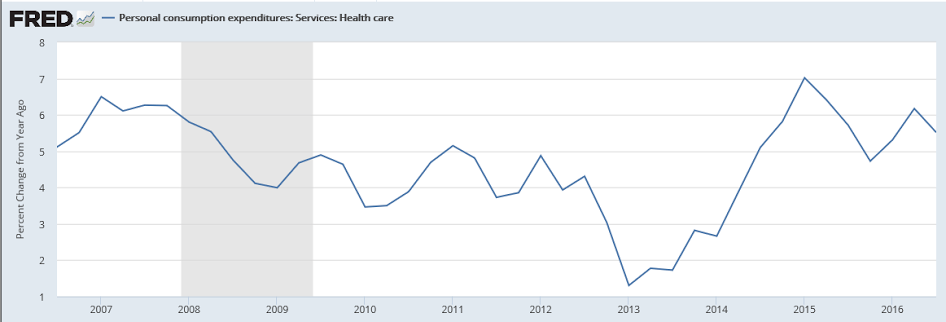
Healthcare premiums count as personal consumption expenditures and have gotten a one time boost from Obamacare and are unlikely to continue to grow at current rates:

122207
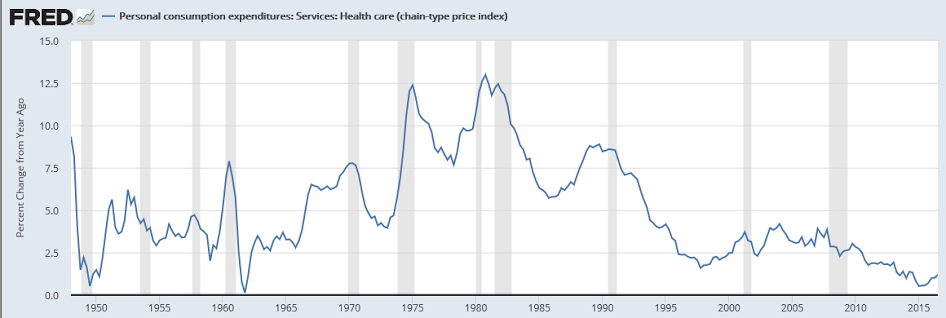
Healthcare costs are growing but not all that fast:

122208
Still working its way lower since the shale boom ended and oil capex collapsed about 2 years ago:

122209
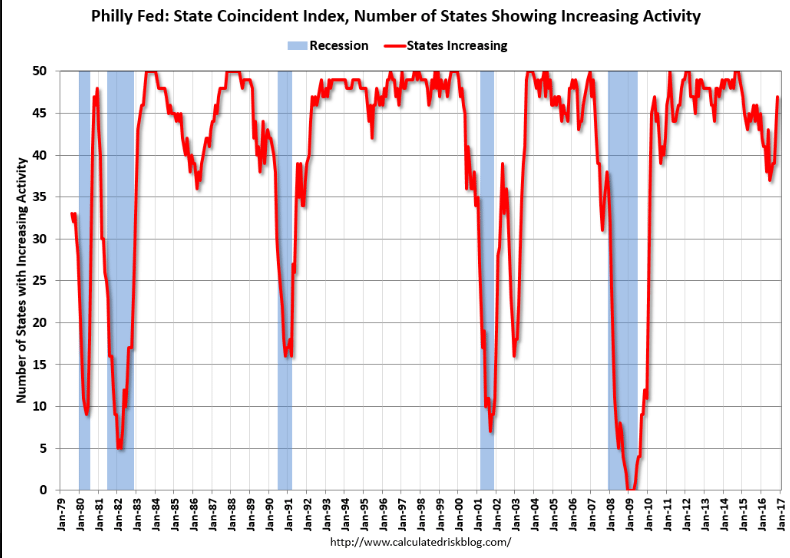
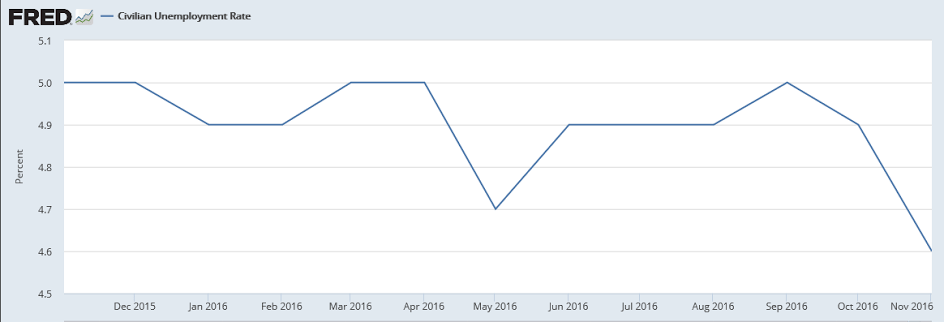
The chart looks like we’ve managed to reverse a ‘death dive’ but I’d give it another month as it was influenced by the large drop in the unemployment rate that came about because the size of the labor force was reported to have dropped by that much:

The coincident indexes combine four state-level indicators to summarize current economic conditions in a single statistic. The four state-level variables in each coincident index are nonfarm payroll employment, average hours worked in manufacturing, the unemployment rate, and wage and salary disbursements deflated by the consumer price index (U.S. city average). The trend for each state’s index is set to the trend of its gross domestic product (GDP), so long-term growth in the state’s index matches long-term growth in its GDP.
Read more at http://www.calculatedriskblog.com/2016/12/philly-fed-state-coincident-indexes.html#R1M9We6R5D4zziYl.99

122210

122211

Auto production, Durable goods orders, Personal income and spending, Chicago Fed

As previously discussed- sales are slowing and inventory is too high:

U.S. Car Makers Idle Plants Amid Oversupply Concerns

By Mike Colias Adrienne Roberts and Christina Rogers

Dec 21 (WSJ) — Detroit auto makers are pulling back on first-quarter production in response to a cooling in retail demand and a shift in consumer tastes, a speed bump for an industry that has laid the foundation for U.S. economic expansion in recent years.

All three domestic car companies this week said they have scheduled down time at some of their factories for as much as three weeks in January. Auto makers typically idle assembly plants for a week or two around the holidays—but shutting factories for multiple weeks in January is unusual. Auto makers produced 3.6% more vehicles in North America last month than November 2015, according to researcher WardsAuto.com.

Bad:

122201

Highlights

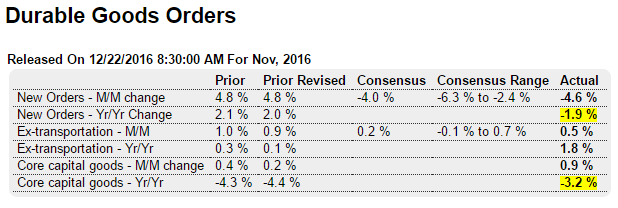
Defense came to the rescue of November’s durable goods report though core capital goods orders are another positive. Durable goods fell 4.6 percent in November but were down an even sharper 6.6 percent excluding defense. When including defense and excluding transportation (commercial aircraft and vehicles), orders rose a better-than-expected 0.5 percent.

Orders for core capital goods (nondefense ex-aicraft) rose a very solid 0.9 percent though the gain is offset slightly by a 2 tenths downward revision to October where the gain is now only 0.2 percent. Shipments of core capital goods, reflecting prior weakness in orders, show only modest life, also at 0.2 percent.

Turning back to defense, orders for defense aircraft doubled in the month, up 103 percent. Orders for defense capital goods, which include aircraft, rose 29 percent. But outside of defense, non-aircraft components show strength including communications equipment (up 6.7 percent), primary metals (up 2.3 percent), machinery (up 1.3 percent), and vehicles (up 0.8 percent).

Total shipments inched 0.1 percent forward in November with inventories also up 0.1 percent to keep the inventory-to-shipments ratio stable at 1.64. A negative in the report is a 0.2 percent dip in unfilled orders following a 0.8 percent rise in October which looks very much like an outlier.

This report is known for its volatility which for November is highlighted by aircraft, both defense and commercial for opposite reasons. In sum, year-end momentum for the factory sector appears to be in place, suggesting a better finish to what has been a flat year.

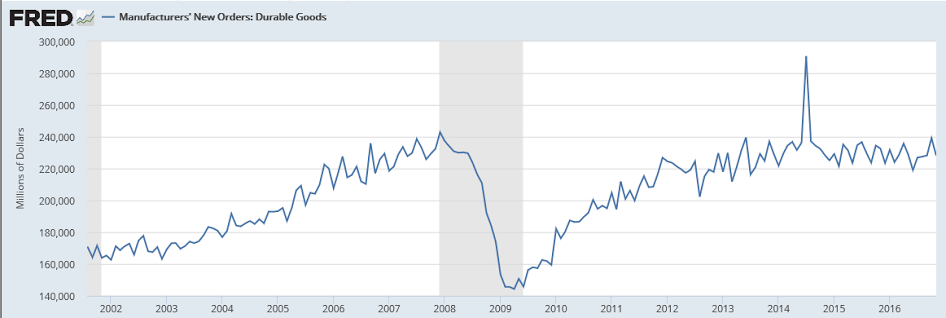
Even not adjusted for inflation at best it’s gone flat:

122202
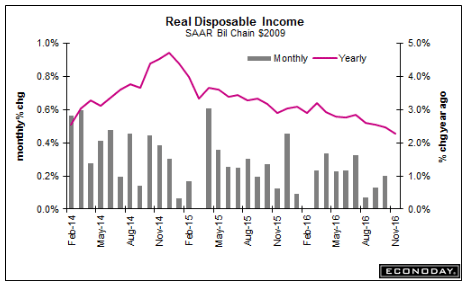
As the chart shows, the decline in real disposable personal income continues uninterrupted:

122203

Highlights

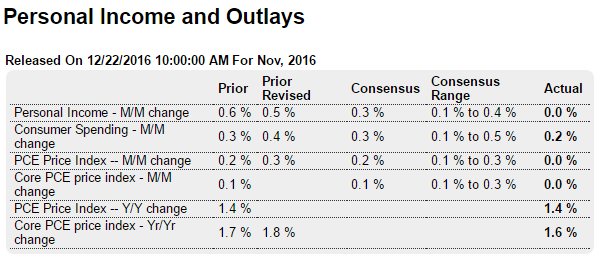
November may have been a cycle high for confidence but it actually proved a weak month for the consumer. Personal income was unchanged in November as the wages & salaries component dipped into the negative column at minus 0.1 percent. Consumer spending rose 0.2 percent and reflected specific weakness in vehicles. Not helped by the weakness in income, the consumer had to dip into savings during the month where the rate fell 2 tenths to 5.5 percent.

Price data are very flat, unchanged for both the PCE and PCE core (less food & energy) with the year-on-year rate at 1.4 percent for the PCE and at 1.6 percent for the core. And in a comparison that doesn’t point to accelerating inflation pressures, the year-on-year rate for the core fell 2 tenths to 1.6 percent..

Two months into the fourth quarter, consumer spending is running at a plus 2.0 percent annualized pace, well down from the 3.0 percent rate of the third-quarter (see GDP report earlier this morning).

But to put the report in context, the wages & salaries component had been showing outsized strength in recent months as had vehicle sales. So one month of weakness shouldn’t be a surprise. But the inflation readings are clearly a concern for Fed policy makers who want to see pressures building.

122204

122205

Highlights

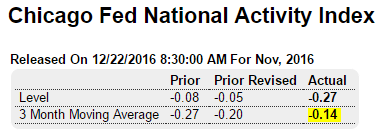
Business and consumer confidence may have jumped but November proved to be a weak month for the economy based on the national activity index which fell to minus 0.27 from a revised minus 0.05 in October. The industrial sector proved weak, falling to minus 0.20 from October’s minus 0.01. Part of this decline reflects warm weather and less utility output but also reflects slippage in manufacturing production. Personal consumption & housing were also weak, at minus 0.10 vs minus 0.03 and reflecting weakness in retail spending and dips for housing starts & permits. Employment was a small positive in the month, at plus 0.2 vs October’s 0.1, with sales/orders/inventories at plus 0.01 vs minus 0.02.

Euronalysis, Architecture billings index, Bank income

This looks like a large part of the ‘portfolio shifting’ that’s been going on out of a variety of ‘fears’. And it is my suspicion that those who are shifting euro assets to other currencies largely have euro liabilities to fund over time. This means they are getting themselves ‘out of balance’ which is another way to say they have gone ‘short euro’ and at some point will be back to cover:

Record Capital Outflows Push Euro Toward Parity With Dollar

By Mike Bird

Dec 21 (WSJ) — More money has left eurozone financial markets this year than at any time in the bloc’s history, helping drive the euro toward parity with the dollar for the first time in 14 years. The eurozone had its largest-ever net outflows in the 12 months to September, data from the European Central Bank showed. Eurozone investors bought €497.5 billion ($516.5 billion) of financial assets outside the bloc in that period. Global investors, meanwhile, sold or let mature €31.3 billion of eurozone assets during the year. Together, that adds up to a net outflow of €528.8 billion, the most since the single currency was introduced in 1999.

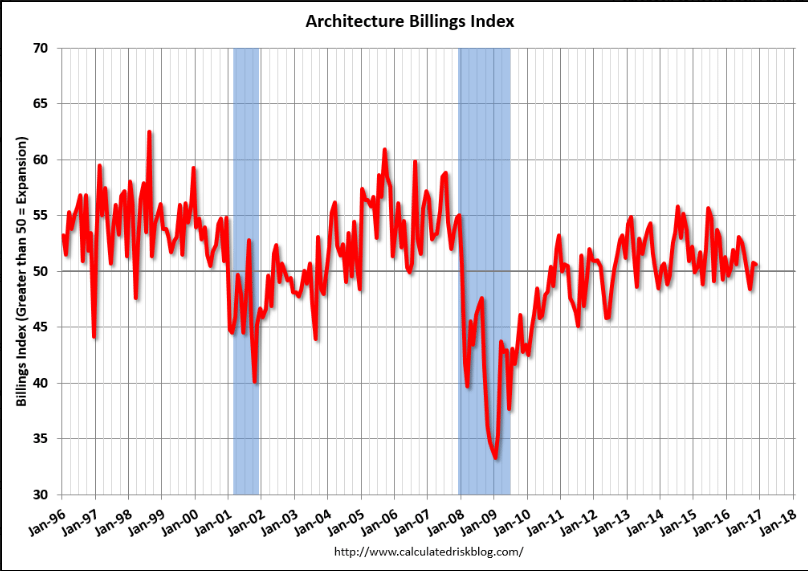
Still indicating recession type levels:

122101
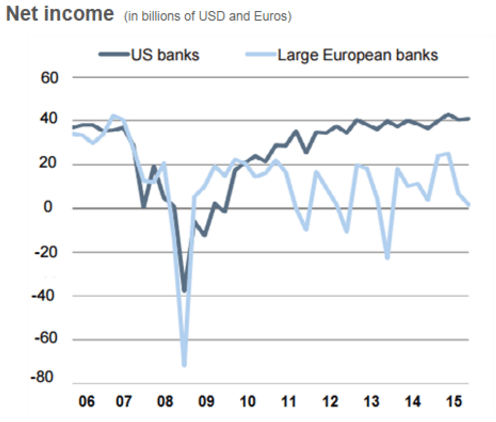
US bank income has been relatively flat, though positive and a source of at least some capital growth:

122102

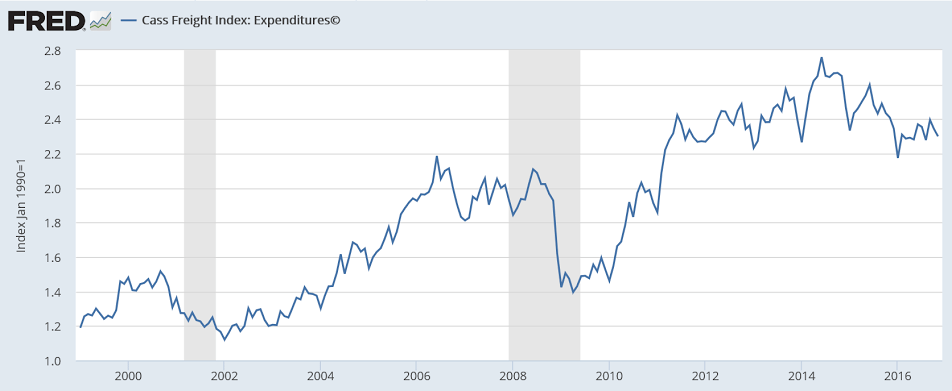
Euro Area current account, Cass freight index, NY Fed

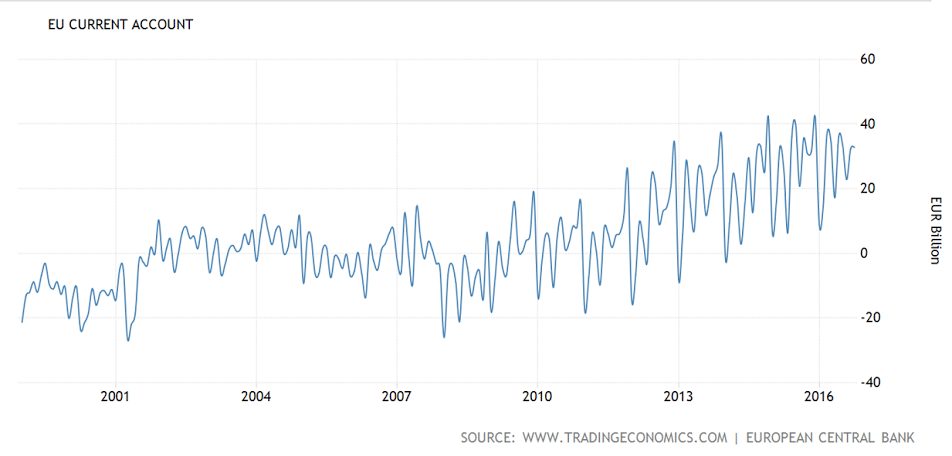
This is persistent, strong euro medicine that ‘absorbs’ the portfolio selling that’s been going on for over 2 years. And the lack of inflation and tight fiscal policy tell me it will persist until currencies adjust sufficiently to shift the balance:

Euro Area Current Account

Eurozone’s current account surplus rose to €32.8 billion in October 2016 from €30.9 billion in the same month a year earlier. The services surplus widened to €8.2 billion (from €2.4 billion a year earlier) and the primary income surplus increased to €8.8 billion (from €4.6 billion). Meanwhile, the goods surplus narrowed to €27.0 billion (from €33.7 billion in the previous year) and the secondary income deficit went up to €11.2 billion (from €9.8 billion). If adjusted for seasonal factors, the current account surplus rose to €28.4 billion compared to €24 billion in October 2015.

122001
Another indicator that shows the US could have already gone into recession:

122002

GDP forecast revised lower:

December 16, 2016: Highlights

  • The FRBNY Staff Nowcast stands at 1.8% for 2016:Q4 and 1.7% for 2017:Q1.
  • This week’s news had a negative effect on the nowcast, pushing down the Q4 and Q1 measures by about 0.7 percentage point each.
  • The largest negative contributions came from capacity utilization and industrial production data as well as housing data, which were only partly offset by a positive contribution from survey data.
  • Border Adjustability: The House Republican Blueprint proposes to convert the corporate income tax into a destination-based cash flow taxation system that would ‘border adjust’ by not taxing revenues from exports and disallowing deductions for the cost of imports. The economic effects of such a policy are similar to an export subsidy combined with an import tariff of equal size.

    PMI services, Oil capex

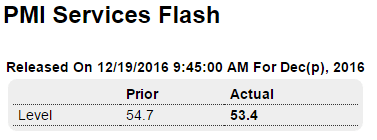
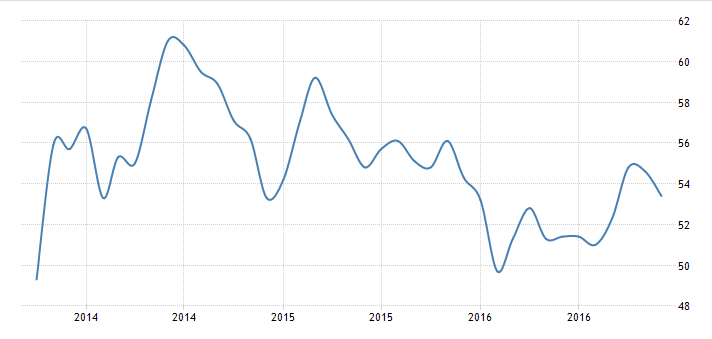
    Less than the expected 55.2 as weakness in the services sector continues, and as post election hopes fade:

    121901

    Highlights

    Growth in new orders, though still near a 12-month high, has slowed so far this month, pulling down the flash services PMI for December by more than 1 point to 53.4. But, given the comparison with November’s unusual strength in new orders, the slowing is deceptive. Other readings in the report are clearly favorable including a gain in backlogs that has triggered a gain in hiring. Optimism is still weaker than average but is up from the record lows hit in June, boosted by orders and also by expectations for greater economic strength in the year ahead. Price data are also coming alive, with input costs up and selling prices showing rare traction. Despite the strength, today’s report will likely lower expectations for December’s ISM non-manufacturing report which was also unusually strong in November (the ISM will be posted in the first week of January).

    121902
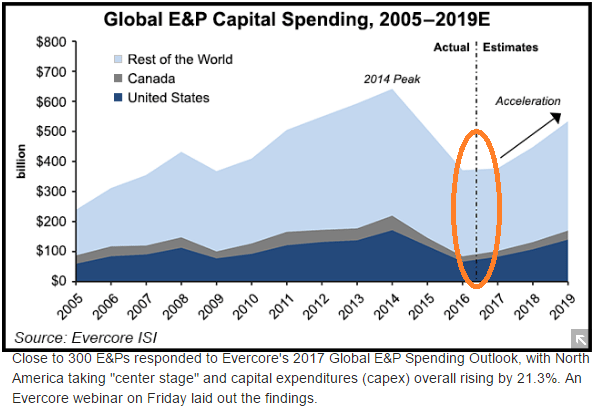
    Coming back some from a drop of maybe $250 billion, so this increase will just be a drop in the bucket at this point:

    North American E&Ps Forecast to Boost Capex For First Time Since 2014, With U.S. Rising 24.5%

    By Carolyn Davis

    Dec 19 (NaturalGasIntel) — North America will spearhead a recovery in global upstream investment in 2017, with U.S. spending — weighted on the onshore — forecast to jump by 24.5%, while Canada outlays will be 9.5% higher, according to an annual survey by Evercore ISI.

    Senior Managing Director James C. West, who has overseen spending surveys of global exploration and production (E&P) operators for 17 years, told NGI’s Shale Dailythat producers “are definitely more optimistic than in the last two years.”

    If oil and natural gas prices continue to climb, spending in the coming year could go even higher, he said.

    Close to 300 E&Ps responded to Evercore’s 2017 Global E&P Spending Outlook, with North America taking “center stage” and capital expenditures (capex) overall rising by 21.3%. An Evercore webinar on Friday laid out the findings.

    Early Signs of Bigger Budgets

    U.S. spending is pegged to rise from around $66.51 billion to $82.77 billion, while Canadian E&Ps are expected to raise spending from around $17.54 billion to $19.21 billion. However, those are “conservative” estimates, West said, as the survey was completed before the Organization of the Petroleum Exporting Countries in late November formally agreed to reduce oil output beginning Jan. 1.

    121904

    Housing starts, Euro trade, State budget shortfalls, Iowa farmland

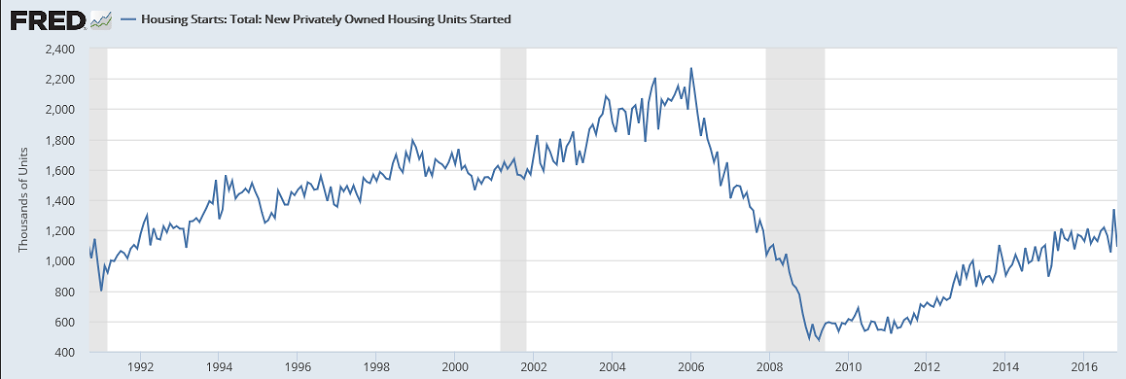
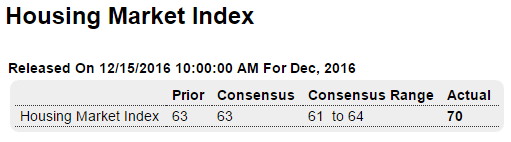
    Housing remains depressed, and not the driver of US growth that had been forecast by most analysts:

    121601

    Highlights

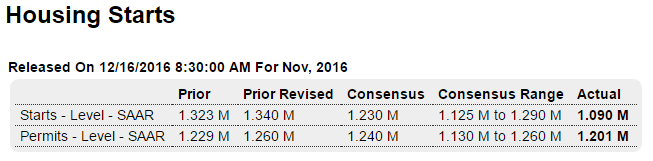
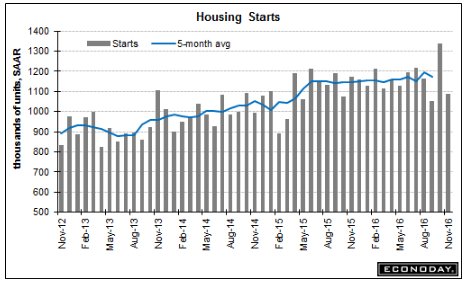
    Housing starts are being hit by huge swings. November starts fell 18.7 percent in November to a much lower-than-expected 1.090 million annualized rate following an upward revised gain of 27.4 percent to 1.340 million in October. There’s less volatility on the permits side where a roughly 30,000 undershoot in November, at 1.201 million vs the Econoday consensus for 1.240 million, is offset by a roughly 30,000 upward revision to October which is now at 1.260 million.

    Trends for both starts and permits have been struggling with year-on-year starts down 6.9 percent and year-on-year permits down 6.6 percent.

    The best news in the report is a 15.4 percent gain in housing completions to a 1.216 million rate which follows a 6.3 percent jump in the prior month. Houses authorized but not started are also up, 3.0 percent higher to 138,000. Gains here will help ease what is very tight supply for new homes.

    Still, lack of supply remains a negative for the new home market where sales, in sharp contrast to starts and permits, look to post a roughly 20 percent gain this year.

    121602
    This chart is not population adjusted:

    121603
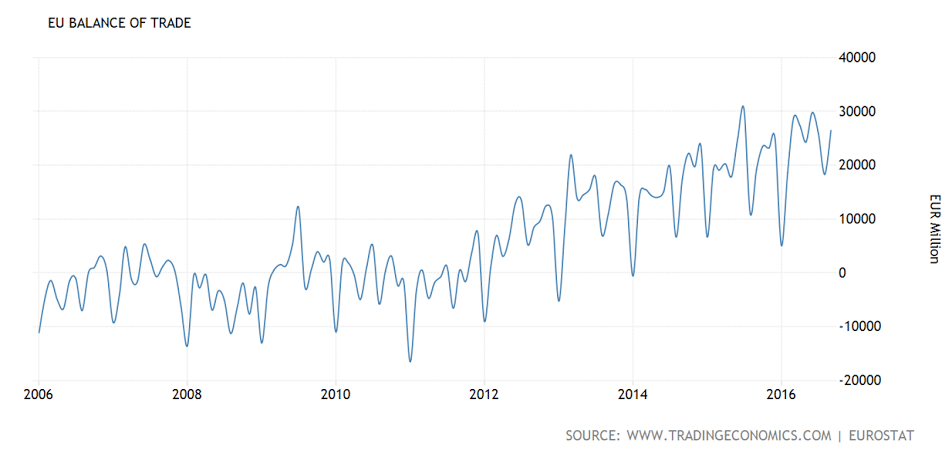
    This is strong euro stuff, further supported by low inflation, even as the euro falls to decade lows due to ongoing portfolio shifting:

    Euro Area Balance of Trade

    The Eurozone trade surplus rose 37.8 percent to €26.5 billion in September 2016 compared to a €19.2 billion in the same month of the previous year, above market consensus of €22.5 billion. Exports increased 2 percent while imports dropped 2 percent. Considering the first nine months of the year, the trade surplus increased to €204.8 billion, compared with €169.1 billion in the same period of 2015.

    121604

    Budget Shortfalls Expected in the Most States Since Recession

    By Liz Farmer

    Dec 13 (Governing) — Almost half the states cut their budgets this year, and that trend is likely to continue into 2017.

    Weak revenues are causing the most state budget shortfalls since the Great Recession.

    According to the National Association of State Budget Officers’ (NASBO) annual state spending survey, half of all states saw revenues come in lower than budgeted in fiscal 2016 and nearly as many (24) are seeing those weak revenue conditions carry into fiscal 2017, which ends in summer 2017 for most states. It marks the highest number of states falling short since 36 budgets missed their mark in 2010.

    As a result, 19 states made mid-year budget cuts in 2016, totaling $2.8 billion. That number of states “is historically high outside of a recessionary period,” according to the report.

    The revenue slowdown is caused mainly by slow income tax growth, even slower sales tax growth and an outright decline in corporate tax revenue.

    Farmland Values in Iowa Tumble
    First time they have dipped 3 years in row since ’80s farm crisis

    Iowa’s average farmland value declined for the third year in a row, down 5.9 percent to $ 7,183 an acre over the past year. It’s the first time since the 1980s farm crisis that land values have fallen three straight years, according to an Iowa State University report released Tuesday.

    CPI, Various surveys, Current account

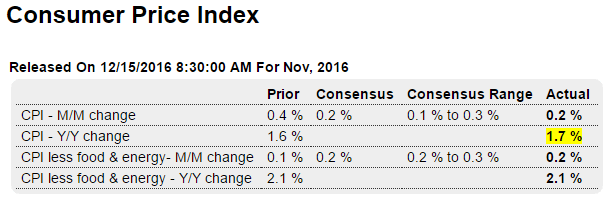
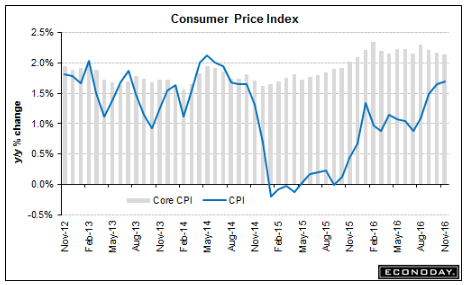
    Fed still failing to hit its 2% target after years of trying, and after years of forecasting that it would hit its 2% target:

    121506a

    Highlights

    Inflation at the consumer level remains low. The CPI rose 0.2 percent in November with the year-on-year rate up 1 tenth to plus 1.7 percent. The core rate, which excludes food and energy, also rose 0.2 percent with this year-on-year unchanged at 2.1 percent.

    Food prices were unchanged in November though energy did move sharply, up 1.2 percent and led by a 2.7 percent jump in gasoline. Excluding just energy, the CPI rose only 0.1 percent.

    The Labor Department is citing housing as a central area of consistent price pressure. The housing component only rose 0.2 percent in November but was up 0.4 percent in both of the prior two months. Owners’ equivalent rent, a closely watched reading in this report, rose 0.3 percent for a second straight month.

    Medical prices have also been a source of pressure but were unchanged in November for a second month in a row. Apparel is a weak point in the report, down 0.5 percent for the second steep monthly fall of the last three months. Weakness here hints at holiday discounting.

    The year-on-year rates are inching forward but just barely. Low inflation will allow the Fed to be patient when raising rates.

    121507
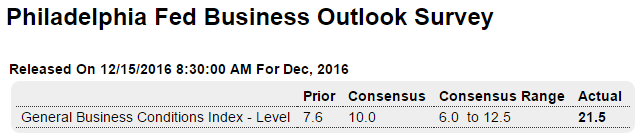
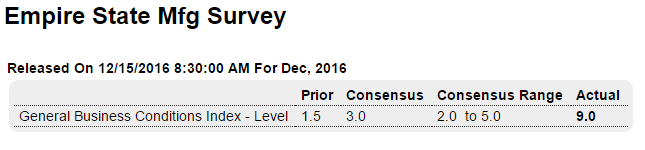
    More Trumped up surveys, even as ‘real’ data sags?

    121508
    121509

    Highlights

    The Empire State report is showing less strength than the Philly Fed report but momentum is building. The general conditions index is in positive ground for a second month in a row, at 9.0 for the December score vs 1.5 in November. New orders are also positive for a second month, at 11.4 vs last month’s 3.1. Like the Philly Fed report, 6-month expectations for new orders are showing a sudden surge, up 18 points in the month to 40.1. Other readings, however, are still lagging including employment, at minus 12.2, and the workweek at minus 7.0. Price data, also like the Philly Fed, show pressure for inputs but no traction for selling prices. The weaknesses aside, the strength and optimism for new orders are strong indications of wider factory strength going into year end.

    121510

    121511

    Highlights

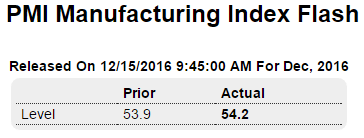
    Both the Philly Fed and Empire State reports have been pointing to accelerating strength for the factory sector, as does Markit Economics’ manufacturing PMI which comes in at 54.2 for the December flash. This index has been moving steadily higher from September’s 51.5. Positives this month include a rise in hiring and a big build for inventories, one the report says reflects confidence in the outlook. New orders are solid but slowing due to weak foreign sales while growth in output is also slowing. Price data show pressure for input costs, especially steel, and slight improvement in selling prices which otherwise remain flat. The factory sector had been flat all year but looks to post solid numbers for the fourth quarter.

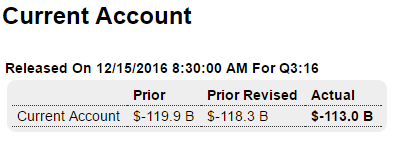
    This is where I see additional risk to growth post election- stronger $US due to portfolio shifting, higher oil prices, and a weaker global (export) market:

    121512

    Highlights

    The nation’s current account narrowed to $113.0 billion in the third quarter from a downward revised $118.3 billion in the second quarter. The trade deficit narrowed by $8.3 billion in the quarter reflecting a $9 billion narrowing in the goods gap that offset a small decline in the services surplus. The surplus in primary income also declined while the deficit on secondary income widened, both small negatives. The gap relative to GDP remains moderate, down 2 tenths in the quarter to 2.4 percent.

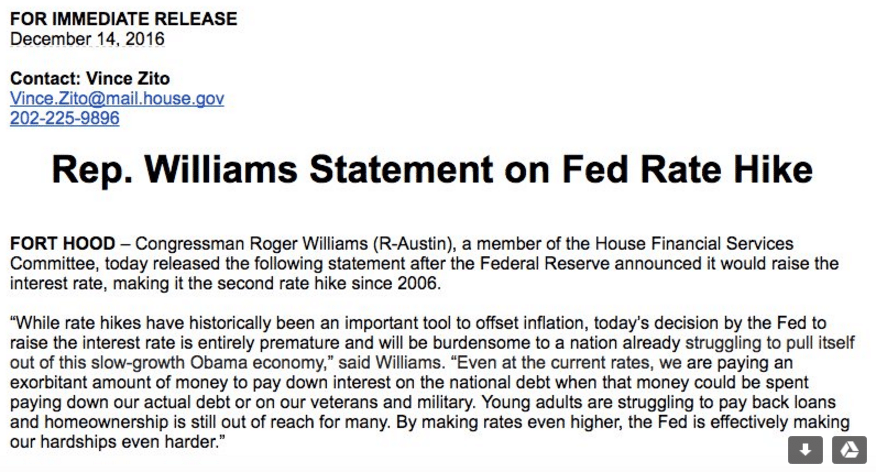
    Retail hiring, Yellen on fiscal, Rep Williams on Fed hike, Fx chart

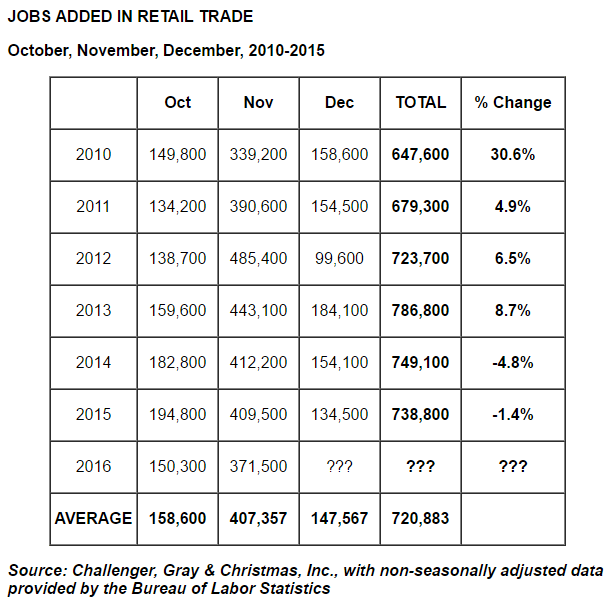
    November 2016 Retail Hiring Falls To 6-Year Low

    Dec 13 (Econintersect) — Retailers added fewer workers through the first two-thirds of the typical holiday hiring period – and is down nearly 10% from a year ago.

    121501
    The latest data from the Bureau of Labor Statistics (BLS) showed that employment in retail grew by 371,500 in November. That was down 9.3 percent from a year ago, when jobs in the sector increased by 409,500. It was the lowest November employment increase since 2010.

    November followed equally anemic employment gains in October, when retailers added 154,600 workers. That figure has since been adjusted even lower to 150,300, which is 23 percent lower than the 194,800 retail employment gains recorded in October 2015.

    121502
    While seasonal hiring is down in retail, it is picking up in other areas; namely, transportation and warehousing. Employment in the sector increased by 96,200 workers in October and November, according to BLS data. That was up from 71,300 a year ago.

    From Fed Chair Yellen:

    The labor market has improved enough that the United States will not need big U.S. government spending to reach full employment, Fed Chair Janet Yellen said Wednesday.

    “I would judge that the degree of slack has diminished. I would say at this point that fiscal policy is not, obviously, needed to help us get up to full employment,” the central bank chief told reporters after the Fed hiked interest rates.

    121503
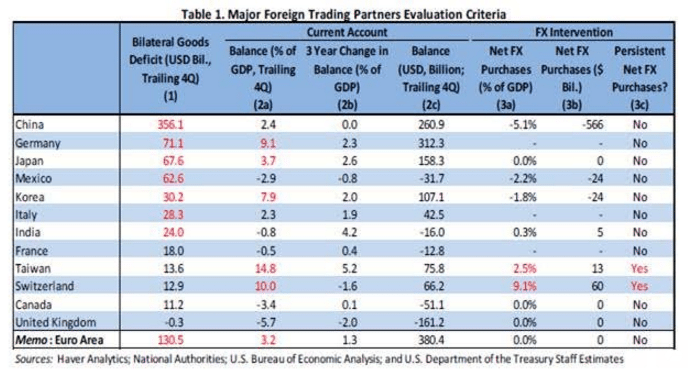
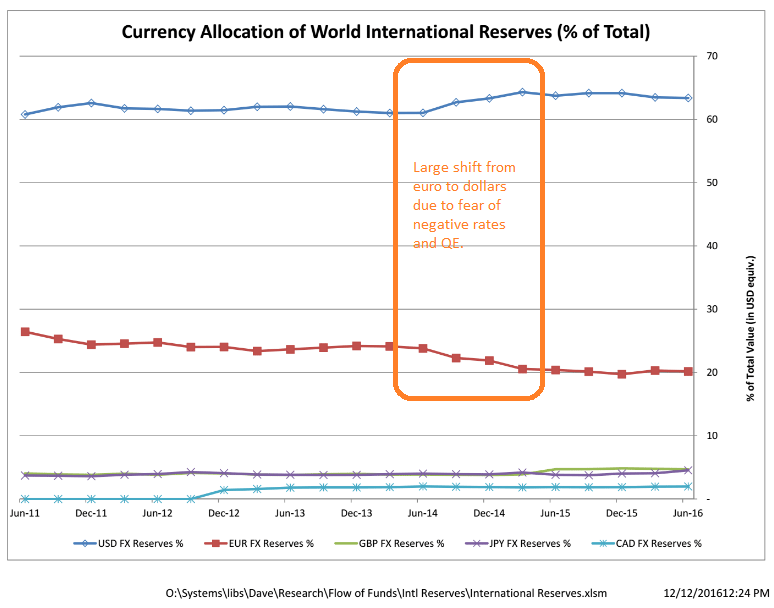
    These charts indicate the extent to which central banks move foreign exchange levels. The Swiss National Bank has been selling their euro to buy dollars, as indicated in the first chart, and the second chart shows how CB’s shifted from euro to dollars when they feared ECB ‘money printing’ would be inflationary:

    121504

    121505

    Purchase apps, Retail sales, Industrial production, Inventoriese, Analyst comments

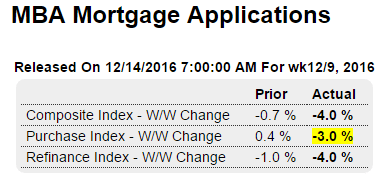
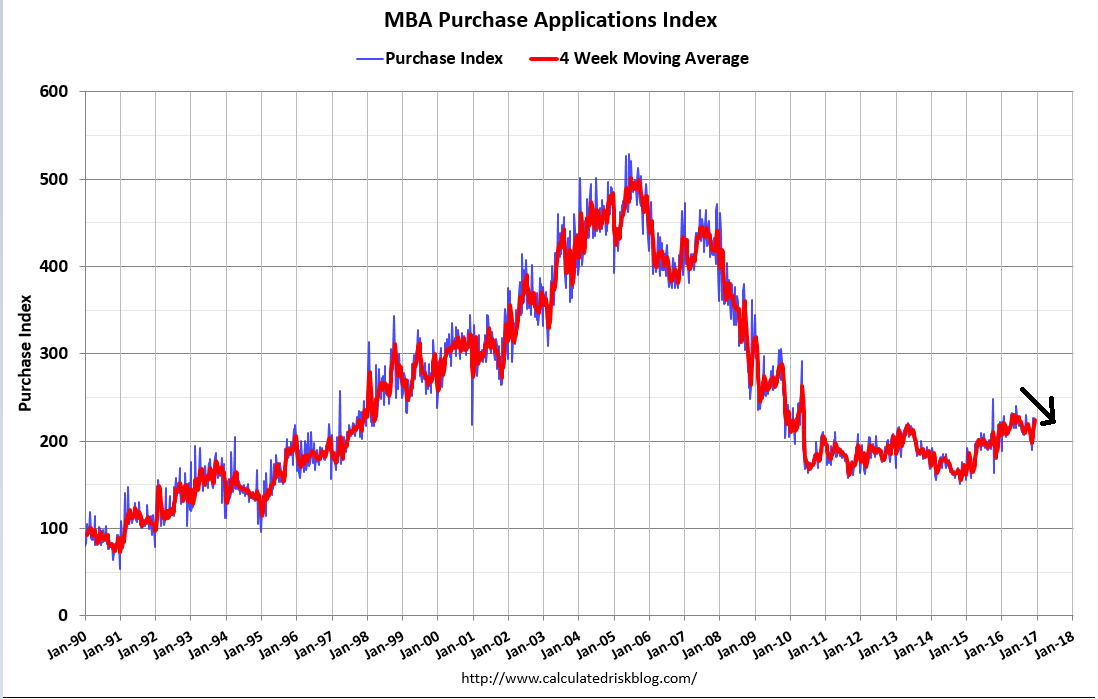
    Continues to decline. One less reason for the Fed to hike today…
    121401

    Highlights

    Rising interest rates continue to take their toll on mortgage activity, with purchase applications for home mortgages falling a seasonally adjusted 3.0 percent in the December 9 week, while refinancing applications fell 4.0 percent. The purchase index now stands just 2 percent above its reading a year ago, a 1 percentage point decline from the prior week. Reaching the highest level since October 2014, the average interest rate on 30-year fixed-rate conforming mortgages ($417,000 or less) rose 1 basis point from the prior week to 4.28 percent.

    Though it is nearly a foregone conclusion that the Fed will hike the Fed funds target range by 25 basis points today, potential home-buyers and refinancing homeowners will be sensitive to rhetoric explaining the decision for clues about the frequency and magnitude of future rate hikes. Upwardly revised inflation expectations have pushed up mortgage rates by more than 50 basis points since the Presidential election, taking them to a level about 70 basis points higher than the 3-year lows seen in July.
    121402
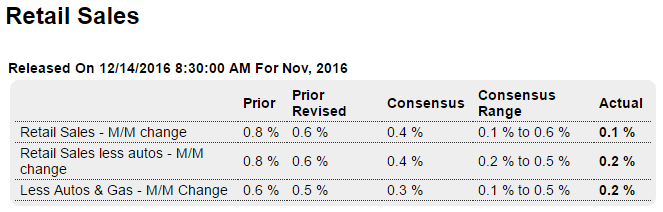
    Very low growth and prior month revised down:
    121403

    Highlights

    The details are a little bit better than the retail sales headline for November which could manage only a 0.1 percent gain. Auto sales, which had been very strong in prior months, fell 0.5 percent in the month for the sharpest drop since March. But most other components managed to show gains though only marginal ones with nonstore retailers (ecommerce) and electronics & appliance stores up only 0.1 percent as was the key general merchandise category.

    But there is strength in the report as restaurants, up 0.8 percent, posted their best gain since February. This is a discretionary category that points to underlying consumer strength. Furniture and furnishings posted a very strong 0.7 percent gain with building materials and gardening equipment a respectable 0.3 percent. Gains for these two readings are consistent with strength in the housing sector.

    Excluding autos, retail sales rose 0.2 percent while excluding both autos and gasoline, the latter not a major factor in the November report, sales also rose 0.2 percent. These are light gains for a month when consumer confidence shot higher, but outside of the monthly swing lower for autos, much of this report is constructive and won’t likely be holding down expectations for the holiday shopping season.

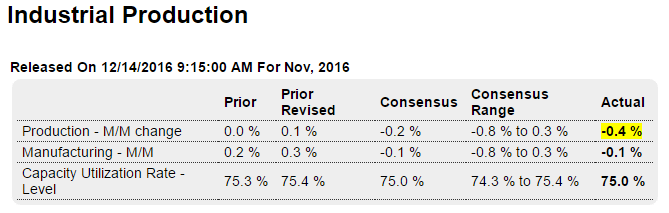
    Another bad one:
    121404

    Highlights

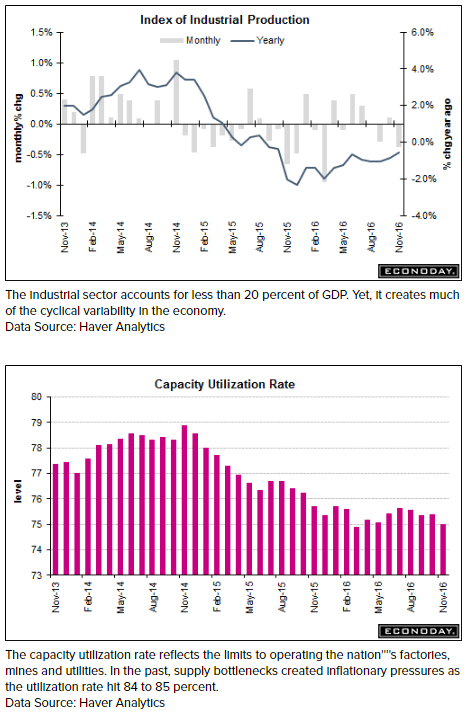
    Unseasonably warm weather pulled utility output lower and total industrial production along with it which fell 0.4 percent in November. Utility output fell 4.4 percent in the month for the third steep decline in a row. Manufacturing output was soft, down an as-expected 0.1 percent in the month though October is revised 1 tenth higher to a gain of 0.3 percent.

    But most of the readings for manufacturing are weak. Motor vehicle production, which had been a leading strength for manufacturing with five straight gains, fell a steep 2.3 percent in the month with assemblies of light trucks going into reverse. Hi-tech goods, also a leading strength, could only manage a 0.1 percent gain. Market groups show a 0.5 percent decline for consumer goods and a 0.3 percent dip for business equipment, the latter once again a disappointment for the business investment and productivity outlooks.

    Overshadowed by manufacturing and utilities, mining had a very strong month, up 1.1 percent following October’s 1.9 percent gain. The recent gains for mining have trimmed its year-on-year decline from the high single digits to and mid-single digits, at minus 4.6 percent in the latest data. For comparison, year-on-year manufacturing production is in the plus column but only at 0.1 percent. Utilities are down 1.9 percent with total industrial production down 0.6 percent.

    With the dip for manufacturing, today’s report offers the first definitive look at the November factory sector, one that will not be raising fourth-quarter GDP estimates. Advance looks at December’s factory conditions follow tomorrow with the closely watched regional reports from the Philly and New York Feds.
    121405
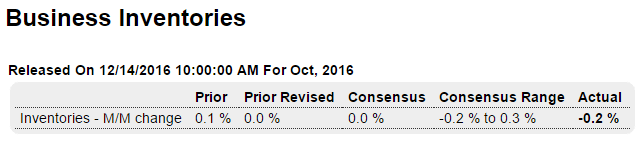
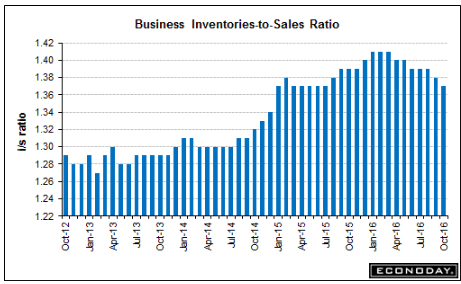
    Also not good for GDP as sales are low and inventories are being worked down rather than new goods being produced, and there’s still a long way to go:
    121406

    Highlights

    High levels of unwanted inventories are not an issue for the year-end economy, based on a 0.2 percent decline in business inventories in October along with a 1 tenth downward revision to September which is now unchanged. Looking at components, both retail and wholesale inventories fell 0.4 percent in the month with manufacturing inventories unchanged.

    Inventories are best measured against sales which, for business sales overall, rose a very strong 0.8 percent in October to pull the inventory-to-stocks ratio down to 1.37 from 1.38. The strength in sales and lack of inventory build points to the need to rebuild inventories which is a plus for the production and employment outlooks.
    121407

    Economists chop growth outlook after consumers shop less than expected

    By Patti Domm

    Dec 14 (CNBC) — Between the miss in retail sales and softer industrial production, JPMorgan chopped its forecast to 1.5 percent GDP growth from 2 percent for the fourth quarter, a disappointment after the third quarter’s 3.2 percent pace.

    Goldman Sachs Chief Economist Jan Hatzius said he lowered tracking fourth-quarter GDP to 2 percent from 2.1 percent, and Barclays lowered the tracking pace to 1.8 percent after weaker retail sales and industrial production.

    “When the economy is running at 2 percent-ish … portions of the economy are kind of in recession at any point in time. There are cracks. We had some concerns about the strength of imports. Imports of consumer and capital goods are soft. The business spending side still seems quite soft to us. We have concerns auto sales will come down just because the pace is unsustainable,” said Gapen.

    Small business survey, McConnell, Redbook retail sales

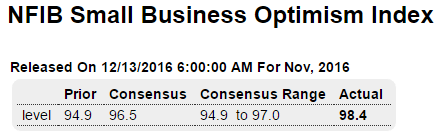
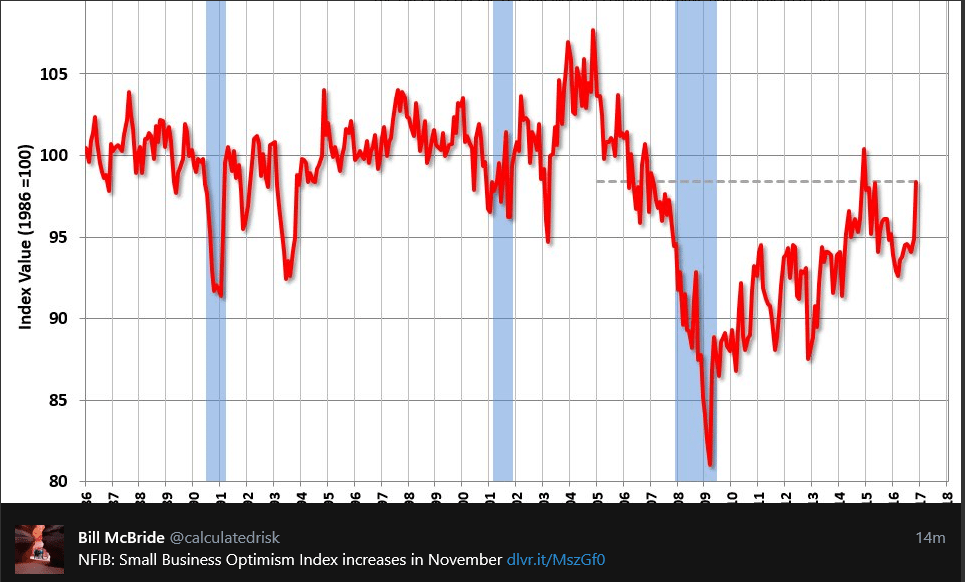
    Nice Trumped up spike, led entirely by expectations the new President would make everything better, but even with that low by historical standards:
    121301

    Highlights

    The small business optimism index rose a sharp 3.5 points in November to 98.4, significantly exceeding expectations and posting the highest reading since May 2015. The NFIB said small business optimism remained flat leading up to Election day, but then rocketed higher, ignited by business owners’ expectations of better business conditions in Washington. At 98.4, the index is above the 42-year average, only the third time it has broken above since 2007.
    All but 2 of the 10 components of the index posted gains in November. The largest gain was recorded in expectations of the economy to improve, which rose 19 points to 12, followed by expectations of higher real sales, up 10 to 11. The lone decline was in capital outlays, down 3 points to a still strong 24. Current inventories were unchanged at minus 4.

    The optimistic outlook also improved an already rosy employment picture, with current job openings rising 3 points to 31. Plans to create new jobs were up 5 points from October to 15 percent, the strongest reading since the recovery.

    Despite the general optimism, business owners remained quite down on earnings trends, which nudged up only 1 point to the still lowest reading of all components at minus 20. On the other hand, the net percent of owners raising average selling did rise 3 points to 5 percent, and looking ahead, a net 19 percent planned price hikes, up 4 points.

    “What a difference a day makes,” said Juanita Duggan, President and CEO of the National Federation of Independent Business (NFIB). “Before Election Day small business owners’ optimism was flat, and after Election Day it soared.”

    The bifurcated data was even more dramatic.

    Job creation plans increased from a net nine percent through November 8th to a net 23 percent after the election. Expected higher sales rose 16 points, from a net four percent to a net 20 percent. Expected better business conditions, the biggest mover in the survey, rose from a net -6 percent to a net 38 percent, a massive 44-point spike.

    “If higher optimism can be sustained, I expect that in the coming months we’ll see an increase in business activity, such as hiring and expanding,” said Dunkelberg.

    121302

    President-elect Donald Trump’s race to enact the biggest tax cuts since the 1980s went under a caution flag Monday as Senate Majority Leader Mitch McConnell warned he considers current levels of U.S. debt “dangerous” and said he wants any tax overhaul to avoid adding to the deficit.

    “I think this level of national debt is dangerous and unacceptable,” McConnell said, adding he hopes Congress doesn’t lose sight of that when it acts next year. “My preference on tax reform is that it be revenue neutral,” he said.

    During a news conference, McConnell also poured cold water on the idea of a massive stimulus package, effectively laying out markers on taxes and spending that that could cramp Trump’s ambitions.

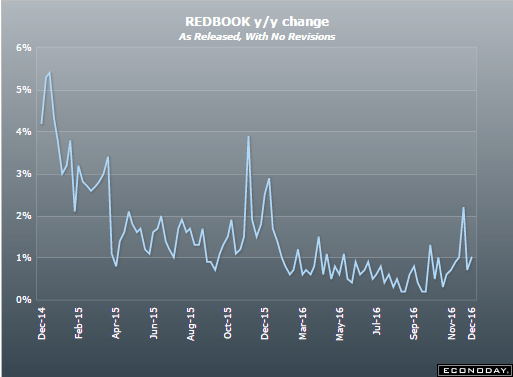
    Back to recessionary levels of growth:

    121303