current storage situation for both petroleum and clean products


[Skip to the end]

Looks like the temporary storage is moving into likely cheaper land based storage.

And much is probably already sold forward into the contango, as forward buying causes spreads to widen to the point where someone buys it spot and sells it forward for enough of a markup to cover storage costs and provide a desired return on capital.

By setting price and letting quantity pumped adjust, the Saudis/OPEC provide an incentive not to store crude and over time that policy should cause the contango to move to backwardation.

On the other side, passive commodity strategies by investors do the reverse, so at the moment it looks like they are in control.

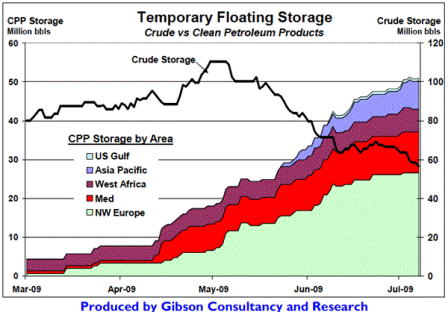
There is a kind of oceanic traffic jam out there among very large crude carriers (VLCCs), with something like 7% (according to Lloyd’s) of them storing crude oil off the coast of Europe, Asia, or North America in anticipation of higher prices later this year. Such are the joys of contango — higher forward prices making it profitable to store petroleum for future sale — but it is a huge gamble. If the people contracting for such VLCCs are wrong, their carrying costs mount and it becomes likely that they just dumb the product on the markets, further depressing prices.

Check the following figure (from EA Gibson) of the current storage situation for both petroleum and clean products, like gasoil:. While crude sea storage has declined from its peak earlier this year, clean products are floating out there is ever larger amounts.

[top]
DOEs: Industrial Demand Rises Above 2008


[Skip to the end]

With any kind of meaningful recovery the saudis will be able to increase price substantially without fear of demand falling off.

Right now they are just setting the hook.
Letting the world economies stabilize and financial markets recover before making their next move, while no conservation efforts of consequence are being put in place by the consumers.

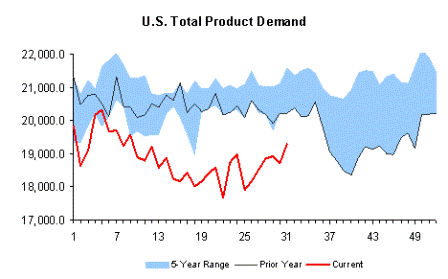
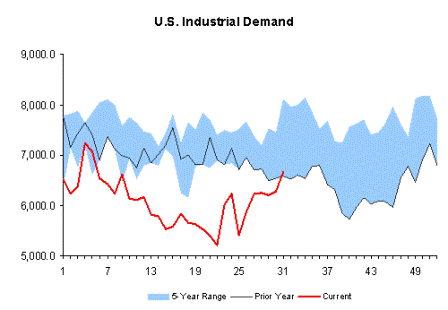
DOEs: Industrial Demand Rises Above 2008!

We have been discussing the industrial demand for oil products as a leading indicator to identify signs for a recovery in Industrial Production. However, we were not as optimistic to think that demand would surge to surpass the prior years’ level of demand in the near-term. We were looking for signs of stabilization. So, this week, we highlight this point that reinforces our belief that U.S. oil demand appears to have bottomed and you should start to see more coincidental indicators of industrial demand.

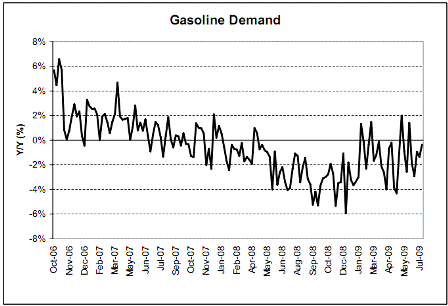
Broadly speaking, Total Product demand in the U.S. continues to rebound and has risen to 19.287 Mbpd from the trough of 17.697 Mbpd at the end of May ’09. Inventory levels continue to be an overhang and much attention is being paid to stocks at Cushing that remain lofty. However, we are demand focused and see continued and substantial improvement. In addition, year-over-year comparisons will be favorable into the later part of 3Q09.

For Industrial demand for oil products, we use residual, asphalt, propane, propylene, waxes, still gas, etc. We believe that these are “leading” and should be closely watched as the industry goes thru a period of restocking. The next data points we believe investors should see in coming months are increases in power generation and also increases in distillate demand. Both of which are “coincidental” indicators of demand in our opinion.


[top]

Taking a side on commercial real estate


[Skip to the end]

Today’s news- rising oil/declining dollar means costs of materials and replacement costs rising.

The only inflation risk comes with rising oil costs which are back up over 71 dollars this am, up from low 60’s last week.

Rising consumption overseas in general seems to be driving up prices here as we compete with a billion new consumers for scarce resources.

Commercial Real Estate – Make Up Your Own Mind

By Malay Bansal


[top]

Drop in crude


[Skip to the end]

>   
>   (email exchange)
>   
>   Warren, Seems like we’ve seen a tiny repeat of what happened during
>   the ( Mosler coined) Mike Masters inventory liquidation last summer.
>   That is, crude oil drops and takes everything else down with it all driven
>   by the fear of increased scrutiny regulation on commodity speculation.
>   Do you agree? NY Times article a few days ago.
>   

Yes, also the fact that it’s done it for the last few years about this time gets the specs going in that direction as well. If there’s nothing ‘fundamental’ going on this year it could quickly reverse as Saudis hold price and let quantity adjust.

Also, lower crude makes dollars harder to get overseas (our oil bill goes down) which tends to firm up the dollar.


[top]

BOE: rates could stay low for “quite some time”


[Skip to the end]

Yes, as previously discussed, announcing a term structure of Fed funds levels would be far more effective in bringing rates down than securities purchases.

But that closes the door to rate hikes for that period of time, which is exactly what markets discount with the current term rate structure.

Especially with crude and commodities going up and the dollar going down, as markets discount that at some point the Fed will react to that ‘imported inflation’ with rate hikes.

Meanwhile the current ‘mercantalist’ Fed is fine with a lower dollar hoping it will help the US export its way to trend GDP growth rather than get there by domestic debt and consumption. Or at least reduce the marginal propensity to import that they fear could drain demand and abort the recovery. Unfortunately the preference for exports over domestic consumption translates to a lower standard of living via a reduction in real terms of trade.

That’s what was happening last year about this time when the great Mike Masters inventory liquidation hit and it all went bad. This time around there isn’t any excess inventory to break prices and cap utilization/employment is way down and still falling some, and rest of world economies appear too weak to absorb substantial US exports.

And the Saudis are back in control of crude prices after a very surprisingly small fall in world consumption given the size and scope of the international slowdown.

BoE’s Barker says rates could stay low for “quite some time”

MPC member Kate Barker told the Leicester Mercury newspaper that there
remained question marks over the sustainability of the recovery and that
interest rates “could stay low for quite some time”. Ms Barker echoed
Paul Tucker’s comments yesterday in saying that it would take some
months yet for the MPC to judge how robust the turnaround in activity
was: “The really important question is (whether) there’s a pick up in
the economy and if people can sustain that so it continues on to autumn.
That would be one of the most encouraging signs,” she said.


[top]

Commodities speculation


[Skip to the end]

I’ve also hear reports that pension funds have been adding to passive commodity strategies:

The green shoots will grow slowly

by David Robertson

May 25 (Business 24/7) — By the middle of this month, copper prices were 60 per cent up on the start of the year and platinum was up by a third. The rebound has been driven by a conviction that these metals were oversold and as construction demand (copper) and automotive demand (platinum) pick up, the price of the metals will return to more sensible levels. However, I bring bad news. Industrial demand is not returning nearly as fast as the London Metal Exchange or London Stock Exchange would have us believe – and that means we are still some way off from seeing a return to the sort of growth levels achieved prior to 2008.

Two things are currently distorting metal prices: Chinese stockpiling and speculation. The Chinese have taken advantage of the low price of metals to fill their warehouses and this has been mistaken for a dramatic ramp up in “real” industrial demand. I have no doubt that Chinese demand from factories and construction companies has increased recently but at nothing like a rate that would support a 60 per cent surge in copper prices.

Speculation has also played a significant role in boosting prices as investors have piled into commodities, partly because they have been fooled by Chinese demand and partly because a lot of people are already thinking about where to stash their cash in the event of rampant inflation next year.

Last week Investec, the South African bank, highlighted the impact speculation was having on market-traded metals by focusing on commodities that are not easily traded. For example, ferrochrome, which is used to make stainless steel, actually fell 13 per cent in price between the first and second quarter of this year and it is off 63 per cent from its high at the end of last year. Manganese contract prices are off 70 per cent and the steel makers are pushing for a 45 per cent cut in iron ore contract prices.

There is no “hot money” in these commodities so they give us a better guide to real industrial demand – and clearly there is little to get excited about yet. As a result, I expect to see a repeat of last year’s oil bubble: everyone will shortly wake up and realise that the shoots are not quite as green as had been hoped and prices will fall back by 20 to 30 per cent (again).


[top]

Saudi Arabian Oil Minister Naimi Says Oil to Reach $75 a Barrel


[Skip to the end]

No reason to expect it won’t happen if they want it to happen.

Saudi Arabian Oil Minister Naimi Says Oil to Reach $75 a Barrel

by Adam L. Freeman

May 23 (Bloomberg) — Saudi Arabian oil minister Ali al- Naimi said the price of oil will climb to $75 a barrel when demand picks up.

“We’ll get there eventually,” al-Naimi told reporters in Rome today where he will attend meetings with energy ministers from the Group of Eight industrialized nations. “The trick is keeping it between $70 and $80. It will be achieved as demand rises and the fundamentals are better than they are now.”

To reach that goal, Naimi said he will recommend OPEC members “stay the course” at their meeting in Vienna on May 28. Saudi Arabia is the biggest and most influential member of the Organization of Petroleum Exporting Countries, which produces about 40 percent of the world’s oil.

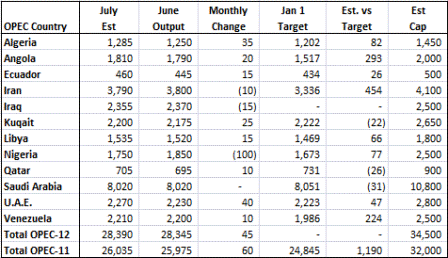
The group is likely to keep daily output quotas unchanged at 24.845 million barrels at the Vienna gathering, according to a Bloomberg survey.

Crude oil for July delivery rose 62 cents to settle at $61.67 a barrel at 2:45 p.m. on the New York Mercantile Exchange yesterday. The July contract increased 8.2 percent this past week. Oil is up 38 percent this year.

Naimi said oil should keep at about $75 a barrel “because that is what is desired for the world economy.”

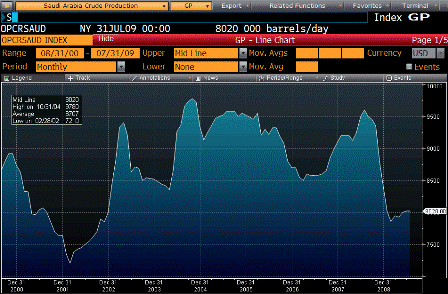
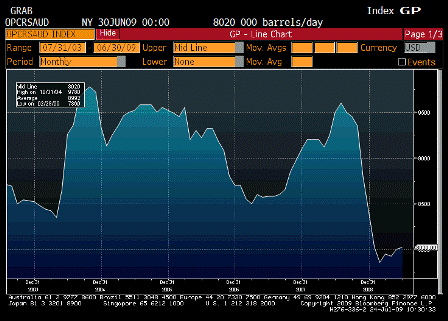
Saudi Arabia produced less than its quota of 8 million barrels a day last month, according to a May 13 OPEC report. The Saudis produced 7.9 million barrels of OPEC’s 25.3 million- barrel daily output.

Naimi said last month that helping to keep oil prices at $50 a barrel was his country’s contribution to the world economy, which is fighting the worst recession in six decades. Since he made those comments in Tokyo on April 25, crude prices have climbed more than 20 percent to above $60 a barrel.

Exceed Ceiling

The 12 members of OPEC, which overshot their ceiling by 410,000 barrels last month, will update their policy on oil output at this month’s meeting. At the last summit on March 15, the group decided to leave quotas unchanged and adhere to its earlier commitment to restrict supply by a total of 4.2 million barrels a day from levels in September 2008.

Naimi said his country “very recently” started production at the Nuayyim oil field and it pumping 100,000 barrels a day. He added that even though Saudi Arabia has opened new production global markets don’t need the product.

“The problem is the market, that the demand is only in one place — Asia and that’s all.”

The group’s production rate rose during April, and most members are still producing more than their quota, a report from the OPEC Secretariat in Vienna showed earlier this month.

OPEC cut its 2009 forecast on May 13 and now estimates daily oil demand will fall by 1.57 million barrels, or 1.8 percent, to 84.03 million barrels of oil a day this year.


[top]