Stimulus package


[Skip to the end]

(email exchange)

>   
>   Mauer wrote:
>   
>   My main worry about the efficacy of the fiscal
>   stimulus–aside from the international
>   spillovers in case it is not supported by equally
>   ambitious fiscal plans elsewhere–is this:
>   households that face considerable employment
>   uncertainty, and hence about their to future
>   income prospects, are unlikely to go on a big
>   spending spree. Just as banks are hoarding
>   cash, households will try to preserve wealth
>   by increasing saving at the margin. This
>   reduces the marginal propensity to consume,
>   and renders the fiscal boost rather ineffective.
>   
>   Why not try to deal with the looming
>   unemployment problem, and the huge sense of
>   risk and uncertainty it creates, more directly?
>   What I have in mind is subsidizing employment
>   directly by providing employers incentives to
>   keep people on the job.
>   

I look at it this way- if people want to work and earn/save/not spend their paychecks, the output can be directed to public goods and services (goods and services not re-offered for sale) without ‘inflation’.

This is done via federal deficit spending, which adds exactly that amount to non-government ‘savings.’

Trying to increase output that needs to be bought on the market when the desire to consume isn’t there requires that much more deficit spending to eventually induce more spending.

This can/does work, and with government solvency not an issue, it’s a viable political option.

However, seems public purpose is better served via deficit spending, producing public goods and services when the desire for private goods and services is suppressed?

For a narrow example to make the point, why try to induce more car production and employment building cars and marketing cars when the demand isn’t there due to desires to save rather than spend? Instead employ people to fix the roads and bridges until demand for vehicles picks up?

That said, my best guess is that given more income, spending will go up substantially and in short order, due to delayed purchases due to lack of income.

Warren


[top]

Fed Minutes


[Skip to the end]

Contraction for all of 2009 and core inflation to fall through 2010.

In the forecast prepared for the meeting, the staff revised down sharply its outlook for economic activity in 2009 but continued to project a moderate recovery in 2010. Real GDP appeared likely to decline substantially in the fourth quarter of 2008 as conditions in the labor market deteriorated more steeply than previously anticipated; the decline in industrial production intensified; consumer and business spending appeared to weaken; and financial conditions, on balance, continued to tighten. Rising unemployment, the declines in stock market wealth, low levels of consumer sentiment, weakened household balance sheets, and restrictive credit conditions were likely to continue to hinder household spending over the near term. Homebuilding was expected to contract further. Business expenditures were also likely to be held back by a weaker sales outlook and tighter credit conditions. Oil prices, which dropped significantly during the intermeeting period, were assumed to rise over the next two years in line with the path indicated by futures market prices, but to remain below the levels of October 2008. All told, real GDP was expected to fall much more sharply in the first half of 2009 than previously anticipated, before slowly recovering over the remainder of the year as the stimulus from monetary and assumed fiscal policy actions gained traction and the turmoil in the financial system began to recede. Real GDP was projected to decline for 2009 as a whole and to rise at a pace slightly above the rate of potential growth in 2010. Amid the weaker outlook for economic activity over the next year, the unemployment rate was likely to rise significantly into 2010, to a level higher than projected at the time of the October 28-29 FOMC meeting. The disinflationary effects of increased slack in resource utilization, diminished pressures from energy and materials prices, declines in import prices, and further moderate reductions in inflation expectations caused the staff to reduce its forecast for both core and overall PCE inflation. Core inflation was projected to slow considerably in 2009 and then to edge down further in 2010.

Policy..low for long plus nontraditional

They agreed that maintaining a low level of short-term interest rates and relying on the use of balance sheet policies and communications about monetary policy would be effective and appropriate in light of the sharp deterioration of the economic outlook and the appreciable easing of inflationary pressures. Maintaining that level of the federal funds rate implied a substantial further reduction in the target federal funds rate. Even with the additional use of nontraditional policies, the economic outlook would remain weak for a time and the downside risks to economic activity would be substantial. Moreover, inflation would continue to fall, reflecting both the drop in commodity prices that had already occurred and the buildup of economic slack; indeed some members saw significant risks that inflation could decline and persist for a time at uncomfortably low levels.

With some talk of abandoning a target altogether…

A few members stressed that the absence of an explicit federal funds rate target would give banks added flexibility in pricing loans and deposits in the current environment of unusually low interest rates. However, other members noted that not announcing a target might confuse market participants and lead investors to believe that the Federal Reserve was unable to control the federal funds rate when it could, in fact, still influence the effective federal funds rate through adjustments of the interest rate on excess reserves and the primary credit rate. The members decided that it would be preferable for the Committee to communicate explicitly that it wanted federal funds to trade at very low rates; accordingly, the Committee decided to announce a target range for the federal funds rate of 0 to 1/4 percent.


[top]

Re: Obama gas tax?


[Skip to the end]

(email exchange)

And this is even worse than the conservation motive:

“Motorists are driving less and buying less gasoline, which means fuel taxes aren’t raising enough money to keep pace with the cost of road, bridge and transit programs.

That has the federal commission that oversees financing for transportation talking about increasing the federal fuel tax.

A 50 percent increase in gasoline and diesel fuel taxes is being urged by the commission to finance highway construction and repair until the government devises another way for motorists to pay for using public roads. “

>   
>   On Fri, Jan 2, 2009 at 12:39 PM, Deep wrote:
>   
>   Hi Warren, Karim,
>   
>   I heard talk of a possible gas tax to make
>   consumers change habits / retain the good
>   ones gained over the last 6 months.
>   
>   It sounds like they want to keep price of gas
>   at the pump high either directly by Crude
>   being high (increase in demand, decrease in
>   supply) or through these artificial measures
>   and thus force a change in Oil consumption
>   patterns. If implemented I can only see
>   negative impacts over the 6m timeframe –
>   
>   a) crimp consumption further by removing $
>   from the consumer
>   
>   b) hurt US Car manufacturer jobs whose
>   bottom line seems more leveraged to high gas
>   prices than foreign manufacturers
>   
>   c) accelerate headline inflation possibly forcing
>   the Fed to tighten
>   

Yes, and worse. Using a gas tax to allocate by price is highly regressive. It means the upper income Americans can have any size SUV they want for safety and prestige and drive all they want, while lower income Americans have to car pool to work in tiny cars.

Seems a Democratic administration would not use allocation (rationing) by price but instead use other, non regressive means of allocation.

Either the Dems don’t know any better or they are now controlled by upper income Americans as the Reps are?

>   
>   All this, together with a delayed fiscal package
>   will likely hit any recovery in consumption.
>   

Yes, it would mean we need a larger fiscal package. But not so large to allow all to afford the new gas tax.

>   
>   Would love to get your thoughts.
>   

Seems the political logic remains convoluted, at best!

>   
>   Thanks, Deep
>   


[top]

Re: What about the Depression?


[Skip to the end]

Yes, and gasoline consumption went up a bit as well. Down only 4% year over year.

The deficit is also ‘automatically’ getting larger as well.

We could stop declining as fast and just go into ‘muddle through’ mode at higher levels of unemployment.

And this could encourage the mainstream to do what it can to minimize any fiscal response as the await ‘market forces and monetary policy kicking in.’

Obama recently stated we needed a fiscal stimulus to get things going, but then focus on ‘fiscal responsibility’ when the economy is growing again.

And they all say one of the major problems of the US government is the high level of debt.

Obama is also backwards on trade, as he talks about protecting US workers and opening new markets for US exporters.

Still hoping for the best!

Merry Christmas!

>   
>   On Thu, Dec 25, 2008 at 1:37 PM, mauer195 wrote:
>   
>   Everybody keeps focusing on the disastrous season that
>   retailers are supposed to be having, but then there’s this
>   news:
>   

Consumers Spend More As Gasoline Prices Fall

By Annys Shin

Consumers increased their spending last month for the first time since spring, as falling gas prices helped boost their purchasing power, new data showed yesterday.

On an inflation-adjusted basis, consumers spent 0.6 percent more in November than they did the month before, the Commerce Department reported, the first increase since May. Disposable income also rose on an inflation-adjusted basis, by 1 percent, compared with an increase of 0.7 percent in October.

But even as consumers returned to stores and shopping malls, analysts cautioned that the data did not signal the start of a turnaround for the economy. Because energy prices are unlikely to sink at the same clip they have over the past few months, Americans won’t be able to pocket much more savings at the pump.


[top]

Today’s Data


[Skip to the end]

Karim writes:

Last data before 12/30

  • Mtge apps up 48% last week (MBA reports record 83% of households looking to refi). Refi apps up 48.4% on the week, purchases 10.6%.

Lower interest rates now starting to help this sector, but at the expense of interest income for others. Much of this is offset by government, however, as the deficit continues to rise counter cyclically (the ugly way- lower revenues and higher transfer payments).

  • Initial claims rise 30k to new cycle high (and highest since 1982) of 586k; continuing claims drop 17k to 4370k

This may get a lot worse after the holidays.

  • Core PCE unch m/m and up 1.9% y/y (core inflation down 0.5% in 3mths; so much for the flat Philips curve).

Yes, but not all that big a move for a negative 7% quarter and a 70% drop in crude oil and large declines in other commodities.

  • Personal income down 0.2%, with wage and salary income down 0.1%.

Lower interest income biting.

  • Savings rate up to 2.8% from 0.8% 3mths ago

It’s not so much that people are saving as it is they are not borrowing, as total mortgage and other credit measures decline.

  • Personal spending down 0.6% m/m

Less than expected as lower fuel prices seem to be helping some.

  • Durable goods orders -1% (prior month revised from -6.2% to -8.4%) and up 4.7% ex-aircraft and defense (this measure was down 12.3% in prior 3mths so correction was expected).
  • Shipments (key for current qtr growth) down 2.6%

Falling fuel prices and automatic stabilizers increasing the federal deficit are beginning to have an effect, but this is a long, drawn out process that in the past has taken years to restore output and employment.

A full payroll tax holiday and maybe $300 billion in Federal revenue sharing with the states can cut that time frame down to months rather than years.

And, of course, without a plan to cut crude oil product consumption fuel prices can likewise quickly elevate.

The Fed is still obstructing bank functioning by demanding collateral from member banks when it lends. This is redundant and should be addressed at once.

Also, the Fed swap lines to foreign CB’s are again rising and approaching $700 billion. Not sure how this ends. Lines are scheduled to end in April, but hard to see this happening. It could turn out to be the largest international fiscal transfer of all time.


[top]

Re: Budget surpluses cause depressions


[Skip to the end]

(email exchange)

All a bunch of true but not relevant crapola.

All 6 US depressions were preceded by the first 6 periods of budget surpluses.

The 7th ended in 2001, as Bloomberg announced it was the longest surplus since 1927-1930.

The difference now we are not on the gold standard so the Treasury can deficit spend at will to restore and sustain aggregate demand.

Yes, it is that simple.

A payroll tax holiday and a few hundred billion of revenue sharing and within a few weeks everyone will wonder what all the fuss was about.

And if nothing fiscally is done, it will be like the early 90’s where the deficit went up via falling tax revenues and rising transfer payments until it gets large enough to restore output and employment.

But that can take a few years.

And nothing is gained by not doing a proactive fiscal adjustment.

(And don’t forget the energy policy to keep gasoline and crude oil consumption down!)

Happy Holidays!

Warren

>   
>   On Mon, Dec 22, 2008 at 7:24 PM, Morris wrote:
>   

How Recessions become Great Depressions

By Martin Hutchinson

Remember the Great Depression of 1921? Or of 1947? Or of 1981? Each of those years began with many of the same problems evident today, or that were evident in 1929-30. Yet they did not produce more than garden-variety recessions, which were soon over. It is instructive to examine why.

The preconditions for depression in 1921, 1947 and 1981 were similar to those operating today, and rather more severe than those of 1929-30. In each case, a large percentage of U.S. assets, built up over the preceding few years, had become obsolete and needed to be scrapped. In 1921 and 1947 the excesses consisted of surplus capacity built to provide munitions for World Wars I and II, together with the boom-time optimism additions of 1919 and 1946. In 1981, the excess consisted of a combination of U.S. factories that had become hopelessly internationally uncompetitive (think Youngstown, Ohio) and capacity that was impossible to retrofit to meet new tighter environmental standards, imposed with such enthusiasm in the 1970s.

All three of these downturns involved an “overhang” of assets that were no longer worth their cost, and associated debt that would default, similar to the housing overhang of 2008. Only in 1929-30 was the overhang less obvious initially, but an overhang was produced during the downturn by the insane political imposition of the Smoot-Hawley tariff, decimating world trade.

The 1921, 1947 and 1981 recessions were short and fairly mild, and 1929-32 became the Great Depression because of government action responding to the initial downturn. In 1929-32, as is well known, government produced the Smoot-Hawley tariff and the huge tax increase of 1932; and the Federal Reserve failed to prevent money supply collapsing after the Bank of the United States crashed in 1930, sparking widespread runs on banks across the country. As a minor addendum, President Herbert Hoover and his acolytes also followed a policy of keeping wage rates high, which was continued by President Franklin Roosevelt and the Democrats after 1933 – thus condemning 20% of the workforce to a decade of unemployment while unionized labor fattened its working conditions.

The mistaken policies of 1929-33 were generally not followed in other downturns. In 1921, Treasury Secretary Andrew Mellon, who believed in allowing the private sector to liquidate its way out of recession, was at the peak of his powers; he therefore organized no bailouts, but instead cut public spending to reduce government’s burden on the economy (he was still there in 1929, but was consistently overruled by Hoover.) In 1947, the Republican 80th Congress also cut public spending sharply and passed the Taft-Hartley Act restricting union power. The backlog of growth potential from technological advances made during the Great Depression and World War II might have lessened the destructive force of 1947’s downturn anyway, but Congress certainly helped rather than hurt. In 1981, incoming President Ronald Reagan restricted government’s spending growth, cut top marginal tax rates and allowed the Paul Volcker Fed to squeeze inflation out of the system – all actions that brought recovery closer.

In none of the 1921, 1947 or 1981 recessions did government engage in massive bailouts (the Chrysler bailout – only $1.5 billion, less than 0.1% of Gross Domestic Product – was passed in 1979, before the main leg of recession hit). Neither did the government indulge in stimulus packages in 1921, 1947 or 1981 (although President Reagan’s tax cuts had some stimulative effect in 1982-83); instead its stand on public spending on all three occasions was markedly restrictive. Finally, at no time in 1921, 1941 or 1981 did the Fed run a negative real interest rate policy; instead real interest rates were positive in all three years, sharply so in 1921 and 1981.

Internationally, the potential to become Great Depressions: 2001 was marginal as the asset overhang, from stock and telecom sectors, and was bailed out by the Fed (at the cost, we now know, of a worse recession 7 years later.); 1991 had only a modest overhang of bad housing finance assets – the rest of the economy was in great shape after the ebullient 1980s; 1974 had a substantial overhang, but the novelty of both high oil prices and environmental restrictions made the overhang less obvious than in 1981, and President Gerald Ford’s restrictive public spending policy, together with a 2001-like monetary bailout through high inflation and lower interest rates prevented it from metastasizing; 1970, 1958 and 1937 had no great new asset overhangs to deal with, although in 1937 the economy was still unbalanced from 1929-32. Thus only about a third of recessions have the potential to turn really nasty, and it appears that government actions, in one direction or the other, determine whether they do so.

Internationally, the Japanese recession after 1990 involved a huge asset overhang, from stock and real estate investments made during the 1980s bubble. The Japanese authorities got policy partly right. They did not sharply increase taxes as did Hoover in 1932, nor did they become significantly more protectionist – indeed they liberalized somewhat. On the other hand, they indulged in an orgy of unproductive infrastructure spending, driving their public debt ratio to over 180% of GDP and “crowding out” private sector borrowing, which was restricted anyway by banks’ lack of capital. After 1998, they drove real interest rates below zero, reducing the domestic savings rate and delaying true recovery.

That recovery only occurred when Prime Minister Junichiro Koizumi cut wasteful infrastructure spending and moved towards a balanced budget, thus freeing up finance for the private sector. However, new Prime Minister Taro Aso’s insistence on wasting yet more money on public spending and the Bank of Japan’s failure in 2006-08 to raise interest rates to a positive real level may well produce in Japan a recurrence of downturn like that of 1937 in the United States, an entirely unnecessary aftereffect of poor public policy.

In the United States in 2008, the current unpleasantness clearly has the potential to become much worse. The asset overhang from the housing bubble is comparable to those of 1921 and 1981 (relative to the U.S. economy) and probably larger than that of 1947, when the memory of Great Depression prevented much postwar “irrational exuberance.” Moreover, public policies of bailout, spending stimulus and negative real interest rates all tend towards producing a “Great Depression” although some of the worst mistakes (protectionism, savage tax rises) of 1929-32 have so far been avoided.

This time around, bailouts have been used on a scale greater than Hoover’s Reconstruction Finance Corporation. The Troubled Asset Relief Program (TARP) gave a spendthrift lame-duck administration and a personally conflicted Treasury secretary complete license to throw money at any problem that appears politically threatening – thus the current attempt to use bank bailout money to assist auto manufacturers, even after Congress has failed to pass an aid package. An initial recapitalization of the banking system, costing about $200 billion, may have been necessary, but the TARP proposal to spend $700 billion on dodgy mortgage assets was an appalling waste of money and in the event unworkable.

In any case, the initial injection of capital to banks should have been definitive. When Citigroup came back for more, only weeks after having been given $25 billion of new capital, it should have been forced into bankruptcy, possibly through an orderly liquidation under government-appointed administrators to minimize market disturbance and unanticipated losses. The financial services industry needs to downsize, which involves removing the worst-run competitors, an accolade for which Citigroup certainly qualifies. Conversely the automobile industry should be able to survive, but only after Chapter 11 filings have removed old union contracts and pension obligations, and allowed the U.S.-owned auto companies to streamline their model ranges and reduce wage costs to their competitors’.

By prolonging the life of incompetent banks and overstuffed union contracts, the government is making matters worse and increasing the probability of serious trouble. It is essential that TARP be closed down and that the window for government bailouts, in banking and elsewhere, is slammed firmly shut. By preventing the market’s destruction process from operating, the government makes the recession almost certainly deeper and without doubt horribly artificially prolonged.

Stimulus plans also raise the chance of a Great Depression because of the deficits they cause. When the government sucks more than $400 billion out of the U.S. economy in two months, it should not be surprised when the credit crunch worsens for the private sector. Indeed, the earlier tax rebate stimulus of the summer may well have caused the surge in unemployment, of over 400,000 per month, which occurred from September onwards. The crunch point for finance availability in a crisis occurs not in the large companies (except those that are due to fail anyway) but in medium-sized and smaller companies, the principal creators of jobs, who find credit lines pulled and survival impossible. The money for stimulus packages has to come from somewhere; when the public sector deficit is already bloated, it comes straight from the job prospects of small company employees and the self-employed.

Loose monetary policy can work either way. When an asset overhang is limited, it can make finance cheaper, raising equilibrium asset prices and limiting the force of a downturn. It was successful in doing this in 1974 and 2001, at the cost of worsening inflation in the 1970s and a more virulent asset bubble in the 2000s. However, when the asset overhang is large enough and the collapse in banking confidence sufficiently severe, loose money can no longer bail the system out of a downturn. Instead it becomes a further depressing factor, eliminating the returns for saving, preventing capital formation and keeping stock and asset prices above the depressed level at which further investment is truly economically attractive. That’s what happened after the Smoot-Hawley tariff disrupted economic activity in 1930, and it is what appears to be happening after the banking crisis of September-October. Whether or not negative real interest rates produce inflation, they will certainly in such circumstances delay recovery.

Current policies could potentially turn today’s recession into tomorrow’s Great Depression. Let us hope that President-elect Barack Obama’s team of economic wizards can figure out a way of preventing this.


[top]

2008-12-23 USER


[Skip to the end]


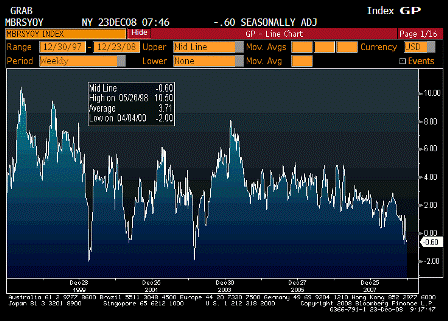
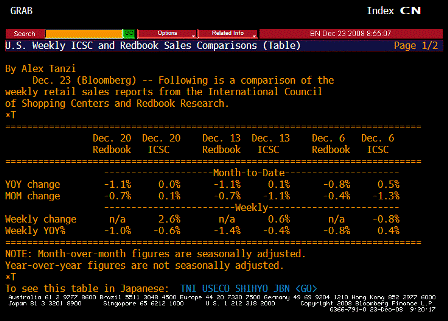
ICSC UBS Store Sales YoY (Dec 23)

Survey n/a
Actual -0.60%
Prior -0.40%
Revised n/a

 
Continues to slip.

[top][end]

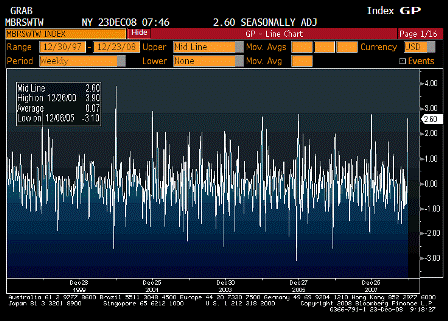
ICSC UBS Store Sales WoW (Dec 23)

Survey n/a
Actual 2.60%
Prior 0.60%
Revised n/a

 
Cheaper gasoline helping some?

[top][end]

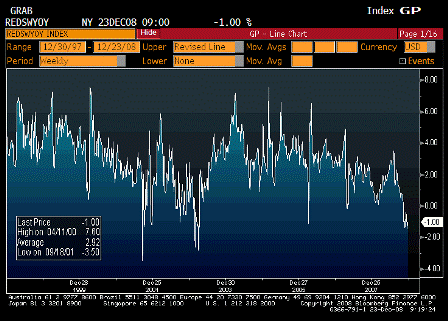
Redbook Store Sales Weekly YoY (Dec 16)

Survey n/a
Actual -1.00%
Prior -1.40%
Revised n/a

 
Still slipping.

[top][end]

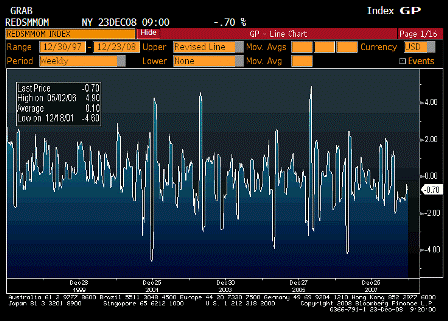
Redbook Store Sales MoM (Dec 16)

Survey n/a
Actual -0.70%
Prior -0.70%
Revised n/a

 
Still slipping.

No meaningul sign of cheaper gasoline helping here yet.

[top][end]

ICSC UBS Redbook Comparison TABLE (Dec 16)

[top][end]


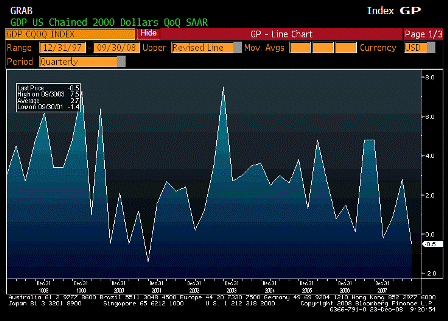
GDP QoQ Annualized (3Q F)

Survey -0.5%
Actual -0.5%
Prior -0.5%
Revised n/a

 
As expected.

[top][end]

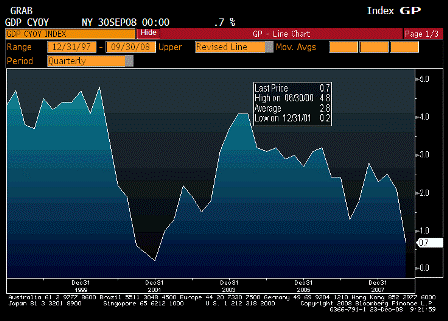
GDP YoY Annualized Real (3Q F)

Survey n/a
Actual 0.70%
Prior 2.1%
Revised n/a

 
Tiny positive for the year.

Next quarter looking negative.

[top][end]

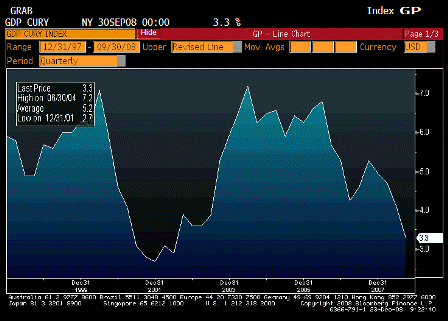
GDP YoY Annualized Nominal (3Q F)

Survey n/a
Actual 3.3%
Prior 4.1%
Revised n/a

 
This is heading to new lows as well.

[top][end]

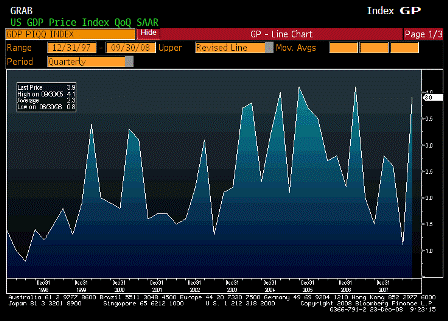
GDP Price Index (3Q F)

Survey 4.25
Actual 3.9%
Prior 4.2%
Revised n/a

 
Should reverse.

[top][end]

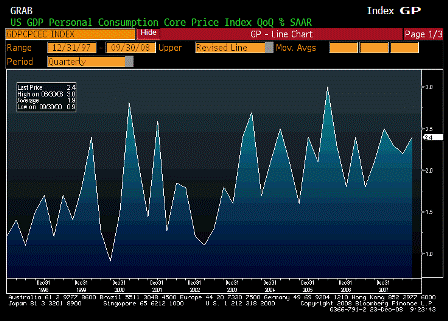
Core PCE QoQ (3Q F)

Survey 2.6%
Actual 2.4%
Prior 2.6%
Revised n/a

 
Should reverse some.

[top][end]

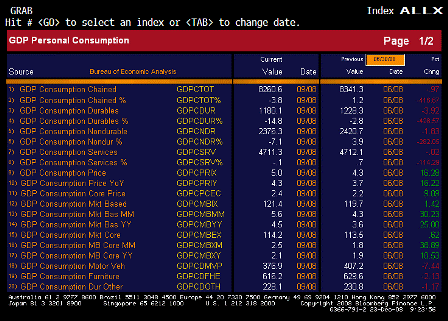
GDP ALLX 1 (3Q F)

[top][end]

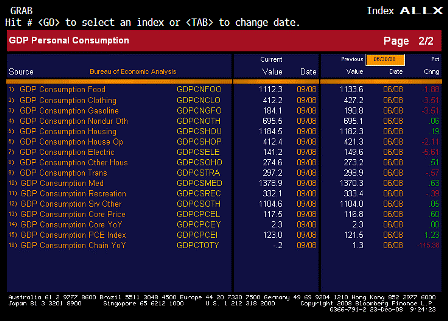
GDP ALLX 2 (3Q F)

[top][end]


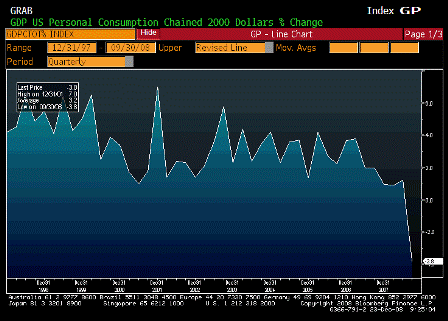
Personal Consumption (3Q F)

Survey -3.7%
Actual -3.8%
Prior -3.7%
Revised n/a

 
Sudden fall from ‘muddling through’ to recession.

[top][end]

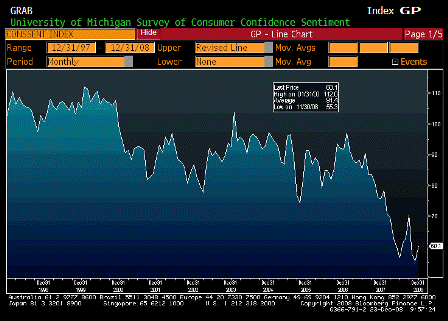
Univ of Michigan Confidence (Dec F)

Survey 58.8
Actual 60.1
Prior 59.1
Revised n/a

 
Gasoline prices helping here.

[top][end]

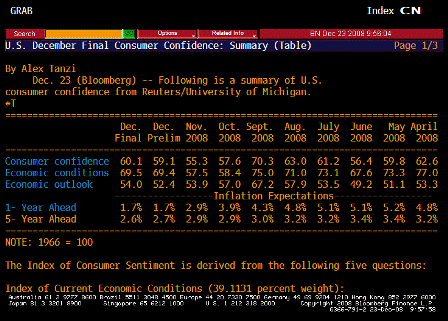
Univ of Michigan TABLE Inflation Expectations (Dec F)

 
Back to where the Fed wants them to be.

[top][end]


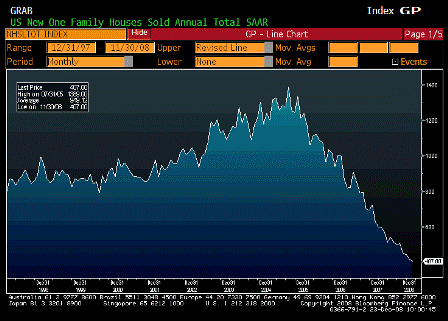
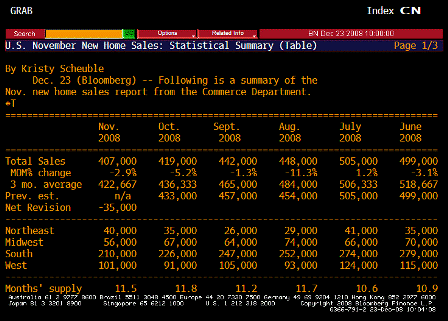
New Home Sales (Nov)

Survey 415k
Actual 407k
Prior 433k
Revised 419k

 
A bit lower than expected and last month revised down some.

[top][end]

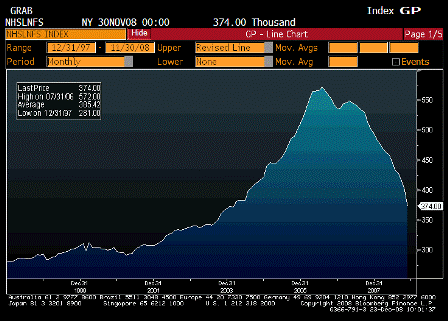
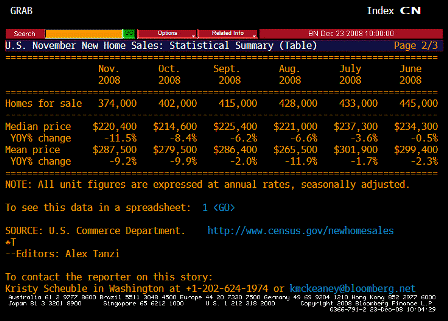
New Home Sales Total for Sale (Nov)

Survey n/a
Actual 374.00
Prior 402.00
Revised n/a

 
Down to very low levels and one reason sales are low.

[top][end]

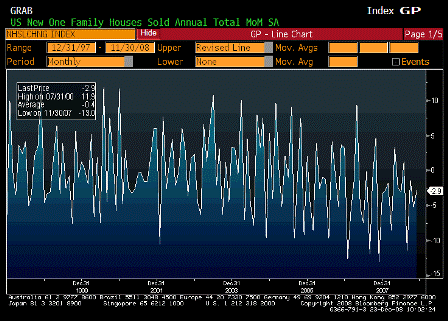
New Home Sales MoM (Nov)

Survey n/a
Actual -2.9%
Prior -5.2%
Revised n/a

[top][end]

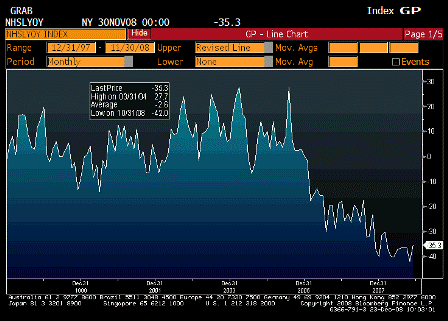
New Home Sales YoY (Nov)

Survey n/a
Actual -35.3%
Prior -42.0%
Revised n/a

[top][end]

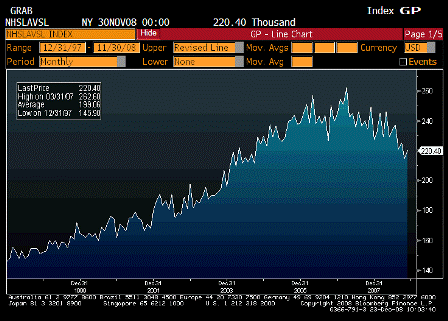
New Home Sales Median Price (Nov)

Survey n/a
Actual 220.40
Prior 214.60
Revised n/a

 
Up, but still trending lower.

[top][end]

New Home Sales TABLE 1 (Nov)

[top][end]

New Home Sales TABLE 2 (Nov)

[top][end]


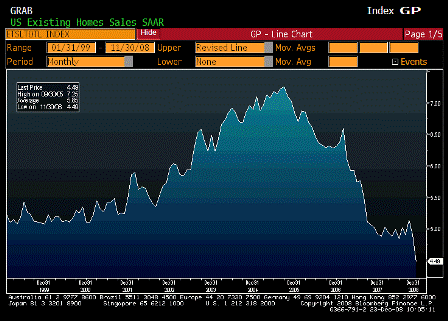
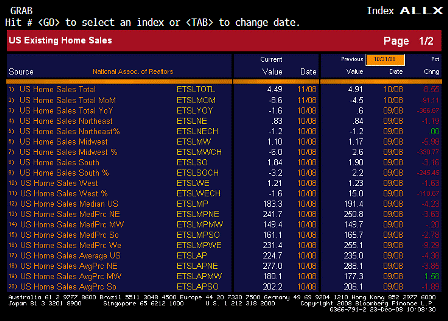
Existing Home Sales (Nov)

Survey 4.93M
Actual 4.49M
Prior 4.98M
Revised 4.91M

 
Large drop.

[top][end]

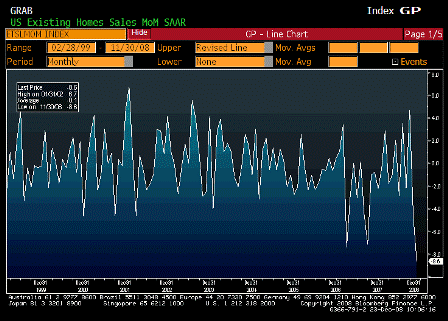
Existing Home Sales MoM (Nov)

Survey -1.0%
Actual -8.6%
Prior -3.1%
Revised -4.5%

[top][end]

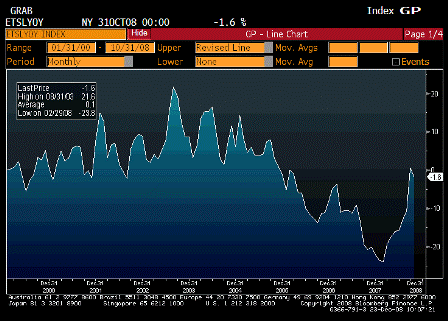
Existing Home Sales YoY (Nov)

Survey n/a
Actual -1.6%
Prior 0.6%
Revised n/a

 
Still well off the bottom.

[top][end]

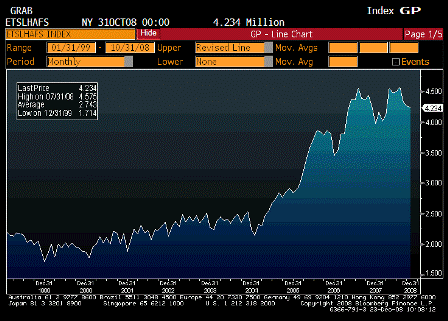
Existing Home Sales Inventory (Nov)

Survey n/a
Actual 4.234
Prior 4.272
Revised n/a

 
Falling some, but new foreclosures probably keeping this high.

[top][end]

Existing Home Sales ALLX 1 (Nov)

[top][end]

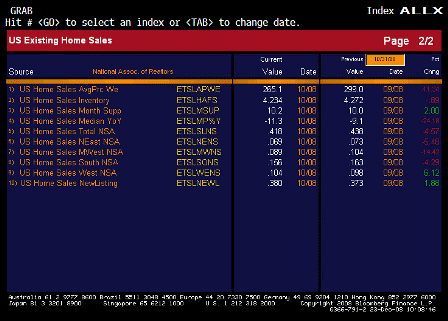
Existing Home Sales ALLX 2 (Nov)

[top][end]


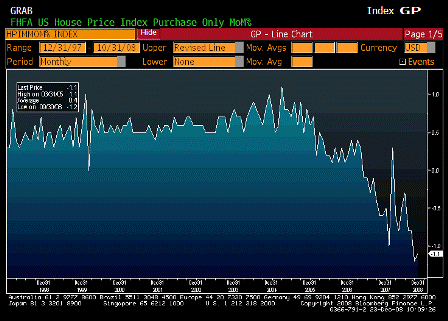
House Price Index MoM (Oct)

Survey -1.3%
Actual -1.1%
Prior -1.3%
Revised -1.2%

 
Still falling.

[top][end]

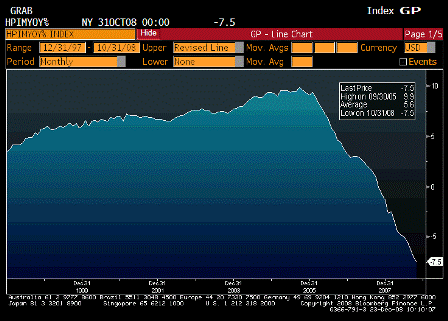
House Price Index YoY (Oct)

Survey n/a
Actual -7.5%
Prior -7.0%
Revised n/a

 
No bottom in sight yet.

[top][end]

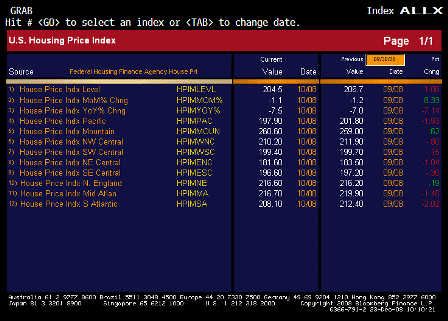
House Price Index ALLX (Nov)

[top][end]

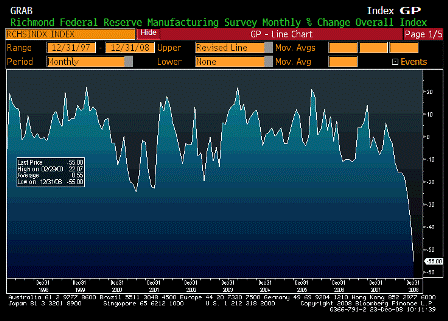
Richmond Fed Manufacturing Index (Dec)

Survey -40
Actual -55
Prior -38
Revised n/a

 
Very weak.

[top][end]

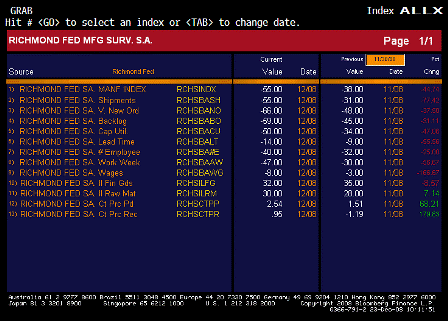
Richmond Fed Manufacturing Index ALLX (Dec)


[top]

Re: Looks like Central Banks are losing it


[Skip to the end]

(email exchange)

In actual fact they’ve never had it to lose.

>   
>   On Mon, Dec 22, 2008 at 11:02 AM, Russell wrote:
>   

The New Doom-and-Gloomers

My, how times have changed.

A year ago, few policymakers, “strategists,” or economists, here or elsewhere, saw an economic downturn coming (even though the National Bureau of Economic Research now says that a U.S. recession actually began in December 2007).

Now, as the following Agence France-Presse report, “World Faces Total Financial Meltdown: Spain’s Bank Chief,” reveals, we have central bankers who sound like doom-and-gloomers (gearing up to write their own books, perhaps?).

The governor of the Bank of Spain on Sunday issued a bleak assessment of the economic crisis, warning that the world faces a “total” financial meltdown unseen since the Great Depression.

“The lack of confidence is total,” Miguel Angel Fernandez Ordonez said in an interview with Spain’s El Pais daily.

“The inter-bank (lending) market is not functioning and this is generating vicious cycles: consumers are not consuming, businessmen are not taking on workers, investors are not investing and the banks are not lending.

“There is an almost total paralysis from which no-one is escaping,” he said, adding that any recovery – pencilled in by optimists for the end of 2009 and the start of 2010 – could be delayed if confidence is not restored.

No, if the appropriate fiscal balance is not restored-

Might I suggest an immediate payroll tax holiday?

Immediate revenue sharing?

Offering a federally funded job to anyone willing and able to work?

Doesn’t get any simpler than that?

Where’s the ‘complex’ problem?

Yes, they are too far out of paradigm to or they never would have let it all go this far, and being willing to wait yet another month for a fiscal response.

Sadly, another case of innocent fraud.

Ordonez recognised that falling oil prices and lower taxes could kick-start a faster-than-anticipated recovery, but warned that a deepening cycle of falling consumer demand, rising unemployment and an ongoing lending squeeze cannot be ruled out.

“This is the worst financial crisis since the Great Depression” of 1929, he added.

Ordonez said the European Central Bank, of which he is a governing council member, will cut interest rates in January if inflation expectations go much below two per cent.

“If, among other variables, we observe that inflation expectations go much below two per cent, it’s logical that we will lower rates.”

As if any of that matters.

Regarding the dire situation in the United States, Ordonez said he backs the decision by the US Federal Reserve to cut interest rates almost to zero in the face of profound deflation fears.

The blind leading the blind.

Central banks are seeking to jumpstart movements on crucial interbank money markets that froze after the US market for high-risk, or subprime, mortgages collapsed in mid 2007, and locked tighter after the US investment bank Lehman Brothers declared bankruptcy in mid-September.

Interbank markets are a key link in the chain which provides credit to businesses and households.

The central bankers and mainstream economists in general are the ‘missing links’, anthropologically speaking.


[top]
FOMC Statement


[Skip to the end]

Federal Reserve Press Release


Release Date: December 16, 2008

The Federal Open Market Committee decided today to establish a target range for the federal funds rate of 0 to 1/4 percent.

Geitner ought to be able to hit that one..

Since the Committee’s last meeting, labor market conditions have deteriorated, and the available data indicate that consumer spending, business investment, and industrial production have declined. Financial markets remain quite strained and credit conditions tight. Overall, the outlook for economic activity has weakened further.

Aggregate demand continued to fall

Meanwhile, inflationary pressures have diminished appreciably. In light of the declines in the prices of energy and other commodities and the weaker prospects for economic activity, the Committee expects inflation to moderate further in coming quarters.

Inventory liquidations to continue and OPEC not expected to hike prices

The Federal Reserve will employ all available tools to promote the resumption of sustainable economic growth and to preserve price stability. In particular, the Committee anticipates that weak economic conditions are likely to warrant exceptionally low levels of the federal funds rate for some time.

Low interest rates per se are believed to promote growth and employment.

The focus of the Committee’s policy going forward will be to support the functioning of financial markets and stimulate the economy through open market operations and other measures that sustain the size of the Federal Reserve’s balance sheet at a high level.

A larger balance sheet promotes growth, employment, and marketing functioning.

As previously announced, over the next few quarters the Federal Reserve will purchase large quantities of agency debt and mortgage-backed securities to provide support to the mortgage and housing markets, and it stands ready to expand its purchases of agency debt and mortgage-backed securities as conditions warrant.

This implies the purchases have some benefit other than from keeping interest rates for these securities lower than otherwise, as it didn’t say the purpose was lowering mortgage interest rates.

The Committee is also evaluating the potential benefits of purchasing longer-term Treasury securities. Early next year, the Federal Reserve will also implement the Term Asset-Backed Securities Loan Facility to facilitate the extension of credit to households and small businesses. The Federal Reserve will continue to consider ways of using its balance sheet to further support credit markets and economic activity.

Seems they still don’t grasp that it’s about ‘price’ (interest rates) and not ‘quantity’.

Voting for the FOMC monetary policy action were: Ben S. Bernanke, Chairman; Christine M. Cumming; Elizabeth A. Duke; Richard W. Fisher; Donald L. Kohn; Randall S. Kroszner; Sandra Pianalto; Charles I. Plosser; Gary H. Stern; and Kevin M. Warsh.

In a related action, the Board of Governors unanimously approved a 75-basis-point decrease in the discount rate to 1/2 percent.

They are still keeping it higher than the Fed Funds rates and still demanding collateral.

In taking this action, the Board approved the requests submitted by the Boards of Directors of the Federal Reserve Banks of New York, Cleveland, Richmond, Atlanta, Minneapolis, and San Francisco. The Board also established interest rates on required and excess reserve balances of 1/4 percent.

No mention of the USD swap lines to foreign central bands that was last reported to be well over $600B.

Still no evidence of a working understanding of monetary operations and reserve accounting.


[top]
2008-12-16 USER


[Skip to the end]
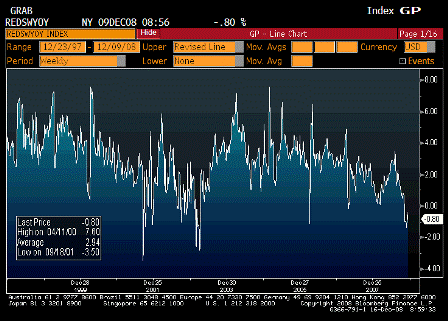

ICSC UBS Store Sales YoY (Dec 16)

Survey n/a
Actual -0.40%
Prior 0.40%
Revised n/a

 
Continues to move lower.

[top][end]

ICSC UBS Store Sales WoW (Dec 16)

Survey n/a
Actual 0.60%
Prior -0.80%
Revised n/a

[top][end]

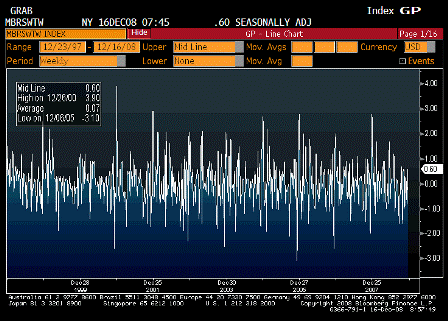
Redbook Store Sales Weekly YoY (Dec 9)

Survey n/a
Actual -0.80%
Prior -0.40%
Revised n/a

 
Continues to move lower.

[top][end]

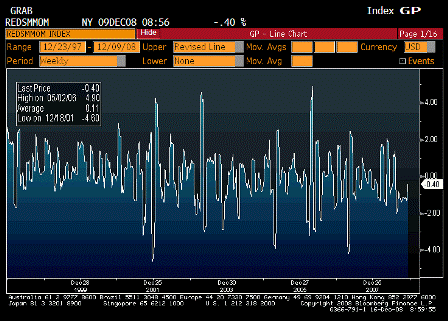
Redbook Store Sales MoM (Dec 9)

Survey n/a
Actual -0.40%
Prior -1.10%
Revised n/a

[top][end]

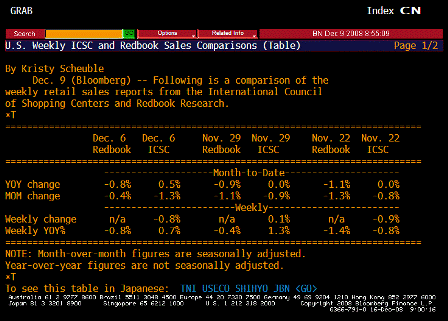
ICSC UBS Redbook Comparison TABLE (Dec 9)

[top][end]

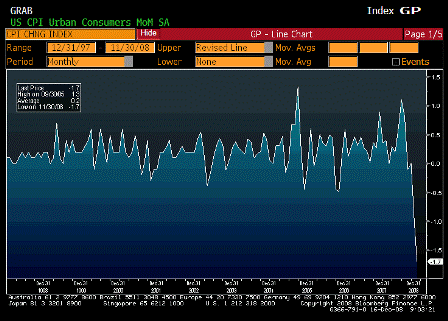
Consumer Price Index MoM (Nov)

Survey -1.3%
Actual -1.7%
Prior -1.0%
Revised n/a


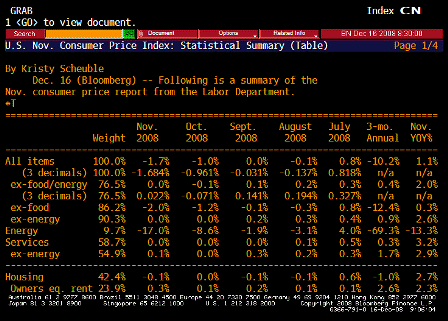
Karim writes:

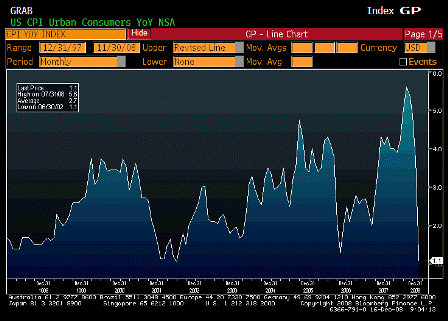
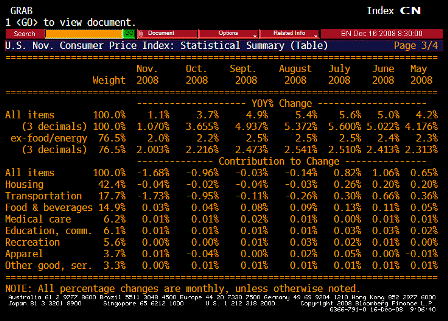
  • Headline CPI dropped 1.7% M/M in November after 1.0% decline last month (Y/Y now at +1.1%)
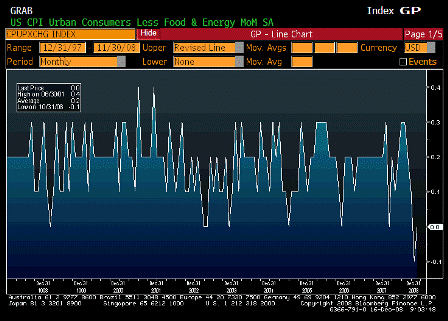
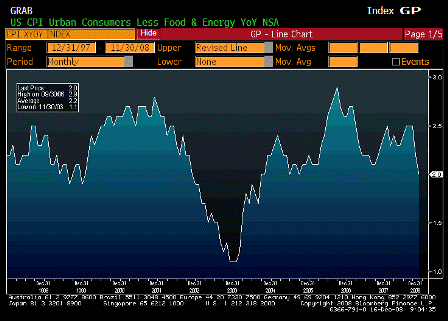
  • Core was flat in November after 0.1% decline (Y/Y at 2.0% and 3 month annualized at 0.4%… core is decelerating quickly and inflation certainly not a concern for Fed at this point)
  • OER was up 0.3% M/M, but partly due to a decline in utility prices that increases economic rents

[top][end]

CPI Ex Food and Energy MoM (Nov)

Survey 0.1%
Actual 0.0%
Prior -0.1%
Revised n/a

[top][end]

Consumer Price Index YoY (Nov)

Survey 1.5%
Actual 1.1%
Prior 3.7%
Revised n/a

 
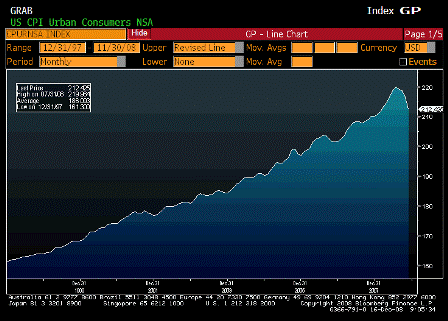
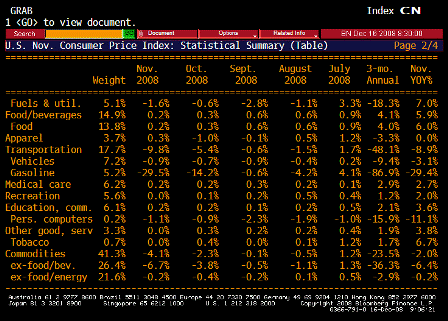
Way down, as crude oil and gasoline are lower than they were last year.

[top][end]

CPI Ex Food and Energy YoY (Nov)

Survey 2.1%
Actual 2.0%
Prior 2.2%
Revised n/a

 
Core drifting lower though owner equivalent rent went up .30% as utility costs fell and rents stayed about the same.

[top][end]

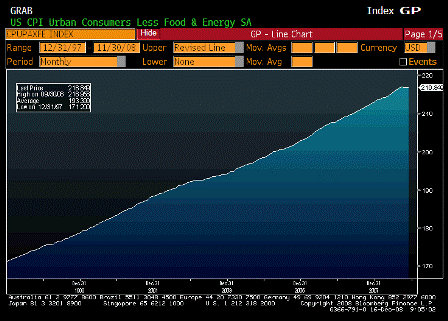
CPI Core Index SA (Nov)

Survey n/a
Actual 216.849
Prior 216.801
Revised n/a

[top][end]

Consumer Price Index NSA (Nov)

Survey 212.699
Actual 212.425
Prior 216.573
Revised n/a

[top][end]

Consumer Price Index TABLE 1 (Nov)

[top][end]

Consumer Price Index TABLE 2 (Nov)

[top][end]

Consumer Price Index TABLE 3 (Nov)

[top][end]

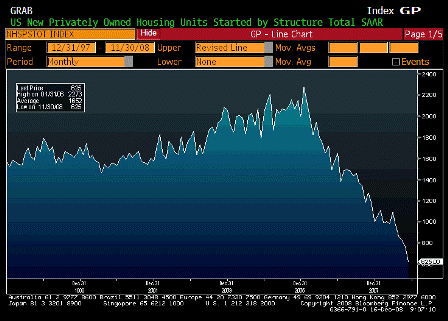
Housing Starts (Nov)

Survey 763K
Actual 625K
Prior 791K
Revised 771K

 
Keeps falling as the headlines have the public and financial institutions scared stiff.

Karim writes:

  • Housing Starts dropped to 625k in November (record low with about 50 years of data!) from 771k last month and 1,179k last year (this should put more downward pressure on residential investment in GDP through early 2009)
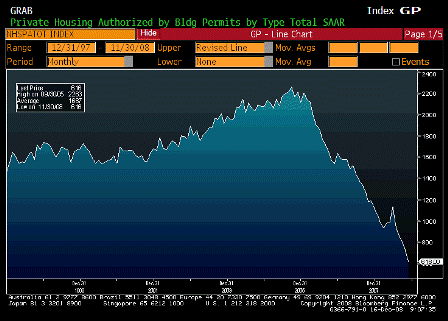
  • Permits dropped to 616k in November (record low with about 50 years of data!) from 730k last month and 1,111k last year
  • Token “Sliver” lining- less pressure on inventories from new homes

[top][end]

Building Permits (Nov)

Survey 700K
Actual 616K
Prior 708K
Revised 730K

[top][end]


[top]