
Bernanke on deficits

>   
>   (email exchange)
>   
>   On Wed, Jul 18, 2012 at 10:39 AM, wrote:
>   
>   Bernanke just said, “We will simply not be able to pay our bills” if we don’t attack the
>   long-run fiscal sustainability issue.
>   

Yes, hasn’t change a bit from from these statements earlier this year:

Bernanke Points to ‘Increased Possibility of a Sudden Fiscal Crisis’

By Matt Cover

(CNSNews.com) — Federal Reserve Chairman Ben Bernanke said that the current trajectory of the federal budget – marked by large annual deficits – was “clearly unsustainable” and that “serious economic consequences” could result.

“Having a large and increasing level of government debt relative to national income runs the risk of serious economic consequences,” Bernanke told the Senate Budget Committee Tuesday.

“Even the prospect of unsustainable deficits has costs, including an increased possibility of a sudden fiscal crisis. As we have seen in a number of countries recently, interest rates can soar quickly if investors lose confidence in the ability of a government to manage its fiscal policy.”

Bernanke said that while nobody knows when a fiscal crisis will come, it is surely “ever closer.”
Fed Chairman remains a non trivial obstacle to prosperity

From Chairman Bernanke earlier today:

The second important risk to our recovery, as I mentioned, is the domestic fiscal situation. As is well known, U.S. fiscal policies are on an unsustainable path, and the development of a credible medium-term plan for controlling deficits should be a high priority. At the same time, fiscal decisions should take into account the fragility of the recovery.

John’s got it!

Congress, Not the Fed, Needs to ‘Get to Work’

By John Carney

July 17 (CNBC) — The Senate Banking Committee’s grilling of Federal Reserve Chairman Ben Bernanke just got weird.

Senator Charles Schumer, the New York Democrat, proposed a novel theory of political management of the economy shortly before 11 am Tuesday morning.

The gist of the theory: If the elected branches of government cannot agree to act, the responsibility for the economy falls to the Fed.

Schumer’s argument amounted to the idea that that because disagreements between Republican and Democrats (and, of course, the political ambitions of members of both parties in a presidential election year) are blocking any agreement to provide fiscal relief to the economy, the Fed should “get to work.”

It’s tempting to say that this is the drunk’s theory of the bar tab.

The drunk has been drinking so much he can’t work—and therefore can’t afford to pay his tab. So it’s up to the bartender to pour another cocktail and extend the tab a bit longer.

But this would be insulting to drunks everywhere. The drunk actually understands the economics of the bar better than Schumer understands the difference between monetary and fiscal policy.

The economy right now suffers because the private sector is attempting to save more than it spends, mostly by paying down its enormous debt burden. Because everyone’s income comes from someone else’s spending, reduced overall spending results in income reduction. In our economy, that means higher unemployment.

If the economy is going to grow while households and businesses pay down their debts instead of spending, someone else must take the opposite side of the trade by growing spending more than its income.

With the rest of the world heading toward recession, the only plausible source of this added income is the government. In other words, the government must cut taxes relative to spending (or grow spending relative to taxes) to replace the lost income in the private sector.

What the economy certainly isn’t suffering from right now is a shortage of liquidity or a meager money supply. Which is to say, we’ve reached the limits of what the Fed can do to spur growth. (Although perhaps not the limits of what the Fed can do to fend off a sharp turn downward in the economy.)

To hear a member of the shirker branch of our government blame the Fed for not doing enough would be laughable if we weren’t living with the consequences of the shirking.

Sen. Schumer—and his fellow lawmakers—are the ones who should “get to work.”

Another vice presidential candidate

:(

‘The Dollar Is Going to Go to Hell’: Trump

By Justin Menza

July 17 (CNBC) — The U.S. needs to pay down its debt, and that won’t happen if Federal Reserve Chairman Ben Bernanke “goes wild” with more stimulus, Donald Trump told CNBC’s “Squawk Box” on Tuesday.


“The fact is that the country owes $16 trillion, and we just can’t keep doing this,” Trump said. “The dollar is going to go to hell.”

Trump said the artificial Fed stimulus has done nothing, and the only way to get the country back on track is to start paying down debt.

Early Thought follow up… A conversation with Warren Mosler– great investor, thinker, sports car manufacturer, author, blogger….

Please click on the link below to listen to a conversation with Warren Mosler. Topics include: Demand leakage (how to fix end-demand), Fed Policy (QE is counterproductive) and overall market/econ outlook for US, Europe and China.

Please click here for the audio

Fed Boosts Capital Rules for Banks, Hitting Stocks

The regulators are already requiring more like 8-10% capital from most banks, so raising the legal limit to 6% from 4% is inconsequential.

Fed Boosts Capital Rules for Banks, Hitting Stocks

June 7 (CNBC) — The Federal Reserve approved new rules Thursday for U.S. banks to set aside more money to cushion against unexpected losses, a key step in preventing another financial crisis.

The new rules require the nation’s largest banks to hold at least 6 percent of their assets in capital reserves, up from a minimum of 4 percent currently, by 2019.

The 2010 Dodd-Frank financial overhaul law—as well as an international agreement last year in Basel, Switzerland—require regulators raise capital requirements for banks.

The banks had lobbied vigorously against the proposals, saying setting aside so much money in reserve could limit what they could lend.

The rules are open to comment until September. They will be finalized after that.

Though the move was expected, financial stocks— including Bank of America and Morgan Stanley— fellsharply after the Fed approval was announced.

LOCKHART SAYS MORE EASING NOT CALLED FOR AT THE MOMENT

I guess he’s ok with the output gap/unemployment…
And not that it matters, as they they only shoot blanks in any case.

*LOCKHART: COMMUNICATIONS, BALANCE SHEET ARE TOOLS
*LOCKHART: `WE HAVE NOT EXHAUSTED ALL OUR OPTIONS’
*LOCKHART: DEFLATION, DETERIORATING CONDITIONS COULD BE TRIGGER
*LOCKHART SAYS `STRESSED’ ECONOMY MIGHT REQUIRE EASING
*LOCKHART SAYS MORE EASING NOT CALLED FOR AT THE MOMENT

Dudley on interest income channel

From a friend:

At the conference on Friday, NY Fed President Dudley presented a chart that showed the long-term impact on the budget deficit of lower Fed remittances of interest income over time (his point was that it would lead to a larger deficit and the Treasury should not assume recent levels of Fed remittances).

I asked him in Q&A if he considered that in the short-term, the interest being accrued by the govt sector would typically be accrued by the non-govt sector and it could thus be viewed as a form of fiscal drag, and that maybe it should be offset by looser fiscal policy elsewhere if the economy warranted it due to a large output gap.

His response, not surprisingly, was:
‘You are factually correct, but’:

  • A lot of that interest income goes to non-u.s. investors, so its not like the U.S. economy loses all that interest income.
  • The propensity to consume of savers is lower than that of borrowers.
  • The drain on interest income is more than offset by easier financial conditions elsewhere (via equities, credit spreads, etc).

That’s just how their models work/they see the world.

Fed Worries ‘Fiscal Cliff’ Is as Big a Threat as Europe

Does this mean the Fed staffers think fiscal policy works?
How about the Fed Chairman?
;)


Fed Worries ‘Fiscal Cliff’ Is as Big a Threat as Europe

By Steve Liesman

May 10 (CNBC) — Officials at the Fed are increasingly concerned about the coming “fiscal cliff,” putting it on par with the European crisis and the housing market as among the US economy’s biggest threats.

April Job Data – ‘Mixed’//Fed Implications


Karim writes:

Highlights

  • April Payrolls rise 115k, below expectations.
  • March revised from 120k to 154k and February from 240k to 259k
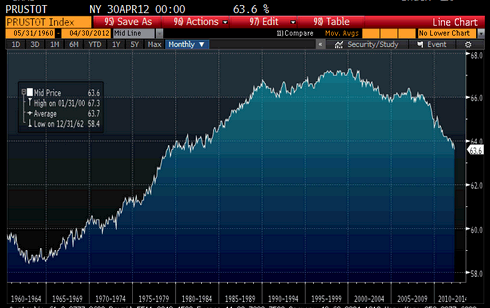
  • Unemployment rate falls to new cycle low of 8.1% (already close to Fed’s year-end forecast of 7.8-8.0%) though due to drop in Participation Rate from 63.8% to 63.6%.
  • A lot of volatility in the job data, making it difficult to divine the broader trend:

    • Manufacturing employment growth slows from 41k to 16k (vs rise in ISM employment component)
    • Leisure/Hospitality slows from 52k to 12k
    • Retail rises from -21k to +29k
    • Temp help rises from -9k to +21k
  • Income equation on the weak side as no growth in average hourly earnings and index of aggregate hours up just 0.1%
  • Diffusion index slows from 64.7 to 56.8, but still well within expansion zone.
  • Median duration of unemployment falls from 19.9 weeks to 19.4 weeks, a new cycle low.

Conclusion

  • The Fed would most certainly have liked to see better headline job growth, but I don’t think this report is enough to push them into additional easing for the following reasons:
    • Data is volatile and the net revisions were significant
    • Unemployment rate continues to fall
    • Inflation right at target
    • Financial conditions (equities and credit spreads) remain loose.
    • Structural issues continue to wane

Agreed on the conclusion. It will take a lot to get the Fed to do any more QE. Not the least reason being most of them know it doesn’t actually do anything apart from getting a lot of people scared and angry, including our esteemed politicians, for example, ready to make a propaganda show out of what they like to call ‘money printing.’

Of more concern, Bill Mitchell mentioned the drop in public sector employment may be dragging us down to negative growth. He may be right, as those paychecks are probably very ‘high multiple’ and require larger federal deficits to make up for the lost aggregate demand.

Actual multiples- propensities to spend out of income- are variable and hard to get a handle on, and therefore generally must be ‘reacted to’ with fiscal adjustments.

Unfortunately, however, all political forces are currently aligned towards deficit reduction.

And note the labor force participation rate is heading back to about where it was before women entered the labor force.