QE

QE in the US has again done what it’s always done- frighten investors and portfolio managers ‘out of the dollar’ and into the likes of gold and other commodities.

And because sufficient market participants believe it works to increase aggregate demand, it’s also boosted stocks and caused bonds to sell off, as markets discount a higher probability of higher growth, lower unemployment, and therefore fed rate hikes down the road.

But, of course, QE in fact does nothing for the economy apart from removing more interest income from the economy, particularly as the Fed adds relatively high yielding agency mortgages to its portfolio.

As ever, QE is a ‘crop failure’ for the dollar. It works to strengthen the dollar and weaken demand, reversing the initial knee jerk reactions described above.

But the QE myth runs deep, and in the past had taken a while for the initial responses to reverse, taking many months the first time, as fears ran as deep as headline news in China causing individuals to take action, and China itself reportedly letting its entire US T bill run off.

But with each successive QE initiative, the initial ‘sugar high’ is likely to wear off sooner. How soon this time, I can’t say.

Global austerity continues to restrict global aggregate demand, particularly in Europe where funding continues to be conditional on tight fiscal. Yes, their deficits are probably high enough for stability- if they’d leave them alone- but that’s about all.

And as the US continues towards the fiscal cliff the automatic spending cuts are already cutting corporate order books.

And oil prices are rising, and are now at the point cutting into aggregate demand in a meaningful way.

Yes, the US housing market is looking a tad better, and, if left alone, probably on a cyclical upturn. And modest top line growth, high unemployment keeping wages in check, and low discounts rates remains good for stocks, and bad for people working for a living.

Too many cross currents today for me to make any bets- maybe next week…
September FOMC Preview and fiscal cliff comments


Karim writes:
September FOMC Preview

Its hard to remember going into an FOMC meeting with as wide a range of outcomes and as wide an array of views on those outcomes from markets and economists.

In play:

  • Do nothing
  • Extend forward guidance (to what date?)
  • Cut IOER
  • Unsterilized asset purchases
    • Open-Ended, or defined amount and time period?
    • MBS and/or USTs?

My own, relatively low conviction, view is that they only extend forward guidance, to mid-2015, from the list above. I think there is a 40% probability they announce new LSAPs that would run concurrently with the end of Twist2. If they do additional LSAPs, I think there is a 40% they are open-ended in nature. If they do additional LSAPS (defined amount), I think it will be a 400bn program over 6mths made up of 75% MBS and 25% USTs. The odds of a cut in IOER would around 25% in my view.

Assuming extending forward guidance is a done deal, as hinted in the minutes, here are some of the pro’s and cons in terms of gauging the likelihood of additional asset purchases.

Pros

  • The term ‘monetary’ accommodation used in the last Minutes suggests more than just forward guidance is being considered: Many members judged that additional monetary accommodation would likely be warranted fairly soon unless incoming information pointed to a substantial and sustainable strengthening in the pace of the economic recovery.
  • Bernanke used the term ‘grave concern’ at Jackson Hole to describe the state of the labor market and the last payroll report looked lousy.
  • He defended the use of QE at Jackson Hole, so if the outlook remains weak, why not do more?

Because he doesn’t want to pick a fight with China again, as per my May 2011 post.

Cons

  • The Fed states that policy works through financial channels and with most borrowing rates near record lows, and equity markets near 4yr highs, those channels are working well right now. Why mess with success?


Yes, he knows it’s about rates, not quantities, and that policy has caused the term structure of rates to be where it is. However, the channel that remains elusive is how low rates are transmitted to aggregate demand, claims of creating 3 million jobs not withstanding.

  • The outlook hasn’t changed much since June when they announced Twist2, so why act now?
  • Its 2mths before the election and the Fed is only a side campaign issue now. For an institution that craves it independence, why do anything that may risk that?

Open-ended purchases would likely be tied to the forecast (i.e., ‘the Fed will buy 150bn/mth of MBS and USTs until the Committee is able to forecast meeting its mandate within its forecast horizon’). The issue is the Fed doesn’t have a common forecast (it takes an average of 17 members to produce the SEP). That common forecast is a work in progress (a Committee headed by Yellen). So an open-ended program may take place, but probably not until next year.

Odds of an IOER cut are low just because Bernanke did not mention it at all at Jackson Hole.

About three months ago I suggested the fiscal cliff was too far away for markets to care.
But now it’s a lot closer, and close enough for those to be affected directly by govt spending cuts to be acting accordingly.

But that also means that at least some of that cliff is already being discounted which means:

It won’t be as bad as expected if it happens.
If it’s avoided there will be a boost to the economy not in current forecasts.

August Payrolls-Stall Speed


Karim writes:

Very poor job data with a gain of only 96k and a net revision of -41k. Somewhat offsetting is the 0.2% drop in the unemployment rate from 8.3 to 8.1% (which along with April 2012 is the lowest since January 2009). The biggest swing (and miss) was manufacturing employment, which shifted from a gain of 23k to a fall of 15k, indicating that global economic weakness is affecting U.S. exporters. Indicators of domestic demand fared better as trade swung from a gain of 11k to 29k jobs, finance from -2k to +7k, and leisure/hospitality from 28k to 34k.
 
Though August payroll data is typically revised higher, the data affirms the notion the economy is hovering around or just below trend growth of 2-2.5%.
 
The data increases the chances of QE3, unsterilized and possibly open-ended purchases of Agency MBS and USTs, but I still think later in the year. An open-ended program likely requires a consensus Fed economic forecast, which is still a work-in-progress. Next week’s FOMC meeting will be contentious, and a close call, however.
 
Other data highlights:

  • The drop in the unemployment rate came as a result of a drop in the participation rate from 63.7% to 63.5% (labor force fell by 368k).
  • The U6 measure improved from 15% to 14.7%, but the median duration of unemployment rose from 16.7 weeks to 18 weeks.
  • Average hourly earnings were unchanged and aggregate hours gained 0.1%, a weakish combination for personal income.
  • The diffusion index dropped from 54.3 to 50.2

Some interesting charts from SMR:

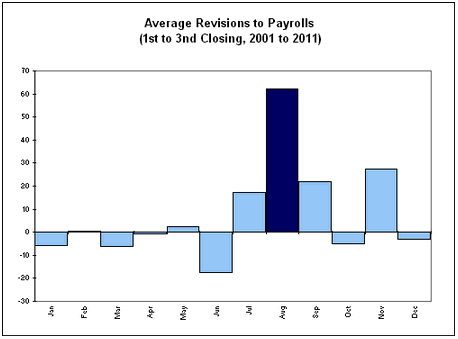
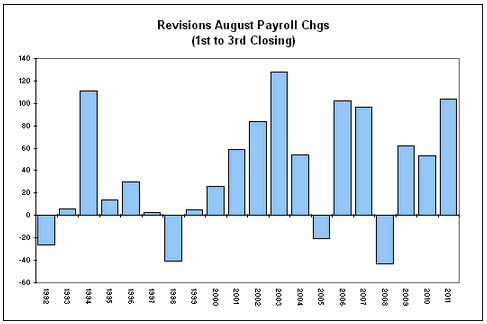
Over the past 20 years August payrolls have been revised upward between the 1st and 3rd release on 16 occasions.

The magnitude of the August payroll revisions over the past 10 years has far exceeded any other month of the year. Over this period the August reading has been revised upward by an average of 62,000, in contrast to the next largest month (November) at +27,600.

Jackson Hole speech

The Chairman seems to be well aware of the upturn in housing, which he mentioned twice. But he was careful to not reveal an upbeat attitude that he knows would cause rates to spike in expectation of the Fed ‘normalizing’ policy with ‘neutral’ being a Fed funds rate maybe 1% over the inflation rate, or something like that.

In other words, he wants longer term rates, and mtg rates in particular, to stay down for now, which causes him to guard any optimism he may have, and then some.

It falls under ‘managing expectations’ and my best guess is he’s waiting for unemployment to fall below 8% before he publicly becomes more optimistic.

“Key sectors such as manufacturing, housing, and international trade have strengthened, firms’ investment in equipment and software has rebounded, and conditions in financial and credit markets have improved.”

“Rather than attributing the slow recovery to longer-term structural factors, I see growth being held back currently by a number of headwinds. First, although the housing sector has shown signs of improvement, housing activity remains at low levels and is contributing much less to the recovery than would normally be expected at this stage of the cycle.”

Paul Davidson on Paul Ryan’s economic knowledge in NY Times in 2009

>   
>   (email exchange)
>   
>   On Sat, Aug 11, 2012 at 1:32 PM, Paul wrote:
>   
>   In an op-ed ”Thirty Years Later, a Return to Stagflation” (Op-Ed, Feb. 14), Representative
>   Paul D. Ryan, Republican of Wisconsin, argued that the stimulus plan will bring the
>   combination of high inflation and high unemployment known as stagflation.
>   
>   Here is a copy of my February 22, 2009 published letter to the Editor of the New York
>   Times evaluating Paul Ryan’s economics.
>   

LETTERS; Can We Spend Our Way to Recovery?

February 22, 2009 (NYT)

To the Editor:

Paul D. Ryan repeats the tired idea that when the Federal Reserve prints money for the government to spend on economic recovery, the result will be inflation because ”it is a situation in which too few goods are being chased by too much money.” This is based on a false assumption that the output of the country will not increase when government lets contracts to businesses to produce more goods and services that will improve the productivity and health of our country.

If there is significant unemployment and idle capacity in the private sector (and who can deny that there is?), then this deficit spending will not cause inflation. Rather, the ”printed” money spent on a recovery plan creates profit opportunities that induce private enterprise to hire and produce more goods. Then there will be many more goods available for this money to chase and no inflation need occur.

Paul Davidson
Boynton Beach, Fla., Feb. 14, 2009

The writer is editor of The Journal of Post Keynesian Economics.

MMT on the immediate restoration of the US’s AAA rating

Not that it matters, of course, but all’s that’s needed is for the Fed to guarantee that all US obligations mature at 100. The Fed is fully authorized to buy US tsy securities and can certainly buy them at maturity value on their maturity date, simply by crediting the appropriate accounts. And the ratings agencies fully recognize that authority.

ECB’s Hansson Says Germany Can Be Outvoted on Governing Council


Karim writes:

This is correct. The Bundesbank voting no is technically equivalent to Lacker dissenting at every FOMC meeting this year. It would be a bigger statement if dissents came from the Executive Board (the equivalent of Yellen dissenting vs a regional Fed bank president).

ECB’s Hansson Says Germany Can Be Outvoted on Governing Council

By Ott Ummelas

August 3 (Bloomberg) — European Central Bank policy maker Ardo Hansson, who heads Estonia’s central bank, said Germany c be outvoted on the ECB’s Governing Council.

“There are 23 members in the council and if there will be a vote then everyone’s vote has the same weight in the sense that some questions are solved by a majority,” Hansson told Eesti Rahvusringhaaling radio today when asked if new ECB bond purchases can be approved without German support.

While there was unanimity on the council to investigate options in the coming month, “there could be differing views of details and these would need to be solved in negotiations,” Hansson said. He also said purchases will focus on “relatively short-term debt instruments.”

Interest income loss from rate cuts

Word’s getting around, from CS:

The side-effect of the Fed’s near-zero interest medicine – the collapse in personal interest income over the last few years. The decline in interest income actually dwarfs estimates of debt service savings. Exhibit 2 compares the evolution of household debt service costs and personal interest income. Both aggregates peaked around $1.4 trn at roughly the same time – the middle of 2008. According to our analysis of Federal Reserve figures, total debt service – which includes mortgage and consumer servicing costs – is down $206bn from the peak. The contraction in interest income amounts to roughly $407bn from its peak, more than double the windfall from lower debt service.

June DGOs/July 20 Claims-Weaker CapEx; Jumpy Claims


Karim writes:

June DGOs/July 20 Claims-Weaker CapEx; Jumpy Claims

  • Durables data was unequivocally weak. Core orders (ex-defense and aircraft) were down 1.4%. The 3mth annualized rate is now -5.1%, a steady decline from the double digit growth pace of 2011. This feeds into Bernanke’s view that some of the gains in employment and capex in the past year were corrections for overly deep cuts in 2008-09 rather than the start of a new uptrend.
  • Core shipments were up 1.2%. That has greater implications for Q2 GDP (out tomorrow), whereas the orders data has greater implications for Q3 and Q4. Expect a slightly above consensus GDP number tomorrow (1.8% vs 1.4% consensus).
  • Claims dropped by 35k to 353k. Even though the labor department stated there were no quirks, +/- 35k weekly swings in the data as we’ve had for 3 straight weeks does seem quirky.
  • The 4-week average of claims did drop to 367k, the lowest since March.
  • At the very least, the report suggests the labor market is holding up at worst, and suggests another 100k-type gain in payrolls for July.