Weber/LBS/Rehn


Karim writes:

Weber being more explicit than what LBS said earlier today. Basically, if 1% is considered too low, 1.25% or 1.5% would be as well.

Domestic orders in Germany today and BdF Confidence survey both firm. Expect 25bp/qtr from ECB until they get to at least 2%.

Weber:
“I wouldn’t do anything here to try to correct market expectations at this point,” Weber told Bloomberg News in Frankfurt today when asked about investors pricing in an increase in the benchmark rate to 1.75 percent by the end of the
year. It was the intention of the ECB to bring forward market expectations and “I see no reason at this stage to signal any
dissent with how markets priced future policies,” he said.\

Weber also said the ECB’s latest inflation forecasts may underestimate price pressures.

LBS:
ECB Board Member Bini Smaghi said this morning that the increase in energy and agricultural raw materials prices is a “permanent” phenomenon. He also said that the wider the gap between real interest rates and GDP growth, the higher the risk of instability, and that keeping interest rates at 1% would further increase the rate of monetary expansion.


Also, EU Commissioner for Economic Affairs Rehn keeping positive sentiment alive about reducing borrowing rates for Ireland and Greece:

“The issue now, today and tomorrow is debt sustainability and I can see that there’s a case to be made to reduce the interest rates paid by Greece and Ireland”.

Agreed, and should it happen this is not good for the euro, though markets will think it is.

Higher rates both increase national govt deficits and exacerbate credit issues.

Employment/Population

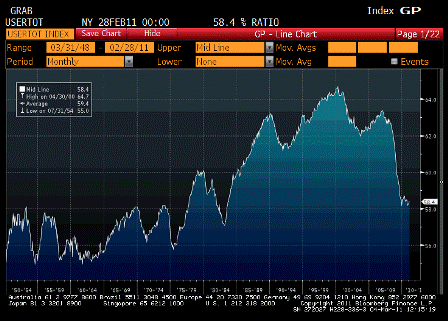
From Goldman: The household survey, however, was stronger than expected. In particular, the unemployment rate dropped another tenth (to 8.922%) due to a firm gain in employment (+250,000) and unchanged labor force participation (at 64.2%). The employment gain was also strong on a “payroll-adjusted” basis, up 342,000 on the month. The employment/population ratio remained unchanged at 58.4%. The decline in unemployment was broad based across different measures of unemployment; for example, the U6 unemployment rate, which counts marginally attached workers and those working part-time for economic reasons, declined by two tenths to 15.9%

With only 58.4% of the population employed it’s a stretch for the Fed or anyone else to declare victory.

Yes, there are some long term demographic changes.
Women entering the workforce probably drove this ratio higher,
and an aging population is probably going to drive it lower.
But we’re back to levels from before women entered the workforce.

Best I can tell, yes, there are signs of improvement, but overall it remains an economic disaster.


Karim writes:

  • Data still weather impacted as 82k workers more than avg couldn’t work due to weather
  • Unemployment rate falls to 8.92% from 9.05% as household survey employment rises 250k and labor force rises 60k
  • Payrolls up 192k, with net revisions of +58k and private sector job gains of 222k (68k last month)
  • Avg hourly earnings unch after 0.4% last month (and likely hard to read due to impact on hours worked from the weather)
  • Index of aggregate hours up 0.2%
  • Median duration of unemployment down from 21.8 to 21.2 weeks
  • U6 measure down from 16.1% to 15.9%
  • And the strongest indicator in this report was the Diffusion Index reaching its highest level since 1988, rising from 60.1 to 68.2 (this is like the ISM, measuring the breadth of industries adding jobs)

Why the public sector is not overpaid

The rhetoric is that the public sector is overpaid relative to the private sector.
Ok, they don’t adjust for education and probably a few other things, but it all still misses the point.

Back when I was a kid in Ct. the 50’s, I recall the private sector jobs paying a lot more than the public sector jobs. People worked for the US Post Office, for example, because of the security, or because they couldn’t get a higher paying private sector job for one reason or another.

So seems since then things have reversed.

The reason is the overly tight fiscal policy that’s kept unemployment a lot higher, and beat down the private sector.

And best I can tell, it’s not that public sector employees are earning too much (with a few anecdotal exceptions), it’s that because the economy is so bad, private sector employees aren’t earning what they might in a good economy.

The obvious answer to me.
Instead of trying to drag down public sector compensation to today’s depressed private sector levels, which also happens to further hurt the private sector at exactly the wrong time,
I’d rather see us restore a full employment economy (like we had in 1999-2000)
and let the good times bring up private sector wages and benefits, which, in a good economy, surpass public sector wages and benefits.

But no one is even considering that option.
Because they all agree:
The US has run out of money.
And now must borrow from the likes of China in order to spend
And leave the tab to the grandchildren.
And Social Security and Medicare are bankrupting the nation.
And the deficit is taking away our savings starving private investment.
And that the US could be the next Greece if we don’t get our fiscal house in order NOW.
And all the rest of that kind of nonsense.

Claims/ECB


Karim writes:

  • Claims drop to new cycle low of 368k; prior week revised down to 388k from 391k.
  • No special factors cited

Trichet Introductory Statement KeyLine:
It is essential that the recent rise in inflation does not give rise to broad-based inflationary pressures over the medium term. Strong vigilance is warranted with a view to containing upside risks to price stability. Overall, the Governing Council remains prepared to act in a firm and timely manner to ensure that upside risks to price stability over the medium term do not materialise.


In the 2005-7 rate hiking cycle, ‘strong vigilance’ or ‘vigilance’ was used in the introductory statement in the month prior to all 8 rate hikes in that cycle. Base Case: Look for the ECB to start raising rates 25bps every 3mths until they get to 2%, likely starting next month. Other key messages were ‘act in a firm and timely manner’ and the absence of the phrase ‘rates are still appropriate’.

the Mideast, the Saudis, and our markets

First, I’ve been pretty quiet on the mideast goings ons.
I’ve been watching intently from the time Egypt made headlines,
and have yet to see anything of particular consequence to us, beyond oil prices.

I’ve yet to come up with any channel to world aggregate demand, inflation, etc. apart from oil prices.

Seems all moves in stocks and bonds have been linked directly or indirectly only to actual and potential changes in crude oil and product prices.

And the mainstream has yet to realize that ultimately the Saudis- the only producer with excess capacity, continues as price setter, at least until their excess capacity is gone.

So the price of crude oil remains set by decree, and not market forces.
And markets don’t yet seem to know that.
Credit the Saudis for outsmarting the world on that score.
They say they don’t set prices, but let the market set price, as they only set spreads to benchmark market prices they post for their refiners.
The world completely misses the simple difference between the Saudi’s reaction function as a price setter, and prices set competitively in the market place.

That’s like the Fed saying they don’t set $US interest rates, because they have a reaction function that guides them.

So what does that mean?

It means the price of crude will come down only if the Saudis want it to come down (assuming they do have excess capacity).

And my best guess is that their survival strategy includes a lower price of oil.

They will play the maestro with grand gesture and international ‘faux diplomacy’ with ‘high level’ behind the scenes goings ons with pledges to come to the rescue with promises of production increases to replace any lost output due to the crisis, making it clear that they are going the extra mile and taking extraordinary measures to ensure the western economies both won’t see any supply disruptions and prices will be contained. Making it clear that we owe them for their selfless, gargantuan, efforts and expenditures of political capital on our behalf.

It’s all a big show to ingratiate themselves to the West in the hopes of getting the western support needed to sustain their position of power.

And the west will never realize that prices went up only because the Saudis raised their posted prices under cover of their reaction function that the west mistakes for ‘market forces,’ and that prices will go down only as the Saudis simply lower their posted prices, as they continue to play us for complete fools.

Much like China does to us because we think we need to sell our Tsy secs to fund our federal spending.

And with lower crude prices we go ‘risk off’ and much of the recent moves in other markets reverse.

The other possibility is that the Saudis don’t cut price, maybe because they decide they want the increased revenues to sustain control domestically with increased distributions to their population.

One way or another, it’s all their political decision, and we don’t even understand how it works, which reduces the odds that whatever influence we might have will be used to our ultimate benefit.

Before the early 1970’s the price of oil was set by the Texas Railroad Commission, who kept it relatively low and stable, fueling growth with reasonable price stability, while govt policy fostered relatively high levels of employment and low output gaps.

Since the hand off to the Saudis in the early 1970’s, when circumstances allowed them to take over as swing producer/price setter, prices have increased dramatically with very high levels of volatility, disrupting the world order and fostering today’s very high levels of unemployment and massive output gaps, as govts struggle with fears of inflation and seemingly no understanding of the process that’s got us into that mess.

And now with the world turmoil perhaps largely a function of mass unemployment, and govts with no idea how to keep that from happening, the pendulum is shifting from order to chaos.

Comments on Non-Mfg ISM

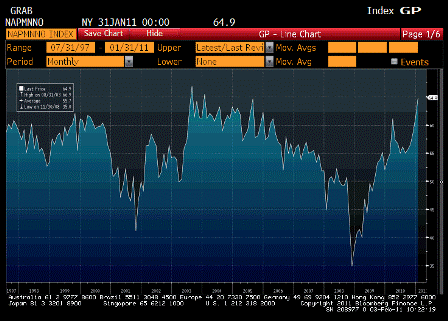
Looks from the chart we’re getting close to the post Bush tax cut, coming out of that recession highs, so we’re on track for our 3-5% read gdp growth guestimates.

And the high productivity reported today reinforces our thoughts on unemployment coming down only slowly as well.

Last time around the expansion phase of what became the sub prime crisis was a substantial contributor to private sector credit growth. Without that kind of contribution from somewhere else, this recovery could be more modest than the last.

For exports to be sustained, the govt would have to keep the dollar down with fx purchases and reserve building, which in my humble opinion isn’t going to happen. That means the adjustment takes place via a climbing US dollar that continues until it dampens exports. Much like what the euro zone has experienced for the last decade or so.


Karim writes:

Multi-year highs for overall index, new orders (3rd highest on record-chart attached), and employment.
Anecdotes also very positive.

  • “New initiatives creating increase in spending.” (Finance & Insurance)
  • “Indications are that business is picking up and that 2011 could see positive growth across many industries. We are seeing an increase in orders at the beginning of the year.” (Professional, Scientific & Technical Services)
  • “Starting to see higher prices in many areas. Low inventory levels are leading to longer delivery time frames.” (Public Administration)
  • “Business uncertainty seems to be subsiding.” (Management of Companies & Support Services)
  • “Business activity is picking up. The challenges in the textile market (cotton/polyester) are significantly impacting price along with the inability to secure pricing for a period longer than two months.” (Accommodation & Food Services)
  • “2011 looking better than 2010.” (Information)


Jan Dec
Composite 59.4 57.1
Business activity 64.6 62.9
Prices Paid 72.1 69.5
New Orders 64.9 61.4
Backlog of Orders 50.5 48.5
Supplier Deliveries 53.5 51.5
Inventory Change 49.0 52.5
Inventory Sentiment 60.0 61.5
Employment 54.5 52.6
Export orders 53.5 56.0
Imports 53.5 51.0

ISM- Obama boom!


Karim writes:

Across the board strength. More evidence that the inventory drag in Q4 was involuntary (demand running well ahead of production). While some of these figures may cool, the order backlog and supplier delivery indices (lead times) suggest very strong data for the next few quarters.

  • Overall index: Highest since May 2004
  • New orders: Highest since Dec 2003
  • Employment index highest since April 1973
  • Export orders: Highest since Dec 1988


ISM Jan Dec
Index 60.8 58.5
Prices paid 81.5 72.5
Production 63.5 63.0
New Orders 67.8 62.0
Backlog of orders 58.0 47.0
Supplier deliveries 58.6 56.7
Inventories 52.4 51.8
Customer inventories 45.5 40.0
Employment 61.7 58.9
Export Orders 62.0 54.5
Imports 55.0 50.5

Yes, manufacturing is being led by exports, which tells me to watch for a dollar rally.

The problem is crude is moving higher, but that may be temporary and fall back as the Egyptian crisis gets resolved, if the Saudis don’t support the higher prices. And the US cost advantage with the dollar at current levels could drive the dollar higher even with the higher crude prices.

The federal budget deficit remains plenty high to support the 3-5% reported real growth, which is enough to bring unemployment down some as well with productivity running maybe 2.5% or so, but unemployment probably won’t fall fast enough for the Fed to declare victory anytime soon. And with core inflation numbers still decelerating the Fed continues to see itself ‘failing’ on both mandates as Chairman Bernanke reported in his last address.

For the Fed, the GDP growth limit is as high as possible without jeopardizing price stability. While they have calculated that should be around the 3-4% real growth level, if the evidence supports higher rates of gdp growth with price stability they should in theory have no problem with higher levels of real growth.

Risks remain China, Europe, and US fiscal tightening, as well as a sharp spike in crude prices

Bernanke testimony

The Economic Outlook and Monetary and Fiscal Policy

Chairman Ben S. Bernanke

Before the Committee on the Budget, U.S. Senate, Washington, D.C.

January 7, 2011

Chairman Conrad, Senator Sessions, and other members of the Committee, thank you for this opportunity to offer my views on current economic conditions, recent monetary policy actions, and issues related to the federal budget.

The Economic Outlook
The economic recovery that began a year and a half ago is continuing, although, to date, at a pace that has been insufficient to reduce the rate of unemployment significantly.1 The initial stages of the recovery, in the second half of 2009 and in early 2010, were largely attributable to the stabilization of the financial system, expansionary monetary and fiscal policies, and a powerful inventory cycle. Growth slowed somewhat this past spring as the impetus from fiscal policy and inventory building waned and as European sovereign debt problems led to increased volatility in financial markets.

More recently, however, we have seen increased evidence that a self-sustaining recovery in consumer and business spending may be taking hold. In particular, real consumer spending rose at an annual rate of 2-1/2 percent in the third quarter of 2010, and the available indicators suggest that it likely expanded at a somewhat faster pace in the fourth quarter. Business investment in new equipment and software has grown robustly in recent quarters, albeit from a fairly low level, as firms replaced aging equipment and made investments that had been delayed during the downturn. However, the housing sector remains depressed, as the overhang of vacant houses continues to weigh heavily on both home prices and construction, and nonresidential construction is also quite weak. Overall, the pace of economic recovery seems likely to be moderately stronger in 2011 than it was in 2010.

Although recent indicators of spending and production have generally been encouraging, conditions in the labor market have improved only modestly at best. After the loss of nearly 8-1/2 million jobs in 2008 and 2009, private payrolls expanded at an average of only about 100,000 per month in 2010–a pace barely enough to accommodate the normal increase in the labor force and, therefore, insufficient to materially reduce the unemployment rate.2 On a more positive note, a number of indicators of job openings and hiring plans have looked stronger in recent months, and initial claims for unemployment insurance declined through November and December. Notwithstanding these hopeful signs, with output growth likely to be moderate in the next few quarters and employers reportedly still reluctant to add to payrolls, considerable time likely will be required before the unemployment rate has returned to a more normal level. Persistently high unemployment, by damping household income and confidence, could threaten the strength and sustainability of the recovery. Moreover, roughly 40 percent of the unemployed have been out of work for six months or more. Long-term unemployment not only imposes exceptional hardships on the jobless and their families, but it also erodes the skills of those workers and may inflict lasting damage on their employment and earnings prospects.

A very ‘dovish’ assessment of this leg of the dual mandate, indicating the low rate policy will continue.

Recent data show consumer price inflation continuing to trend downward. For the 12 months ending in November, prices for personal consumption expenditures rose 1.0 percent, and inflation excluding the relatively volatile food and energy components–which tends to be a better gauge of underlying inflation trends–was only 0.8 percent, down from 1.7 percent a year earlier and from about 2-1/2 percent in 2007, the year before the recession began. The downward trend in inflation over the past few years is no surprise, given the low rates of resource utilization that have prevailed over that time. Indeed, as a result of the weak job market, wage growth has slowed along with inflation; over the 12 months ending in November, average hourly earnings have risen only 1.6 percent. Despite the decline in inflation, long-run inflation expectations have remained stable; for example, the rate of inflation that households expect over the next 5 to 10 years, as measured by the Thompson Reuters/University of Michigan Surveys of Consumers, has remained in a narrow range over the past few years. With inflation expectations stable, and with levels of resource utilization expected to remain low, inflation is likely to be subdued for some time.

A very dovish assessment of the inflation mandate as well, which he links to the output gap and inflation expectations.

Monetary Policy
Although it is likely that economic growth will pick up this year and that the unemployment rate will decline somewhat, progress toward the Federal Reserve’s statutory objectives of maximum employment and stable prices is expected to remain slow. The projections submitted by Federal Open Market Committee (FOMC) participants in November showed that, notwithstanding forecasts of increased growth in 2011 and 2012, most participants expected the unemployment rate to be close to 8 percent two years from now. At this rate of improvement, it could take four to five more years for the job market to normalize fully.

FOMC participants also projected inflation to be at historically low levels for some time. Very low rates of inflation raise several concerns: First, very low inflation increases the risk that new adverse shocks could push the economy into deflation, that is, a situation involving ongoing declines in prices. Experience shows that deflation induced by economic slack can lead to extended periods of poor economic performance; indeed, even a significant perceived risk of deflation may lead firms to be more cautious about investment and hiring. Second, with short-term nominal interest rates already close to zero, declines in actual and expected inflation increase, respectively, both the real cost of servicing existing debt and the expected real cost of new borrowing. By raising effective debt burdens and by inhibiting new household spending and business investment, higher real borrowing costs create a further drag on growth. Finally, it is important to recognize that periods of very low inflation generally involve very slow growth in nominal wages and incomes as well as in prices. (I have already alluded to the recent deceleration in average hourly earnings.) Thus, in circumstances like those we face now, very low inflation or deflation does not necessarily imply any increase in household purchasing power. Rather, because of the associated deterioration in economic performance, very low inflation or deflation arising from economic slack is generally linked with reductions rather than gains in living standards.

It doesn’t get any more dovish than that.

In a situation in which unemployment is high and expected to remain so and inflation is unusually low, the FOMC would normally respond by reducing its target for the federal funds rate. However, the Federal Reserve’s target for the federal funds rate has been close to zero since December 2008, leaving essentially no scope for further reductions. Consequently, for the past two years the FOMC has been using alternative tools to provide additional monetary accommodation. Notably, between December 2008 and March 2010, the FOMC purchased about $1.7 trillion in longer-term Treasury and agency-backed securities in the open market. The proceeds of these purchases ultimately find their way into the banking system, with the result that depository institutions now hold a high level of reserve balances with the Federal Reserve.

Although longer-term securities purchases are a different tool for conducting monetary policy than the more familiar approach of managing the overnight interest rate, the goals and transmission mechanisms of the two approaches are similar. Conventional monetary policy works by changing market expectations for the future path of short-term interest rates, which, in turn, influences the current level of longer-term interest rates and other financial conditions. These changes in financial conditions then affect household and business spending. By contrast, securities purchases by the Federal Reserve put downward pressure directly on longer-term interest rates by reducing the stock of longer-term securities held by private investors.3 These actions affect private-sector spending through the same channels as conventional monetary policy. In particular, the Federal Reserve’s earlier program of asset purchases appeared to be successful in influencing longer-term interest rates, raising the prices of equities and other assets, and improving credit conditions more broadly, thereby helping stabilize the economy and support the recovery.

Reads like he’s finally got it right, and that it’s about price not quantity.

In light of this experience, and with the economic outlook still unsatisfactory, late last summer the FOMC began to signal to financial markets that it was considering providing additional monetary policy accommodation by conducting further asset purchases. At its meeting in early November, the FOMC formally announced its intention to purchase an additional $600 billion in Treasury securities by the end of the second quarter of 2011, about one-third of the value of securities purchased in its earlier programs. The FOMC also maintained its policy, adopted at its August meeting, of reinvesting principal received on the Federal Reserve’s holdings of securities.

The FOMC stated that it will review its asset purchase program regularly in light of incoming information and will adjust the program as needed to meet its objectives. Importantly, the Committee remains unwaveringly committed to price stability and, in particular, to maintaining inflation at a level consistent with the Federal Reserve’s mandate from the Congress.4 In that regard, it bears emphasizing that the Federal Reserve has all the tools it needs to ensure that it will be able to smoothly and effectively exit from this program at the appropriate time. Importantly, the Federal Reserve’s ability to pay interest on reserve balances held at the Federal Reserve Banks will allow it to put upward pressure on short-term market interest rates and thus to tighten monetary policy when needed, even if bank reserves remain high. Moreover, the Fed has invested considerable effort in developing methods to drain or immobilize bank reserves as needed to facilitate the smooth withdrawal of policy accommodation when conditions warrant. If necessary, the Committee could also tighten policy by redeeming or selling securities on the open market.

More evidence he’s finally got it right.

As I am appearing before the Budget Committee, it is worth emphasizing that the Fed’s purchases of longer-term securities are not comparable to ordinary government spending. In executing these transactions, the Federal Reserve acquires financial assets, not goods and services.

And he’s taken to heart some good coaching from his Monetary Affairs executives on this as well.

Ultimately, at the appropriate time, the Federal Reserve will normalize its balance sheet by selling these assets back into the market or by allowing them to mature. In the interim, the interest that the Federal Reserve earns from its securities holdings adds to the Fed’s remittances to the Treasury; in 2009 and 2010, those remittances totaled about $120 billion.

No mention that functions much like a tax, removing that much income from the non govt. sectors.

Fiscal Policy
Fiscal policymakers also face a challenging policy environment. Our nation’s fiscal position has deteriorated appreciably since the onset of the financial crisis and the recession. To a significant extent, this deterioration is the result of the effects of the weak economy on revenues and outlays, along with the actions that were taken to ease the recession and steady financial markets. In their planning for the near term, fiscal policymakers will need to continue to take into account the low level of economic activity and the still-fragile nature of the economic recovery.

Substitute ‘adjusted’ for deteriorated and it’s something I perhaps could have said. And the last sentence opens the door for further fiscal adjustment. But then it all goes bad:

However, an important part of the federal budget deficit appears to be structural rather than cyclical; that is, the deficit is expected to remain unsustainably elevated even after economic conditions have returned to normal. For example, under the Congressional Budget Office’s (CBO) so-called alternative fiscal scenario, which assumes that most of the tax cuts enacted in 2001 and 2003 are made permanent and that discretionary spending rises at the same rate as the gross domestic product (GDP), the deficit is projected to fall from its current level of about 9 percent of GDP to 5 percent of GDP by 2015, but then to rise to about 6-1/2 percent of GDP by the end of the decade. In subsequent years, the budget outlook is projected to deteriorate even more rapidly, as the aging of the population and continued growth in health spending boost federal outlays on entitlement programs. Under this scenario, federal debt held by the public is projected to reach 185 percent of the GDP by 2035, up from about 60 percent at the end of fiscal year 2010.

The CBO projections, by design, ignore the adverse effects that such high debt and deficits would likely have on our economy. But if government debt and deficits were actually to grow at the pace envisioned in this scenario, the economic and financial effects would be severe. Diminishing confidence on the part of investors that deficits will be brought under control would likely lead to sharply rising interest rates on government debt and, potentially, to broader financial turmoil. Moreover, high rates of government borrowing would both drain funds away from private capital formation and increase our foreign indebtedness, with adverse long-run effects on U.S. output, incomes, and standards of living.

It is widely understood that the federal government is on an unsustainable fiscal path. Yet, as a nation, we have done little to address this critical threat to our economy. Doing nothing will not be an option indefinitely; the longer we wait to act, the greater the risks and the more wrenching the inevitable changes to the budget will be. By contrast, the prompt adoption of a credible program to reduce future deficits would not only enhance economic growth and stability in the long run, but could also yield substantial near-term benefits in terms of lower long-term interest rates and increased consumer and business confidence. Plans recently put forward by the President’s National Commission on Fiscal Responsibility and Reform and other prominent groups provide useful starting points for a much-needed national conversation about our medium- and long-term fiscal situation. Although these various proposals differ on many details, each gives a sobering perspective on the size of the problem and offers some potential solutions.

This is absolute garbage from the good Princeton professor.

With this testimony he continues to share the blame for the enlarged output gap.

Because he fears we could be the next Greece, he remains part of the process that is turning us into the next Japan.

Of course, economic growth is affected not only by the levels of taxes and spending, but also by their composition and structure. I hope that, in addressing our long-term fiscal challenges, the Congress will seek reforms to the government’s tax policies and spending priorities that serve not only to reduce the deficit but also to enhance the long-term growth potential of our economy–for example, by encouraging investment in physical and human capital, by promoting research and development, by providing necessary public infrastructure, and by reducing disincentives to work and to save. We cannot grow out of our fiscal imbalances, but a more productive economy would ease the tradeoffs that we face.

Bernanke Excerpts


Karim writes:

Doesn’t seem like someone looking to tighten for a while….but things change and some probability of a hike for later this year or early next needs to be priced in…

Although it is likely that economic growth will pick up this year and that the unemployment rate will decline somewhat, progress toward the Federal Reserve’s statutory objectives of maximum employment and stable prices is expected to remain slow. The projections submitted by Federal Open Market Committee (FOMC) participants in November showed that, notwithstanding forecasts of increased growth in 2011 and 2012, most participants expected the unemployment rate to be close to 8 percent two years from now. At this rate of improvement, it could take four to five more years for the job market to normalize fully.

FOMC participants also projected inflation to be at historically low levels for some time. Very low rates of inflation raise several concerns: First, very low inflation increases the risk that new adverse shocks could push the economy into deflation, that is, a situation involving ongoing declines in prices. Experience shows that deflation induced by economic slack can lead to extended periods of poor economic performance; indeed, even a significant perceived risk of deflation may lead firms to be more cautious about investment and hiring.

I agree that their belief that very low inflation poses the risk of deflation will keep the Bernanke Fed from hiking at least until their inflation forecast picks up, and especially with unemployment north of 8%.

And I don’t see reported inflation picking up without crude oil rising enough and remaining high long enough to drag up core inflation.

Nor do I see any move towards fiscal expansion. Quite the contrary, Congress and the President are in consolidation mode, including cutting Social Security and Medicare expenditures, one way or another.

Nor do I see a burst of domestic credit driven buying anywhere on the horizon.

So still looks to me that fear of being the next Greece continues to work to cause us to be the next Japan.