April Job Data – ‘Mixed’//Fed Implications


Karim writes:

Highlights

  • April Payrolls rise 115k, below expectations.
  • March revised from 120k to 154k and February from 240k to 259k
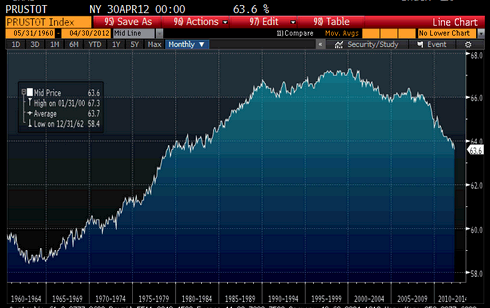
  • Unemployment rate falls to new cycle low of 8.1% (already close to Fed’s year-end forecast of 7.8-8.0%) though due to drop in Participation Rate from 63.8% to 63.6%.
  • A lot of volatility in the job data, making it difficult to divine the broader trend:

    • Manufacturing employment growth slows from 41k to 16k (vs rise in ISM employment component)
    • Leisure/Hospitality slows from 52k to 12k
    • Retail rises from -21k to +29k
    • Temp help rises from -9k to +21k
  • Income equation on the weak side as no growth in average hourly earnings and index of aggregate hours up just 0.1%
  • Diffusion index slows from 64.7 to 56.8, but still well within expansion zone.
  • Median duration of unemployment falls from 19.9 weeks to 19.4 weeks, a new cycle low.

Conclusion

  • The Fed would most certainly have liked to see better headline job growth, but I don’t think this report is enough to push them into additional easing for the following reasons:
    • Data is volatile and the net revisions were significant
    • Unemployment rate continues to fall
    • Inflation right at target
    • Financial conditions (equities and credit spreads) remain loose.
    • Structural issues continue to wane

Agreed on the conclusion. It will take a lot to get the Fed to do any more QE. Not the least reason being most of them know it doesn’t actually do anything apart from getting a lot of people scared and angry, including our esteemed politicians, for example, ready to make a propaganda show out of what they like to call ‘money printing.’

Of more concern, Bill Mitchell mentioned the drop in public sector employment may be dragging us down to negative growth. He may be right, as those paychecks are probably very ‘high multiple’ and require larger federal deficits to make up for the lost aggregate demand.

Actual multiples- propensities to spend out of income- are variable and hard to get a handle on, and therefore generally must be ‘reacted to’ with fiscal adjustments.

Unfortunately, however, all political forces are currently aligned towards deficit reduction.

And note the labor force participation rate is heading back to about where it was before women entered the labor force.
Euro zone news headlines

Typical day for euro zone news.
Slow motion train wreck continues.

Headlines:

EU Finance Ministers to Face Off Over Rules to Implement Basel Ill Standards
France’s Hollande Says He Hasn’t Had Parallel Talks With Merkel
Weidmann Says Reforms Are Best Basis for Growth, Zeit Reports
European Unemployment Rate Rises to Highest in Almost 15 Years
Euro-Region Manufacturing Contracts for a Ninth Month
German Unemployment Unexpectedly Rose in April Amid Crisis
Spain Can Finance Itself, Even If Expensive, Fekter Says

Public employment comparison across administrations

American Austerity

By Paul Krugman

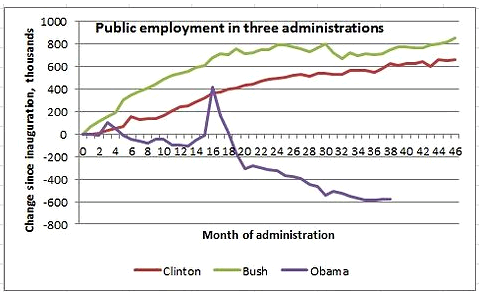
May 1 (NYT) — With all the focus on Europe’s sudden discovery that austerity doesn’t work, we shouldn’t lose sight of just how much de facto austerity we’ve done on this side of the Atlantic. Here’s a comparison of changes in government employment (federal, state, and local) during the first four years of three presidents who came to office amid a troubled economy:

That spike early on is Census hiring; once that was past, the Obama years shaped up as an era of huge cuts in public employment compared with previous experience. If public employment had grown the way it did under Bush, we’d have 1.3 million more government workers, and probably an unemployment rate of 7 percent or less.

Claims/Trade Data


Karim writes:

Claims:
Initial claims was unambiguously weak, rising to 380k, the highest level since January. The prior week was also revised higher, from 357k to 367k.

The labor department cited no special factors despite it being Easter week; the USVI was the only locale where claims were estimated for the holiday.

Trade Balance:
The trade deficit fell to its lowest level since October, largely due to an 18% drop in imports from China (Lunar New Year effect) and a drop in oil imports.

The data may push Q1 GDP estimates to as high as 3% but that should not be confused with a pick-up in the underlying strength of the economy.

The stalling out in the claims data last month did a good job of predicting the slowdown in payrolls. Today’s data throws further job market improvement into greater question.

Employers Added 120,000 Jobs in March, Fewest in Five Months

Looking for a very bad opening and subsequent sell off in Asia and especially the euro zone as hopes of exports to the US fade leaving them no escape from their deteriorating domestic demand.

This is now the beginning of the endgame for the Euro zone, as they discover the firewall is another Maginot line that markets go through like a knife through butter.

Employers Added 120,000 Jobs in March

By Timothy R. Homan

April 6 (Bloomberg) — Hiring by American employers trailed forecasts in March, casting doubt on the vigor of the more than two-year-old economic expansion.

The 120,000 increase in payrolls reported by the Labor Department in Washington today was the smallest in five months and less than the most pessimistic estimate in a Bloomberg News survey of economists. The unemployment rate fell to 8.2 percent from 8.3 percent as people left the labor force.

Stock futures, the dollar and Treasury yields all fell as the report highlighted Federal Reserve Chairman Ben S. Bernanke’s concern that stronger economic growth is needed to keep the nation’s jobs engine humming. Today’s data also showed that Americans worked fewer hours and earned less on average per week, boding ill for the consumer spending that makes up 70 percent of the world’s largest economy.

“We see a lack of sustainability in terms of strong job growth,” Tony Crescenzi, a strategist at Pacific Investment Management Co. in Newport Beach, California, said in a radio interview on “Bloomberg Surveillance” with Tom Keene and Ken Prewitt. “This is still not strong enough to create escape velocity, which is to say an economy strong enough to make it on its own without additional monetary stimulus from the Federal Reserve.”

Among those having trouble finding work is Xander Piper, 30, who has been looking for a full-time job since September, when he completed a master’s program in social science at the University of Chicago. He decided to go to graduate school in 2010 to improve his employment prospects after losing his position at an advertising agency.

Expected Work Sooner
“When I graduated, I assumed I was going to get a job within the first couple of months,” said Piper, a San Francisco resident who said he’s looking for work in education and sometimes sends out 10 resumes a day.

“Now I work for a temp company, but even they’re having trouble staffing me,” he said. “I recently had a two to three month break at my temp company. What I have gotten recently is call center work, which is just brutal.”

A separate report today from the Fed showed consumer borrowing rose less than forecast in February, restrained by a drop in credit-card debt. Credit increased $8.7 billion, the least in four months, after an $18.6 billion gain in January.

Employment Forecasts
Employment in March was forecast to increase by 205,000, according to the median projection of 80 economists in the Bloomberg survey. Estimates ranged from increases of 175,000 to 250,000 after an initially estimated 227,000 gain the prior month.

S&P 500 futures expiring in June slumped 1.1 percent to 1,374.90 following the benchmark index’s 0.7 percent weekly loss. U.S. stock exchanges were shut for the Good Friday holiday. The dollar weakened 1 percent to 81.57 yen at 12:14 p.m. in New York, touching the lowest level since March 8. The yield on the benchmark 10-year Treasury note fell to 2.06 percent from 2.18 percent.

“We see modest growth inside the U.S. and demand for labor,” Carl Camden, president and chief executive officer of Kelly Services Inc. (KELYA) (KELYA), a Troy, Michigan-based staffing agency, said March 12 during a conference. The expansion is “a nice steady, not robust, not rock-and-roll, but a steady recovery, capable of producing a steady stream of jobs.”

Temporary Hiring
Employment at service providers increased 89,000 after a 211,000 gain in February. Professional and business service payrolls rose 31,000 last month, restrained by a 7,500 drop in temporary hiring.

J.C. Penney Co., the fourth-largest U.S. department-store company, is among employers cutting jobs. The company said today it notified about 1,000 workers, primarily in its headquarters in Plano, Texas, and its Pittsburgh customer call center, that their jobs will be cut as part of a restructuring plan.

Part of the slowdown in March may have reflected a warmer winter, which prompted some employers to hire more or retain workers in previous months than they otherwise would have, Paul Ashworth, chief U.S. economist at Capital Economics Ltd., said in an e-mail to clients. The average gain in payrolls from December through February was 246,000.

“We had mild weather, which basically had consumers in the marketplace earlier,” said Jack Kleinhenz, chief economist of the National Retail Federation, a Washington-based trade group. As a result, retailers postponed headcount reductions that typically follow the holiday shopping season, he said.

Retailers Cut Back
The March data showed a 34,000 decrease in retail employment, the biggest decline since October 2009. The Labor Department said today that the number of people unable to work due to inclement weather was 360,000 below average from December through February.

Temperatures in December through February averaged 36.8 degrees Fahrenheit (2.7 degrees Celsius), 3.9 degrees above the average in the 20th century, representing the fourth-warmest winter on record for the 48 contiguous U.S. states, according to the National Oceanic and Atmospheric Administration.

Some economists saw similarities with early 2011, when the economy slowed amid rising energy prices, a disruption of supplies caused by the tsunami in Japan and political gridlock in the U.S. over the debt ceiling.

This year, rising gasoline prices and the European debt crisis are taking a toll, said Mark Zandi, chief economist at Moody’s Analytics Inc. in West Chester, Pennsylvania.

output gap still wide…

Willing To Work, Not Looking

By Sean Higgens

(Investor’s Business Daily)

A Record 2.81 Million Including this group, jobless rate is 9.9% vs. the official 8.3% figure

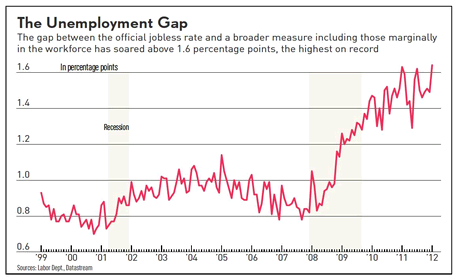
The official unemployment rate has improved, but the number of jobless Americans at the fringe of the workforce has never been greater. The gap between headline and alternative joblessness is the highest on record, according to an IBD analysis of Labor Department data.

The jobless rate is 8.3%, still high but down from 9.1% last August and 9.9% in April 2010. But many don’t think that gives an accurate picture. The official number excludes a record 2.81 million discouraged or other “marginally attached” people out of work that aren’t currently looking but are willing and able.

Factoring these people in, unemployment is a much higher 9.9%, 1.6 percentage points above the official rate. That’s the widest gap on record going back to 1994. It never rose above 1.1 points during the Bush administration.

That means the official rate has been falling in part because an unprecedented number of people are taking a break from searching for work.

“The labor market has weakened so much you’ve just had more and more people falling into that group,” said Heidi Shierholz, labor market economist with the liberal Economic Policy Institute.

Some lawmakers say it is time that the government started paying more attention to them.

Rep. Duncan Hunter, R-Calif., plans to introduce a bill soon that would force the Labor Department to include the marginally attached in the official number.

“Guys like me want a way to know what the unemployment rate really is. It is that simple. The unemployment rate is not really the 8.3% figure,” Hunter, a member of the Education and Workforce Committee, told IBD.

Labor already tracks at least half a dozen variations in the jobless rate publicly released each month.

‘Marginal’ Workers Left Out

The official rate is called the “U-3” number. The one including the marginally attached is the “U-5.” That one also includes: “discouraged workers, plus all other persons marginally attached to the labor force.”

The “marginally attached” are defined as those that want to work and have sought employment within the prior year but are not currently looking.

Hunter’s bill would just make U-5 the official number. “I don’t think most people even know there is an alternate way of calculating unemployment,” he said.

Economists of all stripes agree that it is arbitrary for U-3 to be the official rate. A sound case could be made for any of the others, though most argued that no one figure should be spotlighted.

GOP lawmakers may have political motives to cast President Obama’s economic record in the worst possible light.

But Wayne Vroman, senior fellow at the Urban Institute, notes that the idea of changing the statistic to the U-5 number has a bipartisan pedigree.

“A lot of advocates from the left side of the political spectrum also would want to give (the higher statistic) more prominence because it shows distress among a group that doesn’t get as much attention,” Vroman said.

Surprisingly little is known about the marginally attached. With less than two decades of data, few economists can say much except that the group is very diverse, with many reasons as to why they drop out. Some may have other means or a working spouse, or are retiring early.

Many have quit looking after months or years out of work. Average duration of unemployment was 40.1 weeks in January, just below November’s record 40.9 weeks.

The labor force participation rate has fallen to multi-decade lows even as hiring has slowly improved in recent months.

That may reflect baby-boomer retirements in part, says James Sherk, a labor economist with the conservative Heritage Foundation. But even taking that into account, “the labor force participation rate has fallen even more than you would expect.”

oil

Greece

Comes back to the idea that resolving solvency issues in the euro zone doesn’t fix the economy.

And with negative growth the solvency math doesn’t work for any of the euro members.

And what’s with the ECB threatening to back away on liquidity support for the banking system?

So looks to me like the Greek resolution is not the end of the solvency issues, but that the focus simply moves on to the next weaker sister.

And, as previously discussed, the risk remains elevated that if Greece gets to haircut its obligations and gets funding, others will ask for the same, triggering a general, global, catastrophic financial meltdown.

My first order proposal remains an ECB distribution on a per capita basis to the euro member nations of maybe 10% of euro zone GDP per year to put the solvency issue behind them. Along with relaxed budget rules, maybe allowing deficits up to 6% of GDP annually, further supported by the ECB funding a transition job at a non disruptive wage to facilitate the transition from unemployment to private sector employment. I might also recommend deficits be increased by suspending VAT as a way to increase aggregate demand and lower prices at the same time.

Alternatively, the ECB could simply guarantee all national govt debt and rely on the growth and stability pact for fiscal discipline, which would probably require enhanced authorities.

And rather than trying to bring Greece’s deficit down to current target levels, they could instead relax the growth and stability pact limits to something closer to full employment levels. And, again, I’d look into suspending VAT to both increase aggregate demand and lower prices.

Meanwhile, elsewhere in today’s world news:

The likes of Ford adding to pension funds makes the point of the increasing and ongoing demand leakages putting a damper on GDP.

And oil prices have now crept up enough to materially cut into aggregate demand as well.

Nor are banks adding to capital to meet expanding demand for credit, which remains anemic.

Headlines:

Data Suggests Euro Zone May Slide Back Into Recession
German Manufacturing Slows as New Export Orders Fall
China’s Factory Activity Shrinks for Fourth Month
ECB Preparing to Close Liquidity Floodgates
Ford Pours $3.8 Billion Into Pension Plan
Oil Could Turn to Headwind as Dow Flirts With 13,000
UBS to Issue More Loss-Absorbing Capital
Iran ‘Winning’ on Oil Sanctions: Top Trader
Greek Bailout Puts Focus Back on Credit Default Swaps
Iran Fuels Oil-Price Rally—And Prices Could Keep Rising

Overlooked in last week’s employment report


Karim writes:

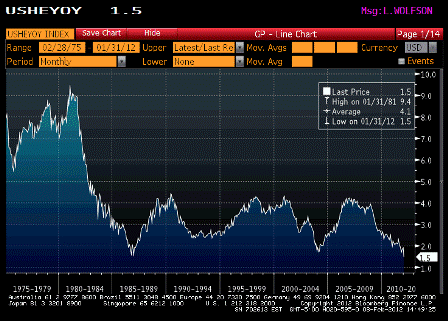
Average hourly earnings reached a new all-time low on a y/y basis of 1.5%.
One of the strongest historical arguments as to why deflation is unlikely is downward nominal wage rigidity.
i.e., its easier to negotiate wage growth from say 4% to 3%, then 1% to 0%, or certainly a wage cut.
But, high unemployment and high duration of unemployment will test that theory.
A move much lower from here will stoke the fears of those Fed members worried about deflation.
Of course the flip side is that this is quite likely a positive for corporate profits.

participation

Greek options

There is probably not much voter support for returning to the drachma.

The voters would probably rather have the Germans run their finances than their own leaders.

They’ve seen past drachma financial dramas, with interest rates spiking for everyone, not just the govt, rampant inflation, and a collapsing currency as well as high unemployment.

With the euro none of that happened, so it’s not obvious the currency is the problem.

What does seem obvious to them is that their leaders are the problem.

So I expect the austerity measures to pass, as the alternative is 0 deficit spending.

And if discounts are ‘granted’ the politics quickly move towards same for the rest of the euro member nations.