
Ryan the next Bachmann?

There’s a reason the hardcore budget balancer/deficit hawk does not last long under the microscope. Their numbers can’t add up, which leaves them with contradictory statements.

Why can’t they add up? The dollar is a ‘closed system’, what’s called a case of ‘inside money’ due to the fact that they all come from govt and/or its designated agents (apart from counterfeits).

This means the dollars in our pension funds, IRA’s, corporate reserves, cash in circulation, foreign central bank reserves, etc. all come from someone else spending more than his income.

Yes, the rest of the private sector can and does often spend a bit more than it’s income to supply those ‘saver’s dollars’ but most of it comes from the $15 trillion or so the US govt has spent in excess of its tax collections. That’s called federal deficit spending.

In fact, the US govt debt is equal to the net dollar denominated ‘savings’ of all the other sectors combined. To the penny. It can’t come from anywhere else.

That means any plan to balance the federal budget is also a plan that doesn’t allow global dollar savings to grow. This means the ‘automatic savings’ like dollars going into and compounding in pension funds, IRA’s, corporate reserves, cash in circulation, and foreign central bank reserves, etc. either can’t happen or are ‘supplied’ by equal private sector debt increases.

So a plan to reduce the deficit $10 trillion from current forecasts is also a plan that either causes private sector debt to increase by that much and/or causes pensions, IRA’s, corporate reserves, cash in circulation, and foreign central bank reserves to decrease by that much.

None of which is consistent with a growing economy, to say the least.

This means, any plan for long term deficit reduction that includes relatively high rates of growth is what can be called a financial optical illusion, that doesn’t hold up on close examination.

And that’s why all the budget balancers ultimately fail. Yes, their headline rhetoric can be casually convincing and even win local elections. But under serious scrutiny, it all falls apart.

But maybe this time it’s different.
:(
Paul Davidson on Paul Ryan’s economic knowledge in NY Times in 2009

>   
>   (email exchange)
>   
>   On Sat, Aug 11, 2012 at 1:32 PM, Paul wrote:
>   
>   In an op-ed ”Thirty Years Later, a Return to Stagflation” (Op-Ed, Feb. 14), Representative
>   Paul D. Ryan, Republican of Wisconsin, argued that the stimulus plan will bring the
>   combination of high inflation and high unemployment known as stagflation.
>   
>   Here is a copy of my February 22, 2009 published letter to the Editor of the New York
>   Times evaluating Paul Ryan’s economics.
>   

LETTERS; Can We Spend Our Way to Recovery?

February 22, 2009 (NYT)

To the Editor:

Paul D. Ryan repeats the tired idea that when the Federal Reserve prints money for the government to spend on economic recovery, the result will be inflation because ”it is a situation in which too few goods are being chased by too much money.” This is based on a false assumption that the output of the country will not increase when government lets contracts to businesses to produce more goods and services that will improve the productivity and health of our country.

If there is significant unemployment and idle capacity in the private sector (and who can deny that there is?), then this deficit spending will not cause inflation. Rather, the ”printed” money spent on a recovery plan creates profit opportunities that induce private enterprise to hire and produce more goods. Then there will be many more goods available for this money to chase and no inflation need occur.

Paul Davidson
Boynton Beach, Fla., Feb. 14, 2009

The writer is editor of The Journal of Post Keynesian Economics.

Bernanke on deficits

>   
>   (email exchange)
>   
>   On Wed, Jul 18, 2012 at 10:39 AM, wrote:
>   
>   Bernanke just said, “We will simply not be able to pay our bills” if we don’t attack the
>   long-run fiscal sustainability issue.
>   

Yes, hasn’t change a bit from from these statements earlier this year:

Bernanke Points to ‘Increased Possibility of a Sudden Fiscal Crisis’

By Matt Cover

(CNSNews.com) — Federal Reserve Chairman Ben Bernanke said that the current trajectory of the federal budget – marked by large annual deficits – was “clearly unsustainable” and that “serious economic consequences” could result.

“Having a large and increasing level of government debt relative to national income runs the risk of serious economic consequences,” Bernanke told the Senate Budget Committee Tuesday.

“Even the prospect of unsustainable deficits has costs, including an increased possibility of a sudden fiscal crisis. As we have seen in a number of countries recently, interest rates can soar quickly if investors lose confidence in the ability of a government to manage its fiscal policy.”

Bernanke said that while nobody knows when a fiscal crisis will come, it is surely “ever closer.”

The certainty of debt and taxes- comments on the Fiscal Cliff

It takes a fiat currency to sustain full employment.

And a fiat currency, like the $US and the euro, includes the certainty of debt and taxes.

Taxation is required to allow the government to spend its otherwise worthless currency.

And ‘debt’- some entity spending more than its income- is required to ‘offset’ an entity’s desire to spend less than its income.

These desires to not spend are known as demand leakages.

That means, at full employment, either a private sector entity or the government will be spending more than its income to offset the demand leakages.

Private sector spending is, operationally, revenue constrained. It is limited by income and credit worthiness.

Public sector spending in a currency it issues is not revenue constrained.

The private sector, the user of the currency, must first obtain funds before it can spend.

The public sector, the issuer of its currency, must, from inception, spend or lend first, before it can ‘collect’ taxes and/or borrow.

The private sector is necessarily pro cyclical. In a down turn, the private sector loses credit worthiness and therefore is limited in its ability to spend more than its income.

That leaves only the public sector to spend more than its income to fill any residual output gap and sustain full employment.

Those claiming ‘the problem is too much debt- private sector and public sector’ are entirely missing the point.

That includes everyone in Congress, President Obama, and Candidate Romney.

Those now pushing for Federal deficit reduction are entirely missing the point.

There is not Federal solvency problem, short term or long term, with any size deficit.

There could be a long term inflation problem.

However, I have seen no credible, professional long term forecasts of substantial inflation. That includes the Fed, the CBO, and the forecasts of the largest financial institutions, as well as the inflation rates implied by the long term inflation indexed US Treasury securities.

Last year the pre debt ceiling war cry from all sides was that immediate deficit reduction was imperative to keep us from becoming the next Greece.

That fell by the wayside after the downgrade, that was supposed to cause interest rates to spike and find the US, Greek like, on its knees before the IMF,
instead cause rates paid by the US Treasury to dramatically fall. The difference is the US govt is the issuer of the $US, while Greece is but a user of the euro.

So seems to me in this economy federal deficit reduction should be off the table, and the burden of proof of a sufficiently high long term inflation risk
be on those who want to put it back on the table. Anything less seems subversive, either by accident or by design.

(feel free to distribute)

EU update

More possible hints that deficits may be large enough to support stability

A little better than expected:

Euro-Area Manufacturing Contracted for 11th Month in June

By Mark Deen

July 2 (Bloomberg) — Euro-area manufacturing output contracted for an 11th straight month in June as Europe’s debt crisis sapped demand across the continent.

A gauge of euro-region manufacturing held at 45.1 in May, London-based Markit Economics said today in a final estimate. That compares with an initial estimate of 44.8 on June 21. A reading below 50 indicates contraction.

A little better than expected:

Italian May Unemployment Rate Declines for First Time in a Year

By Chiara Vasarri

July 2 (Bloomberg) — Italy’s jobless rate unexpectedly fell from a 12-year high in May, the first decline in more than a year.

The unemployment rate decreased to a seasonally-adjusted 10.1 percent, from 10.2 percent in April, Rome-based national statistics office Istat said in a preliminary report today. It was the first decline in the jobless rate since February of last year. Economists forecast an increase to 10.3 percent, the median of eight estimates in a Bloomberg News survey showed.

Joblessness among people aged 15 to 24 rose to 36.2 percent, from 35.3 percent, Istat said.

Better than expected improvement here:

U.K. CIPS Manufacturing Shrank for Second Month in June

By Jennifer Ryan

July 2 (Bloomberg) — U.K. manufacturing shrank for a second month in June as demand “remained weak,” Markit Economics said.

A gauge of factory output was at 48.6 from 45.9 in May, Markit said on its website today. The median estimate in a Bloomberg News survey of 25 economists was 46.5. A reading below 50 indicates contraction.

Some ok Swiss news as well.

Also, sufficient progress at the EU level to give the ECB cover to write checks as needed to get from here to any of the prospective EU measures.

This includes taking forever to get from here to there.

They all seem to understand that the ECB is at least one answer to the solvency issue, and seem to be willing to allow the ECB to provide bank liquidity while they try to finalize an alternative solution. Indirectly that means, at least for now, the member governments will be able to make their payments for the immediate future.

So as previously discussed, they solved the solvency issue, and markets have responded, which leaves them with a bad economy to focus on.

With deficits now perhaps large enough for stability, and maybe a bit of modest GDP growth, I’d at best expect a ‘wait and see’ attitude from an EU that has found it highly problematic to act even in an emergency.

Italian Business Confidence Unexpectedly Rises to 88.9 in June

Another glimmer of hope in a June number that deficits are sufficient for stability:

Italian Business Confidence Unexpectedly Rises to 88.9 in June

June 27 (Bloomberg) — Italian business confidence unexpectedly rose in June from the lowest level in almost three years. The manufacturing-sentiment index rose to 88.9, from a revised 86.6 in May, the lowest since August 2009, Istat said. Istat originally reported a May reading of 86.2.

Demand leakages- the 800lb economist in the room

I can’t say I’ve seen anyone in the deficit debates talking about the demand leakages? Not a mention in the mainstream press, financial news media, or any of the thousands of economic reports?

That’s like discussing the right horsepower for a truck or an airplane without any consideration of the weight of the vehicle.

Demand leakages are unspent income. And if any agent doesn’t spend his income, some other agent has to spend more than his income or that much output doesn’t get sold.

And if the non govt sectors collectively don’t spend all of their income, it’s up to the govt to make sure its income is less than its spending, or that much output does’t get sold, which translates into what’s commonly called the ‘output gap’. Which is largely a sanitized way of saying unemployment.

And with the private sector necessarily pro cyclical, the (whopping) private sector spending gap in this economy can only be filled with by govt via either a (whopping) tax cut and/or spending increase, depending on your politics.

So why the ‘demand leakages’? The lion’s share is due to tax advantages for not spending your income, including pension contributions, IRA’s, and all kinds of corporate reserves. Then there’s foreign hoards accumulated to support foreign exporters. And it all should be a very good thing- net unspent income like that means that for a given size govt our taxes can be that much lower. Personally, I’d rather have a tax cut than a policy to get other people to spend their unspent income. But that’s just me…

And then there’s the fear mongering about the likes of the $200 trillion present value of US govt unfunded liabilities. But 0 mention of the present value of all demand leakages- that future income that will be unspent as it’s squirreled away in the likes of retirement plans, corporate reserves, and foreign central banks.

If history is any guide, the demand leakages will probably continue to outstrip even the so called ‘runaway spending of our irresponsible government,’ like they’ve always done in the past, as evidenced by nearly continuous output gaps/excess unemployment.

Worse, every mainstream economist learned that it’s the demand leakages that create the ‘need’ for govt deficits. But somehow fail to even mention it, even casually.

If anything, they voice no objections to the popular misconception that we need more savings to have funds for investment, thereby tacitly supporting the call for higher levels of demand leaks and the need for even higher levels of govt deficit spending.

And all you hear are calls for deficit reduction, both public and private, all in the face of geometrically expanding demand leakages.

Am I missing something?

Romney’s fiscal message

And all evidence shows President Obama agrees.

FISCAL RESPONSIBILITY

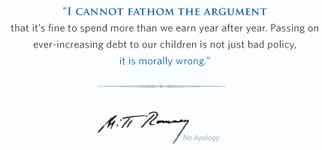
The mission to restore America begins with getting our fiscal house in order. President Obama has put our nation on an unsustainable course. Spending is out of control. Yearly deficits are massive. And unless we curb Washington’s appetite for spending, the national debt will grow to the size of our entire economy this year.

As President, Mitt Romney will cut federal spending and bring much-needed reforms to entitlement programs. Mitt will work toward balancing the budget, reducing the size and reach of the federal government, and returning power to states and the people.


Policy

Exercise fiscal responsibility to restore economic opportunity.
Washington is addicted to deficit spending. As President, Mitt Romney will cut spending to finally move our nation toward a balanced budget.

During the Bush years, the nation’s deficit—the gap between what Washington collects and spends each year—hovered between 2 percent and 4 percent of GDP. These levels were already problematic and a cause for concern. During the Obama administration, however, the deficit exploded to 10 percent of GDP.

One major problem with sky-high deficit spending is that it necessarily leads to another practice that undermines the nation’s fiscal foundation: borrowing unhealthy sums to pay for what we already cannot afford. America is on an unsustainable path that, within just a few short years, will cripple the economy and foreclose any opportunity for recovery.

Mitt Romney will bring fiscal restraint to Washington by placing a hard cap on federal spending to force our government to live within its means and put an end to deficit spending.

Mitt will also curb federal spending by repealing Obamacare, the federal takeover of health care that is scheduled to cost taxpayers one trillion dollars over the next ten years. He will also focus on eliminating wasteful government spending and right-sizing the federal government to save taxpayer dollars.

Mitt Romney’s goal is to put the federal government on a course toward a balanced budget and true fiscal responsibility.

Reform entitlement programs to keep them solvent and put America on a path to prosperity.
Federal spending on entitlement programs like Medicaid, Medicare, and Social Security has not only spiraled out of control, but has placed their very solvency in danger. Unfortunately, President Obama has failed in his fundamental responsibility to articulate a serious vision and plan for the future of these programs. At present, the total cost of U.S. entitlement programs accounts for more than half of all federal spending. Combined with interest payments on the national debt, so-called “mandatory” spending is over 60 percent of all federal spending.

Many of our fellow citizens have no idea that our growing entitlement spending has created a looming crisis. This is because politicians have a habit of hiding our country’s long-term liabilities. Mitt Romney believes that the federal government should publish a balance sheet each year—just as it requires public companies to do—so that Americans can understand the burden that future entitlement spending will place on our budget and economy. Over the course of his campaign, Mitt will propose the specific steps he will take as President to ensure the long-term solvency of Medicare and Social Security. While reforms are needed, Mitt also believes that these changes should not reduce benefits for current seniors or break the promises they have relied upon for their economic security in retirement.

Mitt knows that our economic future—along with the future of entitlement programs—depends on fundamental reform. If we wisely begin to reform entitlements and commit to live within our means, we can bestow on the next generation an America that is stronger and even more prosperous than the one we know today.