2009-05-13 USER


[Skip to the end]

Karim writes:

Falling wage and salary income and rising savings rate continuing to take a toll on consumer spending.

Recent pick-up in gas prices also likely hurting discretionary spending.

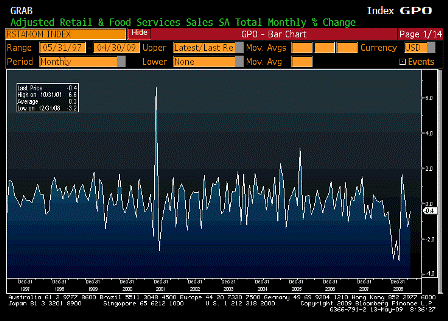
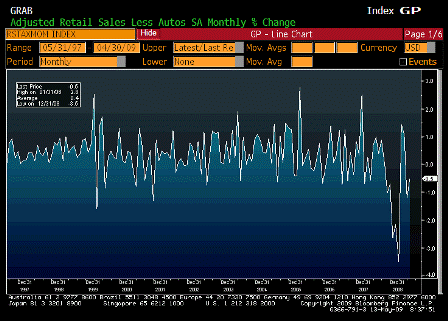
  • April retail sales -0.4% and -0.5% ex-autos (expectations +0.2%)
  • March ex-autos revised from -0.9% to -1.2%
  • April, Ex-gas, -0.2%
  • April, Control group (feeds into PCE component of GDP), -0.3%
  • Need a very sharp rebound in May/June to prevent Q2 PCE from being negative due to combined March/April weakness.
  • Downside risks to Q2 GDP now as low as -5%

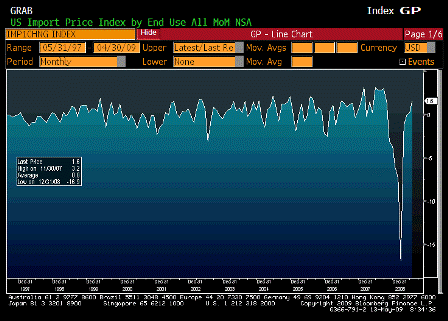
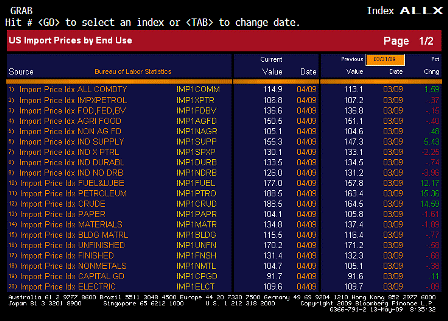
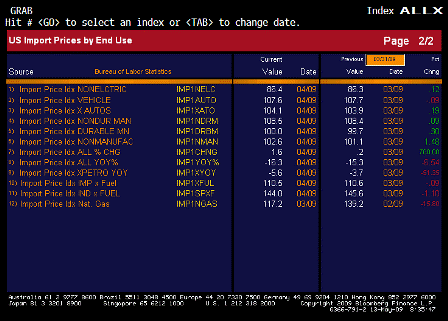
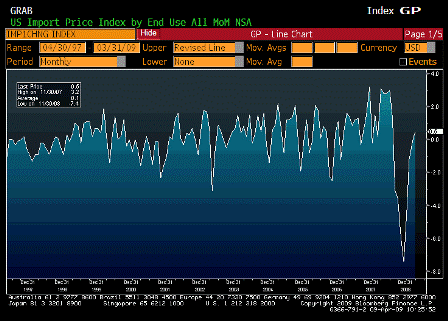
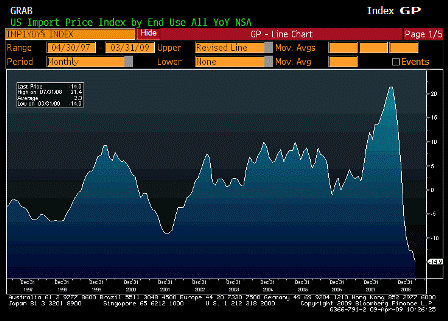
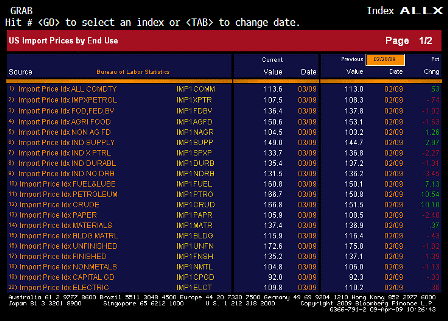
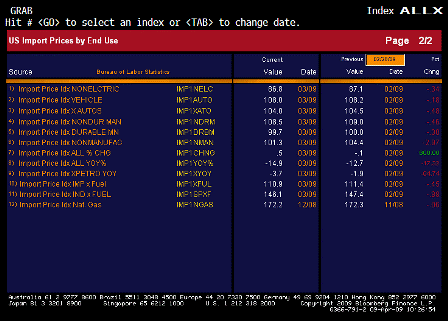
Import prices up 1.6%, -0.4% ex-petroleum and -0.5% from China


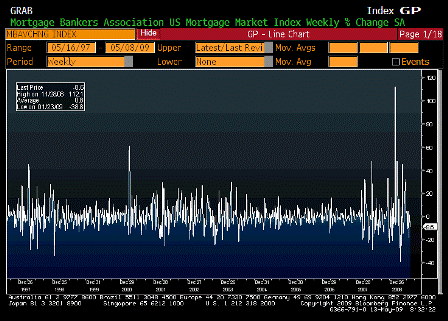
MBA Mortgage Applications (May 8)

Survey n/a
Actual -8.6%
Prior 2.0%
Revised n/a

[top][end]

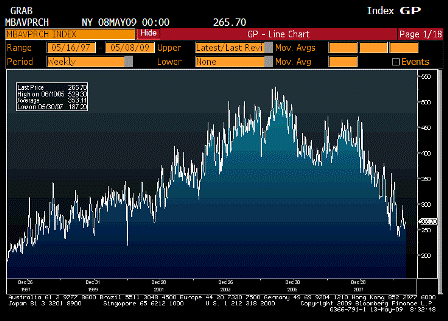
MBA Purchasing Applications (May 8)

Survey n/a
Actual 265.70
Prior 264.30
Revised n/a

[top][end]

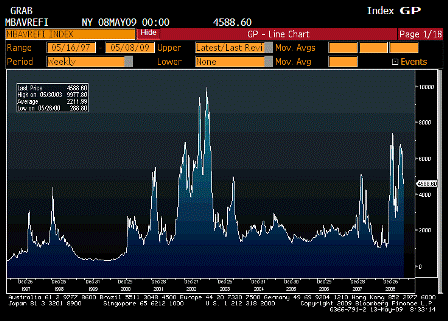
MBA Refinancing Applications (May 8)

Survey n/a
Actual 4588.60
Prior 5169.30
Revised n/a

[top][end]


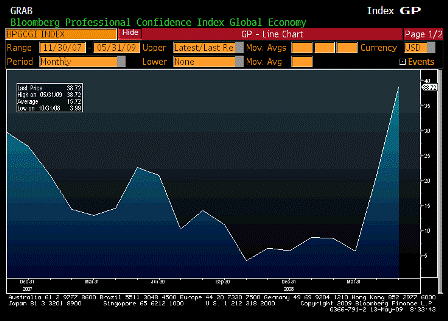
Bloomberg Global Confidence (May)

Survey n/a
Actual 38.72
Prior 21.20
Revised n/a

[top][end]


Import Price Index MoM (Apr)

Survey 0.6%
Actual 1.6%
Prior 0.5%
Revised 0.2%

[top][end]

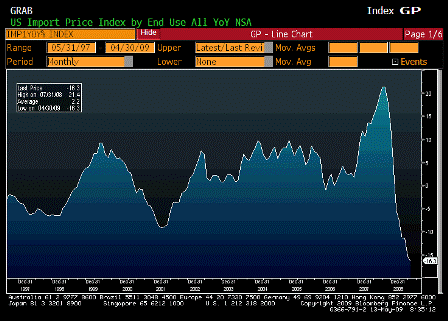
Import Price Index YoY (Apr)

Survey -16.8%
Actual -16.3%
Prior -14.9%
Revised -15.3%

[top][end]

Import Price Index ALLX 1 (Apr)

[top][end]

Import Price Index ALLX 2 (Apr)

[top][end]


Advance Retail Sales MoM (Apr)

Survey 0.0%
Actual -0.4%
Prior -1.1%
Revised -1.3%

[top][end]

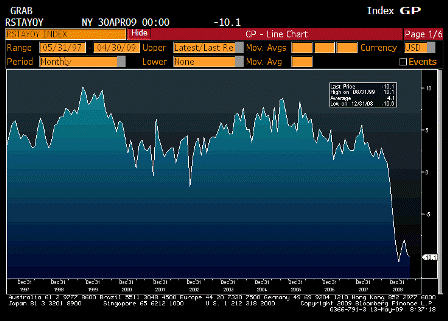
Advance Retail Sales YoY (Apr)

Survey n/a
Actual -10.1%
Prior -9.6%
Revised n/a

[top][end]

Retail Sales Less Autos (Apr)

Survey 0.2%
Actual -0.5%
Prior -0.9%
Revised -1.2%

[top][end]


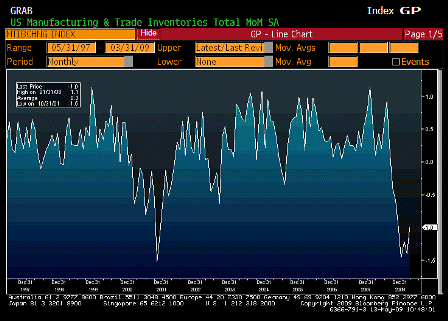
Business Inventories MoM (Mar)

Survey -1.1%
Actual -1.0%
Prior -1.3%
Revised -1.4%

[top][end]

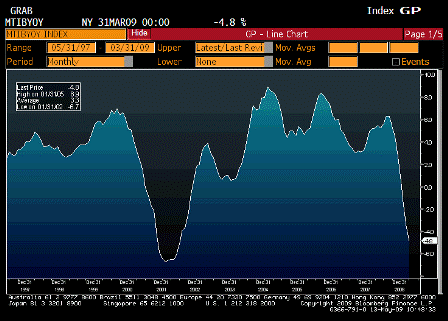
Business Inventories YoY (Mar)

Survey n/a
Actual -4.8%
Prior -3.6%
Revised n/a


[top]

China’s Reserve Strategy


[Skip to the end]

(email exchange)

>   
>   On Tue, May 12, 2009 at 11:22 AM, J A Kregel wrote:
>   
>   And you can add to this the undeclared policy (confirmed to me last week) that
>   Chinese reserve diversification to hedge dollar exposure will be primarily in
>   stockpiling natural resources, not currency diversification
>   


[top]

Chrysler related comments


[Skip to the end]

The point remains that the job of the executive branch is to enforce the laws as enacted by Congress.

This is not a time of war, Chrysler is not a national security or strategic issue, nor is the US automobile industry.

In fact, Chrysler was already largely a foreign entity, and even GM is now probably larger overseas than in the US, and the national origin of its shareholders are of no consequence.

This has turned into a simple, unwarranted, unnecessary, and counterproductive show of force between the President and a few lesser Wall St. players.

In the absence of supporting law, the administration, driven by anger, instead used all its bully powers to avoid a Chrysler bankruptcy (for reasons not yet fully disclosed) and, in this instance, lost that (minor?) battle.

The separation of power between executive, legislative, and judicial branches and the rule of law bent but did not yet break.

This is what happens with a President who doesn’t understand the monetary system, and doesn’t understand the US has unlimited ‘financial resources’ to sustain full employment and social equity with or without Chrysler or any other private employer.

Instead, the President sees an inevitable rise in unemployment and the risk of systemic failure should the automobile industry ‘rescue’ fail.

Just as:

  • The errant belief that we need China and others to be able to deficit spend is driving foreign policy ‘concessions.’
  • The errant belief that we can’t ‘go it alone’ with fiscal policy is squandering a golden opportunity to enhance our standard of living.
  • The errant belief that we are economically better off with a balanced federal budget is risking the sustainability of our domestic economy.
  • The errant belief that bank lending is a prerequisite to economic well being is shifting wealth upward away from lower income working people.
  • The errant belief that ‘monetary policy’ can support GDP delays and limits fiscal response.
  • The errant belief that exports are more desirable than domestic consumption depresses our standard of living.
  • The failure to understand the difference between the purchase of financial assets and the purchase of real goods and services continues to prolong our massive output gap and the unrecoverable real losses of high unemployment.
  • All of this can be traced to a world wide failure to recognize the fundamental difference between the gold based monetary systems of the past and today’s non convertible currency regimes.

The Lenders Obama Decided to Blame

by Zachary Kouwe

May 1 (NYT)


[top]

China allowing state enterprise to invest in Taiwan


[Skip to the end]

Cheaper to buy Taiwan than to invade?

China Makes First Taiwan Investment as Relations Thaw

by Tim Culpan and Janet Ong

Apr 30 (Bloomberg) — China Mobile Ltd. agreed to buy 12 percent of Far EasTone Telecommunications Co., the first investment by a Chinese state-owned company in Taiwan since a civil war ended six decades ago.

Taiwan’s benchmark Taiex index surged 5.7 percent, the biggest gain since Oct. 30, today on speculation more Chinese companies will invest on the island. The NT$17.8 billion ($529 million) purchase, announced by China Mobile yesterday, underscores how warming political relations between the two sides are leading to closer economic ties.

“This is a landmark deal. China Mobile will lead the way for other Chinese companies that have been waiting to invest in Taiwan but were hesitating,” said C.Y. Huang, vice chairman of Polaris Securities in Taipei. “This will open the floodgates for more Chinese investments into Taiwan.”

The Chinese government said this week it would end a ban on investments in the island on May 1 following an agreement to open cross-border operations for financial-services companies, expand direct flights and cooperate in fighting crime.

China Mobile agreed to pay NT$40 a share, or 14 percent higher than Far EasTone’s closing price yesterday, for the stake in Taiwan’s third-largest phone company. China Mobile will get a seat on the Taipei-based company’s board and become its second- largest shareholder, Far EasTone spokeswoman Alison Kao said. The deal is subject to approval from regulators and shareholders.


[top]

Back from a week off


[Skip to the end]

Been away for a week.

First impressions:

Seems world fiscal responses both automatic and more recently proactive have turned the tide.

Looking for a quick return to positive GDP (from very depressed levels) helped by very low inventories in general.

But relatively slow returns to ‘normal’ in many sectors as well.

And central banks doing a lot of foot dragging regarding rate hikes due to large continuing output gaps (high unemployment).

The eurozone lags as it’s passed on proactive fiscal measures and instead is waiting for exports to pick up, and makes these kinds of counterproductive noises:

“The European Union (EU) has officially opened the excessive deficit procedure against Ireland, Greece, Spain and France since their budget deficits shot up beyond the EU’s limit amid the financial crisis.

The decisions, which were taken by EU foreign ministers in Luxembourg on Monday, required the four countries, as well as Britain, which had been under the excessive deficit procedure, to take corrective actions to rein in their deficits by Oct. 27, 2009.

Under the EU’s Stability and Growth Pact, all member states have to keep their budget deficits below 3 percent of their gross domestic product (GDP).”

Q1 Earnings generally better than expected.

This is all very good for US equities.

A few selected somewhat positive headlines from the past week with the most recent on top:

Malaysia Keeps Interest Rate Unchanged as Export Slump Eases
South Korean Current Account Rises, N.Z. Exports Gain
China’s Economy Recovering on Investment Surge, Citic Says
European Retail Sales Decline Least in 11 Months
European Confidence Rises for First Time in 11 Months
ECB’s Wellink Doesn’t See ‘Real Deflation’ in Europe
Tumpel-Gugerell Says ECB Sees No Deflation Risk, Badische Says
Germany’s Economy to Return to Growth Next Year
B0E spots hopeful economic signs
U.K. Has Biggest Budget Deficit Since World War II
U.K. Mortgage Lending Rose 16% in March, CML Says
Industrial Production Index Seen Up For 1st Time In 6 Months
Govt Submits Record Extra Budget For FY09 To Finance Fresh Stimuli
China’s External Demand Showing Signs of Recovery, Sun Says
China to launch more stimulus investment in second quarter
China Central Bank’s Yi Sees Signs of Economy Rebound
WB official: China a ‘bright spot’ in 2009 world economy


[top]

China to boost commodity stockpiling


[Skip to the end]

Looking like they are diversifying a bit away from financial reserves:

China to Boost Commodity Stockpiling Storage Capacity

by John Duce

Apr 19 (Bloomberg) — China will give priority to boosting its storage capacity for resources such as oil and grains to ensure supply and smooth price volatility, a senior government official said.

China is also likely to further ease state controls on oil prices to reflect the market value of the fuel and encourage energy saving, said Zhang Xiaoqiang, vice chairman of the National Development and Reform Commission.

“We need to improve and strengthen our permanent commodity storage,” said Zhang at the Boao meeting of business and political leaders in southern China. “We should also deepen our reform of the oil price system,” he said.

China, the world’s largest consumer of commodities, said March 31 that it will carry out an audit of its grain and soybean stockpiles. The results of the survey will not be made public, according to a joint statement issued by 10 ministries and state agencies. Emergency reserves of oil will be built to store up to 100 days of demand, the head of the National Energy Administration said this month.

Speculation in commodity markets drove up prices in recent months, said Zhang. Boosting reserves would help ensure supply at reasonable prices, he said, without giving details of the likely scale of increases in stockpiling capacity.

“We also need to develop the commercial-sector storage capacity, so we can have a joint effort here,” he said.

Oil prices are controlled by the government to limit their contribution to inflation. The government introduced a pricing mechanism last December which ensures a profit margin for refiners and reflects the market price for crude oil.


[top]

China News


[Skip to the end]

Between car sales and nominal wages doesn’t seem motor fuel consumption is going down any time soon.

And just look at these financial sector increases!

China’s home-made car sales hit new high in March

by Deng Shasha

Apr 9 (Xinhua) — Sales of domestic cars in China set a new record of 1.11 million units in March, up 5 percent from a year earlier, China Association of Automobile Manufacturers (CAAM) said Thursday.

This was an increase of 34 percent from February. In February, sales rose 24.7 percent year-on-year to 827,600 units.

Carmakers produced 1.1 million motor vehicles last month, up 5.55 percent year-on-year, according to CAAM.

The first-quarter sales and production totaled 2.68 million and 2.57 million, up 3.88 percent and 1.91 percent, respectively.

The association said sales were buoyed by government stimulus policies. On January 20, China halved the purchase tax on passenger cars to 5 percent for models with engine displacements of less than 1.6 liters.

China’s Urban Wages Rose 17 Percent Last Year, Government Says

by Paul Panckhurst

April 9 (Bloomberg) — China’s average urban wages jumped 17.2 percent in 2008 from a year earlier, the National Bureau of Statistics said today.

The increase was to 29,229 yuan ($4,276), the bureau said in a statement on its Web site. Excluding inflation, the gain was 11 percent, the bureau said.

Brokerage employees earned the most, almost six times the national average. Workers at timber processors and textile manufacturers earned the least, the statistics bureau said.


[top]

2009-04-09 USER


[Skip to the end]

Karim writes:

View on US EconomySharp drawdown of inventories to lead to restocking to lead to positive contribution to Q2 growth (which will still be negative overall). This has reduced ‘depression’ view in markets. But fact remains that consumer spending (70% of GDP) will remain dire for some time as: labor market remains in tatters, massive household wealth loss from equities/housing, and savings rate continues to climb.

Savings is being fed by the growing deficit spending so that consumption and savings can now be sustained, as some of the recent consumption numbers seem to indicate. So flat consumption (off a low base) and any inventory build (off an extremely low base) has a chance of getting q2 to modestly positive gdp.

Fiscal policy will help.

Yes, adding more than 6% to gdp in q2 from where it would have been other wise.
That’s historically been sufficient to restore gdp to positive territory and fuel the next credit boom.

But with massive output gap (-7% according to CBO last week), economy faces deflationary threat for period ahead (see Fed minutes from yesterday). Fed to keep rates near zero through at least 2010.

Europe

  • German industrial production -2.9% in Feb (after -6.1% in Jan) and Italian industrial production -3.5% in Feb
  • Looks like Q1 at least -6 to -7% for European GDP

Yes, they recover only well after we do.

Report today calling for another 25bp cut to 1% in May, plan to announce framework to buy corporates, no clarity if 1% to be the low for o/n money.

ECB also ‘low for long’: Austrian Governor Nowotny today stated he expects inflation to remain below the ECB’s 2% target over the ‘medium term’, giving the bank room to keep rates at historically low levels for ‘some time’.

Other labor markets weakening sharply as well:

  • Chief Economist of Economic and Social Institute (affiliated with Japanese Cabinet Office) stated unemployment in Japan could climb from 3milllion to 5million between July and December this year
  • Canadian employment down 61k in March (was down over 90k prior month) and unemployment rate up from 7.7% to 8.0%
  • Australian employment down 34k in March, with unemployment rate rising from 5.2% to 5.7%
  • Both looking to substantial fiscal support as well.


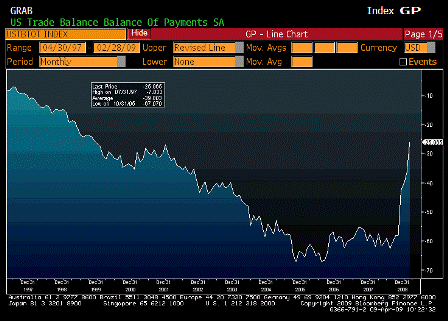
    Trade Balance (Feb)

    Survey -$36.0B
    Actual -$26.0B
    Prior -$36.0B
    Revised -$36.2B

     
    Karim writes:

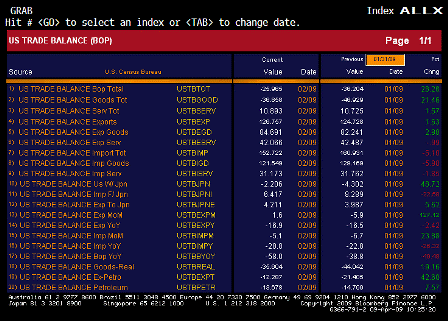
    • Surprise was trade balance improving from -36.bn to -26bn (-44bn to -35bn in real terms)
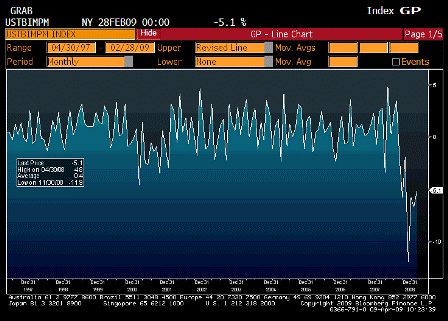
    • But cause for improvement was 5.1% collapse in imports (not caused by energy); capital goods imports -6%; industrial supplies -9.3%; consumer goods -3.9% and not a sign of a healthy economy

    Right, imports should be picking back up with April numbers which won’t be out for quite a while as the additional fiscal adjustments pile on to the automatic stabilizers which already may have the deficit north of 6$ of gdp annually.

    [top][end]

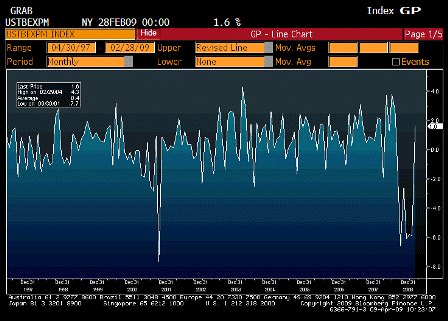
    Exports MoM (Feb)

    Survey n/a
    Actual 1.6%
    Prior -5.9%
    Revised n/a

     
    Karim writes:

  • Exports up 1.6% after 20% fall in prior 4mths
  • [top][end]

    Imports MoM (Feb)

    Survey n/a
    Actual -5.1%
    Prior -6.7%
    Revised n/a

    [top][end]

    Exports YoY (Feb)

    Survey n/a
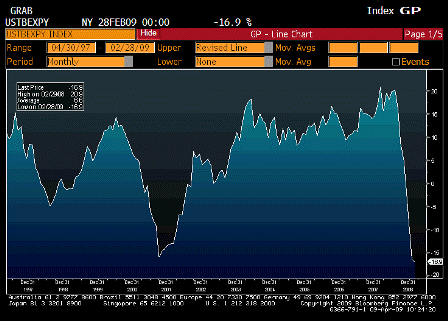
    Actual -16.9%
    Prior -16.5%
    Revised n/a

    [top][end]

    Imports YoY (Feb)

    Survey n/a
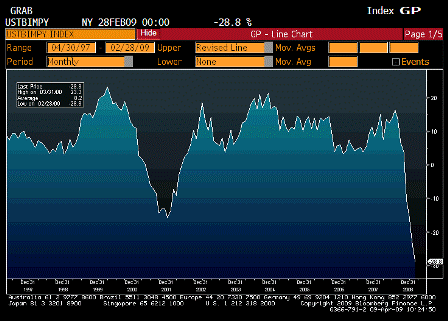
    Actual -28.8%
    Prior -22.8%
    Revised n/a

    [top][end]

    Trade Balance ALLX (Feb)

    [top][end]


    Import Price Index MoM (Mar)

    Survey 0.9%
    Actual 0.5%
    Prior -0.2%
    Revised -0.1%

     
    Karim writes:

  • Import prices up 0.5%, -0.7% ex-petroleum, and -0.6% from China.
  • Yes, any recovery will see crude prices pushing up the inflation indicators, however recent Saudi price cuts may indicate this could be delayed some.

    [top][end]

    Import Price Index YoY (Mar)

    Survey -14.7%
    Actual -14.9%
    Prior -12.8%
    Revised -12.7%

    [top][end]

    Import Price Index ALLX 1 (Mar)

    [top][end]

    Import Price Index ALLX 2 (Mar)

    [top][end]


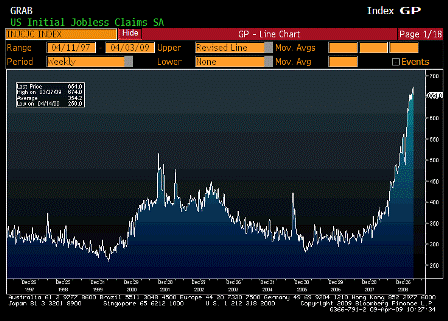
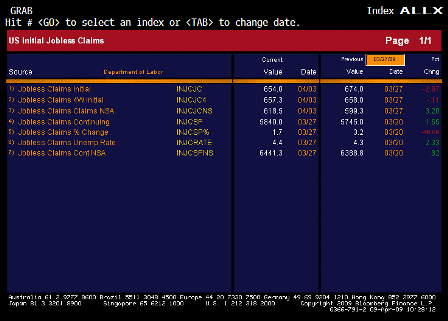
    Initial Jobless Claims (Apr 4)

    Survey 660K
    Actual 654K
    Prior 669K
    Revised 674K

     
    Karim writes:

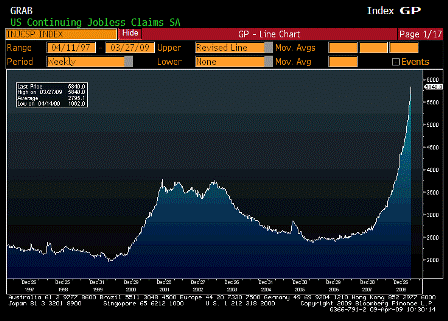
  • Initial claims down 20k to 654k from upwardly revised prior week 674k; continuing claims continue to defy gravity, rising another 112k
  • While unemployment will continue to go up until nominal growth exceeds productivity increases, claims should start falling soon.

    [top][end]

    Continuing Claims (Mar 28)

    Survey 5800K
    Actual 5840K
    Prior 5728K
    Revised 5745K

    [top][end]

    Jobless Claims ALLX (Apr 4)


    [top]

China negotiating on the dollar


[Skip to the end]

Ridiculous, of course, but they are playing the ignorance of our leadership for all its worth. They know we don’t know it’s a bluff, and they have us on the defensive.

That’s what happens with leadership that doesn’t understand its own monetary system, and that we don’t need them or anyone else as buyers of our securities to fund our expenditures.

China calls for new reserve currency

by Jamil Anderlini

Mar 23 (FT) — China’s central bank on Monday proposed replacing the US dollar as the international reserve currency with a new global system controlled by the International Monetary Fund.

In an essay posted on the People’s Bank of China’s website, Zhou Xiaochuan, the central bank’s governor, said the goal would be to create a reserve currency “that is disconnected from individual nations and is able to remain stable in the long run, thus removing the inherent deficiencies caused by using credit-based national currencies”.


[top]

China to keep buying Treasuries


[Skip to the end]

Clever, those Chinese. Now they get to keep their currency down to support their exports while claiming they are acting altruistically to support Obama.

Fortunately for us this keeps the imports flowing our way and supports our standard of living.

I don’t think we did this by design, but instead it falls under better lucky than good.

China to Keep Buying Treasuries, Top Official Says

by Dune Lawrence and Kevin Hamlin

Mar 23 (Bloomberg) — China’s top foreign-exchange official said the nation will keep buying Treasuries and endorsed the dollar’s global role, supporting the U.S. as the Obama administration increases spending to revive growth.


[top]