2009-02-06 USER


[Skip to the end]


Karim writes:

Job losses picking up speed and hours worked continue to plunge.

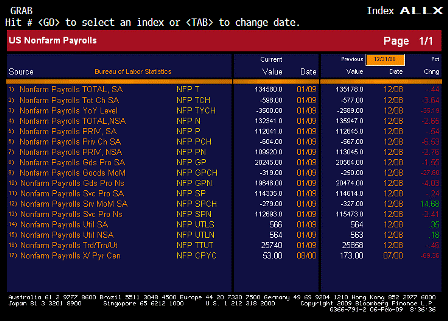
  • -598k job losses in January
  • Benchmark revision for 2008, -400k
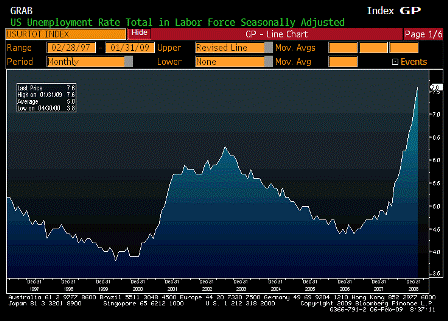
  • Unemployment rate up from 7.2% to 7.6%
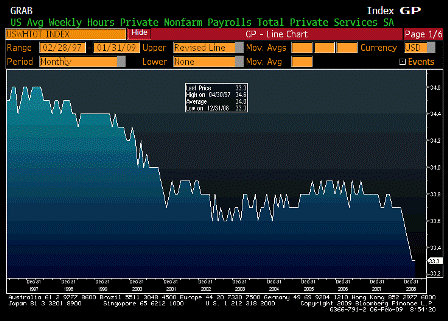
  • Hours worked down another 0.7% (biggest driver of personal income)
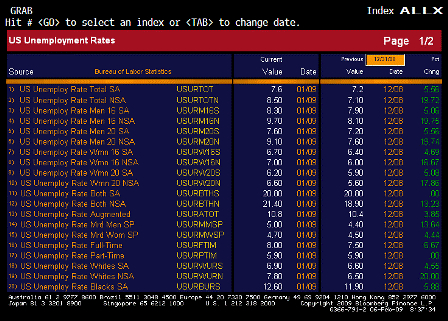
  • Augmented unemployment rate rises from 13.5% to 13.9% (was 8.7% in December 2007)
  • Diffusion index down to 25.3 from 25.5 (only 2 sectors to add jobs were education, 54k, and government, 6k)
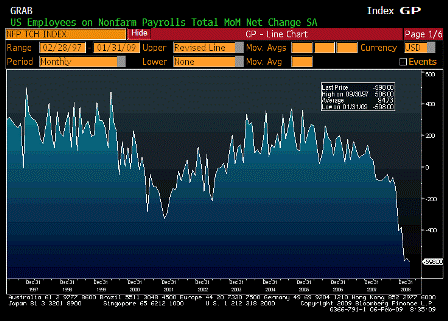
Change in Nonfarm Payrolls (Jan)

Survey -540K
Actual -598K
Prior -524K
Revised -577K

[top][end]

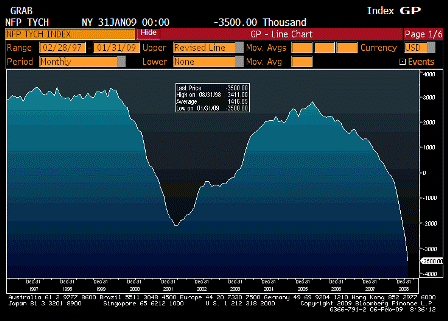
Change in Nonfarm Payrolls YoY (Jan)

Survey n/a
Actual -3500.00
Prior -2589.00
Revised n/a

[top][end]

Nonfarm Payrolls ALLX (Jan)

[top][end]

Unemployment Rate (Jan)

Survey 7.5%
Actual 7.6%
Prior 7.2%
Revised n/a

[top][end]

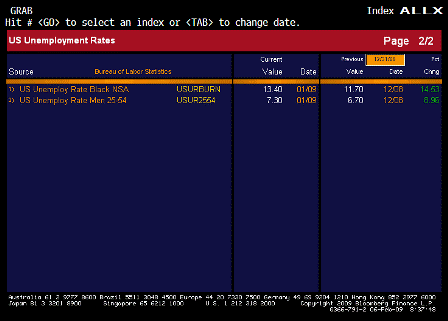
Unemployment Rate ALLX 1 (Jan)

[top][end]

Unemployment Rate ALLX 2 (Jan)

[top][end]

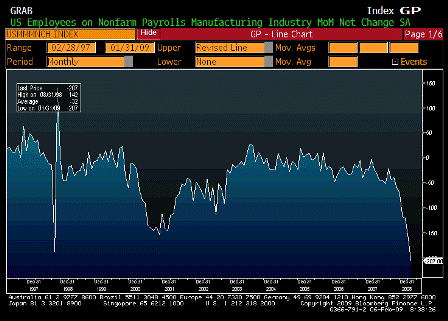
Change in Manufacturing Payrolls (Jan)

Survey -145K
Actual -207K
Prior -149K
Revised -162K

[top][end]

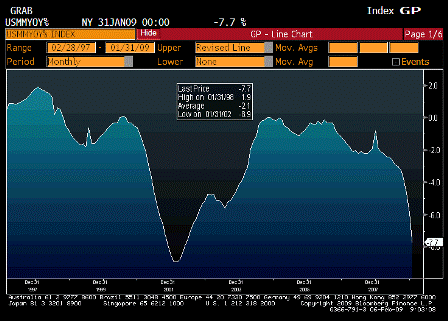
Change in Manufacturing Payrolls YoY (Jan)

Survey n/a
Actual -7.7%
Prior -5.9%
Revised n/a

[top][end]

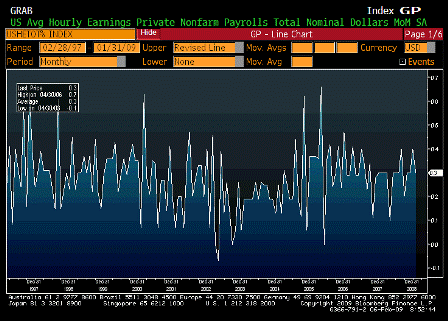
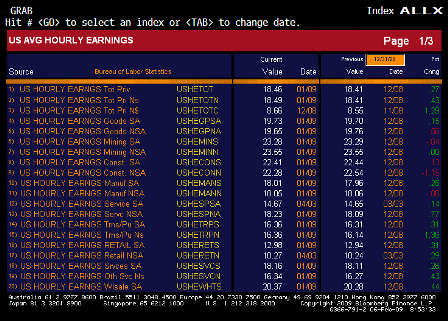
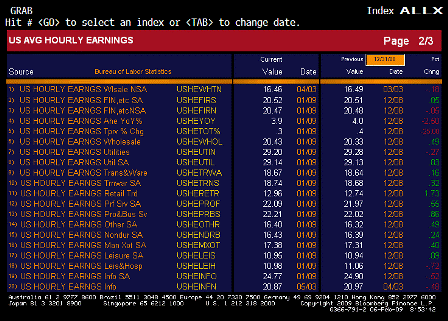
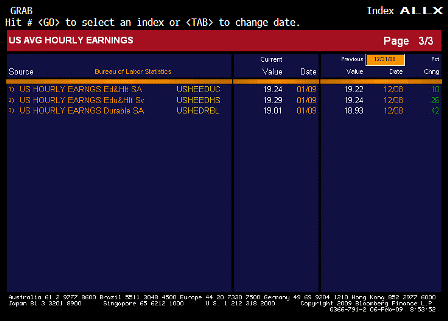
Average Hourly Earnings MoM (Jan)

Survey 0.2%
Actual 0.3%
Prior 0.3%
Revised 0.4%

[top][end]

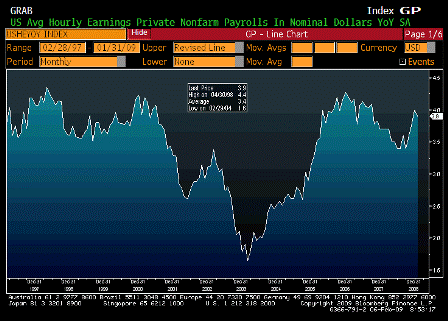
Average Hourly Earnings YoY (Jan)

Survey 3.6%
Actual 3.9%
Prior 3.7%
Revised 4.0%

[top][end]

Average Hourly Earnings ALLX 1 (Jan)

[top][end]

Average Hourly Earnings ALLX 2 (Jan)

[top][end]

Average Hourly Earnings ALLX 3 (Jan)

[top][end]

Average Weekly Hours (Jan)

Survey 33.3
Actual 33.3
Prior 33.3
Revised n/a


[top]

Unemployment increases suicides in Japan


[Skip to the end]

Very, very sad but true. And not just in Japan.

Restoring output and employment is only a matter of a few spread sheet entries by the government on its own spreadsheet.

Lower interest rates and other forms of ‘monetary policy’ don’t cut it.

What’s needed is a fiscal adjustment large enough to offset the desire of the population not to spend its income.

Operationally, that takes nothing more than debiting and crediting a few accounts on the governments spreadsheet.

Suicides, Homeless Ranks to Swell in Japan as Firms Slash Jobs

by Stuart Biggs and Toko Sekiguchi

Feb 5 (Bloomberg) — Homeless and suicide numbers in Japan may spike as manufacturers including Sony Corp., Panasonic Corp. and Honda Motor Co. fire thousands of workers to cut costs amid the country’s worst recession since World War II, unions said.

Changes in labor law since 1999 have left a third of Japan’s workforce employed on short-term contracts offering little security and no unemployment benefits. Wages are often less than welfare payments and many temporary workers live in company dormitories, leaving newly unemployed also homeless, unions and activists say.

As the number of temporary workers increased, so did poverty levels as 4.3 million, or 8.1 percent of all Japanese households, earned less than 1 million yen ($11,200) in 2007, up from 3.1 million in 2001, according to ministry data.

“It’s totally unstable, unlike anywhere else in the world,” Makoto Kawazoe, an official with the Tokyo Young Contingent Workers Union, said yesterday. “You can’t treat labor like raw materials and expect it to conform to a ‘just in time’ manufacturing system. Labor is live human beings who have to eat and survive.”

Economic woes in Japan historically herald an increase in people taking their own lives in a society that already sees a suicide about every 15 minutes. Fifty-seven percent of the 33,093 who killed themselves in 2007 were jobless, police figures show.

“For political leaders the suicide rate is a sharp warning over policies,” Koichi Kato, a lawmaker for the ruling Liberal Democratic Party, said in an interview this week.

Prime Minister Taro Aso said on Jan. 28 the government will ease regulations barring non-regular workers from unemployment coverage. For example, Japan’s labor ministry plans to reduce the qualification period for benefits to six months in the same job from 12, starting April 1.


[top]

McCain gets this part right


[Skip to the end]

Problem is, none of them recognize imports are real benefits, exports real costs, so even when they are right it’s for the wrong reason.

Senate rejects move to kill ‘Buy American’ clause, but softens provision

Feb 4 (CBC) &#8212 Senate rejects move to kill ‘Buy American’ clause, but softens provision

The U.S. Senate rejected an amendment put forward by Republican Senator John McCain to strip the “Buy American” provision from the huge U.S. stimulus bill while agreeing to soften the language that had given rise to concerns of pending trade wars.

McCain’s amendment had stated that the “utilization of funds appropriated or otherwise made available by this act shall not be subject to any ‘Buy American’ requirement.” It was voted down 65 to 31 on Wednesday night.

The Senate, however, agreed to water down the language to include a requirement that indicates international trade agreements cannot be violated as a result of the “Buy American” provision.


[top]

McCain petition


[Skip to the end]

Dear Donna:

I have long been a fighter against wasteful spending in Washington and long an advocate for a balanced budget — that will never change.

    Glad he lost, no deficit is a lot worse than any of the current proposals, even though they fall far short of my proposals:
     

  • Full payroll tax holiday with Tsy making the payments for us.
  • $300 billion to the states on a per capita basis with no strings attached.
  • $8 job funding for anyone willing and able to work.
  • Allow the Fed to lend unsecrured to it’s member banks (demanding collateral is redundant and disruptive with current FDIC arrangements).
  • Implement a strategy to immediately reduce gasoline consumption.
  • This reverses the current slide, and gives Congress time to implement their specific
    proposals in an orderly manner.

I realize we face extraordinary challenges with our economy today, but that is not an excuse for more irresponsibly from Washington. I hope you will join me in saying no to this stimulus package as it currently exists by signing this petition.

Sincerely,

John McCain
Chair, Country First PAC


[top]

2009-02-05 USER


[Skip to the end]


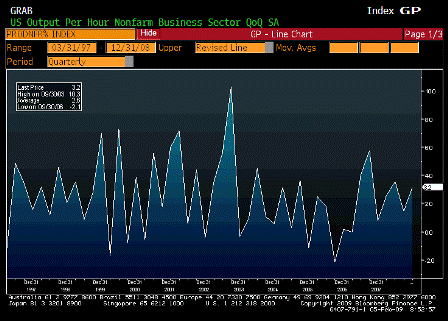
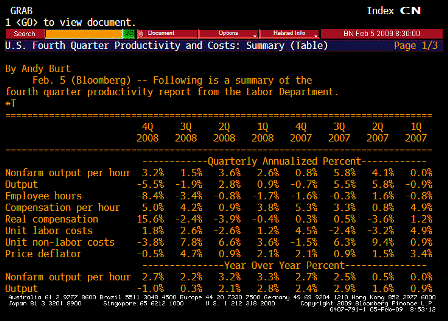
Nonfarm Productivity QoQ (4Q)

Survey 1.6%
Actual 3.2%
Prior 1.3%
Revised 1.5%

[top][end]

Nonfarm Productivity TABLE 1 (4Q)

[top][end]

Nonfarm Productivity TABLE 2 (4Q)

[top][end]

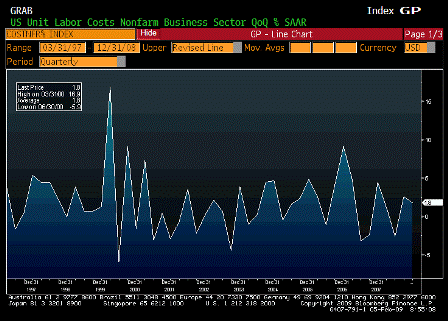
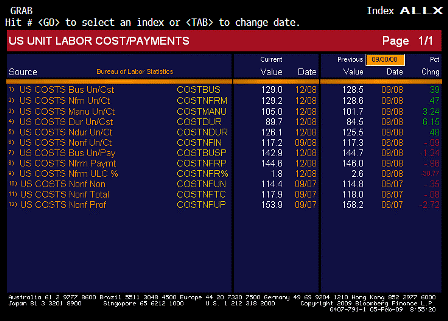
Unit Labor Costs QoQ (4Q)

Survey 2.9%
Actual 1.8%
Prior 2.8%
Revised 2.6%

[top][end]

Unit Labor Costs ALLX (4Q)

[top][end]

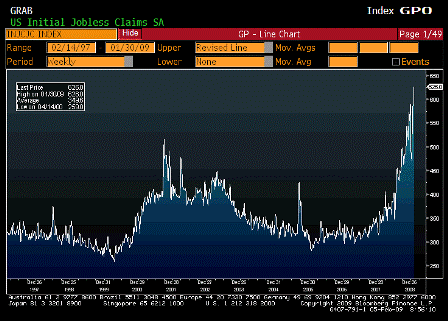
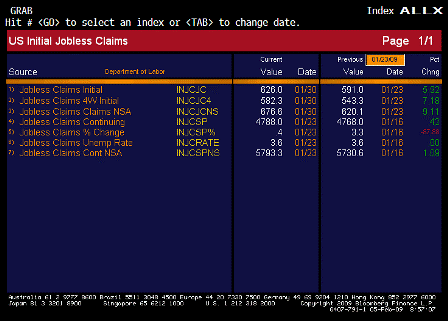
Initial Jobless Claims (Jan 31)

Survey 580K
Actual 626K
Prior 588K
Revised 591K

[top][end]

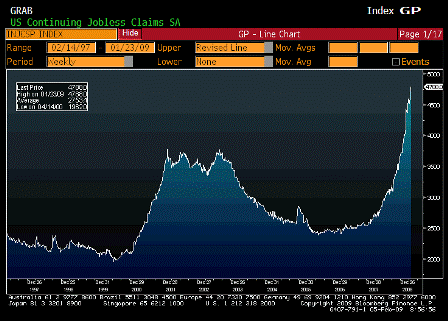
Continuing Claims (Jan 24)

Survey 4795K
Actual 4788K
Prior 4776K
Revised 4768K

[top][end]

Jobless Claims ALLX (Jan 31)

[top][end]

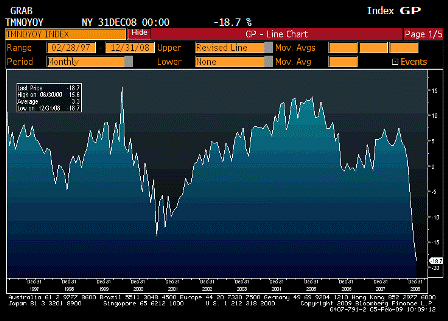
Factory Orders YoY (Dec)

Survey n/a
Actual -18.7%
Prior -13.8%
Revised n/a

[top][end]

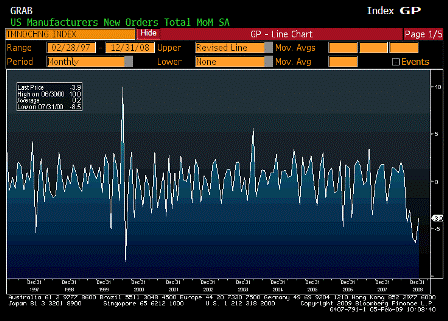
Factory Orders MoM (Dec)

Survey -3.1%
Actual -3.9%
Prior -4.6%
Revised -6.5%

[top][end]

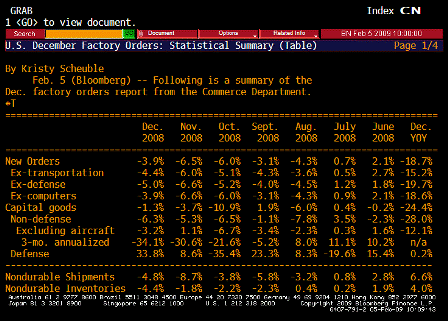
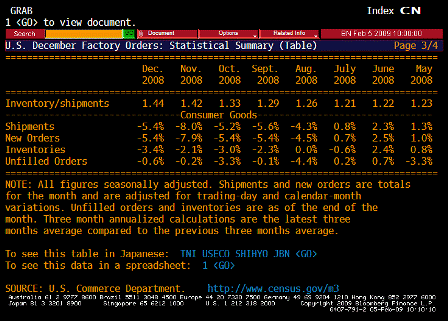
Factory Orders TABLE 1 (Dec)

[top][end]

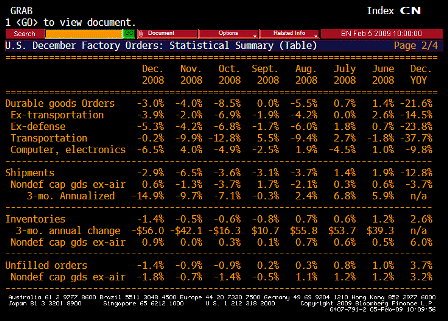
Factory Orders TABLE 2 (Dec)

[top][end]

Factory Orders TABLE 3 (Dec)


[top]

Posen on Japan and fiscal policy


[Skip to the end]

Adam is pretty much right on with this.

Perhaps more interesting is that the deficit terrorists at Peterson keep him on the payroll:

Must We Repeat Japan’s Stimulus Mistakes? (Answer: Not Necessarily)

by Gerald F. Seib

Feb 2 (Wall Street Journal) — Adam Posen, deputy director of the Peterson Institute for International Economics, agrees that Japanese mistakes in executing stimulus spending — perhaps most notably enacting tax increases rather than tax cuts along the way — prevented stimulus spending from hitting the real economy with full effect.

“Most of the time in Japan…they didn’t spend or stimulate even a fraction of what they announced,” he says. “Usually they either raised taxes at the same time they increased spending, thus defeating the purpose, or they promised projects that required state/local government matching funds that didn’t exist, so the money didn’t get spent.” That suggests Washington needs to be sure states don’t have to pull in their horns too severely to improve any package’s chances of success.

Perhaps most important in the long run, Mr. Posen says Japan’s stimulus spending, while it drove up short-term government debt, didn’t lead “to permanent increases in government programs or upward spirals in the debt level.”

The lesson for the U.S. now? “There is nothing inevitable about doing temporary spending that turns into automatic government creep and expansion in a lasting way,” Mr. Posen says.


[top]

2009-02-04 USER


[Skip to the end]


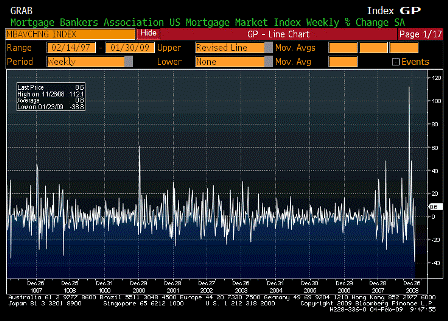
MBA Mortgage Applications (Jan 30)

Survey n/a
Actual 8.6%
Prior -38.8%
Revised n/a

[top][end]

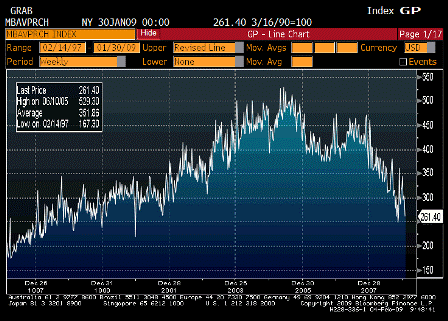
MBA Purchasing Applications (Jan 30)

Survey n/a
Actual 261.40
Prior 294.30
Revised n/a

[top][end]

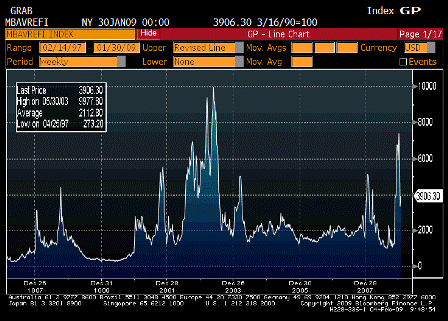
MBA Refinancing Applications (Jan 30)

Survey n/a
Actual 3906.30
Prior 3373.90
Revised n/a

[top][end]

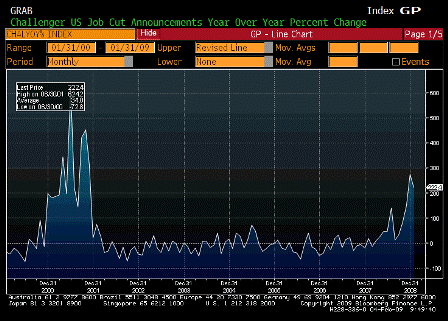
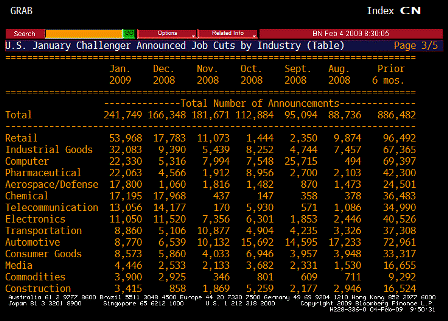
Challenger Job Cuts YoY (Jan)

Survey n/a
Actual 222.4%
Prior 274.5%
Revised n/a

[top][end]

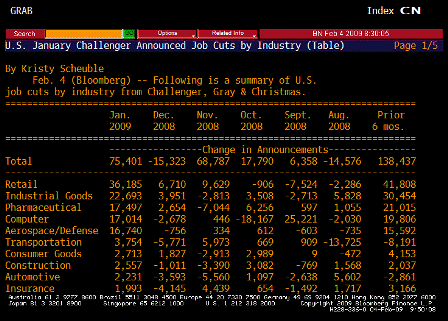
Challenger Job Cuts TABLE 1 (Jan)

[top][end]

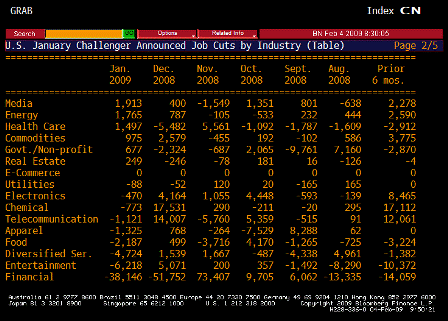
Challenger Job Cuts TABLE 2 (Jan)

[top][end]

Challenger Job Cuts TABLE 3 (Jan)

[top][end]

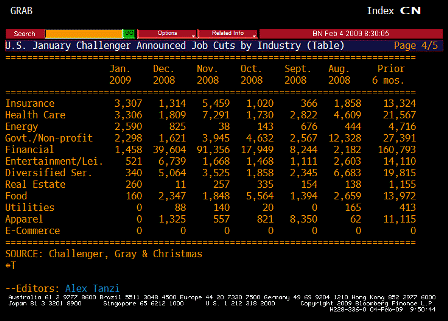
Challenger Job Cuts TABLE 4 (Jan)

[top][end]

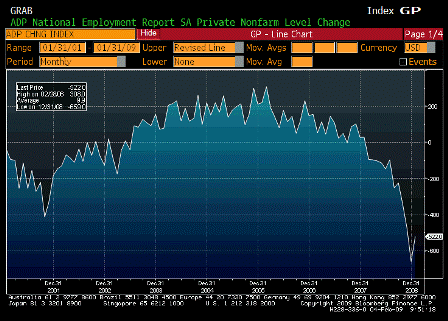
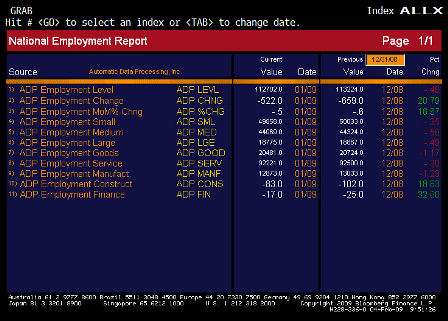
ADP Employment Change (Jan)

Survey -535K
Actual -522K
Prior -693K
Revised -659K

[top][end]

ADP ALLX (Jan)

[top][end]

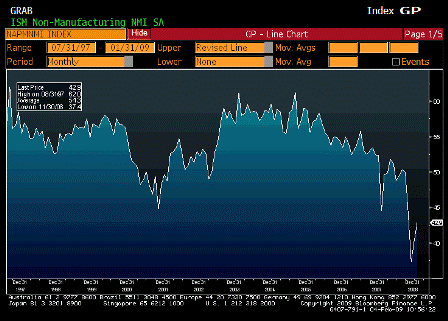
ISM Non Manufacturing Composite (Jan)

Survey 39.0
Actual 42.9
Prior 40.6
Revised 40.1


[top]

Re: A message from Prof. Auerbach


[Skip to the end]

(email exchange)

Robert has it wrong.

There are excess reserves because the Fed has decided to not do what it used to do, sell or ‘reverse out’ its securities to offset operating factors that caused reserves to increase.

These operating factors include Fed purchases of securities.

The reason the Fed would ‘drain’ excess reserves was to keep the interest rate at its target rate.

By paying interest on reserves it can accomplish that without selling its securities.

Reserves are functionally one day securities, as all treasury securities are nothing more than deposits at the Fed anyway.

And previous concerns about the Fed running out of securities were also addressed by being able to pay interest on reserves.

The idea that banks hold reserves (for any reason) ‘instead’ of lending is nonsensical.

All that paying interest on reserves does regarding lending behavior is increase the rates banks might charge for loans.

As always regarding the Fed, it’s about price, not quantity.

With a 0% interest rate policy interest on reserves discussions are moot anyway.

> &#160 
> &#160 J wrote:
> &#160 
> &#160 Auerbach’s idea: stop paying interest on reserves. What do you think? J
> &#160 

Where’s the Stimulus

by Jim McTague

Feb 2 (Barrons) — University of Texas Professor Robert Auerbach, an economist who studied under the late Milton Friedman, thinks he has the makings of a malpractice suit against Federal Reserve Chairman Ben Bernanke, as the Fed is holding a record number of reserves: $901 billion in January as opposed to $44 billion in September, when the Fed began paying interest on money commercial banks parked at the central bank. The banks prefer the sure rate of return they get by sitting in cash, not making loans. Fed, stop paying, he says.


[top]

Re: Niall Ferguson in the FT


[Skip to the end]

(email exchange)

They’ve all forgotten imports are a real benefit, exports a real cost, so they are afraid that imports will go up if you make a fiscal adjustment unilaterally.

In fact, it’s the best of all worlds to do it unilaterally and let the imports flood in.

To paraphrase Nixon (?):

‘They are all half baked Keynesians now’.

>   
>   On Mon, Feb 2, 2009 at 9:53 PM, MAuer wrote:
>   
>   Any thoughts on this?
>   
>   Subject: Niall Ferguson in the FT
>   
>   Today’s born-again Keynesians seem to have forgotten that their prescription
>   of a deficit-financed fiscal stimulus stood the best chance of working in a more
>   or less closed economy. But this is a globalised world, where uncoordinated
>   profligacy by national governments is more likely to generate bond market
>   and currency market volatility than a return to growth.
>   


[top]