Domestic demand picking up in China?


[Skip to the end]

China’s Economy Shows Signs of Recovery on Stimulus

by Kevin Hamlin

Feb 13 (Bloomberg) — “China looks set to be the first major economy to recover from the current global meltdown,” said Lu Ting, an economist with Merrill Lynch & Co. in Hong Kong. “China is the only economy in the world to see significant growth in credit to corporate and household sectors after September 2008, when the financial crisis worsened to a near collapse.”

State owned banks lending without all that much regard to credit quality functions like a fiscal transfer.

The government’s stimulus plan, announced in November, is beginning to gather momentum. Projects such as the building of 3.5 billion yuan of public houses in Shaanxi province and Shanghai began in December, while Shandong province started work on three new railway lines the same month.

China is committing about 1.2 trillion yuan of central government funds to the plan, which means banks’ willingness to fund projects is crucial. So far they are responding.

Housing construction is real investment.

Growth will accelerate from the current pace to 7.2 percent for the full year, according to Wang Qian, an economist with JPMorgan Chase & Co. in Hong Kong. Her calculation is that consumption will contribute 4.4 percentage points and investment 4 percentage points. The collapse in exports will slice off 1.2 percentage points.

Stimulus spending will contribute up to 3 percentage points of the total, she estimates.

Still low growth for China.

China’s imported iron ore has climbed 28 percent to 690 yuan per metric ton since the end of October. Hot-rolled steel has surged 41 percent from Nov. 13 to 4,027 yuan per metric ton. The Baltic Dry Index, a measure of shipping costs for commodities, has more than doubled since Jan. 28.

“You are starting to see the underlying demand of the Chinese economy,” BHP Billiton Ltd. Chief Executive Officer Marius Kloppers said Feb. 4. “We have seen in the steel business in China that the de-stocking cycle is almost complete and that means people are coming back into the market and buying.”

BHP Billiton is the world’s third-largest producer of iron ore. China is its largest consumer.

The post-Olympic lull is over?


[top]

Steroids for the Rentiers


[Skip to the end]

1. The size of the TALF from $200bn to $1 trillion is a very big deal. It requires no Congressional approaval and the Fed seems ready to start buying assets this week or next. Not only will this Fed buying guarantee a revival of many securitised credit markets, but the 10 to 1 Fed leverage in the TALF structure will result in a huge expansion of the Fed’s balance sheet, which ought to be good news from a money supply point of view.

The ‘money supply point of view’ is meaningless with non convertible currency. In fact, adding to the Fed’s portfolio takes income from the rest of us. A $5 trillion portfolio with a 3% coupon removes $150 billion a year in private sector income, for example. Any good the lower interest rates do can be more than offset by the removal of interest income.

2. The public-private partnership (PPP) for acquiring toxic assets is simultaneously too complicated and lacking in detail. But a couple of things do seem clear: This will effectively be a “bad bank” designed to “cleanse” $1 trillion worth of “legacy” assets from bank balance sheets. The surprising element is that Geithner thinks he will be able to capitalize this bad bank partly with private money. This presumably implies that the toxic assets will enjoy some pretty generous government guarantees, which ought to be good news for existing bank shareholders.

Yes, investors will benefit risk free which adds nothing to aggregate demand, meaning unemployment will remain high and borrowers continue to struggle with their payments, while investors profit. And this is from the far left!

An alternative possibility is that the PPP will buy toxic assets very cheaply (which would of course be bad news for the disposing banks. This seems unlikely however because of the third and most important element explicitly stated in the Treasury’s background briefing, though not mentioned by Geithner in his speech (presumably because he did not want to sound like he was being too generous to the banks):

3. A Financial Stability Trust (FST) will inject convertible “contingent equity” into banks once they have cleansed their balance sheets by selling toxic loans to the PPP. This contingent equity will be available in unlimited amounts to banks with consolidated assets of over $100 billion. The most crucial point is that pricing looks very generous. “The conversion price [will be] set at a modest discount from the prevailing level of the institution’s stock price as of February 9, 2009”. In other words, if a bank needs to raise additional equity from the US government, this equity will be priced in line with this week’s market values and will not be grossly dilutive to existing shareholders like the capital injections into Fannie and AIG. This seems very generous to bank shareholders, especially as the Treasury is offering to buy bank equity at this price in unlimited amounts (although looking at the performance of US regional banks yesterday, the market clearly took a different conclusion).

More funds for the investor class.

4. Another generous element of the FST package is the approach to “stress testing” bank balance sheets: “The Treasury Department will work with bank supervisors and the Securities and Exchange Commission and accounting standard setters in their efforts to improve public disclosure by banks. In conducting these exercises, supervisors recognize the need not to adopt an overly conservative posture or take steps that could inappropriately constrain lending.” In other words, banks will be allowed to continue using “hold to maturity” accounting, if the alternative is “overly-conservative” accounting which “inappropriately constrains lending”.

5. Finally, the purpose of the Treasury stress-tests will be to establish whether banks have enough capital to continue sufficient lending even “in a more severe decline in the economy than projected”. After these stress-tests, the Treasury will effectively insure banks against such a deeper-than-expected recessions by providing a “guaranteed buffer” of contingent capital (as described in 4 above). In other words, it looks as if the Treasury will provide a catastrophe insurance policy against a deeper than expected recession, probably at a pretty low price to the banks (certainly at a much lower price than infinity, which is what an insurance policy against economic depression would cost in the markets today).

And yet another distribution to the investor class.

This is trickle down economics that would make even Reaganites blush.

Seems working people have no representation whatsoever.


[top]

Re: Ross Says Investors to Wait for Banks to Write Down


[Skip to the end]

(email exchange)

As I’ve said all along, the problem is best addressed from the bottom up- restore incomes and employment via a payroll tax holiday and a check for $300 billion for the states.

That ends the financial crisis and its effect on the real economy.

Then Congress attempt to rationally address other fiscal action on its merits beyond fixing the crisis.

>   
>   On Thu, Feb. 12, Morris wrote:
>   
>   Part of the problem the banks confront is that their
>   loans continue to deteriorate. This limits their ability
>   to initiate new loans, makes them tighten lending
>   standards and clouds their business visibility. The
>   proper visual is a ship taking on water while the
>   crew is trying to bail out the ship. If the ship takes
>   on water too quickly it will sink, if the crew can plug
>   the whole and bail out the ship the ship will float.
>   This is state of affairs of most banks at the
>   moment. The ultimate success of these bailouts &
>   workouts will take hold when the rate of credit
>   deterioration slows or stops.
>   

Ross Says Investors Will Wait for Bank Writedowns

by Jason Kelly and Carol Massar

Feb 12 (Bloomberg) — Wilbur Ross, the billionaire investor who focuses on distressed assets, said private funds won’t join President Obama’s plan to buy toxic mortgages until banks reduce the value of the
securities on their books.
“The reason the assets haven’t changed hands is they haven’t been
properly marked,” Ross said in an interview with Bloomberg Television
yesterday at his New York office, referring the process of valuing investments based on market prices. “His idea of doing public/private partnerships is correct. The private sector is very good at price
discovery.”


[top]

Re: Saudi blend leading the way?


[Skip to the end]

Thanks, who would have thought the Saudi blend would lead the way…

>   
>   On Thu, Feb 12, 2009 at 12:09 PM, David wrote:
>   
>   U.S. CASH CRUDE MARS SOUR RISES
>   $1.00 TO RECORD $8.00 ABOVE WTI – TRADER
>   
>   I believe this is the Saudi sour equivalent here in
>   US.
>   


[top]

Trichet says rising deficits are ‘problem’


[Skip to the end]

Agreed!

They are risking the solvency of the national governments.

The national governments are beyond the point where they can write the check should any of their major banks be declared insolvent.

Trichet Says Rising Deficits are ‘Problem,’ Osnabruecker Reports

by Matthew Brockett

Feb 12 (Bloomberg) &#8212 European Central Bank President Jean-Claude Trichet said rising budget deficits in the euro region are an “important problem” and urged governments to respect the Stability and Growth Pact, the Neue Osnabruecker Zeitung reported, citing an interview.

Trichet also said the situation in the banking sector remains “difficult” and should be monitored closely by governments and central banks, the newspaper reported on its Web site today. Measures such as so-called bad banks should be competition neutral, Trichet said, according to Neue Osnabruecker.


[top]

Re: China’s new loans rise by record on stimulus efforts


[Skip to the end]

(email exchange)

Yes, they use lending from their state owned banks as a fiscal adjustment, by lending with little concern about getting paid back.

The question is how much is going to domestic demand and how much is going to subsidize exports. Probably mainly the latter.

>   
>   On Wed, Feb 11, 2009 at 11:48 PM, EDWARD wrote:
>   
>   The government mandates the lending, hence the concerns about loan
>   quality and writedowns…but the government is also providing money and
>   the rules are not necessarily the same as in the West…they may be
>   effective to a point as the net aggregate demand lost from failure in the
>   export sector needs to be replaced.
>   

China’s New Loans Rise by Record on Stimulus Efforts (Update 1)

by Kevin Hamlin and Luo Jin

Feb 12 (Bloomberg) — China’s new loans rose by a record in January and money supply expanded more quickly as the government implemented a 4 trillion yuan ($585 billion) stimulus package to revive the world’s third-largest economy.


Banks extended 1.62 trillion yuan ($237 billion) of new local-currency loans and M2, the broadest measure of money supply, climbed 18.8 percent from a year earlier, the fastest pace in more than a year, the People’s Bank of China said today on its Web site.

China’s government has put pressure on banks to boost lending as the government rolls out a stimulus package to reverse the nation’s economic slide. Loan default risk is the biggest single threat to Chinese lenders, which face “a choppy 2009” because the potential for credit losses is rising, Fitch Ratings said last month.


[top]

RBOB moving up


[Skip to the end]

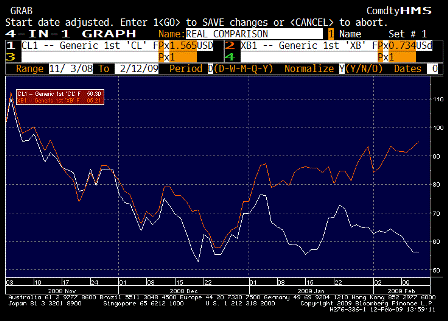
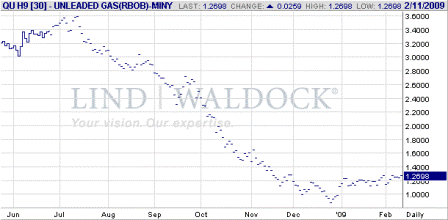
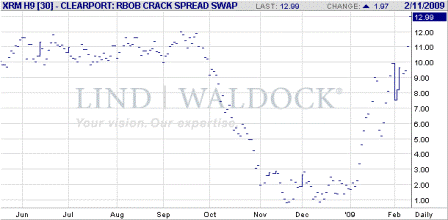
Even as spot crude prices remain low, and the front contango extreme, RBOB (unleaded gasoline) has been steadily moving up, and the crack spread widening substantially.

This fits with anecdotal reports of gasoline consumption remaining reasonably firm with year over year declines under 4%.

It’s not going to take much of a recovery to give the Saudis cover to get crude prices back up to whatever price they want them to be.


[top]

FRA/OIS Update


[Skip to the end]

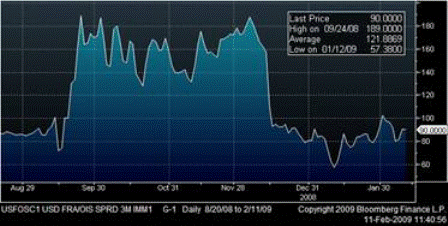
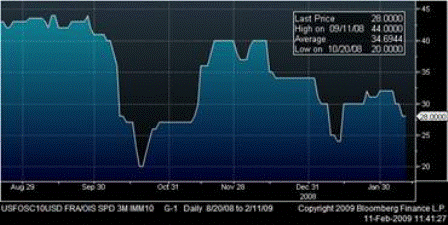
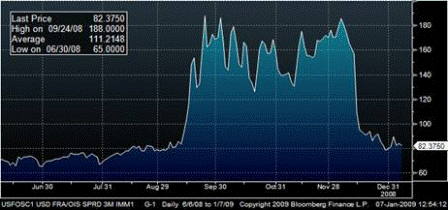
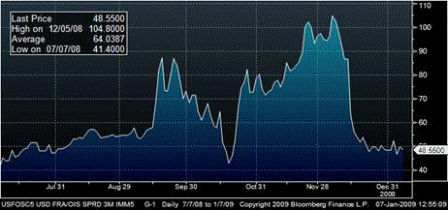
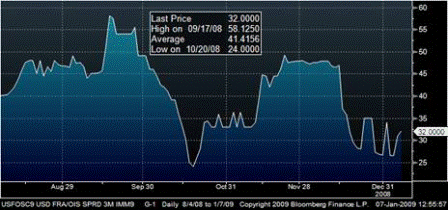
The 18m into 1yr FRA-OIS is now 51 bps mid vs 40 in January

The FRA-OIS curve has steepened since January

Mar 09 1) 90.00

Jun 09 2) 83.38

Sep 09 3) 78.50

Dec 09 4) 81.50

Mar 10 5) 63.00

Jun 10 6) 55.00

Sep 10 7) 47.00

Dec 10 8) 47.00

Mar 11 9) 35.00

Jun 11 10) 28.00

Sep 11 11) 26.00

Dec 11 12) 32.00

Mar 12 13) 34.00

Jun 12 14) 29.00

Sep 12 15) 29.00

Dec 12 16) 28.00

Mar 13 17) 30.00

Jun 13 18) 28.00

Sep 13 19) 28.00

The Jun11 and Sept11 FRA-OIS is pricing in virtually zero term premium for 3mLIBOR

Meanwhile front end OIS spreads have widened by 9 making the “roll-up” more attractive

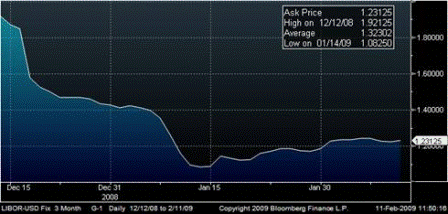
3mLIBOR did find a floor in the 1% area as we expected (at least so far…):

Option on continued financial distress and/or a new paradigm for FF-LIBOR spreads.

From a fundamental standpoint the forward timing of these spreads coincides with termination of TLGP guarantee issuance and other Fed/Trsy financial support programs.

Mar09 (Front)

Jun11 (sweet spot)

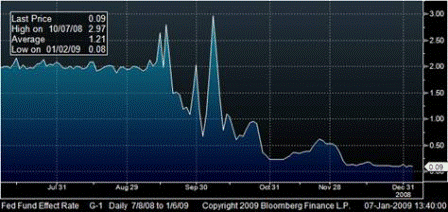
Fed Funds effective rate currently 9bps:

But where will 3m LIBOR be? Currently 1.3975%.

Thus current spot setting is 130bps.

Front rolling OIS-LIBOR:

5th rolling OIS-LIBOR:

9th rolling OIS-LIBOR:

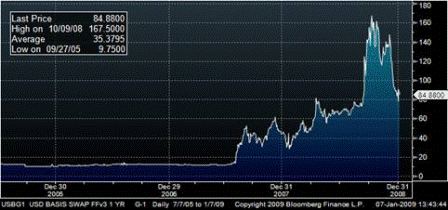
The long term floor for FF-LIBOR has been 12-15bps:

1y FF-LIBOR basis swap:

Banks are still not lending to each other unsecured for term.

The term premium for funding will remain steep as long as financials want to keep flexibility in their cash holdings.

The premium for term LIBOR is further supported by the level of financial CDS:

It is hard to imagine banks lending to each other at levels below those implied by CDS (unless Government or FDIC guaranteed):

Bank 5yr CDS

BANK 5yr CDS
American Express 245.6
BBVA 81.1
BNP 59.1
Banco Santander 82.2
Bank of America 110.1
Barclays 140.5
Citigroup 164.5
Commerzbank 73.1
Credit Agricole 69.2
Credit Suisse 165
Deutsche Bank 119.600
Goldman 246.3
HSBC 90.1
ING 113.2
JPMorgan 110.1
Opec Country Jan Est.
Lloyds TSB 93
Merrill Lynch 112.5
Morgan Stanley 357.4
RBS 112.8
Soc Gen 95.3
UBS 194.7
UniCredit 104.7
Wachovia 111.4
Wells Fargo 110.1
Average 131.7333


[top]