Business borrowing down 44% from Dec

Expiring tax cuts accelerated capex?

U.S. business borrowing for equipment rises in January: ELFA

Feb 25 (Reuters) — U.S. companies borrowed more in January to spend on capital investment, the Equipment Leasing and Finance Association (ELFA) said.

Companies signed up for $6 billion in new loans, leases and lines of credit last month, up 2 percent from a year earlier, but fell 44 percent from December, according to data from the ELFA.

“With fiscal pressures in Washington subsiding … and most major U.S. economic indicators showing positive signs, we are hopeful that these factors will help promote a favorable climate for continued investment in 2014 and beyond,” ELFA Chief Executive William Sutton said.

Washington-based ELFA, a trade association that reports economic activity for the $827 billion equipment finance sector, said credit approvals totaled 76.9 percent in January, down from 78.3 percent in December.

ELFA’s leasing and finance index measures the volume of commercial equipment financed in the United States. It is designed to complement the U.S. Commerce Department’s durable goods orders report, which it typically precedes by a few days.
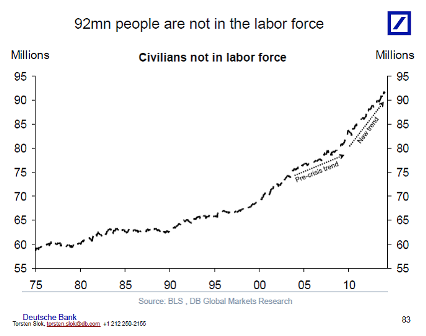
92mn people are not in the labor force

Looks like it’s a lot harder to get into the labor force than it used to be!
;)

From DB:

There are 92mn people who are not in the labor force. And as the chart on Friday showed about 4.4mn of these found a job in January, up from 3.6mn in December. The best explanation we have is still the removal of emergency unemployment benefits (one family member losing benefits forces another to take a job). Also, see how the slope of the line below got steeper when the crisis hit in 2008; for the past five years we have been adding 2mn people per year to Not in the labor force.


Full size image

Portugal comments

From FT on Portugal, says it all:

The national statistics office noted worrying signs that domestic demand was contributing positively to growth in the last quarter for the first time since 2010. This may reflect the impact of previous cuts in public sector pay and pensions that were subsequently overturned by Portugals constitutional court. An over-reliance on the domestic market has been seen as one of Portugals structural weaknesses but exports are now driving the turnround.

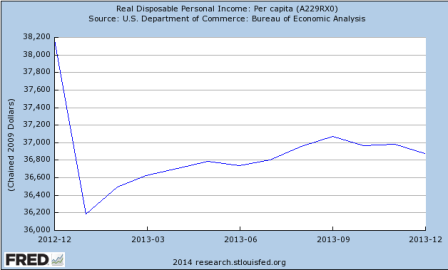
no income growth=no spending growth

CFOs signal fears of consumer spending slump

By Matt Clinch

February 20 (CNBC) — With wage rises failing to match the flickering signs of an upturn in the global economy, chief financial officers have told CNBC that a lack of consumer spending is a major fear for their companies.

CNBC asked 51 chief financial officers (CFO) from Europe and Asia who make up the CNBC CFO council to give their insight on the state of the world economy and conditions for doing business. Nearly half of the respondents ranked weakening consumer demand as their strongest concern for their business. No other risk factor even came close, with fears of a China slowdown receiving 16 percent for their highest ranked concern.

The results match a similar signal from CFOs in the America. In December, the U.S.-based members of the exclusive Global CFO Council ranked weakening consumer demand as one of biggest issues keeping them up at night.\

Fed Adopts Foreign-Bank Capital Rules as World Finance Fragments

Beats me why the Fed should care if foreign banks have any capital if the Fed isn’t insuring their deposits or other liabilities?

Seems if they want to lend their money to people who can’t pay it back it’s their problem???
;)

Fed Adopts Foreign-Bank Rule as World Finance Fragments

By Yalman Onaran

November 1 (Bloomberg) — The Federal Reserve approved new standards for foreign banks that will require the biggest to hold more capital in the U.S., joining other countries in erecting walls around domestic financial systems.

Banks with $50 billion of assets in the U.S. will have to meet the standard under a revised rule approved yesterday, which raised the threshold from $10 billion proposed in 2012. The central bank left out two controversial elements of the original proposal, saying those were still being developed.

Walling off U.S. units of foreign banks, designed to protect taxpayers from having to bail them out in a crisis, may increase borrowing costs for those companies and hurt their profitability. The firms say it will also raise borrowing rates for governments and consumers.

India Budget Seeks 7-Year Low Deficit Amid Sops for Votes

Proactively lowering demand with 9% unemployment
:(

India Budget Seeks 7-Year Low Deficit Amid Sops for Votes

By Unni Krishnan, Kartik Goyal and Siddhartha Singh

February 17 (Bloomberg) — Indias government pledged to reduce the fiscal gap to the lowest in seven years in an interim budget before elections due by May, while boosting defense spending and cutting taxes on cars, mobile phones and television sets.

The budget deficit will narrow to 4.1 percent of gross domestic product by March 31, 2015 from an estimated 4.6 percent in the current fiscal year, which is lower than an earlier target of 4.8 percent, Finance Minister Palaniappan Chidambaram told lawmakers today in New Delhi. The budget would provide funds for several months until a new parliament is elected.

Housing Start and expiring tax credit narrative

So the only explanation I could find for the 30% jump in Nov housing starts was the idea of shovels going in the ground ahead of year end when some 50 low income housing, energy related, and other types of tax credits were expiring. I didn’t see any sign of anything like a sudden 30% jump in starts in any of the other indicators including mtg purchase apps, sales indicators, reports from builders etc. etc.

And now the Jan number seems to have pretty much returned to ‘pre year end spurt’ levels, and if Nov/Dec ‘borrowed’ from 2014 starts could stay soft well after the weather moderates.

Or, I’m mistaken, and when the weather clears (including California…and with no income growth..) we bounce back up to Nov/Dec levels!

We’ll see….

G-20 delays making things worse until at least November

The G-20 said it would “significantly raise global growth” without overtaxing national finance through measures to promote competition and increase investment, employment and trade.

As an initial step toward achieving the $2 trillion target, each country will present a comprehensive growth strategy to a summit of leaders scheduled for November in the Australian city of Brisbane.