Fed preview

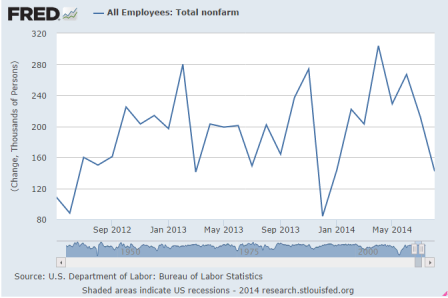
The Fed’s mandates are full employment, price stability, and low long term rates. And along with who knows what, he has to be seeing these charts:

New jobs down for the winter, up some, then back down for several months:

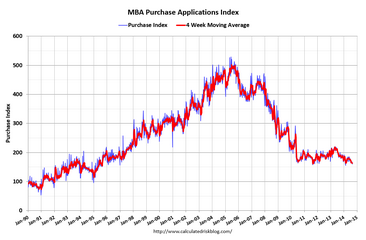
Not forget purchase mortgage applications are down 12% vs last year, and now cash purchases are down as well, as housing contributes less than half of what’s it’s contributed in prior cycles.

And the rest of the world economy is decelerating as well.

Business Roundtable survey falls from 95.4 to 86.6

Whoops…

Third quarter US growth outlook cloudy: Survey

Sept 6 (CNBC) — Corporate executives are scaling back plans for sales, capital spending and job creation this quarter, according to a the Business Roundtable (BRT) survey Tuesday, consistent with other indicators that have tempered growth expectations.

The group’s Economic Outlook Index—a snapshot of CEO expectations for the next six months of sales, capital spending and employment—fell to 86.4 from 95.4 in the second quarter of 2014, the association of top corporate CEOs said. The long-term average of the Index is 80.2.

The majority of the BRT’s members see plans for capital investment, hiring and revenues falling from the second quarter, with job plans declining the most. The 135 members who responded to the BRT’s survey expect 2014 gross domestic product of 2.4 percent, barely above last quarter’s 2.3 percent showing.

Producer prices chart and other news

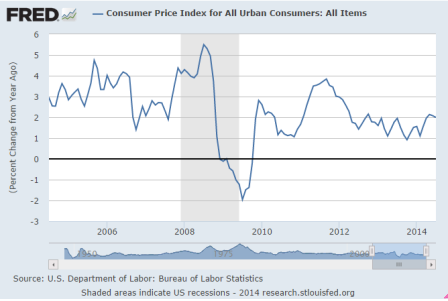
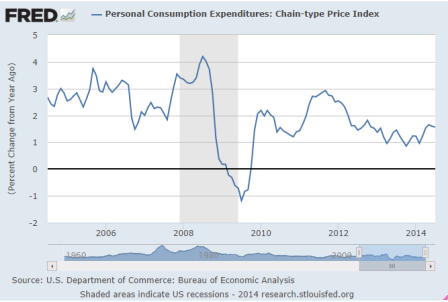
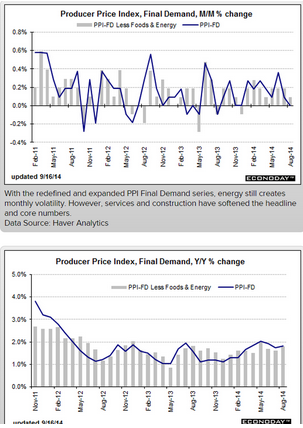
Remember all that ‘hyper inflation’ talk surrounding 0 rates and QE?

No sign of it here. Or anywhere else I’ve looked:

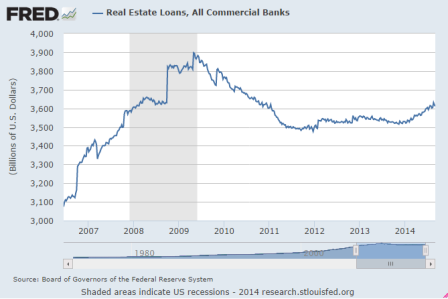
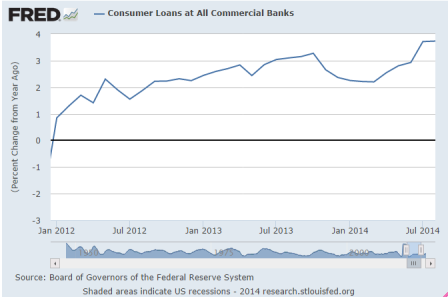
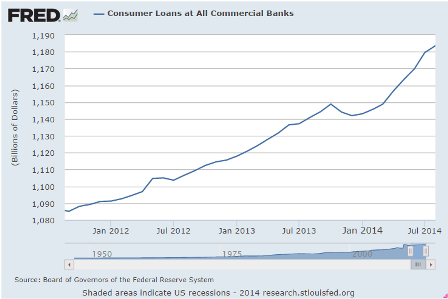
Nor do you hear any more talk about ‘credit acceleration’ since its post winter growth fizzled:

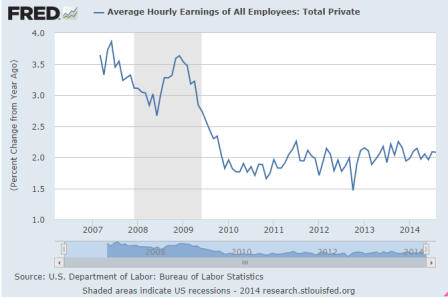
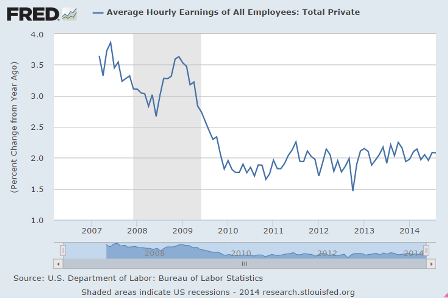
And wage growth (NOT adjusted for inflation) remains next to nothing:

And you only hear about these ‘minor’ reports on retail sales when they go up…

ICSC-Goldman Store Sales


Highlights

Store sales fell back sharply in the September 13 week, down a same-store 2.6 percent from the prior week for a year-on-year rate of plus 3.0 percent vs 4.0 percent in the prior week. But the declines appear to be isolated to the latest week, based on the text of the report which calls the results healthy.

Redbook

Seems the data continues to support my narrative- the deficit is too small given ‘credit conditions’ all of which contributes to a ‘macro constraint’ on the US economy. And the rest of the world is doing same, putting a macro constraint on the global economy.

Furthermore, seems the exporters are in control everywhere, pushing their narrative designed to increase global ‘competitiveness’ by keeping real wages low via low domestic demand and high unemployment.

Industrial production

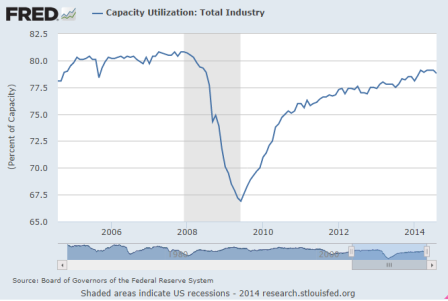
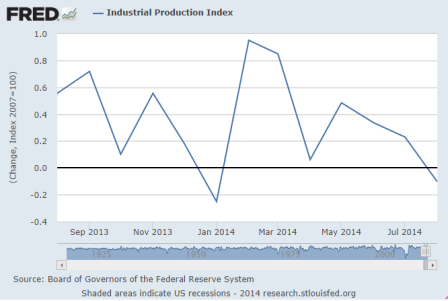
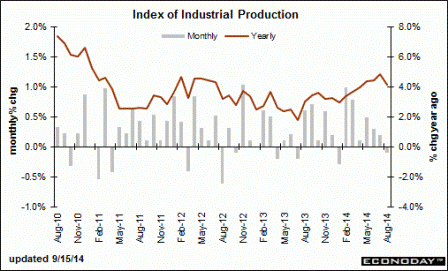
The chart looks true to the ‘down for the cold winter, followed by a bounce back, then back down’ narrative as previously discussed:

Industrial Production

Highlights
Industrial production slipped 0.1 percent in August after a gain of 0.2 percent the month before. Analysts expected a 0.3 percent boost for the month. The decline may be deceiving on auto assemblies on retooling schedules.

Manufacturing production fell 0.4 percent after a 0.7 percent increase in July. Weakness was led by motor vehicles which dropped a monthly 7.6 percent. In contrast, motor vehicle sales have been healthy, indicating that this is just a retooling timing issue. Manufacturing excluding motor vehicles rose 0.1 percent after a matching rise in July.

For other industries, mining rebounded 0.5 percent after slipping 0.3 percent in July. Utilities made a partial comeback of 1.0 percent, following a drop of 2.7 percent the month before.

Capacity utilization eased to 78.8 percent from 79.1 percent in July.

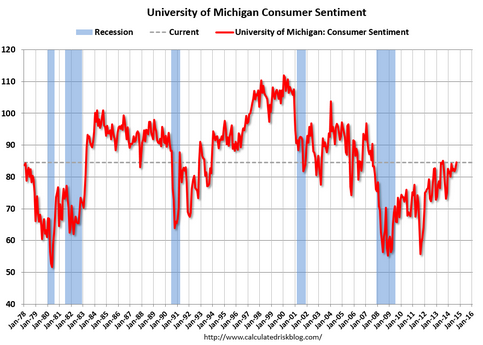
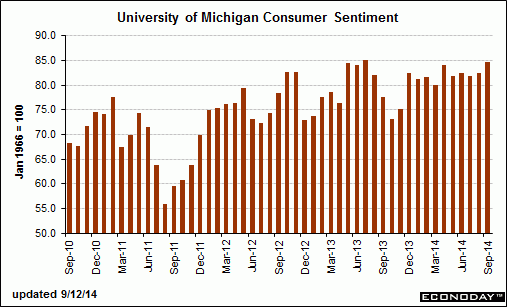
Retail Sales, Univ of MIch consumer sentiment

Seems 16 states had sales tax holidays in August that might have caused August sales to be up a bit and perhaps ‘borrow’ from September:

Tax Holidays

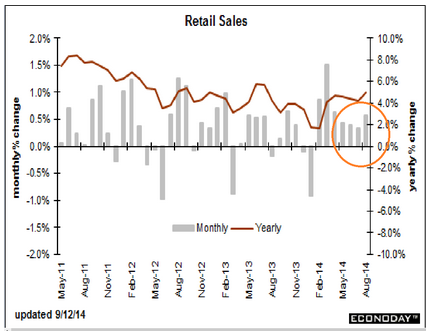
Note the area circled in orange shows a steady decline in the monthly growth rate, with a small uptick in August. We’ll see if that holds through September:

Retail Sales


Highlights
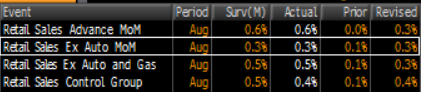
The consumer sector appears to be stronger than indicated by employment data. The consumer is out spending. Retail sales jumped 0.6 percent in August after a rise of 0.3 percent the month before. Analysts projected 0.6 percent for August. The July upward revision was significant-previous estimate of zero.

Excluding autos, sales gained 0.3 percent in both August and July, matching expectations. Excluding both autos and gasoline sales were quite healthy, increasing 0.5 percent, following a rise of 0.3 percent in July. Expectations were for 0.4 percent.

By detail, not surprisingly, motor vehicles increased 1.5 percent. Next, building materials & garden equipment gained 1.4 percent-suggesting some improvement in housing. Food services & drinking places sales were up 0.6 percent, showing healthy improvement in discretionary spending. This is a good sign for the consumer sector.

Weakness was led by a 0.8 percent decline in gasoline sales. Also, general merchandise dipped 0.1 percent.

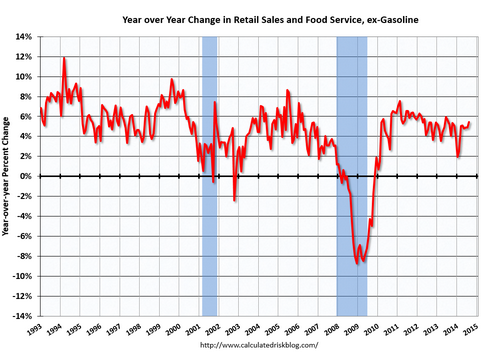
Overall, August retail sales were healthy and point to moderately strong third quarter GDP growth. Economic news has oscillated in recent months but consumer spending may be suggesting that the economy is stronger than suggested by labor market numbers.


Full size image

Saudis cut price- target could be $75?

I missed this when it first came out a few days ago.

This could be serious, as the plan could be to cut price low enough to put the higher priced producers out of business, which they can easily do. This includes all the shale and tar sands producers, for example.

And once that happens, with $trillions(?) of lost investments, it will be that much more difficult to raise capital to restart that production after the Saudis subsequently raise prices to the $150 level?

This article on the price cuts misses the above point entirely:

Saudi Arabia cuts October crude prices

By By Anjli Raval, Oil and Gas Correspondent

Sept 5 (FT) — Saudi Arabia cut October selling prices this week to customers in Asia, Europe and the US, in a sign that Opec’s largest producer is unlikely to curb production even amid an excess of crude oil supply.

The state-owned oil company Aramco reduced prices for its main oil export grade – Arab Light – to Asia by $1.70 a barrel in October from September, to a discount of 5 cents a barrel to the Oman-Dubai benchmark.

Prices to the Mediterranean fell by 95 cents a barrel, to a discount of $3.20 against the Brent benchmark. The same grade going to the US and northwest Europe declined by 40 and 70 cents respectively to the Argus Sour Crude Index and Brent benchmarks.

All four regions saw prices reach levels last seen in November 2010. Heavier grades also posted decreases.

“While the cuts were widely expected, the magnitude took a few in the market by surprise,” said Amrita Sen, at London-based consultancy Energy Aspects.

“For the Saudis, market share has really become an issue over the last year, so this is a signal that they are not just going to cut production because they have done so in the last few years,” she added.

Saudi Arabia has lost significant market share – particularly in Asia and the Mediterranean – to Iraq and Iran, both of which have been heavily discounting their crude. It is also increasingly competing with Kuwait and the UAE.

Although some analysts have said the lowering of prices for the US has been in response to growing shale oil production, others believe it is rather to do with low cost Opec producers seeking to expand their footing in the region.

“The overall reductions indicate they [Saudi Arabia] see a slack market and weak refining margins, meaning they have to discount more – particularly in Asia – to ensure their crude is taken,” said Gareth Lewis-Davies at BNP Paribas.

ICE October Brent, which hit $115 a barrel in mid-June, fell close to the $100 a barrel mark this week amid an oil glut.

Geopolitical tensions, from Libya to Iraq, have failed to disrupt production meaningfully. Moreover, excess supplies in the Atlantic Basin and North Sea, amid weak European demand, have only compounded the effect of North American production increases.

Market participants believe Saudi Arabia will cut production, influence prices and balance the market in times of oversupply, particularly since signalling its preferred price range of about $100 a barrel.

Production stands at close to 10m barrels a day, with 7m-8m b/d allocated for export.

As yet unhindered global production, combined with Saudi Arabia’s reluctance to cut output, bar seasonal fluctuations, could mean the price of oil falls further.

However, Abhishek Deshpande, analyst at Natixis, said the country was too reliant on oil revenues not to step in. “A greater number of exports at lower and lower prices doesn’t make sense.”

Even so, Mr Lewis-Davies added that when Saudi Arabia had sought to cut production in the past, regaining market share without disturbing the price had been problematic. There are also questions as to how much of the Gulf nation will be willing to lower output, especially if other Opec members do not follow suit.

Mtg apps down again, cash buyers fading as well

So if mortgage purchase apps are down and there are fewer cash buyers seems sales are staying down?

From the MBA: Mortgage Applications Decrease in Latest MBA Weekly Survey

Mortgage applications decreased 7.2 percent from one week earlier, according to data from the Mortgage Bankers Association’s (MBA) Weekly Mortgage Applications Survey for the week ending September 5, 2014. This week’s results included an adjustment for the Labor Day holiday. …

The Refinance Index decreased 11 percent from the previous week, to the lowest level since November 2008. The seasonally adjusted Purchase Index decreased 3 percent from one week earlier, to the lowest level since February 2014. …

According to the MBA, the unadjusted purchase index is down about 12% from a year ago.


Full size image

Las Vegas Real Estate in August: YoY Non-contingent Inventory up 39%, Distressed Sales and Cash Buying down YoY