Factory orders, ISM non mfg, ECB news

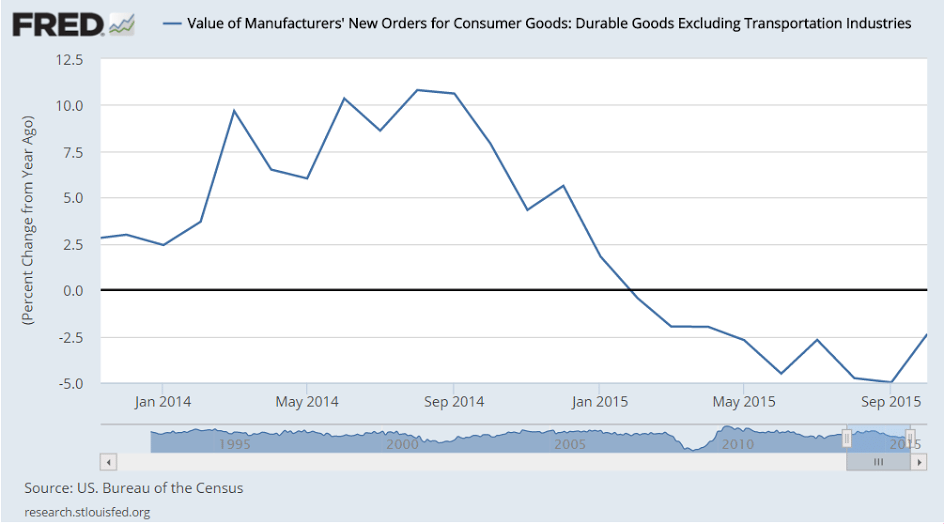
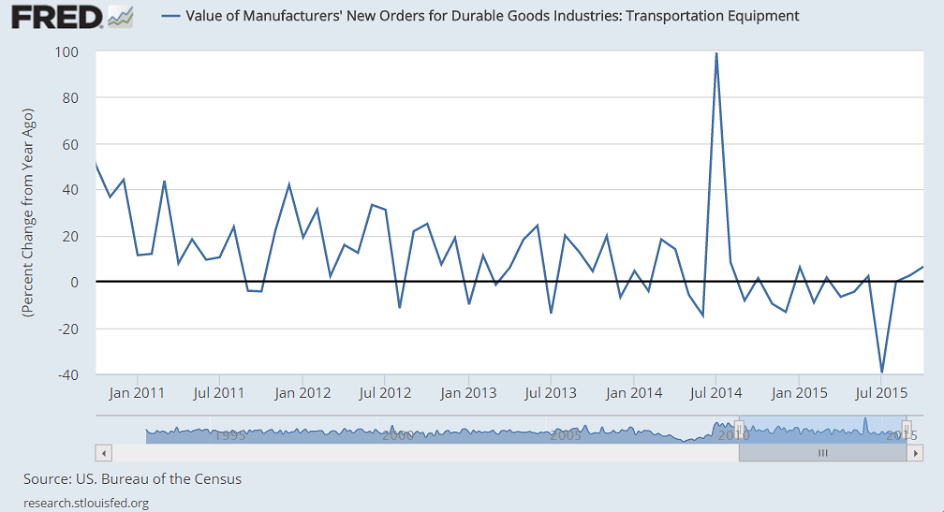
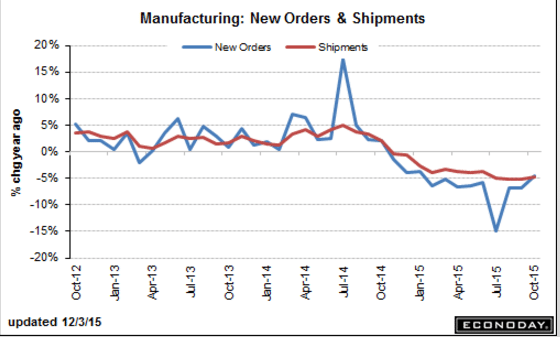
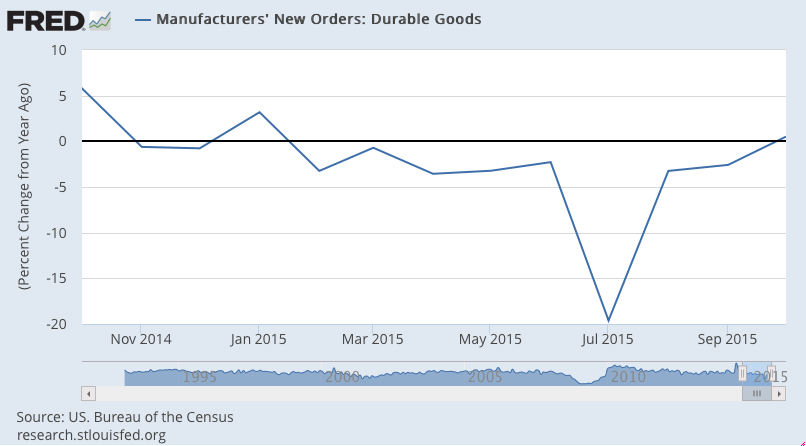
Yes, they were up, but there is a ‘seasonal’ aspect to it, including an air show, so the year over year chart is a bit more indicative of what’s going on and it’s still in negative territory. Also, vehicle orders declined, and inventories remained at levels that beg continuing production cuts.

Factory Orders
er-12-3-1
Highlights
Factory orders bounced sharply higher in October and, together with the bounce higher for manufacturing in the industrial production report, confirm what was a very solid month for the sector. Factory orders rose 1.5 percent in the month led by a 2.9 percent surge in durable goods orders (revised 1 tenth lower from last week’s advance release). This gain offsets a no change result for non-durable goods orders.

Excluding transportation, and orders tied to the biennial Dubai airshow, new orders rose a less exciting 0.2 percent. But indications from core capital goods are very strong with new orders surging 1.3 percent on top of a 0.5 percent orders gain in September. Turning to capital goods industries, new orders for machinery jumped 1.2 percent with computer orders up 5.9 percent.

A negative in the report is a surprising 2.0 percent decline for vehicle orders, a disappointment that may very well be reversed in coming months based on the sustained and unusual strength of vehicle sales.

Looking at other readings, total shipments fell 0.5 percent in October which is not a good start to the fourth quarter with core capital goods shipments also down 0.5 percent. But future shipments are certain to benefit from October’s orders gain. Inventories, which are widely seen as too high, did dip 0.1 percent but relative to shipments could do no more than hold steady at a ratio of 1.35. Unfilled orders are positive, ending two months of decline with a 0.3 percent gain.

Given that the factory sector has been in decline all year, the order data in this report are encouraging and should help offset concern from this week’s sub-50 reading in the ISM manufacturing report.
er-12-3-2

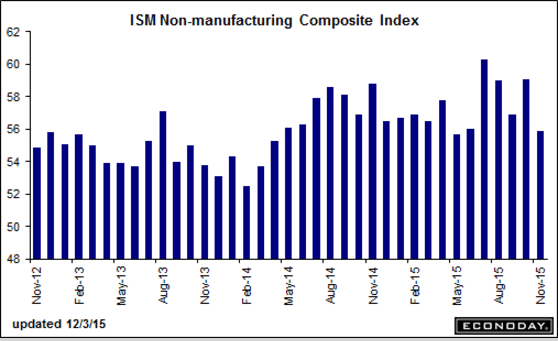
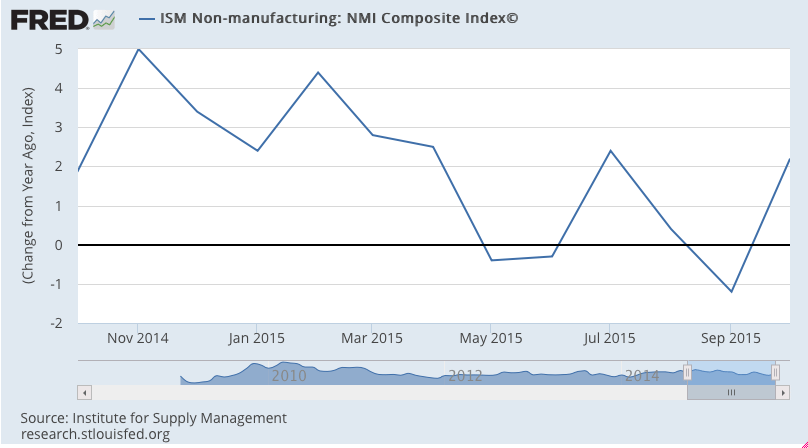
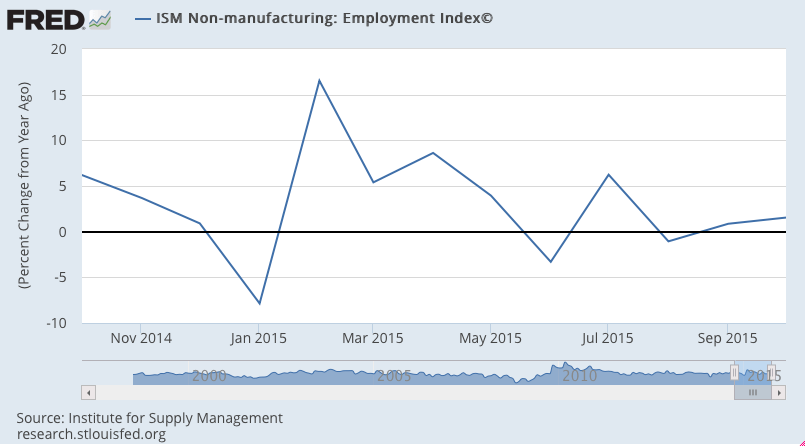
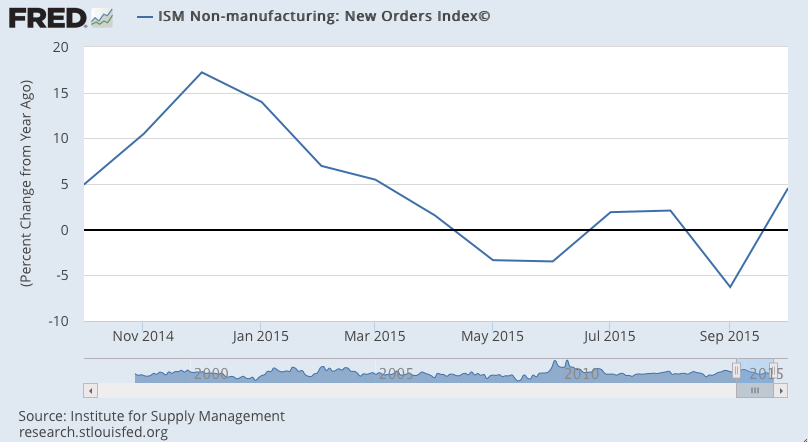
After a ‘normal’ lag non manufacturing is now clearly softening form the decline in aggregate demand that began with the oil capex collapse about a year ago, with nothing that I can see stepping up to replace it. And note that exports went into contraction as it’s been the non manufacturing exports that have held up as other exports declined:

ISM Non-Mfg Index
er-12-3-3
Highlights
Strength in ISM’s non-manufacturing sample is cooling but remains very solid, at 55.9 in November which is, however, the lowest rate of monthly growth since May. Readings across the report have also edged down to growth levels last seen in the second quarter including new orders (57.5), backlog orders (51.5), and employment (55.5). New export orders, at 49.5, show their first contraction since April. The breadth of strength across industries, with 12 showing growth and six in contraction, is positive but, like most of this report, less positive than prior months. Still, this report surged through the third quarter and into October making a step down to a lower rate no major surprise.
er-12-3-4

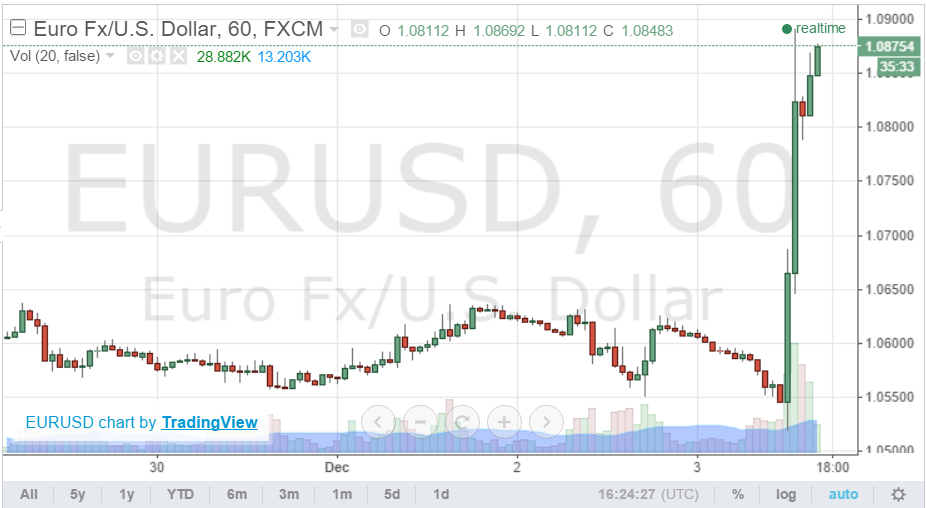
So Draghi increased the tax on deposits, and this time the euro went up. Maybe portfolios don’t have any more left to sell as the high and growing trade surplus drains them from global markets?

Euro Rises After ECB

The Euro gained around 0.58% to 1.0667 USD right after the ECB cut deposit facility rate by 10 bps to -0.3% and said further stimulus measures would be announced during the press conference.
er-12-3-5

And taking euro away from depositors hasn’t seem to help consumer spending:

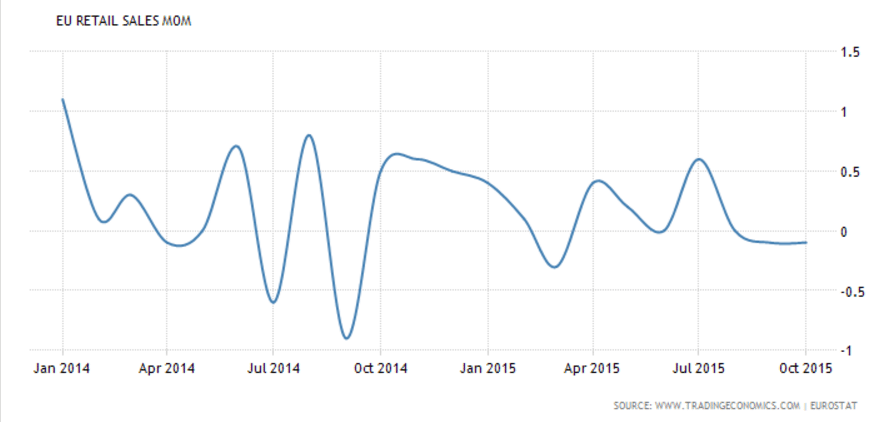
Euro Area Retail Sales Unexpectedly Fall

Retail sales in the Eurozone edged down 0.1 percent in October of 2015, following a 0.1 percent drop in September and no growth in August. Figures came below market expectations of a 0.2 percent gain, marking the longest period of no growth since mid-2013. Sales of food, drinks and tobacco shrank 0.5 percent, those of auto fuel fell 0.4 percent while sales of non-food products edged up 0.1 percent.

er-12-3-6

Business Roundtable, Mtg apps, ADP, Productivity, 1 year charts

More evidence the capital spending contraction is not over:

CEO Confidence Goes From Bad to Worse

Dec 1 (Fox Business) — CEO confidence in the U.S. economy is dwindling. The Business Roundtable CEO Economic Outlook Index for the 4Q, which looks out six months, fell to the lowest level in three years

For third consecutive quarter, U.S. CEOs cautious on economy

Dec 1 (Reuters) — The Business Roundtable CEO Economic Outlook Index fell 6.6 points to 67.5 in the fourth quarter. The long-term average for the index is 80.1 points. Of the 140 CEOs surveyed, 60 percent said they expected sales to increase over the next six months, down from 63 percent during the previous quarter. The proportion of CEOs who said they expected their capital spending to decrease over the next six months rose to 27 percent from 20 percent in the third quarter. CEOs said that regulation was the top cost pressure facing their business, followed by labor and health care costs.

For the first six months of 2016, CEO expectations for sales decreased by 3.2 points and their plans for capital expenditures decreased by 16.7 points. Hiring plans were essentially unchanged from last quarter when they declined by nearly 8 points.

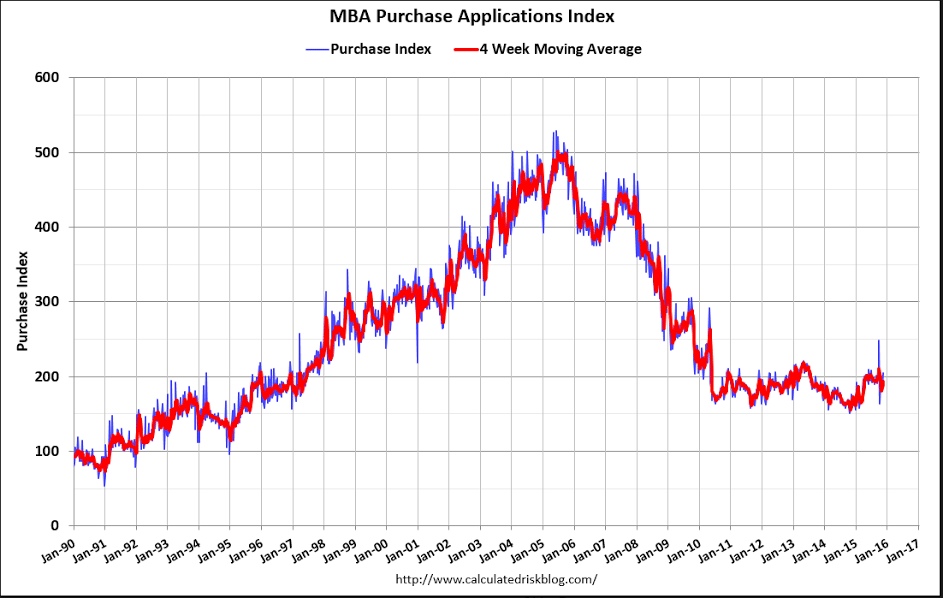
Nice to see purchase apps up but the 4 week moving average remains depressed:

MBA Mortgage Applications
er-12-2-27
Highlights
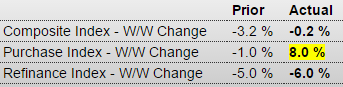
Purchase applications are moving sharply higher, up 8.0 percent in the November 27 week that, after a pause in the November 20 week, follows a 12.0 percent surge in the November 13 week. Year-on-year, purchase applications are up an eye-popping 30 percent in strength that points to much needed acceleration for underlying home sales. The rise in mortgage rates has triggered the move, encouraging buyers to step up and lock in rates before they move even higher. In contrast, demand for refinancing is easing, down 6.0 percent in the latest week. Rates edged lower in the week with the average for 30-year fixed mortgages ($417,000 or less) down 2 basis points to 4.12 percent.

er-12-2-26
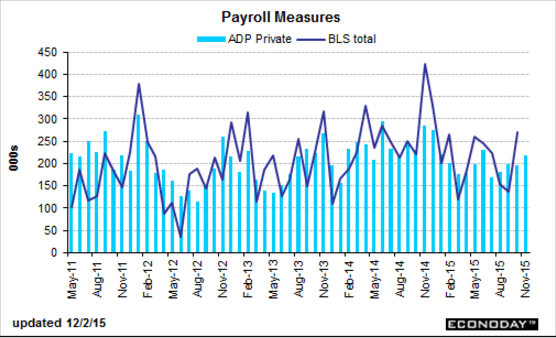
The ADP number is a forecast for Friday’s Non Farm Payroll numbers, based partially on their own payroll data. We’ll see Friday how accurate it is this time:

ADP Employment Report
er-12-2-25
Highlights
ADP is calling for strength in Friday’s employment report, at a higher-than-expected gain of 217,000 for government payrolls in November. Month-to-month, this report is not always an accurate indicator for the government’s data, forecasting a much lower reading than what turned out for October and a much higher reading than what turned out for September. But ADP’s trend has been accurate, that is steady payroll growth near 200,000 — and today’s report points to strength that would be slightly above trend.

er-12-2-24
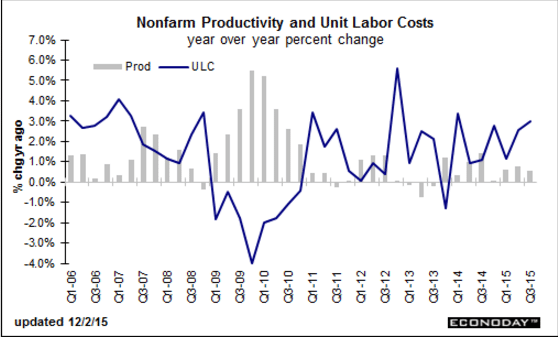
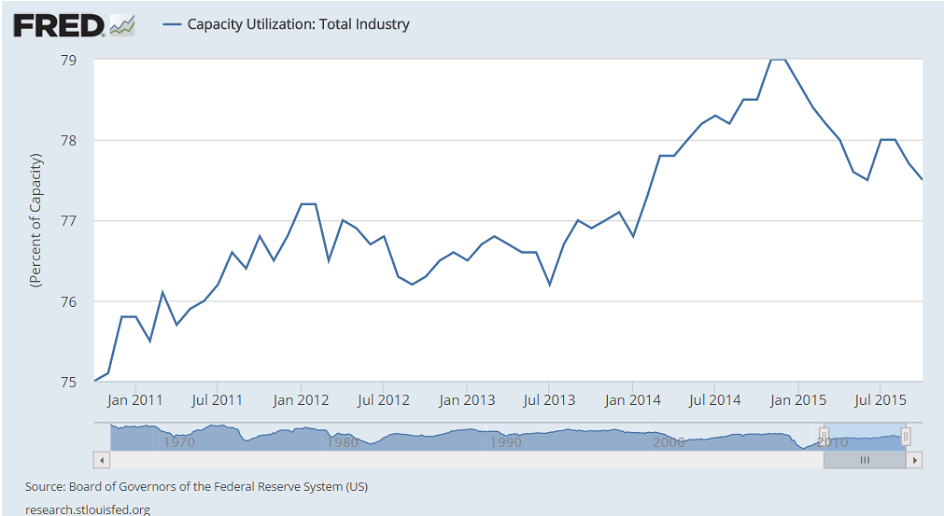
And seems to me what’s keeping unit labor costs up is low capacity utilization, as previously reported, and not wage increases. At some point business adjust with either fewer employees or higher output:
er-12-2-23
Note that this also peaked when oil related capital expenditures collapsed a year ago:

er-12-2-22
In fact it was about a year ago when oil prices fell below costs of production, triggering cuts in capital expenditures. At the time the oil price drop was universally deemed an ‘unambiguous positive’ for the US economy. I wrote that it looked to me like an unambiguous negative, listing my reasons why it would not support consumption or investment, but would instead induce a general economic deceleration with a high probability of negative growth, particularly after subsequent revisions of data.

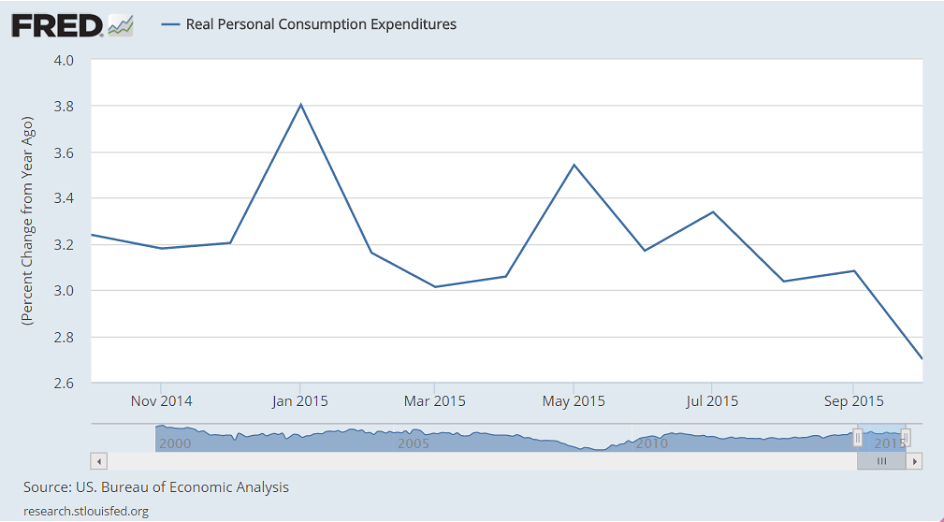
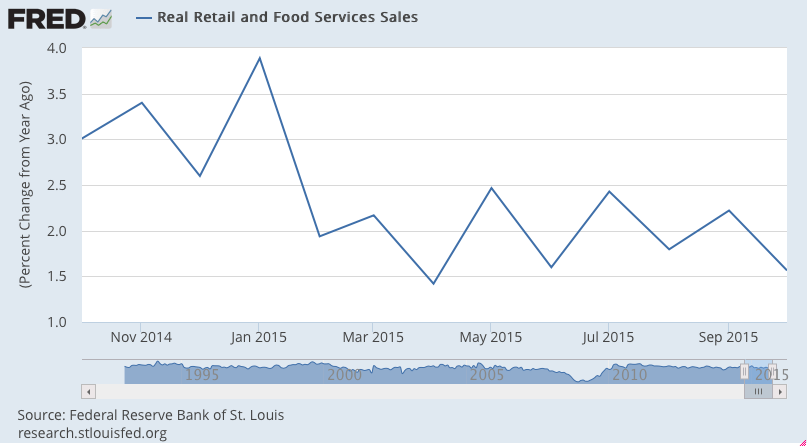
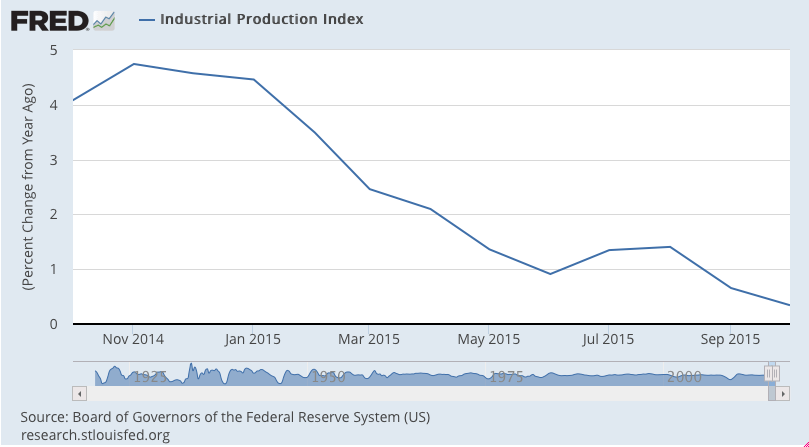
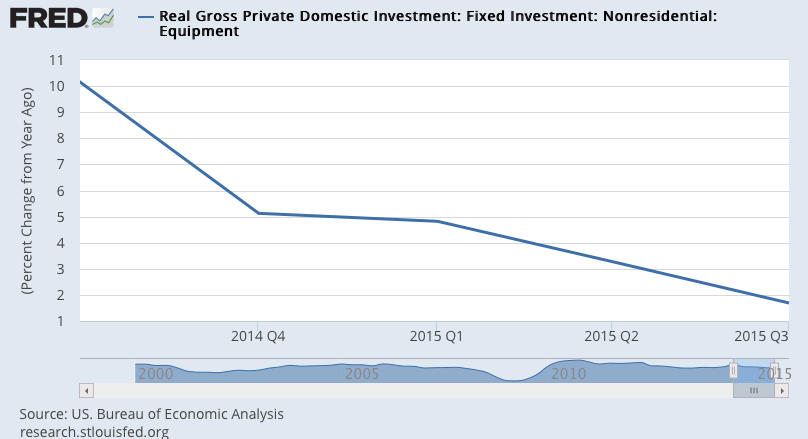
So let’s look at a few 1 year charts to isolate what’s happened:

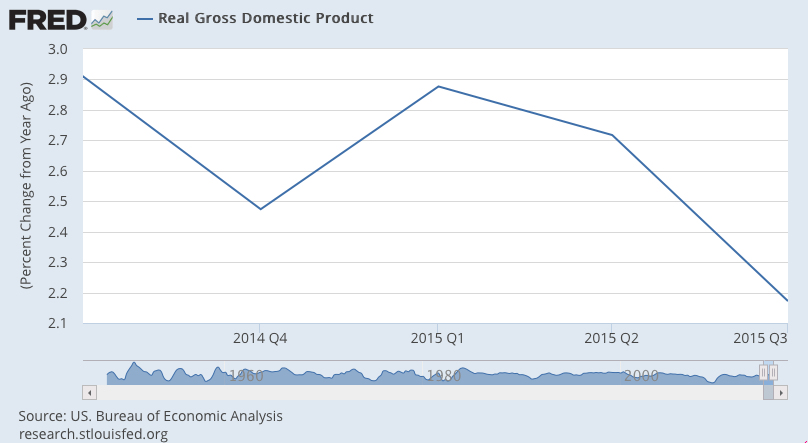
The Fed was looking for 3%+ as ‘monetary policy kicked in’ and oil prices helped consumption.

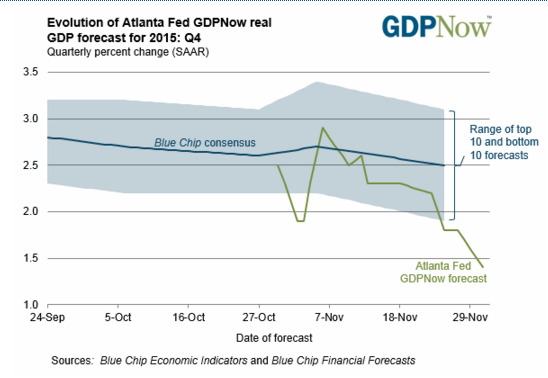
And Q4 is now looking even worse:
er-12-2-21

er-12-2-20

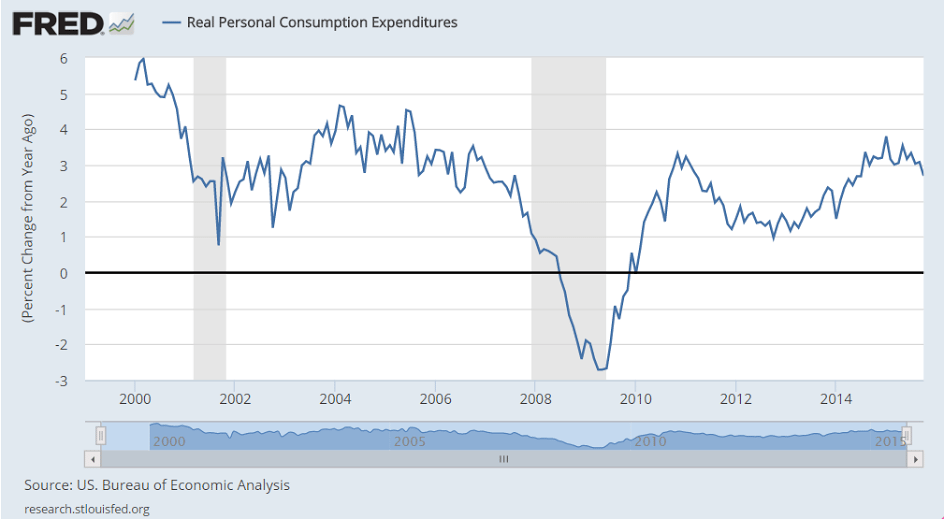
Consumption has decelerated:
er-12-2-19

er-12-2-18

Industrial production not so good:
er-12-2-17

Nor investment:
er-12-2-16

Or manufacturing:
er-12-2-15

er-12-2-14

er-12-2-13

er-12-2-12

How about employment?
er-12-2-11

er-12-2-10

er-12-2-9

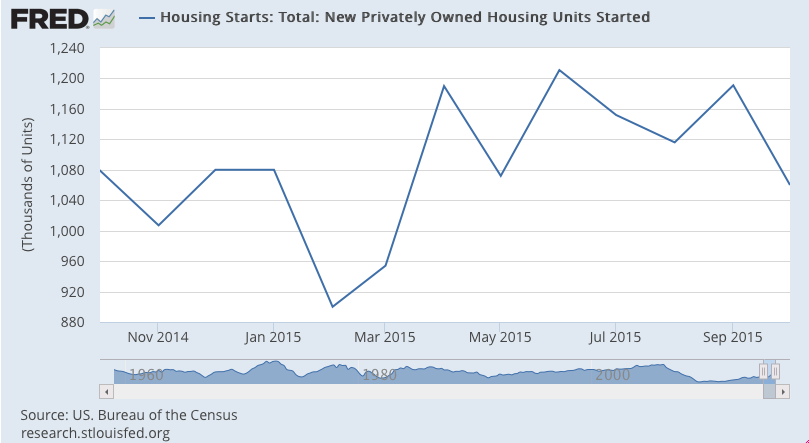
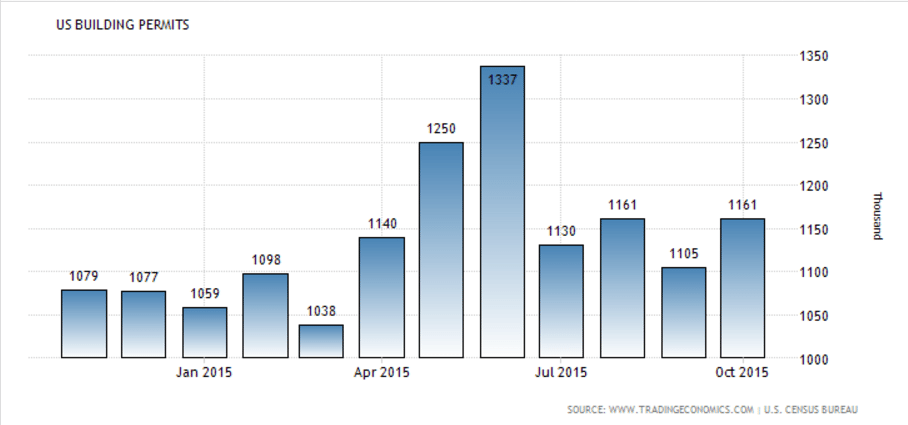
Housing starts are back to where they started from, with a mini surge related to the NY tax bread the expired in June:
er-12-2-8

Non manufacturing slower to react, but sagging as well:
er-12-2-7

er-12-2-6

er-12-2-5
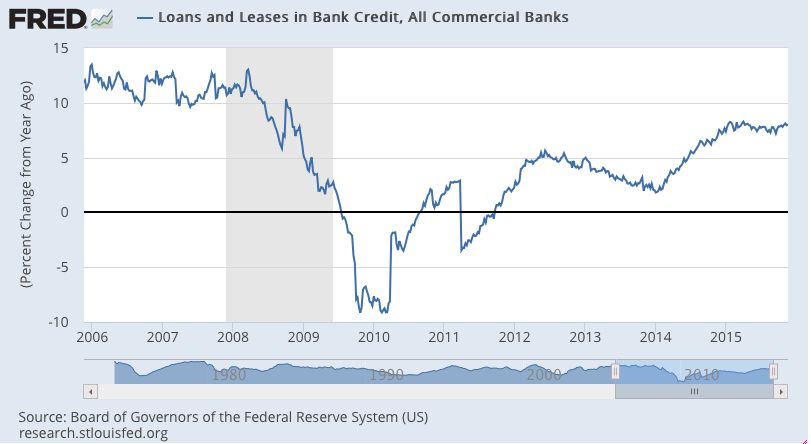
And credit aggregate growth has slowed as well:
er-12-2-4

er-12-2-3

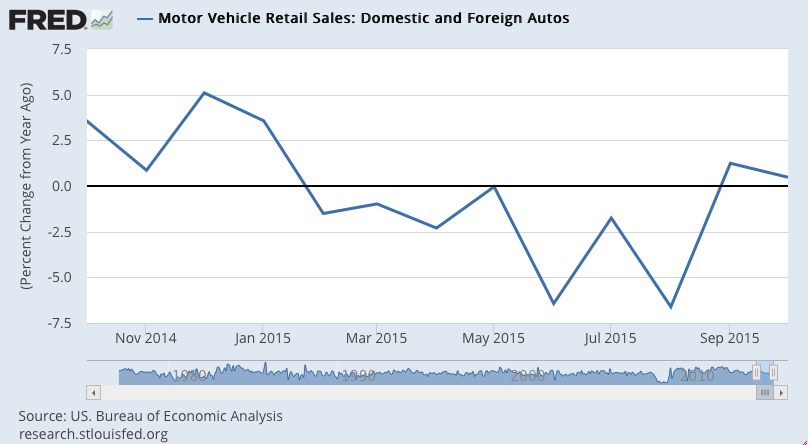
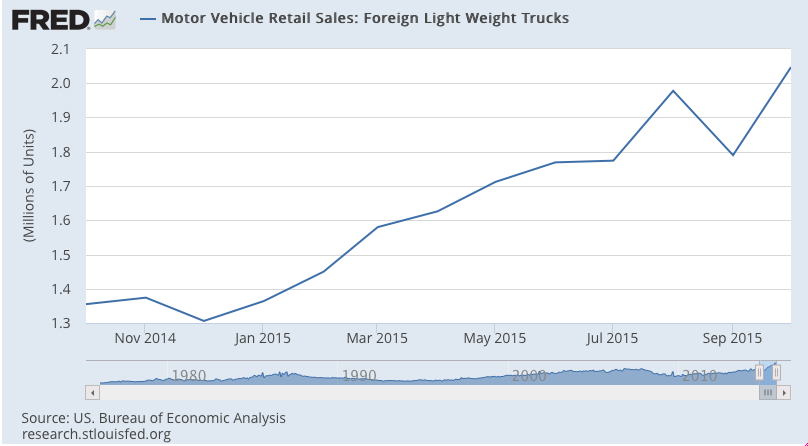
Autos have been the ‘bright spot’ but turns out the growth has been from imports:
er-12-2-2

er-12-2-1

Recent interview transcript, Car sales, Fed Atlanta GDP forecast

Transcript: Interview with Economist Warren Mosler

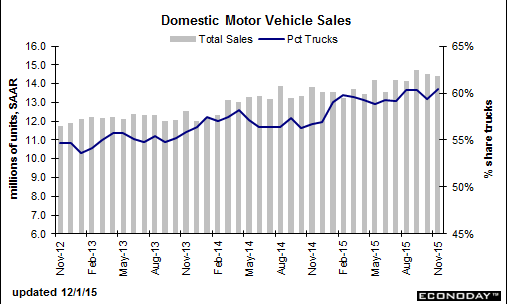
Interesting- total sales rate unchanged, but domestic vehicle sales rate down again.

In other words, not currently growing:

Motor Vehicle Sales
er-12-1-12
Highlights
Consumers have really shown their strength the last three months, buying vehicles at a 12-year high annualized rate of 18.2 million. That’s right, for three months in a row. The results, however, do not point to a monthly gain for the motor vehicle component of the November retail sales report — but they do point to a foundation of strength.

The composition of November’s unit sales shows a shift higher for light truck sales, no doubt the result of low gasoline prices, that offsets a shift lower for cars. Low gas prices are keeping more money in consumer pockets, reflected not only in a rising savings rate but also in exceptionally strong vehicle sales.
er-12-1-13

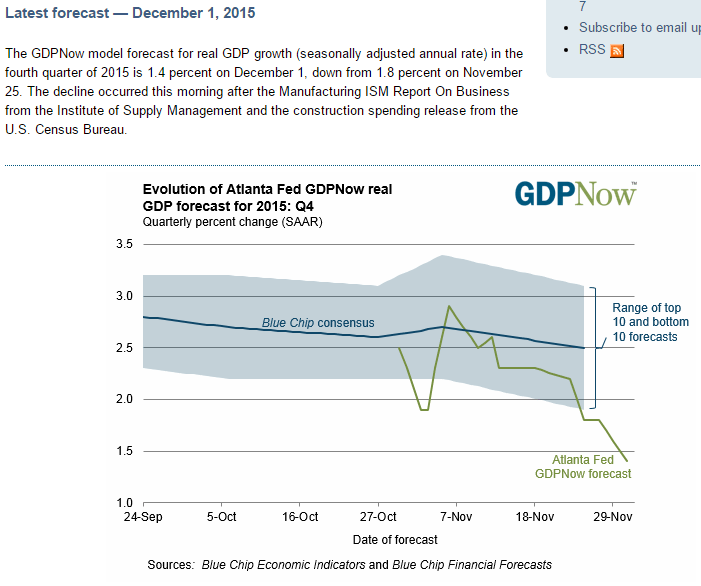
Down again, now forecasting only 1.4% for Q4:
er-12-1-14

Saudi output, Redbook sales, PMI, ISM

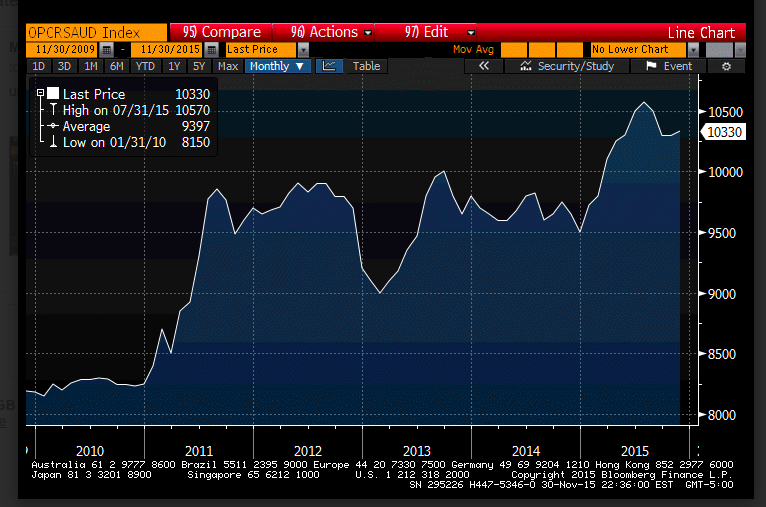
While demand for Saudi crude is up a bit, seems it’s still far below their presumed 12 million or so bpd capacity, and their strategy has been to lower their prices to the point where they are selling their full capacity:
er-12-1-3

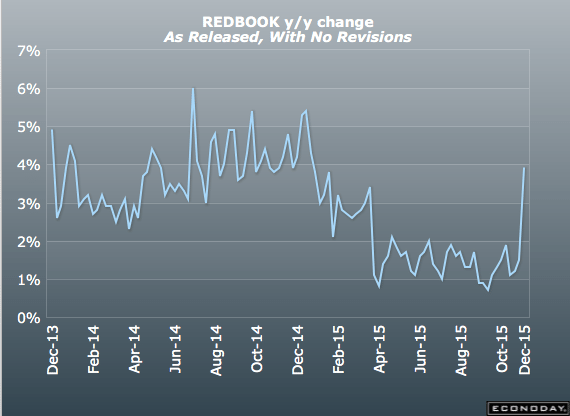
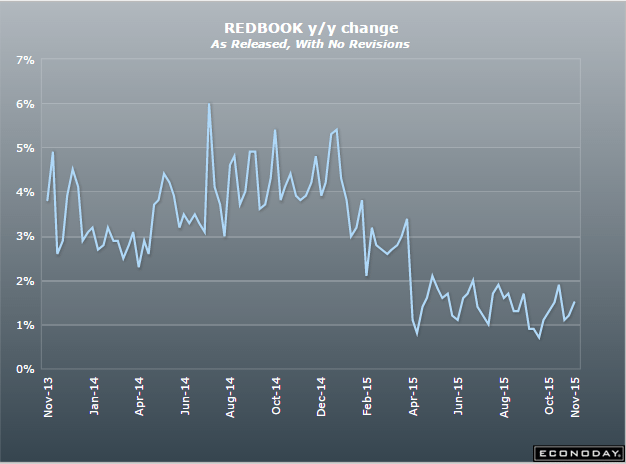
Nice bounce here, as the year over year comparisons get ‘easier’:

Redbook
er-12-1-2
Highlights
Store sales surged in the November 28 week, the week that includes Black Friday. Redbook’s same-store year-on-year sales tally jumped to plus 3.9 percent, more than doubling the pace of prior weeks and the strongest pace since the very beginning of the year. Yet the report is not upbeat, saying shoppers were drawn in by deep discounting. Other commentary on Black Friday notes that shoppers tend to shop for themselves, seeking big ticket items at a discount in buying that is not predictive of holiday sales. Still, the gain in this report offers positive evidence of consumer strength. Watch for motor vehicle sales later today for further evidence of consumer strength.

er-12-1-1
This is the suspect one:

PMI Manufacturing Index

er-12-1-4

Highlights
Markit’s U.S. manufacturing sample, which has been reporting much stronger levels of activity than others, reports slower rates of growth in November. The final index for the month is 52.8 for a 2 tenths improvement from the flash but down a tangible 1.3 points from October.

Softness in new orders, rising at their slowest pace in just over two years, is the chief reason for the dip. Export orders are in contraction, once again the result of weak foreign demand made weaker for U.S. goods by the strength of the dollar. Weakness in new orders is compounded by the first contraction in backlog orders since November last year. With orders down, output moderated in the month and manufacturers cut back inventories of finished goods.

Hiring is slowing and supply deliveries are improving, both indicative of weakness. Price readings remain mute.

Though levels in this report are still pointing to growth, their weakness relative to prior months points perhaps to contraction in November for the factory sector which, however, bounced back in October, at least based on the industrial production and factory order reports. Watch for the ISM report coming up at 10:00 a.m. ET.

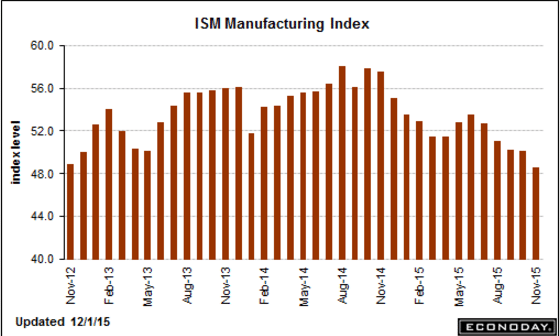
Particularly bad:

ISM Mfg Index
er-12-1-5

Highlights
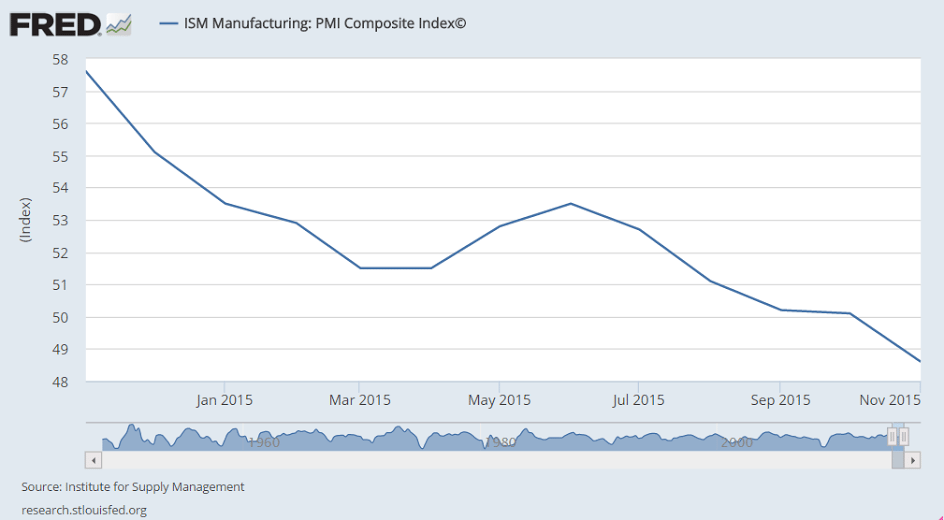
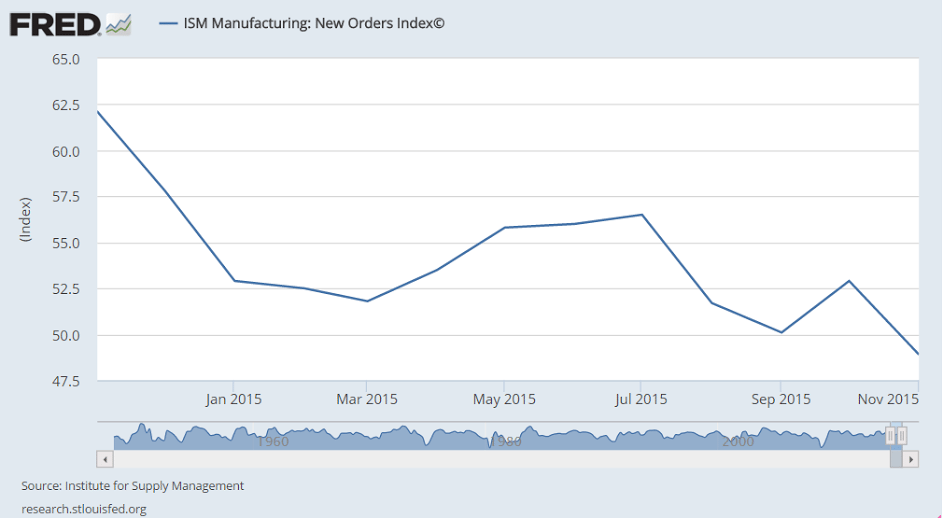
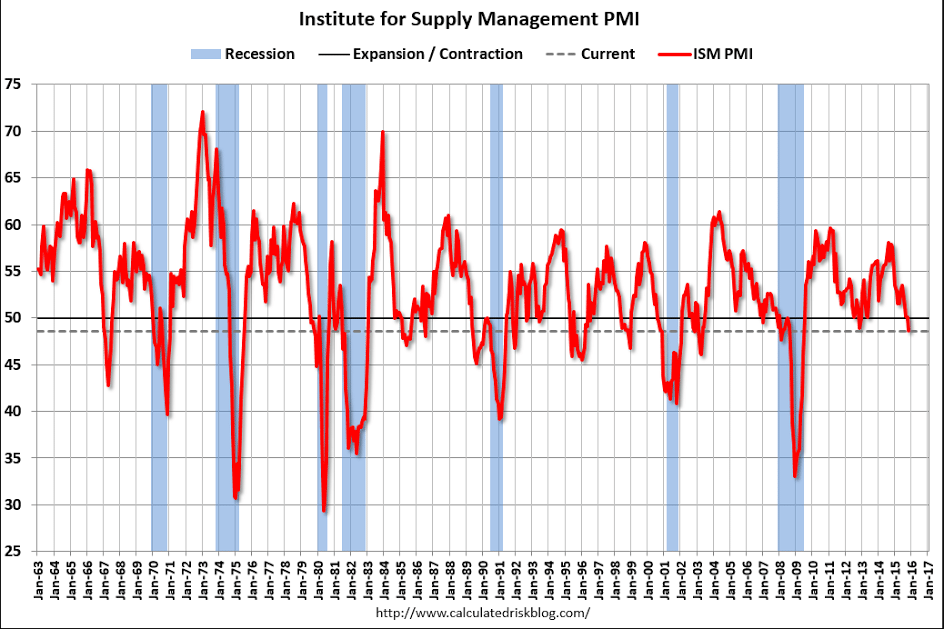
After skirting right at the breakeven 50 line since September, ISM’s manufacturing index broke below in November to 48.6 which is more than 1 point below Econoday’s low-end estimate the lowest reading since June 2009. The decline includes a significant dip for new orders which are down 4.0 points to 48.9 and the lowest reading since August 2012. At 43.0, backlog orders are in a six-month streak of contraction. With orders down, ISM’s sample cut back on production, down nearly 4 points to 49.2, and cut back on inventories, down 3.5 points to 43.0. Employment firmed but remains soft at 51.3. This report is closely watched and will raise expectations for a quick reversal in the factory sector which, in October at least, showed glimpses of strength.

Note the deceleration since oil related capital expenditures collapsed about a year ago:
er-12-1-6

er-12-1-7

Not bad vs last month, but still depressed historically and as a % of GDP.

And in general it’s been softening since the surge in front of the NY tax breaks expired in June.

Construction Spending
er-12-1-8

Highlights
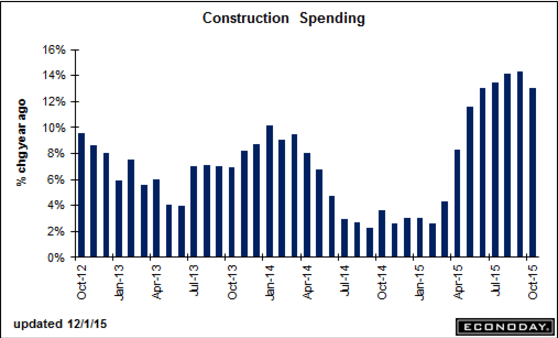
Construction is one of the highlights of the 2015 economy with spending up a solid 1.0 percent in October for the best rate since May. Despite mixed signals from the housing sector, spending on residential construction is very solid, up 1.0 percent in October for a seventh straight gain and all of them convincing. Year-on-year, residential construction is up 16.6 percent vs 13.0 percent for total spending. Private non-residential spending rose 0.6 percent in October with the year-on-year rate at plus 15.3 percent. Public spending is holding down totals with the educational component unchanged in the month though Federal spending did jump, up 19.2 percent for a year-on-year rate of plus 10.7 percent which leads the public components. This report points to solid fourth-quarter contribution from construction.
er-12-1-9

From a previous report:
er-12-1-10
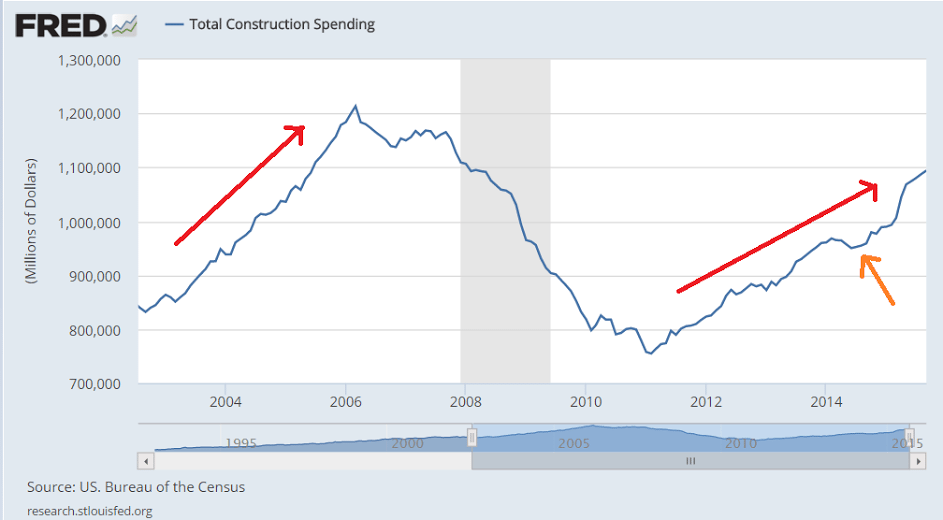
This chart hasn’t updated yet, and so is only through September, but you can see how the growth rate this cycle is well below last cycle, and how year over year comparisons will be a bit misleading for a while due to the dip last year:
er-12-1-11

Saudi production, Restaurant index

Just came out.

Saudis still producing and selling far below their stated ‘cap’:

OPEC November Crude Output Down 33,000 Bbl/Day to 32.121 Mln
2015-11-30 17:55:55.463 GMT

New York, Nov. 30 (Bloomberg) — Crude-oil production from the 12 OPEC members in November declined 33,000 barrels a day from October, the latest Bloomberg survey of producers, oil companies and industry analysts shows. Figures are in the thousands of barrels a day.


Nov. Oct. Monthly 1/1/2012 Nov. vs Est.
OPEC Country Est. Output Change Target* Target Cap(@)
Algeria 1,100 1,100 0 — — 1,150
Angola 1,840 1,814 26 — — 1,870
Ecuador 537 544r -7 — — 540
Iran 2,800 2,800r 0 — — 2,900
Iraq* 4,321 4,217r 104 — — 4,400
Kuwait# 2,850 2,820 30 — — 2,950
Libya 375 430 -55 — — 1,550
Nigeria 1,878 2,019 -141 — — 2,200
Qatar 670 640 30 — — 780
Saudi Arabia# 10,330 10,300r 30 — — 12,500
U.A.E. 2,940 2,970 -30 — — 3,150
Venezuela 2,480 2,500 -20 — — 2,500
Total OPEC-12 32,121 32,154r -33 30,000 2,121 36,490
Total OPEC-11 27,800 27,937r -137 — — 32,090

Yes, it’s still expanding, but seems the rate peaked as oil capex collapsed and its since been decelerating:

rpi

Posted in Oil

Chicago PMI, Pending home sales, Dallas Fed

Another bad one, reversing last month’s suspect move up:

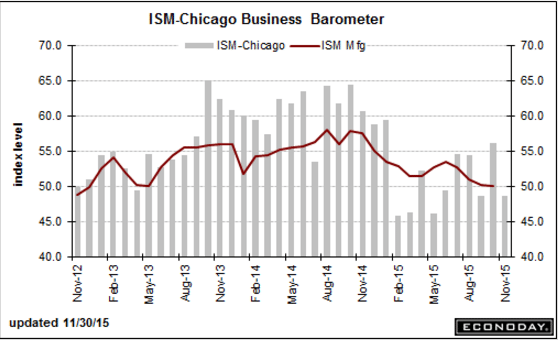
Chicago PMI
er-11-30-9
Highlights
Volatility is what to expect from the Chicago PMI which, at 48.7, is back in contraction in November after surging into strong expansion at 56.2 in October. Up and down and up and down is the pattern with prior readings at 48.7 in September (the same as November) and 54.4 in August.

New orders are down sharply and are back in contraction while backlog orders are in a 10th month of contraction. Production soared nearly 20 points in October but reversed most of the gain in November. Despite November’s weakness, employment are up slightly. Prices paid is in contraction for a fourth straight month.

Though this report points to November weakness for the whole of the Chicago economy, the volatility of the report should limit its impact on the month’s outlook.

Along with the ISM, it’s decelerated with the collapse in oil related capital expenditures, and nothing yet has come along to fill that spending gap (apart from building unsold inventory):
er-11-30-10

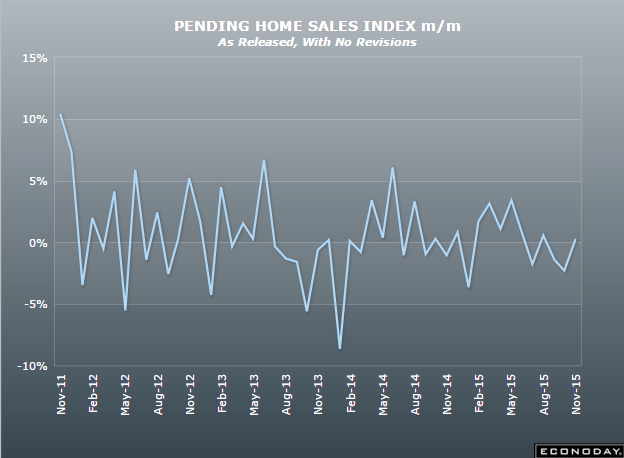
More bad, and it’s not like mortgage rates aren’t low:

Pending Home Sales Index
er-11-30-11
Highlights
Sales of existing homes have been soft and are not likely to pick up in the next few months based on October’s pending sales index which is up only 0.2 percent. Year-on-year, the index is up 3.9 percent which matches the rate of gain for final sales during October. Flatness, unfortunately, is the theme.

The Northeast did the best in October, up 4.5 percent for a year-on-year plus 6.8 percent. The West is next with pending sales up 1.7 percent for a year-on-year gain of 10.4 percent. Bringing up the rear are the Midwest, down 1.0 percent on the month for a year-on-year plus 3.3 percent, and the largest region which is the South, down 1.7 percent in October for the only negative year-on-year reading of minus 0.3 percent.

The National Association of Realtors cites low supply of available homes as a negative for sales and warns that prices in some markets are rising too fast, especially for first-time buyers. The association cites strength in the Northeast as an example, a region where price appreciation is lower and supply greater.

The new home market isn’t doing that much better than existing homes, with sales up 4.9 percent year-on-year in the latest available data. Watch for construction spending on tomorrow’s calendar, one aspect of the housing market that has been showing solid strength.
er-11-30-12

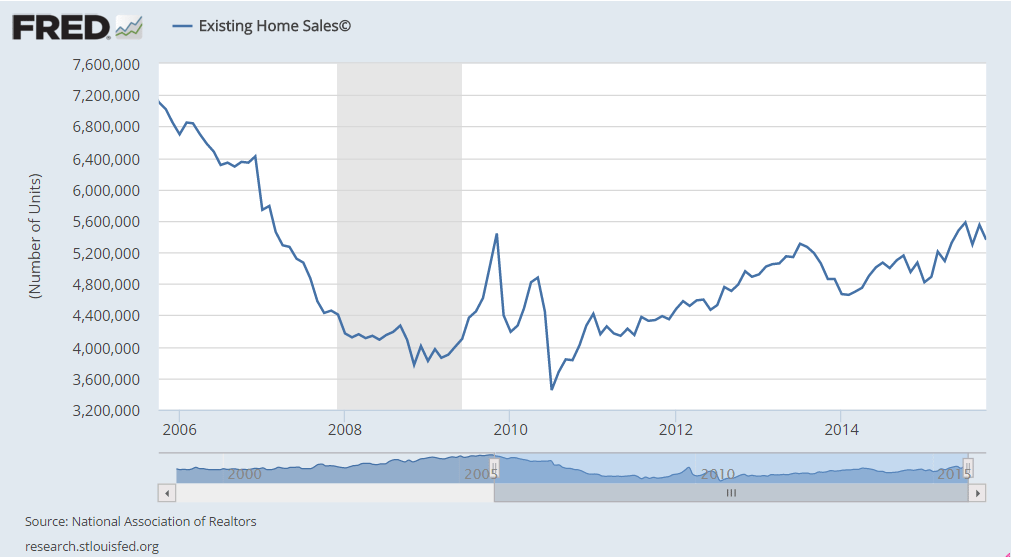
And in sync with last week’s existing home sales report also showing flatness at low levels:
er-11-30-13
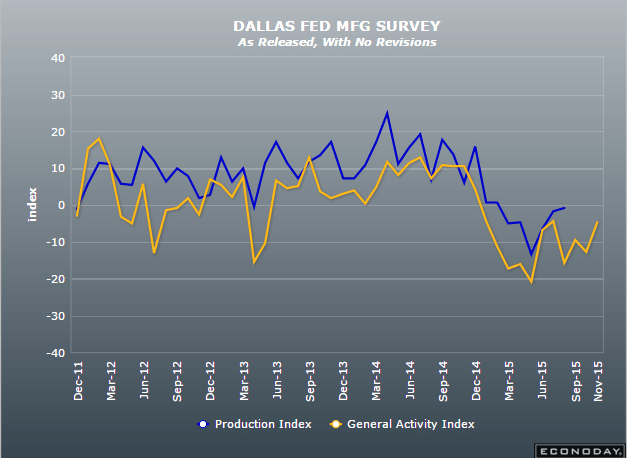
Not as bad as expected but still in contraction mode:

Dallas Fed Mfg Survey
er-11-30-14
Highlights
The Dallas Fed’s general activity index is in contraction for an 11th consecutive month, at minus 4.9 for November which is, however, improved from October’s minus 12.7. The Econoday consensus was calling for an 11.0 point decline.

Order readings are also negative, at minus 1.6 for new orders, which is a 6 point improvement, but at minus 7.3 for the growth rate of new orders which is little changed from October and in the negative column for the 13th month in a row.

On the plus side is a second straight increase for production, up 4 tenths to 5.2. And readings on the business outlook are steady to higher.

But price data in the report are pushing further into negative ground with finished goods prices at minus 12.1 for an 11th straight negative reading, underscoring the deflationary effects of low energy prices on the Texas economy.

This report rounds out what is a flat to negative run of regional indications for the nation’s manufacturing sector during November, a sector that continues to be hurt by weak export demand and low prices.
er-11-30-15

Credit check

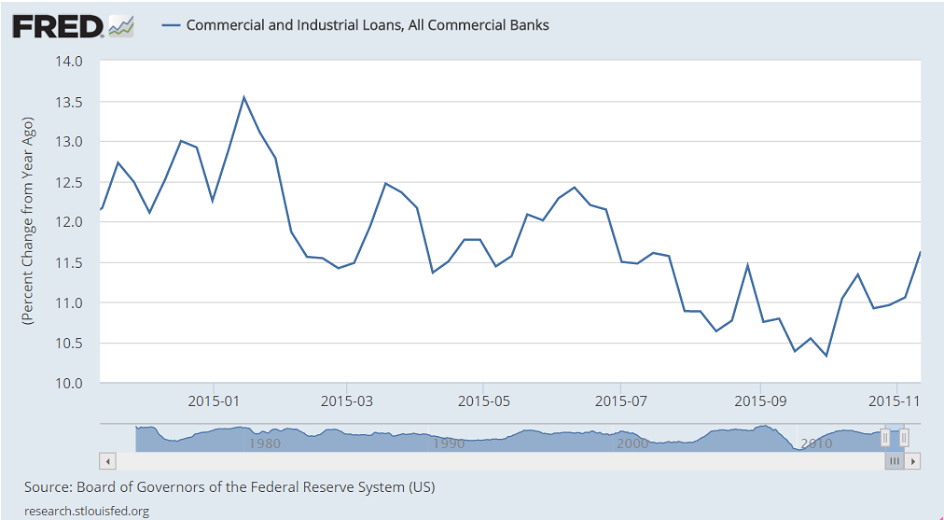
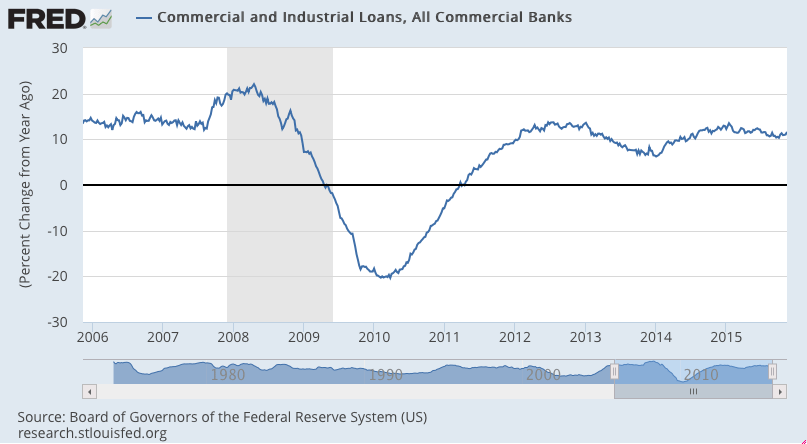
Nothing of consequence here. Growth still below prior cycles and not accelerating as it was beginning to do before oil capex collapsed:
er-11-30-1
er-11-30-2

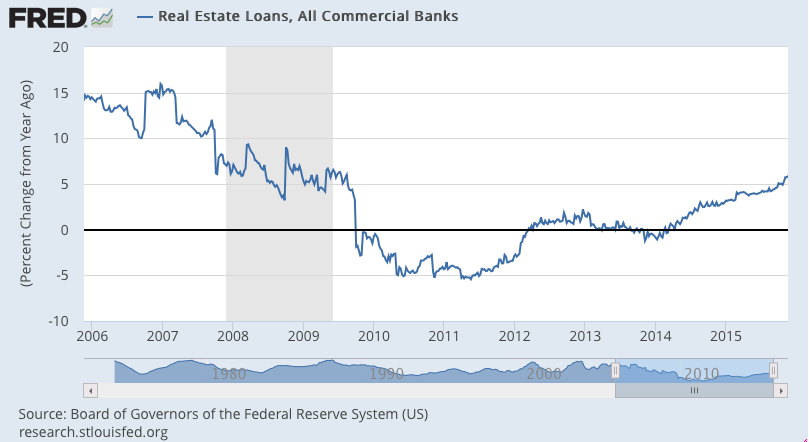
While growth of real estate lending is still far below the prior cycle, it has been increasing, probably due to fewer ‘all cash’ purchases, and the modest recovery in prices and sales:
er-11-30-3
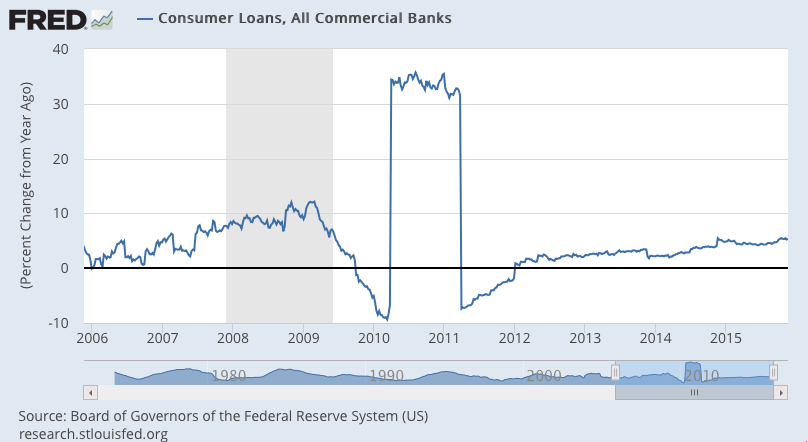
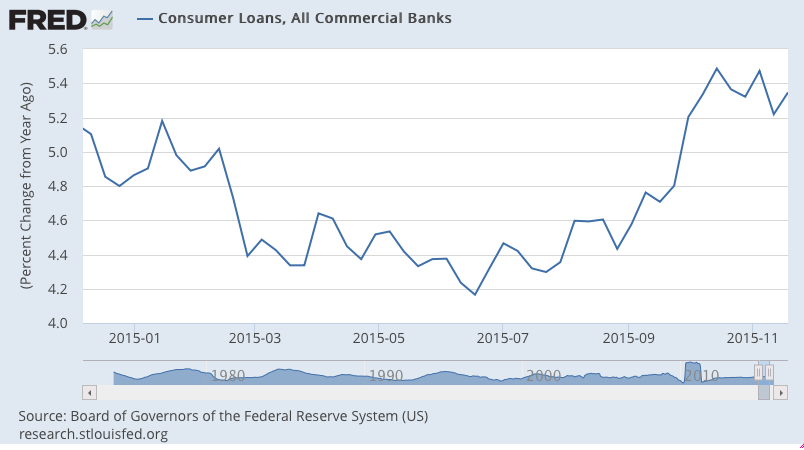
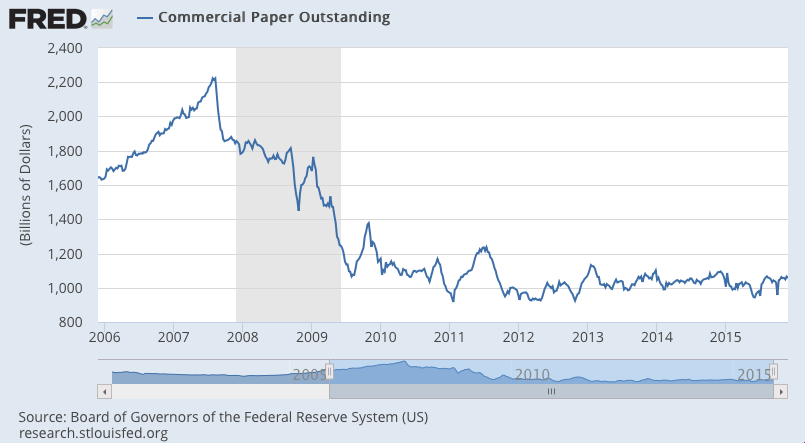
Consumer credit growth remains modest and, if If anything, is softening most recently:
er-11-30-4
er-11-30-5
er-11-30-6

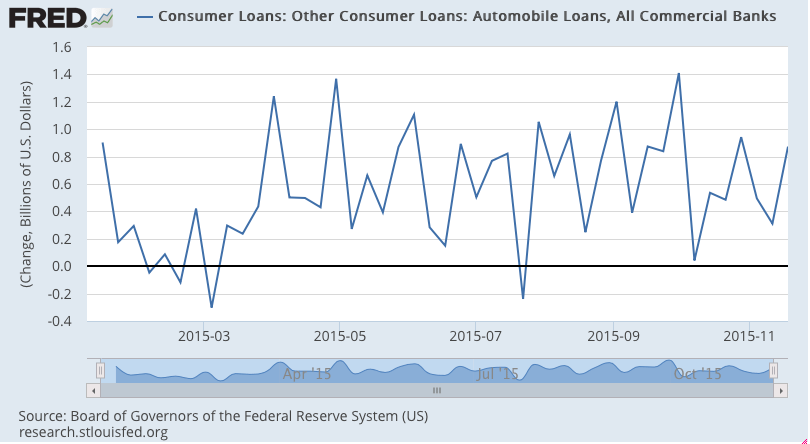
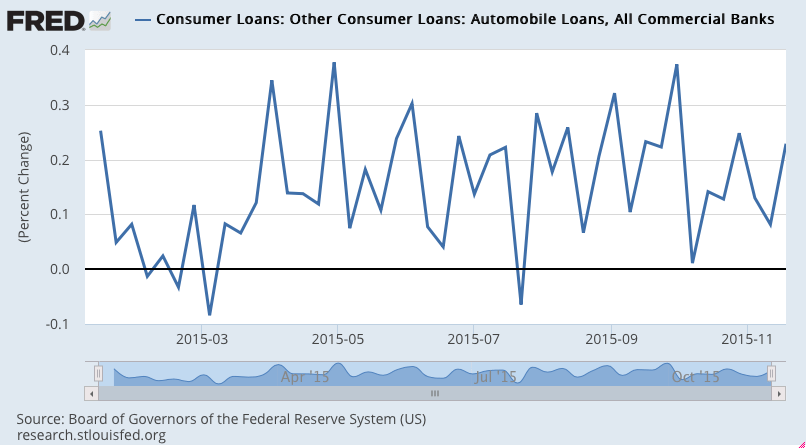
Looks to me like car loan growth is slowing a bit:
er-11-30-7
er-11-30-8

Mtg prch apps, Durable goods, Personal income and outlays, New home sales, Consumer Sentiment, PMI services

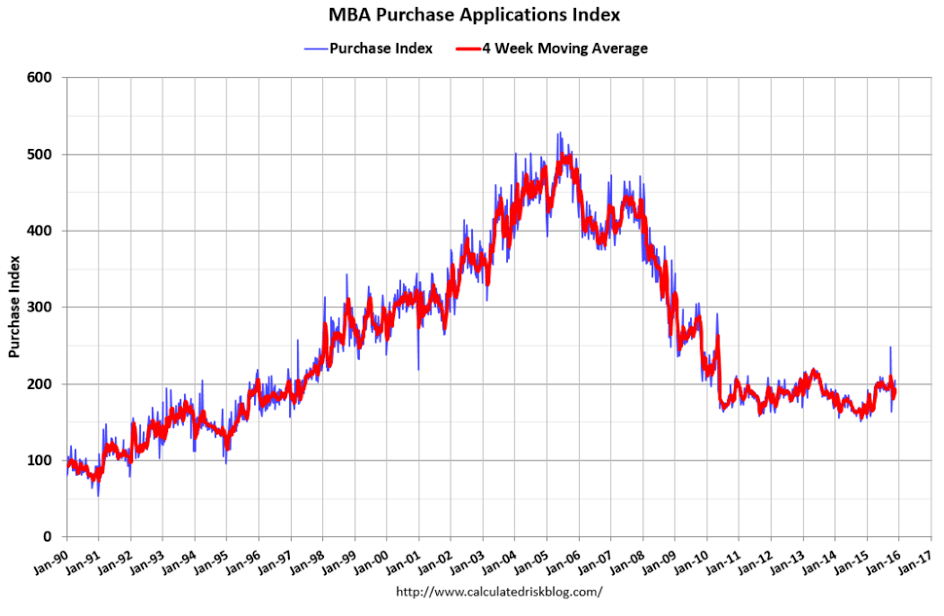
Purchase apps have been flat to down for quite a while now,
and the year over year comp will be reflecting that in a few months as well:

United States : MBA Mortgage Applications
er-11-26-1
Highlights
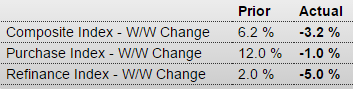
After spiking sharply in the prior when rates jumped and triggered concern they would move even higher, mortgage application volumes eased in the November 20 week as rates settled back with purchase applications down 1.0 percent and refinancing applications down 5.0 percent. However, purchase applications, up a stunning 24 percent year-on-year, are pointing very strongly to underlying gains for home sales. The average for conforming 30-year mortgages ($417,000 or less) fell 4 basis points to 4.18 percent after rising 6 basis points in the prior week.
er-11-26-2

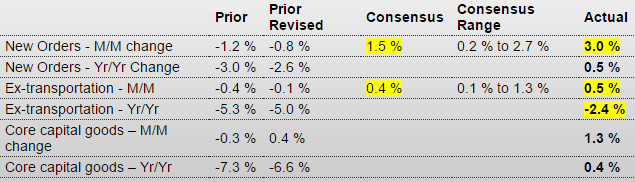
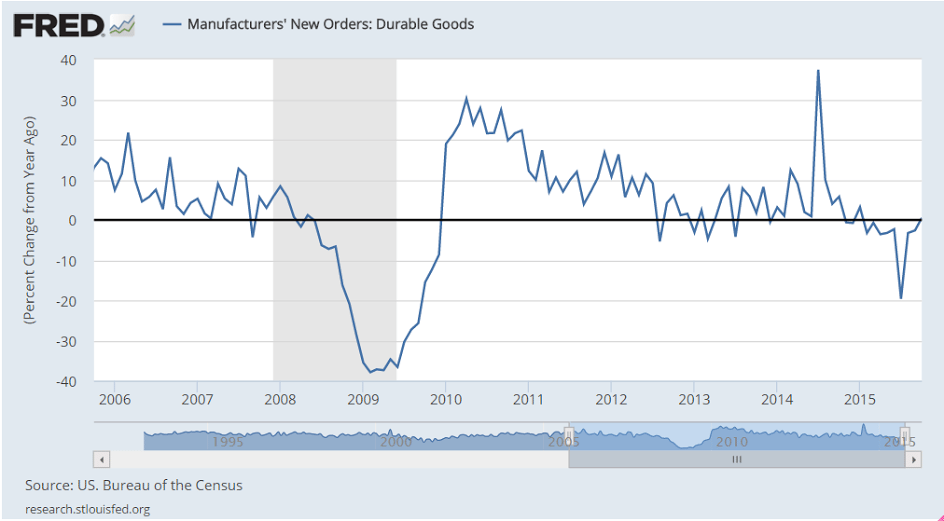
Up more than expected, and the details highlighted below and year over year chart still looking recession:

United States : Durable Goods Orders
er-11-26-3

Highlights
The factory sector is showing life with new orders in October up a very solid 3.0 percent which just exceeds Econoday’s high-end forecast. Excluding transportation, and orders tied to the biennial Dubai airshow, new orders rose 0.5 percent which is also solid and higher than expected. And underscoring the gains in a significant way is sudden strength in orders for core capital goods, up an outsized 1.3 percent with the prior month revised from a decline to a 0.4 percent gain.

Looking at details, commercial aircraft orders surged more than 200 percent, which again is an anomaly, though in a sign of weakness out transportation, orders for motor vehicles fell 2.9 percent in the month. But this decline is probably not the beginning of a trend given still very strong vehicle sales.

Turning to capital goods industries, new orders for machinery jumped 1.6 percent with computer orders up 5.5 percent and communications equipment up 1.8 percent. Total year-on-year core orders are suddenly in the plus column, at 0.4 percent for the first positive reading since January. These gains speak to a rebound in expectations among businesses which perhaps are now looking for strength in the new year.

Among other readings, total shipments fell 1.0 percent in October which is not a good start to the fourth quarter with core capital goods shipments also lower, down 0.4 percent. Inventories do offer good news, down 0.2 percent amid concern that levels are too high right. And relative to shipments, if not orders, inventories are too high with the inventory-to-shipments ratio jumping to 1.66 from 1.64. Unfilled orders, however, are positive, ending two months of decline with a 0.3 percent gain.

The order data in this report are very encouraging and follow strength in the manufacturing component of the industrial production report. Together they point to a year-end rebound underway for what had been, at least, an export-depressed factory sector. As far as a December rate hike, this report will offset, at least to a degree and perhaps to a large degree, the softness in this morning’s PCE price data.
er-11-26-4

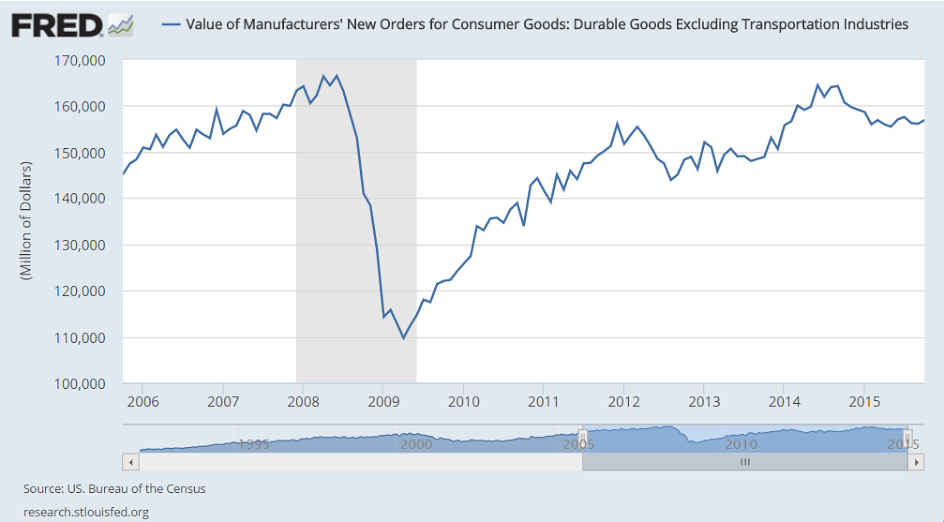
This is for consumer goods:
er-11-26-5

er-11-26-6

er-11-26-7
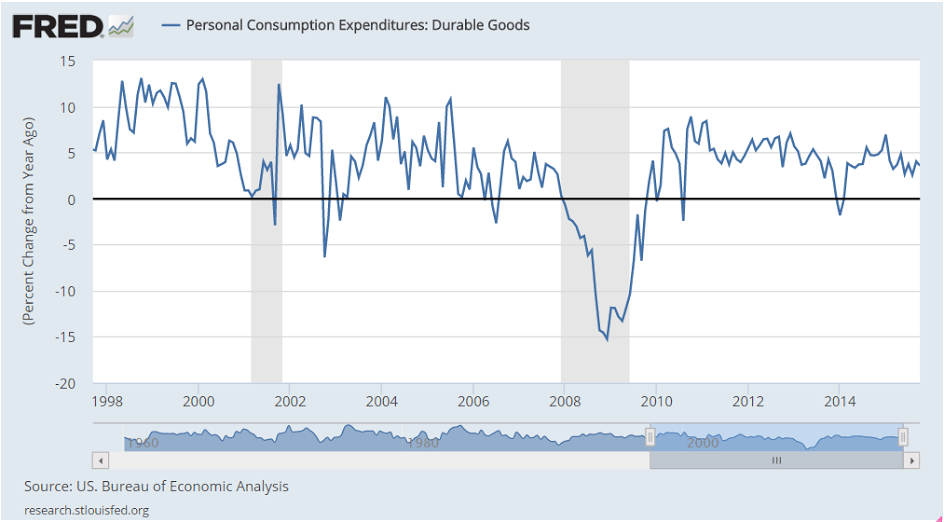
PCE for durable goods growth has been working its way lower ever since oil related capex collapsed about a year ago:
er-11-26-8

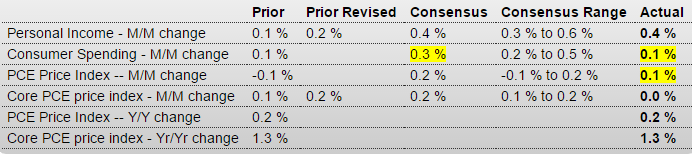
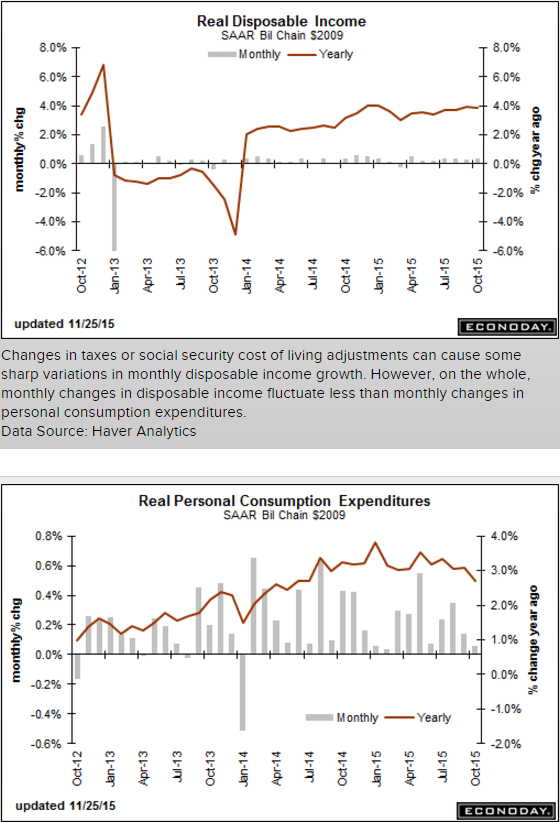
Spending is low and below expectations, and it’s spending that ultimately provides the income. Also, inflation related data remains depressed, perhaps giving the Fed pause regarding rate hikes. But perhaps not…:

United States : Personal Income and Outlays
er-11-26-9

Highlights
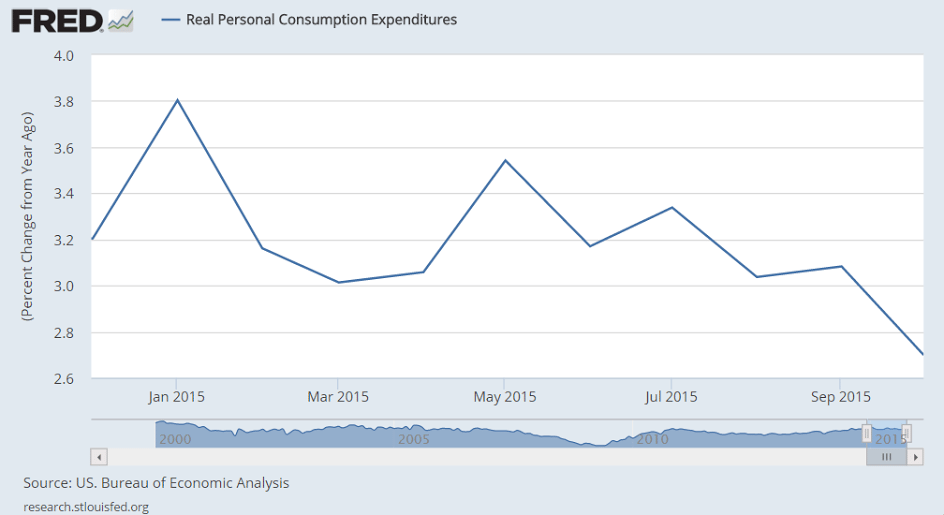
The core PCE is the Fed’s most important inflation reading and it is not showing rising pressure, coming in unchanged in October, vs an expected gain of 0.2 percent, with the year-on-year rate at 1.3 percent which is also unchanged. Consumer spending also proved soft, up only 0.1 percent vs expectations for a 0.3 percent gain. Spending shows flat readings across categories including only a small gain for services which usually are strong.

The income side is better, hitting expectations at a 0.4 percent gain with wages & salaries showing an outsized gain of 0.6 percent. And the outlook for future spending is solid with a strong 3 tenths rise in the savings rate to 5.6 percent.

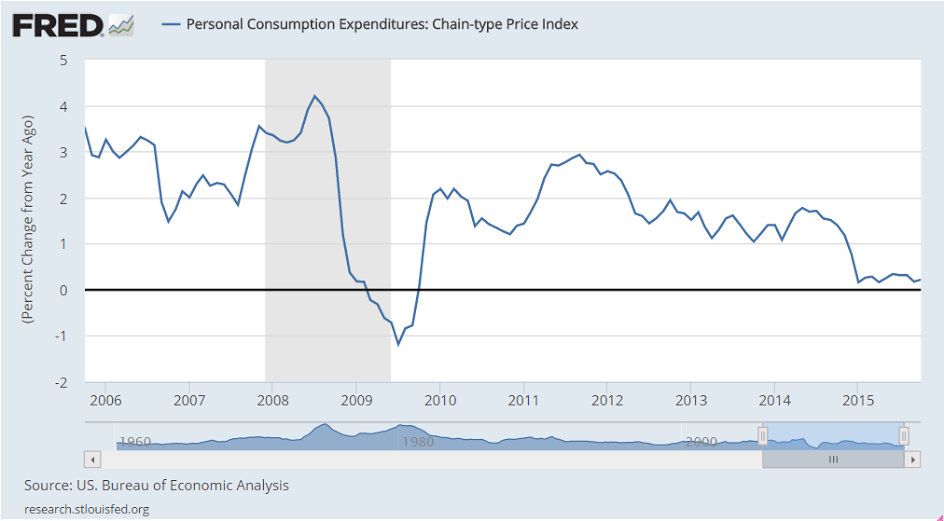
Turning back to inflation readings, the overall PCE price index remains nearly dead flat in a reminder that fuel prices remain very low and should give a boost to durable spending during the holidays. The PCE price index is up only 0.1 percent, vs Econoday expectations for a 0.2 percent gain, with the year-on-year rate at a very telling and extremely low plus 0.2 percent.

Though income data in this report do point to consumer strength ahead, the spending data are not a strong start at all for the fourth quarter. These results, especially the core price readings, will not lift the odds for a December rate hike.
er-11-26-10

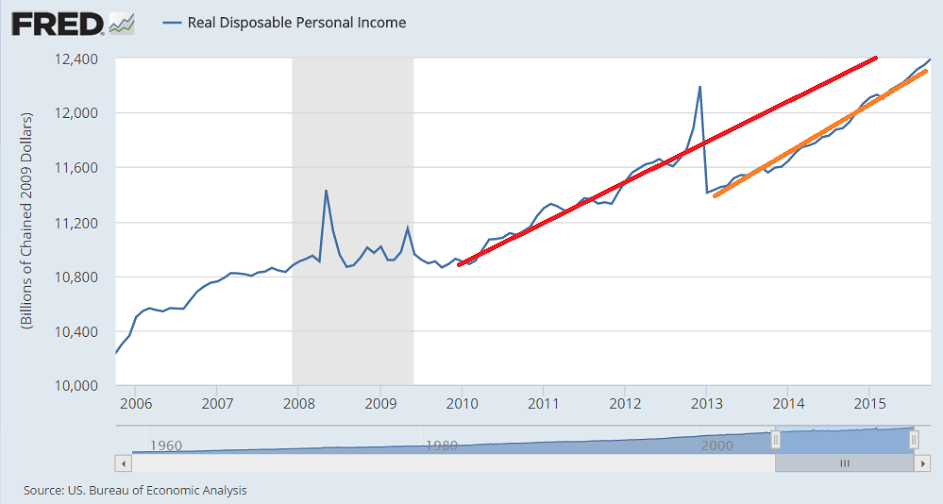
The consumer took a hit with the tax hikes and sequesters and that wide gap is still there:
er-11-26-11

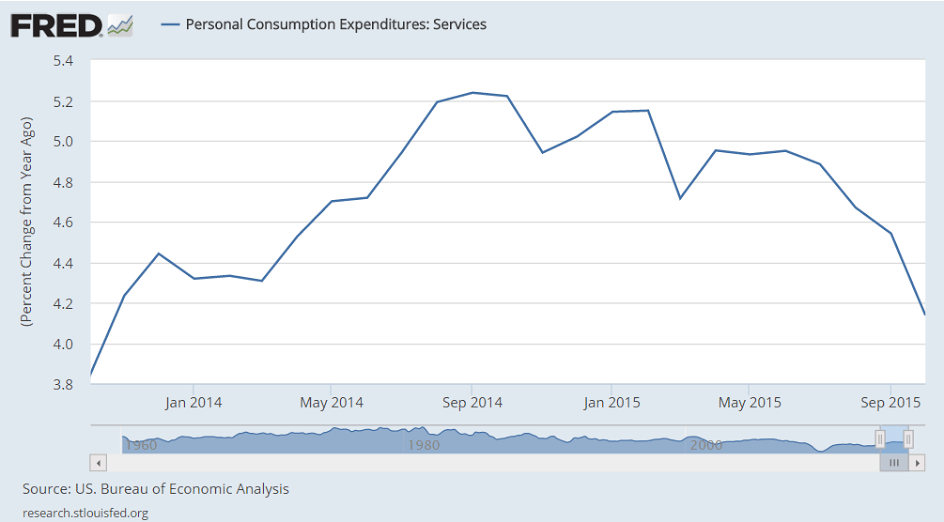
Consumption growth is decelerating, including services:
er-11-26-12
er-11-26-13
er-11-26-14
This inflation indicator remains depressed:
er-11-26-15
Last month revised lower and this month below expectations, as a presumed housing ‘burst’ has again failed to materialize:

United States : New Home Sales

er-11-26-16
Highlights
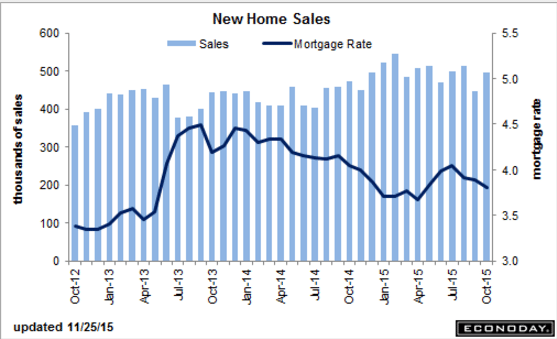
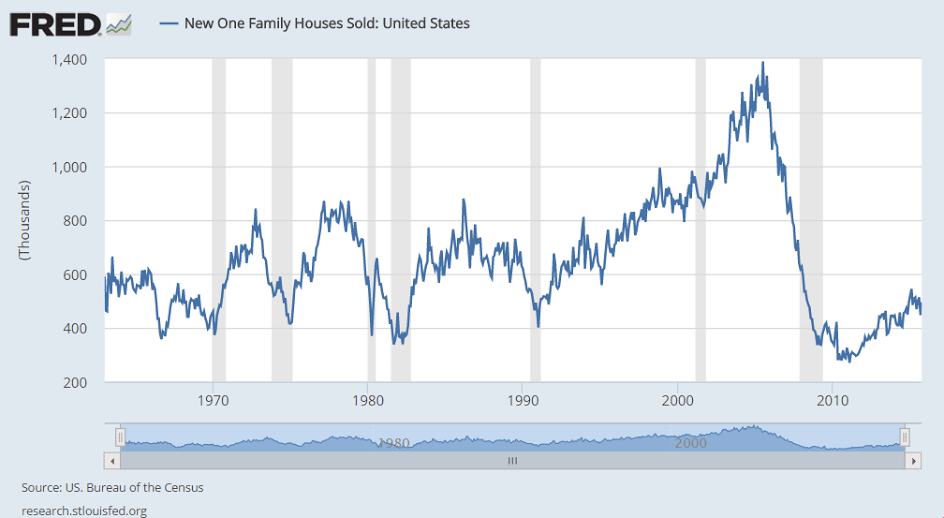
New home sales are not surging, coming in near expectations in October at a 495,000 annualized rate. Though the month’s gain is 10.7 percent, it doesn’t quite reverse the prior month’s 12.9 percent plunge. Year-on-year new home sales are up a respectable looking 4.9 percent which, however, pales to the double-digit rates through most of the year.

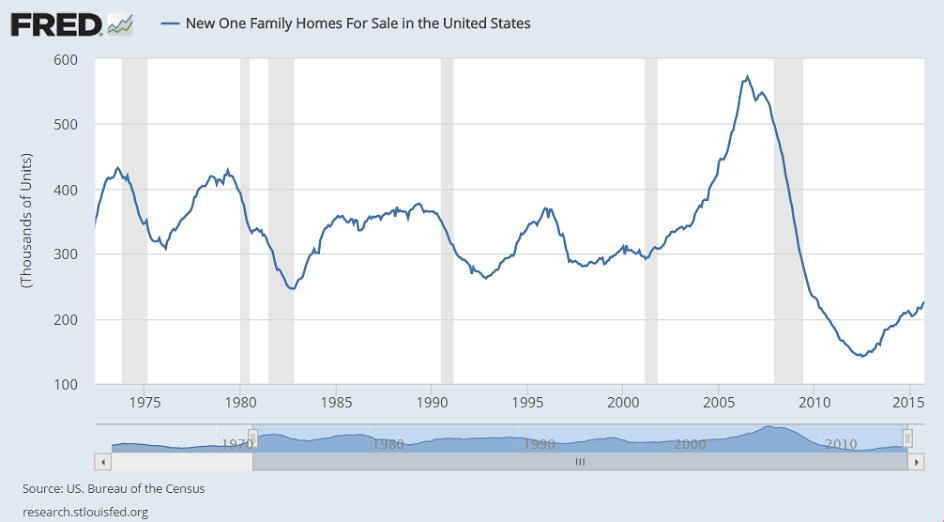
Lack of supply is a key issue for the new home sector that is holding down sales, at only 5.5 months relative to sales which is down from 6.0 months in September. But actual new homes on the market are up slightly, at 226,000 which compares to 208,000 a year ago.

Unlike price data in this week’s Case-Shiller and FHFA reports, there is no indication of improved traction in what belies the lack of supply in the market. The median price, at $281,500, is down a very severe looking 8.5 percent in the month with the year-on-year rate at minus 6.0 percent.

The Northeast is showing very solid strength, up more than 100 percent in the month though sales levels in this region make up only a tiny fraction of national sales. The South, by far the largest region for new home sales, showed key strength in the month with a 8.9 percent gain. Year-on-year, the Northeast is out in front with a 60 percent gain followed by the South with a 5.2 percent gain. The West, a key region for home builders, shows a disappointing 2.6 percent year-on-year decline with the Midwest bringing up the rear at minus 4.8 percent.

The housing sector remains uneven with this report confirming lack of strength in Monday’s existing home sales report. Though there are indications, not in this report of course, of price traction in housing, conditions in the sector do not point to an increased chance for a December rate hike.
er-11-26-17
Still below the bottom of all prior recessions, and this is not population adjusted!
er-11-26-18
Sales are near the bottom of prior recessions:
er-11-26-19
A bit worse than expected:

Consumer Sentiment

er-11-26-20
Highlights
Consumer sentiment fell back in the last half of November to a final reading of 91.3 vs a mid-month flash of 93.1. Though November’s final is higher than the 90.0 final in October, the implied reading for the last two weeks is in high 80s/low 90s area and do, unfortunately, point to a possible effect from the Paris attacks. Like yesterday’s very disappointing consumer confidence report, weakness is centered in expectations with this component at 82.9 vs 85.6 for November’s flash. The implied reading here over the last two weeks is in the high 70s area which is noticeably below the mid-80s trend.

But in a positive that points to no immediate effect on consumer spending, the current conditions component shows much less weakness, down only 5 tenths from the flash at 104.3. Inflation readings are up from mid-month but little changed from October, at 2.7 percent for the 1-year outlook, which is unchanged from October, and at 2.6 percent for the 5-year outlook which is up 1 tenth from October.

This is the Markit index which tends to overstate things relative to other indexes:

PMI Services Flash

er-11-26-21