Proposals for Obama, update


[Skip to the end]

  1. Effective immediately have the Tsy make all FICA payments on behalf of employees and employers. Leave this arrangement in place at least until it is deemed that the economy is growing too rapidly.

    These payroll taxes currently reduce income by about $1 trillion per year for employees and employers and are highly regressive.

    Removing these payroll deductions will immediately add about $20 billion per week of ‘spending power’ to the economy on an ongoing basis, and all the funds benefit workers and businesses.
  2. Effective immediately distribute $100 billion in unrestricted federal revenue sharing to the states on a per capita basis.
  3. Make another $200 billion of federal revenue sharing available to the states for general infrastructure repairs and projects.

    This will effectively increase take home pay, remove a cash drain on business, address infrastructure needs, and support employment and income in general.

    What Wall St. and Main St. need most are consumers who have the funds to make their mortgage payments and car payments, and be able to buy what the US can produce.

    This ‘bottom up’ approach will work, while the current ‘top down’ proposals may eventually show results but will take far longer to reverse the current slowdown.

    And while my proposals will result in an immediate recovery, they do not address the energy issue.

    Any recovery will drive up energy prices if consumption is not first reduced by both the private and public sectors.


[top]

Weakest crude demand report to date


[Skip to the end]

Still looks to me the call on OPEC crude will be about the same:

CGES: Global oil demand to contract in 2009

CGES,The Centre for Global Energy Studies a leading energy forecasting organization said on Tuesday on its monthly oil report that Global oil demand
is likely to contract in 2009 for the first time in 25 years.

CGES said demand growth in Asia, Latin America and the Middle East can no longer offset the continuing decline in the Organization of Economic Cooperation and Development countries.

In a report, the consultancy said consumers are still responding to recent high pump prices, and a loss of confidence in employment and income prospects means even a lower price won’t halt the decline in demand.

CGES also said the recent slide in oil prices won’t end until the Organization of Petroleum Exporting Countries implements its recent 1.5 million barrels a day cut in output, or higher cost non-OPEC production is shut-in.

CGES said its demand pessimism is “offset to a degree” by its view of non-OPEC supply, which is “unlikely to show any real growth in either 2008 or 2009.”


[top]

Russian Central Bank spent $58 billion backing Ruble (Update1)


[Skip to the end]

Russian Central Bank Spent $58 Billion Backing Ruble (Update1)

By Alex Nicholson and Maria Levitov

Nov. 19 (Bloomberg) — Russia’s central bank spent $57.5 billion defending the ruble in September and October, Chairman Sergey Ignatiev said.

Why would they ‘defend’ the ruble? Maybe they ‘defend’ it selectively, via transactions with ‘insiders’ moving from rubles to dollars?

Russia held 45 percent of its reserves in U.S. dollars, 44 percent in euros, 10 percent in pounds and about 1 percent in yen on Nov. 1, Ignatiev, said in the lower house of parliament in Moscow today.

“Russia ensures the stability of its currency, given the fundamental indicators of our economy,” Finance Minister Alexei Kudrin told lawmakers today. The amount of reserves ensures “a firm foundation for macroeconomic stability, for stability of the national currency,” he added.

Looks like I’m wrong on suspecting insider conversion. Sorry!!!

Russia’s international reserves stood at $475.4 billion as of Nov. 7, the third-biggest after China’s and Japan’s. They have fallen $122.7 billion since Aug. 8 as the central bank shored up the ruble. The bank buys and sells currency to keep it within a trading band against a dollar-euro basket to limit the impact of exchange-rate fluctuations on the economy.

Right, that’s the reason…

Ignatiev also said that the central bank reduced its holdings of Fannie Mae and Freddie Mac bonds, which are held by Russian oil funds that are part of the reserves, to $20.9 billion on Nov. 1 from $65.6 billion on Jan. 1.

Explains some of the spread widening.

Fannie and Freddie were “taken under state control” in the U.S. in September, guaranteeing their reliability, Ignatiev said. The bank isn’t currently selling bonds of the two U.S. mortgage- finance companies, he said.

Right, not even if an insider wants to buy them with rubles.


[top]

Fed funds rate, control of


[Skip to the end]

Bernanke’s Cash Injections Risk Eclipse of Fed’s Benchmark Rate

By Craig Torres

Bernanke said in a congressional hearing yesterday that the expansion of the Fed’s balance sheet “makes it more difficult to control the federal funds rate.” It is “still an issue we are working on,” he told the House Financial Services Committee.

How about the Fed trading Fed funds and making a 1 basis point market in Fed funds. Yes, that would mean lending to Fed member banks without specific collateral, but Fed collateral demands are redundant, as other government agencies- FDIC, OCC, etc- are already responsible for monitoring all bank assets and capital, and presumably close down any and all insolvent banks.


[top]

Re: To prevent bubbles, restrain the Fed


[Skip to the end]

(email exchange)

Right, add CATO to the list of organizations that have no credibility and now put the Dallas Fed on the suspect list as well. The difference between now and 1929 is back then we were on the gold standard he proposes, and therefore didn’t have the option for the Treasury to deficit spend without the loss of the nation’s gold reserves and devaluation/default as we ran out of gold. This also subjected the banks to true systemic failure as customers demanding their funds were entitled to convertible currency, which was limited by the same gold reserves. That’s exactly what happened as multitudes of banks failed, depositors lost their money, and the US both devalued for international purposes and was forced off gold domestically by 1934.

Since then, ‘automatic stabilizers’ (deficits counter cyclically ‘automatically’ rise in down turns and fall in expansions) and some proactive fiscal responses have resulted in much milder downturns and also have limited expansions.

The gold standard wasn’t abandoned because it worked so well- rather, because it has always gone down in flames:

To Prevent Bubbles, Restrain the Fed

By Gerald P. O’Driscoll

The incoming administration must think about that possibility because the timing of boom and bust cycles seems to be shortening. The next bust could come five or six years from now — or about in the middle of an Obama second term. Should that happen, Mr. Obama would be unable to blame Republicans for the mess and would be tagged as the second coming of Jimmy Carter.

To avoid such a fate, Mr. Obama needs to stop the next asset bubble from being inflated by imposing a commodity standard on the Fed. A commodity standard (such as a gold standard) imposes discipline on a central bank because it forces it to acquire commodity reserves in order to increase the money supply. Today the government can inflate asset bubbles without paying a cost for it because the currency isn’t linked to the price of a commodity.

With a commodity standard in place, the government would also have price signals that would alert it to the formation of a bubble. Why? Because the price of the commodity would be continuously traded in spot and futures markets. Excessive easing by the Fed would be signaled by rising prices for the commodity. In recent years, Fed officials have claimed that they cannot know when an asset bubble is developing. With a commodity standard in place, it would be clear to anyone watching spot markets whether a bubble is forming. What’s more, if Fed officials ignored price signals, outflows of commodity reserves would force them to act against the bubble.

The point is not to deflate asset bubbles, but to avoid them in the first place. Imposing a commodity standard is a practical response to the repeated failures of central banks to maintain sound money and financial stability. What would be impractical is to believe that the next time central banks will get it right on their own.

Mr. O’Driscoll, a senior fellow at the Cato Institute, was formerly a vice president at the Federal Reserve Bank of Dallas.

>   
>   On Tue, Nov 18, 2008 at 10:27 PM, Ron wrote:
>   
>   Warren,
>   
>   I know you’ll love this one.
>   
>   http://online.wsj.com/article/SB122688652214032407.html
>   


[top]

2008-11-19 USER


[Skip to the end]


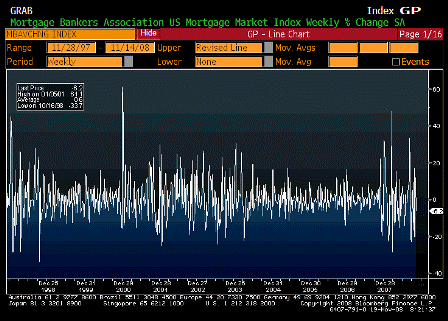
MBA Mortgage Applications (Nov 14)

Survey n/a
Actual -6.2%
Prior 11.9%
Revised n/a

[top][end]

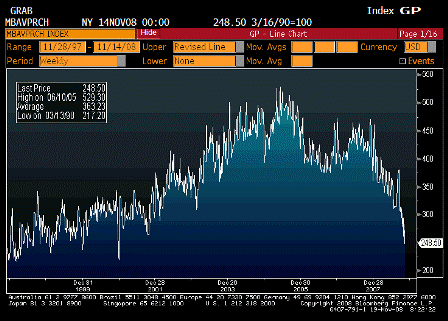
MBA Purchasing Applications (Nov 14)

Survey n/a
Actual 248.50
Prior 284.40
Revised n/a

 
Back down big time.

[top][end]

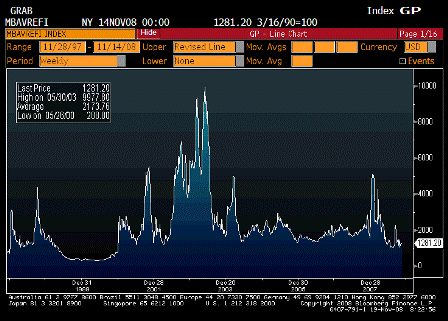
MBA Refinancing Applications (Nov 14)

Survey n/a
Actual 1281.20
Prior 1248.40
Revised n/a

[top][end]


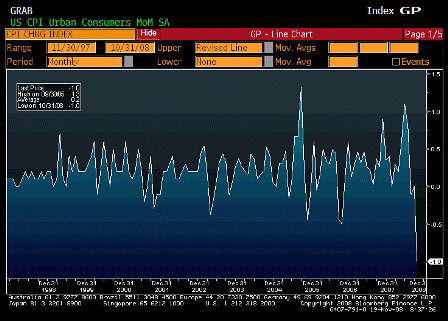
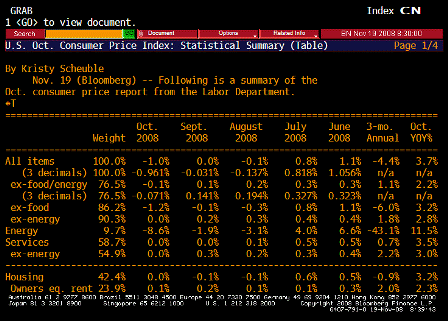
Consumer Price Index MoM (Oct)

Survey -0.8%
Actual -1.0%
Prior 0.0%
Revised n/a

 
Not much of a surprise led by gasoline prices. More to come.

[top][end]

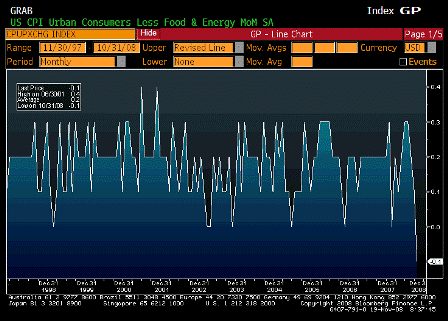
CPI Ex Food and Energy MoM (Oct)

Survey 0.1%
Actual -0.1%
Prior 0.1%
Revised n/a

 
Lower than expected. Owner equivalent remains positive at up 0.1%.

[top][end]

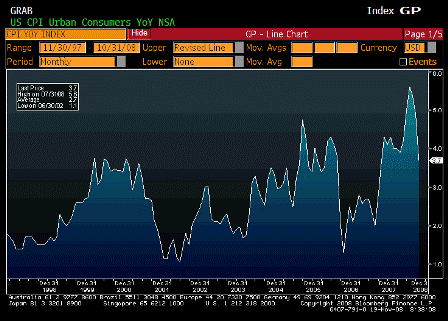
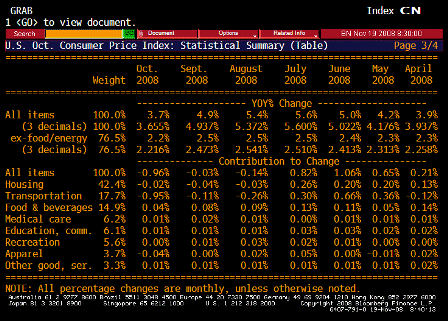
Consumer Price Index YoY (Oct)

Survey 4.0%
Actual 3.7%
Prior 4.9%
Revised n/a

 
Coming down quickly with the fall in gasoline prices, much like Aug 06 when Goldman changed their commodity index and triggered a liquidation of gasoline inventories.

Karim writes:

  • Largest single mthly fall on record in headline CPI: -0.961%
  • Core also falls, by 0.071%
  • Service inflation now unchanged for 2 straight months
  • OER up 0.1%
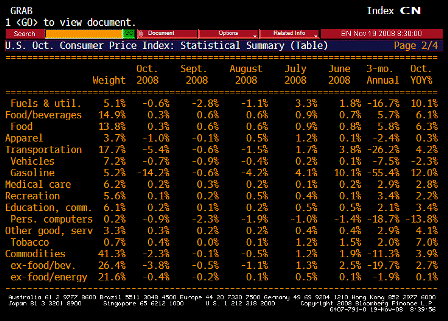
  • Apparel -1%, vehicles -0.7% (new -0.5%, used -2.4%)
  • Medical care and education each up 0.2%
  • Market strains + output gap + weaker commodities to lead to falling/slowing inflation in period ahead

[top][end]

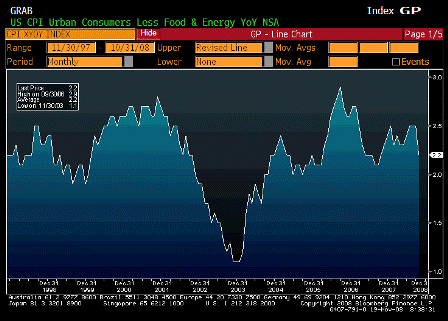
CPI Ex Food and Energy YoY (Oct)

Survey 2.4%
Actual 2.2%
Prior 2.5%
Revised n/a

 
Also moving down.

[top][end]

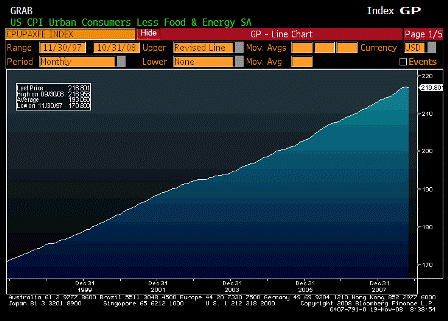
CPI Core Index SA (Oct)

Survey n/a
Actual 216.801
Prior 216.956
Revised n/a

[top][end]

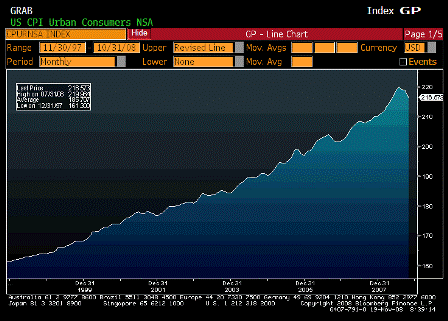
Consumer Price Index NSA (Oct)

Survey 216.700
Actual 216.573
Prior 218.783
Revised n/a

[top][end]

Consumer Price Index TABLE 1 (Oct)

[top][end]

Consumer Price Index TABLE 2 (Oct)

[top][end]

Consumer Price Index TABLE 3 (Oct)

[top][end]


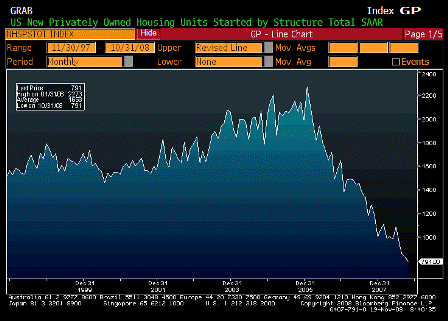
Housing Starts (Oct)

Survey 780K
Actual 791K
Prior 817K
Revised 828K

 
Looking grim again after showing signs of bottoming.

Karim writes:

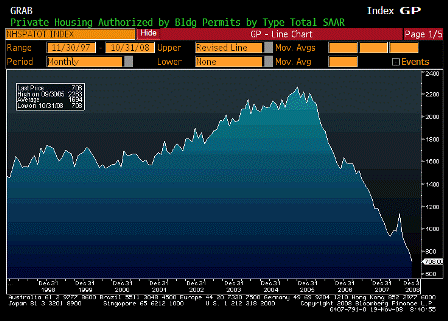
  • October housing starts down another 4.5% and permits down 12%-contribution from housing to GDP will remain a significant drag at least thru Q2 2009 (based on lag from permits to construction).

[top][end]

Building Permits (Oct)

Survey 774K
Actual 708K
Prior 786K
Revised 805K


[top]